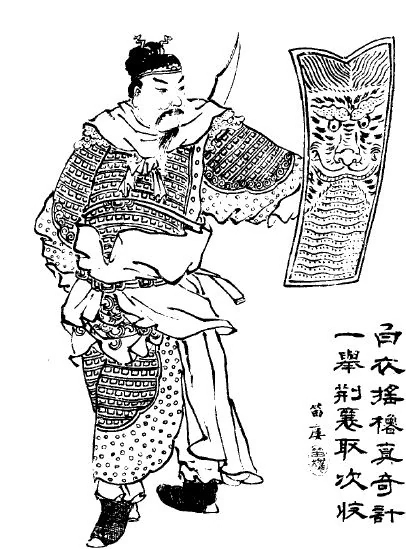
Biography
Family Background and Early Life
Lü Meng was born in 178, the first year of Guanghe, at Fupo in Runan. His family was poor, and the histories do not record his father's name. Because his home region north of the Huai was frequently affected by war and livelihood was difficult, Lü crossed south, or according to another account crossed the Huai, and joined his brother-in-law Deng Dang. Deng Dang was a subordinate of Sun Ce and had repeatedly campaigned against the Shanyue. At about fifteen or sixteen, Lü Meng secretly followed Deng Dang into battle. Deng was shocked and rebuked him, but Lü continued to join the fighting. After returning, Deng told Lü's mother, who wanted to punish him. Lü replied that poverty was impossible to endure, that military service might bring merit and wealth, and invoked the saying that one cannot obtain a tiger cub without entering the tiger's den. His mother relented.
One of Deng Dang's subordinate officers despised Lü for his youth and repeatedly mocked him, saying that the boy was only feeding meat to a tiger. Lü became enraged and killed him with a knife, then fled to the home of a fellow townsman, Zheng Chang. He later surrendered through Commandant Yuan Xiong. Yuan spoke on his behalf and recommended him to Sun Ce. Sun Ce summoned Lü, recognized unusual qualities in him, and kept him nearby. After Deng Dang died several years later, Zhang Zhao recommended that Lü take over Deng's position, and he became a Major of a Separate Command.
Rise to Prominence
In 200, the fifth year of Jian'an, Sun Ce was assassinated and Sun Quan inherited control of Jiangdong. Sun Quan considered consolidating the troops of younger officers whose commands were small and ineffective. Lü Meng heard of the plan and realized that if his men were merged into other units he would have fewer opportunities to advance. He obtained supplies on credit, equipped his soldiers with crimson clothing and leggings, and intensified their training. When Sun Quan reviewed the force, its formation and drill impressed him. Rather than reducing the unit, Sun Quan increased Lü Meng's manpower.
In 203 Sun Quan campaigned against Huang Zu and broke Huang Zu's naval force, but had to withdraw when Shanyue uprisings broke out in Danyang, Yuzhang, and Luling. Lü Meng took part in the campaign and, together with Huang Gai, Han Dang, Zhou Tai, and others, guarded strategic positions and administered districts where Shanyue activity was intense, suppressing local resistance by force. For these achievements Lü became Commandant Who Pacifies the North and concurrently chief of Guangde.
Major Military Achievements
In 208 Sun Quan followed Gan Ning's advice and attacked Xiakou. Huang Zu blocked the Miankou with large warships anchored by massive ropes and stones, with more than a thousand soldiers shooting bows and crossbows from the decks. Sun Quan ordered Dong Xi and Ling Tong to lead one hundred heavily armored volunteers each in ships against the blockade. Dong Xi cut the ropes, allowing the obstructing vessels to drift away and the Wu fleet to advance. Huang Zu then sent naval commander Chen Jiu to counterattack. Lü Meng led the vanguard, fought at the front, and personally killed Chen Jiu. The Wu army pressed forward by land and water, captured Xiakou, and Huang Zu was killed while fleeing. Sun Quan regarded Chen Jiu's defeat as the decisive point and appointed Lü General of the Household Who Sweeps Across the Wilderness, awarding him ten million cash.
In the tenth month of the same year, Lü fought with Zhou Yu, Cheng Pu, and others at Red Cliffs and helped defeat Cao Cao. Cao withdrew north and left Cao Ren at Jiangling. Sun Quan ordered Zhou Yu and Cheng Pu to confront him. When Xi Su, a commander from Yi Province, surrendered with his troops, Zhou Yu proposed assigning Xi Su's men to Lü Meng. Lü argued instead that Xi Su had courage and ability and had come from afar out of admiration; his force should be increased rather than taken from him. Sun Quan accepted Lü's advice.
When Zhou Yu later sought to take Jiangling, he first sent Gan Ning to seize Yiling. Cao Ren detached troops and surrounded Gan Ning. Gan requested aid, but the other officers feared that rescuing Yiling would leave Jiangling open. Lü told Zhou Yu and Cheng Pu to leave Ling Tong to hold the base while the main force relieved Gan Ning, arguing that the operation would not take long and promising that Ling Tong could hold for ten days. Lü also advised blocking the difficult mountain road with timber so that a retreating enemy would have to abandon its horses. Zhou Yu adopted the plan, defeated Cao's relief force at Yiling, and killed more than half. During the night retreat, cavalrymen were forced to leave their horses at the blocked road. Zhou Yu and Lü pursued and captured about three hundred horses. They then returned across the river, attacked the northern bank, built camps, and pressed Jiangling. After nearly a year of losses Cao Ren abandoned the city. Zhou Yu became Administrator of Nan Commandery, and Lü Meng was appointed General of a Separate Command and concurrently magistrate of Xunyang.
Devotion to Learning
On one occasion Sun Quan told Lü Meng that a man holding important office and command could not afford not to study. Lü replied that military duties left no time. Sun Quan said he did not expect Lü to master the Confucian classics as a professional scholar, only to read broadly enough to understand earlier events. He added that his own responsibilities were greater yet he regularly read and benefited greatly from doing so. Lü accepted the advice and began serious study. Over time, the histories say, he read more extensively than many older scholars.
Sun Quan later praised Lü Meng and Jiang Qin as men who continued to improve after reaching adulthood, saying that although they had become wealthy and honored they humbled themselves to study, delighted in books, treated wealth lightly, valued righteousness, and behaved as true men of the state.
In 210, after Zhou Yu's death, Lu Su succeeded him. Passing Lü Meng's station at Lukou, Lu Su initially looked down on Lü as a soldier of rough background. Someone warned him that Lü's fame and ability had grown and that he should not judge him by old impressions. Lu Su visited. During the banquet Lü asked what strategy Lu Su intended to use while holding a frontier next to Guan Yu. Lu Su replied vaguely that he would respond according to circumstances. Lü warned that although Sun and Liu were formally allied, Guan Yu was a formidable commander and that preparations were essential. He then analyzed the situation and proposed five measures. Lu Su was astonished, moved closer, patted Lü on the back, and said he had never imagined Lü Ziming's ability and planning had reached such a level. The famous exchange followed in which Lu Su said Lü was no longer the "A-Meng of Wu," and Lü replied that after three days apart a scholar should be viewed with fresh eyes. The two thereafter became close friends.
Guarding Strategic Areas
Lü Meng's camps lay near those of Cheng Dang, Song Ding, and Xu Gu. When the three died and their sons were too young to take command, Sun Quan wanted to merge their troops into Lü's force. Lü firmly declined, arguing repeatedly that the men had served the state diligently and loyally and that their descendants should not be dispossessed simply because they were young. Only after three memorials did Sun Quan accept his position. Lü also arranged teachers for the sons of the three commanders and took care with their education.
Cao Cao appointed the Lujiang man Xie Qi to supervise agricultural colonies at Qichun, with a base in the farming districts around Wan, from which he repeatedly harassed the frontier. Lü Meng first tried to induce his surrender; when Xie refused, Lü found an opportunity to attack. Xie withdrew, and many of his people surrendered with their families.
In the first month of 213 Cao Cao personally led one hundred thousand troops against Sun Quan and advanced to Ruxu, taking a camp west of the river and capturing the commander Gongsun Yang. Lü Meng helped Sun Quan lead seventy thousand defenders. He repeatedly proposed stratagems that proved effective and urged Sun Quan to build a naval stockade at the narrow water passage. Other officers objected that soldiers could simply go ashore to fight and return to the ships. Lü replied that battle could not always be won and that if enemy infantry and cavalry pressed them unexpectedly they might not have time to reach the water. Sun Quan agreed and built the stockade. Cao later observed the orderly and imposing Wu army and uttered his famous praise that a son should be like Sun Zhongmou. With spring flooding approaching and Sun Quan urging withdrawal, Cao judged the situation and withdrew.
Operations in Jing Province
In 214 Cao Cao sought to increase grain supplies by having Lujiang Administrator Zhu Guang farm around Wan and by sending agents to recruit local bandit leaders around Poyang. Lü Meng argued that the fertile land of Wan would quickly strengthen Cao's army and that the city should be taken before its harvest. Sun Quan accepted the recommendation and attacked Wan in the fifth month. The other commanders wanted to build siege mounds and engines. Lü argued that this would take days, allowing the defenders to strengthen the walls and relief troops to arrive, while the high water that had carried the Wu army there would fall and make withdrawal difficult. He judged the city vulnerable to an immediate assault and urged a four-sided attack while morale was high. Sun Quan agreed. Lü recommended Gan Ning as the officer leading the wall assault and followed with elite troops. The attack began at dawn; Lü beat the drum himself, and the city fell after breakfast. Sun Quan rewarded him by appointing him Administrator of Lujiang, assigning captured people and troops to him, and granting an additional six hundred agricultural soldiers at Xunyang and thirty officials.
In 215 Liu Bei placed Guan Yu in charge of Jing Province. Sun Quan sent Lü Meng with twenty thousand troops under officers including Xianyu Dan, Xu Zhong, and Sun Gui to take Changsha, Lingling, and Guiyang. Lü sent letters calling on the three commanderies to surrender. Changsha and Guiyang submitted, but Lingling Administrator Hao Pu refused. Liu Bei then came to Gong'an and ordered Guan Yu with thirty thousand troops to Yiyang to contest the territory. Sun Quan summoned Lü back to help Lu Su confront Guan Yu and ordered him to abandon the siege of Lingling. Lü concealed the message, assembled his officers at night, and the next morning both prepared an attack and sent Deng Xuanzhi into the city with false intelligence that Liu Bei was trapped and Guan Yu had been defeated, leaving Lingling isolated. Hao Pu was deceived and agreed to surrender. Lü had four commanders prepare one hundred men each to seize the gates as soon as Hao emerged. Only after Hao came out did Lü show him Sun Quan's letter, revealing that Liu Bei was already at Gong'an and Guan Yu at Yiyang. Hao was deeply ashamed. Lü left Sun Gui of Sun He's force to hold Lingling and marched to Yiyang. The episode became a celebrated example of taking three commanderies through strategy with little fighting.
The "Crossing in White Clothes" and Death
In 217, after Lu Su's death, Lü Meng replaced him at Lukou, bordering Guan Yu's territory. Lü regarded Guan Yu as a powerful and ambitious commander occupying the upper Yangtze and privately advised Sun Quan to seize Jing Province. When Sun Quan asked whether to take Xu Province or Jing Province first, Lü argued that Xu Province's open terrain favored cavalry and was difficult to hold, while control of Jing would secure the Yangtze. Sun Quan accepted the strategic logic.
In 219 Guan Yu campaigned north against Fan. He left troops at Gong'an and Nan Commandery. Lü petitioned to return to Jianye on the pretext of illness, intending to lull Guan Yu into relaxing his defenses. Guan Yu believed the report and transferred much of his reserve north. At Jianye Lü and Sun Quan secretly planned the attack. Asked who should replace him at Lukou, Lü recommended Lu Xun as thoughtful, capable, and suitable for a heavy responsibility. After taking up the post, Lu Xun wrote Guan Yu an extremely deferential letter of praise. Guan became less cautious and further reduced his defenses.
In the intercalary tenth month, Lü Meng led elite troops upriver. At Xunyang he hid soldiers inside boats and had men dressed in plain white clothes row them while posing as merchants, traveling day and night. Along the river, Guan Yu's watch posts were quietly captured, preventing news from reaching him. Lü first sent Yu Fan to induce Shi Ren, the defender of Gong'an, to surrender, then used Shi Ren to persuade Mi Fang, Administrator of Nan Commandery, to surrender. Lü occupied Jiangling and gained control of the families of Guan Yu's soldiers. He ordered that civilians were not to be disturbed or requisitioned. When one of Lü's own fellow townsmen took a straw hat from a household to cover government armor from rain, Lü judged that the use of public property did not excuse violation of military law and, weeping, had him executed. Discipline became so strict that the histories say dropped objects were not picked up from the road.
When Guan Yu learned Nan Commandery had fallen, he returned south. Lü treated the families of Guan's soldiers well, undermining their willingness to fight. Guan's army disintegrated through desertion. He withdrew to Maicheng, while Sun Quan ordered Zhu Ran and Pan Zhang to block the escape route. In the twelfth month Guan Yu and his son Guan Ping were captured near Linju by Pan Zhang's subordinate Ma Zhong and executed on Sun Quan's orders. Jing Province was secured. Lü Meng was appointed Administrator of Nan Commandery, enfeoffed as Marquis of Chanling, and awarded one hundred million cash and five hundred jin of gold.
Before he could formally receive the enfeoffment, an old illness returned. Sun Quan had him moved into the inner palace and offered a reward of one thousand jin to anyone who could cure him. Wishing to see Lü without exhausting him, Sun Quan reportedly made an opening in the wall to observe him; when Lü improved Sun rejoiced, and when his condition worsened Sun sighed in distress. Lü also had Daoists pray for his life beneath the stars. He died at Gong'an in the twelfth month of Jian'an 24 at the age of forty-two. Sun Quan grieved deeply and reduced his own expenditures in mourning.
Entering the Army Young, Killing an Officer, and His First Merit
At fifteen or sixteen Lü Meng secretly followed his brother-in-law Deng Dang on campaign; Deng Dang, finding him out, was astonished and scolded him, but he went on following in secret. On his return Deng Dang told Lü Meng's mother, who was angry and meant to punish him, and Lü Meng said: "Poverty and low estate are hard to live in; by chance, if one wins merit, wealth and honour may be had. And if one does not go into the tiger's den, how shall one get the tiger's cub?" and his mother, "pitying him, let him be." A subordinate officer of Deng Dang, taking him for a child, despised him, saying that "what can that brat do? He means to feed himself to the tiger"; and when the man mocked and insulted him again Lü Meng, in a fury, "drew his sword and killed the officer, and fled to the house of Zheng Zhang." Because the colonel Yuan Xiong surrendered himself in his place and spoke for him at the right moment, Sun Ce summoned him, "thought him remarkable and kept him at his side." When Deng Dang died some years later Zhang Zhao recommended Lü Meng in his place, and he was made commander of a separate division. After Sun Ce's murder in 200 and Sun Quan's assumption of power, when Sun Quan meant to merge the small and useless commands of the young officers, Lü Meng, knowing that he could do even less once merged, "borrowed on credit" to make crimson coats and leggings for his men and drilled them hard, so that on inspection day "his array was brilliant and his men trained," and Sun Quan, delighted, "increased his troops." He followed the campaign against Danyang "winning merit wherever he went," and was made commandant of the north, in charge of Guangde. In the campaign against Huang Zu, Huang Zu sent his commander Chen Jiu out with the fleet, and Lü Meng "drew up the vanguard and cut off Jiu's head with his own hand"; the troops pressed on and took the city, and Huang Zu abandoned it and fled, so that Sun Quan said that "the success of the affair came of Chen Jiu's being taken first," making Lü Meng general of the sweep and giving him ten million coins. When the Yi officer Xi Su came over with his troops and Zhou Yu memorialized that Xi Su's men be transferred to Lü Meng, Lü Meng praised Xi Su's courage and ability and said that "as he comes from far away out of admiration for our rule, it is right to increase rather than take away his troops," and Sun Quan, approving, returned them — not to seize a surrendering officer's troops being his constant way.
Merit after Red Cliff, and "No Longer the A-Meng of Wu"
After Red Cliff he broke Cao Cao with Zhou Yu and Cheng Pu at Wulin and besieged Cao Ren at Nanjun. When Zhou Yu sent Gan Ning forward to hold Yiling and Cao Ren detached troops against him, Gan Ning in extremity begged for aid, and the generals all feared that they had too few men to divide; Lü Meng said to Zhou Yu and Cheng Pu: "Leave Ling Gongji; I shall go with you, and to raise the siege and relieve the crisis will not take long — I guarantee Gongji can hold ten days," and further advised Zhou Yu to "send three hundred men to block the steep road with firewood, and when the enemy flees we may take his horses." Zhou Yu followed him, and reaching Yiling fought the same day, "killing more than half"; the enemy fled by night and, coming on the blocked road, "all the riders left their horses and went on foot," and the pursuers "took three hundred horses," so that "the officers' and men's spirits doubled," and they crossed the river, set up camp and attacked, so that Cao Ren withdrew and they occupied Nanjun and settled Jingzhou; Lü Meng was made a general of the side and governor of Xunyang.
Sun Quan's urging him to study was the turning point of his life. Sun Quan told him that "now that you hold office and authority, you should study to open and enrich yourself," and when Lü Meng pleaded the multitude of military business, Sun Quan answered: "Do I want you to master the classics and become a scholar? Only to skim and learn the past... you should read Sunzi, the Six Secret Teachings, the Zuo Commentary, the Guoyu and the three histories at once," and added that Confucius had said that "to think all day without eating and all night without sleeping is of no use; it is better to learn," that Guangwu "kept his book unrolled even amid armies," and that Cao Cao "called himself a lover of learning in old age" — "why should you alone not exert yourself?" Lü Meng "then began to study, firm of purpose and tireless, and what he read the old scholars could not surpass." When Lu Su, succeeding Zhou Yu, passed his camp and argued with him, "he was constantly worsted," and Lu Su, patting his back, said: "I thought my young brother had only military skill; as for now, his learning is broad and excellent — no longer the A-Meng of Wu." Lü Meng answered that "a gentleman parted from another for three days should be looked at with new eyes," and privately set out three plans for Lu Su, who received them respectfully. Sun Quan used to sigh that "in growing older and advancing, none can match Lü Meng and Jiang Qin; amid wealth and honour to bow to learning, to delight in books, to think little of wealth and much of right — such conduct may be followed, and both are true knights of the state." To his subordinates too he was generous: when the three commanders Cheng Dang, Song Ding and Xu Gu, whose camps adjoined his, died leaving young sons, and Sun Quan meant to merge their troops into his, Lü Meng "firmly refused," memorializing that "Gu and the others laboured at the state's business and, though their sons are young, they may not be abolished," and "the memorial went up three times before Sun Quan consented," whereupon Lü Meng "chose teachers for the sons to instruct them."