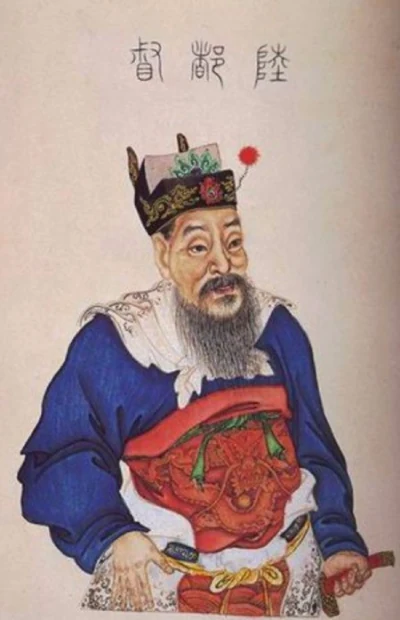
Later artistic depiction of Lu Kang (Eastern Wu) in a historical painting or book illustration.

226 CE–274 CE

General

Lu Kang

陆抗

Lu Kang (226–274), courtesy name Youjie, was a general of Wu during the Three Kingdoms period, from Wu County in Wu Commandery (present-day Suzhou, Jiangsu). He was Lu Xun's second son and a maternal grandson of Sun Ce. Lu Kang inherited the title Marquis of Jiangling County and began his career as Commandant Who Establishes Martial Might, taking command of five thousand of his father's troops. He later served as General of…

226 CE–274 CESun Wu

PROFILE

Lu Kang (226–274), courtesy name Youjie, was a general of Wu during the Three Kingdoms period, from Wu County in Wu Commandery (present-day Suzhou, Jiangsu). He was Lu Xun's second son and a maternal grandson of Sun Ce. Lu Kang inherited the title Marquis of Jiangling County and began his career as Commandant Who Establishes Martial Might, taking command of five thousand of his father's troops. He later served as General of the Household Who Establishes Integrity, General Who Displays Might, Commander of Chaisang, General Who Attacks the North, General Who Guards the Army, and Senior General Who Guards the Army. He supervised military affairs at Xiling, Xinling, Yidao, Lexiang, and Gong'an, was stationed at Lexiang (southwest of present-day Jiangling, Hubei), and concurrently held the title of Governor of Yizhou. In 272, the first year of the Fenghuang era, he repelled Jin forces under Yang Hu, captured and killed the rebel Bu Chan, and was additionally appointed Protector-General. He later rose to Grand Marshal and Governor of Jingzhou. Lu Kang died in 274, the third year of the Fenghuang era, at the age of forty-nine. Together with his father Lu Xun, he was regarded as one of Wu's main pillars and the two were jointly known as “Xun and Kang.” Lu Kang was among the last major generals of Wu.

Other name
Courtesy name Youjie
Courtesy name
Youjie
Period
Wu
Dynasty/Regime
Wu
Identity
General
Ethnicity
Not reliably established by existing materials
Native place
Wu County, Wu Commandery (present-day Suzhou, Jiangsu)
Date of birth
226
Place of birth
Unknown
Date of death
274

LIFE TIMELINE

Birth | Born in Wu County, Wu Commandery, as Lu Xun's second sonOpen

Birth | Born in Wu County, Wu Commandery, as Lu Xun's second son

Age 20 | After Lu Xun died, inherited the title Marquis of Jiangling COpen

Age 20 | After Lu Xun died, inherited the title Marquis of Jiangling County, was appointed Commandant Who Establishes Martial Might, and took command of five thousand of his father's troops

Age 21 | Promoted to General of the Household Who Establishes IntegritOpen

Age 21 | Promoted to General of the Household Who Establishes Integrity, exchanged defense sectors with Zhuge Ke, and was stationed at Chaisang

Age 26 | Returned to the capital for medical treatment; Sun Quan tearfOpen

Age 26 | Returned to the capital for medical treatment; Sun Quan tearfully apologized to him and burned documents that had accused Lu Xun

Age 27 | After Sun Quan died and Sun Liang succeeded him, Lu Kang was Open

Age 27 | After Sun Quan died and Sun Liang succeeded him, Lu Kang was appointed General Who Displays Might

Age 28 | After the powerful minister Zhuge Ke was killed, Lu Kang was Open

Age 28 | After the powerful minister Zhuge Ke was killed, Lu Kang was implicated by kinship and divorced Zhuge Ke's niece

Age 32 | Appointed Commander of Chaisang, went to Shouchun to assist ZOpen

Age 32 | Appointed Commander of Chaisang, went to Shouchun to assist Zhuge Dan, defeated Wei forces, and was promoted to General Who Attacks the North

Age 34 | Appointed General Who Guards the Army and placed in command aOpen

Age 34 | Appointed General Who Guards the Army and placed in command at Xiling, responsible for the defenses from Guanyu Rapids to Baidicheng

Age 39 | Led thirty thousand troops in a siege of Yong'an but failed tOpen

Age 39 | Led thirty thousand troops in a siege of Yong'an but failed to take the city; after Sun Hao succeeded to the throne, was promoted to Senior General Who Guards the Army and concurrently made Governor of Yizhou

Age 45 | After Grand Marshal Shi Ji died, Lu Kang was placed in chargeOpen

Age 45 | After Grand Marshal Shi Ji died, Lu Kang was placed in charge of military affairs at Xinling, Xiling, Yidao, Lexiang, and Gong'an, with headquarters at Lexiang

Age 47 | When Xiling commander Bu Chan rebelled and surrendered to JinOpen

Age 47 | When Xiling commander Bu Chan rebelled and surrendered to Jin, Lu Kang besieged Xiling, heavily defeated Jin forces under Yang Zhao and Yang Hu, captured Xiling, executed Bu Chan, and was additionally appointed Protector-General

Age 48 | Appointed Grand Marshal and Governor of JingzhouOpen

Age 48 | Appointed Grand Marshal and Governor of Jingzhou

Age 49 | Died of illnessOpen

Age 49 | Died of illness

BIOGRAPHY

Biography

Family Background and Early Years

Lu Kang came from the Lu clan of Wu Commandery, one of the prominent families of Jiangdong. His father Lu Xun was chancellor of Wu and a central pillar of the state who defeated Liu Bei at the Battle of Yiling. Lu Kang's mother was a daughter of Sun Ce, so he was both a member of the prominent Lu clan and related by blood to the Sun ruling house. His elder brother Lu Yan died young, leaving Lu Kang, the second son, as Lu Xun's heir.

Lu Kang received a good education from childhood and was deeply influenced by his father. Lu Xun was known for loyalty, integrity, and strict military discipline, qualities that Lu Kang inherited. In 245, the eighth year of the Chiwu era, Lu Xun became entangled in the succession dispute between the princes of Nan and Lu, was repeatedly reproached by Sun Quan, and died in grief at the age of sixty-three. Lu Kang, then twenty, inherited the title Marquis of Jiangling County, was appointed Commandant Who Establishes Martial Might, and took command of five thousand of his father's troops at Wuchang.

After burying his father, Lu Kang returned to the capital to give thanks. Sun Quan produced twenty accusations previously made against Lu Xun by Yang Zhu and questioned Lu Kang about them. Lu Kang answered each point clearly and defended his father, dispelling Sun Quan's anger toward Lu Xun. The episode demonstrated Lu Kang's eloquence and filial devotion and helped establish his own position at the Wu court.

Emergence as a Commander

In 246, Sun Quan promoted Lu Kang to General of the Household Who Establishes Integrity and ordered him to exchange defense sectors with Zhuge Ke, after which Lu Kang was stationed at Chaisang. Before leaving his old post, Lu Kang ensured that its fortifications, walls, buildings, mulberry trees, and fruit trees were all carefully maintained. Zhuge Ke arrived to find the place as if newly built, whereas the position he had left to Lu Kang was in poor condition. Zhuge Ke was deeply embarrassed. The episode illustrated Lu Kang's careful approach to military administration in contrast to Zhuge Ke's negligence.

In 251, Lu Kang returned to the capital for medical treatment. When he recovered and was about to return to his post, Sun Quan summoned him and tearfully admitted that he had listened to slander about Lu Xun and had failed in the proper relationship between ruler and minister. Sun Quan said he would burn all the documents in which he had questioned Lu Xun and would not allow anyone to see them again. The gesture both apologized to Lu Kang and reassured the Lu family.

In 252, Sun Quan died and Sun Liang succeeded him. Lu Kang was appointed General Who Displays Might. In 253, the powerful minister Zhuge Ke was killed and his relatives by marriage were implicated. Lu Kang's wife was a daughter of Zhang Cheng, whose wife was a daughter of Zhuge Jin, making Lu Kang's wife Zhuge Ke's niece. Lu Kang therefore divorced her to avoid implication. The episode reflected the instability of Wu politics and the difficult choices imposed by factional purges.

Guarding Xiling

In 257, the Wei general Zhuge Dan rebelled at Shouchun and submitted to Wu. Sun Liang appointed Lu Kang Commander of Chaisang and sent him to assist at Shouchun. Lu Kang defeated a Wei field officer and was promoted to General Who Attacks the North. In 259, he was appointed General Who Guards the Army and sent to defend Xiling, present-day northwestern Yichang in Hubei, with responsibility for the region from Guanyu Rapids to Baidicheng. The following year he received the authority of the imperial tally. Xiling was Wu's western gateway and held major strategic importance. Lu Kang spent years developing the defenses, repairing fortifications, and stockpiling supplies, laying the groundwork for the later Battle of Xiling.

In 263, Cao Wei attacked Shu Han. Sun Xiu ordered Ding Feng, Liu Ping, Shi Ji, and other forces to move toward Shouchun and Mianzhong in support of Shu. Soon afterward Liu Shan surrendered to Wei. Lu Kang reported this to Sun Xiu, who ordered Ding Feng and the others to withdraw. With the fall of Shu Han, Wu lost its western buffer and directly faced the pressure of Cao Wei, later the Western Jin.

In 264, Sun Xiu ordered General Bu Xie to advance west into Yizhou and attack Yong'an, but he was defeated by Luo Xian, the former Shu Han administrator of Badong. Sun Xiu then sent Lu Kang with thirty thousand troops to join Bu Xie, General Who Attacks the West Liu Ping, and Jianping Administrator Sheng Man in besieging Yong'an. The forces attacked from the second month to the seventh month without taking the city. When Wei ordered Hu Lie to advance toward Xiling to relieve Luo Xian, Lu Kang and the others had to withdraw. Although the campaign failed to capture Yong'an, Lu Kang displayed a steady style of command.

Command in Jingzhou

In 264, after Sun Hao took the throne, Lu Kang was promoted to Senior General Who Guards the Army and concurrently made Governor of Yizhou. In the fourth month of 270, after Left Grand Marshal Shi Ji died, Lu Kang was placed in charge of military affairs at Xinling, Xiling, Yidao, Lexiang, and Gong'an and stationed at Lexiang, southwest of present-day Jiangling in Hubei.

On taking command, Lu Kang discovered that subordinate units followed separate patrons rather than a unified chain of command. He memorialized Sun Hao, urging him to prevent eunuchs from manipulating power or interfering in military administration and submitting seventeen proposals that included assigning men to offices according to ability and suppressing petty favorites. His advice was not adopted. Lu Kang understood the corruption of Wu politics and Sun Hao's cruelty, yet continued to fulfill his military duties and strengthen the frontier.

While in Jingzhou, Lu Kang faced the Western Jin general Yang Hu. Yang Hu pursued a conciliatory policy toward Wu and, according to the source text, arranged times of battle in advance rather than launching surprise attacks. Lu Kang understood the purpose and warned his officers that if Yang Hu devoted himself to virtue while Wu practiced violence, Wu would submit without a battle; each side should therefore keep to its boundary and not seek petty advantages. When Sun Hao criticized this approach, Lu Kang answered that even a town or village could not exist without trust and righteousness, much less a great state, and that abandoning such conduct would merely make Yang Hu's virtue more visible.

Their relationship gave rise to the story known as the “friendship of Yang and Lu.” Lu Kang once sent Yang Hu fine wine, which Yang Hu drank without suspicion. When Lu Kang later fell ill, Yang Hu sent medicine. Wu officers feared deception and advised Lu Kang not to take it, but Lu Kang replied that Yang Hu was not a man who would poison another and swallowed it. Their relationship as both enemies and mutually respectful counterparts was unusual in the warfare of the period.

Battle of Xiling and Final Years

In the eighth month of 272, Sun Hao summoned Bu Chan, General Who Displays Martial Might and commander of Xiling. Because Bu Chan's family had held the Xiling command for generations, the sudden summons made him fear punishment or denunciation. In the ninth month he surrendered the city to Jin and sent his nephew Bu Ji to Luoyang as a hostage. Emperor Wu of Jin appointed Bu Chan to command military affairs at Xiling and made him General of the Guards.

In the tenth month, Lu Kang learned of the rebellion and quickly sent generals Zuo Yi, Wu Yan, Cai Gong, and others to encircle Xiling. Emperor Wu of Jin ordered Jingzhou Inspector Yang Zhao to assist Bu Chan, ordered General of Chariots and Cavalry Yang Hu to lead fifty thousand infantry against Jiangling, and sent Badong military supervisor Xu Yin with a fleet against Jianping in order to relieve Xiling.

To avoid being attacked from both sides, Lu Kang ordered the Wu forces at Xiling to construct a long wall from Chixi to Gushi, in present-day Yichang. The wall was designed both to contain Bu Chan and to block Jin relief forces, and Lu Kang refused to rush an assault on the city. His men worked on the encirclement day and night and repeatedly asked to storm Xiling. Lu Kang explained that the fortifications were strong, the terrain difficult, supplies abundant, and the defensive works and equipment had largely been planned by himself when he had earlier held the post. A rapid assault was unlikely to succeed, while northern reinforcements were certain to arrive. If Wu failed to prepare for those forces, it would be attacked from inside and outside. When Yidu Administrator Lei Tan pressed especially hard for an attack, Lu Kang permitted a single assault so that his officers could see the difficulty. It failed, and the construction of the enclosing defenses was completed.

Lu Kang was then stationed at Lexiang and wanted to go personally to Xiling. When the Wu generals learned that Yang Hu's fifty thousand troops had advanced toward Jiangling, they urged Lu Kang to defend Jiangling instead. Lu Kang argued that Jiangling's city walls were strong and its troops sufficient. Even if the enemy captured it, they would be unable to hold it and Wu's losses would be limited. If Xiling, however, joined with the enemy, the peoples of the southern mountains might rise in disorder, creating a much greater danger. He therefore chose Xiling over Jiangling.

Earlier, because the area around Jiangling was flat and open, Lu Kang had ordered Jiangling commander Zhang Xian to build a large dike and use the water as a defensive obstacle. Yang Hu planned to take advantage of the water to transport grain by boat and publicly announced that he would destroy the dike while relieving Bu Chan. Lu Kang ordered Zhang Xian to break the dike himself, cutting off the Jin army's waterborne grain route. Yang Hu, learning that the dike had been destroyed, had to move provisions by cart, slowing his main force.

In the eleventh month, Yang Zhao's Jin reinforcements reached Xiling and Xu Yin's fleet reached Jianping. Lu Kang ordered Zhang Xian to hold Jiangling; Gong'an commander Sun Zun to maneuver south of the Yangtze and guard against Yang Hu crossing; naval commander Liu Lü and General Who Guards the West Zhu Wan to block Xu Yin's fleet; and he personally held the long encircling works against Yang Zhao. At this point Wu officers Zhu Qiao and Yu Zan defected. Lu Kang reasoned that Yu Zan had long served in his army and knew its strengths and weaknesses, and that Jin would probably attack the poorly trained non-Han auxiliary troops first. He therefore replaced them overnight with experienced troops. The next day Yang Zhao concentrated his attack on that sector, only to meet strong resistance and a rain of arrows and stones. The Jin army was badly defeated.

In the twelfth month, with his options exhausted, Yang Zhao withdrew at night. Lu Kang wanted to pursue but feared that Bu Chan might attack from the city, so he had drums beaten as if a general pursuit were underway. Yang Zhao's troops panicked, discarded their armor, and fled. Lu Kang then sent light troops after them, inflicting another defeat. Yang Hu's other forces also withdrew. Lu Kang turned back to Xiling, captured the city, and killed Bu Chan and dozens of his close followers together with their families as specified in the source text, while pardoning tens of thousands who had been coerced into the rebellion.

In the campaign Lu Kang first broke the coordination of the Jin forces, used secondary forces to contain the main Jin formations, and concentrated his own strength on surrounding the city and defeating relief armies. After entering Xiling he repaired its defenses and returned east to Lexiang. Despite his victory, the source describes him as showing no pride and remaining modest as before, which won the loyalty of his troops. He was additionally appointed Protector-General.

In the third month of 273, Lu Kang became Grand Marshal and Governor of Jingzhou. He died in 274 at the age of forty-nine. Only after Lu Kang's death did Yang Hu petition the Jin court for a full conquest of Wu. Before dying, Lu Kang memorialized Sun Hao on the importance of Xiling and urged stronger defenses at Jianping and Xiling and the deployment of more elite troops against a future combined land-and-water Jin offensive. His recommendations were not adopted. Less than six years after his death, the Western Jin conquered Wu.

Major Activities

Military Ability

Lu Kang was the principal military pillar of late Wu. His greatest victory was suppressing Bu Chan's rebellion and defeating the Jin relief forces in the Battle of Xiling. He rejected pressure for a premature assault, built a long encircling line to contain Bu Chan and block Jin troops, correctly judged that Yang Hu's attack on Jiangling was secondary to the danger at Xiling, adjusted his defenses after Yu Zan defected, and used a feigned pursuit to panic Yang Zhao's retreating troops. These actions made the Battle of Xiling one of the major campaigns of the late Three Kingdoms period.

Lu Kang was also meticulous in military administration. When exchanging defense sectors with Zhuge Ke early in his career, he left walls, buildings, mulberry trees, and orchards carefully maintained. During his command in Jingzhou he strengthened fortifications and accumulated supplies, helping keep Wu's western front relatively stable.

Political Activity

Lu Kang inherited his father's reputation for loyalty and forthrightness. While serving as Grand Marshal and Governor of Jingzhou, he memorialized Sun Hao about the failings of Wu politics. He urged the ruler to stop eunuchs from manipulating power and interfering in military affairs and submitted seventeen recommendations, including assigning posts according to ability and restraining petty favorites. Although they were not adopted, the proposals reflected his concern for the state.

The source also records that Lu Kang interceded for prominent Wu families. When He Shao, as administrator of Wu Commandery, accused the Gu and Lu clans and other elite households of using government soldiers and hiding fugitives, many members of those families were imprisoned. Lu Kang submitted a memorial requesting leniency, and the prisoners were soon released. The episode shows both his court influence and his protection of Jiangdong elite families.

Friendship of Yang and Lu

The relationship between Lu Kang and the Western Jin general Yang Hu became a celebrated story of the late Three Kingdoms period. Though they served opposing states, each respected the other's character. Yang Hu pursued a conciliatory policy toward Wu, and Lu Kang likewise told his troops to maintain the frontier and avoid petty advantages. They exchanged wine and medicine in a spirit of mutual trust, and contemporaries compared them to Hua Yuan and Zifan.

Lu Kang understood the strategic effect of Yang Hu's policy, observing that if Jin relied on virtue while Wu relied on violence, Wu would submit without battle. Yet he could not reform the corrupt political situation in Wu and could only preserve relative stability on the frontier. Their relationship reflected the changing balance of power between Wu and Jin near the end of the Three Kingdoms period.

Family and Descendants

Lu Kang had six sons: Lu Yan, Lu Jing, Lu Xuan, Lu Ji, Lu Yun, and Lu Dan. After Lu Kang's death, Sun Hao divided his troops among five of his sons. Lu Yan and Lu Jing were killed during the Jin conquest of Wu. Lu Ji and Lu Yun became noted writers of the Western Jin but were later killed during the War of the Eight Princes, with their families implicated. Lu Kang's descendants Lu Ji and Lu Yun remained famous for their literary achievements despite their tragic ends.

Personal Relations

Family

  • Father: Lu Xun, chancellor of Wu and leading general at the Battle of Yiling
  • Mother: daughter of Sun Ce
  • Elder brother: Lu Yan, died young
  • Wife: Lady Zhang, daughter of Zhang Cheng and maternal granddaughter of Zhuge Jin; divorced because of the purge following Zhuge Ke's fall
  • Eldest son: Lu Yan, general and supervisor of Yidao, killed during the Jin conquest of Wu
  • Second son: Lu Jing, married a princess, served as Cavalry Commandant and Commander of Zhongxia, was made Marquis of Piling, and was killed during the Jin conquest of Wu
  • Third son: Lu Xuan, inherited troops after his father's death
  • Fourth son: Lu Ji, Western Jin writer, killed during the War of the Eight Princes
  • Fifth son: Lu Yun, Western Jin writer, killed during the War of the Eight Princes
  • Sixth son: Lu Dan, Western Jin official, killed during the War of the Eight Princes

Rulers

  • Sun Quan: Emperor Da of Wu, Lu Kang's early ruler; later apologized to Lu Kang for having wronged Lu Xun
  • Sun Liang: deposed emperor of Wu, appointed Lu Kang General Who Displays Might
  • Sun Xiu: Emperor Jing of Wu, appointed Lu Kang General Who Guards the Army and entrusted him with Xiling
  • Sun Hao: final ruler of Wu, promoted Lu Kang to Senior General Who Guards the Army, Grand Marshal, and Governor of Jingzhou, but often rejected his remonstrances

Colleagues

  • Zhuge Ke: powerful Wu official who exchanged defense sectors with Lu Kang and was later killed
  • Shi Ji: Grand Marshal of Wu and Lu Kang's predecessor
  • Bu Chan: commander of Xiling who defected to Western Jin and was defeated and killed by Lu Kang
  • Wu Yan: Lu Kang's subordinate and later a noted Wu general

Opponents

Historical Assessment

Wu and Contemporary Assessments

  • Chen Shou in the *Records of the Three Kingdoms* praised Lu Kang's integrity, planning, and resemblance to his father, describing him as a worthy successor to Lu Xun.
  • Lu Kai, a senior Wu official, listed Lu Kang among officials who were either incorruptible and diligent or outstanding in talent and were pillars of the state.
  • Wu Yan said that Lu Xi surpassed Lu Kang in moral reputation, while Lu Kang surpassed Lu Xi in concrete achievement.
  • Xi Zuochi's *Han-Jin Chunqiu* praised Lu Kang for maintaining trust and righteousness even while serving a small state under a violent ruler as Jin grew stronger.

Jin and Northern-Southern Dynasties

  • Lu Ji, Lu Kang's son, in the *Bian Wang Lun*, credited Lu Kang with using civil and military talents to preserve the court and argued that after his death the danger to Wu rapidly deepened.
  • He Chong of the Eastern Jin was quoted as saying that while Lu Kang lived, Wu lived, and when Lu Kang died, Wu died.

Tang and Song Periods

  • In the Tang, ceremonial officials under Yan Zhenqing proposed enshrining sixty-four ancient generals for state sacrifices, including “Lu Kang, Grand Marshal and Governor of Jingzhou of Wu.” Among his contemporaries, Guan Yu, Zhang Fei, Zhang Liao, Zhou Yu, Lü Meng, Lu Xun, Deng Ai, Wang Jun, Yang Hu, and Du Yu were also included.
  • In the fifth year of the Xuanhe era of the Song, the imperial court followed Tang precedents in establishing temples for ancient generals, and Lu Kang was among the seventy-two commanders honored.

Modern Assessments

  • Qing scholar Cheng Haiying praised Lu Kang's trustworthiness in dealing with Yang Hu, his continuation of his father's forthright remonstrance, his defeat of Jin forces and Bu Chan, his modesty after victory, and the strategic advice he submitted before death.
  • Modern historians generally regard Lu Kang as the last great general of Wu, with military ability comparable to that of his father Lu Xun. His death marked the collapse of one of Wu's final military supports, and the Western Jin conquered Wu less than six years later.

LOCAL NETWORK

Sun Hao↗Linked from this entry

Original note (Chinese): 大司马,西陵之战功臣,多次上疏劝谏孙皓休兵养民

Sun Xiu↗Linked from this entry

Original note (Chinese): 镇军将军,永安七年率军西征巴蜀

Lu Xun↗Linked from this entry

Original note (Chinese): 陆逊次子,东吴后期名将,承袭父业

Yang Hu↗Linked from this entry

Original note (Chinese): 吴国名将,荆州对峙的对手,但互相敬重,有“羊陆之交”美谈

Sun Chen↗Linked from this entry

Original note (Chinese): 陆抗曾劝阻朱异去见孙綝,朱异不听终被杀害

Lu Xun↗Related entry

Original note (Chinese): 陆抗之父,吴国丞相,夷陵之战名将。赤乌八年(245年)陆逊去世,陆抗袭封江陵县侯,统领其父部众五千人。

Sun Ce↗Related entry

Original note (Chinese): 陆抗的外祖父,其母为孙策之女。

Sun Quan↗Related entry

Original note (Chinese): 吴大帝孙权,陆抗早期君主。孙权曾因听信谗言冤屈陆逊,后向陆抗流泪致歉,焚毁相关文书。

Sun Hao↗Related entry

Original note (Chinese): 吴末帝孙皓,加陆抗为镇军大将军、大司马、荆州牧。陆抗多次上书进谏,但多未被采纳。

Yang Hu↗Related entry

Original note (Chinese): 西晋车骑将军,与陆抗对峙荆州。两人亦敌亦友,有'羊陆之交'的佳话,互赠酒药,推心置腹。

Xue Ying↗Linked from this entry

Original note (Chinese): 陆抗为大司马,曾上疏为薛莹和楼玄求情,请求宽恕。

Sun Wu↗Era association

Original note (Chinese): 吴;吴

诸葛恪 · No matching entry available

吴国权臣,与陆抗互换防区屯守柴桑。诸葛恪被杀后,陆抗受牵连与诸葛恪外甥女离婚。

步阐 · No matching entry available

西陵督,凤凰元年(272年)叛降西晋,被陆抗率军围攻,最终城破被杀,夷三族。

杨肇 · No matching entry available

西晋荆州刺史,西陵之战中率援军至西陵,被陆抗击败,乘夜逃走,丢弃铠甲溃逃。

陆机 · No matching entry available

陆抗第四子,西晋著名文学家。陆抗死后领兵,后在西晋八王之乱中被杀,夷三族。

陆云 · No matching entry available

陆抗第五子,西晋文学家,与其兄陆机并称'二陆',八王之乱中被杀,夷三族。

陆晏 · No matching entry available

陆抗长子,裨将军、夷道监。父死后统领父兵,280年晋灭吴之战中战死。

陆景 · No matching entry available

陆抗次子,尚公主孙皓妹,拜骑都尉、中夏督,封毗陵侯。晋灭吴时与其兄一起为王濬别军所杀。

张承 · No matching entry available

陆抗岳父,张昭之子。陆抗妻张氏为张承之女,诸葛瑾外孙女。

施绩 · No matching entry available

吴国左大司马,建衡二年(270年)去世后,陆抗都督信陵、西陵、夷道、乐乡、公安诸军事。

吾彦 · No matching entry available

陆抗部将,西陵之战中受命进围西陵。后为吴国名将,评价陆抗'道德名望,抗不及喜;立功立事,喜不及抗'。

CONTEMPORARIES

Bibliography

  • Chen Shou, *Records of the Three Kingdoms*, Book of Wu, “Biography of Lu Kang,” with Pei Songzhi's annotations
  • *Book of Jin*, “Biography of Yang Hu,” compiled by Fang Xuanling and others