Born at Wen County | Born at Wen County, Henei.
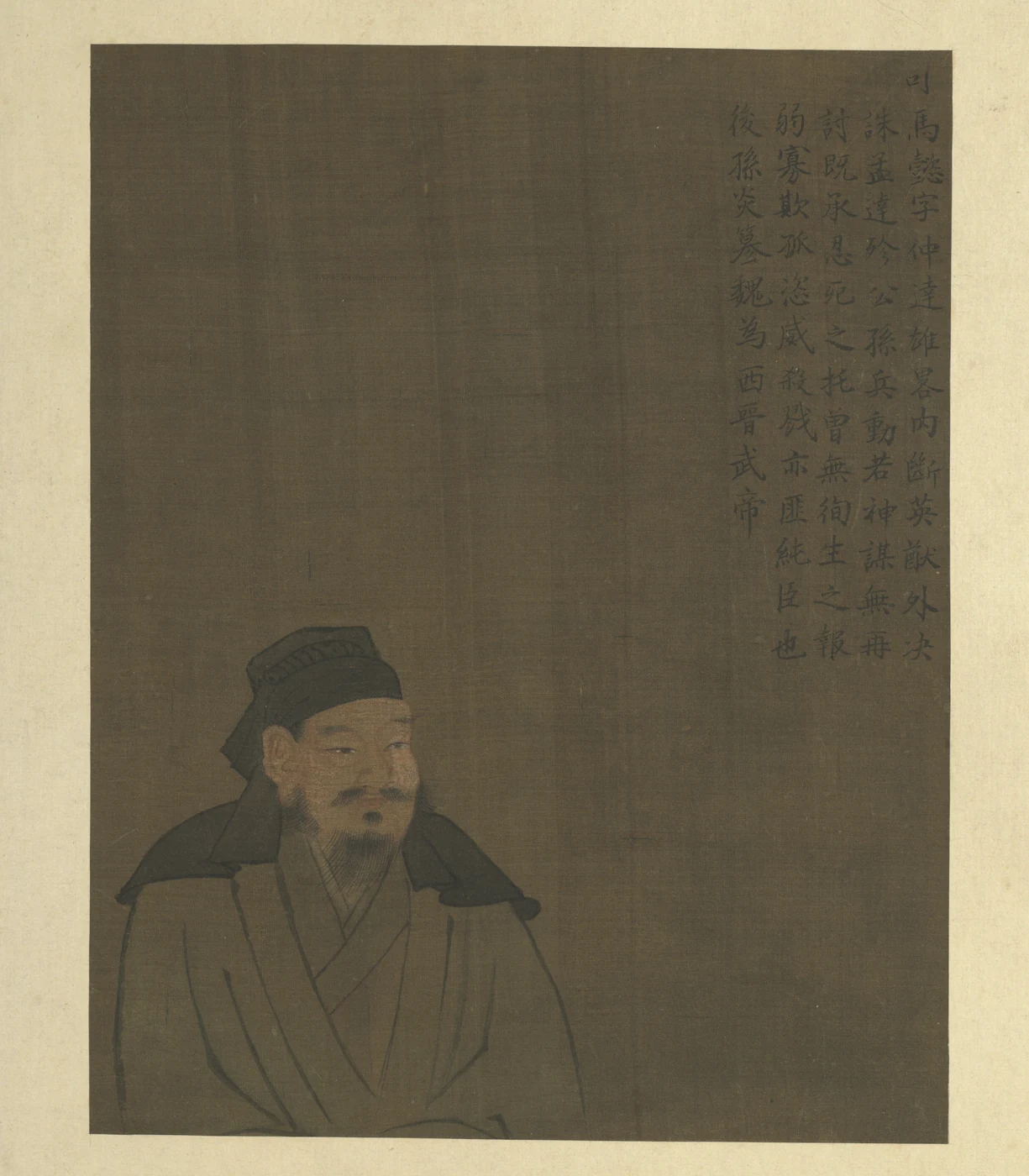
Image credits
歷代聖賢半身像 冊 司馬懿 國立故宮博物院,臺北,CC BY 4.0 @ www.npm.gov.twImage sourceCC BY 4.0Source-provided thumbnailStatesmanpowerful ministermilitary commanderand strategist of Cao Wei
Sima Yi
司马懿
Sima Yi (179 – September 7, 251), courtesy name Zhongda, a native of Xiaojing Village, Wen County, Henei Commandery (present-day Wen County, Jiaozuo, Henan), was a statesman, powerful minister, military commander, and strategist of Cao Wei in the Three Kingdoms era, and the founder of the Jin dynasty. Clever from childhood and of grand design, widely learned and devoted to Confucian teaching, he at first declined office under…
Cao Wei
PROFILE
Sima Yi (179 – September 7, 251), courtesy name Zhongda, a native of Xiaojing Village, Wen County, Henei Commandery (present-day Wen County, Jiaozuo, Henan), was a statesman, powerful minister, military commander, and strategist of Cao Wei in the Three Kingdoms era, and the founder of the Jin dynasty. Clever from childhood and of grand design, widely learned and devoted to Confucian teaching, he at first declined office under Cao Cao while the Han emperor was in Cao hands; in 208 (the thirteenth year of Jian'an), when Cao Cao became chancellor, he forcibly recruited Sima Yi as Clerk of Literature. After Cao Cao became King of Wei, Sima Yi served as Aide to the Heir Apparent assisting Cao Pi, helping him win the struggle for succession. Dying, Cao Pi named Sima Yi and Cao Zhen among the regents for Emperor Ming of Wei, Cao Rui, under whom Sima Yi rose through General Who Comforts the Army, Grand General, and Grand Commandant. He was a master of bold stratagems: he captured and executed the rebel Meng Da, twice repelled Zhuge Liang's northern invasions with large armies, and campaigned far to pacify Liaodong, while contributing importantly to agriculture through military colonies and waterworks. At Emperor Ming's death, the young emperor Cao Fang was entrusted to Sima Yi and Cao Shuang; displaced by Cao Shuang, Sima Yi was promoted to the powerless post of Grand Tutor. In 249 (the tenth year of Zhengshi), taking advantage of Cao Shuang's accompanying Cao Fang from Luoyang to sacrifice at the Gaoping Tombs, Sima Yi rose in a coup and seized control of the capital—whereafter the military and political power of Cao Wei passed into the hands of the Sima clan, the event known as the Incident at the Gaoping Tombs. He died of illness on the wuyin day of the eighth month of the third year of Jiaping (September 7, 251), at the age of seventy-three, having declined a princely fief and special honors; he was buried at Shouyang Mountain, with the posthumous name Wenzhen, later changed to Wenxuan. When his grandson Sima Yan took the imperial title, he honored Sima Yi posthumously as Emperor Xuan with the temple name Gaozu.
- Also known as
- Xuanwang of Sima; Emperor Xuan of Jin; "Tomb Tiger" (Zhonghu)
- Courtesy Name
- Zhongda
- Era
- End of the Han; Three Kingdoms (Cao Wei)
- Ethnicity
- Han
- Place of Origin
- Xiaojing Village, Wen County, Henei Commandery (present-day Wen County, Jiaozuo, Henan)
- Identity / Occupation
- Statesman, powerful minister, military commander, and strategist of Cao Wei; founder of the Jin dynasty
- Place of Death
- The capital, Luoyang
- Tomb
- Gaoyuan Tomb (Shouyang Mountain, Heyin)
- Father
- Sima Fang
- Principal Offices
- Grand Commandant (Taiwei), Grand Tutor (Taifu)
- Titles
- Marquis of Hejinting, Marquis of Xiang, Marquis of Wuyang, Duke of Anping
- Temple Name
- Gaozu
- Posthumous Names
- Wenzhen, then Wenxuan, then Xuanwang, then Emperor Xuan
- Notable Work
- "Song at the Feast" (Yanyin Ge)
- Major Achievements
- Captured and executed Meng Da; repelled Zhuge Liang's northern campaigns; pacified Liaodong; seized power in the Incident at Gaoping Tombs; promoted military agricultural colonies
- Date of Birth
- 179 CE(2nd year of Ling Di Guang He)
- Date of Death
- September 7, 251 CE(3rd year of the Jiaping era, Wei, 8th month)
LIFE TIMELINE
Forcibly recruited by Chancellor Cao Cao as Clerk of Literature. | Forcibly recruited by Chancellor Cao Cao as Clerk of Literature.
Aide to the Heir Apparent | Aide to the Heir Apparent, helping Cao Pi win the succession.
Named regent by Cao Pi for Emperor Ming | Named regent by Cao Pi for Emperor Ming, Cao Rui.
Took Xincheng in sixteen days and executed Meng Da. | Took Xincheng in sixteen days and executed Meng Da.
Twice repelled Zhuge Liang's northern campaigns. | Twice repelled Zhuge Liang's northern campaigns.
Campaigned to Liaodong and took Xiangping | Campaigned to Liaodong and took Xiangping, destroying Gongsun Yuan.
Entrusted with the young emperor Cao Fang | Entrusted with the young emperor Cao Fang, sharing the regency with Cao Shuang.
The Incident at the Gaoping Tombs: seized Luoyang while Cao Shuang accompanied the sacrifi | The Incident at the Gaoping Tombs: seized Luoyang while Cao Shuang accompanied the sacrifice and executed his faction.
Suppressed Wang Ling's revolt | Suppressed Wang Ling's revolt; died of illness at Luoyang on September 7, aged seventy-three.
Later years | He launched the Gaopingling coup, took control of Luoyang and stripped the Cao Shuang faction of power; Cao Shuang and his chief associates were killed soon afterwards.
Later years | He led troops against Wang Ling's rising in Huainan; Wang Ling surrendered and was taken back, and Sima Yi fell gravely ill the same year.
Age seventy-three | He died of illness in Luoyang and was buried in the area of Mount Shouyang.
BIOGRAPHY
Biography
Early Years and Entry into Office
Sima Yi was a native of Xiaojing Village, Wen County, Henei Commandery. His lineage traced to Zhongli, whose Zhou-era descendant Cheng Bofu, having quelled the rebellion of Xu under King Xuan of Zhou, was granted the office-title "Sima" as a surname; among his descendants was Sima Ang, King of Yin at the end of the Qin, whose offspring settled in Henei. Sima Yi's great-great-grandfather Sima Jun, great-grandfather Sima Liang, grandfather Sima Jun, and father Sima Fang served in office for generations; Sima Fang fathered eight sons, known as the "Eight Das of the Sima," Sima Yi being the second.
Sima Yi was clever from childhood, of grand strategy, broadly learned, and devoted to Confucian teaching. Because the Han court was controlled by the Cao clan, he at first declined the posts Cao Cao offered; in 208, when Cao Cao became chancellor, he forcibly recruited Sima Yi as Clerk of Literature, and Sima Yi gradually won Cao Cao's trust. After Cao Cao became King of Wei, Sima Yi was made Aide to the Heir Apparent to assist Cao Pi, helping him prevail in the contest for the succession.
Service as Regent
Dying, Cao Pi named Sima Yi, Cao Zhen, Chen Qun, and others as regents for Emperor Ming of Wei, Cao Rui, under whom Sima Yi rose through General Who Comforts the Army, Grand General, and Grand Commandant. In 227 (the first year of Taihe), Meng Da, Administrator of Xincheng, plotted to defect to Shu; Sima Yi marched day and night, reaching his city in eight days and taking it in sixteen, capturing and executing Meng Da. During Zhuge Liang's northern campaigns, Sima Yi twice successfully resisted the Shu armies with massed forces, holding fast and refusing battle until Zhuge Liang died at Wuzhang Plains and the Shu army withdrew. In 238 (the second year of Jingchu), Sima Yi campaigned far into Liaodong against Gongsun Yuan, stormed Xiangping, and pacified the region. He also repeatedly repelled attacks by Zhu Ran and Zhuge Ke and killed the Wu general Zhang Ba.
Sima Yi contributed importantly to the agrarian economy through military colonies (juntun) and irrigation works, and directed the building of city walls.
The Incident at the Gaoping Tombs
At Emperor Ming's death, the young emperor Cao Fang was entrusted to Sima Yi and Cao Shuang. After Cao Fang's accession, Cao Shuang sidelined Sima Yi, promoting him to the powerless post of Grand Tutor. In the first month of 249 (the tenth year of Zhengshi), Sima Yi seized the moment when Cao Shuang accompanied Cao Fang from Luoyang to sacrifice at the Gaoping Tombs: he rose in a coup, sealed the city gates, and took the arsenal; Cao Shuang gave up resistance, and Sima Yi then executed him and his partisans—He Yan, Ding Mi, and others—for treason, exterminating their three clans. From then on the military and political power of Cao Wei fell into the hands of the Sima clan, the event known in history as the Incident at the Gaoping Tombs. Later he suppressed the rebellion of the Grand Commandant Wang Ling in Huainan.
Death
On the wuyin day of the eighth month of the third year of Jiaping (September 7, 251), Sima Yi died of illness at Luoyang, aged seventy-three. He had declined a commandery-duke's fief and special ceremonial honors, and by testament directed burial at Shouyang Mountain without grave mound or burial goods. His posthumous name was Wenzhen, later changed to Wenxuan. His son Sima Zhao, enfeoffed King of Jin, posthumously titled him Xuanwang; his grandson Sima Yan, on becoming emperor, honored him posthumously as Emperor Xuan with the temple name Gaozu, his tomb called Gaoyuan.
His Lineage, Names and Early Years
The Jin shu, in the annals of Emperor Xuan, records that the Emperor Xuan was named Yi, his courtesy name Zhongda, a man of Xiaojingli in Wenxian of Henei, of the surname Sima; that his ancestors came from Chongli, son of the High Ancestor, who was the fire officer of the Xia, and held that office through Tang, Yu, Xia and Shang, becoming the minister of war under the Zhou; that afterwards Cheng Bolinfu, in the time of King Xuan of Zhou, by hereditary office pacified the land of Xu and was granted the official clan, and so took the surname; and that between Chu and Han Sima Ang was a general of Zhao and fought Qin with the lords, and when Qin fell was made King of Yin with his capital at Henei, the Han making the land a commandery so that his descendants settled there. Sima Yi had from youth extraordinary principle, was intelligent and of great design, broadly learned and widely informed, and devoted to Confucian teaching. Cao Cao, having just defeated Yuan Shao and needing men urgently, hearing that Sima Yi was very able, summoned him to office; and Sima Yi, learning of it, thought Cao Cao a eunuch's descendant and was unwilling to serve him, yet dared not refuse openly, and so pretended to suffer from the disease of the wind and be unable to move about, Cao Cao suspecting that he was putting him off, secretly sending men to watch him by night. In his early years there was also the matter of Hu Zhao's rescue: the Biographies of Eminent Scholars records that when the Emperor Xuan was a commoner he was on terms with Hu Zhao, and that Zhou Sheng and others of the same commandery plotted to kill him; and Hu Zhao, hearing of it, went on foot over the passes and met Zhou Sheng between Yao and Mian and stopped him, but Zhou Sheng would not yield; and Hu Zhao wept and pledged him in sincerity, and Zhou Sheng, moved by his righteousness, desisted; and Hu Zhao then cut a jujube tree with him and made a covenant before parting; and though Hu Zhao had thus secretly done the Emperor a good turn he never spoke of it and no one knew, his good faith being noted in his district.
The Danger at Xiangfan and the Proposal to Bind Sun Quan
Sima Yi's strategical judgement appeared early in the affair of Xiangfan. At that time Guan Yu was besieging Fan, and Yu Jin with seven armies was utterly defeated, Hu Xiu and Fu Fang duly surrendering to Guan Yu, so that Cao Ren's position became very critical: Cao Ren held the city with several thousand men, and of the wall the unflooded part was no higher than a few planks; Guan Yu brought his boats up to the wall and invested it in several rings, so that the city was cut off from the outside and its grain nearly spent while relief had not come; and Cao Ren encouraged his officers and men and showed them his resolve to die, so that they were moved and none had a second mind. Afterwards Cao Cao was once minded to move the capital to avoid his edge, and Sima Yi asked to bind Sun Quan in order to deal with Guan Yu, and Sun Quan did indeed attack and kill Guan Yu afterwards, and the siege of Fan was raised. Sima Yi also argued that Xiangyang could not be abandoned: when Cao Ren was holding Xiangyang and someone asked that he be recalled to Wancheng, Sima Yi said that Sun Quan had just defeated Guan Yu, which was precisely the time when he wished to make friends with us, so that he would certainly not dare to invade; and that Xiangyang was the meeting point of land and water and the key ground for resisting the enemy, and could not be given up. His advice was in the end not taken, and Cao Ren burned and abandoned both Fancheng and Xiangyang, and Sun Quan did indeed not invade, at which the Emperor Wen of Wei felt regret.
The Defence Against Shu and Military Farming on the Frontier
After Cao Zhen's death the Emperor Ming of Wei, weighing the matter again and again, held that none but Sima Yi could settle the western front. Sima Yi was charged with the military and political affairs of the west and moved to Hanyang to face Zhuge Liang. Sima Yi knew well that Zhuge Liang thought deeply and that every movement had a plan, and held that he should not be pursued; and most of the Wei generals were dissatisfied with a long defensive strategy, mocking him for fearing the Shu army as a tiger. After the Shu army withdrew the Wei generals held that it would soon return and that grain should be moved at once and preparations hurried; but Sima Yi held that Shu was weak and of small strength and could not mount a great attack without three years' accumulation, and that therefore the garrison should not be strained but should continue the policy of military farming and frontier defence against a great Shu attack three years hence. And indeed, as Sima Yi had foreseen, it was not until the second year of Qinglong, that is 234, that Zhuge Liang launched his fifth northern campaign. His caution appears also in the matter of the wheat at Shanggui: in the fifth year of Taihe, that is 231, when Zhuge Liang attacked Tianshui, the wheat of the military farms at Shanggui had already grown, and some proposed to cut the standing wheat at Shanggui to take the enemy's food, but the Emperor Ming would not, sending troops repeatedly to strengthen the King Xuan's army and ordering the wheat to be protected; and Sima Yi held out against Zhuge Liang, owing his success in great part to the wheat of the military farms at Shanggui as military grain.
Facing the River with His Back to It and Holding Firm Without Fighting
In the second year of Qinglong Zhuge Liang led a hundred thousand Shu troops against the Wei River. The north bank of the Wei was rich farmland, and Sima Yi, so that the local people should not suffer the greater loss, boldly crossed the Wei and drew up his array with his back to the river facing the Shu army; and against the Shu army's weakness of coming from afar with difficulty in transporting grain he still took the strategy of holding firm without fighting, meaning to wear them out by the passage of time. The two armies held each other for long, and the Shu strength gradually failed, until Zhuge Liang died of illness brought on by toil in the army and the Shu generals could only withdraw slowly into Shu according to his dispositions before death; and the great fifth northern campaign was thus dragged down by Sima Yi. His reason for not moving appears also in his reading of his opponent: Sima Yi said that Zhuge Liang thought too much and decided too slowly and would surely first strengthen his ramparts to secure himself and only then reap the wheat, and that they could reach Shanggui by forced marches day and night within two days; and he accordingly ordered the army to march light and fast day and night, and Zhuge Liang, seeing the dust of the Wei army, led his troops away. Sima Yi said also that his own troops had marched day and night and were wearied, and that this was precisely the opportunity that a skilful commander covets; but Zhuge Liang did not dare to occupy the ground, and so lost the moment.
The Insult of Women's Dress and the Edict on Asking for Battle
In Zhuge Liang's last northern campaign his means of provoking Sima Yi to battle are recorded. In the second year of Qinglong, that is 234, Zhuge Liang launched his fifth northern campaign and sent troops to challenge, insult and provoke before the Wei camp; but though every device was used, Sima Yi's resolve did not move and he still held firm without fighting; and when the challenges availed nothing, Zhuge Liang in his urgency sent Sima Yi a set of women's garments as an insult, meaning that being so cautious and timid he deserved to be a woman and not a commander. Such an insult to the Wei commanders did indeed anger them, and they were furious and demanded battle; and Sima Yi, seeing that persuasion and orders would not restrain his generals' wish to fight, could only tell them that he would memorialise the court asking leave to fight, and would fight at once if the emperor allowed. So Sima Yi sent his memorial asking for battle to the Emperor Ming of Wei, and the emperor, knowing well Sima Yi's purpose, at once sent the commandant of the guards Xin Pi as his military adviser with an edict to the front, proclaiming that the emperor's order was to hold firm only and not to fight, and the generals' demand was quieted.
The Beginning and End of His Charge on the Western Front
Sima Yi's charge on the western front came of the Emperor Ming's decision. After Cao Zhen's death the Emperor Ming, weighing the matter again and again, held that none but Sima Yi could settle it, and Sima Yi was accordingly charged with the military and political affairs of the west and moved to Hanyang to face Zhuge Liang, as has been told above. In Zhuge Liang's northern campaign of the second year of Qinglong the emperor again used Sima Yi against him, and his rule was to drive hard when there was profit and to keep his ranks when his opponent camped: when Zhuge Liang attacked, Sima Yi went to meet him at speed, and when Zhuge Liang camped, Sima Yi kept his ranks and waited; until Zhuge Liang, eating little and troubled by many affairs, was known by Sima Yi early to be in straits; and with the autumn wind at Wuzhangyuan Zhuge Liang died in the army and the Shu troops withdrew, so that nothing the Wei men did afterwards could mend it. The historical discussion therefore says of Sima Yi that he foretold death and life and that his merit was already sufficient, and that he knew early the bitterness of eating little and being troubled by many affairs, all of it spoken of his years of standoff with Zhuge Liang.
The Liaodong Campaign, I: The Plan and the Setting Out
In the first month of the second year of Jingchu, that is 238, the Emperor Ming of Wei recalled Sima Yi and ordered him to lead troops against Gongsun Yuan in Liaodong. The Emperor Ming summoned Sima Yi and ordered him to lead troops with the Wuhuan, Xianbei and Koguryo by sea and land on a distant expedition to Liaodong to destroy Gongsun Yuan; and Sima Yi, taking the order, mustered forty thousand troops and set out at once, the emperor escorting him in person to the Ximing Gate and ordering the governors and agricultural officers of the commanderies to go and pay their respects. The emperor asked Sima Yi what he reckoned Gongsun Yuan's course would be, and Sima Yi said that to abandon the city and flee was the best course, to resist our army by the Liao River the middle course, and to sit and hold Xiangping would make him a prisoner. The emperor asked which course Gongsun Yuan would take, and Sima Yi answered that only a wise man could rightly measure the strength of each; that to abandon the city beforehand was not in Gongsun Yuan's power, and that he would certainly think our lone expedition could not last, and would first resist at the Liao and then fall back on Xiangping, which was the middle and the worst course. The emperor asked how long the going and returning would take, and Sima Yi said a hundred days to go, a hundred to return, a hundred for the fighting and sixty for rest, and a year would be enough. As he set out his kinsmen and friends saw him off, and Sima Yi, moved, made a song: heaven and earth were opened, sun and moon shine again; meeting the occasion, I spend my strength in distant parts; I shall sweep the throng of filth and pass again by my old home; I shall clear ten thousand li and bring the eight wastes into order; my work done I shall return to old age, awaiting punishment at Wuyang. Sima Yi marched north by way of Guzhu and past the Jieshi rocks straight toward the Liao River.
The Liaodong Campaign, II: The Battle at Liaosui
Having reached Liaodong, Sima Yi had many banners set up on the south bank of the Liao to make a show and create the appearance of preparing to cross, drawing the enemy's main force toward him; while secretly he ferried his main force across by boat, approached the enemy camp and formed an encircling position. Gongsun Yuan duly sent several tens of thousands of foot and horse to hold Liaosui, building strong ramparts to hold, extending sixty or seventy li north and south to resist Sima Yi; and Sima Yi disposed a great force with many banners and advanced toward the south of Liaosui, and the enemy moved all his picked troops to the southern line to resist, whereupon Sima Yi secretly sent troops by boat across the Liao to the north of Liaosui, pressed close to the enemy's great camp, then sank the boats and burned the bridges, drew a long line of investment along the Liao, abandoned the enemy at Liaosui and turned toward Xiangping. His officers passed through and pressed on Xiangping; and the enemy commander Beiyan, seeing the Wei army suddenly appear behind him, indeed could not contain himself and attacked the Wei army of his own accord. Sima Yi seized the moment and loosed his troops in hard fighting, winning three victories in three battles and breaking the Liao army utterly. His argument on the campaign was that the ancients said that even an enemy with high ramparts and strong walls must still fight us, because we attack what he must relieve; that with the enemy's main force gathered here his lair was empty; and that if we went straight to Xiangping his officers and men would be anxious within and ask for battle out of fear for their lair, and their defeat would be certain. He told his generals also that he did not attack their ramparts precisely in order to draw them out to fight, and that the moment must not be lost. He therefore set his array in order and, passing the enemy's great camp at Liaosui, advanced on Xiangping; and the enemy, seeing the Wei army in his rear, did indeed send troops to intercept them, and Sima Yi, ordering his troops out to meet them, broke them utterly, winning three battles in succession, so that the enemy fell back on Xiangping and the Wei army advanced and invested it.
The Change at Gaopingling: Feigning Illness to Deceive Li Sheng
In the Zhengshi years Cao Shuang monopolised power, and Sima Yi therefore pleaded illness and took no part in government. Cao Shuang sent men to test the truth of it: Sima Yi had two slave girls attend him, and when he took his clothes they fell from his hand; and he raised his hand to his mouth and said he was thirsty and wanted water, and when the girls brought gruel he took the cup and drank, and the gruel ran out and wet his breast. Li Sheng, pitying him, wept and told him that the sovereign was young and the empire relied on the lord, yet all said his old illness had returned, and that he had not thought his body would come to this. Sima Yi slowly slowed his voice and made his breath come haltingly, saying that he was old and gravely ill and might die at any time; that Li Sheng was going to Bingzhou, which was near the Hu, and should manage his affairs well, for they would surely not meet again, and what was to be done? Li Sheng said that he was returning to his own prefecture and not to Bingzhou; and Sima Yi still feigned confusion, saying that he was indeed going to Bingzhou and should take good care of himself, speaking so disjointedly that it seemed raving. When Li Sheng said again that he was going to Jingzhou as its governor, Sima Yi seemed to understand a little and told him that being old and confused he had not heard him clearly; that now that Li Sheng was returning to his native place as governor, of high repute and great spirit, he should establish merit well; and that since they must now part, and he felt his strength daily failing and would certainly never see him again, he wished to force himself to set out a poor banquet to see him off, and at this parting of life and death to have his brothers Sima Shi and Sima Zhao make friends with him and not grow distant, to fulfil his own wish. And he wept as he spoke, and Li Sheng answered with a long sigh that he would certainly follow his charge and await the court's appointment. Li Sheng, taking his leave, met Cao Shuang and the others and told them that the grand tutor spoke disjointedly and could not hold his cup and took the south for the north, saying that he was going to Bingzhou, and that when he had answered that he was returning to Jingzhou and not Bingzhou and talked with him slowly, he understood only in his clearer moments that he was going to Jingzhou. Cao Shuang and the rest therefore relaxed their guard.
The Change at Gaopingling: The Memorial Against Cao Shuang and the Holding of Luoyang
In the first month of the tenth year of Zhengshi, that is 249, Sima Yi took the occasion of Cao Shuang and his brothers accompanying the emperor to pay their respects at the Gaoping tomb to raise the coup. His memorial to the Emperor of Wei said that the late emperor had ordered the emperor, the Prince of Qin and himself to ascend the imperial couch, and holding his hand had said that he was deeply mindful of what should come after; that now the general-in-chief Cao Shuang had turned his back on the late emperor's testament and corrupted and disordered the statutes of the state, imitating within the sovereign's equipage and monopolising all power without, placing his own confidants in every important office and driving out and dismissing the old palace guards, his partisans bound together and his root firm; that Cao Shuang grew daily more unrestrained and had made the eunuch Zhang Dang a ... by which they colluded and spied for the throne, so that all hearts in the empire were troubled and everyone feared; that the emperor was now as one lodged in the throne and how could this last; that this was not the meaning of the late emperor's ordering the emperor and himself to ascend the couch; that though he was old and infirm he dared not forget the late emperor's last words; that formerly Zhao Gao ran wild and the Qin fell, while the Lü and Huo families were destroyed early and the fortune of Han endured, which the emperor should take for a lesson and which was the hour for him to serve the state; that the ministers and great officers all held that Cao Shuang had designs against the sovereign and that his brothers should not command the palace guards, and that he had memorialised the empress dowager, whose order was to carry out his memorial; and that he had ordered the officers concerned and the eunuch director to dismiss Cao Shuang, Cao Xi and the others from their posts. The matter of Huan Fan leaving the city is also recorded: Si Fan was an officer whom Huan Fan had formerly recommended, and Huan Fan called to him and showed him the tablet in his hand, falsely saying that an edict summoned him and that he should open the gate at once; and when Si Fan wished to examine the edict Huan Fan cried out that he was not the officer he had formerly recommended, and how dared he; and Si Fan then opened the gate. When Huan Fan had left the city he turned and told Si Fan that the grand tutor was plotting rebellion and that he should come with him; and Si Fan, unable to keep up on foot, hid himself aside. Huan Fan went south to Cao Shuang and urged him and his brothers to serve the emperor in going to Xuchang and to summon the armies of the empire to their aid, and Cao Xi and his brother were silent and would not obey. Cao Shuang hesitated and Cao Xi too was silent; and Huan Fan told Cao Xi that the matter was now clear beyond doubt and what use was his reading; that their house was about to perish. The two were still silent; and Huan Fan said also that the separate camp Cao Xi commanded was south of the palace gate and that the office of the agricultural officer of Luoyang was outside the city, so that they could be summoned at any time; that to go now to Xuchang would take no more than half a night, and that the stores of Xuchang would suffice for arms and equipment, and that the only thing to fear was grain, and the seal of the grand minister of agriculture was in his hand. Cao Xi and his brother were still silent and would not obey. From midnight to the fifth watch Cao Shuang at last threw his sword on the ground and told the ministers who followed the emperor that he supposed the grand tutor's meaning was only to have him and his brother ...
The Military Farms of the Huai and Deng Ai's Proposal
Among the substantial measures of Sima Yi's later years the military farms of the north and south of the Huai were the chief. Deng Ai, after inspecting the ground, held that the region was fertile but had not enough water to bring out its full yield; that canals should be cut both to irrigate the fields and store up military grain on a large scale and to open a water route for the transport of grain and goods; and he accordingly wrote his Essay on the Ji River to set out his plan. His argument was that between Chen and Cai the land was low and fertile, and that some of the rice fields near Xuchang might be abolished and their water led eastward to irrigate the fields from Chen and Cai to Shouchun; and he proposed to station twenty thousand farm soldiers north of the Huai and thirty thousand south of it, with a system of twelve parts and one at rest, so that forty thousand could plough and guard together the year round; that where water was plentiful the yield was usually three times that of the west; and that after deducting the costs of the farms five million hu of grain could be saved each year as military reserve, so that in six or seven years thirty million hu could be stored along the Huai, enough for a hundred thousand troops for five years; and that with such a base an attack on Wu must succeed everywhere. Sima Yi adopted his proposal and carried it out.
The Making of the Farms and the Granaries of the North of the Huai
In the second year of Zhengshi, that is 241, when Sima Yi directed the war against Wu, he first took counsel with Deng Ai on establishing military farms north and south of the Huai; the next year Sima Yi memorialised for the cutting of the Guangcao Canal to lead the river into the Bian and irrigate the pools of the southeast, and the great farming north of the Huai began; and the year after, in the same region, he greatly extended the farms and garrisons, opening the two canals of Huaiyang and Baichi and repairing the pools north and south of the Ying to more than ten thousand qing, so that thereafter the granaries of the north of the Huai looked upon one another from Shouyang to the capital and the agricultural officers and farm soldiers were joined in one line. This followed upon the earlier military farms at Shanggui: in the fifth year of Taihe, 231, when Zhuge Liang attacked Tianshui, the wheat of the farms at Shanggui had grown, and some proposed to cut the standing wheat to take the enemy's food, but the Emperor Ming would not, sending troops to strengthen the King Xuan's army and ordering the wheat protected, and Sima Yi held out against Zhuge Liang owing much to that wheat for military grain; and even as late as the second year of Zhengyuan, 255, the general of the west Deng Ai practised the method of pit cultivation at Shanggui, taking the plough in his own hand before his officers and men. From Shanggui in the passes to the north and south of the Huai the policy of military farming and water works continued, and its beginning lay in the time when Sima Yi directed the armies of the west and the east, being the financial side of his policy of endurance and frontier defence.
The Honours After His Receiving the Charge and His Declining of Rank
The Jin shu, in the annals of Emperor Xuan, records that when the Prince of Qi came to the throne, Sima Yi was promoted to palace attendant, holder of the tally, commander of all the armies within and without and supervisor of the secretariat, with Cao Shuang each commanding three thousand troops and jointly holding the government, attending in turn in the palace and entering it with the imperial carriage; that Cao Shuang, wishing that memorials to the throne should first pass through himself, spoke to the emperor and had Sima Yi transferred to be grand marshal; that the court held that the successive grand marshals had one after another died in that office, and so made him grand tutor; that he entered the palace without hastening, was announced without being named and wore sword and shoes in the hall, as in the old case of Xiao He of Han; that his marriages, funerals and burials were supplied by the government; that his heir Sima Shi was made loose attendant and three of his sons and younger brothers marquises and four cavalry commandants; and that Sima Yi firmly declined the offices for his sons and brothers. Of his declining of rank there is also the following: that his fief was enlarged by four counties to eight in all with twenty thousand households, and that he was allowed to memorialise without giving his name; and Sima Yi memorialised declining, saying that he had personally received the late emperor's charge at his death, that his cares were heavy and his responsibility great; that by Heaven's majesty he had destroyed the wicked and rebellious, and that to escape guilt was more than he deserved and his merit was not worth speaking of; that moreover the three ducal offices were established by the sage rulers of antiquity and recorded in the ritual books, and that as for the chancellorship, the Han had continued that institution without further change; that the three dukes being now complete, to grant him besides the special favour of a chancellorship would violate the statutes of former dynasties, change the regular practice of sage rulers and follow the old system of Qin and Han; and that such a thing he should correct even in another, how much more in himself; and that unless he fought against it firmly, what would the empire say of him. He memorialised more than ten times declining, and the young emperor at last granted his request.
The Integrity of the Lady Xiahou Lingnü
Cao Shuang's destruction implicated his kin, and the matter of the lady Xiahou Lingnü is the most remembered. She took the occasion to steal into her chamber, cut off her own nose with a knife and lay down covered by the quilt; and when her mother called to her and she did not answer, and the quilt was lifted, the blood covered the mat. The whole household was in confusion and ran to look, and all who saw it were grieved and moved. Someone said to her that a man's life in the world was like a light speck of dust clinging to a weak blade of grass, and why should she toil and trouble herself to this degree; and that moreover the Cao house had been utterly destroyed, and for whom was she keeping her chastity? And the lady Xiahou Lingnü answered that she had heard that a man of benevolence does not change his principles with the rise and fall of another's house, nor a man of righteousness waver with the life and death of another; that while the Cao house flourished she had meant to guard the marriage to the end, and that now that the house had fallen how could she bear to forsake it; and that she would not do what beasts do. That in the ruin of Cao Shuang there should be one of his kin of such integrity sets against the cruelty with which Sima Yi destroyed Cao Shuang to the third degree, and later ages discussing the change at Gaopingling have often named the two together.
The Affairs of His Household
Of Sima Yi's household there is also this in the histories: in his later years he favoured concubines besides Zhang Chunhua, and even Zhang Chunhua could hardly find occasion to see him; and when he lay ill in bed and Zhang Chunhua came to inquire after him, Sima Yi said that the old thing was a nuisance and what need was there for her to come out; and Zhang Chunhua, ashamed and resentful, refused to eat and wished to kill herself, and her several children too would not eat; and Sima Yi, alarmed, apologised, and she then ceased her fast; and Sima Yi, coming out, said to others that the old thing was not worth regretting but that he feared only for the hardship of his good sons. Small as this matter is, it shows the manner of his household and the weight he gave to the teaching of his sons; and afterwards Sima Shi and Sima Zhao rose in succession and the foundation of the Sima house was made, whence the saying that the foundation of the Jin emperors was all the legacy of Yi.
The Sequence of His Offices
Sima Yi's official career began under Cao Cao with a literary office, served four reigns and reached the three dukes. In Cao Cao's time he was summoned as a staff officer and passed through various posts, gradually dissolving Cao Cao's suspicion by his diligence in business; in Cao Pi's time he was a powerful supporter, the trust of Xuchang and the charge at Chonghua being recorded in the histories; in the Emperor Ming's time he held the military charge of the western front and held out against Zhuge Liang for years, and as grand commandant recommended men and directed military and state affairs; in the second year of Jingchu, that is 238, he was ordered on the distant expedition to Liaodong and on his return received the testamentary charge to assist the government together with the general-in-chief Cao Shuang; in the Zhengshi years he was promoted to palace attendant, holder of the tally, commander of all the armies within and without and supervisor of the secretariat, with Cao Shuang each commanding three thousand troops, attending in turn in the palace and entering with the imperial carriage; and when Cao Shuang wished memorials to pass first through himself he spoke to the emperor and had Sima Yi transferred to be grand marshal, but the court held that the successive grand marshals had died one after another in that office and made him grand tutor, entering the palace without hastening, announced without being named and wearing sword and shoes in the hall, as in the old case of Xiao He of Han. After the change at Gaopingling, for the merit of the memorial against Cao Shuang he was enfeoffed with four counties, making eight in all with twenty thousand households, and allowed to memorialise without giving his name; and Sima Yi memorialised declining the establishment of a chancellorship, more than ten times, and the young emperor granted his request.
The Jin After His Death and the Sima House Replacing Wei
After Sima Yi's death his sons and grandsons replaced Wei with Jin, and Sima Yi himself was posthumously honoured as emperor. The discussion in the Jin shu says that of old the High Ancestor, the Emperor Xuan, with heroic talent and great capacity, came to office in accordance with the times, at the very founding of the Wei ancestor's enterprise planned military and state affairs and repeatedly hit the mark with excellent counsels, and so served the carriage and exerted himself through three reigns; that his nature was deep and reserved as a citadel yet he could be broad and accommodating, and that he governed things by method and knew men and was good at selecting and promoting them, so that wise and foolish alike were won and high and low did their utmost; and that he drew Deng Ai from among the farm workers and Qu Tai from the ranks of service, entrusting them with civil and military affairs each according to his excellence, so that he could take Meng Da in the west, raise up the matter of Gongsun Yuan in the east, destroy Cao Shuang within and strike Wang Ling without, his divine strategy decided by himself alone, his campaigns successful in all four quarters, controlling the princes and holding the great power in his own hands, repeatedly holding off Zhuge Liang's disciplined troops and supporting the eastern front against the Wu who backed one another. The poem says also that Sima Yi was a man of Wei and followed the campaign against Zhang Lu; that when Bei contended for Jiangling he asked to take advantage of the Shu land; that his words were not followed yet his great purpose was seen; that when Guan Yu shook Fan and Wei wished to avoid Xu, Yi asked to bind Sun Quan and so Guan Yu was killed; that Meng Da, though he had surrendered, was still uncertain, and was taken in eight days, to the astonishment of all at his divine valour; that when Zhuge Liang came out at Qi, Yi was used against him; that when there was profit he drove hard and when the enemy camped he kept his ranks; that though women's dress was sent him he did not lightly stir; that from his eating little and being troubled with much he knew early his hardship; that with the autumn wind at Wuzhangyuan no successor could mend it; that he foretold death and life and his merit was already sufficient; that Gongsun Yuan rebelled in Liao and was as a fish in the cauldron; that he measured the days, attacked the empty place and broke him as easily as taking; and that the foundation of the later Jin emperors was all the legacy of Yi. After Sima Yi's death his son Sima Shi held the government of Wei, Sima Zhao destroyed Shu and was enfeoffed as Duke and then Prince of Jin, and Sima Yan replaced Wei and founded Jin, honouring Sima Yi posthumously as the High Ancestor, Emperor Xuan. Hence those who later discussed the turn from Wei to Jin always took the change at Gaopingling, brought about by Sima Yi's management, as its beginning.
His Art of War as It Squares with the Master Sun
Later writers have matched the articles of the Master Sun's art of war one by one with Sima Yi's conduct, their account being this: that Sima Yi, whose courtesy name was Zhongda, was a man of Wenxian in Henei, of extraordinary principle from youth, intelligent and of great design, broadly learned and widely informed, and devoted to Confucian teaching. The Master Sun says that the next best is to break the enemy's alliances, and Sima Yi had Sun Quan check Liu Bei from behind; the Master Sun says that the essence of war is speed, and Sima Yi reached the wall of Meng Da's city in eight days; the Master Sun says to shape others while remaining without form, and Sima Yi sent his land forces out from Wancheng while his fleet moved toward Xiakou; the Master Sun says to vary between dividing and concentrating, and Sima Yi did not divide his troops into van and rear; the Master Sun says to anger and so disturb him, and Sima Yi did not stir though the enemy provoked him with women's dress; the Master Sun says to know the day of battle, and Sima Yi said the Liaodong campaign would take a year and was right; the Master Sun says to attack what he must relieve, and Sima Yi abandoned the enemy and turned toward Xiangping; the Master Sun says that in war one has heard of a clumsy speed, and Sima Yi in attacking Meng Da did not weigh the dead and wounded against the race for grain; the Master Sun says to seem incapable when capable, and Sima Yi in attacking Gongsun Yuan would not take small profit, showing himself incapable; and the Master Sun says to shape the enemy and he will follow, and Sima Yi showed he must attack and the Wu army fled by night. Seen in these articles, the essentials of his art of war all answer to the military writings, and what made it possible was that he settled the plan first and held firm afterwards.
A Survey of His Military Achievements
Sima Yi's military achievements may be gathered under several heads: first, he took Meng Da in the west by a swift march that broke his city; second, he held off Zhuge Liang in the region of the passes, at Shanggui, Lucheng and Wuzhangyuan, wearing out his army by endurance and awaiting his end; third, he supported the eastern front against the Wu who backed one another, repeatedly holding off the armies of Wu; fourth, he pacified Gongsun Yuan in Liaodong, taking Xiangping by count of days; and fifth, he destroyed Cao Shuang within and struck Wang Ling without, settling the internal government of Wei. The history says that his divine strategy was decided by himself alone and his campaigns successful in all four quarters, and that he repeatedly held off Zhuge Liang's disciplined troops while supporting the eastern front against the Wu; all of it spoken of his defence and distant expeditions east and west. And in the Liaodong campaign, when the Emperor Ming asked how long the going and returning would take, he answered that a hundred days to go, a hundred to return, a hundred for the fighting and sixty for rest and a year would be enough; and he did return on time, which was the proof of his knowing the day of battle.
The Reality of His Standoff with Zhuge Liang
In the years in which Sima Yi held out against Zhuge Liang the reality of the fighting may be summarised thus: in the fifth year of Taihe, 231, when Zhuge Liang attacked Tianshui, the wheat of the farms at Shanggui had already grown, and some proposed to cut it to take the enemy's food, but the Emperor Ming would not, sending troops to strengthen Sima Yi's army and ordering the wheat protected, whereby Sima Yi held out against Zhuge Liang; and afterwards, following Zhuge Liang to Lucheng, Zhang He asked to detach surprise troops behind him and not to advance without daring to press, which Sima Yi would not hear, and on arriving he climbed the hill and dug in and would not fight, so that Jia Xu and Wei Ping asked for battle and there was even the taunt that he feared Shu as a tiger, at which Sima Yi was troubled while all his generals demanded battle. In the second year of Qinglong, 234, Zhuge Liang with a hundred thousand men pressed on the Wei River, and Sima Yi crossed the Wei and drew up with his back to it; and when Zhuge Liang sent troops to challenge and abuse him and sent him women's dress to provoke him, the Wei generals were angered and demanded battle, whereupon Sima Yi memorialised asking for battle and the Emperor Ming sent Xin Pi with an edict to stop him, allowing only to hold firm; and the two armies holding each other for long, the Shu strength gradually failed, and Zhuge Liang died in the army of illness brought on by toil, the Shu generals withdrawing slowly according to his dispositions. After his death Sima Yi entered the Shu camp a day later, examined the traces, took the books, maps and grain, and sighed that Zhuge Liang was indeed a genius of the world; and Xin Pi held it not yet certain, but Sima Yi said that what soldiers value is documents, secrets, troops and grain, and since all these had been abandoned, who could cast away his five viscera and live? The historical discussion says that he foretold death and life and his merit was already sufficient, and that from his eating little and being troubled with much he knew his hardship early, all referring to those years.
The Judgement on His Standoff with the Shu Army
Later writers on Sima Yi's standoff with Zhuge Liang say that to lead the strong troops of Qin and Yong and to wear out the enemy's army by not responding was not for nothing, since he sought a single complete victory; and that although when Zhuge Liang died the Shu army withdrew, Sima Yi did not pursue them to the end because he could not foresee Zhuge Liang's death, their soldiers were still fed and their army unchanged, and the roads of Shu were dangerous and suited to ambush, so that he suspected a feigned retreat to lure him. They say also that in commanding troops and meeting the unexpected with sudden change he was swift as a spirit and destroyed wherever he turned, so that even Duke Cao did not reach him. Such judgements come from later ages, yet what they rest on is the reality of Sima Yi's steadiness in not pursuing and his waiting in ease for a weary enemy.
The Four Periods of His Life
Sima Yi's life may be seen in four periods. First, the period of serving the Cao house: from Cao Cao's summons through the reigns of Cao Pi and Cao Rui he rose from a staff office to the charge of assisting the government, dissolving his sovereign's suspicion by diligence and reserve and gaining weight by the acceptance of his counsels; his feigning the disease of the wind to evade a summons and his redoubled diligence in business when men watched him by night belong to this period. Second, the period of the western front: after Cao Zhen's death he was charged with the west and held out against Zhuge Liang in Hanzhong, at Shanggui, Lucheng and Wuzhangyuan, wearing out his army by endurance and awaiting his end behind strong walls; in which period fell also the taunt that he feared Shu as a tiger, the insult of the women's dress and the edict forbidding battle. Third, the period of the Liaodong expedition: in the second year of Jingchu he took forty thousand men against Gongsun Yuan, took Xiangping by count of days and, on the day of his return, received the testamentary charge to assist the government, the greatest turn in his life. Fourth, the period of seizing power: in the Zhengshi years he pleaded illness and took no part in government, deceived Li Sheng by feigned sickness, and at Gaopingling in one stroke gathered the power of Wei into his hands, afterwards destroying Cao Shuang's party and putting down Wang Ling's rebellion, whereby the foundation of the Sima house's replacement of Wei was laid. In the first three periods he kept the duty of a subject and won fame by merit; in the last he shifted the fortune of Wei, and hence later ages have praised and blamed him differently.
The Forming of His Power
That Sima Yi could accomplish what he did was bound up with the forming of his power: first, he bound the generals to himself by military merit and frontier commands, as Deng Ai and Qu Tai were both raised by him; second, he bound the court officials by marriages and the friendships of colleagues, being on good terms with Jiang Ji and esteeming Xun Yu; third, he distributed high offices among his sons and brothers, making his heir Sima Shi a loose attendant and his sons marquises and cavalry commandants, which he firmly declined but in the end accepted; and fourth, he appealed to his district and his house, the Sima of Henei being a family of learning whose forebears' standing and whose wife's kin were the means of his advancement. Hence at the change at Gaopingling he could shut the city gates, memorialise the empress dowager and have the government of Luoyang levy the people to guard a residence, none of it the work of a single day.
His Death and Burial
Sima Yi died in the third year of Jiaping of Wei, that is 251, not long after putting down Wang Ling's rebellion, at the age of seventy-three. His words at death have often been set beside those of Cao Cao by later critics for comparison: some say that men now name Cao Cao and Sima Yi together, but that if one looks at Sima Yi's words at death, Yi differs from Cao; that the things Cao did were done by Yi's sons while Yi himself never dared in his lifetime do what Cao did; that Cao's hostility toward the former ruler was a wish to remove the worthy of the imperial clan while Yi's plot against Cao Shuang merely killed the unworthy of the imperial clan; and that as for killing an empress, harming an imperial heir, usurping the imperial title and receiving the nine bestowals, these are seen in Cao but not in Yi, so that the gentleman has words of indulgence for Yi. This argument, resting on his never daring in his lifetime to do Cao's deeds and on his not being seen in them, is spoken of Sima Yi's death and of his conduct while living; and as for his burial, it was at Shouyang Mountain by the He. Afterwards his sons and grandsons received the abdication and founded Jin, honouring him posthumously as the High Ancestor, Emperor Xuan, so that his original station as a minister of Wei was the starting point of his whole life.
The Date of the Change at Gaopingling and His Age
The change at Gaopingling took place in the first month of the tenth year of Zhengshi of Wei, that is 249, when Cao Shuang and his brothers accompanied the emperor to pay their respects at the tomb of the Emperor Ming, and Sima Yi took the occasion to shut the gates of Luoyang and raise the coup; it was eleven years after he had received the testamentary charge to assist the government, and only two years before his death in the third year of Jiaping, that is 251. Born in the second year of Guanghe of Han, that is 179, he was then seventy-one; and reckoning his service from the reign of Cao Cao, he served four reigns of Wei, whence the history says that he served the carriage and exerted himself through three reigns. To take power at seventy and die two years later is why later ages, discussing the change at Gaopingling, have often dwelt on the nearness of age and event.
His Years and His Heirs
Sima Yi died in the third year of Jiaping of Wei, that is 251, at the age of seventy-three; his sons Sima Shi and Sima Zhao in turn carried on his work and held the government of Wei, and his grandson Sima Yan received the abdication and founded Jin, honouring him posthumously as the High Ancestor, Emperor Xuan. That a great minister of Wei should open the imperial line of Jin made his own life the epitome of the turn from Wei to Jin.
An Outline of His Life
Sima Yi, whose courtesy name was Zhongda, was a native of Wenxian in Henei and was born in the second year of Guanghe of Emperor Ling of Han. Of an old official family, he had from youth an uncommon integrity. In the Jian'an period Cao Cao summoned him to be a literary clerk, and he served Cao Cao, Cao Pi and Cao Rui in three reigns; he aided Cao Pi's establishment as heir apparent and urged him to diligence in learning. Under Emperor Ming of Wei he commanded the armies of Jing and Yu, defeated the host of Sun Quan and captured and beheaded Meng Da; in the Qinglong years he held Zhuge Liang at the Wei River and would not come out, so that the Shu army ran out of grain and withdrew; in the early Jingchu years he put down Gongsun Yuan in Liaodong. When Emperor Ming died he shared the testamentary charge with Cao Shuang over the young lord Cao Fang; in the tenth year of Zhengshi he brought about the change at the Gaoping tomb, put Cao Shuang and his faction to death, and grasped the whole authority of the court; he died in the third year of Jiaping at seventy-three. His grandson Sima Yan supplanted Wei and founded Jin, and he was honoured posthumously as Emperor Xuan with the temple name Gaozu.
Major Activities
- Military: captured and executed Meng Da in sixteen days; twice repelled Zhuge Liang's northern invasions; pacified Liaodong and Gongsun Yuan; repeatedly repelled Zhu Ran and Zhuge Ke and killed Zhang Ba; suppressed Wang Ling's rebellion
- The seizure of power: after the Incident at the Gaoping Tombs, the military and civil power of Cao Wei passed to the Sima clan, laying the foundation of Jin
- Economy: promoted military agricultural colonies, built irrigation works and city walls, contributing importantly to agrarian development
The Taking of Meng Da
In Sima Yi's use of troops, that the essence of war is speed appears in the taking of Meng Da. When Meng Da was about to rebel, Sima Yi, fearing he would act quickly, wrote to persuade him: that the general had formerly forsaken Liu Bei and come over to the state, which had entrusted the weight of the frontier to him and given him the business of plotting against Shu, a trust bright and clear as the sun and moon; that the men of Shu, wise and foolish alike, gnashed their teeth at him; that Zhuge Liang wished to ruin his relations with the state and had only lacked the means; and that what Guo Mo had said was no small matter, so that Zhuge Liang would hardly have let it leak, and the reason the general could easily understand. Meng Da, much pleased on receiving the letter, hesitated over the rebellion; and Sima Yi took the occasion secretly to lead troops against him. His generals said that Meng Da had leagued with Wu and Shu and that they should wait to see how matters stood; and Sima Yi said that Meng Da had no good faith, that this was precisely the moment when he and Wu and Shu doubted one another, and that they should settle him quickly before he came to a decision. He therefore marched double stages and reached the city wall in eight days. At first Meng Da had written to Zhuge Liang that Wancheng was eight hundred li from Luoyang and twelve hundred from him, so that Sima Yi, hearing of his rebellion, would first memorialise the Son of Heaven, and that when the court had deliberated and sent back word a month at least would pass, by which time he would have strengthened his walls and his troops would be enough to meet them; that moreover the ground he held was strategically dangerous, so that Sima Yi would certainly not come in person, and that if only other generals came he had no anxiety. When Sima Yi's great army arrived, Meng Da told Zhuge Liang again that he had risen only eight days before and the enemy was already beneath his wall, so swift were they. To slow his mind by a letter and break his preparations by speed was one instance of Sima Yi's use of troops.
The Stand at Lucheng and the Remonstrance of Zhang He
When Sima Yi engaged Zhuge Liang his advances and halts often differed from the views of his generals. Sima Yi followed Zhuge Liang to Lucheng, and Zhang He said that the Shu army had come from afar to meet them and their request for battle was not granted, so that they would think our army found its advantage in holding firm and meant to wear them down by a long war; that moreover the garrison of Qishan, knowing the great army was near, would have its hearts steadied; that they might halt there, dividing off surprise troops to appear behind the Shu army, and should not advance without daring to press, losing the people's confidence to no purpose; and that Zhuge Liang, with a single army deep in hostile ground and short of grain, would soon withdraw. Sima Yi would not listen, and having reached Lucheng climbed the hill and built ramparts and would not fight; Jia Xu, Wei Ping and others repeatedly asked for battle, saying that he feared Shu as a tiger and what would the world think, at which Sima Yi was troubled, while all the generals asked for battle. The effect of this appeared after Zhuge Liang's death: a day later Sima Yi led his troops into the Shu camp, examined the traces left there and took a great quantity of books, maps and grain; and Sima Yi, certain that Zhuge Liang must be dead, said that he was indeed a genius of the world. Xin Pi held that it was not yet certain, and Sima Yi said that what the soldier values is the military documents, the secret plans, the troops and horses and the grain, and that since the Shu army had abandoned all these, who could cast away his five viscera and yet live?
The Death of Zhuge Liang and the Withdrawal of the Shu Army
Of Zhuge Liang's last northern campaign the records may be read together with Sima Yi's defence: the histories of the Three Kingdoms hold that the real reason for the withdrawal from Zhuge Liang's fourth northern campaign was the exhaustion of grain and not any great loss suffered; and that since the strength of Shu-Han was in itself small, its whole army at its fall being only a hundred and two thousand, had Zhuge Liang in this campaign truly suffered a loss of ten thousand killed and captured, then, taking the failure at Jieting as a warning, some Shu general or Zhuge Liang himself should have been held to account, yet no record of any general being called to account appears in the histories. Read with the records that Sima Yi was certain Zhuge Liang must be dead and that he foretold death and life, this shows the true state of their standoff: Zhuge Liang was straitened by the transport of grain and Sima Yi made a strong wall his policy, and the issue did not lie in victory or defeat before the array but in the length and shortness of national strength and grain transport.
The Defence Against Wu and the Campaign Against Zhuge Ke
Sima Yi's military career in his later years extended to the eastern front. At that time the frontier regions suffered greatly from Zhuge Ke's raids, and Sima Yi wished to lead troops against him in person, but most of those who deliberated held that the enemy, holding strong cities and storing grain, meant to lure our army; and that for our army to march far and attack alone, with the enemy's relief sure to come, would make advance and retreat alike difficult and offered no visible advantage. Sima Yi said that the enemy's strength lay in fighting on the water, and that if we attacked their cities and watched their movements, and if they used their strength and abandoned the cities to flee, that would be the victory the court had planned beforehand; while if they dared to hold the cities there was other matter to be planned. The essence of his argument was to attack where the enemy must relieve and so control his movements, which was of a piece with his earlier policy against Shu.
The Dispute Over Boundaries and Sun Li
Beyond military and political affairs Sima Yi also took part in the petty business of the frontier commanderies. There was one Sun Li who was charged with settling a dispute over boundaries, and Sima Yi set out his meaning: that by the fairness of the evidence the dispute should be dissolved, and that on taking up his post he should handle it well and mark the boundary clearly. Sun Li answered that those who went to law relied on graves as evidence while those who judged relied on the word of the elders; that the elders could not be questioned under torture, and that the position of graves often shifted, some being moved to be near high and dry ground and some to avoid an enemy; so that from what he had heard, even an ancient judge of justice would find it hard to decide. Afterwards when Sun Li went to see the grand tutor Sima Yi he wore a look of anger and did not speak; and Sima Yi asked him whether he was dissatisfied at receiving the post of Bingzhou, or resented the unfair handling of the boundary dispute and the wrong done him, and why he was displeased at so long a parting. Sun Li answered that how could the lord speak of such trifling matters; that though he had no high virtue, would he take the rank of an office or a small matter of the past to heart? In a boundary dispute and the resentment of a transfer the manner of the two men toward each other may be seen, and also how heavy was Sima Yi's standing in his later years.
The Liaodong Campaign, III: The Siege of Xiangping and the Return of the Army
When the Liao army fell back on Xiangping the Wei army pressed on and invested the enemy's lair. In the eighth month of that year a meteor struck the city and the Wei army spread prophecies, so that the people of the eastern state were thrown into confusion; and in the ninth month the Wei army entered Xiangping, put to death all males above fifteen in the place, and then, pressing its advantage, pacified the four commanderies of Liaodong, Daifang, Lelang and Xuantu. During the siege Wang Jian and others wished Sima Yi to raise the siege and fall back with his troops, and Sima Yi said that they were all feudal states, and that even the Earl of Zheng bared his shoulders and led a sheep out of the city to receive the army of Chu; that he was an officer appointed by the court and his post that of a high duke, and that Wang Jian and the others wished him to raise the siege and fall back, which was no comparison with the matter of Chu and Zheng in those days; that these two men were old and confused and had surely departed from his own meaning in conveying the order, and that he had already beheaded them for him; and that if his will to surrender was unchanged he might send younger and wiser men. His order for the campaign was that in ancient times, when a state was attacked, only the chief offender was put to death, and that those whom Gongsun Yuan had implicated were all pardoned; and that men of the central plain who wished to return to their homes might do so at will. When soldiers suffering frostbite asked for short coats Sima Yi would not allow it; and when someone said that happily there were many old short coats which might be given them, Sima Yi said that the short coats were government property and that as a subject he could not bestow them privately. He afterwards memorialised the court, dismissed and sent home more than a thousand soldiers over sixty, and for the officers and men who had followed the army and died in battle escorted their coffins to their homes, and then led the army back. The Emperor Ming sent envoys to comfort the army at Jicheng and increased Sima Yi's fief. By the end of that year Liaodong was pacified and the northeastern frontier of Wei was at peace.
The Deathbed Charge and the Testamentary Edict
On the return from Liaodong the Emperor Ming of Wei fell gravely ill. At first, when Sima Yi reached Xiangping, he dreamed that the emperor laid his head on his knee and said, look at my face; and Sima Yi looked down and saw that the emperor's countenance was not as usual, and was much disgusted by the dream. Earlier the emperor had ordered Sima Yi on his way back to hold the region of the passes in passing, and when Sima Yi reached Baiwu the emperor sent another edict recalling him to the capital, five edicts arriving within three days, one in the emperor's own hand saying that he was lying on his side and longing for his coming, and that when he arrived he should push open the door and come in and look at his face. Sima Yi, in great haste, travelled in a light pursuit carriage day and night back to the capital and was brought into the emperor's sleeping chamber in the Jiafu Hall. Sima Yi came to the imperial couch and with tears asked after the emperor's illness; and the emperor took Sima Yi's hand and, looking at the Prince of Qi, Cao Fang, said that he entrusted the affairs after his death to him; that death was hard for a man to bear, but that he had held off dying to await his coming, and that to have seen him he had no regret. Sima Yi with the general-in-chief Cao Shuang received the testamentary edict together and supported the young sovereign. To lead forty thousand men on a distant expedition to Liaodong and, on the day of returning, to receive the charge of the dying sovereign was a great change in the politics of his later years; and the later struggle with Cao Shuang and the change at Gaopingling came of this testamentary edict.
The Destruction of Cao Shuang and the Case of He Yan
After Cao Shuang and his brothers had returned to their residence the court ordered the government of Luoyang to levy eight hundred of the common people and have a commandant lead them to surround the four corners of the Cao residence, a high tower being built at each corner with men to watch the movements of Cao Shuang and his brother. Cao Shuang had nothing to do and was troubled and melancholy; and taking his sling to the rear garden, the men on the tower cried out that the former general-in-chief was going toward the southeast; and Cao Shuang, returning to the hall and taking counsel with his brother, not knowing Sima Yi's true intention, wrote to Sima Yi saying that he, Cao Shuang, in grief and fear, had brought calamity on himself by his misconduct and deserved death; that a member of his household had been sent for grain and had not returned, and that they had lacked food for several days, and he begged him to relieve them that they might live. In the trial of the case He Yan also took part: He Yan took part in trying the case of Cao Shuang and the others and strove to trace out Cao Shuang's partisans, hoping thereby to obtain pardon; and Sima Yi said that eight clans in all were to be punished. He Yan listed the names of Ding Mi, Deng Yang and five others of seven clans; and Sima Yi said that he had not yet finished. He Yan, hard pressed and anxious, then suddenly understood and asked whether he himself were meant; and Sima Yi said that he was. He then ordered He Yan's arrest. Afterwards Cao Shuang's party were all executed to the third degree of kinship. There is also the matter of the Princess of Jinxiang: the princess, a daughter of Cao Cao and wife of He Yan, and his sister by the same mother, was of worthy conduct and told her mother, the Dowager Consort of the Prince of Pei, that He Yan's wickedness grew daily worse and how would he preserve himself in the end; and the dowager laughed and asked whether she were not jealous of He Yan. Soon after He Yan was killed, and he had a son of five or six, whom Sima Yi sent men to seize; and He Yan's mother hid her grandson in the palace of the Prince of Pei and knocked her head on the ground before the envoy begging that the boy's life be spared, and the envoy reported it to Sima Yi; and Sima Yi, having also heard of the Princess of Jinxiang's foresight and having long approved her in his heart, spared the child out of regard for the Prince of Pei.
The Deliberations of Xiahou Xuan and Sima Yi's Reply
After Cao Shuang's destruction there were many changes in the court's deliberations, and among the chief of them were Xiahou Xuan's arguments on the official system and on dress. Xiahou Xuan held that the selection and appointment of able officials was the key authority of the state, so that the power of appointment should belong exclusively to the central offices, which was the business of the upper court, while the people's virtue as shown in their conduct belonged to the villages, whose merits should be judged by their fellow villagers, which was the business of the lower level; and that to make the teaching clear and the selection just the essential was to distinguish the duties of high and low and not let their powers be confused. He argued further that the impartial judges should only examine a man's conduct and his reputation among his fellows, and that if his conduct was upright and his fellows agreed he might be given office; and that there was no need for the impartial judges to interfere at the lower level in the court's selection nor for the central offices holding the key authority to depend on the judgments of the lower level, since interference up and down could only breed confusion. Xiahou Xuan argued also for five benefits in abolishing the commandery governors and keeping only the inspectors, and he argued on the alternation of ceremony and plainness, holding that the present age, following the last years of the dynasties and the customs left by Qin and Han, gave too much weight to ornament and luxury, and should be greatly reformed. Sima Yi replied that the careful selection of officials, the abolition of redundant posts and the reform of dress were all very good; that to honour men of upright conduct in the villages and to assess the achievements of officials at court was in the main the same as what he proposed; but that these institutions had long been established by custom and could not in the end be changed at once. He said also that in Qin there had been no office of inspector but only governors of commanderies and magistrates of counties; and that although the Han established inspectors, the inspector merely carried out the six articles of supervision. His answer, that such things could not be changed at once, shows that in his later years Sima Yi mostly followed the old statutes and did not lightly reform.
The Rebellion of Wang Ling
After the change at Gaopingling the internal strife of Wei rose again, and the rebellion of Wang Ling was the greatest of it. Wang Ling, because the Emperor of Wei was young and controlled by an overmighty minister and unfit for the throne, while the Prince of Chu, Cao Biao, was elder and able, wished to welcome and set him up as emperor to revive the fortunes of the Cao house. Wang Ling sent word to his son Wang Guang, who said that in undertaking a great matter one should accord with men's hearts; that Cao Shuang had lost the people's hearts by his extravagance, that He Yan was frivolous and impractical, and that although Ding Mi, Bi Gui, Huan Fan and Deng Yang had old reputations they were all bent on contending for power and profit; that they had changed the court's statutes and altered its orders again and again, and that although their aims were lofty they were not close to the people's livelihood, so that the people, accustomed to the old order, followed none of them; and that therefore though their power overshadowed the empire and their fame shook the four seas, once they were put to death and half the famous men were cut down the people were as calm as before and none mourned them, which was because they had lost the people's hearts. He said also that Sima Yi's mind was hard to fathom but that he had as yet shown no rebellion; that he promoted the able and employed widely men better than himself, restoring the orders of the former dynasty and according with what men sought; that whatever ills Cao Shuang had done he corrected, labouring day and night with the care of the people first; and that father, sons and brothers all held the keys of military power, so that he was not easily overthrown. Wang Ling would not listen, and rose and was defeated.
The Wife of Guo Huai and Sima Yi's Pardon
Among the consequences of Wang Ling's rebellion there was also the matter of the wife of Guo Huai. Guo Huai, when commandant of the region of the passes, had won the hearts of the people and had repeatedly won merit; and his wife was the sister of the grand commandant Wang Ling, and being implicated in Wang Ling's rebellion should have been put to death with him. The court's writs of summons and arrest came urgently, and Guo Huai had his wife pack and fixed the day for her departure; and the civil and military officers of the province and the people all urged Guo Huai to raise troops in resistance, which he would not do. On the appointed day he took leave of his wife, and the people followed weeping and calling in tens of thousands; and after she had gone several tens of li Guo Huai ordered his men to bring her back, whereupon the officers and men galloped after her with the urgency of men saving one about to be beheaded. When his wife had returned Guo Huai wrote to Sima Yi that his five sons grieved and clung to their mother, and that if their mother died the five sons could not live, and that if the five sons were gone he himself had no reason to live. Sima Yi therefore memorialised the court and specially pardoned Guo Huai's wife. Later, when the commanders under Guo Huai and several thousand Qiang and Hu chiefs knocked their heads on the ground begging him to memorialise to keep his wife, Guo Huai would not; and when his wife set out the crowd all wept and wrung their wrists and wished to seize and keep her; and his five sons knocked their heads until they bled in entreaty, so that Guo Huai could not bear to look and ordered his men to bring his wife back, several thousand horsemen pursuing, and she was brought back only after several days; and Guo Huai wrote to the King Xuan of Jin that his five sons pitied and clung to their mother and did not spare their own lives, and that without their mother there would be no five sons, and without five sons no Guo Huai; and that having of his own will brought his wife back, if this were against the law he would answer for it to the officers concerned, and that he would soon come to court to have audience; and on the letter arriving the King Xuan also pardoned him. That with military law so strict a general should be allowed to bring back his wife for private feeling shows that Sima Yi's handling of men in his later years had its breadth too.
Zhang Chunhua, His Household and the Dissolution of Cao Cao's Doubt
Of Sima Yi's household there is one matter recorded: he came to favour the Lady Bai and could hardly find occasion to see Zhang Chunhua; and when he lay ill in bed Zhang Chunhua came to inquire after him, and Sima Yi said that the old thing was a nuisance and what need was there for her to come out; and Zhang Chunhua, ashamed and resentful, refused to eat and wished to kill herself, and her several children too would not eat; and Sima Yi, alarmed, apologised, and Zhang Chunhua then ceased her fast; and Sima Yi, coming out, said to others that the old thing was not worth regretting but that he feared only for the hardship of his good sons. Of his early years at court it is recorded that one who had always been friendly with him often shielded and preserved him, so that he escaped; and that Sima Yi thereafter applied himself diligently to business, working through the night until dawn, going so far as to look into such small matters as the cutting of grass and the herding of animals himself, whereby Cao Cao's suspicions were gradually dissolved. And of his severity there is also record: in pacifying Gongsun Yuan he slaughtered greatly; and in destroying Cao Shuang his partisans were all put to death to the third degree, old and young, women and men alike, even the sisters of his house who had married out being executed. That one man's household and temper could hold both the frugal diligence by which he dissolved his sovereign's doubt and the severity by which he destroyed a rival's clan shows the two sides of his character as the histories record it.
The Wit of Jiang Ji and His Praise of Xun Yu
In his dealings with his colleagues there are things to record. First, Sima Yi was on friendly terms with Jiang Ji, and at a time when five hundred bolts of silk were required, Sima Yi privately asked Jiang Ji of the matter, and Jiang Ji could not explain it and jested that in the markets of Luoyang nothing could be done if a single cash were wanting; and the two then laughed together. When Xiahou Xuan succeeded Jiang Ji as commander of the central guards he too could not put an end to the traffic in favours; but when Sima Shi succeeded Xiahou Xuan he reformed the rules and regulations, and none dared again to offer bribes contrary to the law. Second, in judging men Sima Yi singled out Xun Yu: Xun Yu had calmly discussed the way of governing with Cao Cao, who often approved and adopted his views; his virtue was complete and he would never do what was not in accord with the right way, and he enjoyed the highest repute in the empire, so that men took him for their model and the able of the empire revered him; and Sima Yi often said that from the ancient matters recorded in books to the recent matters he had himself seen and heard, in nearly a century and more, no worthy man could compare with Xun Yu. A jest and a weighty praise show his relations with the men of his time.
A Summary of His Employment of Men and His Government
Taking Sima Yi's employment of men and his government together, several points may be counted: first, his skill in concealing himself, as when in his youth he feigned the disease of the wind to evade Cao Cao's summons and in his old age feigned illness to deceive Li Sheng, advancing by retreating; second, his mastery in war, as in taking Meng Da by speed, holding off Zhuge Liang by endurance and pacifying Liaodong by surprise, each with a settled plan; third, his attention to practical measures, as in the military farms and water works of the passes and of the Huai, all aimed at endurance and frontier defence; fourth, his strictness in preserving what was established, as in his answer to Xiahou Xuan that such things could not be changed at once, following mostly the old statutes; fifth, his care for his own position, as in repeatedly declining rank and firmly refusing offices for his sons and brothers; and sixth, his decisiveness in slaughter, as in the massacre at the pacification of Gongsun Yuan and the destruction of Cao Shuang's clan to the third degree. These six points existed in one man, so that later ages have praised his strategy, or spoken of his breadth and capacity to bear, or blamed his deep and unfathomable reserve, their praise and blame differing because of the two sides of his conduct.
The Traces of His Self-Concealment
Throughout his life Sima Yi was skilled in concealing himself. In his early years under Cao Cao, being unwilling to serve him because he was a eunuch's descendant, he feigned the disease of the wind and inability to move about, and Cao Cao, suspecting him of putting him off, sent men by night to watch him; and afterwards, saved by the constant protection of a friend, he applied himself diligently to business, working through the night to dawn and going so far as to look into the cutting of grass and the herding of animals himself, whereby Cao Cao's suspicions were gradually dissolved. And at the end of the Zhengshi period, when Cao Shuang monopolised power, Sima Yi again pleaded illness and kept within, deceiving Li Sheng by feigned sickness so that he relaxed his guard, and then settled the change at Gaopingling in one stroke. To feign illness in youth to evade a summons and feign it in old age to accomplish a work, the two answering each other, is the reality of his seeming incapable while capable.
His Treatment of Men, Broad and Severe Together
Sima Yi treated men with breadth and severity together: his breadth, as in pardoning Guo Huai's wife, pardoning He Yan's son, firmly declining offices for his sons and brothers and repeatedly declining rank; his severity, as in the massacre of all males above fifteen at the pacification of Gongsun Yuan, the destruction of Cao Shuang's party to the third degree of kinship, and the beheading of Wang Jian and the others who carried the order. The historical discussion says that his nature was deep and reserved as a citadel yet he could be broad and accommodating, and that he governed things by method and knew men and was good at selecting and promoting them; the first speaks of the depth of his reserve and the second of his discernment in employing men. As to his own position, the histories record that he memorialised repeatedly to restrain himself and never claimed his merit; and in teaching his sons he was strict, so that Sima Shi and Sima Zhao could in succession carry on his work. Taking his life as a whole, his gains and losses, his breadth and his severity, all answer to the two sides of his reserve and his capacity to bear, which is why he was a key figure in the turn from Wei to Jin.
The Beginning of the Turn from Wei to Jin
Once Sima Yi had gathered all the power of Wei into his hands by the change at Gaopingling, the course of the turn from Wei to Jin was settled by it. Several points may be put: first, Cao Shuang's party was destroyed to the third degree of kinship, He Yan among them, so that the imperial clan and the famous men of Wei were for a time laid low, which was the harshest case of his time in power; second, with Wang Ling's rebellion put down no one in the provinces dared to stand against the Sima house; third, with Guo Huai's wife pardoned from above the hearts of the frontier commanders were steadied; and fourth, though Xiahou Xuan's arguments were good, such things could not be changed at once, and the government of the court mostly followed the old statutes with no hope of further reform. Thereafter Sima Shi and Sima Zhao held the handle of Wei in succession, until Sima Yan received the abdication and founded Jin, honouring Sima Yi posthumously as the High Ancestor, Emperor Xuan. Hence the discussion in the Jin shu sums up his life in the words that he controlled the princes and held the great power in his own hands, and that he repeatedly held off Zhuge Liang's disciplined troops while supporting the eastern front against the Wu who backed one another; and its poem sums up what came after him in the words that the foundation of the later Jin emperors was all his legacy. That a man who was one of the three dukes of Wei should be the founding ancestor of Jin shows that his life was a great hinge in the rise of the aristocratic houses and the succession of powerful ministers in the Wei, Jin and Northern and Southern dynasties.
His Government of His House and His Teaching of His Sons
Of Sima Yi's teaching of his sons his strictness appears in the histories: his sons Sima Shi and Sima Zhao both followed him in his campaigns, as when, on the return from Liaodong and at the time when he feigned illness to deceive Li Sheng, he spoke of having his brothers Sima Shi and Sima Zhao make friends with Li Sheng, his purpose being to bind the court officials to himself and prepare for what was to come. There is also this record of his household: he favoured a concubine, so that even Zhang Chunhua could hardly find occasion to see him; and when Zhang Chunhua came to inquire after him in illness and was insulted by him, she refused to eat and wished to die, and her several children too would not eat, and Sima Yi apologised, saying afterwards to others that the old thing was not worth regretting but that he feared only for the hardship of his good sons. From the words about the hardship of his good sons his hope for his sons may be seen; and the deep resolution of Sima Shi and the decisiveness of Sima Zhao became the foundation on which the Sima house replaced Wei.
His Political and Military Legacy
Of the government and arms Sima Yi left behind several points may be counted: first, the policy of military farms and water works, from the farms at Shanggui in the passes to the Guangcao Canal north and south of the Huai and the two canals of Huaiyang and Baichi, by which the granaries of the north of the Huai looked upon one another from Shouyang to the capital with agricultural officers and farm soldiers joined in one line, and which became the grain base for the later Jin conquest of Wu; second, his discernment in employing men, drawing Deng Ai from the farm workers and Qu Tai from the ranks of service and entrusting them with civil and military affairs each according to his excellence, whereby he could take Meng Da in the west and raise up the matter of Gongsun Yuan in the east; third, his policy of frontier defence, taking steadiness, strong walls, frontier preparation and military farming as its essentials and not lightly crossing swords with a strong enemy, which was his standing method against Shu and Wu in his later years; fourth, his political legacy, in that reserve and capacity to bear existed together in him, whereby the power of the Sima house could replace Wei; and fifth, the strictness of his teaching of his sons, whereby Sima Shi and Sima Zhao could in succession carry on his work and at last found the Jin house. None of these five was the effect of a moment but the legacy of a whole reign.
The Two Sides of His Conduct and Its Judgement
In Sima Yi two sides existed: his breadth, as in pardoning Guo Huai's wife, pardoning He Yan's son, repeatedly declining rank and firmly refusing offices for his sons and brothers; his severity, as in slaughtering the people of Gongsun Yuan, destroying Cao Shuang's clan and beheading the envoys who carried an order. That he held both came on the one hand of his discernment in knowing and selecting men and on the other of his deep and unfathomable caution. Hence later writers have praised him for commanding troops and meeting change as swift as a spirit and destroying wherever he turned, or blamed him with the words that he who covets what is near loses what is far and he who is drowned in profit injures his name, or commended him as one whose heroic strategy was decided within and whose excellent plans were resolved without, or disliked him because, having received the charge of two sovereigns, with the Son of Heaven outside the city he raised arms within it. Praise and blame differ, yet that he was a key figure in the turn from Wei to Jin is agreed by critics of every age.
Sima Yi in Later Tradition
Sima Yi in later tradition took three forms. First, his listing by historians: encyclopaedias of the Tang and Song, discussing the famous commanders of successive ages, listed that Zhou had the Grand Duke of Qi, Qin had Wang Jian, the two Han had Han Xin, Zhao Chongguo, Geng Gong, Yu Xu and Duan Jiong, Wei had Sima Yi, Wu had Zhou Yu, Shu had the Marquis of Wu, Zhuge Liang, Jin had Yang Hu and Duke Du Yuan of Kai, Liang had Wei Rui, the Northern Wei had Cui Hao, Zhou had Wei Xiaokuan, Sui had Yang Su, and the present dynasty had Li Jing, Li Ji, Pei Xingjian and Guo Yuanzhen; and they said that such men, in their own times, in the plans they produced, all examined antiquity and measured the present, their secret and far-seeing designs settled within and their achievements accomplished without; so that Sima Yi's name stands beside the famous commanders of every age. Second, the presentations of fiction and drama: the later Romance of the Three Kingdoms and the like shaped him into an overmighty minister of hawk's gaze and wolf's turn, its ninety-first chapter putting into Hua Xin's mouth Cao Cao's words that Sima Yi had the look of a hawk and the turn of a wolf and could not be entrusted with military power, for in time he would be a great calamity to the state, and into Wang Lang's mouth that he understood strategy deeply, knew the machinery of war and had long harboured great ambitions; all of which is the talk of novelists and not the record of the histories. Third, the arguments of modern critics: some hold that the abuse and curses he received were not fair, and others that his coup of 249 was loved by court and country alike, and that when Wang Ling rose in 251 he showed not the least sign of rebellion and his reputation was at its height. The three traditions differ, so that the image of Sima Yi wears different faces in the histories, in fiction and in criticism.
His Posthumous Name and the Stages of His Honouring
After Sima Yi's death Wei gave him the posthumous name Xuan, so that the Jin shu calls him the Emperor Xuan whose name was Yi, and the High Ancestor, Emperor Xuan; and when Jin replaced Wei he was posthumously honoured as Emperor Xuan with the temple name Gaozu. The sense of the posthumous name Xuan agrees with the practice since Han and Wei by which the name was often used for rulers of enterprise and strategy; and that he should pass from grand tutor and King Xuan of Wei to the High Ancestor, Emperor Xuan of Jin, was the final resting point in name of his whole life's conduct. His son Sima Shi received the posthumous name Zhongwu and Sima Zhao that of Wen, and Sima Yan received the abdication and became emperor, so that the work of the Sima house through three generations was accomplished; and all of it began with the change at Gaopingling.
His Name and His Work Together
From the reign of Cao Cao to the change at Gaopingling, the name of Sima Yi stands throughout with the military and political affairs of Wei: he took Meng Da in the west, held off the men of Wu in the east, held out against Zhuge Liang in the passes, pacified Gongsun Yuan in Liaodong, destroyed Cao Shuang at Luoyang and struck Wang Ling in the Huai; and all the great matters of Wei appear in large part in his biography. Hence those who later discussed the end of the Three Kingdoms began from Sima Yi.
An Outline of His Deeds
Sima Yi's deeds lie first in arms. Against Meng Da he advanced in eight columns by forced marches, covering twelve hundred li in eight days, and took him unawares and beheaded him; against Zhuge Liang at the Wei River he waited in defence for change and would not come out even when Zhuge Liang sent him the insult of women's headdress, so that Zhuge Liang died at the Wuzhang plain; against Gongsun Yuan in Liaodong he feigned to attack the east while striking the west and turned the waters against the city, slaughtering its people and returning. Second, in stratagem: at the change at the Gaoping tomb he acted on the empress dowager's order against Cao Shuang, first seizing the arsenal and then holding the pontoon bridge on the Luo River, promising Cao Shuang that if he yielded to judgement his life would be spared, and once in power destroying his whole clan, so that he made himself sole master of the government of Wei. Third, in the art of rule: he encouraged farming and laid up grain, opened canals and set up military farms to spare the cost of transport; in office he promoted the worthy and received counsel, yet was suspicious and fond of killing, and put very many of those who opposed him to death.
Personal Relations
- | Relation | Person | Notes |
- |---| --- |---|
- | Father | Sima Fang | Prefect of the Capital of Eastern Han |
- | Eldest brother | Sima Lang | Died early |
- | Third brother | Sima Fu | Senior minister of Cao Wei |
- | Wife | Lady Zhang Chunhua | Posthumously Empress Xuanmu of Jin |
- | Eldest son | Sima Shi | Honored posthumously as Emperor Jing of Jin |
- | Second son | Sima Zhao | Honored posthumously as Emperor Wen of Jin |
- | Grandson | Sima Yan | Emperor Wu of Jin, replaced Wei and founded Jin |
Historical Assessment
- Fang Xuanling and the compilers of the Book of Jin: "In youth he had extraordinary resolve; clever and of grand design, broadly learned and devoted to Confucian teaching."
- Cao Cao is recorded as telling Cao Pi: "Sima Yi is no servant of any man; he will surely meddle in your family's affairs."
- Folk tradition styles him the "Tomb Tiger" and pairs him with Zhuge Liang the "Sleeping Dragon" in the popular saying of the "Sleeping Dragon, Fledgling Phoenix, Tomb Tiger, and Young Qilin."
In Romance of the Three Kingdoms, Sima Yi is a leading figure of the later chapters; episodes such as the "Empty Fort Strategy" and "the dead Zhuge fools the living Zhongda" are widely known.
On screen: Wei Zongwan in the 1994 Romance of the Three Kingdoms; Ni Dahong in Three Kingdoms (2010); Wu Xiubo in The Advisors Alliance and Growling Tiger, Roaring Dragon (2017).
FIGURES ASSOCIATED WITH THIS DYNASTY
Bibliography
- Book of Jin, Annals of Emperor Xuan; Records of the Three Kingdoms, Book of Wei, with Pei Songzhi's annotations
- Fang Xuanling et al., Book of Jin, Annals of Emperor Xuan
- Chen Shou, Records of the Three Kingdoms, Book of Wei, with Pei's annotations