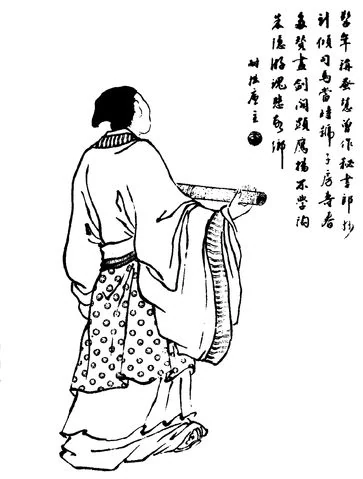
Biography
Family Background and Early Life
Zhong Hui came from the Zhong clan of Yingchuan and was the youngest son of Zhong Yao, Grand Tutor of Cao Wei. Zhong Yao was a founding statesman of Cao Wei who served Cao Cao, Cao Pi, and Cao Rui and became famous for his calligraphy. Zhong Hui's birth mother, Zhang Changpu, was a concubine of Zhong Yao from Zishi in Taiyuan and came from a respectable family with considerable learning. According to Zhong Hui's own *Biography of My Mother, Lady Zhang*, Zhang Changpu placed great emphasis on his education. Zhong began studying the *Classic of Filial Piety* at four, recited the *Analects* at seven, the *Book of Odes* at eight, the *Book of Documents* at ten, the *Book of Changes* at eleven, the *Zuo Commentary on the Spring and Autumn Annals* and *Discourses of the States* at twelve, the *Rites of Zhou* and *Book of Rites* at thirteen, his father Zhong Yao's *Notes on the Changes* at fourteen, and entered the Imperial Academy at fifteen. This systematic and demanding education laid the foundation for his later broad learning and mastery of metaphysical thought.
Zhong Hui was intelligent and quick from childhood and was regarded as extraordinary. When he was five, Zhong Yao took him to see Jiang Ji, then Central Protector of the Army. Jiang examined the boy's eyes and exclaimed, “He is no ordinary person.” (*Records of the Three Kingdoms*, Wei 28, “Biography of Zhong Hui”). As Zhong grew older he displayed talent in many arts, became widely learned, and especially excelled in metaphysical argument concerning names and principles. He studied day and night and acquired a strong reputation. Around age twenty he was ranked together with Wang Bi of Shanyang, both becoming leading figures in metaphysical discussion. Wang Bi delighted in discussing Confucian and Daoist thought, possessed brilliant argumentative ability, and wrote commentaries on the *Book of Changes* and *Laozi* before dying in his twenties; he was an important founder of Wei-Jin metaphysics. Zhong Hui's association with Wang Bi in reputation reflected the depth of his own learning.
Zhong Hui lived frugally. From youth he wore only ordinary plain-colored clothing in blue or dark indigo, personally managed household affairs, and conducted himself according to principles of respectfulness and thrift. These traits stood alongside his later skill in reading people and calculating political advantage.
Entry into Office and Service in the Sima Faction
In 244, the fifth year of Zhengshi, Zhong Hui began his career as Gentleman of the Palace Library. In 247 he was transferred to Gentleman of the Masters of Writing. Zhang Changpu took his hand and admonished him: “You have only just reached adulthood and are already promoted and employed. People easily become self-satisfied, and disaster is hidden within that. You must remember this warning.” In 249, the first year of Jiaping, Zhong became Vice Director of the Secretariat. That same year the Incident at the Gaoping Tombs occurred. Zhong accompanied the Wei emperor Cao Fang and General-in-Chief Cao Shuang outside the capital to Gaoping, while Sima Yi launched a coup inside the city. Everyone was frightened except Zhang Changpu, who calmly reasoned that Sima Yi's coup was aimed not at the state but at Cao Shuang's faction; because Sima's troops carried no baggage, the conflict would not last long, and Zhong Hui, being in attendance on the emperor, need not be feared for. Events later unfolded as she predicted.
After the Incident at the Gaoping Tombs, the Sima father and sons successively became the real controllers of Cao Wei. Zhong Hui won Sima Shi's appreciation early. According to Pei Songzhi's annotation to the *Records of the Three Kingdoms*, citing *Shiyu*, Sima Shi once ordered Secretariat Director Yu Song to draft a memorial. Yu repeatedly revised it but could not satisfy Sima Shi and was visibly distressed. Zhong perceived his anxiety, learned the reason, and changed five characters in the text. Yu was delighted and presented it again. When Sima Shi asked who had revised it, Yu named Zhong Hui. Sima Shi praised him and said, “If so, he can be put to great use; have him come.” Zhong asked Yu about Sima Shi's abilities, and Yu replied: “He is broadly learned and clear-sighted, and there is nothing he does not comprehend.” Zhong then cut off visitors and thought intensely for ten days before meeting Sima Shi, speaking with him from dawn until after the second drum. Sima Shi clapped his hands and exclaimed, “This truly is talent fit to assist a king!” Zhong thereafter became an important member of his staff.
In 254, the first year of Zhengyuan, Cao Mao, Duke of Gaogui District, ascended the throne and granted Zhong Hui the rank Marquis Within the Passes. Zhong privately assessed Cao Mao to Sima Shi: “His talent equals Chen Si [Cao Zhi], and his martial spirit resembles Taizu [Cao Cao].” The remark reflected both Zhong's observation of Cao Mao's abilities and his concern that the young ruler might act independently.
Suppression of the Huainan Rebellions
In 255, the second year of Zhengyuan, Guanqiu Jian and Wen Qin rebelled in Huainan. Sima Shi had just undergone surgery for an eye tumor and had not recovered. Most at court believed Grand Commandant Sima Fu could be sent to suppress the rebellion, but Fu Gu, Wang Su, and Zhong Hui alone strongly urged Sima Shi to command in person. Sima Shi therefore led a large army east, with Zhong Hui accompanying him and handling confidential affairs, while General of the Guards Sima Zhao brought up the main rear force. Sima Shi suddenly died at Xuchang, leaving Sima Zhao in command, with Zhong Hui helping plan the transition.
At this abrupt moment of transfer within the Sima family, the court sent an edict to Fu Gu, then serving among the Masters of Writing, ordering Sima Zhao to remain at Xuchang on the grounds that the southeast had only just been pacified, while Fu was to lead the army back to court. Emperor Cao Mao intended thereby to recover military control from the Sima family. Zhong Hui and Fu Gu secretly planned a response: Fu submitted a memorial and departed together with Sima Zhao, withdrawing to the south bank of the Luo River and encamping there. The court was forced to appoint Sima Zhao General-in-Chief and regent. Zhong Hui became Palace Attendant and was enfeoffed as Marquis of Dongwu Village with 300 households. This planning was a decisive step in Zhong's political career: he helped Sima Zhao defeat Cao Mao's attempt to recover military authority, consolidated Sima power, and established himself at the core of Sima Zhao's faction.
In 257, the second year of Ganlu, the court appointed Zhuge Dan Minister of Works and summoned him to the capital. Zhong Hui was then mourning his mother. He calculated that Zhuge Dan would refuse the summons and hurried on horseback to warn Sima Zhao. Sima Zhao believed the matter had already gone too far to reverse the appointment. Zhuge Dan subsequently rebelled and sought aid from Eastern Wu. Sima Zhao took the Wei emperor with him and personally led 260,000 troops on campaign, with Zhong Hui again accompanying him.
At the time, Quan Yi, son of the Eastern Wu Right Grand Marshal Quan Cong, together with Quan Jing, Quan Duan, Quan Pian, Quan Ji, and others, led 30,000 troops to aid Zhuge Dan. Quan Hui and Quan Yi, nephews of Quan Yi who had remained at Jianye, became involved in a legal case and crossed the Yangtze with their mother and several dozen retainers to surrender to Sima Zhao. Zhong devised a plan: he secretly drafted letters in the names of Quan Hui and Quan Yi and sent their relatives into the city to deliver them to Quan Yi, falsely saying that the Wu ruler was furious that Quan Yi and the others had failed to take Shouchun and intended to kill their families, which was why the two had fled north. Quan Yi and the others became frightened and opened the city to surrender. Those who surrendered were treated well, and morale among the Eastern Wu relief forces inside the city began to collapse.
After Shouchun was taken, Zhong Hui was credited with much of the planning, earning increasing favor from Sima Zhao, and contemporaries compared him to the Western Han strategist Zhang Liang. When the army returned, the court wished to promote Zhong to Minister of the Imperial Stud, one of the Nine Ministers, but he firmly refused. Instead, while holding a gentleman rank, he became recorder in the headquarters of the General-in-Chief, a position reserved for Sima Zhao's close confidants. For his role in defeating Zhuge Dan he was granted the title Marquis of Chen, which he repeatedly declined. Emperor Cao Mao issued an edict praising his refusal to claim credit: “Hui administered military affairs and participated in the plans, assessed the enemy and achieved victory, and has merit in strategy. Yet he repeatedly yields favor and firmly declines it; his words are sincere and substantial. Though rewards have been increased again and again, his resolve cannot be moved. The ancients valued accomplishing success without occupying it. Let Hui follow his determination, thereby completing his virtue.”
Colonel Director of Retainers and Political Struggles
After Emperor Cao Mao was killed in 260, the first year of Jingyuan, Zhong Hui probably succeeded Wang Xiang as Colonel Director of Retainers around late 260 or 261. Although the post was technically outside the central court, Zhong intervened in affairs large and small and in official appointments. The execution of the famous scholar Ji Kang and others resulted from Zhong's planning.
According to the *Book of Jin*, volume 49, Zhong told Sima Zhao: “Ji Kang is a sleeping dragon and must not be allowed to rise. My lord need not worry about the realm; Kang alone should concern you.” He further slandered him: “Kang once wished to assist Guanqiu Jian, but fortunately Shan Tao would not listen. In the past Qi executed Hua Shi and Lu put Shaozheng Mao to death precisely because they harmed their age and disrupted instruction, so sages and worthies removed them. Kang, Lü An, and the others speak wantonly, criticize established norms, and are men a ruler should not tolerate. They should be removed on the occasion of their offense, thereby purifying customs.” Sima Zhao accepted Zhong's argument and had Ji Kang and Lü An executed. Ji Kang's death became a major event in Chinese cultural history, and Zhong Hui, as one of its principal instigators, acquired a lasting reputation for blame.
While serving as Colonel Director of Retainers, however, Zhong also promoted Xiang Xiong, who had mourned Wang Jing and had been imprisoned, appointing him an administrative assistant under the office. This showed that Zhong's personnel decisions were not uniformly harsh.
Conquest of Shu, Rebellion, and Death
During the Jingyuan era, the Shu Han general Jiang Wei repeatedly harassed the frontier. Sima Zhao judged that Shu's territory was small, its people exhausted, and its resources near depletion, and wanted to launch a major invasion. Most ministers believed it could not succeed; Zhong Hui alone argued that Shu could be conquered. He therefore worked in advance with Sima Zhao on strategy, surveying terrain and discussing the military situation. In the winter of 262, the third year of Jingyuan, Zhong was appointed General Who Pacifies the West, Acting with the Imperial Tally, and commander of military affairs in Guanzhong.
In the autumn of 263, the fourth year of Jingyuan, Wei launched the invasion of Shu Han. Deng Ai led more than 30,000 men toward Gansong and Tazhong to pin down Jiang Wei; Zhuge Xu led more than 30,000 toward Wujie and Qiaotou to cut off Jiang Wei's retreat. Zhong Hui, the principal commander, led more than 100,000 troops advancing separately through Xie Valley and Luo Valley. He ordered his subordinate Xu Yi to go ahead repairing the road while he followed with the main army. When crossing a bridge, Zhong's horse stepped into a hole. Despite the distinguished service of Xu Yi's father Xu Chu, Zhong had Xu Yi executed. The armies were all shocked and fearful.
Shu Han had ordered the troops at its various defensive positions not to engage but to withdraw and hold the two cities of Han and Le. Zhong sent Protector of the Army Xun Kai and Former General Li Fu, each with 10,000 men, to surround Han and Le respectively. Zhong then moved west through Yang'an Pass, sent men to sacrifice at Zhuge Liang's tomb, and ordered soldiers not to graze horses or cut firewood nearby. He also sent Protector of the Army Hu Lie and others ahead to capture the fortified pass and seize the grain stored there. Jiang Wei withdrew from Tazhong and reached Yinping, where he deceived Zhuge Xu, who intended to cut off the Shu retreat. Jiang gathered troops and sought to fight back toward the fortified pass, but before arriving learned that it had fallen, so he withdrew to Baishui and joined Zhang Yi and Liao Hua in defending Jiange against Zhong Hui. Zhong issued the *Proclamation to the Generals, Officials, Soldiers, and People of Shu*, urging the people of Shu to surrender.
Deng Ai had pursued Jiang Wei to Yinping and proposed bypassing Jiange, entering Jiangyou through Hande and the Zuodan route, reaching Mianzhu, and advancing on Chengdu. He invited Zhuge Xu to join him on the Yinping route. Zhuge refused because he had received no orders to advance west and instead moved to Baishui to join Zhong Hui. Zhong wanted sole control of the army and secretly reported that Zhuge Xu had hesitated and failed to advance, causing Zhuge to be placed in a prison cart and sent back to the capital. Zhong thereby gained command of all the troops.
Shu forces held the natural defenses at Jiange and resisted to the death, and Zhong Hui's army could not capture the position. Deng Ai, however, crossed Yinping by a hidden route, made a surprise advance toward Chengdu, killed Zhuge Zhan at Mianzhu, and induced Liu Shan to surrender. Jiang Wei heard that Zhuge Zhan had been defeated and also received conflicting reports about Liu Shan, so he abandoned Jiange and led his army toward Chengdu. Zhong immediately advanced to Fu County and sent subordinates after Jiang. Liu Shan sent an envoy ordering Jiang Wei and the others to surrender to Zhong Hui, and after receiving the order Jiang submitted to him. Zhong then prohibited looting and harassment by his soldiers, treated former Shu officials favorably, and developed a relationship with Jiang Wei. Earlier, while in Hanzhong, Zhong had asked Jiang Bin, son of Jiang Wan, where Jiang Wan was buried in Fu County; he later went there and sacrificed at Jiang Wan's tomb.
In the twelfth lunar month, Emperor Cao Huan of Wei appointed Zhong Hui Minister of Education and promoted him to county marquis with an additional fief of 10,000 households; two of his sons were also enfeoffed as village marquises with 1,000 households each.
After Shu fell, Zhong secretly reported to Sima Zhao that Deng Ai was arrogant over his achievements and intended to rebel. Sima Zhao ordered Zhong to place Deng in a prison cart and send him back to court. Zhong then advanced to Chengdu. Supervising Army Officer Wei Guan went ahead with Sima Zhao's handwritten order for Deng Ai's soldiers; they laid down their weapons and Deng was placed in a prison cart. Zhong then received another letter from Sima Zhao, saying that he feared Zhong might be unable to subdue Deng and had therefore sent Central Protector of the Army Jia Chong with 10,000 infantry and cavalry through Xie Valley to camp at Lecheng, while Sima Zhao himself was leading 100,000 troops to Chang'an. Zhong immediately recognized that Sima Zhao had begun to suspect him, and this pushed him toward rebellion.
On the sixteenth day of the first lunar month in 264, the first year of Xianxi, Zhong Hui assembled Protectors of the Army, commandery administrators, and military officers of Cavalry Commandant of the Gate or higher, together with former Shu officials, in the Shu court to hold mourning rites for the recently deceased Empress Dowager Guo. He announced that he possessed a posthumous edict from the empress dowager ordering the destruction of Sima Zhao and confined the military officers in the city. Zhong appears initially to have planned for Jiang Wei to lead former Shu troops out through Xie Valley and seize Chang'an, then send cavalry overland and infantry by water routes to converge on Luoyang and reverse the political situation of the realm; another account says he intended simply to hold Shu. Protector of the Army Hu Lie used the transmission of food to contact his son outside the city and spread information that threw the outer armies into disorder. The *Book of Jin* also gives an account in which Supervising Army Officer Wei Guan feigned illness and went outside the city to contact the armies. On the eighteenth day of the first lunar month, troops suddenly surrounded and stormed the city. Zhong Hui, Jiang Wei, and a number of former Shu officials were killed in the fighting. Zhong was forty.
His Judgements during Mourning and the Division of Quan Yi
In 257 the court summoned Zhuge Dan to the capital as minister of works, and Zhong Hui, then at home in mourning for his mother, reckoned that Zhuge Dan would certainly refuse and rode to report it to Sima Zhao, who judged the matter already set in motion and would not reverse it; Zhuge Dan then rebelled and asked help of Wu. Sima Zhao took the emperor with him against him with two hundred and sixty thousand men, the imperial carriage halting at Xiang, and Zhong Hui went with him again to Shouchun. The Wu general Quan Cong was a close connexion by marriage of Sun Quan and a weighty minister, and his son Quan Yi, his grandson Quan Jing and his nephews Quan Duan, Quan Pian and Quan Ji all led troops to relieve Zhuge Dan; and Quan Yi's brother's sons Quan Hui and Quan Yi, remaining at Jianye, fell into litigation with the family, crossed the river with their mother and several dozen households of retainers and came over to Sima Zhao. Zhong Hui therefore proposed a plan, secretly writing letters in the names of Quan Hui and Quan Yi and sending them in by their trusted men to tell Quan Yi and the rest that Wu was enraged at their failure to take Shouchun and meant to put all the generals' families to death, so that the two had fled to submit; and Quan Yi and the others, in fear, opened the eastern gate with their troops and surrendered, all receiving titles and favour, "and by this the city was divided against itself." After Shouchun was taken Zhong Hui's plans had had the greater part in it, and his favour grew daily, "men of the time calling him their Zifang"; and when the army returned and the court would have made him grand coachman, he firmly refused, serving instead as a gentleman of the household in the general-in-chief's office in charge of the secretariat, a post of the inmost confidence. For his merit against Zhuge Dan he was given the rank of marquis of Chen and repeatedly declined it, whereupon the court issued an edict that he "has administered military affairs, shared in the plans, judged the enemy and won, and yet puts away favour and firmly declines," with words sincere and repeated, so that his will could not be taken from him, and that "to succeed and not take the place" was what the ancients valued; and it allowed him to hold to his own choice so as to perfect his excellence.
As Colonel of the Capital Province, the Case of Ji Kang, and the Preparations against Shu
Zhong Hui was then transferred to colonel of the capital province; and it is recorded that though in an outer office he "weighed the gains and losses of the government of the time, and nothing of the promotion and removal of the men of the day but he took part in it," that is, the successes and failures of court policy and the advancement or dismissal of men all passed through his hands. Of the killing of Ji Kang and others it is expressly said that "all was Zhong Hui's design": according to the Jin Shu, Zhong Hui told Sima Zhao that Ji Kang was a sleeping dragon and must not be roused, that he need not worry about the realm but should think of Ji Kang; and he added the slander that Ji Kang had wished to help Guanqiu Jian but that Shan Tao would not hear of it, and that as Qi had put Hua Shi to death and Lu Shao Zhengmao, because they harmed the times and disordered teaching, so should this man be removed when an occasion offered, to purify manners; and Sima Zhao, being fond of and trusting Zhong Hui, destroyed him as well. In the winter of 262, because the Shu-Han general Jiang Wei was constantly troubling the frontier and Sima Zhao reckoned the state small, its people weary and its resources nearly spent and wished to undertake the conquest of Shu on a great scale, all the ministers thought it impossible and Zhong Hui alone thought Shu could be taken, and having beforehand planned the strategy with Sima Zhao and surveyed the ground and weighed the situation, he was made general of the western garrison with the staff of authority and commander of military affairs in Guanzhong. In the autumn of 263 an edict had Deng Ai and Zhuge Xu each command more than thirty thousand men: Deng Ai towards Gansong and Tazhong to hold Jiang Wei, Zhuge Xu towards Wujie and Qiaotou to cut his retreat, while Zhong Hui with more than a hundred thousand entered by the Xiegu and Luogu valleys. Before marching he ordered the gate commander Xu Yi to repair the road ahead while he followed behind, and when a bridge broke and his horse's foot sank in, he had Xu Yi beheaded; Xu Yi was the son of Xu Chu and had done service to the royal house, yet was not spared, "and all the armies, hearing of it, were shaken with fear."
Hanzhong, the Jiange, and the Submission of Shu-Han
Shu-Han ordered its garrisons not to fight but to withdraw and hold the two cities of Han and Le; the Wei governor of Weixing, Liu Qin, moved by way of the Ziwu valley, the Wei armies marching on several roads reached Hanzhong, and the Shu inspector of the army Wang Han held Le city and the protector Jiang Bin held Han city, five thousand men each. Zhong Hui sent the protector Xun Kai and the general of the vanguard Li Fu with ten thousand men each, Xun Kai to besiege Han city and Li Fu Le city, while he himself passed straight on, going west out of the Yang'an pass and sending men to sacrifice at the tomb of Zhuge Liang; and sending the protector Hu Lie and others ahead, he took the pass city and got the stores of grain in its treasury. Jiang Wei, returning from Tazhong to Yinping, gathered his men to go to the pass city, but hearing before he arrived that it had fallen, he withdrew towards Baishui and joined the Shu generals Zhang Yi and Liao Hua in holding the Jiange against Zhong Hui. Deng Ai, following Jiang Wei to Yinping, wished to go round the Jiange by way of Handeyang into Jiangyou and the Zuo Dan road to Mianzhu and so towards Chengdu, and invited Zhuge Xu to go by the Yinping road with him; but Zhuge Xu refused on the ground that he had no order to move west and marched instead to join Zhong Hui; and Zhong Hui sent the general Tian Zhang and others west of the Jiange straight out to Jiangyou, and before they had gone a hundred li Tian Zhang broke three camps of Shu-Han's ambush and Deng Ai had him lead the way, driving straight on. After this Zhong Hui, wishing to have the whole command himself, secretly reported that Zhuge Xu had been cowardly and would not advance and had him brought back to the capital in a cage cart, "and the whole army was Zhong Hui's." Deng Ai reached Mianzhu, fought a great battle and cut off Zhuge Zhan; and Jiang Wei and the others, hearing that Zhuge Zhan was broken, led their men east into Ba, whereupon Zhong Hui advanced to Fu and sent Hu Lie, Tian Xu and Pang Hui in pursuit of Jiang Wei; while Deng Ai marched on Chengdu, where Liu Shan submitted to him and sent envoys ordering Jiang Wei and the rest to surrender to Zhong Hui. Jiang Wei, reaching Qixian in Guanghan, had his men lay down their arms and sent his credentials to Hu Lie, then came by the eastern road to submit to Zhong Hui. The Shu-Han protector Jiang Bin came to Fu to see Zhong Hui, who treated him with the courtesy of a friend, and going with him to Chengdu was killed by mutinous soldiers; his younger brother Jiang Xian, a servant of the heir, whose ability Zhong Hui also admired, died at the same time. Zhong Hui treated Jiang Wei and the others generously, restoring them for the time their seals, titles, credentials and canopies, and went out in the same carriage and sat on the same mat with him, telling his secretary Du Yu that compared with the famous men of the central plain, Zhuge Dan and Xiahou Xuan were not his betters. In the twelfth month an edict declared that wherever Zhong Hui turned he broke the enemy, that no strong foe stood before him, that he had sealed and held the many cities and netted the fugitives, that the chiefs of Shu had bound themselves and come to submit, that his plans left nothing undone and no enterprise of his failed, and made him minister of works, raised him to marquis of a county with ten thousand households and made two of his sons marquises of a pavilion with a thousand households each.
The Implication of Deng Ai, the Forged Edict, and the Mutiny at Chengdu
Zhong Hui already had other designs, and because Deng Ai acted on his own authority, he secretly reported that Deng Ai showed signs of rebellion, whereupon an edict ordered Deng Ai brought in a cage cart. Sima Zhao, fearing Deng Ai might not obey, ordered Zhong Hui to advance into Chengdu as well, with the army inspector Wei Guan going before him to proclaim and explain Sima Zhao's own written order to Deng Ai's troops, who all laid down their arms and let Deng Ai be taken into the cart. The only man Zhong Hui feared was Deng Ai, and Deng Ai being taken and Zhong Hui arriving soon after, he alone commanded the host and awed the west; and thinking his fame and merit unmatched in the world and that he could no longer be another's subordinate, with brave generals and keen troops all in his hand, he plotted rebellion. He meant to have Jiang Wei and the rest lead the Shu troops out by the Xiegu valley with himself following with the host; and reaching Chang'an, to send the horsemen by the land road and the foot by water down the Wei into the Yellow River, thinking to reach Mengjin in five days and join the horse at Luoyang, "and in a single morning the realm could be settled." Sima Zhao's letter said that fearing Deng Ai might not come when summoned, he had sent the protector of the centre Jia Chong with ten thousand foot and horse straight into the Xiegu valley to camp at Le city, and would himself camp at Chang'an with a hundred thousand, "and we shall meet before long." Zhong Hui, greatly alarmed at the letter, told his confidants that to take Deng Ai alone the chancellor knew he could do it by himself, but that now he was coming with so great a force he must have perceived something amiss, so that they must start at once; if it succeeded the realm was his, and if not he could fall back on Shu-Han and be at least a Liu Bei. On the fifteenth day of the first month of 264 Zhong Hui reached Chengdu and first sent Deng Ai away; on the sixteenth he summoned the protectors, commandery governors, gate commanders and cavalry inspectors and above, with the old officials of Shu-Han, and held mourning for the empress dowager Guo, mother of Emperor Ming of Wei, in the Shu-Han court hall, forging an edict of the empress dowager ordering Zhong Hui to raise troops and depose Sima Zhao, showing it to all who sat there and having them discuss it, writing out the appointments on tablets and having his own trusted men take command of the several armies. At that time the chancellor's left marshal Xiahou He, the cavalry section officer Zhu Fu, the centre army marshal's secretary Jia Fu and the gentleman of the interior Yang Xiu all held to their principles and refused his words, so that Zhong Hui had them shut up in the several government offices of Yizhou under guard, and kept Wei Guan by him for counsel, meaning to force a decision out of him, so that the two lay all night with their knives across their knees. Zhong Hui had a trusted officer of his camp, Qiu Jian, who had formerly been Hu Lie's and whom Hu Lie had recommended to Sima Zhao and Zhong Hui had asked along, holding him dear; and Qiu Jian, pitying Hu Lie in his confinement, asked Zhong Hui to let one of his own guards come out for food, and each of the gate commanders then had one man in by the same rule. Hu Lie took the chance to invent the tale, told to his guards and in a letter to his son, that Zhong Hui had dug a great pit and had several thousand white cudgels, meaning to call the outside troops in one by one and beat them to death in the pit; and the guards of the gate commanders repeated this among themselves, "and in one night it was told about and everywhere known," so that the soldiers longed for home and there was uproar within and without. Zhong Hui ordered Wei Guan to go and reassure the armies, and Wei Guan said that he was the master of the three armies and should go himself; Zhong Hui answered that Wei Guan was the inspector and should go first, and that he would come out after. Wei Guan left the hall, and Zhong Hui, repenting, sent to call him back; but Wei Guan pleaded a sudden dizziness and pretended to fall, and when he had got out of the gate and several dozen of his trusted men came after him, he reached the outer quarters and drank salt water and vomited violently, and being always frail, seemed at the point of death, so that Zhong Hui sent his own men and a physician to look at him and all reported he would not rise, "and by this Zhong Hui had no fear left." At dusk, when the gates were shut, Wei Guan issued a proclamation to the armies, which had already declared for the rightful cause, and at dawn they attacked Zhong Hui together. At midday on the eighteenth, Hu Lie's soldiers with his son Hu Yuan beat the drums and went out of the gate, and the several armies, without any summons, all went out with a clamour and raced for the city; and Zhong Hui, who had just then given Jiang Wei armour and weapons, heard the confused noise outside as of fire, and then a report that troops were moving on the city, and asked Jiang Wei in alarm what was to be done if the troops meant mischief, and Jiang Wei answered that they had only to strike at them. Zhong Hui sent troops to kill the imprisoned gate commanders and commandery governors, and those within propped the door with a frame and the soldiers hewed at it without breaking it; but after a moment the men outside climbed the wall by ladders, or burned the houses of the city, swarming up like ants, with arrows falling like rain, and the gate commanders and governors got out over the roofs and joined their own soldiers. Jiang Wei fought with Zhong Hui's attendants, killing five or six with his own hand, and the soldiers having cut him down pressed forward to kill Zhong Hui, who was then forty, with several hundred officers and men dying as well.