Birth in Tianshui
Born in Ji County, Tianshui; his father died heroically in battle, leaving him to be raised by his mother.
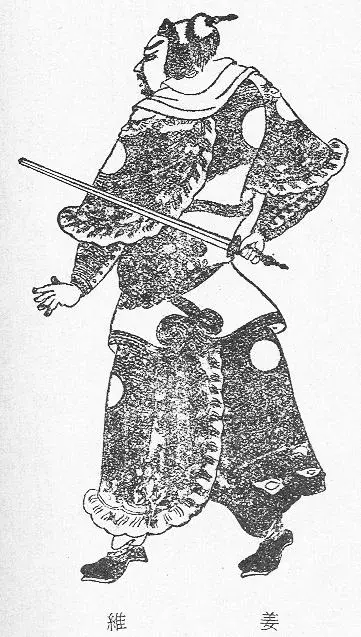
202 CE–264 CE
姜维
Jiang Wei (202–264 CE), courtesy name Boyue, was a native of Ji County in Tianshui (modern Gangu, Gansu). He was a celebrated military strategist, generalissimo, and supreme commander of the Shu Han state during the late Three Kingdoms period. Hailed as the chosen spiritual successor to Chancellor Zhuge Liang, he attained the highest imperial rank of Grand General, Manager of the Affairs of the Masters of Writing (supreme…
Jiang Wei (202–264 CE), courtesy name Boyue, was a native of Ji County in Tianshui (modern Gangu, Gansu). He was a celebrated military strategist, generalissimo, and supreme commander of the Shu Han state during the late Three Kingdoms period. Hailed as the chosen spiritual successor to Chancellor Zhuge Liang, he attained the highest imperial rank of Grand General, Manager of the Affairs of the Masters of Writing (supreme commander), and Marquis of Pingxiang. Originally an officer of Cao Wei in Tianshui, Jiang Wei was suspected of disloyalty by the local administrator during Zhuge Liang's First Northern Expedition in 228 CE and defected to Shu Han. Zhuge Liang recognized his rare military intellect, praising him as a "peerless talent of Liangzhou" and instructing him in strategic formations and the mechanical arts. Following Zhuge Liang's death, Jiang Wei rose through the military ranks, assuming supreme command of the army in 256 CE. Remaining dedicated to Zhuge Liang's vision of restoring the Han Dynasty, Jiang Wei conducted eleven campaigns against Cao Wei. At the Battle of the Tao River in 255 CE, he routed the Wei legions under Wang Jing, inflicting tens of thousands of casualties. In 263 CE, when Cao Wei mobilized eighteen legions to conquer Shu, Jiang Wei executed a masterful retreat to Jiange Pass, holding the mountain bastion against Zhong Hui's hundred-thousand-strong host. However, when Deng Ai crossed the treacherous Yinping mountains and forced Emperor Liu Shan's unconditional surrender at Chengdu, Jiang Wei received an imperial edict ordering total disarmament. Submitting formally to Zhong Hui, Jiang Wei secretly orchestrated a conspiracy to induce Zhong Hui to rebel against Wei, aiming to resurrect Shu Han. When the plot was exposed in March 264 CE, Jiang Wei fought to the death in combat at sixty-two years of age. Celebrated for his tragic heroism and unyielding loyalty, Jiang Wei remains an immortal symbol of devotion to a fallen state.
Born in Ji County, Tianshui; his father died heroically in battle, leaving him to be raised by his mother.
Suspected by the Wei administrator during the First Northern Expedition; surrendered to Zhuge Liang and won deep trust.
Maintained military order following Zhuge Liang's death at Wuzhang Plains; appointed General Who Supports the Han.
Stationed at Hanzhong; constrained by Fei Yi, who limited his expeditionary forces to fewer than ten thousand men.
Assumed total executive command of the expeditionary army following Fei Yi's assassination.
Shattered the Wei army under Wang Jing on the west bank of the Tao River, inflicting massive casualties.
Appointed Grand General and Manager of the Affairs of the Masters of Writing, launching regular campaigns into the north.
Relocated his headquarters to Tazhong to cultivate military grain and escape the slanders of eunuch Huang Hao.
Eluded encirclement to hold Jiange Pass against Zhong Hui; forced to surrender by imperial decree after Liu Shan abdicated.
Engineered a daring plot to use Zhong Hui to restore Shu Han; slain in the resulting military mutiny at age sixty-two.
Jiang Wei was born in Ji County, Tianshui Commandery, in the rugged northwestern marches of Liangzhou. His father, Jiang Jiong, served as Merit Officer in the commandery government and died valiantly in hand-to-hand combat suppressing a Qiang tribal revolt. Out of gratitude for his father's sacrifice, the imperial administration awarded the family an estate, where Jiang Wei lived in filial devotion with his widowed mother. In his youth, Jiang Wei read widely in classical philosophy, historical chronicles, and ancient military treatises, achieving equal mastery over letters and horse-archery. He entered the regional administration of Cao Wei as an Officer of Tianshui.
In the spring of 228 CE, Chancellor Zhuge Liang led the Shu Han legions on the First Northern Expedition, advancing through Qishan. The western commanderies of Nan'an, Tianshui, and Anding renounced Wei allegiance and declared for Shu. The Administrator of Tianshui, Ma Zun, was inspecting eastern border outposts accompanied by Jiang Wei. Panicked by rumors of imminent rebellion, Ma Zun suspected Jiang Wei of treason and fled in the night to Shanggui. When Jiang Wei arrived at Shanggui, the city gates were barred against him; returning to Ji County, local officials likewise refused entry. Abandoned and without recourse, Jiang Wei rode directly to Zhuge Liang's headquarters to surrender.
Meeting Jiang Wei, Zhuge Liang was astounded by the young officer's strategic acumen and moral integrity, exclaiming: "Jiang Boyue is diligent, profound, and exceptionally skilled in military matters; he is truly a peerless talent of Liangzhou!" Zhuge Liang immediately appointed him Granary Clerk, created him Marquis of Dangyang Pavilion, and wrote to chief ministers Zhang Yi and Jiang Wan in Chengdu: "Jiang Boyue is sharp in military theory, possessed of both courage and intellect, and deeply understands the spirit of warfare. I have placed five thousand elite shock troops under his command and will instruct him in all my tactical systems." Zhuge Liang passed on his military treatises, repeating crossbow designs, and Eight Formations tactics to Jiang Wei, grooming him as the primary guardian of the Shu Han state.
In 234 CE, Zhuge Liang died of exhaustion at Wuzhang Plains. Jiang Wei coordinated with chief secretary Yang Yi to conduct an orderly withdrawal, repelling Wei general Sima Yi's pursuit and safely escorting the chancellor's casket to Chengdu. Emperor Liu Shan appointed Jiang Wei Right Army Supervisor, General Who Supports the Han, and Marquis of Pingxiang.
During the subsequent administrations of Jiang Wan and Fei Yi, the court adopted a defensive posture aimed at domestic economic recovery. Fei Yi was particularly opposed to offensive expeditions. Whenever Jiang Wei proposed advancing across the border, Fei Yi restricted his force to no more than ten thousand men, admonishing him: "Neither you nor I possess the transcendent genius of Chancellor Zhuge. If the Chancellor could not conquer the central plains, how can we hope to do so? Our duty is to preserve our state and guard our borders, waiting for a heaven-sent opportunity!" Jiang Wei was forced to bide his time.
In 253 CE, Fei Yi was assassinated by a Wei defector during a New Year banquet. Free from domestic constraints, Jiang Wei assumed full military command. In 254 CE, he captured Didao and annexed Lintao.
In 255 CE, capitalizing on civil war in northern China following the Huainan rebellion, Jiang Wei launched a massive offensive alongside General of Chariots and Cavalry Xiahou Ba. The Wei Inspector of Yongzhou, Wang Jing, mobilized tens of thousands of infantry and cavalry to meet him on the western banks of the Tao River. Deploying a coordinated flanking maneuver against the riverbanks, Jiang Wei struck the enemy center. The Shu legions fought with desperate fury, crushing Wang Jing's host and slaying tens of thousands; fleeing soldiers drowned in the Tao River, and Wang Jing escaped with merely ten thousand survivors into Didao fortress. The victory shook the northern court, forcing Wei commanders Chen Tai and Deng Ai to mobilize northern reserves to lift the siege. The Triumph at the Tao River represented the greatest victory achieved by Shu Han since Zhuge Liang's death. In 256 CE, Liu Shan elevated Jiang Wei to Grand General and Manager of the Affairs of the Masters of Writing.
However, during subsequent campaigns at Duangu, subordinate commander Hu Ji failed to arrive on schedule, enabling Deng Ai to inflict a severe defeat on Jiang Wei's vanguard. Demonstrating accountability, Jiang Wei submitted a memorial demoting himself to General of the Rear while retaining operational command. Over two decades, he launched eleven campaigns into the northwest, wearing down Wei frontier defenses despite vast disparities in national manpower.
In his final years, the court at Chengdu was corrupted by the scheming palace eunuch Huang Hao, who monopolized imperial patronage. Witnessing Huang Hao's subversive influence, Jiang Wei privately petitioned Liu Shan to execute the eunuch. Liu Shan dismissed the memorial, shielding his favorite. Huang Hao subsequently plotted with Right Senior General Yan Yu to strip Jiang Wei of his command. Aware of the danger of palace assassination, Jiang Wei led his main army into Tazhong (modern Gangu, Gansu) in 262 CE to conduct agricultural garrisoning, cultivating grain for the troops while maintaining a forward defensive perimeter.
In the summer of 263 CE, Jiang Wei received intelligence that the Wei regent Sima Zhao was mobilizing vast armies for an invasion of Shu. Jiang Wei dispatched an urgent, top-secret dispatch to Chengdu, imploring the court to immediately deploy Liao Hua to Yinping Bridge and Zhang Yi to Yangping Pass to seal the mountain borders. However, Huang Hao consulted sorcerers who declared that no invasion would occur, and suppressed Jiang Wei's warning.
In the autumn of 263 CE, eighteen legions of Wei troops invaded across three fronts: Zhong Hui commanded one hundred thousand troops against Hanzhong, Deng Ai pinned down Jiang Wei at Tazhong with thirty thousand men, and Zhuge Xu severed the rear passes. Realizing the mortal peril, Jiang Wei executed brilliant tactical maneuvers, slipping past Deng Ai and feinting against Zhuge Xu to cross Yinping Bridge, falling back to Jiange Pass.
Jiange Pass was a formidable mountain bottleneck where soaring limestone cliffs formed a natural gate. Gathering forty thousand surviving soldiers, including formations under Liao Hua, Zhang Yi, and Dong Jue, Jiang Wei fortified the defiles. Zhong Hui deployed his hundred thousand troops in continuous assaults against the pass for months, suffering immense casualties without gaining an inch of ground. With provisions running dry across rugged mountain paths, Zhong Hui was preparing to order a full retreat to the north.
At that miraculous juncture, Wei general Deng Ai executed an unprecedented gamble: leading elite mountain troops across seven hundred li of uninhabited, vertical alpine wilderness through the Yinping passes, tumbling down cliffs wrapped in felt blankets. Deng Ai appeared unexpectedly before Jiangyou, routed imperial guards under Zhuge Zhan at Mianzhu, and marched to the gates of Chengdu. Paralyzed with terror and dominated by Huang Hao, Emperor Liu Shan unconditionally surrendered, sending imperial envoys to Jiange with an imperial decree ordering Jiang Wei's army to lay down their arms.
When the imperial edict was read at Jiange, the battle-hardened soldiers wept aloud in rage and despair, drawing their swords to slash at the mountain boulders until their blades shattered. Bound by absolute loyalty to the throne, Jiang Wei yielded to the decree, riding to Zhong Hui's headquarters at Fu County to surrender his weapons.
Yet even in defeat, Jiang Wei refused to surrender his sovereign purpose. Observing that Zhong Hui commanded immense legions, was arrogant, and harbored deep jealousy of Deng Ai, Jiang Wei resolved to execute a stunning counterplot. He secretly dispatched an operative with a letter to Liu Shan: "I pray Your Majesty will endure a few days of humiliation; I intend to make the endangered state secure once more, and cause the darkened sun and moon to shine brightly again!"
Jiang Wei cultivated an intimate bond with Zhong Hui, flattering his intellect and convincing him to frame Deng Ai for treason. After Sima Zhao ordered Deng Ai's arrest, Zhong Hui seized control of Chengdu and declared himself Governor of Yi Province, intending to carve out an independent empire. Jiang Wei urged him to purge all Wei military officers. However, on March 3, 264 CE, terrified Wei officers launched an armed uprising, storming the palace. Zhong Hui was slain in the initial fighting. Drawing his sword, Jiang Wei fought alone against overwhelming numbers, killing several enemy soldiers before being cut down by spears, dying at sixty-two years of age. When soldiers cut open his body, they found his gall bladder was "as large as an egg," terrifying his killers. Jiang Wei's tragic attempt to restore his fallen dynasty through sheer intellectual daring remains an immortal testament to sacrificial loyalty.
Surrendering during the 228 CE campaign, Jiang Wei earned Zhuge Liang's total trust, mastering his secret military treatises, defensive formations, and repeating crossbow designs to become the martial protector of the state.
In 255 CE, Jiang Wei outmaneuvered the Wei army under Wang Jing on the west bank of the Tao River, achieving a massive tactical encirclement that crushed enemy legions and established the greatest victory of late Shu Han.
In 263 CE, facing an invasion of eighteen enemy legions, Jiang Wei concentrated forty thousand troops at the natural fortress of Jiange, repelling Zhong Hui's hundred-thousand-strong host and forcing the enemy to the brink of retreat.
Following the surrender of Chengdu, Jiang Wei orchestrated a daring political counterstroke to manipulate Zhong Hui into rebellion, sacrificing his life in combat to uphold his pledge to "make the endangered state secure once more."
FIGURES ASSOCIATED WITH THIS DYNASTY