About age thirty | Entered Shu with Liu Bei as a provincial secretary and later became magistrate of Guangdu.
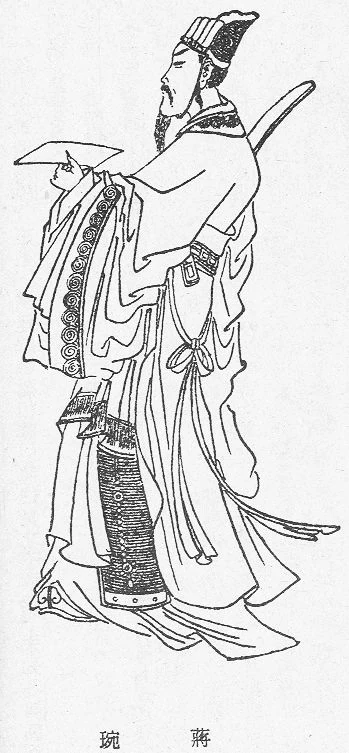
?–246 CE
Shu Han statesmanchief minister
Jiang Wan
蒋琬
Jiang Wan (d. 246), courtesy name Gongyan, was a native of Xiangxiang in Lingling Commandery, present-day Jingzi Town, Shuangfeng County, Loudi, Hunan. He was a leading official of Shu Han during the Three Kingdoms period and one of the “Four Chief Ministers” of Shu Han, together with Zhuge Liang, Fei Yi, and Dong Yun. Jiang Wan initially followed Liu Bei into Yi Province and became magistrate of Guangdu. His neglect of…
?–246 CEShu Han
PROFILE
Jiang Wan (d. 246), courtesy name Gongyan, was a native of Xiangxiang in Lingling Commandery, present-day Jingzi Town, Shuangfeng County, Loudi, Hunan. He was a leading official of Shu Han during the Three Kingdoms period and one of the “Four Chief Ministers” of Shu Han, together with Zhuge Liang, Fei Yi, and Dong Yun. Jiang Wan initially followed Liu Bei into Yi Province and became magistrate of Guangdu. His neglect of official affairs nearly led Liu Bei to execute him, but Zhuge Liang interceded and saved him. During Zhuge Liang's Northern Expeditions, Jiang Wan remained in Chengdu and managed rear-area affairs, supplying provisions and troops to the front. Before his death, Zhuge Liang submitted a confidential memorial to the Later Emperor Liu Shan designating Jiang Wan as his successor. After Zhuge Liang died, Jiang Wan became the leading administrator, serving as Director of the Imperial Secretariat, General-in-Chief, and Recorder of the Affairs of the Masters of Writing; he was created Marquis of Anyang Village and later promoted to Grand Marshal. During his administration he adopted a policy of resting the people rather than launching continuous campaigns. He adjusted Zhuge Liang's strategy of repeated northern expeditions and proposed advancing east down the Han River to attack Wei, but the plan was never carried out because of the recurrence of an old illness and opposition at court. Jiang Wan died in 246, the ninth year of Yanxi, and received the posthumous title Gong. During his tenure, Shu Han's borders remained secure and the state stayed internally united, making him an important stabilizing force in the later history of Shu Han.
- Other name
- Jiang Gongyan
- Courtesy name
- Gongyan
- Period
- Shu Han
- Date of Birth
- Not recorded in historical sources
- Date of Death
- 246
- Dynasty / polity
- Shu Han
- Identity
- Shu Han statesman; chief minister
- Ethnicity / group
- Not recorded in historical sources
- Native place
- Xiangxiang, Lingling Commandery (present-day Jingzi Town, Shuangfeng County, Loudi, Hunan)
- Place of birth
- Not recorded in historical sources
- Place of death
- Not recorded in historical sources
- Highest office
- See Biography and Major Activities
- Major achievements
- Named by Zhuge Liang as his successor; one of the “Four Chief Ministers” of Shu Han; advocated advancing east along the Han River against Wei.
LIFE TIMELINE
About age thirty-three | Because he neglected affairs and remained drunk, Liu Bei intended to punish him; Zhuge Liang interceded and Jiang Wan was dismissed instead.
About age thirty-four | Appointed magistrate of Shifang.
About age thirty-eight | When Liu Bei became King of Hanzhong, Jiang Wan entered the central government as a Gentleman of the Masters of Writing.
About age forty-two | When Zhuge Liang opened his administrative office, Jiang Wan was recruited as an assistant in the Eastern Bureau and nominated as a maocai; he repeatedly tried to yield the nomination and was later promoted to army adviser.
About age forty-six | Zhuge Liang stationed at Hanzhong; Jiang Wan and Zhang Yi remained behind to manage the affairs of the chancellor's office.
About age forty-nine | Succeeded Zhang Yi as chief clerk to the chancellor and was additionally appointed General Who Pacifies the Army, taking responsibility for provisions and manpower.
About age fifty-three | Zhuge Liang died; Jiang Wan became Director of the Imperial Secretariat, later received acting authority as Protector-General and Bearer of Credentials, concurrently served as Inspector of Yi Province, was promoted to General-in-Chief and Recorder of the Affairs of the Masters of Writing, and was created Marquis of Anyang Village.
About age fifty-seven | Ordered to open his own administrative office and led troops to Hanzhong, forming an east-west strategic relationship with Eastern Wu.
About age fifty-eight | Promoted to Grand Marshal; appointed Jiang Wei as his military aide and repeatedly sent him with detached forces west into Qiang territory.
About age sixty | Discussed grand strategy with Fei Yi and advocated advancing east along the Han River against Wei; an old illness recurred and many officials opposed the plan.
About age sixty-two | Memorialized that Jiang Wei should be Inspector of Liang Province while Jiang Wan himself stationed at Fu County; his illness worsened.
About age sixty-three | Because of illness, yielded the position of Inspector of Yi Province to Fei Yi.
About age sixty-five | Died in the eleventh lunar month and received the posthumous title Gong; buried at Fu County, present-day Mianyang, Sichuan.
BIOGRAPHY
Biography
Family Background and Early Years
Jiang Wan came from Xiangxiang in Lingling, present-day Shuangfeng County in Hunan. In youth he was studious, highly intelligent, dignified in appearance, and broad in bearing. Around the age of twenty he and his younger maternal cousin Liu Min were known locally for their learning. Liu Min later became a Shu Han general and rose to Left Protector of the Army and General Who Displays Might. Another cousin, Pan Jun, later served Eastern Wu and became Grand Ceremonial. Jiang Wan's own career in Shu Han began when he entered Shu with Liu Bei as a provincial secretary.
Early Service in Shu Han and the Guangdu Incident
After Liu Bei pacified Yi Province, he appointed Jiang Wan magistrate of Guangdu. Jiang Wan neglected administrative affairs and was often drunk. On one inspection Liu Bei reached Guangdu and saw that Jiang Wan had delayed official business through drunkenness. Enraged, Liu Bei intended to execute him. Zhuge Liang, then General of the Military Advisers, remonstrated: “Jiang Wan Shi SheJiZhiQi,Fei BaiLiZhi Cai,Wei ZhengYiAnMin Wei Ben,BuYiXiu Shi Wei Xian,Wang Zhu Gong Ming Cha。” Liu Bei had long respected Zhuge Liang and therefore spared Jiang Wan's life, though he removed him from office. Not long afterward, Jiang Wan was appointed magistrate of Shifang as a further test of his ability. In 219, when Liu Bei took the title King of Hanzhong, Jiang Wan entered the central administration as a Gentleman of the Masters of Writing.
Zhuge Liang's Trust and Rear-Area Administration
In 223, after Liu Shan became the Later Emperor, Chancellor Zhuge Liang opened his administrative office and recruited Jiang Wan as an assistant in the Eastern Bureau, also nominating him as a maocai. Jiang Wan modestly declined and repeatedly recommended Liu Yong, Yin Hua, Pang Yan, and Liao Chun instead. Zhuge Liang repeatedly encouraged him and explained in an official communication that avoiding worthy men merely because they were acquaintances would cause harm and misunderstanding; Jiang Wan should display his talent so that the fairness and care of the selection would be clear. Jiang Wan was later promoted to army adviser.
In 227, Zhuge Liang stationed at Hanzhong in preparation for the Northern Expeditions. Jiang Wan and Chief Clerk Zhang Yi remained in Chengdu and managed all affairs of the chancellor's office. In 230, Jiang Wan succeeded Zhang Yi as chief clerk and was additionally appointed General Who Pacifies the Army. Whenever Zhuge Liang campaigned, Jiang Wan regularly gathered grain, organized transport, and replenished troops, ensuring sufficient provisions and military manpower. Zhuge Liang repeatedly praised him, writing that “Gongyan entrusted to him weighty charge, and he should join with me in furthering the kingly enterprisealso,” and submitted a confidential memorial to Liu Shan stating: “Chen RuoBuXing,Hou ShiYiYiFuWan.” In 234, when Zhuge Liang became gravely ill at Wugong, Liu Shan sent Li Fu to visit him. Zhuge Liang clearly told Li Fu that after his death Jiang Wan could take charge of major affairs and that “Wen WeiKeYiJiZhi.”
Succeeding to Government and Stabilizing the Court
After Zhuge Liang's death, Wei Yan and Yang Yi fell into conflict and each memorialized that the other was in rebellion. Jiang Wan and Palace Attendant Dong Yun supported Yang Yi and distrusted Wei Yan. Jiang Wan led the palace guard units northward, but after traveling several dozen li learned that Wei Yan had already died and returned. Following Zhuge Liang's death, Jiang Wan was appointed Director of the Imperial Secretariat and soon received acting authority as Protector-General and Bearer of Credentials, concurrently became Inspector of Yi Province, and was then promoted to General-in-Chief and Recorder of the Affairs of the Masters of Writing, with the title Marquis of Anyang Village. Shu Han had just lost its principal commander and people near and far were alarmed, yet Jiang Wan showed neither grief-stricken appearance nor delight and conducted himself as usual; public confidence gradually settled on him.
As the leading administrator, Jiang Wan adopted a policy of closing the passes and allowing the people to recover rather than lightly beginning wars. In 238, Liu Shan ordered Jiang Wan to open his own administrative office, and the next year he was promoted to Grand Marshal. Jiang Wan led troops to Hanzhong, where Shu Han's forces formed a strategic east-west alignment with Eastern Wu and Wei did not dare attack. During this period he repeatedly ordered his military aide Jiang Wei to lead detached forces west into Qiang territory with Liang Province as the objective.
Strategic Adjustment and Later Years
Jiang Wan believed that Zhuge Liang's repeated campaigns into Qin-Chuan had suffered from difficult roads and transport and were unlikely to succeed. He instead proposed moving east by the Han and Mian rivers to strike Weixing and Shangyong commanderies. For this purpose he had large numbers of boats built, but a recurrence of an old illness prevented the campaign. Many court officials argued that if a river expedition failed, retreat would be difficult and that the plan was therefore unsound. The court sent Fei Yi, Jiang Wei, and others to Hanzhong to communicate its position. Jiang Wan then submitted a memorial proposing that Jiang Wei be appointed Inspector of Liang Province while he himself stationed at Fu County, a place with good water and land communications suitable for supporting operations. In 243 he moved to Fu County, where his illness worsened. In 244, because of illness, he firmly yielded the position of Inspector of Yi Province, and Liu Shan appointed Fei Yi instead. Jiang Wan died in the eleventh lunar month of 246, received the posthumous title Gong, and was buried at Fu County, present-day Mianyang in Sichuan, where his tomb remains preserved.
Jiang Wan, courtesy name Gongyan, was a native of Xiangxiang in Lingling. A student from youth, quick beyond his years and of striking bearing and presence, he was known in his twenties with his cousin Liu Min for his learning. He followed Liu Bei into Shu and was made magistrate of Guangdu. When Liu Bei and Zhuge Liang came on inspection they found the county's business neglected and Jiang Wan drunk; Liu Bei in anger would have punished him with death, but Zhuge Liang told him that Jiang Wan was a vessel for the altars of state and no talent for one small county, and Liu Bei contented himself with dismissing him.
He was afterward employed again. During Zhuge Liang's northern campaigns he remained in the rear directing supply and administration, his competence acknowledged by Zhuge Liang, who mentioned him in a confidential memorial to the throne as fit for great responsibility. On Zhuge Liang's death in 234 Jiang Wan became director of the Secretariat, conducting the state's daily business, and afterward general-in-chief and supervisor of Secretariat affairs, the actual ruler of Shu-Han.
His government was chiefly one of stability: he kept the institutions of Zhuge Liang's time, attending to lightening the people's burdens and maintaining the alliance with Wu. In military matters he proposed changing the route of the northern campaigns, going east by water to strike at Weixing and Shangyong, but the court held the road too difficult and hard to withdraw from, and the plan was not carried out. He then held Hanzhong and Fu city with Jiang Wei and others, keeping up the frontier.
He died in 246 with the posthumous name Gong. For more than ten years after Zhuge Liang's death he directed the state, keeping it comparatively steady under external pressure; his style of government, steady and prudent, followed on from Zhuge Liang's. Later discussions of Shu-Han's last decades generally name him with Fei Yi, Dong Yun and Jiang Wei as among the men who sustained the regime.
On taking office after Zhuge Liang's death his first problem was internal stability. The northern campaigns had drained Shu-Han, and opinions differed after his death, some urging recuperation and others a continuation of the campaigns. Jiang Wan took a middle course: keeping the alliance with Wu and the army in readiness on one hand, and lightening taxes and reassuring the people on the other, so that Shu-Han had no great internal trouble during his dozen years in power.
His plan to attack Wei by water was his most important military proposal: to go down the Han and Mian rivers against Weixing and Shangyong to open a new northern route. Fei Yi, Jiang Wei and others opposed it on the ground that a force going by water could not withdraw if it failed, and Jiang Wan accordingly moved to Fu city, adopted a steadier defensive posture and left Jiang Wei in charge of the northwest. The division kept the basic pattern of Shu-Han's later years.
Through the twenty-odd years in which Jiang Wan and Fei Yi governed, internal affairs were comparatively stable while the posture abroad was defensive. Jiang Wei's frequent campaigns afterward drained the state further, and it fell to Wei in 263. In the history of Shu-Han's last decades his period of government is the comparatively settled one, later ages speaking of it as the government of Jiang and Fei.
The histories call Jiang Wan generous and easy in temper: in office he did not readily punish subordinates and made much allowance for his colleagues' faults, a manner different from Zhuge Liang's strict application of the law. The political atmosphere of Shu-Han's later years was therefore comparatively relaxed, though it also loosened the court's grip on its commanders — Jiang Wei's repeated northern expeditions with little effective restraint from the court are one sign of that tendency.
His sons Jiang Bin and Jiang Xian held office in the later years and died in the disorders when the state fell. The Records of the Three Kingdoms gives him a biography in the same chapter as Fei Yi and Jiang Wei and preserves Zhuge Liang's judgment of him, material important for the study of Shu-Han's later politics. Later assessments generally name Jiang Wan, Fei Yi and Dong Yun with Zhuge Liang as the four chancellors who kept Shu-Han going for decades.
Shu-Han's institutions largely followed the Han, and after Zhuge Liang's death the offices of chancellor, director of the Secretariat and general-in-chief passed in succession to Jiang Wan and others, forming a sequence of rule. His passage from director of the Secretariat to general-in-chief and supervisor of Secretariat affairs is the key link in that sequence, and his manner of governing was carried on by Fei Yi and Jiang Wei.
The alliance with Wu was the pillar of Shu-Han's foreign relations in its later years. Under Jiang Wan the two kept up fairly steady embassies, having a common interest against Wei. The alliance lasted until Shu-Han's fall, with occasional friction but no rupture.
Under his government Shu-Han's finances and armament stayed within manageable limits. The northern campaigns were scaled down from Zhuge Liang's time, farming colonies and supply becoming the chief frontier business, and the garrisons at Hanzhong and Fu city were maintained for years, their management providing the basis for the state's later frontier defense.
After his death Fei Yi governed for several more years and then Jiang Wei took charge of military affairs, the state's posture turning to frequent northern campaigns that drained its strength. In 263 Wei armies attacked by several routes and Shu-Han fell within months, the lesson of it much discussed afterward.
His government under the last emperor also reflects a feature of Shu-Han politics: after Zhuge Liang the center of decision shifted from the chancellery to the Secretariat and the general-in-chief's office, the sovereign's own role remaining limited. Liu Shan reigned more than forty years, the government passing successively to Zhuge Liang, Jiang Wan, Fei Yi and Jiang Wei — an arrangement that let Shu-Han survive comparatively long among the three states.
The sources for Jiang Wan are chiefly his biography in the Shu chapters of the Records of the Three Kingdoms and such regional histories as the Chronicle of Huayang, with additions drawn from Pei Songzhi's commentary. Together they form the basis for present knowledge of him and of Shu-Han's late politics.
His government in Shu-Han's later years, together with the cooperation of Fei Yi and Dong Yun, kept the state comparatively steady after Zhuge Liang. No large northern campaign was launched in this period, frontier and internal affairs were broadly in order, and the alliance with Wu continued — factors that let Shu-Han hold out until 263.
After the state fell its old officials were mostly moved to Luoyang and Guanzhong, Jiang Wan's descendants among them. The history of Shu was afterward arranged in works such as the Chronicle of Huayang, and his career was preserved through them.
His place in Shu-Han forms with Zhuge Liang, Fei Yi and Dong Yun a continuous line of government, its completeness making Shu-Han the state whose political continuity is clearest among the three.
The internal and external stability of his government won Shu-Han a considerable stretch of time in the later Three Kingdoms, and the judgment of him in the Records of the Three Kingdoms answers to that record.
The institutions and personnel of Shu-Han's later years are fairly clearly traced in the Records of the Three Kingdoms, Jiang Wan's government being a key link in it.
His government is a case in Three Kingdoms political history of how a regime was kept running after its great chancellor: lacking Zhuge Liang's authority yet needing to reconcile the parties within the existing institutions, he sustained the state by steady administration and limited military action.
His posthumous name Gong matches his manner of governing, the Shu-Han court crediting him with steadiness.
The business of his government centered on keeping Shu-Han's internal order and its frontier defenses.
His government offers a concrete case of how a regime was sustained in the later Three Kingdoms.
He governed about twelve years, in which Shu-Han suffered no great internal trouble or foreign attack, owing much to the cooperation of the court's various parties after Zhuge Liang's death.
His government is a case often cited on the question of how a state in the Three Kingdoms period was kept going.
The manner and results of his government are confirmed favorably in the judgment of the Records of the Three Kingdoms.
His name stands with Zhuge Liang's and Fei Yi's in the sequence of Shu-Han's government.
His posthumous name Gong matches the steadiness of his government.
His government offers an analyzable sample of how a Three Kingdoms state was kept alive.
Major Activities
Political Contributions
After Jiang Wan succeeded Zhuge Liang, Shu Han passed through a period of uncertainty, but his calm and steady administration stabilized the court. He continued Zhuge Liang's established institutions while avoiding excessive warfare and adopted a policy of resting the people, allowing the economy to recover. Chen Shou described him as “Fang Zheng You Wei Zhong” and wrote of Jiang Wan and Fei Yi: “Xian Cheng ZhuGeZhi Cheng Gui,Yin XunErBuGe,ShiYiBian JingWuYu,Bang JiaHeYi.” Jiang Wan was also skilled in handling internal disputes. Yang Min once criticized him as incompetent in handling affairs, but Jiang Wan did not take offense. Later, when Yang Min was imprisoned for another matter, Jiang Wan did not seize the opportunity for revenge, demonstrating breadth and fairness.
Military Strategy
Jiang Wan changed Zhuge Liang's pattern of near-annual northern expeditions and advocated attacking Wei by moving east along the Han River. He believed that Zhuge Liang's campaigns into Qin-Chuan had been hampered by dangerous roads and difficult supply lines, and that use of river transport to strike Weixing and Shangyong offered a better option. He therefore had many boats built, but the plan was not implemented because of his recurring illness and opposition at court. Jiang Wan later shifted toward supporting Jiang Wei's operations in Liang Province and use of Qiang and other non-Han groups as allies in attempts to erode Wei power. His memorial proposing Jiang Wei as Inspector of Liang Province and his own stationing at Fu County reflected a flexible and pragmatic strategic approach, although it was never implemented on a large scale.
Personnel and Recommendation
While serving as assistant in the Eastern Bureau, Jiang Wan tried to yield his maocai nomination to Liu Yong, Yin Hua, Pang Yan, and Liao Chun, and Zhuge Liang urged him not to avoid selection out of concern for appearances. After becoming the leading administrator, Jiang Wan relied on Fei Yi, Dong Yun, Jiang Wei, and others, contributing to the later “Four Chief Ministers” order. He promoted capable men and yielded office when appropriate; in 244, because of illness, he gave up the post of Inspector of Yi Province to Fei Yi, for which Yuan Hong praised him as “Tui Xian GongJi.”
Literary and Scholarly Works
Jiang Wan was credited with a one-juan work titled Sangfu Yaoji, listed in the “Bibliographic Treatise” of the Book of Sui, as well as a one-juan Jiang Gonghou Ji included in the Lushan Jingshe Congshu. Complete Prose of the Three Kingdoms preserves writings attributed to him such as “Memorial Recommending Dong Yun” and “Memorial Submitted on Receiving the Command.”
Personal Relations
- Family: Younger maternal cousin Liu Min (Shu Han general), younger maternal cousin Pan Jun (Eastern Wu Grand Ceremonial), sons Jiang Bin, Jiang Xian, and Jiang Yi.
- Teachers and associates: Zhuge Liang (superior and sponsor), Fei Yi (colleague and successor), Dong Yun (colleague), Jiang Wei (subordinate), Yang Xi (subordinate).
- Rulers and subjects: Liu Bei (ruler, once intended to punish him), Liu Shan (ruler, trusted and relied upon him).
- Conflicts: Wei Yan (involved in the conflict with Yang Yi; Jiang Wan supported Yang Yi), Yang Min (once criticized Jiang Wan and was later treated leniently).
Historical Assessment
Shu Han and Contemporary Assessments
- Zhuge Liang: “Jiang Wan is a vessel of the state, not one of a hundred-li talent。” (Records of the Three Kingdoms, “Biography of Jiang Wan”)
- Zhuge Liang: “Gongyan entrusted to him weighty charge, and he should join with me in furthering the kingly enterprisealso。” (Records of the Three Kingdoms, “Biography of Jiang Wan”)
- Zhuge Liang: “Chen RuoBuXing,Hou ShiYiYiFuWan。” (Records of the Three Kingdoms, “Biography of Jiang Wan”)
- Chen Shou: “Jiang Wan was upright and grave, and Fei Yi broad-minded and kindly; they inherited Zhuge Liang's established institutions and followed them without change, and so the frontier was quiet and the state was at peace.” (Records of the Three Kingdoms, “Biographies of Jiang Wan, Fei Yi, and Jiang Wei”)
Jin and Northern-Southern Dynasties
- Yuan Hong: “His roots were firm and he did not forget uprightness; by agreement and without transgression he stood in the elegant conduct of the age; his benevolence accumulated and his merit assembled; in pushing forward the worthy he was reverent and respectful.” (Eulogy of Famous Ministers of the Three Kingdoms)
- Pei Songzhi: “Jiang and Fei were chancellors; they could uphold the splendour of the state and did not fall short in long service, though there were losses. Abroad they withheld the ambitions of the fallen state; at home they preserved the will for quiet and good order. Their wisdom was small and their strength weak: how could the state have escaped this?” (Annotations to the Records of the Three Kingdoms)
Song, Yuan, Ming, and Qing
- Wang Fuzhi criticized Jiang Wan's proposed river strategy as even less practical than Zhuge Liang's earlier approach. (Du Tongjian Lun, juan 10)
- Duanmu Cai wrote that among Shu Han's remaining figures, Zhao Yun stood out among veteran generals and Jiang Wan in internal administration. (Youbuweizhai Ji)
- Tang Peng contrasted Jiang Wan's poor performance as magistrate of Guangdu with the later acceptance of his leadership as General-in-Chief and Recorder of the Affairs of the Masters of Writing. (Fuqiuzi, juan 5)
Modern Assessments
- Historians such as Lü Simian have regarded Jiang Wan as a rare steady statesman of late Shu Han and considered his principle of placing the people's security first important to the state's stability.
- Modern scholarship generally affirms Jiang Wan's administrative ability and strategic willingness to adjust policy, while also criticizing his proposed eastward river campaign as impractical.
FIGURES ASSOCIATED WITH THIS DYNASTY
Bibliography
- Chen Shou, Records of the Three Kingdoms, Book of Shu, Biographies of Jiang Wan, Fei Yi and Jiang Wei
- Pei Songzhi, Annotated Records of the Three Kingdoms