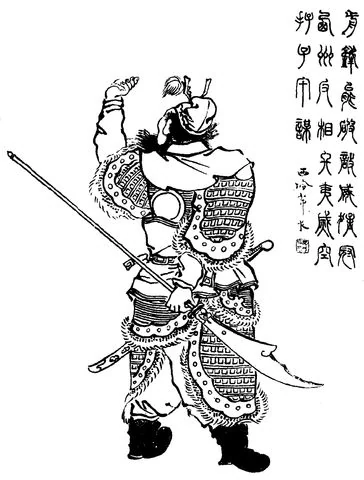
Later artistic depiction in a historical story illustration.

180 CE–234 CE

Noted general of Shu Han during the Three Kingdoms

Wei Yan

魏延

Wei Yan (died 234 AD), courtesy name Wenchang, was a native of Yiyang Commandery (around modern Tongbai or Nanyang, Henan Province). He was an illustrious commanding general and founding pillar of the Shu Han state during the Three Kingdoms period, renowned for his aggressive battlefield valor and superb command of troops. In 211, he accompanied Liu Bei into Yi Province with his personal retinue, rendering distinguished…

180 CE–234 CEShu Han

PROFILE

Wei Yan (died 234 AD), courtesy name Wenchang, was a native of Yiyang Commandery (around modern Tongbai or Nanyang, Henan Province). He was an illustrious commanding general and founding pillar of the Shu Han state during the Three Kingdoms period, renowned for his aggressive battlefield valor and superb command of troops. In 211, he accompanied Liu Bei into Yi Province with his personal retinue, rendering distinguished services and rising to Standard-Bearing General (Yamen Jiangjun). In 219, when Liu Bei assumed the title of King of Hanzhong, he broke standard protocol by elevating Wei Yan to General Who Pacifies Distant Lands and Grand Administrator of Hanzhong, entrusting him with the vital northern frontier for nearly a decade. Following the founding of Shu Han, he was promoted to General Who Pacifies the North, Front Military Adviser, and Senior General Who Conquers the West, granted Imperial Staff privileges and ennobled as the Marquis of Nanzheng. During Zhuge Liang's Northern Expeditions, he famously proposed the daring "Ziwu Valley Strategy," shattered the Wei army at Yangxi, and routed Sima Yi's legions at Lucheng. However, his unbending arrogance brought him into bitter conflict with Chief Clerk Yang Yi. Following Zhuge Liang's death at the Wuzhang Plains in 234, Wei Yan resisted withdrawal orders and clashed violently with Yang Yi, burning the mountain plank roads before being hunted down and executed by Ma Dai, leading to the extermination of his lineage.

Era
Ancient times
Dynasty
Ancient times
Identity
Noted general of Shu Han during the Three Kingdoms
Date of Birth
Not recorded in historical sources
Date of Death
234
Ethnicity
Han
Ancestral Home
Yiyang commandery of Jingzhou
Place of Birth
Yiyang commandery of Jingzhou
Place of Death
Unknown
Lifespan
Unknown
Peerage
Marquis of the Pavilion of the Capital, marquis of Nanzheng

LIFE TIMELINE

Entering Sichuan | Accompanied Liu Bei from Jingzhou into Sichuan withOpen

Entering Sichuan | Accompanied Liu Bei from Jingzhou into Sichuan with his private retainers, stationing at Jiameng Pass to guard against Zhang Lu

Conquest of Chengdu | Following the breach between Liu Bei and Liu ZhaOpen

Conquest of Chengdu | Following the breach between Liu Bei and Liu Zhang, marched alongside Huang Zhong and Zhuo Ying, capturing Fucheng and rising to Standard-Bearing General

Elevation to Command Hanzhong | Liu Bei claimed the title King of HanzOpen

Elevation to Command Hanzhong | Liu Bei claimed the title King of Hanzhong; to the universal astonishment of the army, he elevated Wei Yan to General Who Pacifies Distant Lands and Grand Administrator of Hanzhong

General Who Pacifies the North | Following Liu Bei's imperial accessioOpen

General Who Pacifies the North | Following Liu Bei's imperial accession, promoted to General Who Pacifies the North, anchoring the northern defenses

Ennobled as Marquis of Duting | Following the ascension of Emperor LiuOpen

Ennobled as Marquis of Duting | Following the ascension of Emperor Liu Shan, awarded the noble title of Marquis of Duting in recognition of founding merits

Chancellor's Marshal | As Zhuge Liang moved to Hanzhong for the NortheOpen

Chancellor's Marshal | As Zhuge Liang moved to Hanzhong for the Northern Expeditions, appointed Vanguard Commander, Chancellor's Marshal, and Inspector of Liangzhou

The Ziwu Valley Plan | During the first expedition, proposed leading fOpen

The Ziwu Valley Plan | During the first expedition, proposed leading five thousand shock troops through Ziwu Valley to seize Chang'an; Zhuge Liang rejected the plan as excessively precarious

Victory at Yangxi | Cao Wei launched a three-pronged invasion; Wei YanOpen

Victory at Yangxi | Cao Wei launched a three-pronged invasion; Wei Yan led a flying column deep into Qiang territory, routing Wei forces under Fei Yao and Guo Huai at Yangxi; promoted to Senior General Who Conquers the West, granted Imperial Staff, ennobled as Marquis of Nanzheng

Counterattack at Lucheng | During the fourth expedition, Sima Yi attacOpen

Counterattack at Lucheng | During the fourth expedition, Sima Yi attacked in force; Wei Yan counter-charged alongside Gao Xiang and Wu Ban, decapitating 3,000 elite troops and capturing 5,000 suits of armor

Impeachment of Li Yan | Following the expedition, signed second on theOpen

Impeachment of Li Yan | Following the expedition, signed second on the collective court memorial impeaching Central Military Controller Li Yan, outranking all frontline generals

Conflict with Liu Yan | General of Chariots and Cavalry Liu Yan clasheOpen

Conflict with Liu Yan | General of Chariots and Cavalry Liu Yan clashed with Wei Yan; Zhuge Liang reprimanded Liu Yan and ordered him back to Chengdu, confirming Wei Yan's indispensable status

Vanguard at Wuzhang Plains | Appointed vanguard during the fifth expedOpen

Vanguard at Wuzhang Plains | Appointed vanguard during the fifth expedition; dreamed of horns growing from his head, which diviner Zhao Zhi privately interpreted as an omen of execution

Death of Zhuge Liang | Zhuge Liang fell critically ill and secretly plOpen

Death of Zhuge Liang | Zhuge Liang fell critically ill and secretly planned the army's withdrawal; after his death, Yang Yi sent Fei Yi to probe Wei Yan, who demanded the campaign continue

BIOGRAPHY

Biography

Early Service and Rise under Liu Bei

Wei Yan was born in Yiyang Commandery, Jingzhou (modern Tongbai or Nanyang in Henan Province). In his youth, he immersed himself in military treatises, exhibiting exceptional physical prowess, tactical acumen, and fierce ambition. Contrary to the fictionalized portrayal in the *Romance of the Three Kingdoms*—which depicts him as a treacherous subordinate who assassinated Han Xuan—authentic historical records in the *Records of the Three Kingdoms* confirm that Wei Yan was a loyal, long-standing private retainer (Buqu) of Liu Bei. In 211, Liu Zhang, Governor of Yi Province, invited Liu Bei into Sichuan to counter the dual threats of Cao Cao and Zhang Lu. Wei Yan marched into the region as part of Liu Bei's inner corps, garrisoning the strategic northern outpost of Jiameng Pass. When open warfare erupted between Liu Bei and Liu Zhang in 212, Liu Bei executed the enemy garrison commanders at Baishui Pass and launched an offensive southward. Wei Yan, together with veteran general Huang Zhong and Zhuo Ying, spearheaded the advance columns, storming Fucheng and encircling Luocheng. During this campaign, Liu Bei commanded fewer than ten thousand troops deep within hostile territory, facing severe logistical strain against superior regional forces commanded by Liu Gui, Zhang Ren, and Wu Yi. Across two years of brutal sieges and mobile engagements, Wei Yan consistently charged at the head of his troops, capturing enemy redoubts and establishing a sterling record of tactical victories. When Chengdu surrendered in the summer of 214, Liu Bei rewarded his exceptional merits by promoting him to Standard-Bearing General (Yamen Jiangjun), an honor previously bestowed upon Zhao Yun following the Battle of Changban. ### Supreme Command at Hanzhong In 219, following the decisive victory over Xiahou Yuan at Mount Dingjun and the expulsion of Cao Cao's legions, Liu Bei secured full control of Hanzhong. Establishing his seat as King of Hanzhong at Mianyang, Liu Bei prepared to return to Chengdu to organize his central administration. Hanzhong was the strategic gateway to Sichuan: whoever held it controlled the mountain passes leading north to the Guanzhong plains while shielding the agricultural heartland of Shu. The selection of a commander for Hanzhong was the most consequential military appointment in the realm. The universal consensus among officers and statesmen was that the post would inevitably be given to Zhang Fei, who possessed unmatched seniority, prestige, and brotherhood ties with Liu Bei. Zhang Fei himself assumed the command was rightfully his. In a move that stunned the entire state, Liu Bei bypassed Zhang Fei and announced the appointment of Standard-Bearing General Wei Yan as Commander of Hanzhong, General Who Pacifies Distant Lands, and Grand Administrator of Hanzhong. Chen Shou described the court's reaction in the *Records of the Three Kingdoms* with four vivid words: "the entire army was shocked" . To establish the new commander's authority, Liu Bei convened a grand assembly of civil and military officials in Chengdu. Turning to Wei Yan before the gathering, Liu Bei asked: "Now that I have entrusted you with this supreme responsibility, what are your intentions in discharging your office?" Wei Yan stepped forward and proclaimed with resounding martial conviction: "If Cao Cao brings the entire empire against us, I beg leave to hold him off for Your Majesty; if a subordinate general arrives with a host of one hundred thousand, I beg leave to swallow him whole for Your Majesty!" This magnificent pledge dispelled all doubt, drawing enthusiastic praise from Liu Bei and winning the deep admiration of the assembled court. Historical events validated Liu Bei's strategic insight: Wei Yan governed and fortified Hanzhong for nearly a decade, pioneering the celebrated defensive doctrine of "Interlocking Fortresses" . By garrisoning the narrow mountain passes with mutually supporting defensive redoubts, Wei Yan turned Hanzhong into an impenetrable barrier against all northern incursions. ### Vanguard Commander of the Northern Expeditions Following Liu Bei's imperial proclamation in 221, Wei Yan was promoted to General Who Pacifies the North. When Liu Shan mounted the throne in 223, Wei Yan was ennobled as Marquis of Duting. In 227, Chancellor Zhuge Liang mobilized the Shu Han armies to Hanzhong to launch the Northern Expeditions against Cao Wei. Recognizing Wei Yan's unparalleled prestige and tactical mastery, Zhuge Liang appointed him Vanguard Commander, Chancellor's Marshal, and Inspector of Liangzhou, placing him at the helm of the field army. In the spring of 228, Zhuge Liang launched the First Northern Expedition toward Mount Qi. Popular opinion and senior commanders argued that seasoned veterans such as Wei Yan and Wu Yi should lead the forward armies. However, Zhuge Liang appointed his favorite protege, Ma Su, to command the vanguard at Jieting, resulting in a catastrophic tactical collapse that forced a general retreat. Although Wei Yan fought tenaciously to stabilize the rear, the campaign's strategic momentum was lost. In 230, Cao Wei mounted a massive counter-offensive led by Sima Yi, Cao Zhen, and Zhang He. As torrential rains paralyzed the enemy's logistical routes in the Qinling Mountains, Zhuge Liang ordered Wei Yan to lead a mobile detachment westward into Qiang territory to sever Wei's cavalry connections. Marching deep into enemy-held territory, Wei Yan engaged the combined forces of Wei Rear General Fei Yao and Governor of Yongzhou Guo Huai at the Battle of Yangxi. Despite being heavily outnumbered in unfamiliar terrain, Wei Yan executed a devastating frontal charge that routed the Wei formations. The Battle of Yangxi was one of the most brilliant tactical victories in Shu Han history. In recognition of this feat, the court elevated Wei Yan to Front Military Adviser and Senior General Who Conquers the West, granting him the Imperial Staff (Jiajie) and ennobling him as the Marquis of Nanzheng. ### The Battle of Lucheng and Domestic Preeminence In the spring of 231, Zhuge Liang embarked on his Fourth Northern Expedition, laying siege to the fortress of Mount Qi. Sima Yi marched west with the main imperial Wei army to relieve the siege. In May, Sima Yi ordered Zhang He to assault Wang Ping's southern defenses while personally leading the central column against Zhuge Liang's headquarters. Zhuge Liang deployed Front Military Adviser Wei Yan, Gao Xiang, and Wu Ban to meet Sima Yi's advance head-on. The two elite armies clashed in the brutal close-quarters engagement known as the Battle of Lucheng. Leading from the front, Wei Yan's shock infantry smashed through the Wei ranks, inflicting a crushing defeat. According to the *Chronicles of Han and Jin*, the Shu forces decapitated three thousand armored soldiers, seizing five thousand sets of iron armor and 3,100 heavy crossbows. Sima Yi retreated into his fortified camp and refused all further engagements, giving rise to the contemporary northern saying that Sima Yi "feared the Shu as if they were tigers." Following the army's return to Hanzhong, Zhuge Liang submitted a formal petition to depose and exile Central Military Controller Li Yan, who had fabricated military reports to conceal logistical failures. On this historic court document, Wei Yan's signature—"Subject Wei Yan, Acting with Imperial Staff, Front Military Adviser, Senior General Who Conquers the West, Inspector of Liangzhou, and Marquis of Nanzheng"—stood second only to General of Chariots and Cavalry Liu Yan, outranking all other military commanders. In 232, Liu Yan clashed with Wei Yan and uttered slanderous accusations against him in the field. Zhuge Liang intervened decisively, harshly censuring Liu Yan and expelling him back to Chengdu while preserving Wei Yan's frontline authority. This incident underscored Zhuge Liang's reliance on Wei Yan's martial capabilities for the continuation of the northern war. ### The Ziwu Valley Plan and Factional Enmity As a field commander endowed with aggressive strategic vision, Wei Yan advocated bold operational maneuvers. According to the *Records of the Three Kingdoms*, "Whenever Wei Yan accompanied Zhuge Liang on campaign, he invariably requested a separate command of ten thousand troops, planning to take an alternative route and rendezvous with Zhuge Liang at Tong Pass, emulating the precedent of Han Xin." The most celebrated manifestation of this vision was the "Ziwu Valley Strategy" , proposed prior to the First Northern Expedition. Noting that the Wei commander defending Chang'an, Xiahou Mao, was young, inexperienced, and cowardly, Wei Yan proposed leading five thousand picked shock troops and five thousand supply-bearers through the tortuous Ziwu Valley. He calculated that his forces could emerge at Chang'an within ten days. Xiahou Mao, seized by panic, would abandon the city, allowing Shu to capture the imperial grain depots and hold Tong Pass until Zhuge Liang's main army advanced through the Xie Valley, thereby "securing everything west of Xianyang in a single stroke." However, Zhuge Liang's strategic philosophy was anchored in methodological prudence, aiming for the methodical subjugation of Longyou rather than high-risk gambles. Fearing that the narrow defiles of Ziwu Valley invited ambush and total annihilation, Zhuge Liang rejected the plan. Wei Yan bitterly resented this caution, privately grumbling that the Chancellor was excessively timid and lamented that his own genius was tragically constrained. Far more perilous than operational disagreements was Wei Yan's virulent feud with Chief Clerk Yang Yi. Wei Yan was renowned for being "attentive to his troops and immensely valiant, yet exceedingly proud and arrogant," leading contemporary courtiers to treat him with cautious deference. Only Yang Yi, an equally capable yet intensely vindictive bureaucrat, treated Wei Yan with open disdain. The two men loathed one another. During heated confrontations, Wei Yan frequently drew his sword and brandished it in Yang Yi's face, leaving the terrified clerk weeping in humiliation. Zhuge Liang valued Yang Yi's logistical administrative brilliance while relying upon Wei Yan's battlefield leadership, refusing to discard either. He even composed the philosophical essay *Discourse on Sweet and Sour* to urge reconciliation, yet both men remained obdurate. Only the tireless diplomatic mediation of Army Protector Fei Yi maintained a fragile truce between them during Zhuge Liang's lifetime. ### The Five Wuzhang Plains Crisis and Seditious Retreat In the spring of 234, Zhuge Liang launched his Fifth Northern Expedition, establishing base camps on the Wuzhang Plains south of the Wei River. Wei Yan once again led the vanguard. Ten li outside camp, Wei Yan dreamed that two horns sprouted from his head. He consulted the diviner Zhao Zhi, who flatteringly claimed that like the horns of an auspicious qilin, this signified that the enemy would collapse without battle. In private, however, Zhao Zhi warned his confidants: "The character for 'horn' consists of 'knife' above 'use' ; to have a knife used upon one's head portends ultimate calamity!" In August of that year, Zhuge Liang's health failed. On his deathbed, the Chancellor summoned Yang Yi, Fei Yi, and Jiang Wei, secretly dictating withdrawal instructions: "Order Wei Yan to command the rearguard, with Jiang Wei next; if Wei Yan refuses to comply, the divisions shall depart on their own." This deathbed decree effectively stripped the senior field general of supreme authority and placed control of the army in the hands of his mortal enemy, Yang Yi. Following Zhuge Liang's death, the camp kept his passing confidential. Yang Yi dispatched Fei Yi to probe Wei Yan's intentions. Wei Yan reacted with typical martial obstinacy, declaring: "Though the Chancellor has perished, I am still alive! Let the household officers and personal attendants escort his funeral cortege back to Chengdu, while I lead the grand army forward to destroy the enemy! How can the great enterprise of the realm be abandoned on account of one man's death? Furthermore, who is Wei Yan to take orders from Yang Yi and serve as his rearguard commander!" Wei Yan drew up alternative mobilization orders and demanded that Fei Yi co-sign them. Fei Yi feigned compliance, claiming he would return to the main camp to persuade Yang Yi, only to mount his horse and gallop away the moment he cleared the gates. Wei Yan realized he had been duped, but pursuit was impossible. When Wei Yan's scouts confirmed that the main divisions were packing camp and retreating toward Sichuan in accordance with Zhuge Liang's plan, he flew into an uncontrollable rage. Determining to assert control by force, Wei Yan marched his vanguard south at breakneck speed, burning and destroying every mountain plank gallery (Zhandao) in his wake to block Yang Yi's retreat. Both commanders dispatched urgent couriers to Chengdu, each accusing the other of open rebellion. Emperor Liu Shan consulted Imperial Attendant Dong Yun and Chief Clerk Jiang Wan. Given Wei Yan's volatile temperament, both statesmen vouched for Yang Yi and suspected Wei Yan. Jiang Wan mobilized imperial guard units and marched north to suppress the expected insurrection. ### The Final Stand and Tragic Legacy Confronting the severed plank roads, Yang Yi's army worked around the clock, felling trees to bridge the gorges and marching relentlessly behind Wei Yan's rear. Reaching the southern entrance of the mountain valley, Wei Yan entrenched his forces to intercept Yang Yi's approaching columns. At this decisive juncture, Yang Yi ordered the veteran general Wang Ping forward. Riding out before the lines, Wang Ping pointed his whip at Wei Yan's troops and shouted: "The Chancellor's corpse is not yet cold; how dare you scoundrels behave in this manner after all the favors he bestowed upon you!" Wang Ping's rebuke struck home. The soldiers, deeply loyal to Zhuge Liang's memory and recognizing that Wei Yan was the aggressor in this internal feud, refused to fight their brethren. In an instant, Wei Yan's army melted away into the surrounding hills. Abandoned by his troops, Wei Yan fled toward Hanzhong accompanied only by his sons. Yang Yi dispatched General Ma Dai with picked cavalry in pursuit. Ma Dai overtook the fugitives on the road, decapitated Wei Yan, and delivered his head to Yang Yi. In an infamous display of petty vengeance, Yang Yi sprang from his seat, trampled the severed head with his boot, and sneered: "Worthless slave! Can you ever commit evil again?" Subsequently, Yang Yi ordered the complete extermination of Wei Yan's three ancestral lineages. Assessing Wei Yan's tragic end, Chen Shou delivered an objective verdict in the *Records of the Three Kingdoms*: "Wei Yan's intention was not to defect north to Wei, but to march south to eliminate Yang Yi and his rivals... He hoped that contemporary court opinion would designate him as Zhuge Liang's successor. Such was his true design; he had no thought of treason." Wei Yan remained a loyal servant of Shu Han; his violent destruction was the tragic culmination of excessive pride, political ineptitude, and an irreconcilable personal feud in an embattled frontier state.

Major Activities

1. Defending Hanzhong through Interlocking Fortresses

Following his elevation to General Who Pacifies Distant Lands and Grand Administrator of Hanzhong in 219, Wei Yan implemented the innovative military doctrine of "Interlocking Fortresses" . By fortifying key mountain passes along the Qinling frontier with self-sufficient garrison posts, he turned Hanzhong into an impregnable bastion, shielding Shu Han from northern invasion for nearly a decade and justifying Liu Bei's bold decision to bypass Zhang Fei. ### 2. The Crushing Victory at the Battle of Yangxi In 230, as Cao Wei launched a coordinated three-pronged invasion of Sichuan, Wei Yan executed a brilliant counter-stroke by leading a detached mobile column deep into Qiang territory. Encountering the superior combined forces of Rear General Fei Yao and Governor of Yongzhou Guo Huai at Yangxi, Wei Yan delivered a decisive tactical defeat, securing one of the few open-field annihilation victories of the Northern Expeditions and earning promotion to Senior General Who Conquers the West and the noble title Marquis of Nanzheng. ### 3. Decisive Tactical Counterattack at Lucheng During the Fourth Northern Expedition in May 231, when Sima Yi launched a massive frontal assault against the Shu positions at Mount Qi, Wei Yan led the frontline shock troops alongside Gao Xiang and Wu Ban. Charging directly into the enemy formation, his assault routed the Wei legions, claiming 3,000 enemy heads, 5,000 sets of armor, and over 3,000 heavy crossbows, forcing Sima Yi to abandon active field combat for the remainder of the war. ### 4. Proposing the Ziwu Valley Strategic Conception Prior to the First Northern Expedition, Wei Yan formulated the daring "Ziwu Valley Strategy," proposing to march five thousand elite troops through the Qinling defiles to seize Chang'an by surprise within ten days, exploiting the incompetence of the Wei commander Xiahou Mao. Although rejected by Zhuge Liang in favor of a cautious, methodical advance through Longyou, the Ziwu Valley Plan has remained one of the most vigorously debated strategic concepts in Chinese military historiography for over eighteen centuries.

Personal Relations

  • Sovereigns: Liu Bei (Emperor Zhaolie, his primary imperial patron who elevated him from obscurity), Liu Shan (Emperor Houzhu)
  • Prime Minister / Superior: Zhuge Liang (Chancellor of Shu Han, who relied upon his martial genius while restraining his strategic adventurism)
  • Mortal Factional Adversary: Yang Yi (Chief Clerk of the Chancellor, whose bitter personal enmity triggered the fatal armed confrontation)
  • Comrades / Mediators: Fei Yi (Secretary to the Chancellor, who mediated their conflicts), Wang Ping (General who broke Wei Yan's troops at the southern valley), Jiang Wei (Army Protector, later General-in-Chief), Jiang Wan (Chief Clerk of the Imperial Office), Dong Yun (Imperial Attendant), Wu Yi (Senior General), Liu Yan (General of Chariots and Cavalry, who feuded with Wei Yan)
  • Cao Wei Counterparts / Adversaries: Sima Yi (Grand Commandant of Cao Wei), Guo Huai (Inspector of Yongzhou), Fei Yao (Rear General), Zhang He (Senior General of Chariots and Cavalry), Xiahou Mao (General Who Pacifies the West)
  • Executioner: Ma Dai (General Who Pacifies the North, who overtook and beheaded Wei Yan on Yang Yi's orders)

Historical Assessment

Evaluations by Contemporary and Jin Dynasty Historians

  • Liu Bei (Emperor Zhaolie of Shu Han): "The First Sovereign praised him, and the entire assembly marveled at his grand words."
  • Sun Quan (Emperor of Eastern Wu): "Yang Yi and Wei Yan are petty herd-boys; although they have rendered minor service to current affairs, once given office their influence cannot be lightly checked. If Zhuge Liang should pass away one day, disaster and chaos will surely ensue."
  • **Yang Xi (*Tributes to the Ministers of Ji-Han*)**: "Wenchang was unyielding and rough; answering his sovereign's summons in times of peril, he repelled foreign foes and preserved the frontier. Yet unable to harmonize with colleagues, he forgot duty and sowed chaos; his tragic end was indeed the product of his natural disposition."
  • **Chen Shou (*Records of the Three Kingdoms*)**: "Wei Yan was attentive to his troops and immensely valiant, yet exceedingly proud and arrogant, causing contemporaries to yield before him... Wei Yan was employed for his martial prowess; Yang Yi was distinguished for his administrative talent... Observing their conduct, both brought calamity upon themselves through their own flaws."
  • Chen Shou: "Wei Yan's true intent was not to defect north to Wei, but to march south to eliminate Yang Yi and his rivals, hoping that court consensus would make him Zhuge Liang's successor. Such was his design; he had no intention of treason."
  • **Chang Qu (*Chronicles of Huayang*)**: "Zhuge Liang relied upon Wei Yan's martial fury while valuing Yang Yi's logistical planning, unable to discard either; he composed the *Discourse on Sweet and Sour* to admonish them, yet neither responded... During Liang's life, each was used to his fullest capacity."
  • **Pei Songzi (*Annotations to Records of the Three Kingdoms*)**: "Viewed today, many regard Liang's rejection of Yan's plan as timidity. But in military movements, one must assess the enemy sovereign and his generals. Liang rejected Yan's plan because he respected the Wei ruler's wisdom and knew that men like Sima Yi could not be trifled with. Liang failed even in his methodical attempt to seize Longyou; how could he have gambled on luck to conquer everything west of Xianyang!" ### Commentaries by Later Scholars
  • Zhang Dan (Southern Song Scholar): "When wise rulers appoint generals and ministers, they do not select by mere seniority. Han Xin was not an old veteran; Ran Ju was not an established general; Lu Meng was not an ancient hero; and Wei Yan was not chosen for long-standing virtue. Enlightened rulers appoint men strictly according to their capacity to accomplish monumental tasks."
  • Wei Yuanzhong (Tang Dynasty Chancellor): "When Han appointed Han Xin, the whole army gasped in surprise; when Shu employed Wei Yan, the ministers grumbled in discontent. For the wealthy, virtue is easily achieved; for the humble, merit is bitterly won."
  • He Qufei (Song Dynasty Military Theorist): "On every campaign, Wei Yan asked for ten thousand troops to take an alternative route as an unconventional force (Qi). Zhuge Liang rejected him every time, causing Yan immense frustration. Zhuge Liang launched six expeditions and employed unconventional strategy only once, feigning an advance via Xie Valley while striking Mount Qi by surprise, causing three commanderies to surrender. Unconventional warfare cannot be neglected in arms!"
  • **Hong Mai (*Rongzhai Suibi*)**: "The historians claim Zhuge Liang rejected the plan because it was precarious, but this is untrue. The Master was a righteous warrior who disdained deceit and trickery. Leading hundreds of thousands, he advanced along the righteous path against the guilty, drumming his banners straight toward the Wei capital."
  • **Wang Fuzhi (*On the Comprehensive Mirror for Aid in Governance*)**: "Wei Yan's request to strike Chang'an via Ziwu Valley was conventional warfare (Zheng); Zhuge Liang's circuitous westward advance through Mount Qi was unconventional warfare (Qi). When Gaozu left the plank roads and emerged from Chencang, he took the Three Qins by surprise because their forces were dispersed; but Wei's situation was entirely different."

LOCAL NETWORK

Liu Bei↗Linked from this entry

Original note (Chinese): 刘备麾下大将,镇守汉中

Zhuge Liang↗Linked from this entry

Original note (Chinese): 蜀汉大将,诸葛亮北伐时的重要将领,诸葛亮死后被杀

Jiang Wan↗Linked from this entry

Original note (Chinese): 魏延与杨仪内讧,蒋琬保杨仪而疑魏延。

Liu Bei↗Related entry

Original note (Chinese): 刘备破格提拔魏延为汉中太守,魏延深受其知遇之恩

Zhuge Liang↗Related entry

Original note (Chinese): 诸葛亮重用魏延,但不用其子午谷奇谋,魏延常抱怨

Liu Shan↗Related entry

Original note (Chinese): 刘禅在魏延与杨仪之争中听信董允、蒋琬之言,怀疑魏延

Jiang Wei↗Related entry

Original note (Chinese): 姜维与魏延同为北伐将领,参与诸葛亮临终部署

Wu Ban↗Related entry

Original note (Chinese): 吴班与魏延在卤城之战中共同作战

Jiang Wan↗Related entry

Original note (Chinese): 蒋琬在魏延与杨仪之争中担保杨仪,怀疑魏延

Wu Ban↗Linked from this entry

Original note (Chinese): 建兴九年北伐同破司马懿

Dong Jue↗Linked from this entry

Original note (Chinese): 魏延为蜀汉镇北将军,与董厥同为义阳人

Shu Han↗Era association

Original note (Chinese): 古代;蜀汉

杨仪 · No matching entry available

魏延与杨仪势同水火,诸葛亮死后争权,魏延被杀

费祎 · No matching entry available

费祎常为魏延与杨仪调解,但在魏延之死中扮演关键角色

王平 · No matching entry available

王平在魏延与杨仪之争中率军抵御魏延,叱散其军

马岱 · No matching entry available

马岱奉杨仪之命追杀魏延并斩其首

刘琰 · No matching entry available

刘琰与魏延不和,被诸葛亮责让

高翔 · No matching entry available

高翔与魏延在卤城之战中共同作战

吴懿 · No matching entry available

吴懿与魏延一同西入羌中作战

董允 · No matching entry available

董允在魏延与杨仪之争中担保杨仪,怀疑魏延

CONTEMPORARIES

Bibliography

  • Chen Shou, *Records of the Three Kingdoms* (*Records of the Three Kingdoms*), Volume 40: "Shu Book 10: Biography of Wei Yan" (*Book of Shu*·)
  • Pei Songzi, *Annotations to Records of the Three Kingdoms* (*Annotated Records of the Three Kingdoms*), citing *Weilüe* and *Chronicles of Han and Jin*
  • Chang Qu, *Chronicles of Huayang* (*Records of Huayang*), Volumes 5 and 7
  • Ouyang Xiu and Song Qi, *New Book of Tang* (*New Book of Tang*), "Treatise on Military Affairs"