Birth in Eastern Palace
Born on the twelfth day of the sixth month in the Eastern Palace of Chang'an as the fifth son of Emperor Muzong.
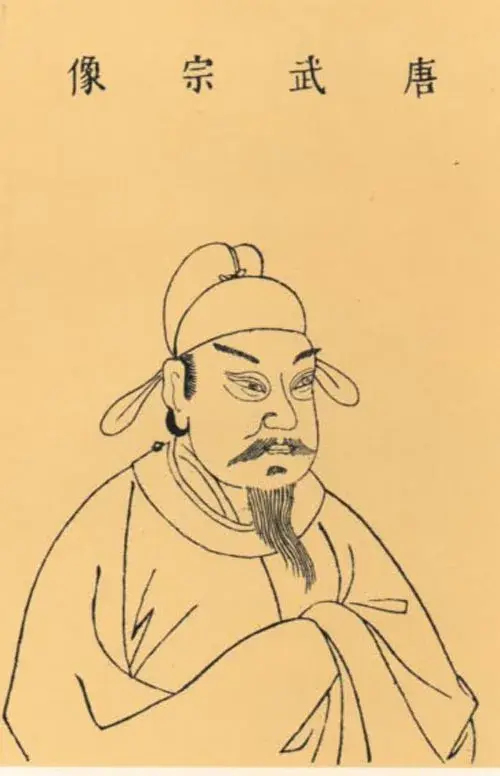
814 CE–846 CE
李炎
Li Yan (李炎, July 2, 814 – April 22, 846), originally named Li Chan (李瀍), ancestral home in Chengji, Longxi (present-day Qin'an, Gansu), was the fifth son of Emperor Muzong (Li Heng) and younger brother of Emperor Wenzong (Li Ang). He reigned as the sixteenth emperor of the Tang dynasty from 840 to 846, adopting the era name Huichang. In the first month of 840, amidst Emperor Wenzong's critical illness, the powerful eunuchs…
Li Yan (李炎, July 2, 814 – April 22, 846), originally named Li Chan (李瀍), ancestral home in Chengji, Longxi (present-day Qin'an, Gansu), was the fifth son of Emperor Muzong (Li Heng) and younger brother of Emperor Wenzong (Li Ang). He reigned as the sixteenth emperor of the Tang dynasty from 840 to 846, adopting the era name Huichang. In the first month of 840, amidst Emperor Wenzong's critical illness, the powerful eunuchs Qiu Shiliang and Yu Hongzhi forged imperial edicts to install him as Crown Younger Brother to oversee state affairs, following which he ascended the imperial throne. Unlike his predecessors who suffered under eunuch dominance, Li Yan displayed exceptional political resolve and administrative acumen. Refusing to become a puppet, he appointed the capable and resolute statesman Li Deyu as chief minister. Together, they purged corrupt factions, curtailed the political overreach of palace eunuchs, trimmed excessive bureaucratic posts, reformed imperial examinations, and enforced strict civil service evaluations, effectively revitalizing the central authority of the Tang court. In foreign defense and regional governance, Li Yan pursued assertive policies against rebellious warlords and nomadic incursions. When the fragmented Uyghur khaganate raided northern borderlands, Li Yan dispatched generals Liu Mian and Shi Xiong, who launched a decisive nighttime raid at Shahu Mountain in 843, routing the nomadic invaders and rescuing Princess Taihe, securing border peace for three decades. In 844, he decisively suppressed the insubordinate Zelu military governor Liu Zhen, shattering the tradition of hereditary warlord succession in central garrisons. Economically and religiously, Li Yan enacted the massive Huichang Suppression of Buddhism (known as the Great Anti-Buddhist Persecution), dismantling over forty thousand temples and shrines, forcing more than 260,000 monks and nuns to return to lay status, and returning tens of millions of acres of fertile temple estates to the taxable registry, which vastly alleviated the fiscal and manpower crises of the imperial state. However, his excessive devotion to Daoist immortality arts and prolonged consumption of toxic metallic alchemical elixirs led to his sudden collapse and death in 846 at the age of thirty-three. He was given the temple name Wuzong and interred in Duanling Mausoleum.
Born on the twelfth day of the sixth month in the Eastern Palace of Chang'an as the fifth son of Emperor Muzong.
Created Prince of Ying in the third month, later receiving honorary high civil offices under Emperor Wenzong.
Eunuch Qiu Shiliang forged edicts designating him Crown Younger Brother; formally ascended the throne upon Wenzong's death.
Appointed Li Deyu as chief minister in the ninth month, inaugurating a series of sweeping institutional reforms.
Changed era name to Huichang, issued strict edicts penalizing bureaucratic bribery and checking eunuch domination.
Generals Liu Mian and Shi Xiong routed nomadic forces at Shahu Mountain, welcoming back Princess Taihe and pacifying the frontier.
Marshaled imperial garrisons to crush rebellious warlord Liu Zhen across five prefectures, reasserting central supremacy.
Decreed the secularization of 260,000 Buddhist clergy and reclaimed thousands of monastic properties to replenish state finances.
Suffered severe poisoning from alchemical elixirs, changed personal name to Li Yan in the third month, and died at Daming Palace.
Li Yan was born in the Eastern Palace of Chang'an during the summer of 814. He grew up during an era marked by escalating eunuch dominance and intense factional strife between aristocratic bureaucrats and examination graduates. Enfeoffed as the Prince of Ying in 821, he remained relatively distant from the direct vortex of succession rivalries during the reigns of his brothers Emperor Jingzong and Emperor Wenzong, focusing instead on physical training, archery, equestrian sports, and Daoist health preservation practices.
Following the tragic failure of the Sweet Dew Incident in 835, Emperor Wenzong fell into deep depression and was virtually placed under house arrest by powerful palace eunuchs. The premature death of Crown Prince Li Yong in 838 created an acute succession vacuum. In early 840, as Wenzong lay dying, the eunuch commanders of the Shence Army, Qiu Shiliang and Yu Hongzhi, executed a preemptive palace coup. Disregarding Wenzong's deathbed decree favoring Prince Li Chengmei, they forged orders declaring Li Yan the Crown Younger Brother and installed him on the throne.
Upon ascending the imperial throne, Li Yan demonstrated that he was far from the pliable figurehead the eunuchs had anticipated. Recognizing the precarious nature of his legitimacy, he acted swiftly to eliminate rival claimants, ordering the executions of Consort Yang and Prince Li Rong, while consolidating his authority over palace guards and central administrative departments.
Understanding that counterbalancing eunuch usurpation required strong civilian leadership, Li Yan recalled the veteran statesman Li Deyu from his post as military governor of Huainan in the autumn of 840, entrusting him with the position of chief minister. Over the subsequent six years, Li Yan placed unreserved trust in Li Deyu, granting him comprehensive authority over civil appointments, administrative reform, and military campaigns.
Together, the emperor and his chief minister instituted rigorous measures to rehabilitate the central government. They reorganized the Secretariat and Chancellery, ensuring that major policy decisions originated from imperial conferences rather than the eunuch-dominated Northern Office. To eliminate widespread administrative indolence, Li Deyu dissolved redundant offices, discharging over two thousand unnecessary functionaries across the empire in 844 alone.
In personnel recruitment, Li Yan tightened the standards for imperial examinations to combat superficial rhetoric and factional nepotism. He simultaneously restricted hereditary privilege systems that allowed elite families to bypass regular screening, establishing a meritocratic baseline for provincial and metropolitan offices that significantly restored imperial prestige.
The Huichang era was confronted with formidable external and domestic military crises. In 840, the collapse of the northern steppe empire caused hundreds of thousands of nomadic Uyghurs to flee southward toward the Great Wall, launching pillaging raids into Hedong and Zhenwu frontier commanderies. Rather than appeasing the nomads with humiliating subsidies, Li Yan took a firm military stance.
In early 843, general Shi Xiong executed a brilliant nighttime assault against the encampment of the Uyghur khagan at Shahu Mountain. Imperial forces routed the nomadic host, captured significant spoils, and safely escorted Princess Taihe back to the imperial capital. This decisive victory eliminated nomadic threats along the northern frontier for over three decades and earned Tang vassals' renewed submission.
Concurrently, a dangerous rebellion erupted in the strategically vital Zelu garrison following the death of warlord Liu Congjian. Defying court authority, the warlord's nephew Liu Zhen unilaterally seized military control and demanded dynastic recognition. Supported by Li Deyu's steadfast strategy, Li Yan mobilized allied military governors from Weibo and Chengde to encircle Zelu. After an arduous multi-pronged campaign, imperial troops crushed the insurrection in 844, beheading the rebel leaders and demonstrating that the Tang dynasty still possessed the power to enforce territorial integrity.
By the mid-ninth century, the expansion of monastic institutions had exerted catastrophic pressures on imperial finances and demographic resources. Buddhist establishments held vast tax-exempt landed estates, accumulated enormous quantities of bronze and gold, and harbored millions of agricultural laborers who evaded state corvee obligations and military conscription.
Supported by Li Deyu and influenced by Daoist counselors, Li Yan launched a systematic campaign against institutional Buddhism from 842 to 845. The court prohibited unauthorized ordinations, shut down thousands of unregistered shrines, and confiscated illicit monastic properties. In the eighth month of 845, Li Yan issued a sweeping decree ordering the demolition of over 4,600 major monasteries and 40,000 local shrines throughout the realm.
The campaign forced more than 260,000 monks and nuns and over 150,000 temple dependents back into secular life as tax-paying citizens. Millions of fertile acres were redistributed to common farmers or absorbed into state registries, while bronze statues and bells were melted down to cast standard currency and agricultural implements. Although criticized by later religious chroniclers, this decisive action immediately replenished exhausted state coffers and restored substantial manpower to imperial armies.
Throughout his life, Li Yan harbored an intense fascination with Daoist longevity techniques and esoteric breathing arts. Following his accession, he invited notable Daoist masters such as Zhao Guizhen to conduct elaborate rituals in the imperial precincts and established sacred altars within the palace complex.
As military campaigns and administrative burdens intensified, Li Yan's health began to deteriorate in late 845. In pursuit of physical rejuvenation and immortality, he consumed large quantities of potent alchemical elixirs prepared by court Daoists. The toxic mercury and lead compounds contained in these pills severely damaged his nervous system, inducing violent mood swings, extreme irritability, and progressive physical debilitation.
In the third month of 846, believing in mystical elemental theories that fire would overcome sickness and fortify dynastic power, he formally changed his personal name from Li Chan to Li Yan. However, his condition rapidly degenerated into paralysis and speechlessness. On April 22, 846, Li Yan passed away in Daming Palace at the age of thirty-three. He was succeeded by his uncle Li Chen (Emperor Xuanzong), who reversed several religious policies while preserving the institutional stability achieved during the Huichang reign.
FIGURES ASSOCIATED WITH THIS DYNASTY