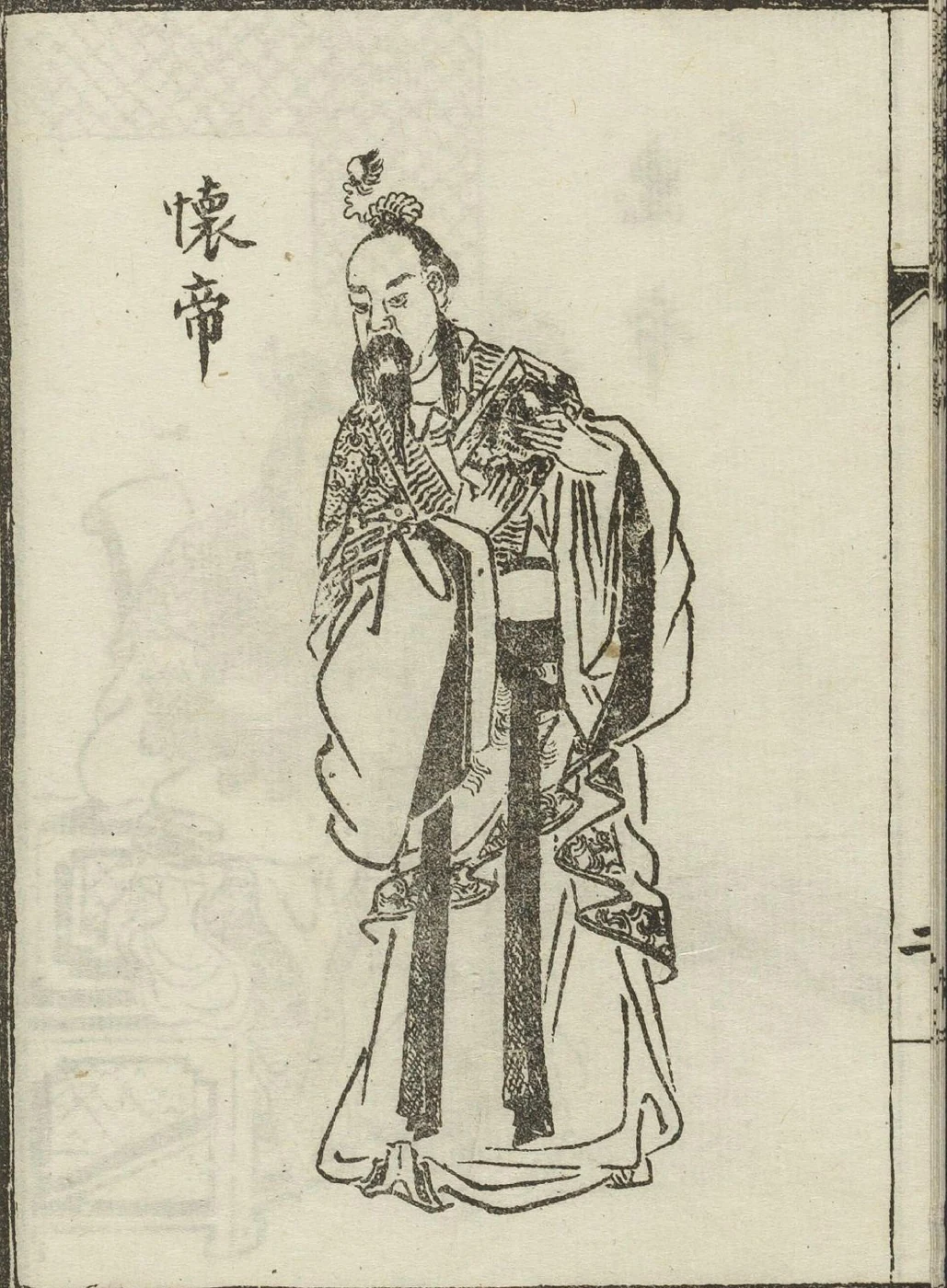
Later artistic depiction in a historical story illustration.
284 CE–313 CE
Emperor
Sima Chi
司马炽
Sima Chi (284–March 14, 313), courtesy name Fengdu, was a native of Wen County, Henei Commandery (present-day Wen County, Henan). He was the third emperor of the Western Jin, the twenty-fifth son of Emperor Wu of Jin, Sima Yan, and a younger half-brother of Emperor Hui of Jin, Sima Zhong. In 290, the first year of the Taixi era, he was enfeoffed as Prince of Yuzhang, and in 304, the first year of the Yongxing era, he was…
284 CE–313 CEFormer Zhao
PROFILE
Sima Chi (284–March 14, 313), courtesy name Fengdu, was a native of Wen County, Henei Commandery (present-day Wen County, Henan). He was the third emperor of the Western Jin, the twenty-fifth son of Emperor Wu of Jin, Sima Yan, and a younger half-brother of Emperor Hui of Jin, Sima Zhong. In 290, the first year of the Taixi era, he was enfeoffed as Prince of Yuzhang, and in 304, the first year of the Yongxing era, he was appointed Imperial Younger Brother and heir apparent. He ascended the throne on January 11, 307, corresponding to the twenty-first day of the eleventh month in the first year of Guangxi, and adopted the Yongjia era name; later generations called him Emperor Huai of Jin. In the sixth month of 311, the fifth year of Yongjia, troops of Liu Cong of Former Zhao captured Luoyang. Sima Chi was seized while attempting to flee, in the event known as the Disaster of Yongjia. After being taken to Pingyang, he was appointed Duke of Kuaiji Commandery. In the second month of 313, the first year of Jianxing, he was forced to wear a servant's blue robe and pour wine at a Former Zhao banquet. The sight caused former Jin officials to weep, angering Liu Cong, who had Sima Chi poisoned. He was thirty years old and received the posthumous title Emperor Xiaohuai.
Also known as
Emperor Huai of Jin
Courtesy name
Fengdu
Period
Former Zhao
Date of Birth
284
Date of Death
March 14 313
Dynasty/Polity
Former Zhao
Identity
Emperor
Ethnicity
Not recorded in historical sources
Ancestral home
Wen County, Henei Commandery (present-day Wen County, Henan)
Place of birth
Not recorded in historical sources
Reign
307–311
Predecessor
Emperor Hui of Jin (Sima Zhong)
Successor
Emperor Min of Jin (Sima Ye)
Era name
Not recorded in historical sources
Temple name
Not recorded in historical sources
Posthumous title
Emperor Xiaohuai
Main significance
Twenty-fifth son of Emperor Wu; captured by Liu Cong and taken to Pingyang during the Disaster of Yongjia, and later poisoned after being forced to serve wine in a servant's blue robe.
LIFE TIMELINE
Born | Born in Luoyang as the twenty-fifth son of Emperor Wu of Jin, SOpen
Born | Born in Luoyang as the twenty-fifth son of Emperor Wu of Jin, Sima Yan; his mother was Middle-ranked Talented Lady Wang Yuanji.
Age six | Enfeoffed as Prince of Yuzhang Commandery; in the fourth monOpen
Age six | Enfeoffed as Prince of Yuzhang Commandery; in the fourth month, Emperor Wu of Jin died and Crown Prince Sima Zhong succeeded as Emperor Hui of Jin.
Age seventeen | Sima Lun, Prince of Zhao, deposed Emperor Hui, and SimOpen
Age seventeen | Sima Lun, Prince of Zhao, deposed Emperor Hui, and Sima Chi was detained; in the fourth month Emperor Hui was restored, and Sima Chi became Colonel of the Archers Who Shoot at Sound.
Age seventeen | Successively promoted to General-in-Chief of Chariots Open
Age seventeen | Successively promoted to General-in-Chief of Chariots and Cavalry and Commander of Military Affairs in Qing Province.
Age twenty | Appointed General Who Guards the North and placed in commOpen
Age twenty | Appointed General Who Guards the North and placed in command of military affairs defending Ye; in the twelfth month he was appointed Imperial Younger Brother and heir apparent.
Age twenty-three | Emperor Hui of Jin died.Open
Age twenty-three | Emperor Hui of Jin died.
Age twenty-three | Ascended the imperial throne; honored Yang XianrongOpen
Age twenty-three | Ascended the imperial throne; honored Yang Xianrong as Empress Hui and posthumously honored his birth mother Wang Yuanji as Empress Dowager.
Age twenty-three | Changed the era name to Yongjia, proclaimed a generOpen
Age twenty-three | Changed the era name to Yongjia, proclaimed a general amnesty, and abolished punishment extending to three generations of a family; Sima Yue, Grand Tutor, served as regent.
Age twenty-seven | Secretly ordered Gou Xi to campaign against Sima YuOpen
Age twenty-seven | Secretly ordered Gou Xi to campaign against Sima Yue.
Age twenty-seven | Issued an edict publicly enumerating Sima Yue's criOpen
Age twenty-seven | Issued an edict publicly enumerating Sima Yue's crimes; Sima Yue died of illness.
Age twenty-seven | Wang Yan escorted Sima Yue's coffin back to his fieOpen
Age twenty-seven | Wang Yan escorted Sima Yue's coffin back to his fief but was annihilated by Shi Le at Ningping; the main Western Jin field army was destroyed.
Age twenty-seven | Liu Yao and Wang Mi captured Luoyang; Sima Chi was Open
Age twenty-seven | Liu Yao and Wang Mi captured Luoyang; Sima Chi was captured while fleeing, in the event known as the Disaster of Yongjia.
Age twenty-seven | Taken to Pingyang, where Liu Cong appointed him to Open
Age twenty-seven | Taken to Pingyang, where Liu Cong appointed him to a ceremonial office equivalent to the Three Excellencies and enfeoffed him as Duke of Kuaiji Commandery.
Age twenty-nine | At a Former Zhao banquet, forced to wear a servant'sOpen
Age twenty-nine | At a Former Zhao banquet, forced to wear a servant's blue robe and serve wine; Palace Attendant Yu Min and others wept, provoking Liu Cong's resentment.
Age thirty | Poisoned by Liu Cong at Pingyang; place of burial unknownOpen
Age thirty | Poisoned by Liu Cong at Pingyang; place of burial unknown.
BIOGRAPHY
Biography
Family Background and Early Years
Sima Chi was born in 284, the fifth year of the Taikang era. His father was Sima Yan, Emperor Wu of Jin and founder of the Western Jin, while his mother was Middle-ranked Talented Lady Wang Yuanji. Wang Yuanji died early, and Sima Chi was raised by Emperor Wu's second empress, Empress Wuyuan Yang Zhi. In 290, the first year of Taixi, the six-year-old Sima Chi was enfeoffed as Prince of Yuzhang Commandery. In the fourth month of the same year Emperor Wu died, and Crown Prince Sima Zhong succeeded as Emperor Hui of Jin.
During Emperor Hui's reign, the sixteen-year War of the Eight Princes broke out as imperial princes fought one another and the court fell into chronic instability. Sima Chi lived through the turmoil without becoming involved in the princes' struggle. According to the *Book of Jin*, he “kept himself pure and restrained, closed his gates to guests and social intercourse, did not involve himself in worldly affairs, and devoted himself to historical texts, thereby gaining a good reputation at the time.” He did not seek extensive social connections, avoided political entanglements, and concentrated on studying historical works. Sima Chi possessed no extraordinary political talent, but his modest, cautious, and low-profile character allowed him to survive the vortex of the War of the Eight Princes.
Years as an Imperial Prince
Sima Chi initially served as a Regular Mounted Attendant. In 301, the second year of Yongkang, Sima Lun, Prince of Zhao, deposed Emperor Hui of Jin and proclaimed himself emperor, and Sima Chi was also detained. In the fourth month of that year Sima Lun was defeated and killed and Emperor Hui was restored. The era name was changed to Yongning, and Sima Chi became Colonel of the Archers Who Shoot at Sound. He later rose successively to General-in-Chief of Chariots and Cavalry and Commander of Military Affairs in Qing Province. In 304, the first year of Yongxing, he became General Who Guards the North and commander of the forces defending Ye.
On the twenty-fourth day of the twelfth month that year, Sima Chi was appointed Imperial Younger Brother and heir apparent. This appointment did not arise from his own ambition for power; rather, it represented a political compromise amid the confrontation between Sima Ying, Prince of Chengdu, and Sima Yong, Prince of Hejian. At first Sima Chi did not dare accept, believing that his nephew Sima Tan, Prince of Qinghe, was a more suitable successor. Xi Su, Director of Documents, urged him to follow public expectations. Sima Chi compared Xi Su to Song Chang, the adviser of Emperor Wen of Han, and only then accepted the appointment.
On January 8, 307, corresponding to the eighteenth day of the eleventh month in the first year of Guangxi, Emperor Hui of Jin was poisoned; this was generally believed to have been the work of Sima Yue, Prince of Donghai. Empress Yang Xianrong believed that, because she was the elder sister-in-law of Sima Chi, then Imperial Younger Brother, ritual propriety prevented her from becoming empress dowager. She therefore urged Sima Tan, Prince of Qinghe, to come to the capital and assume the throne. Sima Tan had already reached the Secretariat offices when Palace Attendant Hua Hun and others urgently summoned Sima Chi to the palace. On the twenty-first day of the eleventh month (January 11, 307), Sima Chi ascended the throne as Emperor Huai of Jin. He honored Yang Xianrong as Empress Hui and placed her in Hongxun Palace, posthumously honored his birth mother Wang Yuanji as Empress Dowager, and made his consort Liang Lanbi empress.
In the following year Sima Chi adopted the Yongjia era name. Sima Yue, Grand Tutor, served as regent and for a long time held the real power of the court. Although Sima Chi was emperor, in practice he had little authority. After his accession he tried to restore established court practices, appeared in the Taiji Hall, had Secretariat gentlemen read seasonal ordinances, and heard government matters in the Eastern Hall. At banquets he often discussed administration and examined classical texts with officials, seeking to play an active role. Yet the Western Jin's accumulated problems were already severe. Sima Yue monopolized power, while the Xiongnu ruler Liu Yuan had founded the Former Zhao regime in the north, leaving the dynasty surrounded by internal and external crises.
The Disaster of Yongjia and Capture
In the first month of 311, the fifth year of Yongjia, Emperor Huai, unwilling to remain controlled by Sima Yue, secretly ordered Gou Xi, General-in-Chief Who Conquers the East, to campaign against him. In the third month the emperor issued a formal edict announcing Sima Yue's crimes and directing regional commanders to attack him. Sima Yue died of illness that same month, and Wang Yan was chosen as commander of the army. In the fourth month, Wang Yan led the army escorting Sima Yue's coffin back to his fief in Donghai. Near Ningping in Ku County, present-day Dancheng in Henan, the column encountered twenty thousand cavalry under Shi Le. Shi Le surrounded the Jin troops and subjected them to concentrated mounted archery. More than one hundred thousand soldiers and accompanying people trampled one another, and the force was annihilated. After being captured, Wang Yan tried to save his life by urging Shi Le to establish a state and proclaim himself emperor, but Shi Le nevertheless had him buried alive. The Western Jin's last major field army was completely destroyed.
In the sixth month of the same year, Liu Cong's commanders Liu Yao and Wang Mi entered Luoyang. Emperor Huai fled through a gate of Hualin Garden and attempted to reach Chang'an, but was overtaken and captured at Ouchi in Heyin. Liu Yao and the others burned palaces and ancestral temples, humiliated imperial consorts and empresses, and killed more than thirty thousand officials and commoners. Crown Prince Sima Quan was killed. The event is known as the Disaster of Yongjia.
Captivity at Pingyang and Death
Emperor Huai was taken to Pingyang, capital of Former Zhao. Liu Cong appointed him to a ceremonial office equivalent to the Three Excellencies and enfeoffed him as Duke of Kuaiji Commandery. At a banquet Liu Cong once recalled an earlier encounter between the two when Sima Chi was Prince of Yuzhang. Liu Cong said that he and Wang Ji had visited the prince, who had shown them Music Bureau songs for their appraisal, invited them to shoot arrows, and presented them with a cudgelwood bow and a silver inkstone. Sima Chi replied that he had not forgotten the occasion, but regretted that he had not recognized Liu Cong's imperial destiny earlier. Liu Cong asked why members of the Sima clan had slaughtered one another so viciously. Sima Chi answered that it had been Heaven's will: the Han state was destined to receive the mandate, and the Sima family had merely cleared itself away on behalf of the Liu clan. Liu Cong then gave Sima Chi a young Lady Liu, granddaughter of the prominent official Liu Yin, as a wife and granted her the title Lady of Kuaiji.
In the first month of 313, the first year of Jianxing, Liu Cong ordered Sima Chi to wear a servant's blue robe and pour wine for guests at a banquet. Blue clothing was associated with servants, and the act was intended as humiliation. Former Jin officials including Palace Attendant Yu Min saw this and wept aloud, deeply offending Liu Cong. Soon afterward, on the first day of the second month, March 14 in the Gregorian calendar, Liu Cong had Sima Chi poisoned. He was thirty years old. His burial place is unknown.
Major Activities
Political Measures
After Sima Chi's accession, on the first day of the first month in 307, the first year of Yongjia, he proclaimed a general amnesty and ordered the abolition of the severe punishment of exterminating three generations of an offender's family. This was one of the relatively few political measures associated with his reign and to some extent moderated the harsh legal environment inherited from Emperor Hui's period. By then, however, the Western Jin's crisis had become too deep to reverse. Sima Yue monopolized authority, and imperial orders had little force beyond Luoyang, so the practical effect of the decree was limited.
Sima Chi was unwilling to remain a puppet emperor. In the first month of 311 he secretly ordered Gou Xi to attack Sima Yue, and in the third month publicly issued an edict enumerating Sima Yue's crimes. This was his final attempt to resist Sima Yue's domination. The move, however, directly widened the break between Sima Yue's forces and the central court and accelerated the collapse of the Western Jin military position.
After Sima Chi ascended the throne, Grand Tutor Sima Yue controlled court government for an extended period. Sima Yue had dominated politics in the final phase of the War of the Eight Princes, and Emperor Hui's death was also suspected to have been his work. He placed Sima Chi on the throne in order to continue controlling the government. Although Sima Chi was modest by temperament, he was not entirely without independent views. Through classical lectures, audiences, and policy discussions he attempted gradually to restore imperial authority, but he was never able to escape Sima Yue's control. The secret order to attack Sima Yue in the fifth year of Yongjia marked the final rupture. After Sima Yue's death, his army was annihilated by Shi Le at Ningping, destroying the Western Jin's central military strength, and Luoyang fell soon afterward.
The Disaster of Yongjia
In the sixth month of 311, the fifth year of Yongjia, Liu Yao and Wang Mi captured Luoyang, a landmark event in the fall of the Western Jin. Emperor Huai was captured while fleeing, the Crown Prince was killed, more than thirty thousand members of the imperial clan, officials, and commoners died, and the palaces and temples of Luoyang were burned. Sima Chi was taken to Pingyang and became a prisoner of Former Zhao. The Disaster of Yongjia marked the end of effective Western Jin rule in the Central Plains. Although Emperor Min later maintained a remnant regime in Chang'an, the dynasty's overall position had already collapsed.
Humiliation and Death in Captivity
Sima Chi spent roughly a year and a half as a captive in Pingyang. Liu Cong treated him with outward courtesy, enfeoffing him as Duke of Kuaiji Commandery, giving him a wife from the Liu clan, and recalling old acquaintances at banquets, but in reality kept him as a trophy subject to humiliation and control. In the first month of 313 Liu Cong ordered Sima Chi to serve wine in a servant's blue robe, openly humiliating the former emperor. The weeping of Yu Min and other former Jin officials angered Liu Cong. He first executed Yu Min and the others and then had Sima Chi poisoned.
The course around his capture can be set out by year: in the third month of 311 (fifth year of Yongjia), at twenty-seven, he issued an edict publishing the crimes of Sima Yue, who died soon afterwards; in the fourth month Wang Yan led the escort of Sima Yue's coffin home and was destroyed with his army by Shi Le at Ningping, the main Western Jin force perishing; in the sixth month Liu Yao and Wang Mi took Luoyang and he was captured while fleeing, the event known as the Yongjia disaster; in the same year he was taken to Pingyang, where Liu Cong made him a dignitary with the same honours as the three excellencies and enfeoffed him as Duke of Kuaiji Commandery; in the first month of 313, at twenty-nine, he was forced to serve wine in blue robes at a banquet of the Han-Zhao court, at which the attendant Yu Min and others wept and Liu Cong took offence; on 14 March 313 he was poisoned at Pingyang by order of Liu Cong, his burial place unknown. The fall of the Western Jin is bound up with his capture and death, and the episode of serving wine in blue robes is a direct record of his condition as a captive.
His treatment and death after capture are concrete records of the Western Jin's end: at Pingyang he was first given the honours of the three excellencies and the title Duke of Kuaiji Commandery, then forced at a banquet to serve wine in blue robes, at which the Jin ministers wept and Liu Cong took offence, and he was finally poisoned at Pingyang; that his burial place is unknown shows that his position in the Han-Zhao court was from the first that of a captive and a controlled former sovereign.
Measures of his later years are also recorded: the edict of the third month of 311 publishing the crimes of Sima Yue was a reckoning by the court with the regent of the imperial clan, while the defeat at Ningping in the fourth month, the fall of Luoyang in the sixth and his capture followed within months, showing that after the war of the eight princes the Western Jin could no longer organise effective resistance. Taken to Pingyang he was enfeoffed as Duke of Kuaiji Commandery, nominally still of rank but in fact watched; when at a banquet in 313 he was made to serve wine in blue robes and the Jin ministers wept, Liu Cong took offence and had him poisoned, his end running parallel with the destruction of the Western Jin.
As to the court in the years around the Yongjia disaster, three things may be counted: first, the confrontation between the court and Sima Yue, Prince of Donghai, became open, the publication of his crimes in the third month of 311 marking it; second, the main Western Jin army was destroyed by Shi Le at Ningping and Luoyang fell at once, the emperor himself being captured; and third, after capture he was enfeoffed as Duke of Kuaiji Commandery, made to serve wine in blue robes, and finally poisoned at Pingyang. The three form the immediate course of the Western Jin's destruction, in which he was throughout the passive party, his edicts and words appearing chiefly in the passive records of these events.
Personal Relations
Father: Sima Yan, Emperor Wu of Jin
Mother: Middle-ranked Talented Lady Wang Yuanji (posthumously honored as Empress Dowager after his accession)
Foster mother: Empress Wuyuan Yang Zhi
Paternal half-brothers: Emperor Hui of Jin Sima Zhong; Sima Gui, Prince Dao of Piling; Sima Jian, Prince Xian of Qin; Sima Jing, Prince Huai of Chengyang; Sima Xian, Prince Shang of Chengyang; Sima Wei, Prince Yin of Chu; Sima Zhi, Prince Chong of Donghai; Sima Yu, Prince Ai of Shiping; Sima Yun, Prince Zhongzhuang of Huainan; Sima Gai, Prince of Xindu; Sima Xia, Prince Kang of Qinghe; Sima Ai, Prince of Changsha; Sima Mo, Prince Ai of Ruyin; Sima Ying, Prince of Chengdu; Sima Yan, Prince of Wu; Sima Hui, Prince Shang of Bohai; Sima Yan, Prince Ai of Dai; and others
Empress: Liang Lanbi
Lady: Lady Liu (given by Liu Cong; granddaughter of Liu Yin)
Crown Prince: Sima Quan (adopted from Sima Xia, Prince Kang of Qinghe)
Sima Yue: Grand Tutor; long controlled the court and had severe conflicts with Sima Chi
Gou Xi: General-in-Chief Who Conquers the East; secretly ordered to attack Sima Yue
Wang Yan: Defender-in-chief; chosen as commander after Sima Yue's death and later killed by Shi Le after defeat at Ningping
Yu Min: Palace Attendant; wept when Sima Chi was forced to serve wine in blue clothing and was executed by Liu Cong
Hua Hun: Palace Attendant who urgently summoned Sima Chi to the palace after Emperor Hui's death
Liu Cong: emperor of Former Zhao; captured Sima Chi, enfeoffed him as Duke of Kuaiji Commandery, and later had him poisoned
Fu Xuan remarked, “Today we again see the age of Emperor Wu!” praising the restoration of court ceremony after Sima Chi's accession.
Xun Song assessed him: “Emperor Huai was naturally pure and distinguished and showed outstanding promise from youth. Had he encountered an age of peace, he would have been an excellent ruler who preserved the established order. Yet after the disorders of Emperor Hui, Donghai monopolized government; though the emperor committed none of the crimes of Kings You and Li, he suffered the calamity of exile.”
Gan Bao wrote: “Emperor Huai received the throne amid disorder and was constrained by a powerful minister.”
Fang Xuanling and the other compilers of the *Book of Jin* wrote: “The emperor kept himself pure and restrained, closed his gates to guests and social intercourse, did not involve himself in worldly affairs, and devoted himself to historical texts, thereby gaining a good reputation at the time.”
The praise in the *Book of Jin* states: “Huai wore the jade seal; Min dwelt beneath the yellow roof.”
Song and Yuan Periods
Sima Guang's *Comprehensive Mirror in Aid of Governance* gives a detailed account of Sima Chi's conversations with Liu Cong after his capture and of his death. It treats his fate sympathetically while also attributing the Western Jin collapse to the internal wars and mutual slaughter of imperial princes.
In his commentary on the *Comprehensive Mirror in Aid of Governance*, Hu Sanxing described Sima Chi as one who “committed none of the crimes of Kings You and Li yet suffered the calamity of exile,” arguing that he was not a tyrant but a ruler born into an exceptionally disastrous age.
Ming and Qing Periods
Wang Fuzhi's *Du Tongjian Lun* argued that although Emperor Huai wanted to act, “the accumulated decline had already reached its limit and could not be reversed by a single ruler.” The fall of the Western Jin was therefore not the fault of Emperor Huai alone, but the result of institutional deterioration and princely conflict dating from Emperor Wu's reign.
Zhao Yi's *Notes on the Twenty-Two Histories*, in discussing the calamity caused by Western Jin princes, emphasized that the War of the Eight Princes exhausted the dynasty's strength and left Emperor Huai with little possibility of recovery when he came to the throne.
Modern and Contemporary Scholarship
Lü Simian's *History of the Jin and the Northern and Southern Dynasties* argues that Sima Chi personally committed no major fault but possessed only ordinary abilities. He was unable to control powerful ministers such as Sima Yue and had no effective response to the military pressure from Former Zhao; his tragedy concentrated the institutional crisis of the Western Jin.
Tian Yuqing's *Aristocratic Politics of the Eastern Jin*, when discussing the political structure at the end of the Western Jin, treats Emperor Huai as a transitional figure in the formation of aristocratic politics. His marginalization by Sima Yue reflected the decline of imperial authority and the rise of great clans.