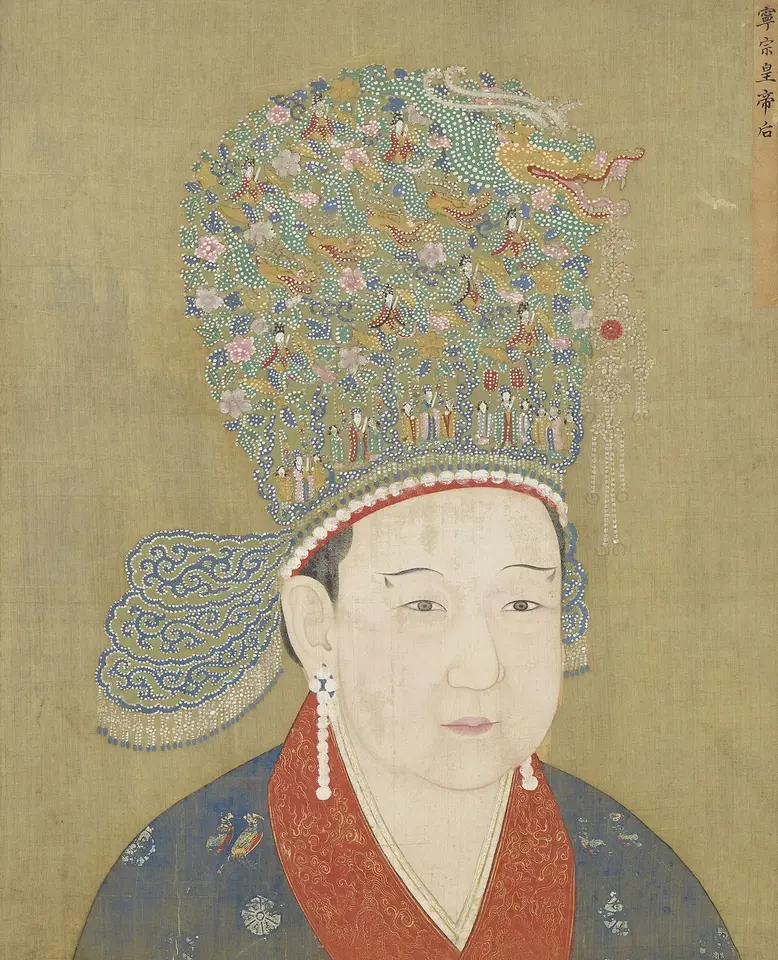
Life Story
Early Palace Life and Favor of Empress Wu
Lady Yang was born on the sixteenth day of the fifth month in the thirty-second year of Shaoxing (1162) in Sui'an County, Yanzhou. Her adoptive mother, Lady Zhang, was a skilled musician and performer in elite households and the court musical bureau. Gifted with natural grace and sharp perception from childhood, Lady Yang accompanied her adoptive mother to the capital city of Lin'an at an early age.
During the Qiandao era, around the age of ten, Lady Yang entered the Deshou Palace, the retirement residence of retired Emperor Gaozong and Empress Wu. In court parlance, the clever young girls who performed music for the imperial consorts were affectionately called the play children. In addition to excelling at the pipa, dancing, and singing, Lady Yang demonstrated a profound passion for classic historical texts, poetry composition, and fine calligraphy.
Because her demeanour and conduct consistently delighted Empress Wu, the senior matriarch kept Lady Yang at her side as a trusted companion. During the Chunxi era, Crown Prince Zhao Kuo was captivated by Lady Yang's refined elegance while paying formal respects at the Deshou Palace. Discerning his admiration, Empress Wu formally bestowed Lady Yang upon the prince as a consort.
Elevation to Noble Consort and Central Palace
In 1194, Emperor Guangzong abdicated, and Zhao Kuo mounted the throne as Emperor Ningzong. At the start of the reign, Lady Han was invested as empress consort. In 1196, Ningzong conferred upon Lady Yang the title of Lady of Pingle Commandery. Endowed with exquisite artistic talents, political awareness, and great emotional intelligence, Lady Yang rapidly secured the emperor's deep affection, rising successively to Lady of Handsome Fairness and Lady of Complete Deportment.
In 1200, Lady Yang was elevated to Noble Consort, reaching the apex of the inner court hierarchy beneath the empress. In the eleventh month of that same year, Empress Gongshu succumbed to illness, leaving the position of empress vacant. At court, both Noble Consort Yang and Lady Cao enjoyed intense imperial favor.
Chancellor Han Tuozhou, an influential statesman and maternal granduncle of the deceased Empress Han, grew deeply alarmed by Noble Consort Yang's formidable intellect, erudition, and political acumen. Fearing an independent-minded sovereign in the inner chambers, Han secretly counseled Ningzong against promoting her, contending that an astute woman versed in historical precedents might cause domestic discord, and suggested selecting the mild Lady Cao instead. However, Ningzong remained steadfastly devoted to Lady Yang. In the twelfth month of the second year of Jiatai (1202), Ningzong officially proclaimed Noble Consort Yang as empress. Han Tuozhou's interference created a permanent breach between the chancellor and the new empress.
The Jade Garden Coup and Elimination of Han Tuozhou
Upon assuming the central palace, Empress Yang exhibited remarkable prudence and political shrewdness. Mindful of Grand Empress Dowager Wu's foundational patronage, she inscribed the names of the Wu lineage upon the walls of her private chambers, frequently querying attendants whether Wu relatives had obtained substantive official appointments and instructing Crown Prince Zhao Xun to prioritize their advancement.
In 1206, Han Tuozhou launched an ill-prepared northern military campaign against the Jurchen Jin dynasty. The expedition ended in catastrophic defeat across the Huai River basin, bringing devastating retaliatory invasions, immense economic strain, and severe domestic disillusionment. Despite the collapsing military situation, Han obstinately refused to seek a diplomatic settlement.
Recognizing the escalating national crisis, Shi Miyuan, then Minister of Rites, secretly approached Empress Yang's elder brother Yang Cishan and Crown Prince Zhao Xun to secure royal backing for Han's dismissal. Knowing Emperor Ningzong was weak-willed and intimidated by the powerful minister, Empress Yang tearfully remonstrated with the sovereign during private nocturnal audiences, emphasizing that Han's unchecked belligerence threatened the very survival of the imperial altars.
In the eleventh month of 1207, with Empress Yang's secret authorization, Shi Miyuan and palace guards ambushed Han Tuozhou at the Yujin Garden as he traveled to morning audience, executing him on the spot. Following Han's downfall, the Southern Song concluded peace negotiations with the Jin, Shi Miyuan rose to dominate the executive administration, and Empress Yang's standing at court became unassailable.
Imperial Succession Crisis and Lizong's Enthronement
After the early passing of Crown Prince Zhao Xun, Emperor Ningzong, having lost all biological sons in infancy, designated imperial clansman Zhao Hong as Prince of Ji and presumptive successor. However, Prince Zhao Hong possessed an abrasive disposition and openly despised Chancellor Shi Miyuan, writing defiant verses pledging to banish the powerful minister to remote borders upon his accession.
Terrified of impending ruin, Shi Miyuan conspired to alter the succession by covertly grooming Zhao Yun, a tenth-generation descendant of Emperor Taizu living in humble circumstances in Shaoxing. In the intercalary eighth month of 1224, Emperor Ningzong fell mortally ill in the Funing Palace and passed away.
Taking immediate command of the palace gates, Shi Miyuan summoned Zhao Yun into the palace and sent Empress Yang's nephews, Yang Gu and Yang Shi, into the inner quarters to persuade the empress to alter the succession decree. Empress Yang initially refused with unyielding firmness, reprimanding them that Prince Zhao Hong had been designated by the late emperor and that altering succession violated ancestral law. Shi Miyuan sent emissaries seven times throughout the night, yet the empress remained adamant.
In desperation, Yang Gu and Yang Shi threw themselves to the ground, weeping profusely and warning her that military commanders, civil ministers, and imperial guards were completely aligned with Shi Miyuan and Zhao Yun; if she resisted, an armed insurrection would erupt immediately, destroying the dynasty and consigning the Yang clan to total extermination. Sensing the unavoidable political reality, Empress Yang relented after a long silence and asked to see Zhao Yun. When Zhao Yun was ushered into the hall, Empress Yang stroked his back and declared that from that moment he was her imperial son, formally promulgating the edict investing him as Emperor Lizong.
Abdication of Regency and Cultivated Retirement
Upon ascending the throne, Emperor Lizong expressed profound gratitude for Empress Yang's decisive support, immediately investing her as Empress Dowager and beseeching her to administer state affairs behind the curtain in accordance with traditional precedent.
During her regency, Empress Dowager Yang displayed extraordinary self-restraint and respect for bureaucratic norms. She regarded the regency solely as an institutional bridge to stabilize the succession transition, refraining from unilateral meddling in state affairs and maintaining harmonious equilibrium with chancellor Shi Miyuan and the civil bureaucracy.
In the fourth month of 1225, after fewer than eight months of listening to governance, Empress Dowager Yang issued a personal rescript citing declining health and voluntarily terminated her regency, handing complete imperial governance back to Emperor Lizong. When Lizong and the court ministers submitted two earnest memorials pleading for her continued guidance, she firmly declined, withdrawing entirely from political life.
Relieved of administrative burdens, Empress Dowager Yang resided in peace at the Chiming Palace. She spent her final years immersed in poetry, classical studies, and fine calligraphy, composing elegant palace lyrics and adding poetic inscriptions to masterpieces in the imperial painting academy. Emperor Lizong attended to her needs with filial devotion, bestowing exalted honorific titles on her seventieth birthday. In the twelfth month of the fifth year of Shaoding (1232), the Empress Dowager passed away peacefully at age seventy-one. In 1233, she was interred in the Yongmao Mausoleum and received the posthumous name Empress Gongshengrenlie.
Major Achievements
Stabilizing Dynastic Transitions and Court Crises
Throughout the middle period of the Southern Song dynasty, Empress Yang served as the essential anchor during acute structural crises. Her sanction of the elimination of Han Tuozhou in 1207 rescued the empire from a reckless and devastating foreign war. During the volatile succession crisis following Ningzong's death in 1224, her pragmatic judgment averted a catastrophic armed showdown, securing an orderly imperial transition.
Throughout her decades in power, Empress Yang maintained strict discipline over her maternal relatives. Her brother Yang Cishan and nephews remained modest and restrained, never coalescing into an overbearing consort clique, which preserved bureaucratic integrity in an era of intense political tension.
Exemplary Voluntary Abdication of Regency
In Chinese imperial history, regents who voluntarily surrendered supreme power were exceptionally rare. Following her pivotal role in enthroning Emperor Lizong, Empress Dowager Yang held supreme administrative legitimacy. Yet she held no craving for perpetual autocracy, relinquishing the regency after just seven months despite repeated imperial supplications to stay.
Her refusal to cling to autocratic prerogative was widely lauded by contemporary scholar-officials as a shining model of imperial rectitude and matriarchal modesty, setting a benchmark for harmonious co-governance.
Artistic Mastery and Calligraphic Renown
Empress Yang achieved immortal distinction as one of the preeminent female poets, calligraphers, and connoisseurs of imperial China. Highly schooled in classical prosody, she authored refined palace verses that captured court life with lyrical subtlety.
In calligraphy, Empress Yang absorbed the fluid grace and rigorous brushwork of Emperor Gaozong, developing a distinguished hand that seamlessly matched Emperor Ningzong's writing, known historically as the calligraphy of Yang Meizi. Numerous world-renowned Southern Song court paintings conserved in modern museums bear her exquisite inscriptions and imperial seals, marking her as a central figure in medieval Chinese visual culture.
Historical Evaluation
In the History of Song (Song Shi, Biographies of Empresses and Consorts), the imperial historians praised her wisdom: "The empress was perceptive, shrewd, and versed in literature and history, possessing extraordinary skill in brushwork. From the central palace to the Chiming Palace, she traversed four reigns and twice determined the dynastic succession. When Han Tuozhou sought to promote Lady Cao at her expense, she bided her time; when Shi Miyuan devised the plan to remove Han, she provided crucial inner support. When Ningzong died, she initially hesitated to change the succession, but ultimately acted for the preservation of the altars. Her graceful and prompt retirement from behind the curtain shielded her from accusations of usurpation. How truly virtuous she was!"
The late Song and early Yuan historian Zhou Mi wrote in Miscellaneous Records from the Eastern Qi: "Empress Dowager Yang possessed peerless intelligence, and her calligraphy was vigorous, clean, and extraordinary, inheriting the authentic brushwork of Gaozong. Her contribution in settling the succession rendered immense service to the Song house. Observing how she voluntarily folded the curtain, dwelling in tranquil modesty at the Chiming Palace for over a decade, she surpassed almost all virtuous empresses of the two Song dynasties."
Qing historian Bi Yuan observed in the Continued Comprehensive Mirror for Aid in Government: "Empress Gongshengrenlie preserved her station in the inner palace through brilliant discernment, eradicating reckless ministers within and collaborating with capable counselors without. Her decisive action turned peril into stability, proving her a heroine among women. In surrendering the regency with prompt dispatch, she avoided the blemish of autocracy, securing lasting tranquility for the Song ancestral temples."