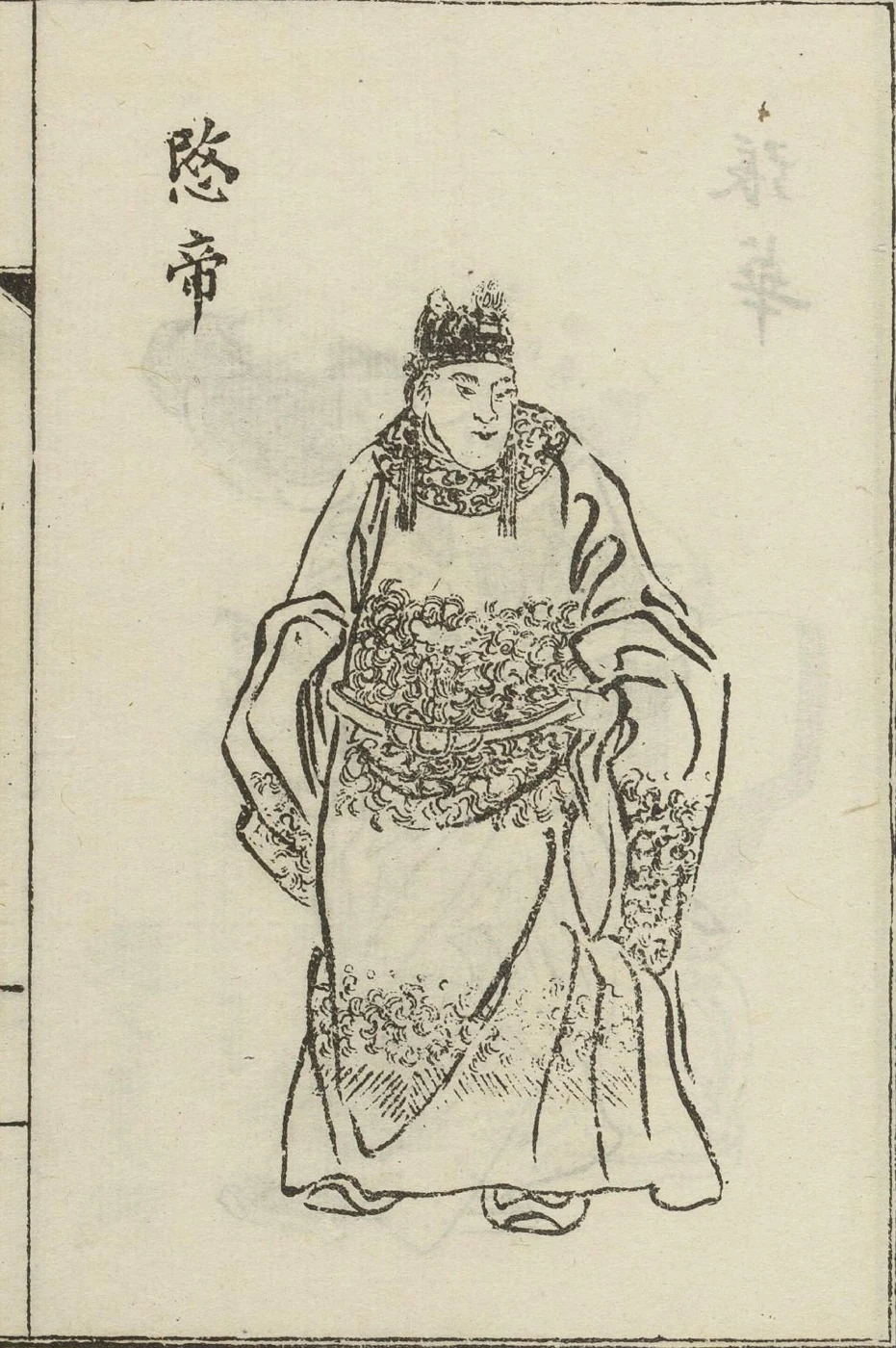
Historical painting or book illustration depicting 司马邺; a later artistic interpretation.

300 CE–318 CE

Emperor

Sima Ye

司马邺

Sima Ye (300–February 7, 318), also written Sima Ye, courtesy name Yanqi, was a native of Wen County in Henei Commandery (present-day Wen County, Henan) and the last emperor of the Western Jin. He was a grandson of Emperor Wu of Jin, Sima Yan, and the son of Sima Yan, Prince Xiao of Wu. In 311, the fifth year of the Yongjia era, Former Zhao captured Luoyang. After moving from refuge to refuge, Sima Ye was escorted to Chang'an…

300 CE–318 CEFormer Zhao

PROFILE

Sima Ye (300–February 7, 318), also written Sima Ye, courtesy name Yanqi, was a native of Wen County in Henei Commandery (present-day Wen County, Henan) and the last emperor of the Western Jin. He was a grandson of Emperor Wu of Jin, Sima Yan, and the son of Sima Yan, Prince Xiao of Wu. In 311, the fifth year of the Yongjia era, Former Zhao captured Luoyang. After moving from refuge to refuge, Sima Ye was escorted to Chang'an and in 313, the seventh year of Yongjia, ascended the throne and adopted the era name Jianxing. In 316, the fourth year of Jianxing, Liu Yao of Former Zhao besieged Chang'an. With food exhausted inside the city, Sima Ye left the walls and surrendered. He was taken to Pingyang and enfeoffed as Marquis of Huai'an, and on February 7, 318, the twentieth day of the twelfth month of the fifth year of Jianxing, Liu Cong had him killed. He was eighteen. His surrender marked the formal end of the Western Jin, after which the Central Plains entered the prolonged era of conflict associated with the Sixteen Kingdoms. His full posthumous title was “Emperor Xiaomin”; later generations commonly omitted “Xiao” and referred to him as Emperor Min of Jin.

Alternate name
Emperor Min of Jin
Courtesy name
Yanqi
Period
Former Zhao
Date of Birth
300
Date of Death
February 7 318
Dynasty/Regime
Former Zhao
Identity
Emperor
Ethnicity/Ethnic affiliation
Not recorded in historical sources
Ancestral home
Wen County, Henei Commandery (present-day Wen County, Henan)
Place of birth
Not recorded in historical sources
Reign
Not recorded in historical sources
Predecessor
Emperor Huai of Jin (Sima Chi)
Successor
Not applicable (Western Jin fell to Han Zhao)
Era name
Jianxing
Temple name
Not recorded in historical sources
Posthumous title
Emperor Xiaomin

LIFE TIMELINE

Birth | Born as a son of Sima Yan, Prince Xiao of WuOpen

Birth | Born as a son of Sima Yan, Prince Xiao of Wu

Age eight | Adopted as heir by his paternal uncle Sima Jian, Prince XiOpen

Age eight | Adopted as heir by his paternal uncle Sima Jian, Prince Xian of Qin; inherited the title Prince of Qin and was appointed Regular Mounted Attendant and General Who Pacifies the Army

Age eleven | Former Zhao captured Luoyang; his biological father Sima Open

Age eleven | Former Zhao captured Luoyang; his biological father Sima Yan and brothers were killed; Sima Ye took refuge in Mi County, Xingyang, and later entered the passes with Yan Ding

Age twelve | In the ninth month, Yan Ding and others proclaimed him CrOpen

Age twelve | In the ninth month, Yan Ding and others proclaimed him Crown Prince, established the ancestral temples and altars of state, and declared a general amnesty

Age thirteen | Learned in the fourth month of Emperor Huai's death; onOpen

Age thirteen | Learned in the fourth month of Emperor Huai's death; on the twenty-seventh day of the fourth month ascended the throne and changed the era name to Jianxing

Age fourteen | Former Zhao armies repeatedly attacked Chang'an; Qu YunOpen

Age fourteen | Former Zhao armies repeatedly attacked Chang'an; Qu Yun and Suo Chen led resistance

Age fifteen | Failed to obtain reinforcements from Sima Bao; territoriOpen

Age fifteen | Failed to obtain reinforcements from Sima Bao; territories west of Chang'an ceased sending tribute, and court officials suffered hunger

Age sixteen | Liu Yao besieged Chang'an in the eighth month; on the elOpen

Age sixteen | Liu Yao besieged Chang'an in the eighth month; on the eleventh day of the eleventh month Sima Ye left the city to surrender, was sent to Pingyang, and was enfeoffed as Marquis of Huai'an

Age seventeen | In the tenth month Liu Cong ordered him to wear militaOpen

Age seventeen | In the tenth month Liu Cong ordered him to wear military dress and carry a halberd at the front during a hunt; in the twelfth month he was forced to pour wine, wash cups, and hold the privy cover at a banquet

Age eighteen | Killed by Liu Cong at PingyangOpen

Age eighteen | Killed by Liu Cong at Pingyang

BIOGRAPHY

Biography

Family Background and Early Life

Sima Ye was born into the Western Jin imperial house. His grandfather was Emperor Wu of Jin, Sima Yan; his biological father was Sima Yan, Prince Xiao of Wu; and his mother was a woman of the Xun clan of Yingchuan, daughter of Minister of Education Xun Xu. Sima Ye was initially adopted by his paternal uncle Sima Jian, Prince Xian of Qin, and succeeded to the title Prince of Qin. In 308, the second year of the Yongjia era, he was appointed Regular Mounted Attendant and General Who Pacifies the Army.

In 311, the fifth year of Yongjia, Former Zhao forces captured Luoyang and seized Emperor Huai of Jin. Sima Ye's biological father Sima Yan and his brothers were killed. Sima Ye himself fled to Mi County in Xingyang, where he encountered his maternal uncles Xun Fan and Xun Zu, and from Mi County they moved south toward the Xu-Ying region. Yan Ding, Inspector of Yuzhou, together with Wang Pi, formerly Chief Clerk to the General Who Pacifies the Army; Liu Chou, Chief Clerk to the Minister of Education; Li Xin, Gentleman of the Secretariat; Xun Fan; and others planned to escort Sima Ye back to Chang'an. Liu Chou and others rebelled on the way; Yan Ding pursued and killed Liu Chou, while Xun Fan and Xun Zu escaped. Yan Ding then took Sima Ye with him in an ox cart through Wan County toward Wuguan. They repeatedly encountered bandits; many soldiers deserted, and the party halted at Lantian. Yan Ding informed Jia Pi, Inspector of Yongzhou, who immediately sent provincial troops to receive and protect Sima Ye. After they reached Chang'an, General Who Assists the State Liang Zong also helped defend the city.

Establishing Himself at Chang'an and Becoming Emperor

In the ninth month of 312, the sixth year of Yongjia, Yan Ding and others proclaimed Sima Ye Crown Prince, erected an altar to sacrifice to Heaven, reestablished the ancestral temples and altars of state, and proclaimed a general amnesty. Jia Pi was granted the additional title General-in-Chief Who Conquers the West, while Sima Bao, Inspector of Qinzhou and Prince of Nanyang, was made Grand Marshal. Jia Pi was killed while campaigning against the rebel Zhang Lian. The assembled officials then selected Qu Yun, Administrator of Shiping, to concurrently serve as Inspector of Yongzhou and act as leader of the alliance.

On the first day of the fourth month of 313, the seventh year of Yongjia, Sima Ye learned that Emperor Huai had died and performed mourning sacrifices. On the twenty-seventh day of the fourth month, he ascended the throne, declared a general amnesty, and changed the era name to Jianxing, becoming Emperor Min of Jin. General of the Guards Liang Fen was appointed Minister of Education. Qu Yun, Inspector of Yongzhou, became Bearer of Credentials, General of the Guards, and Supervisor of the Affairs of the Secretariat. Suo Chen, Administrator of Jingzhao, became Right Vice Director of the Department of State Affairs. On the eighteenth day of the fifth month, Sima Rui, General-in-Chief Who Guards the East and Prince of Langya, was appointed Attendant, Left Chancellor, and Commander-in-Chief of military affairs east of the Shan region. Grand Marshal Sima Bao, Prince of Nanyang, became Right Chancellor and Commander-in-Chief of military affairs west of the Shan region.

When Emperor Min took the throne, the Disaster of Yongjia had shattered the realm. Fewer than one hundred households remained in Chang'an. Buildings had collapsed and thorns covered the city. The court lacked carriages, horses, robes, and insignia, and officials had to write their titles on mulberry-wood tablets as markers of rank. The army was no larger than a single brigade; public and private households together possessed only four carts, equipment was scarce, and supplies could not be transported in. To secure the support of fortified local landholding forces in the Guanzhong region, the court granted general's titles to the leaders of walled settlements.

Besieged in Chang'an

In 315, the third year of Jianxing, Emperor Min repeatedly called on Chancellor Sima Bao to send troops. Sima Bao's advisers said: “When a viper bites the hand, a strong man cuts off the wrist so that the poison will not spread. The northern rebels are now vigorous; we should temporarily cut the routes through Long and watch how events develop.” Pei Shen, Gentleman of the Interior serving on the staff, replied: “The snake has already bitten the head. Can the head also be cut off?” Only then did Sima Bao appoint General Who Guards the Army Hu Song as vanguard commander and prepare to advance when the various forces had assembled, but the plan was never carried out. Qu Yun wished to escort Emperor Min to Sima Bao, but Suo Chen argued: “If Sima Bao obtains the Son of Heaven, he will certainly indulge his private ambitions.” The plan was therefore abandoned. Regions west of Chang'an ceased sending tribute or honoring the central court, and civil and military officials in the capital went hungry, surviving by gathering wild grain.

In the eighth month of 316, the fourth year of Jianxing, Liu Yao of Former Zhao besieged Chang'an, cutting the city off from the outside. By the tenth month the famine had become severe: one dou of rice reportedly cost two taels of gold, cannibalism appeared, and more than half the population of Chang'an starved to death. The imperial granary contained several dozen cakes of fermentation starter used for brewing. Qu Yun crushed them and cooked them into porridge for Emperor Min, but before long even these were exhausted. Emperor Min wept and told Qu Yun that the situation had become desperate, there was no outside relief, and he ought to die for the state altars. Yet, thinking of the suffering of the soldiers, he believed they should preserve their lives before the city fell, perhaps sparing the people from massacre. He therefore ordered that a letter of surrender be sent at once to Former Zhao.

Surrender and Death

On the eleventh day of the eleventh month of 316, the fourth year of Jianxing, Emperor Min sent Attendant Song Chang to deliver a surrender document to Liu Yao. Sima Ye himself rode out in a sheep cart, removed his upper garments, held a jade bi in his mouth, and had attendants carry a coffin behind him as he left the city to surrender. His ministers cried out and wept, clinging to the carriage and grasping the emperor's hands, while Sima Ye himself was overcome with grief. Imperial Censor-in-Chief Ji Lang killed himself. Liu Yao burned the coffin, accepted the jade, and ordered Song Chang to accompany Emperor Min back into the palace.

On the seventeenth day of the eleventh month, Emperor Min was sent to Pingyang to live in captivity, with Qu Yun and other officials following him. Liu Cong, emperor of Former Zhao, granted Sima Ye the titles Grand Master for Splendid Happiness and Marquis of Huai'an. On the eighteenth, Liu Cong ascended the hall and Sima Ye was made to kneel and kowtow before him. Seeing this, Qu Yun prostrated himself and wept before taking his own life.

After Emperor Min's surrender, Liu Cong repeatedly humiliated him. In the tenth month of 317, the fifth year of Jianxing, Liu Cong went hunting and ordered Sima Ye to perform the duties of General of Chariots and Cavalry, dressed in military clothing and carrying a halberd at the front of the procession. Crowds gathered beside the road to watch; some elderly former subjects of Jin sobbed and wept, which greatly displeased Liu Cong. Later, at a banquet, Liu Cong had Sima Ye pour wine and wash wine cups; when Liu Cong went to the latrine, he made Sima Ye hold the privy cover. Jin officials nearby could not restrain their crying. Gentleman of the Department of State Affairs Xin Bin embraced Sima Ye and wept loudly and was killed by Liu Cong. On February 7, 318, the twentieth day of the twelfth month of the fifth year of Jianxing, Liu Cong had Emperor Min killed at Pingyang. He was eighteen.

Sima Ye was at first given in adoption to his uncle Sima Jian, Prince Xian of Qin, and inherited the title of Prince of Qin; in 308 he was made cavalier attendant in ordinary and general of the pacification army. After Luoyang fell he took refuge at Mixian in Xingyang, met his uncles by marriage Xun Fan and Xun Zu, and went south from Mixian toward Xuying. The governor of Yuzhou, Yan Ding, with Wang Pi, Liu Chou, Li Xin and the two Xun, planned to escort him back to Chang'an, but Liu Chou and the others revolted on the way and Yan Ding pursued and killed them, the Xun brothers barely escaping. Yan Ding then carried Sima Ye in an ox cart from Wan toward the Wu pass, meeting bandits repeatedly until his soldiers dispersed and he halted at Lantian. Informing the governor of Yongzhou, Jia Ya, of his plight, Jia at once sent provincial troops to escort him to Chang'an and detailed the general Liang Zong to help hold it. On 19 October 312 Yan Ding and the others raised Sima Ye as heir apparent, with sacrifice to heaven, ancestral temples and the altars of soil and grain, and a general amnesty; Jia Ya was made grand general of the western expedition and Sima Bao, Prince of Nanyang, grand marshal. When Jia Ya was killed campaigning against the bandit Zhang Lian, the assembly made the administrator of Shiping, Qu Yun, acting governor of Yongzhou and leader, with authority to appoint officials.

In the fourth month of 313 Sima Ye mourned for Emperor Huai and on the twenty-seventh day took the throne with a general amnesty and the era name Jianxing, becoming Emperor Min. He made Liang Fen minister of education, Qu Yun commissioner with the tally, general of the guards and director of the Secretariat, and Suo Chen, administrator of Jingzhao, right vice director of the Secretariat; in the fifth month he made Sima Rui, the Prince of Langya, palace attendant, left chancellor and grand commander of military affairs east of Shaanxi, and Sima Bao, Prince of Nanyang, right chancellor and grand commander west of Shaanxi. The realm was then breaking apart in the Yongjia disorders; Chang'an had fewer than a hundred households, thorn bushes grew in the streets, the granary held only a few dozen cakes of leaven, and his forces amounted to a single brigade, so that every chief of a fortified camp was given a general's title to hold the support of the Guanzhong landowners.

In 315 the emperor repeatedly called on the chancellor Sima Bao for troops, and those about Sima Bao argued from the proverb that when a viper bites the hand a brave man cuts off the wrist, urging him to close the Long road and await events; the master of attendants Pei Shen retorted that when the snake has bitten the head, the head cannot be cut off. Sima Bao then sent the general Hu Song as vanguard, but when Qu Yun wished to take the emperor to Sima Bao, Suo Chen stopped him, saying that with the Son of Heaven in hand Sima Bao would gratify his private ambition; thereafter the region west of Chang'an sent the court no tribute, and the officials starved, living on gathered wild grain. In the eighth month of 316 Liu Yao pressed on Chang'an and cut it off. In the tenth month famine was extreme, a peck of rice bringing two ounces of gold, men eating one another, more than half the population dead, and the leaven in the granary exhausted. The emperor, weeping, told Qu Yun that with no relief from without he ought to die for the altars of state, but that he would take the chance, while the city still stood, to surrender and perhaps spare the people slaughter; he had the letter of submission sent at once.

On 11 November 316 Emperor Min sent the palace attendant Song Chang with the letter to Liu Yao, and riding an ox cart, stripped to the waist, the jade disc in his mouth and a coffin carried behind him, came out to surrender; the ministers wailed and clung to his carriage and he himself was overcome with grief, while the assistant censor-in-chief Ji Lang took his own life. Liu Yao burned the coffin, accepted the jade and had Song Chang escort the emperor back to the palace. On the seventeenth day he was taken to Pingyang with Qu Yun and the officials, and the Han-Zhao emperor Liu Cong gave him the titles of grand master of the palace and Marquis of Huai'an; the next day, when Liu Cong held court, the emperor knocked his head on the ground before him and Qu Yun, prostrate and weeping, killed himself. Liu Cong humiliated him in every way: in the tenth month of 317, hunting abroad, he made Emperor Min in military dress with a lance clear the road ahead, and the common people and old adherents of Jin who saw it wept; at banquets he made him pour wine and wash cups, and at the privy hold the lid, while the Jin ministers present sobbed aloud, the secretary Xin Bin who embraced him in tears being killed by Liu Cong. On 20 December 317 (7 February 318) Liu Cong had Emperor Min put to death at Pingyang at the age of eighteen.

The *Book of Jin* records that he was given in adoption to his uncle Sima Jian, Prince Xian of Qin, and inherited the title of Prince of Qin, and that Chang'an then had fewer than a hundred households with thorn bushes growing in the streets — concrete testimony to the state of Guanzhong after the Yongjia disorders. His death marks the formal end of the Western Jin; thereafter Sima Rui took the throne at Jiankang and the Eastern Jin began, while the north entered the wars of the Sixteen Kingdoms, Guanzhong being contested in turn by Liu Yao, Shi Le and others.

After his capture most of the Western Jin clan and gentry had already crossed south, and Sima Rui in the east first took the title King of Jin on receiving word of Emperor Min's death and then the imperial title the next year, so that the founding of the Eastern Jin begins with that death.

Emperor Min reigned only four years, throughout which Chang'an suffered from failing supplies and a government whose writ barely reached beyond Guanzhong.

Major Activities

Adoption as Prince of Qin

Sima Ye was originally adopted as heir by his paternal uncle Sima Jian, Prince Xian of Qin, and succeeded to the title Prince of Qin. In 308, the second year of the Yongjia era, he was appointed Regular Mounted Attendant and General Who Pacifies the Army. This status made him an important political symbol of the Western Jin imperial house after the fall of Luoyang.

Entry into the Passes and Accession

After Luoyang fell in 311, the fifth year of Yongjia, Sima Ye was escorted to Chang'an by Yan Ding, Jia Pi, and others. In 312 he was proclaimed Crown Prince, and in 313 he ascended the throne. At Chang'an he established a temporary central government in an effort to continue the Western Jin state, but the dynasty's strength had already collapsed: fewer than one hundred households remained in the city, and the army was only a single brigade.

Calls for Loyalist Relief

After his accession, Emperor Min issued edicts appointing Sima Bao Right Chancellor and Commander-in-Chief over military affairs west of the Shan region, and Sima Rui, Prince of Langya, Left Chancellor and Commander-in-Chief over military affairs east of the Shan region. He ordered them to eliminate the enemy, recover Emperor Huai's coffin, and mobilize forces: Youzhou and Bingzhou were to send 300,000 troops against Pingyang; Sima Bao was to lead 300,000 men from Qinzhou, Liangzhou, and Yongzhou to Chang'an; and Sima Rui was to take 200,000 elite troops to Luoyang in loyalist relief. Sima Bao and Sima Rui, however, gave only nominal professions of loyalty and provided no effective assistance.

Surrender to Former Zhao

In the eleventh month of 316, the fourth year of Jianxing, food was exhausted in Chang'an and cannibalism had appeared. Emperor Min decided to leave the city and surrender in the hope of sparing the population from massacre. He sent Attendant Song Chang with the surrender letter and went out in a sheep cart, bare above the waist, holding a jade bi in his mouth, while his attendants carried a coffin. The event marked the formal fall of the Western Jin.

Humiliation and Death

After being taken to Pingyang, Emperor Min suffered repeated humiliation at Liu Cong's hands. During a hunt Liu Cong made him wear military dress and carry a halberd at the front of the procession; at banquets he was ordered to serve wine, wash cups, and hold the privy cover. Gentleman of the Department of State Affairs Xin Bin was killed after embracing the emperor and weeping. Sima Ye was finally executed at Pingyang on February 7, 318, the twentieth day of the twelfth month of the fifth year of Jianxing, aged eighteen.

Personal Relations

  • Sima Yan, Emperor Wu of Jin: Grandfather
  • Lady Li: Grandmother
  • Sima Jian, Prince Xian of Qin: Adoptive father
  • Sima Yan, Prince Xiao of Wu: Biological father; killed by Liu Cong
  • Lady Xun of Yingchuan: Biological mother; daughter of Minister of Education Xun Xu
  • Eldest brother: Name unknown; killed by Liu Cong
  • Sima Xiang: Second elder brother; adopted as heir of Sima Yun, Prince of Huainan; killed by Liu Cong
  • Sima Gu: Fourth younger brother; Prince of Jinan; killed by Liu Cong
  • Sima Yan: Fifth younger brother; Prince of Jiyin and Regular Mounted Attendant; killed by Liu Cong
  • Xun Fan and Xun Zu: Maternal uncles; encountered Sima Ye after Luoyang fell and participated in plans to enter the passes
  • Yan Ding: Inspector of Yuzhou; carried Sima Ye to Chang'an; later attacked and killed by Qu Yun and others
  • Jia Pi: Inspector of Yongzhou; sent troops to receive Sima Ye at Chang'an and was later killed while fighting rebels
  • Qu Yun: Administrator of Shiping, later Inspector of Yongzhou, General of the Guards, and Supervisor of the Affairs of the Secretariat; followed Emperor Min to Pingyang and killed himself
  • Suo Chen: Administrator of Jingzhao, later Right Vice Director of the Department of State Affairs and General of the Guards; surrendered to Former Zhao and was later killed by Liu Cong
  • Sima Chi, Emperor Huai of Jin: Predecessor; after his death at Pingyang Sima Ye became emperor
  • Sima Rui: Prince of Langya; appointed Left Chancellor by Emperor Min and later established Eastern Jin in the south
  • Sima Bao: Prince of Nanyang; appointed Right Chancellor but failed to provide effective relief
  • Liu Cong: Emperor of Former Zhao; captured, humiliated, and killed Sima Ye
  • Liu Yao: Former Zhao general who besieged Chang'an and accepted Emperor Min's surrender

Historical Assessment

Tang and Early Assessments

  • Fang Xuanling and others wrote in the *Book of Jin*: “After Emperor Min's flight and displacement, he possessed little more than an empty title. The government of the realm had already departed; without extraordinary talent equal to the age, it could not be recovered.” The judgment emphasizes that although Emperor Min retained legitimate status, the broader political situation had already been lost.
  • The *Book of Jin* also lamented: “Huai bore the jade seal; Min dwelt beneath the imperial canopy. The great turtle supporting the Three Mountains fell; a whale swallowed the Nine Provinces. The Xun entered the metal quarter; felt tents occupied Weiyang. Round heads all fell, square feet all lay stiff. The great officers turned their heads; they moved us to Pingyang. The ruler grieved and the ministers wept—where was there anything good?” The passage mourns the tragic end of Emperor Min and his ministers.
  • The *Book of Jin* summarized the reasons for the collapse: “The great villains overwhelmed Heaven, the imperial capital was in desperate danger, the feudal lords had no intention of leaving their positions, and provincial commanders failed to raise armies to save the ruler. Thus sovereign and ministers were driven into extremity, ending in slaughter and humiliation.”

Song and Yuan Periods

  • Sima Guang's *Comprehensive Mirror in Aid of Governance* records Emperor Min's reign in detail and repeatedly notes how Sima Bao, Sima Rui, and others retained troops for themselves rather than coming to the state's rescue, implicitly criticizing their conduct.
  • Wang Fuzhi wrote in *Reflections on Reading the Comprehensive Mirror*: “For Emperor Min to go west into Chang'an was a situation bound for destruction,” arguing that Sima Ye's entry into the passes was doomed from the outset.
  • Wang Fuzhi further criticized the policy: “How much more so Emperor Min, who knew nothing of warfare and was merely upheld in name and righteousness? The wise understand this. Yet the foolish and impetuous treated the Son of Heaven as a last desperate stake and mocked others for fear and hesitation, without measuring strength or judging the situation. They merely ruined the state and the people—how could there be rescue in that?” He argued that failing to assess actual strength and conditions accelerated Western Jin's collapse.

Ming and Qing Periods

  • Ming and Qing scholars often discussed Emperor Min through the lessons of Western Jin's fall, particularly the failure of powerful imperial princes to come to the throne's aid despite controlling armies.
  • Regarding his surrender, some scholars considered his intention to be the preservation of the people, while noting that the practical effect was limited and that Chang'an's population did not thereby escape subsequent warfare.
  • Later assessments of Qu Yun and Suo Chen often judged them loyal but insufficiently capable and hampered by mutual restraint, leaving them unable to organize an effective defense.

Modern Assessments

  • Modern historians commonly evaluate Emperor Min within the larger fall of Western Jin and the formation of the Sixteen Kingdoms era, treating his surrender as the formal end of Western Jin and the opening of a prolonged period of division and warfare in the Central Plains.
  • Some scholars note that central Western Jin authority had already disintegrated during his reign. After Sima Rui established Eastern Jin in the south, the political center of Jin shifted from the Central Plains to the Jiangnan region, and a long-term pattern of coexistence between Eastern Jin and northern regimes gradually emerged.
  • Emperor Min himself is often treated with sympathy: he ascended the throne as a youth and inherited a situation already beyond recovery. His surrender compromised imperial dignity, but is also interpreted as an action taken under extreme necessity.

LOCAL NETWORK

Sima Rui↗Linked from this entry

Original note (Chinese): 晋愍帝,被俘后司马睿称晋王,后正式称帝

Liu Cong↗Linked from this entry

Original note (Chinese): 降后被杀

Sima Yan↗Related entry

Original note (Chinese): 晋武帝司马炎是司马邺的祖父

Sima Chi↗Related entry

Original note (Chinese): 晋怀帝司马炽是前任皇帝,在平阳遇害后司马邺即位

Sima Rui↗Related entry

Original note (Chinese): 琅琊王司马睿受愍帝诏令为左丞相,后在江南建立东晋

Liu Cong↗Related entry

Original note (Chinese): 汉赵皇帝刘聪俘虏并杀害司马邺

Liu Yao↗Related entry

Original note (Chinese): 汉赵将领刘曜围攻长安,接受愍帝投降

司马晏 · No matching entry available

吴孝王司马晏是司马邺的生父,在洛阳陷落时被刘聪所杀

司马柬 · No matching entry available

秦献王司马柬是司马邺的伯父,司马邺出继为嗣

荀勖 · No matching entry available

司徒荀勖是司马邺的外祖父

荀藩 · No matching entry available

荀藩是司马邺的舅父,洛阳陷落后与司马邺相遇,共同谋划入关

荀组 · No matching entry available

荀组是司马邺的舅父,洛阳陷落后与司马邺相遇,后任司空

阎鼎 · No matching entry available

豫州刺史阎鼎裹挟司马邺入长安,后被麴允等攻杀

贾疋 · No matching entry available

雍州刺史贾疋派兵迎接司马邺入长安,后讨贼被杀

麴允 · No matching entry available

麴允任领军将军、录尚书事,随愍帝到平阳后自杀

索綝 · No matching entry available

索綝任尚书右仆射、卫将军,投降汉军后被刘聪所杀

司马保 · No matching entry available

南阳王司马保受愍帝诏令为右丞相,但未能有效救援

辛宾 · No matching entry available

尚书郎辛宾在刘聪宴会上抱愍帝痛哭,被刘聪杀害

吉朗 · No matching entry available

御史中丞吉朗在愍帝出降时自杀

CONTEMPORARIES

Bibliography

  • Fang Xuanling et al., *Book of Jin*, vol. 5, “Imperial Annals, No. 5”
  • Fang Xuanling et al., *Book of Jin*, vol. 102, “Hereditary Records, No. 2”
  • Fang Xuanling et al., *Book of Jin*, vol. 64, “Biographies, No. 34”
  • Sima Guang, *Comprehensive Mirror in Aid of Governance*, vol. 88, “Jin Annals 10”
  • Sima Guang, *Comprehensive Mirror in Aid of Governance*, vol. 89, “Jin Annals 11”