Liu Yuan Proclaims Han King at Zuoguocheng
Southern Xiongnu leader Liu Yuan initiates an uprising at Zuoguocheng during the War of the Eight Princes, offering sacrifices to four Han emperors and founding the Han state.
304 CE–329 CE
前赵
The Former Zhao (前赵, 304–329 CE), also known as Han Zhao (汉赵), was the first northern regional dynastic state established by the Tuhe aristocracy of the Southern Xiongnu during the Sixteen Kingdoms period, ushering in more than a century of fragmented multi-ethnic polities across northern China. In the twilight years of the Western Jin dynasty, the cataclysmic civil war known as the War of the Eight Princes shattered imperial central authority. Seizing this historic opportunity, Liu Yuan, the…
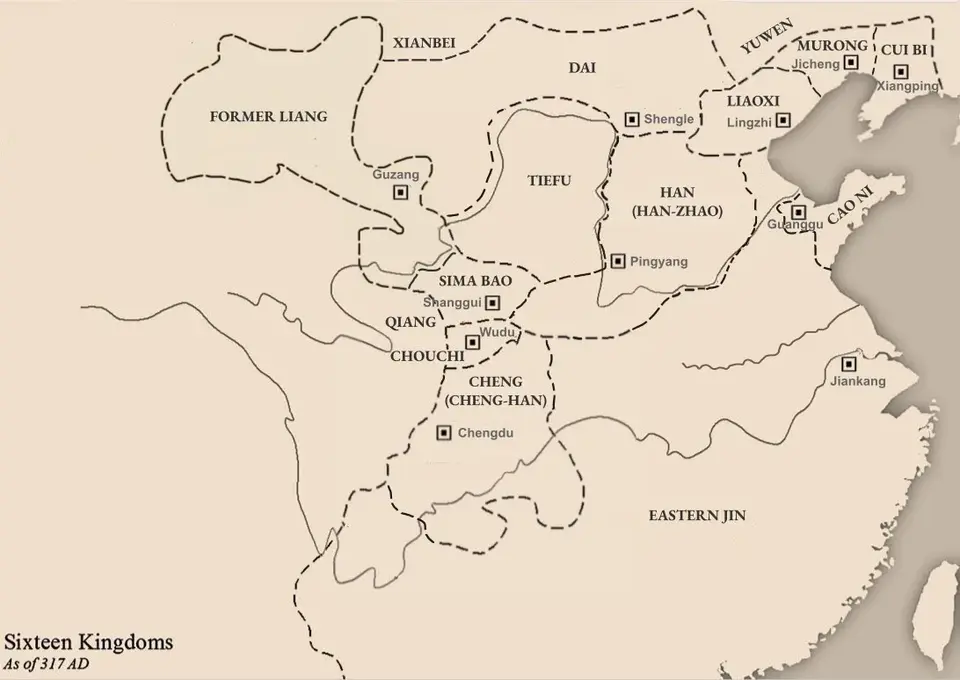
The Former Zhao (前赵, 304–329 CE), also known as Han Zhao (汉赵), was the first northern regional dynastic state established by the Tuhe aristocracy of the Southern Xiongnu during the Sixteen Kingdoms period, ushering in more than a century of fragmented multi-ethnic polities across northern China. In the twilight years of the Western Jin dynasty, the cataclysmic civil war known as the War of the Eight Princes shattered imperial central authority. Seizing this historic opportunity, Liu Yuan, the Southern Xiongnu Worthy Prince of the Left, mobilized his followers at Zuoguocheng in Lishi. Claiming dynastic legitimacy as an imperial grandson of the Han dynasty through ancient diplomatic marriages, he adopted "Han" as his state title, proclaimed himself Grand Chanyu (Chanyu Platform) and King of Han, and established the Yuanxi reign era. Following the relocation of the capital to Pingyang and the death of Liu Yuan, his ambitious second son Liu Cong seized the throne through a violent palace coup. Liu Cong dispatched prominent commanders, including Liu Yao and the formidable Jie warlord Shi Le, on extensive southern campaigns that successively stormed the Western Jin capitals of Luoyang and Chang'an. The capture and eventual execution of Emperor Huai and Emperor Min of Jin brought about the total collapse of the Western Jin dynasty, an event remembered in Chinese historiography as the Disaster of Yongjia. In 318 CE, Emperor Liu Can of Han lost control of the state through debauchery, prompting the maternal relative Jin Zhun to launch a bloody palace revolt in Pingyang that slaughtered the imperial clan. Commanding armies from Chang'an, general Liu Yao crushed the rebellion, ascended the imperial throne at Chibi, relocated the capital to Chang'an, and renamed the dynastic state "Zhao"—thereafter distinguished by historians as the Former Zhao. This transition precipitated a permanent split with Shi Le, who established the Later Zhao in the east, initiating a brutal decade-long struggle for northern supremacy. In Guanzhong, Liu Yao instituted an elaborate dual governance system, combining traditional Han civilian commanderies with a Grand Chanyu Chancellery for nomadic tribes, while promoting classical Confucian education and extensive irrigation projects. However, in 328 CE, Liu Yao suffered total defeat and capture by Shi Le at the Battle of Luoyang. The following year, Later Zhao forces under Shi Hu captured the final stronghold of Shanggui, executing Crown Prince Liu Xi and extinguishing the dynasty after twenty-six years and five imperial reigns.
Southern Xiongnu leader Liu Yuan initiates an uprising at Zuoguocheng during the War of the Eight Princes, offering sacrifices to four Han emperors and founding the Han state.
Liu Yuan conducts suburban sacrifices, formally ascends the imperial throne, issues a general amnesty, and subsequently moves the capital to Pingyang.
Following the death of Liu Yuan, his eldest son Liu He moves to purge imperial princes but is overthrown and executed by Liu Cong, who accelerates the military conquest of Jin.
Han commanders Liu Yao and Shi Le capture the Western Jin capital of Luoyang, capturing Emperor Huai, burning imperial palaces, and executing thirty thousand officials and civilians.
Liu Yao completely besieges Chang'an, forcing Emperor Min of Jin to surrender in bare-chested submission, bringing the fifty-one-year-old Western Jin dynasty to an end.
Maternal relative Jin Zhun assassinates Emperor Liu Can and massacres the imperial clan in Pingyang; Liu Yao marches from Chang'an to suppress the revolt and ascends the throne at Chibi.
Liu Yao relocates the capital to Chang'an, formally changing the dynastic name to Zhao; simultaneously, Shi Le proclaims himself King of Zhao at Xiangguo, splitting the realm.
Liu Yao lays siege to Jinyong in Luoyang but is enveloped by Shi Le's relief army along the Shiliang stream; fighting while intoxicated, Liu Yao is thrown from his horse and captured.
Later Zhao commander Shi Hu captures Shanggui, executing Crown Prince Liu Xi, Prince Liu Yin, and over three thousand court ministers, bringing the dynasty to an end.
During the final decades of the Eastern Han dynasty, protracted civil wars among warlords compelled large segments of the Southern Xiongnu confederacy to migrate southward into the Fen River valley around Jinyang in Bingzhou. Following his unification of northern China, Cao Cao reorganized the Southern Xiongnu into five distinct territorial divisions—Left, Right, South, North, and Center—placing each under native noble command while stationing Han military supervisors to oversee tribal affairs. Over decades of permanent agrarian coexistence with the local Chinese population, the Xiongnu ruling elite underwent profound cultural sinicization. Noble families adopted the imperial Han surname Liu, mastered classical Confucian texts, and adapted their nomadic military traditions to sedentary statecraft.
Liu Yuan, courtesy name Yuanhai, was a direct descendant of the supreme Xiongnu ruler Modu Chanyu and the son of Liu Bao, Commander of the Southern Division. From early youth, Liu Yuan displayed exceptional intellectual and martial talents. He studied under the renowned Han scholar Cui You, thoroughly mastering the Book of Changes, the Classic of History, the Classic of Poetry, the Records of the Grand Historian, the Book of Han, as well as the treatises of Sunzi and Wuzi. He excelled equally in equestrian archery, physical prowess, and classical scholarly discourse. During the Xianning era of Western Jin, Liu Yuan resided in Luoyang as a noble hostage, winning high praise from eminent Jin grandees including Wang Hun and Wang Ji. Upon the accession of Emperor Hui of Jin, imperial authorities successively appointed Liu Yuan as Chief Commandant of the Northern Division and Commander-in-Chief of the Five Divisions.
Following the Taikang reign, the Sima imperial house plunged into the sixteen-year War of the Eight Princes. Fratricidal massacres tore the central plains apart, bankrupting imperial finances and paralyzing provincial garrisons. In 304 CE, Sima Ying, Prince of Chengdu, became locked in fierce fighting against Sima Yue and Sima Teng. Sima Ying appointed Liu Yuan as General Who Displays Martial Prowess and Supervisor of Five Division Military Affairs, stationing him in Yecheng to harness Xiongnu cavalry power. Meanwhile, back in Bingzhou, Xiongnu elders under Liu Xuan secretly conferred, concluding that the moral bankruptcy and violent disintegration of the Jin dynasty presented an unprecedented opening to resurrect the ancient glory of the Xiongnu empire. They secretly elected Liu Yuan as Grand Chanyu and sent trusted envoys to urge his return.
Recognizing that the Western Jin was sliding into terminal collapse, Liu Yuan persuaded Sima Ying to permit his return to Bingzhou under the pretext of mobilizing tribal cavalry reinforcements. In October 304 CE, Liu Yuan arrived safely at Zuoguocheng in Lishi. He formulated a shrewd grand strategy: perceiving that the Han populace retained profound emotional nostalgia for the glorious Han dynasty, and emphasizing that the Han and Xiongnu houses had bonded as fraternal brothers through royal marriages since the time of Emperor Gaozu, Liu Yuan proclaimed that as a maternal descendant of the Han emperors, he possessed legitimate title to the Mandate of Heaven. Establishing an open-air altar at Zuoguocheng, he performed solemn sacrificial rites to four Han sovereigns—Emperor Gaozu, Emperor Wu, Emperor Guangwu, and Emperor Zhaolie of Shu Han. He proclaimed the founding of the Han state, adopted the Yuanxi reign title, and styled himself Grand Chanyu and King of Han, organizing an administrative council with Liu Xuan as Chancellor and establishing strict disciplinary codes prohibiting pillage. This synthesis of nomadic authority and Han imperial legitimacy attracted not only the five Xiongnu divisions, but also thousands of displaced Han refugees and local fortress magnates.
Having established his court at Zuoguocheng, Liu Yuan launched aggressive military operations across Bingzhou. Sima Teng, Prince of Taiyuan, sent general Nie Xuan to halt the uprising, but the Jin force was shattered outside the west gate of Lishi. Sima Teng subsequently forged an alliance with Wang Jun, Governor of Youzhou, and the northern Tuoba Xianbei chieftains Yituo and Yilu, bringing tens of thousands of elite Xianbei cavalry southward to attack the Han base. Faced with this formidable coalition, Liu Yuan followed Chancellor Liu Xuan's prudent advice, temporarily withdrawing to the rugged southern mountains of Lishi to preserve cavalry strength and conduct agricultural reclamation.
As widespread famine and banditry overwhelmed Jinyang, Sima Teng abandoned Bingzhou, evacuating more than twenty thousand households southward. Liu Yuan immediately exploited this power vacuum, capturing Taiyuan, Shangdang, and Xihe commanderies. Displaced communities across the Fen and Taihang valleys, including Jie tribesmen, Ba and Di refugees, and entrenched Han magnates, submitted to his authority. Renowned Han intellectuals such as Cui You, Chen Yuanda, and You Xia joined his advisory staff, swelling his forces to tens of thousands of seasoned combatants.
In 308 CE, with his realm expanding rapidly, Liu Yuan held formal imperial ceremonies at the southern suburban altar, declaring himself Emperor of Great Han, issuing a general amnesty, and adopting the Yongfeng reign title. Recognizing that the mountainous terrain of Zuoguocheng constrained strategic troop deployments toward the Central Plains, Liu Yuan moved his court southward to Puzi, and in 309 CE permanently established his imperial capital at Pingyang.
Pingyang occupied the fertile heartland of the Linfen Basin, shielded by the Fen River gorge to the north, anchored by the Yellow River to the south, and guarding key mountain passes into both Guanzhong and the central lowlands. In Pingyang, Liu Yuan erected imperial ancestral shrines and palaces, founded a Grand Academy to educate noble youth in Confucian governance, codified dynastic statutes, and forged a centralized civil-military command apparatus. He invested his eldest son Liu He as Crown Prince and placed his battle-tested second son Liu Cong in charge of central mobile strike columns, directing sustained offensives against the Western Jin capital of Luoyang.
In July 310 CE, Emperor Liu Yuan died of illness in Pingyang, and Crown Prince Liu He ascended the throne. Cruel and suspicious by temperament, Liu He listened to conspiratorial advisers and moved swiftly to eliminate his capable brothers who held command over the central armies. He executed imperial ministers Liu Yu and Liu Long and ordered palace guards to assault the residence of Liu Cong. Prepared for the betrayal, Liu Cong mobilized his veteran armor-clad guard, stormed the western palace gates, captured and executed Liu He, and was unanimously elevated by civil and military officials to the throne as Emperor Zhaowu.
Liu Cong immediately intensified the war of conquest against the Western Jin. He appointed his cousin Liu Yao as Commander-in-Chief, deploying him in close coordination with the brilliant Jie cavalry leader Shi Le and the defected Han general Wang Mi. In the spring of 311 CE, Sima Yue, the Prince of Donghai who had monopolized supreme power in Luoyang, panicked in the face of acute famine and advancing enemy armies, fleeing the capital eastward with over one hundred thousand imperial soldiers, courtiers, and aristocrats. Shi Le's light cavalry overtook this massive fleeing column at Ningpingcheng in Ningxian, surrounding the unentrenched masses and unleashing coordinated cavalry charges. Over one hundred thousand Jin troops and nobles were wiped out, and grand chancellor Wang Yan and numerous princes were captured and executed, destroying the last mobile field army of the Jin empire.
The annihilation at Ningpingcheng left Luoyang completely undefended and starving. In June 311 CE, the combined forces of Liu Yao, Shi Le, and Wang Mi broke through the Xuan Yang Gate of Luoyang. Han troops sacked the imperial capital, torching imperial palaces, ancestral temples, and archives, and desecrating the imperial tombs. Liu Yao captured Emperor Huai of Jin hiding in the Hualin Gardens, executing Crown Prince Sima Quan, high ministers, and more than thirty thousand imperial subjects on the banks of the Luo River. Emperor Huai was transported to Pingyang as a captive, subjected to humiliating servitude, and poisoned three years later, an epic catastrophe remembered as the Disaster of Yongjia.
Following the fall of Luoyang, surviving Jin loyalists fled to Chang'an, elevating Sima Ye as Emperor Min in 313 CE. However, Guanzhong had been ravaged by successive years of severe drought and localized warfare, leaving Chang'an with barely one hundred surviving households and an impoverished administration without grain reserves. Determined to extinguish all imperial Jin pretenses, Liu Cong dispatched Liu Yao with a massive expeditionary force to lay siege to Chang'an in 316 CE. After months of complete encirclement, during which starvation forced the city into cannibalism, Emperor Min emerged from the eastern gate in a simple carriage, bare-chested and holding jade insignia in submission. Transported to Pingyang, Emperor Min was degraded and eventually murdered. The fifty-one-year-old Western Jin dynasty was completely extinguished, and northern China entered an era of fragmented rival states.
Following the destruction of Western Jin, Emperor Liu Cong degenerated into extreme self-indulgence and tyrannical paranoia. He squandered imperial revenues constructing extravagant palace compounds, established three concurrent empresses in defiance of ancestral protocol, and executed principled officials such as Chen Yuanda who dared criticize his conduct. During this decline, maternal relative Jin Zhun ingratiated himself with the emperor by offering two daughters, Jin Yueguang and Jin Yuehua, who became favored consorts. Jin Zhun rose rapidly to Grand General and Director of the Department of State Affairs, gaining absolute command over palace guards and central intelligence.
In July 318 CE, Liu Cong died, and Crown Prince Liu Can succeeded him. Weak and dissolute, Liu Can delegated all administrative and military matters to his father-in-law Jin Zhun. Scheming to usurp supreme power, Jin Zhun fabricated treason accusations, inducing Liu Can to execute his own influential uncles, including Prince of Taizai Liu Jing and Prince of Sima Liu Ji, effectively liquidating the imperial clan's military bulwarks in the capital.
In August 318 CE, Jin Zhun launched a bloody coup d'etat. Leading armed guards into Guangji Hall, he personally slaughtered Emperor Liu Can and initiated an indiscriminate massacre of all Xiongnu Liu family members in Pingyang. From royal princes to infant children, hundreds were beheaded in the eastern marketplace, while the tombs of Liu Yuan and Liu Cong were desecrated and their remains burned. Jin Zhun proclaimed himself Grand General and King of Han, sending messengers to pledge allegiance to the Eastern Jin court in Jiankang.
This massacre provoked furious reactions from the two most powerful regional commanders of the realm: Liu Yao, who governed Guanzhong from Chang'an, and Shi Le, who held sway over Hebei and Henan. Mobilizing their respective field armies, both marched upon Pingyang from the west and east. Shi Le led fifty thousand veteran troops to encamp on the northern plains of Xiangling, while Liu Yao brought his elite western strike force across Puban to Chibi.
At Chibi, high ministers Huyan Yan and Zhu Ji, who had escaped the slaughter, presented the Imperial Hereditary Seal and urged Liu Yao to assume the throne. In October 318 CE, Liu Yao formally declared himself Emperor, proclaimed a general amnesty, and adopted the Guangchu reign era.
To preserve political unity, Liu Yao promoted Shi Le to Grand Marshal and Duke of Zhao, granting him the Nine Bestowals. Faced with converging armies, the rebel garrison in Pingyang fractured. In December, rebel officers Jin Kang and Qiao Tai assassinated Jin Zhun, elevated his brother Jin Ming, and surrendered to Liu Yao. Furious that Liu Yao had accepted the surrender of the mutineers, Shi Le attacked Pingyang, forcing Jin Ming and fifteen thousand citizens to flee into Liu Yao's camp. Shi Le occupied Pingyang and burned its devastated palaces to the ground.
Surveying the charred ruins of Pingyang and recognizing its strategic vulnerability to eastern cavalry raids, Liu Yao evacuated his armies and the refugee population westward to Chang'an, designating it the permanent imperial capital. In April 319 CE, during solemn suburban rites, Liu Yao formally abolished the dynastic title "Han" and adopted "Zhao", reflecting ancestral ties to the northern Zhao lands rather than outdated claims to Han descent. Historians denote this restructured empire as the Former Zhao.
The establishment of Chang'an as the Former Zhao capital widened the rift between Liu Yao and Shi Le. In the spring of 319 CE, Shi Le dispatched Chief Attendant Wang Xiu to Chang'an with tribute to inspect political conditions. Suspicious advisers warned Liu Yao that Shi Le was consolidating an independent power base in the east, prompting Liu Yao to execute Wang Xiu and detain his entourage. Enraged by this provocation, Shi Le executed Liu Yao's envoys, formally repudiated his vassal status, and in November 319 CE proclaimed himself Grand Chanyu and King of Zhao at Xiangguo, establishing the Later Zhao. Northern China was split between two hostile empires: Former Zhao governing Guanzhong, Qinlong, and southern Shanxi, and Later Zhao controlling the extensive plains east of the Taihang Mountains.
During the early 320s, Liu Yao focused on consolidating his western frontiers. Guanzhong was contested by local Di, Qiang, Ba, and Xiongnu tribal fortresses. Demonstrating exceptional military acumen, Liu Yao personally conducted punitive expeditions, subduing the rebel Chen An in Longxi, defeating Yang Nandi of Chou Chi, incorporating Ba-Di and Qiang tribal chieftains Pu Hong and Yao Gezhong, and forcing Zhang Mao of Former Liang to render tribute as Prince of Liang. Under Liu Yao's vigorous governance, Guanzhong stabilized, imperial revenues recovered, and Former Zhao reached the height of its power.
Meanwhile, Later Zhao armies under Shi Le and Shi Hu expanded relentlessly across Henan, Shandong, and Hebei, absorbing the remnant loyalist forces of Zu Ti and exterminating rival warlords. By 328 CE, Later Zhao held undisputed military superiority along the lower Yellow River, applying intense strategic pressure on Former Zhao's eastern defenses.
In early 328 CE, the cold war escalated into total conflict. Shi Hu led forty thousand cavalry through the Zhi Pass into southern Shanxi, threatening Puban. Liu Yao counterattacked, ambushing Shi Hu at Gaogiao and routing his army with over ten thousand casualties. Emboldened by this initial victory, Liu Yao advanced along the Yellow River to lay siege to the heavily fortified fortress of Jinyong in Luoyang. For two months, Former Zhao forces battered the walls without success, exhausting men and mounts. Recognizing that the loss of Luoyang would open the floodgates to Later Zhao's heartland, Shi Le overruled cautious advisers and led eighty thousand elite cavalry south from Xiangguo in an all-out relief operation.
Shi Le executed a rapid forced march through Hulao Pass, concentrating his relieving forces east of Luoyang while Shi Hu converged from the north. Aware of Shi Le's approach, Liu Yao lifted the siege of Jinyong, deploying over one hundred thousand troops along the Shiliang stream west of Luoyang in a line stretching several miles. However, Liu Yao suffered from chronic alcoholism and severe battle fatigue; on the eve of the engagement, he consumed vast quantities of wine throughout the night.
On the morning of the decisive clash in December 328 CE, Shi Le launched a double envelopment against Former Zhao's flanks while Shi Hu led heavy cavalry directly into their center. The intoxicated Liu Yao mounted an armor-clad warhorse to direct the fight, but as his ranks wavered and his horse slipped on the frozen stream, he was thrown and captured by Later Zhao officer Yuan Jing. The capture of their supreme commander instantly triggered a catastrophic collapse. Over fifty thousand Former Zhao soldiers were killed or trampled in the rout, shattering the empire's main field army.
Following his capture, Liu Yao was escorted to Xiangguo. Presented before Shi Le, Liu Yao maintained an unyielding, dignified demeanor. When Shi Le demanded that he write a letter ordering Crown Prince Liu Xi to surrender Chang'an, Liu Yao instead penned a defiant message instructing his son: "Do not consider my survival; uphold the ancestral altars with wise ministers, defend Shanggui resolutely, and sustain our lineage." Convinced that Liu Yao would never submit, Shi Le ordered his secret execution several months later.
News of the disaster at Luoyang sent shockwaves through Guanzhong. Crown Prince Liu Xi and his younger brother Liu Yin, Prince of Nanyang, concluded that with their veteran armies destroyed, Chang'an could not withstand Later Zhao's impending assault. Panicking, the royal family, imperial court, and surviving palace guards abandoned Chang'an, fleeing westward into the mountainous refuge of Shanggui in Qinzhou.
This precipitous retreat left a dangerous power vacuum in the Guanzhong plains. Later Zhao commander Shi Sheng marched unopposed through Tong Pass to occupy Chang'an, while regional warlords shifted allegiance. In the autumn of 329 CE, Liu Yin made a desperate counteroffensive, mobilizing tens of thousands of tribal levies from Longxi and advancing to Zhongqiao near Chang'an, besieging Shi Sheng inside the city.
Shi Le dispatched Shi Hu with twenty thousand elite cavalry to relieve Chang'an. In September 329 CE, Shi Hu confronted Liu Yin at Yiqu, crushing the Former Zhao army through a massive cavalry breakthrough. Liu Yin fled back toward Shanggui with Shi Hu in relentless pursuit. Reaching the demoralized city walls, Later Zhao forces stormed Shanggui, capturing Crown Prince Liu Xi, Liu Yin, and more than three thousand high officials and noblemen. Shi Hu systematically executed the entire royal family and administration, deported nine thousand prominent local families to Xiangguo, and buried alive five thousand Tuhe Xiongnu warriors at Luoyang. Founded in 304 CE by Liu Yuan, the Former Zhao dynasty was permanently extinguished after twenty-six years and five imperial reigns.
Former Zhao holds an indispensable position in the institutional history of the Sixteen Kingdoms, most notably for creating the "Dual Governance System" that accommodated both pastoralist warriors and sedentary agrarian subjects. When the Southern Xiongnu aristocracy assumed control over northern China, they faced a complex governance dilemma: preserving the traditional military organization, mobility, and tribal loyalties of their nomadic followers, while simultaneously governing millions of sedentary Han agriculturalists to secure land tax revenues and bureaucratic stability. To resolve these contradictory imperatives, Liu Yuan, Liu Cong, and Liu Yao institutionalized a dual-track administrative structure.
Under this framework, central authority operated through two parallel divisions: First, a traditional Chinese bureaucratic system presided over the registered Han population. Former Zhao replicated the classic imperial bureaucracy of the Han and Jin dynasties, maintaining the Three Excellencies—Chancellor, Grand Marshal, and Grand Commandant—as the highest policy advisers, supported by the Department of State Affairs with specialized sections managing civil appointments, public revenue, and judicial affairs. In local administration, Han-populated territories remained organized under classic commanderies and counties administered by court-appointed governors and magistrates, whose primary responsibilities included registering households, encouraging grain production, levying agricultural taxes, and maintaining public order.
Second, an autonomous tribal hierarchy governed the nomadic and semi-nomadic populations. Former Zhao established the Chanyu Chancellery, traditionally headed by the imperial heir or crown prince serving as Grand Chanyu, exercising direct jurisdiction over the "Six Barbarians"—encompassing the five Xiongnu divisions, Jie, Di, Qiang, and Xianbei clans. Under Liu Cong, the administration introduced Left and Right Chanyu Assistants to supervise pasture allocations, resolve inter-tribal disputes, and mobilize tribal cavalry for military campaigns. Native chieftains retained hereditary titles and governed their clans in accordance with ancestral customary law.
Following the relocation of the imperial capital to Chang'an, Liu Yao refined this structure by instituting Left and Right Colonels-Director of Retainers in Guanzhong. The Left Colonel-Director governed over two hundred thousand households of registered Han agriculturalists, while the Right Colonel-Director oversaw hundreds of thousands of settled tribal households. This dual-track architecture provided a flexible institutional template that was subsequently adopted and refined by Later Zhao, Former Yan, Former Qin, and the Northern Wei.
The internal distribution of political power within Former Zhao was heavily shaped by pastoral militarism and collective clan leadership. Wary that Han civil officials might undermine imperial authority, Liu Yuan, Liu Cong, and Liu Yao relied almost exclusively on close agnatic kin, reviving extensive princely enfeoffment.
Upon founding the state, Liu Yuan invested his sons and senior uncles as regional kings, granting them concurrent military commands, private princely guard units, and hereditary territorial appanages. Liu Cong expanded this practice, entrusting his cousin Liu Yao with western military operations while placing his son Liu Can in charge of central executive bureaus. To consolidate tribal alliances, Liu Cong instituted the unprecedented practice of appointing multiple concurrent empresses from powerful noble lineages, creating an intricate web of maternal relative factions.
While this decentralized princely command structure enabled rapid mobilization during early conquests, it inflicted catastrophic instability on the succession. Princes holding private armies and independent territorial revenues routinely contested the throne upon an emperor's death. The violent coup of Liu Cong against his brother Liu He, followed by the bloodbath executed by maternal relative Jin Zhun against Liu Can's lineage, demonstrated the inherent vulnerability of relying on personal military retinues rather than institutionalized succession protocols.
In jurisprudence and administrative oversight, Former Zhao transitioned from crude military decrees toward established Han-Jin legal traditions. Upon his initial uprising, Liu Yuan rescinded the harsh penal laws of the late Western Jin, introducing light tax rates and strict prohibitions against looting. Following the establishment of the empire, court jurists compiled formal statutes modeled after the Cao Wei and Western Jin codes, adapting them to tribal disciplinary conventions.
The imperial censorate played an active role in curbing autocratic excesses. During Liu Cong's reign, the Han scholar Chen Yuanda served as Palace Attendant and Court Judicial Officer, renowned for his fearless remonstrances. When Liu Cong squandered state resources constructing lavish pleasure palaces and executing outspoken critics, Chen Yuanda chained himself to an imperial palace pillar, risking execution to denounce the waste of public funds and compel the emperor to suspend forced labor levies.
Recognizing that military force alone could not sustain imperial rule, Former Zhao emperors actively recruited the Han scholar-gentry into central and provincial governance. Liu Yuan established the Grand Academy at Pingyang, appointing distinguished classicists to instruct both Xiongnu noble youths and Han aristocratic sons. In Chang'an, Liu Yao expanded higher education by establishing the Imperial Academy and Grand Academy, directing commanderies to recommend filial and talented candidates for imperial civil examinations. Successful candidates were appointed to central secretariats and county magistrates, bridging the cultural divide between the northern tribal rulers and the entrenched landed gentry of Guanzhong.
Former Zhao's military apparatus evolved through the synthesis of traditional Southern Xiongnu tribal levies and Western Jin regular military systems, characterized by high mobility and diverse ethnic composition. Its armies comprised two distinct structural components:
First, elite nomadic cavalry served as the primary shock force for strategic field engagements. The core echelon consisted of Tuhe Xiongnu warriors and veteran cavalry from the five royal divisions, augmented by allied Jie, Xianbei, Di, and Qiang contingents. Trained from early childhood in mounted archery, these nomadic horsemen possessed extraordinary mobility, tactical flexibility, and physical endurance. In tactical deployment, Former Zhao employed light horse archers for reconnaissance, screening, and harassment, alongside heavily armored cataphracts. These armored lancers, protected by iron bards and laminar coats, delivered crushing charges designed to shatter enemy infantry battle arrays in open-field combat.
Second, infantry and combat engineering units drawn predominantly from the Han peasantry and defected garrison troops formed the tactical foundation for siege warfare and garrison duty. Equipped with long spears, ring-pommel broadswords, pavises, and heavy crossbows, Han infantry protected defensive encampments, secured communication routes, and escorted supply trains. In siege warfare, Former Zhao incorporated Chinese siegecraft, employing high scaling towers, battering rams, traction trebuchets, and mining techniques. This engineering capability eliminated the traditional nomadic deficiency in siege operations, enabling the successful storming of heavily fortified strongholds such as Luoyang, Chang'an, and Jinyong.
Former Zhao commanders excelled in rapid operational maneuvers, deep strategic envelopments, and tactical deception. In landmark engagements such as the encirclement of Sima Yue's army at Ningpingcheng and the multi-pronged assault on Luoyang, generals Shi Le and Liu Yao concentrated overwhelming force against isolated enemy strongholds with devastating speed.
Nevertheless, Former Zhao's military system suffered from severe institutional liabilities. First, the armed forces remained deeply fragmented along tribal and personal lines. Regional warlords and tribal chieftains commanded private retinues, collected local revenues, and exercised independent authority within their respective garrison zones. The central court exercised fragile control over powerful marcher lords, as demonstrated when the Jie army under Shi Le broke away following the fall of Western Jin to form the rival Later Zhao.
Second, the logistical infrastructure depended heavily on battlefield forage and predatory plunder rather than organized supply depots. Protracted campaigns during drought years frequently precipitated severe supply crises, prompting large-scale desertions and mutinies. Furthermore, the recurrent atrocities committed against conquered cities devastated the regional agrarian economy, alienating local populations and provoking stubborn resistance from rural fortress networks across northern China.
Throughout its twenty-six-year history, Former Zhao was surrounded by hostile polities, engaging in dynamic geopolitical and military confrontations: First, an intractable ideological hostility defined relations with the Eastern Jin dynasty in Jiankang. Having captured and executed Emperors Huai and Min, Former Zhao was viewed by the southern court as an illegitimate usurper. Eastern Jin commanders launched multiple northern expeditions to reclaim the Central Plains, maintaining persistent military pressure along the Huai River frontier. Second, cooperative diplomatic exchanges were maintained with the Cheng Han dynasty in Sichuan. Established by Ba-Di refugee leaders, Cheng Han shared no direct borders with Former Zhao and had no territorial conflicts with it. Both states exchanged official embassies and luxury commodities, forming a mutual strategic alignment that diverted Eastern Jin military resources away from the north. Third, a delicate tributary relationship governed affairs with the Former Liang regime in the Hexi Corridor. Although nominally loyal to Eastern Jin, Former Liang was directly vulnerable to Former Zhao's western armies. Liu Yao repeatedly led campaigns to the Yellow River, compelling Zhang Mao to accept vassalage, royal titles, and dispatch tribute, though Former Liang routinely reasserted its autonomy whenever Former Zhao faced crises in the east. Fourth, a mortal duel for northern hegemony with the Later Zhao dictated Former Zhao's ultimate fate. Initially allied under Liu Yuan, the relationship deteriorated into bitter territorial rivalry after Liu Yao established his capital at Chang'an and executed Shi Le's diplomatic envoys. A decade of grinding warfare culminated in the Battle of Luoyang in 328 CE, where the destruction of Former Zhao's field army sealed the doom of the dynasty.
The protracted devastation of the War of the Eight Princes followed by the Disaster of Yongjia dealt a catastrophic blow to the agricultural civilization of the Yellow River valley and Guanzhong. Continuous campaigning depopulated entire commanderies, reduced cities to ruins, and destroyed hydraulic irrigation networks, leaving fertile farmland overgrown with wild brush and corpses littering the roads.
Confronting economic ruin, Liu Yuan recognized that agricultural productivity was the prerequisite for imperial survival. During his reigns at Lishi and Pingyang, he instituted strict field discipline prohibiting cavalry from trampling growing crops or confiscating draft cattle, establishing special commissioners to oversee grain production and storage.
Following Liu Yao's relocation of the imperial capital to Chang'an in 318 CE, the rehabilitation of Guanzhong became the foremost domestic priority. To revive the severely depopulated region, Liu Yao promulgated sweeping economic policies: he declared a general amnesty, canceled delinquent tax debts, and issued repatriation decrees promising returning refugees three years of exemption from land taxes and corvee labor, while providing free oxen, seed grain, and iron implements through local granaries. Nomadic tribes settling in the interior were assigned designated pasturelands and encouraged to adopt sedentary farming methods, initiating a gradual transition from pure pastoralism to a mixed agropastoral economy.
To alleviate chronic grain shortages for the central military establishment, Former Zhao developed extensive state-managed farming colonies (tuntian) across Guanzhong and Shanxi, operating through two distinct institutions: Civil colonies (mintian) organized landless refugees, surrendered captives, and destitute peasants under dedicated agricultural directors. Assigned abandoned state lands, these tenant cultivators were exempt from standard county corvee, surrendering a fixed proportion of their harvest directly to state granaries. Military colonies (juntian) were staffed by garrison troops along key frontier passes, practicing alternate cycles of military drill and agricultural cultivation, which substantially lowered the logistical cost of long-distance grain transport.
Simultaneously, Former Zhao directed major labor initiatives toward repairing the ancient hydraulic systems of the Guanzhong plains. Since the Qin and Han eras, Guanzhong had flourished due to the Zhengguo Canal and the Bai Canal systems, which had fallen into complete disrepair during late Jin conflicts. Liu Yao mobilized tens of thousands of soldiers and corvee laborers to clear silt, reinforce dikes, and restore the primary diversion gates along the Jing and Wei rivers, bringing tens of thousands of hectares of arable land back under irrigation. These hydraulic works secured the subsistence of Chang'an and stabilized the logistical base of the imperial court.
In fiscal administration, Former Zhao retained the core framework of the Cao Wei and Western Jin tax systems, levying agricultural land taxes in grain and household taxes in silk, hemp cloth, and yarn, alongside mandatory military and labor corvee. However, to cultivate the political loyalty of prominent Han aristocratic families, the state granted sweeping tax exemptions to elite estate holdings, shifting the primary tax burden onto common registered households.
The pervasive chaos of the era precipitated a complete collapse of monetary circulation. Western Jin copper coinage disappeared from daily transactions, and trade reverted almost entirely to barter transactions conducted in grain, bolts of silk, and metal ingots.
Despite monetary contraction, Chang'an regained modest commercial vitality as the eastern terminus of the overland Silk Road during periods of regional peace. Liu Yao established municipal market offices to regulate weights, measures, and commodity prices, suppressing price manipulation and racketeering. Revitalized trade routes linked Guanzhong with Cheng Han in the southwest, Former Liang in the northwest, and the Western Regions, enabling the exchange of horses, hides, and salt for Central Plains silks, lacquerware, and iron tools, yielding meaningful commercial transit duties for the imperial treasury.
Although founded by Southern Xiongnu nomadic conquerors, Former Zhao exhibited an extraordinary commitment to classical Confucian statecraft and institutional sinicization. This cultural orientation reflected both the intellectual convictions of its rulers and their practical need to legitimize imperial rule over a predominantly Han population.
Emperor Liu Yuan had received an elite classical education under eminent Confucian masters, and he consciously framed his state-building around traditional principles of benevolent governance. Liu Yuan and Liu Yao firmly rejected proposals to govern through tribal customs, championing the restoration of orthodox ritual and music. In Chang'an, Liu Yao erected the Chongwen Pavilion and the Grand Academy, founding the Imperial Academy and appointing distinguished scholars as Chancellors and Academicians of the Five Classics. Noble sons of Xiongnu and Xianbei lineages were educated alongside aristocratic Han youths, with student enrollments consistently exceeding one thousand scholars.
Liu Yao personally attached profound importance to Confucian education, regularly leading cabinet ministers to perform solemn sacrifices to Confucius and Yan Hui, donning traditional Han-style imperial robes and engaging professors in erudite debates over the Book of Changes and the Zuo Tradition. He commissioned scholars to collect, catalog, and transcribe ancient classical texts that had been dispersed during the fall of Luoyang, establishing a scriptorium in the imperial palace to preserve historical archives. This sustained patronage accelerated the acculturation of the Xiongnu aristocracy, keeping the flame of classical Chinese civilization alive in northern China during an era of profound political fragmentation.
The catastrophic collapse of Western Jin shattered the intellectual credibility of traditional Han cosmological thought and aristocratic Xuanxue metaphysics, creating a profound spiritual void among all social strata. In this turbulent environment, Buddhism experienced its first great wave of popular expansion and royal patronage across the Yellow River valley and Guanzhong.
In 310 CE, the illustrious Central Asian monk Fotudeng arrived in Luoyang, having traversed the Silk Road to propagate the Dharma. Encountering the destructive campaigns of Liu Yao and Shi Le, Fotudeng utilized his profound scriptural mastery, strict monastic discipline, and reputed thaumaturgical abilities to gain the deep respect of Xiongnu commanders. Both Liu Cong and Liu Yao regularly consulted Fotudeng regarding military strategy and political ethics. Fotudeng consistently invoked the Buddhist doctrine of karmic retribution and universal compassion to persuade these martial rulers to curb indiscriminate massacres, saving tens of thousands of civilian lives.
During Liu Yao's reign in Chang'an, Buddhist monasteries and monastic communities expanded rapidly across Guanzhong. As an international trade emporium, Chang'an attracted prominent translators and monks from Khotan, Kucha, and northern India. Liu Yao sponsored the construction of major temples and supported early scriptural translation projects, introducing foundational Abhidharma treatises and Prajnaparamita sutras. These early translation activities created the literary and institutional foundations that culminated decades later in the monumental translation work of Kumarajiva in Chang'an under the Later Qin.
The rise and fall of Former Zhao triggered one of the largest demographic migrations and spatial reorganizations in ancient Chinese history, fundamentally altering the ethnic topography and social fabric of northern China.
The first major dynamic was the large-scale southward settlement of northern steppe peoples. From the initial uprising of Liu Yuan through the fall of Western Jin, hundreds of thousands of nomadic pastoralists—including the Tuhe Xiongnu, twenty Jie clans, Xianbei divisions, and Di-Qiang tribesmen—migrated across the Great Wall into the Fen River valley, the Taihang foothills, and the Guanzhong plains. Settling permanently among the indigenous Han populace, these diverse ethnic groups laid the groundwork for complex multi-ethnic communities.
The second major dynamic was the bifurcation of the Han population. While prominent aristocratic clans and thousands of displaced refugees fled across the Yangtze River to establish the Eastern Jin in Jiangnan—a migration known as the "Southward Flight of the Gentry"—those who remained in the north adapted to perpetual warfare by constructing fortified rural redoubts known as wubao (docked fortress-settlements). Scattered across the Guanzhong hills and strategic mountain valleys, these fortresses possessed independent private militias and grain stores, operating under the patriarchal authority of local clan leaders. In managing regional administration, Former Zhao was compelled to negotiate with these fortress magnates. Through the dual governance system, imperial examination recruitment, and the protection of private estate privileges, Liu Yao gradually integrated the entrenched fortress leadership into the state apparatus, initiating the long, profound historical process of northern multi-ethnic integration.
| Temple Name | Posthumous Name | Personal Name | Reign Period | Era Names | Primary Capital | Historical Appraisal and Key Achievements |
|---|---|---|---|---|---|---|
| Gaozu | Emperor Guangwen | Liu Yuan | 304–310 CE | Yuanxi, Yongfeng, Herui | Lishi, Zuoguocheng, Puzi, Pingyang | Founding sovereign; initiated the uprising claiming Han descent, instituted the dual governance system, and laid the foundations of the state. |
| None | Deposed Emperor / Prince of Liang | Liu He | 310 CE (several months) | None | Pingyang | Eldest son of Liu Yuan; suspicious and erratic, attempted to purge his brothers but was overthrown and executed by Liu Cong. |
| Liezong | Emperor Zhaowu | Liu Cong | 310–318 CE | Guangxing, Jiaping, Jianyuan, Linjia | Pingyang | Formidable conqueror who directed the capture of Luoyang and Chang'an to destroy Western Jin; fell into severe tyranny and debauchery in late life. |
| None | Emperor Yin | Liu Can | 318 CE (one month) | Hanchang | Pingyang | Incompetent heir who delegated supreme command to Jin Zhun, triggering the Pingyang massacre where he was assassinated. |
| None | Emperor Zhaowen / Later Master | Liu Yao | 318–328 CE | Guangchu | Chibi, Chang'an | Distinguished commander who conquered Western Jin, crushed the Jin Zhun coup, renamed the state Zhao, and relocated to Chang'an; captured and executed at Luoyang. |
| None | Final Sovereign / Crown Prince | Liu Xi | 328–329 CE | Guangchu (continued) | Shanggui | Crown Prince who retreated to Shanggui after the Battle of Luoyang; captured and executed along with his court by Shi Hu. |
As the first non-Han regional dynastic state founded during the Sixteen Kingdoms period, the Former Zhao occupies an epochal position in the three-hundred-year transformation of the Wei, Jin, and Northern and Southern Dynasties. In the official Book of Jin compiled under Fang Xuanling in the Tang dynasty, the biography of Liu Yuan records: "Yuanhai possessed extraordinary talents from youth, combining civil learning with martial prowess... Rising upon ancient tribal foundations, he achieved monumental military exploits," affirming Liu Yuan's profound classical erudition and bold statecraft in an age of turbulence. In the Comprehensive Mirror for Aid in Government, Sima Guang similarly observed: "During the chaos of the Five Barbarians, Liu Yuan seized upon the decay of the Jin dynasty, borrowing the name of Great Han to rally the people of the central plains and employing both barbarians and Chinese to commence an era of division," illuminating how Former Zhao utilized both classical legitimacy and dual governance to reshape northern geopolitics.
Viewed through the broader perspective of institutional and cultural evolution, Former Zhao's enduring contributions and structural flaws were equally profound: Institutionally, Former Zhao pioneered the Dual Governance System, successfully integrating the mobile military power of steppe nomadic confederacies with the administrative and fiscal apparatus of sedentary Chinese agrarian society. This administrative innovation resolved the historical dilemma of nomadic conquerors governing sedentary empires, providing the structural model for Later Zhao, Former Yan, Former Qin, and the Northern Wei.
Culturally, the genuine devotion of rulers such as Liu Yuan and Liu Yao to classical Confucian statecraft fostered a shared civilizational identity between the nomadic aristocracy and the indigenous Han elite. By founding imperial academies, patronizing classical scholars, and protecting local agricultural communities, Former Zhao preserved the continuity of Chinese classical traditions amidst catastrophic warfare. Furthermore, the early patronage extended to Buddhist masters such as Fotudeng marked the beginning of Buddhism's profound integration into northern Chinese culture and society.
Nevertheless, Former Zhao proved incapable of achieving lasting dynastic stability. Its governing elite failed to institutionalize orderly succession protocols or eliminate destructive tribal factionalism. Fratricidal civil strife among imperial princes, unchecked decentralization of military commands, and the descent of late rulers into tyranny and alcoholism rendered the empire fragile, leaving it vulnerable to the more centralized and ruthless military apparatus of Shi Le's Later Zhao.
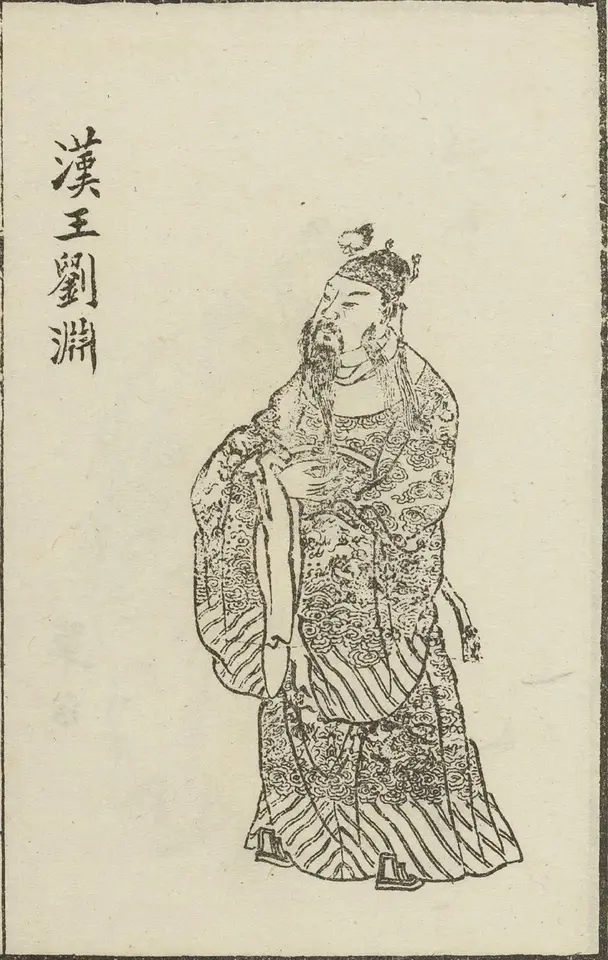 Former Zhao Dynasty (前赵)
Historical figure
Liu Yuan (刘渊, 252 – August 29, 310), courtesy name Yuanhai, native of Xinxing (modern Xinzhou, Shanxi), was the paramount chieftain of the southern Xiongnu noble Tu'ge clan and the founding emperor of Han Zhao (also known as Former Zhao), reigning from 304 to 310. A direct descendant of the Xiongnu Chanyu royal lineage through his father Liu Bao, Worthy Prince of the Left, Liu Yuan studied Confucian classics under Shangdang scholar Cui You, mastering the Book of Documents, Zuo Zhuan, and Sunzi's Art of War alongside exceptional martial equestrian skills. During his youth as a hostage in Luoyang, his imposing stature and erudition earned the profound respect of Western Jin statesmen Wang Hun and Sima Zhao. Appointed Northern Commandant in 289 and later Grand Commander of the Five Xiongnu Divisions, Liu Yuan governed his tribesmen with strict discipline and magnanimity. Amidst the destructive chaos of the War of the Eight Princes, Prince of Chengdu Sima Ying recruited Liu Yuan as an allied general. In 304, taking advantage of military mobilization orders to return to Bingzhou, Liu Yuan was acclaimed Grand Chanyu by the Xiongnu and regional nomadic confederations at Zuoguocheng. In October 304, astutely claiming dynastic succession from the Han dynasty through historic marriage treaties, he offered ancestral sacrifices to Liu Bang, Liu Xiu, and Liu Bei, proclaimed himself King of Han, and founded the Han Zhao dynasty, inaugurating the tumultuous Sixteen Kingdoms era. Politically, Liu Yuan accommodated both Chinese gentry and nomadic warriors by establishing a dual administrative system. Militarily, supported by his capable sons Liu Cong and Liu Yao alongside Jie general Shi Le, he crushed Jin regional armies across Shanxi and relocated his capital to Pingyang (modern Linfen) in 308, where he formally declared himself emperor. Between 308 and 310, Liu Yuan directed multi-pronged offensives against the Western Jin capital of Luoyang, critically eroding the imperial defenses of the Jin dynasty. In the seventh month of 310, Liu Yuan passed away in the Guangji Palace at age fifty-nine. He was posthumously honored as Emperor Guangwen with the temple name Gaozu and entombed in Yongguangling.
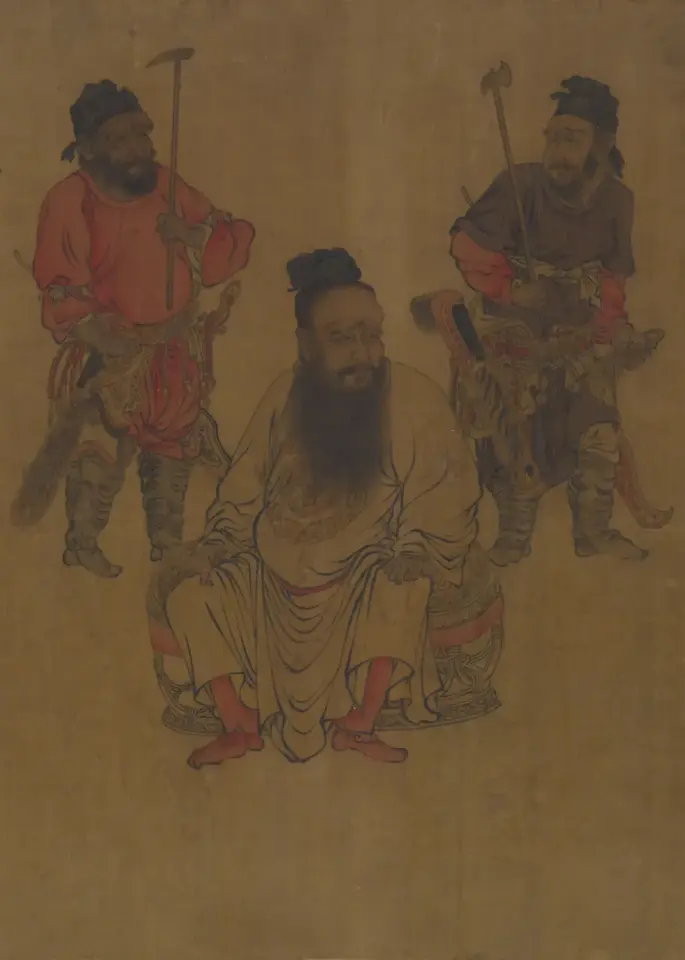 Former Zhao Dynasty (前赵)
Historical figure
Liu Cong (刘聪, c. 268 – August 31, 318), courtesy name Xuanming, original name Liu Zai, native of Xinxing (modern Xinzhou, Shanxi), was the fourth son of founding emperor Liu Yuan and the third emperor of Han Zhao (reigned 310–318), historically designated Emperor Zhaowu. Renowned from childhood for extraordinary intellectual brilliance, he mastered Confucian classics, historiography, poetry, and cursive calligraphy while demonstrating exceptional archery and combat prowess. Following his father's uprising against the Western Jin in 304, Liu Cong served as frontline commander, leading nomadic cavalry across Shanxi and repeatedly threatening the imperial capital Luoyang. In 310, following Liu Yuan's death, his eldest brother Liu He ascended the throne and immediately plotted to slaughter his capable younger brothers. Liu Cong executed a swift counter-coup, storming the palace, executing Liu He, and assuming the imperial throne under the era name Guangxing. As emperor, Liu Cong deployed armies commanded by Huyan Yan, Wang Mi, Liu Yao, and Shi Le to wage total war against Western Jin. In July 311, his armies captured and pillaged Luoyang, massacring over thirty thousand aristocrats and soldiers and capturing Emperor Huai of Jin in the cataclysmic Disaster of Yongjia. In late 316, his general Liu Yao captured Chang'an and accepted the surrender of Emperor Min of Jin, formally extinguishing the Western Jin dynasty. Administratively, Liu Cong reformed bureaucratic organs by establishing the Left and Right Grand Chanyu Assistants to separately govern nomadic and Chinese populations. However, his later reign was marked by extreme tyranny, sensual dissipation, and political paranoia. He violated traditional dynastic decorum by simultaneously elevating up to seven empresses, constructed lavish palaces, and delegated supreme judicial authority to corrupt palace eunuchs such as Wang Shen and treacherous in-law Jin Zhun. In 317, he executed Crown Prince Liu Ai and butchered thousands of imperial guards based on fabricated treason charges. Liu Cong died of illness in Pingyang in August 318 at age fifty, buried in Xuanguangling Mausoleum.
 Former Zhao Dynasty (前赵)
Fourth Monarch of Han Zhao (reigned 318)
Liu Can (刘粲, died 318), courtesy name Shiguang, was a native of Xinxing (modern Xinzhou, Shanxi Province) belonging to the noble Xiongnu royal lineage, and the fourth emperor of the Han Zhao (Former Zhao) dynasty during the Sixteen Kingdoms era. He was the son of Emperor Zhaowu Liu Cong and the grandson of the founding sovereign Liu Yuan. In his early years, Liu Can displayed distinguished martial prowess and strategic acumen, initially created Prince of Henei. Serving as vanguard commander during the Yongjia upheavals, he spearheaded offensives into the central plains, capturing the Western Jin capital of Luoyang, eliminating Prince of Nanyang Sima Mo in Chang'an, and storming Jinyang to rout Bingzhou governor Liu Kun. In 317, Liu Can was invested as Prince of Jin and designated Crown Prince, concurrently serving as Grand Chancellor and Grand Chanyu while commanding the imperial palace guards and overseeing administrative affairs. However, as his power expanded, he became arrogant and indulged in luxury. In July 318, following the demise of Liu Cong, Liu Can ascended the imperial throne in Pingyang, inaugurating the Hanchang era. Abandoning mourning protocols, he devoted himself to sensual pleasures in the inner palace and delegated state governance and military authority to his father-in-law, Minister of Works Jin Zhun. Harboring treasonous ambitions, Jin Zhun fabricated accusations against senior imperial princes, including Grand Preceptor Liu Jing and Grand Marshal Liu Ji, claiming they were plotting insurrection. Gullible and reckless, Liu Can executed dozens of imperial kinsmen without trial, dismantling his dynasty's defensive bulwark. In August 318, Jin Zhun orchestrated a violent palace coup, stormed the Guangji Hall, and executed Liu Can before slaughtering the imperial Liu clan in Pingyang. Liu Can reigned for merely forty-odd days, and his successor Liu Yao posthumously honored him as Emperor Yin.
Historical figure
Liu Yao (刘曜, c. 280–329), courtesy name Yongming (永明), from Xinxing Commandery (modern Xinzhou, Shanxi Province), was of Southern Xiongnu origin. He was the fifth and final emperor of the Former Zhao (Han Zhao) dynasty during the Sixteen Kingdoms period and one of the preeminent military commanders of the northern dynastic era. As the son of Emperor Xuancheng (Liu Lu) and a fraternal nephew of founding monarch Emperor Guangwen (Liu Yuan), Liu Yao lost his father in infancy and was brought up directly by Liu Yuan. Renowned for towering stature, martial audacity, and superb archery that could pierce inch-thick iron plates, he was acclaimed as the Divine Archer and praised by Liu Yuan as the fleet steed of the clan. In 304, when Liu Yuan established the Han dynasty, Liu Yao served as General Establishing Might, spearheading campaigns to conquer Xuanshi and Tunliu. In 311 (5th year of Yongjia), Liu Yao joined Shi Le and Wang Mi in storming the Western Jin capital of Luoyang, capturing Emperor Huai and Empress Dowager Yang. In 316, he besieged Chang'an, accepting the unconditional surrender of Emperor Min and terminating Western Jin rule across northern China. Following the catastrophic coup of Jin Zhun in Pingyang in 318, Liu Yao ascended the imperial throne at Chibi, adopting the reign era Guangchu. In 319, he relocated the capital to Chang'an and renamed the dynasty Zhao (historically known as Former Zhao), while Shi Le broke away to establish Later Zhao. During his decade-long rule over Guanzhong and Longyou, Liu Yao subjugated Di and Qiang insurgencies, annihilated rebel Chen An, and compelled Zhang Mao of Former Liang to render tributary vassalage. In 328, during the escalating conflict with Later Zhao, he shattered Shi Hu's veterans at Gaohou before besieging Luoyang. However, succumbing to habitual intoxication and tactical overconfidence, Liu Yao was wounded, unhorsed, and captured in battle on the frozen Luo River in late 328, being executed in Xiangguo the following year before Former Zhao collapsed.