Birth in the Imperial Palace
Born in Luoyang as the sixth son of Emperor Wu, by Lady Shen
277 CE–304 CE
司马乂
Sima Ai (司马乂, 277–304), courtesy name Shidu (士度), was an imperial prince, prominent military commander, and key figure of the Western Jin dynasty during the War of the Eight Princes. He was the sixth son of Emperor Wu of Jin (Sima Yan) and a younger half-brother of Emperor Hui (Sima Zhong). Initially enfeoffed as Prince of Changsha, Sima Ai was demoted to Prince of Changshan following the execution of his full brother Sima…
Sima Ai (司马乂, 277–304), courtesy name Shidu (士度), was an imperial prince, prominent military commander, and key figure of the Western Jin dynasty during the War of the Eight Princes. He was the sixth son of Emperor Wu of Jin (Sima Yan) and a younger half-brother of Emperor Hui (Sima Zhong). Initially enfeoffed as Prince of Changsha, Sima Ai was demoted to Prince of Changshan following the execution of his full brother Sima Wei, Prince of Chu. Standing seven chi five cun tall, Sima Ai possessed a resolute, discerning intellect, exceptional physical valor, and a modest, courteous demeanor toward scholar-officials, enjoying wide renown among the imperial clan. In 301, Sima Ai raised loyalist troops from Changshan to defeat the usurper Sima Lun, earning reinstatement as Prince of Changsha and promotion to General-in-Chief Pacifying the Army. In 302, when the regent Sima Jiong (Prince of Qi) grew autocratic and corrupt, Sima Ai led a daring detachment of one hundred cavalry into the imperial palace, sheltering Emperor Hui and capturing Sima Jiong after three days of ferocious street fighting. Assuming the regency as Grand Commandant, Sima Ai scrupulously respected the imperial court, referring all administrative matters to Emperor Hui. In late 303, a joint coalition of 300,000 troops led by Sima Ying (Prince of Chengdu) and Sima Yong (Prince of Hejian) besieged Luoyang. Sima Ai commanded the outnumbered garrison with remarkable tactical skill, repeatedly shattering rebel armies and decapitating tens of thousands. However, in early 304, Sima Yue (Prince of Donghai) orchestrated a treasonous palace mutiny, imprisoning Sima Ai and surrendering him to rebel general Zhang Fang, who brutally burned Sima Ai to death over a slow fire at the age of twenty-eight. Following his death, Emperor Huai posthumously conferred upon him the title Prince Li.
Born in Luoyang as the sixth son of Emperor Wu, by Lady Shen
Enfeoffed as Prince of Changsha at age thirteen and appointed Supernumerary Cavalier Attendant
Exhibited intense filial grief upon Emperor Wu's death, weeping at the imperial tomb; appointed Infantry Colonel
Following the execution of his brother Sima Wei, demoted to Prince of Changshan and exiled to his northern fief
Rose in arms from Changshan against the usurper Sima Lun, capturing Fangzi and restoring the Prince of Changsha title
Commanded one hundred palace horsemen to seize the inner citadel, defeating and executing Sima Jiong after three days of combat
Appointed Grand Commander; resisted a 300,000-man coalition outside Luoyang, routing northern armies at Jianchun Gate
Captured in a treacherous coup led by Sima Yue and burned to death by Zhang Fang at age twenty-eight
Sima Ai was born in 277 in the imperial palace of Luoyang as the sixth son of Emperor Wu of Jin. His mother was Lady Shen, who also gave birth to Sima Wei, Prince of Chu. Gifted with an imposing stature of seven chi five cun, Sima Ai exhibited decisive judgment, extraordinary martial strength, and genuine humility toward gentlemen-scholars, earning early respect throughout the Western Jin nobility. In 289, at the age of thirteen, he was enfeoffed as Prince of Changsha and granted the court rank of Supernumerary Cavalier Attendant.
In April 290, Emperor Wu passed away. The fifteen-year-old Sima Ai displayed a degree of grief that far exceeded customary ritual protocol. When his elder brother Sima Wei hurried to Luoyang from his provincial post in Jingzhou, other imperial princes gathered along the main highway to greet him; Sima Ai alone walked on foot to Emperor Wu's mausoleum, waiting beside the tomb while weeping uncontrollably. This unfeigned filial devotion moved court and country alike, leading to his appointment as Infantry Colonel.
In June 291, Sima Wei executed Grand Preceptor Sima Liang and Grand Tutor Wei Guan under secret orders from Empress Jia. Sima Ai was assigned to guard the Dongye Gate. When imperial messengers displayed the Zouyu banner declaring Sima Wei's orders fraudulent, Sima Ai discarded his weapons in tears, professing that he had acted in good faith under royal command. Following Sima Wei's summary execution, Sima Ai was demoted due to his sibling relationship to Prince of Changshan and exiled to his northern principality.
Throughout his ten years of exile in Changshan, Sima Ai accepted political adversity with calm equanimity. Rather than indulging in resentment, he devoted himself to classical texts, practiced strict personal frugality, and patronized honest scholars. Furthermore, he supervised local agricultural and hydraulic works, lightened labor burdens, and established an orderly, benevolent administration. Local commoners and gentry revered him, even erecting stone stelae to commemorate his virtuous governance.
In early 301, Zhao King Sima Lun usurped the imperial throne, imprisoning Emperor Hui. Loyal princes across the empire, led by Sima Jiong and Sima Ying, raised righteous armies in revolt. Situated in northern Changshan, Sima Ai immediately mobilized his principality's three thousand guards to join the loyalist cause.
Advancing south toward Luoyang, Sima Ai encountered the magistrate of Fangzi County, who refused passage and fortified the city walls. Sima Ai executed a swift assault, breached the defenses, and beheaded the rebellious magistrate to enforce military discipline. He then united his forces with Sima Ying, serving as a reliable rearguard for the northern coalition.
Following Sima Lun's defeat and Emperor Hui's restoration, the court rewarded Sima Ai's distinguished service. Emperor Hui reinstated him as Prince of Changsha, promoted him to General-in-Chief Pacifying the Army, and granted him the high office of General of Agile Cavalry. Sima Ai distributed all imperial monetary bounties among his officers and soldiers without retaining a single coin, earning profound admiration from the metropolitan populace.
Following his ascension as regent, Sima Jiong grew tyrannical, erecting ostentatious private palaces in Luoyang and terrorizing officials. In late 302, Sima Yong, Prince of Hejian, plotted rebellion from the Guanzhong region. Sima Yong sent secret letters encouraging Sima Ai to assassinate Sima Jiong, calculating that Sima Jiong's overwhelming force would kill Sima Ai, providing Sima Yong with a pretext to march on the capital.
Discerning this treacherous trap, Sima Ai resolved to act decisively to preserve the emperor. When Sima Jiong discovered the correspondence and dispatched troops to besiege the Changsha residence in December 302, Sima Ai mobilized over a hundred elite personal guards. Riding in open chariots, they dashed directly through the imperial palace gates. Securing the inner citadel, Sima Ai brought Emperor Hui onto the imperial pavilion, proclaiming royal decrees against the rebels.
Sima Jiong deployed tens of thousands of retainers to storm the palace. Arrows flew like hail through the imperial bedchambers, striking the dais before Emperor Hui, while fires consumed the palace gates. Fighting on the front lines, Sima Ai commanded imperial guards through three days and nights of continuous combat. Finally, Sima Ai led a mounted countercharge that breached Sima Jiong's headquarters, capturing Sima Jiong and executing him outside the Changhe Gate, restoring order to the court.
Following this victory, Sima Yong sent an assassin named Li Han to murder Sima Ai. Wang Ju, Chief Attendant of the Changsha household, detected the assassin and struck him down, preserving Sima Ai's life. Frustrated by these failures, Sima Yong issued proclamations slandering Sima Ai and allied with Sima Ying to launch a massive combined offensive against Luoyang.
Following Sima Jiong's fall, the court ministers selected Sima Ai to lead the imperial government as Grand Commandant and Commander-in-Chief of Internal and External Military Affairs. Mindful of the catastrophic dynastic damage caused by princely arrogance, Sima Ai conducted all state affairs with scrupulous modesty. Regardless of importance, every policy decision and administrative appointment was submitted to Emperor Hui for imperial approval. Furthermore, he maintained respectful diplomatic correspondence with Sima Ying at Yecheng, exhibiting exemplary ministerial loyalty.
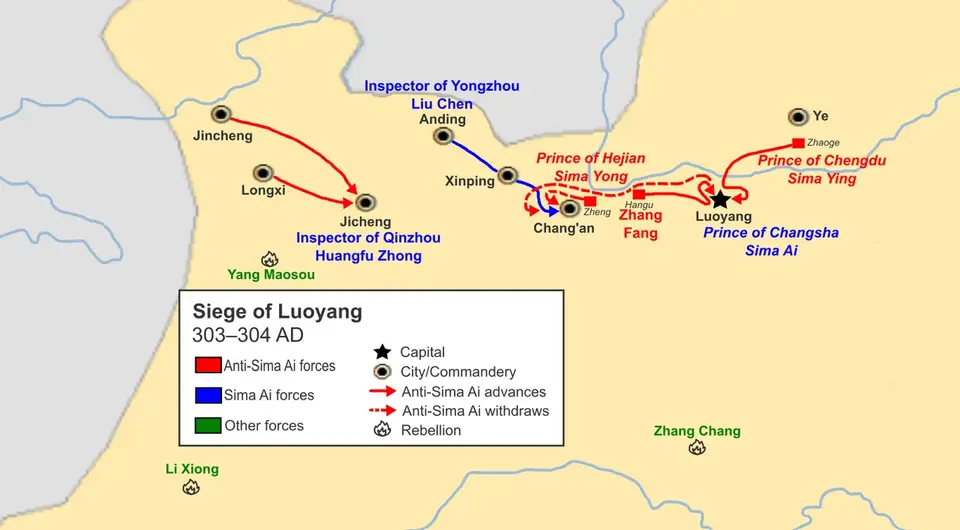
However, Sima Ai's popularity provoked the bitter envy of Sima Ying and Sima Yong. In late 303, the two princes launched a combined force of 300,000 troops against Luoyang under northern general Lu Ji and western commander Zhang Fang. Emperor Hui appointed Sima Ai as Grand Commander to direct the defense.
Outnumbered three to one, Sima Ai personally wielded his battle halberd at the Jianchun Gate, leading cavalry divisions in flanking thrusts that routed Lu Ji's army, killing general Meng Jiu and inflicting tens of thousands of casualties. He then wheeled his forces westward, crushing Zhang Fang's assault.
As the siege dragged on through the winter into early 304, food supplies in Luoyang were utterly exhausted. Grain prices soared, cavalry horses starved, and civilians stripped bark from trees. Yet Sima Ai personally shared the meager rations of his soldiers, dressing wounds and sleeping beside the garrison. Moved by his selflessness, not a single officer or soldier deserted, all swearing to fight to the death beside the Prince of Changsha.
Observing the stalemate and harboring deep jealousy of Sima Ai's martial prestige, Sima Yue, Prince of Donghai, plotted treachery. On the night of February 17, 304, Sima Yue conspired with palace guard commanders, arresting Sima Ai in a surprise coup and confining him within Jinyong Castle. When the imperial soldiers learned that Sima Ai had been betrayed, they wept openly and organized a rescue attempt.
Terrified by the prospect of a loyalist counter-coup, Sima Yue secretly dispatched messengers to Zhang Fang's camp. Zhang Fang dispatched three thousand heavy cavalry to storm Jinyong Castle and seize Sima Ai. The brutal Zhang Fang stripped Sima Ai, tied him to a wooden stake, and roasted him alive over a slow fire.
Confronting this agonizing execution with unyielding fortitude, Sima Ai submitted a final farewell memorial to Emperor Hui, lamenting the betrayal of his kin and the impending ruin of the dynasty: "I exhausted my loyalty resisting invaders, yet suffered internal betrayal from my own flesh and blood. My death is of no consequence, but I mourn that the ancestral altars shall collapse from this day forward!" Even enemy soldiers wept in sorrow at the sight. Sima Ai died a martyr at the age of twenty-eight. Following his death, Zhang Fang's barbarian armies ransacked Luoyang, burning palaces and enslaving tens of thousands. Only Liu You, a loyal former subordinate of Sima Ai, walked barefoot behind the funeral cart in mourning garb, weeping bitterly. Emperor Huai later posthumously restored his memory and conferred the title Prince Li.
In 301, Sima Ai took up arms from his northern fiefdom of Changshan to challenge the usurpation of Sima Lun. By executing the rebellious magistrate of Fangzi and uniting with the loyalist coalition, he anchored the northern offensive that destroyed Sima Lun's usurping regime and restored Emperor Hui to the throne.
Facing an assault by Sima Jiong's overwhelming metropolitan forces in 302, Sima Ai executed a brilliant preemptive strike with only one hundred cavalry, securing the inner palace and fighting for three continuous days amidst fire and arrow storms. His personal bravery crushed Sima Jiong's dictatorship and liberated the court.
During the siege of Luoyang in 303, Sima Ai faced 300,000 veteran troops led by Lu Ji and Zhang Fang. Demonstrating masterly tactical ingenuity, he launched dynamic counteroffensives from the city gates, routing northern armies, slaying enemy generals, and inflicting over sixty thousand casualties, presenting one of the most brilliant defensive campaigns of the Jin dynasty.
Throughout his tenure as regent, Sima Ai stood out as the sole Western Jin prince who subordinated personal ambition to dynastic duty. He revered the intellectually disabled Emperor Hui, shared privation with besieged commoners, and endured brutal martyrdom by fire rather than compromise his allegiance, remembered by subsequent generations as a paragon of loyalty.
FIGURES ASSOCIATED WITH THIS DYNASTY