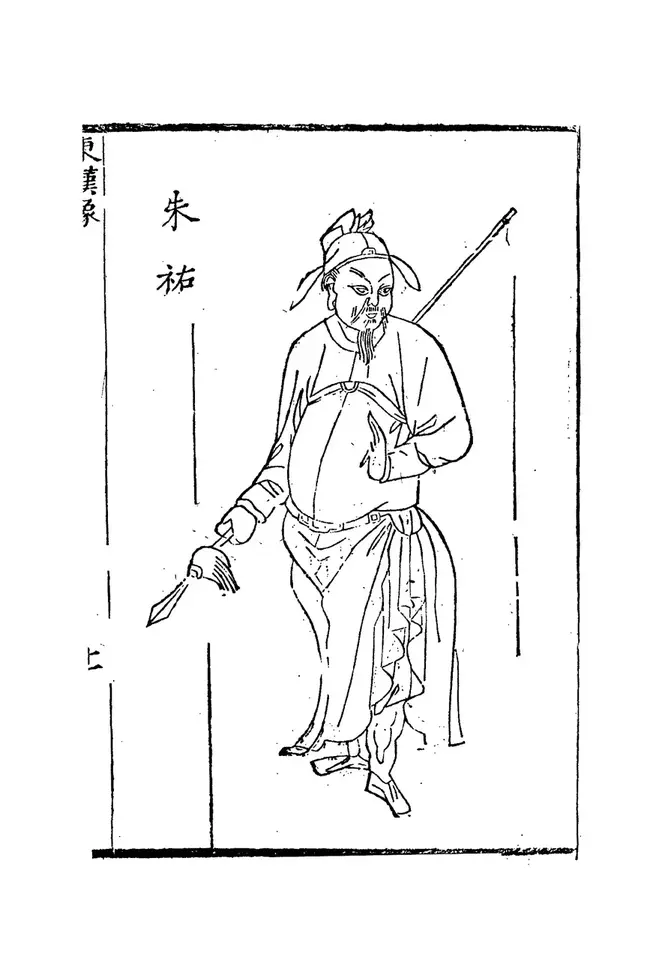
Biography
Early Orphanhood, Studies in Chang'an, and the Chongling Uprising
Zhu You was born in the third year of the Yuanyan era of Emperor Cheng of Han (10 BCE) in Wan County, Nanyang Commandery (modern Nanyang, Henan Province). Losing his father in childhood, he accompanied his mother to reside with his maternal grandfather's Liu clan in Fuyang County (east of modern Tongbai County, Henan Province). Because his maternal kinsmen belonged to the same clan as the Liu family of Chongling and Zhu You frequently traveled between Wan County and Chongling to visit relatives, he grew up in close companionship with the brothers Liu Yan (courtesy name Bosheng) and Liu Xiu, treating each other like brothers. During the Xin dynasty of Wang Mang, Zhu You accompanied Liu Xiu to the imperial capital of Chang'an, where the two attended lectures on the Confucian classics at the Imperial University and lived side by side. On one occasion in Chang'an, when Liu Xiu fell ill and lacked the money to buy honey needed for his medicine, Zhu You unhesitatingly used his own meager pocket money to purchase honey for him; on another occasion, when Liu Xiu called on Zhu You and waited for a long time, the earnest Confucian student Zhu You insisted on finishing his lecture in the classics hall before coming out to greet his friend—episodes that Emperor Guangwu cherished for the rest of his life.
As social turmoil swept the realm at the end of the Xin dynasty and the Lulin and Chimei armies rose in rebellion, Liu Yan and Liu Xiu raised their "Chongling Army" in Nanyang in the tenth month of the third year of the Dihuang era (22 CE), and twenty-two-year-old Zhu You immediately joined their ranks. When the Gengshi Emperor Liu Xuan ascended the throne by the Yu River in the second month of the first year of the Gengshi era (23 CE) and appointed Liu Yan Grand Minister over the Masses, Liu Yan named his trusted friend Zhu You Army Supervisor (Hujun) in charge of his personal guard. In the fifth month of that year, after Liu Yan captured Wan County, the Gengshi Emperor and Lulin generals grew jealous of Liu Yan's prestige and had him executed on a pretext. With Liu Xiu away at the Kunyang front, Zhu You risked his life to slip out of Wan County alone and ride day and night to bring word to Liu Xiu, who thereafter kept Zhu You constantly at his side as one of his most trusted confidants.
Pacifying Hebei and Storming Luoyang
In the tenth month of the first year of the Gengshi era (23 CE), when the Gengshi Emperor dispatched Liu Xiu across the Yellow River as Acting Grand Marshal to pacify the commanderies of Hebei, Liu Xiu reappointed Zhu You as Army Supervisor to the Grand Marshal. Throughout the Hebei campaign, Liu Xiu relied heavily on Zhu You, consulting him daily and sharing meals and quarters with him. Facing the pretender Wang Lang, who had proclaimed himself emperor in Handan and won over most of Hebei, Zhu You fought fiercely in the counteroffensive of the spring of 24 CE, repeatedly charging enemy lines to win distinction, for which Liu Xiu appointed him Lieutenant General and enfeoffed him as Marquis of Anyang. Upright and outspoken by nature, Zhu You spoke without reserve on account of his boyhood brotherhood with Liu Xiu: after the fall of Handan and the destruction of Wang Lang, Zhu You used a shared meal to urge Liu Xiu to break away from the Gengshi regime and establish independent rule, and after the pacification of Hebei he repeatedly urged Liu Xiu to proclaim himself emperor, drawing stern rebukes from the cautious Liu Xiu to guard his tongue.
Following the elimination of Wang Lang, dozens of peasant insurgent groups—including the Bronze Horses, Gaohu, Chonglian, and Five Schools—remained across Hebei, and Zhu You campaigned alongside Liu Xiu to subdue and absorb their main forces. Returning to Ji County (southwest of modern Beijing) in the winter of 24 CE, Liu Xiu ordered Zhu You along with Geng Yan, Wu Han, Jing Dan, Gai Yan, Pi Tong, Geng Chun, Liu Zhi, Cen Peng, Zhai Zun, Jian Tan, Wang Ba, Chen Jun, and Ma Wu—thirteen generals in all—to pursue the remaining insurgent bands northward. Crushing the enemy east of Lu County and at Pinggu (modern Pinggu District, Beijing) with over thirteen thousand heads taken, Zhu You and his fellow generals pursued the remnants all the way to Wuzhong (modern Jizhou District, Tianjin), Tuyin (modern Fengrun District, Tangshan), and Junmi (modern Zunhua, Hebei) in Youbeiping Commandery, clearing the northern frontier.
In the sixth month of the first year of the Jianwu era (25 CE), Liu Xiu ascended the imperial throne at Hao, founding the Eastern Han dynasty, and appointed Zhu You General-in-Chief Who Establishes Righteousness (Jianyi Dajiangjun). In the autumn of that year, to capture the central strategic metropolis of Luoyang, Emperor Guangwu placed Grand Marshal Wu Han in command of eleven generals—including Zhu You, Wang Liang, Wan Xiu, Jia Fu, Hou Jin, Feng Yi, and Jian Tan—to lay siege to Luoyang. Gengshi Grand Marshal Zhu Wei, who had participated in the murder of Liu Yan, defended the city stubbornly for months. Eventually, a subordinate commander guarding Luoyang's eastern wall secretly agreed with General Jian Tan to open the Shangdong Gate at dawn; informed immediately by Jian Tan, Zhu You led elite troops alongside Jian Tan to storm through the Shangdong Gate at daybreak, engaging Zhu Wei's main force in a bloody battle beneath the armory until the morning meal hour and compelling Zhu Wei to surrender Luoyang, which became the imperial capital.
Major Achievements
Capture at Yuyang and Escorting Qin Feng from Liqiu
In the first month of the second year of the Jianwu era (26 CE), during Emperor Guangwu's second grand enfeoffment of meritorious ministers in Luoyang, Zhu You's fief was changed to Marquis of Duyang. Shortly thereafter, when remnants of the Five Schools and Tanxiang peasant armies raided Wei Commandery (centered at Ye, southwest of modern Linzhang County, Hebei) and Qinghe Commandery, Zhu You crossed the Yellow River under Grand Marshal Wu Han along with Wang Liang, Jia Fu, and five other generals, routing the insurgents along the Zhang River east of Ye with over one hundred thousand killed or surrendered. In the spring of 26 CE, to secure the southwestern approaches to Luoyang, Zhu You led forces with Wang Chang, Jing Dan, Zhai Zun, Wang Liang, and Zang Gong south through Jiguan Pass, fighting for nearly a year to pacify the Hongnong, Yanxin, Baihua, and Manzhong insurgent strongholds; that autumn, he joined Wu Han, Jing Dan, and Geng Yan in defeating the Five Schools army at Yiyang and accepting the surrender of fifty thousand men.
Even as victories mounted on the front, however, Dong Xin and General Who Smashes the Caitiffs Deng Feng—resentful over Wu Han's soldiers plundering his home county of Xinye—rose in rebellion in Nanyang. In the eleventh month of 26 CE, Emperor Guangwu appointed Commandant of Justice Cen Peng as General-in-Chief Who Conquers the South and sent Zhu You, Jia Fu, Geng Yan, and Wang Chang south with tens of thousands of troops. Advancing deep into Yuyang (northeast of modern Xinye County, Henan Province), Zhu You was defeated and captured by Deng Feng. Because Zhu You was an old acquaintance from Luoyang, Deng Feng treated him with courtesy in camp and often played pitch-pot and board games with him. When Emperor Guangwu personally led an army to Nanyang in the third month of the third year of the Jianwu era (27 CE) and routed Deng Feng at Shunyang in the fourth month, the cornered Deng Feng asked Zhu You to mediate and walked bare-chested under Zhu You's escort to the imperial camp to plead guilty. Emperor Guangwu not only pardoned Zhu You for his capture but credited him with inducing Deng Feng's surrender, restoring his office and marquisate with generous rewards, whereupon Zhu You captured Xinye and Sui counties.
At that time, Qin Feng—who had styled himself "King of Chuli" across the Xiangyang and Nan Commandery region—held formidable power, blocking Cen Peng's advance along the Yu River. At the end of the sixth month of 27 CE, Emperor Guangwu ordered Zhu You as commander-in-chief and General Who Conquers Caitiffs Zhai Zun as deputy to lead reinforcements south. Dividing their tasks with Cen Peng, Cen Peng engaged Qin Feng's main force in the south while Zhu You confronted Qin Feng's ally Yan Cen and general Zhang Cheng in the north. In a decisive battle at Dongyang (southwest of modern Zaoyang, Hubei Province), Zhu You and Zhai Zun routed Yan Cen's army, slew Zhang Cheng in battle, forced Yan Cen to flee to Qin Feng, and captured ninety-seven seals and ribbons; advancing on Huangyou (east of modern Xinye, Henan), Zhu You received its surrender and was rewarded by Emperor Guangwu with thirty catties of gold. In the winter of 27 CE, after Han forces converged to encircle Qin Feng's capital of Liqiu (northwest of modern Yicheng, Hubei Province), Emperor Guangwu sent Cen Peng south against Tian Rong at Yiling and entrusted the siege of Liqiu to Zhu You, assisted by Hou Jin and Geng Zhi.
Taking command of the siege, Zhu You first defeated Qin Feng's officer Zhang Kang at Caiyang. In the winter of the fourth year of the Jianwu era (28 CE), Emperor Guangwu visited the siege lines at Liqiu in person and sent Censor-in-Chief Li You with an imperial letter to summon Qin Feng to surrender, but Qin Feng responded with abusive curses; furious, the emperor instructed Zhu You before returning to Luoyang to press the attack and execute Qin Feng along with his three kindreds on the spot as soon as the city fell, without sending him to the capital. In the sixth month of the fifth year of the Jianwu era (29 CE), after a year and a half of siege exhausted Liqiu's grain, Qin Feng came out bare-chested with his mother, wife, and children—nine people in all—to surrender. Compassionate by nature and devoted to Confucian benevolence, Zhu You pitied Qin Feng's aged mother and young children and could not bear to slaughter a hundred innocent family members; instead, he placed Qin Feng and his family in a cage cart and sent them to Luoyang. Although Grand Marshal Wu Han impeached Zhu You for violating imperial orders by accepting the surrender, Emperor Guangwu understood Zhu You's humane intent, executed Qin Feng alone in Luoyang while sparing his family, and recalled Zhu You without blame to join Zang Gong in clearing Yan Cen's remnants from Yin, Zan, and Zhuyang counties.
Frontier Defense Against the Xiongnu, Returning the Seal, and Yuntai Honors
Plainspoken, upright, and steeped in Confucian learning, Zhu You conducted warfare with the sole aim of capturing cities and pacifying territory rather than collecting severed heads for personal credit, strictly forbidding his soldiers from killing surrendered troops or plundering civilians. Because his strict discipline prevented his men from enriching themselves through loot, restless soldiers often grumbled, and Zhu You generously distributed his own imperial rewards among his troops.
In the spring of the ninth year of the Jianwu era (33 CE), after General-in-Chief of Agile Cavalry Du Mao and Grand Administrator of Yanmen Guo Liang were defeated at Fanshi by over ten thousand Xiongnu cavalry aiding the northern warlord Lu Fang and retreated into Loufan City (modern Loufan County, Shanxi Province), Emperor Guangwu urgently ordered Zhu You, Hou Jin, and Wang Ba to march north day and night from Luoyang to join Grand Marshal Wu Han and Wang Chang. In the sixth month of 33 CE, Zhu You and Wu Han led over fifty thousand troops into battle against Lu Fang's generals Jia Lan and Min Kan at Gaoliu (northwest of modern Yanggao County, Shanxi), where heavy rain and Xiongnu cavalry reinforcements forced the Han army back. When Wu Han returned to Luoyang, he left Zhu You stationed in Changshan Commandery, Wang Chang in Zhuo Commandery, Hou Jin in Yuyang Commandery, and Wang Ba in Shanggu Commandery. Garrisoning Nanxingtang in Changshan Commandery (modern Gujun Village, Xingtang County, Hebei Province) for years, Zhu You built fortifications and trained soldiers to deter Xiongnu and Lu Fang incursions.
In the thirteenth year of the Jianwu era (37 CE), following the destruction of Gongsun Shu in Sichuan and the complete reunification of the empire, Emperor Guangwu increased Zhu You's fief and permanently enfeoffed him as Marquis of Ge (northwest of modern Pingyuan County, Shandong Province) with a revenue of 7,300 households. Recognizing the court's transition from military conquest to civil governance, Zhu You voluntarily entered court in the second month of the fifteenth year of the Jianwu era (39 CE) to surrender his seal and ribbon as General-in-Chief Who Establishes Righteousness, remaining in Luoyang as a marquis attending court (Fengchaoqing). At the same time, citing Confucian classical precedent, he submitted two influential memorials: first, arguing that throughout antiquity no subject had ever been enfeoffed with the title of King (Wang), he proposed that all kings be re-enfeoffed as Dukes (Gong), a measure Emperor Guangwu soon enacted for imperial clansmen; second, noting that the late Western Han titles of the Three Excellencies (Da Situ, Da Sikong, Da Sima) departed from classical usage, he proposed removing the character "Grand" (Da) from the Three Excellencies (formally adopted in 51 CE when Da Sima became Grand Commandant Taiwei and the other two became Situ and Sikong).
During Zhu You's decade of retirement in Luoyang, Emperor Guangwu frequently visited his old classmate's residence to reminisce and feast. When Zhu You stood respectfully at his gate to welcome the imperial carriage, the emperor jokingly asked: "Will the host abandon Me again to go attend a lecture in the classics hall first?" On another occasion, recalling their student days in Chang'an, the emperor bestowed upon him one picul of white honey and asked: "How does this honey compare with the honey we bought together in Chang'an?" Zhu You died peacefully at home in the twenty-fourth year of the Jianwu era (48 CE) at age fifty-eight, and his son Zhu Shang succeeded to the marquisate of Ge. In the third year of the Yongping era (60 CE), Emperor Ming commissioned portraits of twenty-eight founding generals in the Yuntai Hall of the Southern Palace in Luoyang, ranking Zhu You eighth.