Biography
Pillar Historian of Qin and Deliverance by Wang Ling
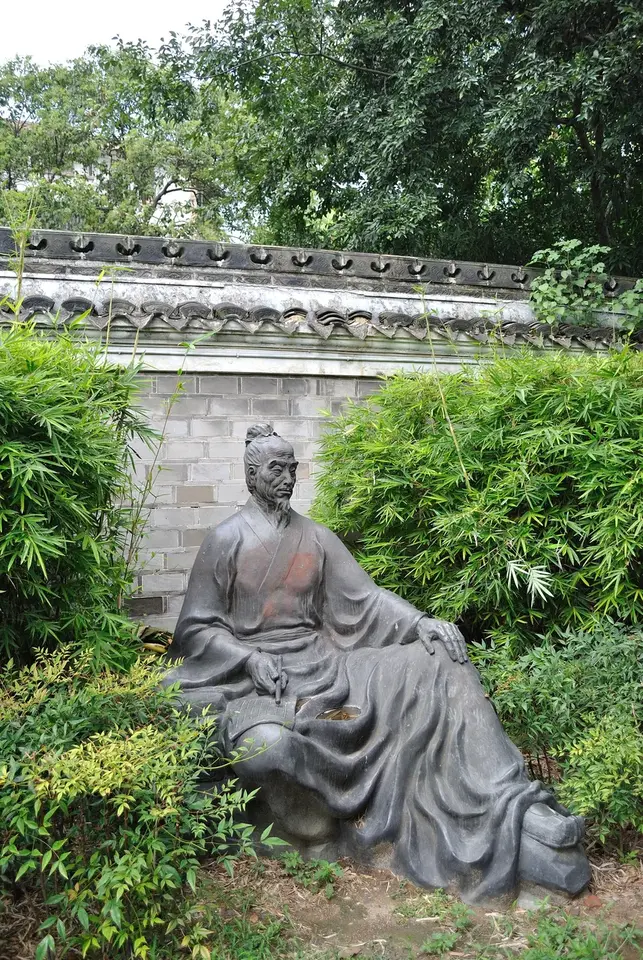
Zhang Cang was a native of Yangwu County, Sanchuan Commandery (modern-day Yuanyang County, Xinxiang City, Henan Province). Passionate from youth about books, musical harmonics, and astronomical calendars, he traveled to Lanling to study under the renowned Confucian master Xun Kuang (Xunzi) alongside fellow students Li Si and Han Fei. Entering the service of the Qin Dynasty, Zhang Cang was appointed Censor Beneath the Pillar (Zhuxiashi), responsible for recording court proceedings and overseeing the imperial library as well as administrative and fiscal archives submitted from commanderies and counties across the realm.
During the harsh reign of Qin Er Shi, Zhang Cang committed an administrative infraction and fled back to his hometown of Yangwu to escape punishment. In 207 BCE (3rd year of Qin Er Shi), when Liu Bang marched westward through Yangwu on his way to attack Nanyang, Zhang Cang joined his forces as a guest retainer. Along the march, Zhang Cang violated military law and was sentenced to beheading. Just as he removed his upper garment and lay face down on the iron chopping block, the prominent commander Wang Ling happened to pass by. Seeing that Zhang Cang was extraordinarily tall and stout, with skin as fair and glossy as gourd seeds, Wang Ling marveled at his noble appearance and hurried to Liu Bang to plead for his life. Liu Bang pardoned Zhang Cang, who subsequently followed the rebel army through Wu Pass into Xianyang and honored Wang Ling as a father for the rest of his life.
Campaigns in Zhao and Dai and Enfeoffment as Marquis of Beiping
In 206 BCE (1st year of Han), after Liu Bang was made King of Han in Hanzhong and marched north to pacify the Three Qin, Zhang Cang accompanied the campaign headquarters. In 205 BCE (2nd year of Emperor Gaozu), after Chen Yu drove out Zhang Er, King of Changshan, Liu Bang appointed Zhang Cang as Administrator of Changshan Commandery to help contest the northern plains. In the 10th month of 204 BCE (3rd year of Emperor Gaozu), Zhang Cang marched east through the Jingxing Pass under General-in-Chief Han Xin and Zhang Er; during the decisive Battle of the Zhi River against two hundred thousand Zhao troops, Zhang Cang personally captured the Zhao commander Chen Yu. After Zhao was pacified, Liu Bang appointed Zhang Cang as Chancellor of Dai to guard the northern frontier against Xiongnu raids, later transferring him to serve as Chancellor of Zhao under Zhang Er and his son Zhang Ao before returning him to the post of Chancellor of Dai.
In the autumn of 201 BCE (6th year of Emperor Gaozu), when Zang Tu, King of Yan, rebelled against the Han court, Zhang Cang led troops from Dai to join Emperor Gaozu's punitive expedition. For his battlefield distinction, he was enfeoffed in the 8th month as Marquis of Beiping with a fief of one thousand two hundred households. Recognizing that Zhang Cang possessed unmatched familiarity with the old Qin cadastral and fiscal registries as well as advanced mathematical skill, Emperor Gaozu recalled him to Chang'an and created the post of Chancellor of Accounts (Jixiang) for him. One month later, his title was changed to Chief Accountant (Zhuji); holding the rank of marquis, he worked inside Chancellor of State Xiao He's headquarters for four years, auditing the annual population, land, and tax accounts submitted by every commandery and vassal kingdom.
In 196 BCE (11th year of Emperor Gaozu), after suppressing the rebellion of Ying Bu, King of Huainan, Emperor Gaozu invested his young son Liu Chang as the new King of Huainan and appointed the experienced Zhang Cang as Chancellor of Huainan. Serving faithfully in Shouchun for fourteen years, Zhang Cang was recalled to Chang'an in 180 BCE (8th year of Empress Lü) and promoted to Censor-in-Chief, one of the Three Excellencies. Following Empress Dowager Lü's death that autumn, Zhang Cang joined Grand Commandant Zhou Bo and Right Grand Councilor Chen Ping in eliminating the Lü consort faction and welcoming Liu Heng, King of Dai, to ascend the throne as Emperor Wen of Han.
Fifteen Years as Grand Councilor and Longevity as a Centenarian
Following the death of Grand Councilor Guan Ying in the 12th month of 176 BCE (4th year of Emperor Wen), Emperor Wen appointed Zhang Cang as Grand Councilor in the 1st month of 175 BCE. More than two decades after the founding of the dynasty, when almost all senior ministers at court were former military commanders, Zhang Cang stood out as an encyclopedic scholar of institutional texts, music, and calendars. Even as head of the bureaucracy, he never forgot the debt he owed to his benefactor Wang Ling, Marquis of Anguo. Though Wang Ling had already passed away, whenever Zhang Cang had his routine five-day administrative holiday (xiumu), he would always ride first to the residence of Lady Wang (Wang Ling's widow) to pay his respects and present fine food before daring to return to his own home.
Because Emperor Gaozu had originally entered Guanzhong and encamped at Bashang in the 10th lunar month—the first month of the old Qin year—Zhang Cang calculated the cycle of the Five Virtues (Wude Zhongshi) and concluded that the Han Dynasty ruled under the Virtue of Water (Shuide), just as Qin had. He therefore instituted the continued use of the Qin Zhuanxu Calendar (which began the year in the 10th month) and retained black as the dynasty's ritual color, setting aside proposals by Jia Yi and others to switch to the Virtue of Earth and the color yellow.
In 166 BCE (14th year of Emperor Wen), a scholar from Lu named Gongsun Chen submitted a memorial arguing that Han ruled by the Virtue of Earth, which conquered Water, and predicting that a yellow dragon would soon appear as an auspice. Referred the memorial by the emperor, Zhang Cang dismissed it as unfounded. However, in the spring of 165 BCE (15th year of Emperor Wen), a yellow dragon was reported at Chengji County in Tianshui Commandery. Delighted, Emperor Wen summoned Gongsun Chen, appointed him Erudite (Boshi), and ordered the drafting of a new ritual calendar aligned with the Virtue of Earth. Humbled by this turn of events, Zhang Cang began excusing himself from court audiences on the pretext of illness. Soon afterward, an official whom Zhang Cang had recommended for the post of Zhonghou was exposed for corrupt profiteering; rebuked by Emperor Wen, Zhang Cang formally resigned on grounds of illness in the 8th month of 162 BCE (2nd year of the Houyuan era), having served as Grand Councilor for fifteen years.
In his retirement, Zhang Cang was so advanced in years that he had lost all his teeth and could no longer chew solid grain or meat, sustaining himself entirely by drinking human milk provided by wet nurses. Fond of female company, he kept nearly a hundred wives and concubines in his household, never again approaching any woman who had once conceived and borne a child. Living past the age of one hundred, the venerable statesman died in 152 BCE (5th year of the Qianyuan era of Emperor Jing) and was honored with the posthumous name Wen (Marquis Wen of Beiping).
Major Achievements
Auditing Imperial Finances and Institutionalizing the Annual Accounting System
At the founding of the Western Han, decades of war had left state population and tax records in disarray. Drawing on his archival experience as a Qin Pillar Historian and his mastery of arithmetic, Zhang Cang served for four years as Chancellor of Accounts and Chief Accountant in Xiao He's chancellery, establishing the rigorous Western Han annual accounting system (shangji). By auditing and compiling annual reports on household registration, cultivated acreage, and tax revenues from every commandery and kingdom, he provided the central government with accurate fiscal data to sustain early Han recovery policies.
Standardizing Musical Harmonics, the Calendar, and Weights and Measures
Over more than two decades as Chief Accountant and Grand Councilor, Zhang Cang personally directed the codification of early Han calendrical science, musical pitch, and metrology. While maintaining the Zhuanxu Calendar, he calibrated the twelve pitch pipes (lüguan) to harmonize the five tones and eight timbres, and used the length, volume, and millet-grain weight of the Yellow Bell (Huangzhong) pitch pipe to derive unified national standards for length (du), capacity (liang), and weight (heng) across all crafts and markets. As Sima Qian noted, every specialist in harmonics and calendrical science throughout the Western Han traced their scholarly lineage to Zhang Cang.
Revising The Nine Chapters on the Mathematical Art
Applying mathematics directly to fiscal administration, civil engineering, land surveying, and grain taxation, Zhang Cang played a pivotal role in preserving and advancing ancient Chinese mathematics. Following the destruction of pre-Qin treatises during the Qin burning of books, Zhang Cang collected surviving mathematical bamboo slips and systematically edited, supplemented, and organized them into the foundational structure of The Nine Chapters on the Mathematical Art (Jiuzhang Suanshu). Covering 246 practical problems across nine categories—including field measurement, grain exchange, proportional distribution, engineering calculations, equitable taxation, and right-angled triangles—this work became the cornerstone of classical Chinese mathematics for over a millennium.