Left Leader
Appointed Left Leader (Zuo Shuzhang); captured Xincheng in Han.
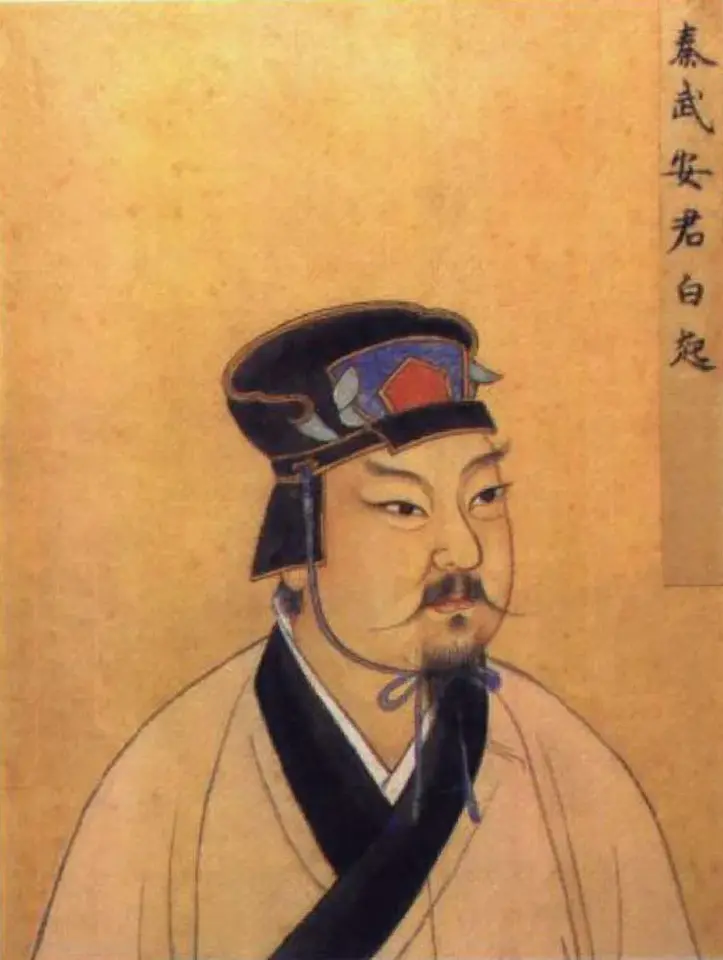
?–257 BCE
白起
Bai Qi (白起, ?–257 BCE), also known as Gongsun Qi, a native of Meiyi (modern Meixian County, Shaanxi), was an extraordinary military strategist, undefeated commander-in-chief of the State of Qin, and universally revered as the foremost of the "Four Great Generals of the Warring States" (Zhanguo Si Mingjiang). A supreme master of operational maneuver, psychological warfare, and battles of annihilation (Jianmie Zhan), Bai Qi…
Bai Qi (白起, ?–257 BCE), also known as Gongsun Qi, a native of Meiyi (modern Meixian County, Shaanxi), was an extraordinary military strategist, undefeated commander-in-chief of the State of Qin, and universally revered as the foremost of the "Four Great Generals of the Warring States" (Zhanguo Si Mingjiang). A supreme master of operational maneuver, psychological warfare, and battles of annihilation (Jianmie Zhan), Bai Qi served King Zhaoxiang of Qin for over three decades, rising through the meritocratic twenty-tier military honor system from Left Leader to State Commandant and ennobled as the Lord of Wu'an (Wu'an Jun). He directed massive campaigns across ancient China, triumphing in more than seventy battles without suffering a single defeat. At the Battle of Yique (293 BCE), he routed the combined Han-Wei host, decapitating 240,000 soldiers. During the invasion of Chu (279–278 BCE), he breached the southern mountain passes, flooded Yan city, captured the Chu capital of Ying, and burned the ancestral burial mounds of the Chu royalty. At the climactic Battle of Changping (260 BCE), Bai Qi feigned retreat, enveloped the massive Zhao army led by Zhao Kuo, and eliminated over 450,000 enemy troops, permanently shattering the balance of power among the Warring States. Later embroiled in political friction with King Zhaoxiang and Chancellor Fan Ju over the siege of Handan, Bai Qi was stripped of rank and ordered to commit suicide at Duyou.
Appointed Left Leader (Zuo Shuzhang); captured Xincheng in Han.
Promoted to Left Geng; annihilated 240,000 Han-Wei allied troops at Yique; elevated to State Commandant.
Promoted to Supreme Dignitary (Daliangzao); seized sixty-one towns and fortresses from Wei.
Led Qin forces against Zhao, capturing Guanglangcheng in the Dai region.
Diverted rivers to inundate Yan city; conquered the Chu heartland.
Stormed the Chu capital of Ying; annexed Nan Commandery; ennobled as Lord of Wu'an (Wu'an Jun).
Conquered Wu Commandery and the Jiangnan region alongside Zhang Ruo.
Executed an eighty-mile daily forced march; crushed the Wei-Zhao coalition at Huayang, capturing 150,000 troops.
Attacked Xingcheng in Han, capturing nine fortresses and decapitating 50,000 enemy troops.
Secretly appointed Supreme Commander; encircled Zhao Kuo's army, eradicating over 400,000 Zhao troops.
Refused King Zhaoxiang's order to assume command of the siege of Handan, warning of imminent defeat.
Ordered to commit suicide by imperial sword at Duyou following strategic dissent against King Zhaoxiang.
Bai Qi rose from the plebeian ranks in Meiyi during the zenith of King Zhaoxiang's reign, when the legalist reforms of Shang Yang and the military merit system (Jungong Juezhi) allowed men of exceptional talent to rise regardless of aristocratic pedigree. Recommended by Prime Minister Wei Ran (Marquis of Rang), Bai Qi was entrusted with independent command in 293 BCE when a colossal joint army of 240,000 Han and Wei soldiers blocked the strategic Yique defile (modern Longmen, Luoyang). Observing that the Han and Wei armies operated under separate commands with mutual distrust, Bai Qi deployed weak diversionary units against the Han forces while concentrating Qin's elite shock divisions against Wei's flank. The Wei army collapsed in panic, sparking a total rout. Bai Qi's cavalry pursued relentlessly, beheading 240,000 enemy troops and capturing commander Gongsun Xi.
In 279 BCE, Bai Qi launched a daring deep-penetration invasion into the Kingdom of Chu. Bypassing heavily fortified border strongholds, he sailed down the Han River and encircled Yan, Chu's secondary capital. Bai Qi constructed massive dikes upriver and dug canal trenches, releasing roaring torrents that submerged Yan's mud walls, drowning hundreds of thousands of defenders and civilians. In 278 BCE, he struck Ying, Chu's historic capital, forcing King Qingxiang of Chu to flee eastward to Chen. Bai Qi leveled Chu's imperial shrines at Yiling, carving out Nan Commandery and securing Qin's southeastern border. King Zhaoxiang rewarded him with the highest military peerage: Lord of Wu'an.
In 262 BCE, the strategic struggle between Qin and Zhao erupted over Shangdang Commandery. By 260 BCE, the two greatest military powers of the era confronted each other across the Dan River at Changping. After Zhao's veteran general Lian Po entrenched behind impregnable stone ramparts, Qin secretly orchestrated rumors that Qin feared the inexperienced young theorist Zhao Kuo. When King Xiaocheng of Zhao replaced Lian Po with Zhao Kuo, King Zhaoxiang immediately and secretly appointed Bai Qi as Supreme Commander, imposing the death penalty on anyone who divulged the secret.
When Zhao Kuo ordered a general offensive, Bai Qi deliberately retreated, drawing the massive Zhao army into a narrow basin. He then deployed a mobile vanguard of 25,000 warriors to sever Zhao Kuo's rear communication corridors, while 5,000 elite horsemen drove a wedge between the Zhao forward divisions and their base camp. Completely surrounded without food or water for forty-six days, the Zhao soldiers turned to cannibalism. When Zhao Kuo led his elite shock units in a desperate breakout attempt, he was killed by Qin archers. The entire remaining force of over 400,000 men surrendered. Fearing that such a colossal mass of prisoners would rebel once Qin departed, Bai Qi ordered the clandestine mass execution of the captives, sparing only 240 young youths to return to Zhao and spread terror throughout the central plains.
Following the triumph at Changping, Bai Qi advocated an immediate march on Handan to eradicate Zhao completely before other states could mobilize. However, Prime Minister Fan Ju (Marquis of Ying), jealous of Bai Qi's soaring prestige and anxious that Bai Qi would eclipse him at court, persuaded King Zhaoxiang to accept Zhao's peace petition in exchange for territory. This strategic hesitation allowed Zhao to rally, form alliances with Wei and Chu, and fortify Handan.
When King Zhaoxiang decided to resume the siege of Handan in late 259 BCE, Bai Qi strongly opposed the operation, arguing that Zhao was now united in desperation and that allied armies would inevitably assault Qin's rear. King Zhaoxiang insisted, dispatching generals Wang Ling and Wang He, who suffered catastrophic defeats outside Handan. Enraged when Bai Qi remarked that his warnings had proven true, King Zhaoxiang ordered Bai Qi to take command despite severe illness. Bai Qi adamantly refused to lead an army doomed to failure.
In late 257 BCE, King Zhaoxiang stripped Bai Qi of all noble ranks, demoting him to an ordinary infantryman and ordering him exiled to Yinmi. When Bai Qi reached Duyou outside Xianyang, King Zhaoxiang, egged on by Fan Ju's slanders that Bai Qi was harboring seditious bitterness, sent an imperial messenger bearing a ceremonial sword, commanding him to commit suicide. Looking toward the heavens, Bai Qi lamented: "How have I offended Heaven to merit this fate?" After a long silence, he sighed: "Indeed, I deserve to die. At Changping, several hundred thousand Zhao soldiers surrendered to me, and I deceitfully slaughtered them all. This alone is sufficient to warrant my death." He then drew the sword and ended his life.
Commanding over seventy major engagements across three decades without a single defeat, Bai Qi pioneered the strategic doctrine of battles of annihilation (Jianmie Zhan), systematically destroying the field armies of Han, Wei, Chu, and Zhao.
Elevated through the patronage of Chancellor Wei Ran under Qin's meritocratic military honor system, Bai Qi later clashed with Chancellor Fan Ju over the timing of the final assault on Handan, illustrating the tension between frontline military strategy and court diplomacy.
From Meiyi and Xianyang in Guanzhong to Yique in Henan, Yan and Ying in Hubei, Huayang, and Changping in Shanxi, Bai Qi's campaigns redrew the territorial map of Warring States China.
Facing renowned adversaries such as Gongsun Xi, Lian Po, and Zhao Kuo while serving alongside Qin generals Sima Cuo and Wang He, Bai Qi stood as the premier military figure of the late Warring States era.
Contemporary strategists and scholars such as Cai Ze and Xunzi marveled at Bai Qi's unmatched battlefield record across seventy engagements.
Sima Qian in the Records of the Grand Historian celebrated Bai Qi's operational supremacy while recording the sorrow of his demise: "Bai Qi possessed unmatched mastery in dividing forces, capturing fortresses, and deploying unexpected maneuvers; his name caused terror across the feudal realms, yet he was betrayed by court slanders and perished at Duyou. The people of Qin pitied him and established shrines in his honor."
Tang and Song commentators honored Bai Qi in the Martial Temple (Wumiao) while debating the moral and strategic consequences of the mass execution of Zhao captives at Changping.
Classical and modern military theorists study Bai Qi's operations at Yique, Yan, and Changping as the world's earliest fully documented paradigms of envelopment, strategic deception, and warfare of annihilation, establishing the indispensable material baseline for the ultimate Qin unification of China.
FIGURES ASSOCIATED WITH THIS DYNASTY