Noble Birth
Born in Chang'an into the Guanlong military elite as the eldest son of Yuwen Shu.
619 CE
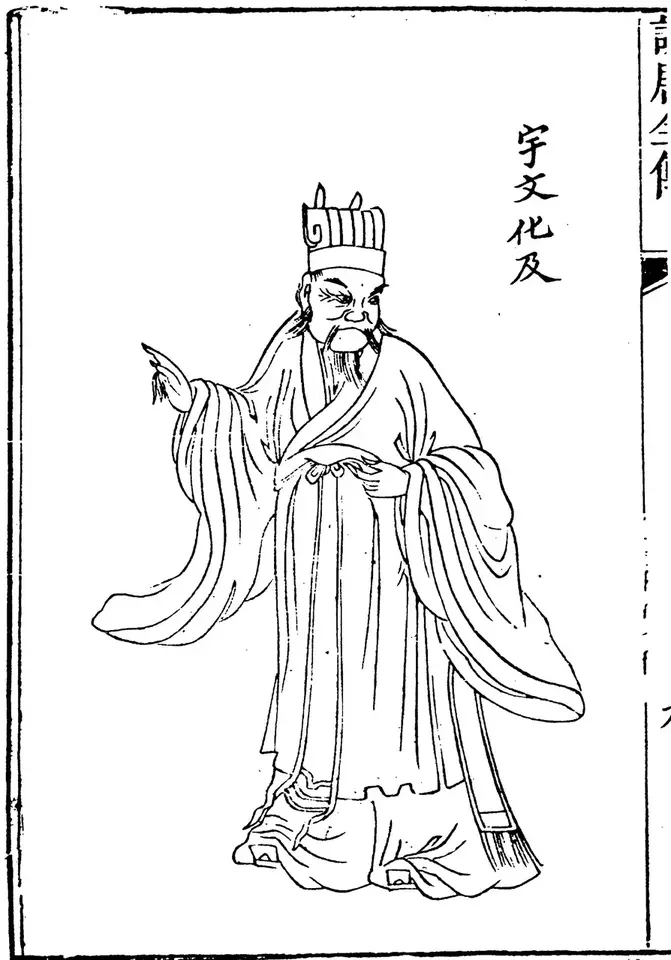
宇文化及
Yuwen Huaji (c. 569–619), a native of Wuchuan in Dai Commandery, was a Sinicized Xianbei military leader and founder of the short-lived Great Xu regime during the turbulent transition from Sui to Tang. He was the eldest son of Yuwen Shu, Duke of Xu and a prominent founding general of the Sui dynasty. Relying upon his noble lineage and close ties to Crown Prince Yang Guang, he served as Attendant in the Crown Prince's…
Yuwen Huaji (c. 569–619), a native of Wuchuan in Dai Commandery, was a Sinicized Xianbei military leader and founder of the short-lived Great Xu regime during the turbulent transition from Sui to Tang. He was the eldest son of Yuwen Shu, Duke of Xu and a prominent founding general of the Sui dynasty. Relying upon his noble lineage and close ties to Crown Prince Yang Guang, he served as Attendant in the Crown Prince's Household and Vice Minister of the Imperial Stud. Despite repeated dismissals for corruption and illegal frontier trade with the Turks, he was consistently pardoned through Emperor Yang's personal favor and later appointed Senior General of the Right Garrison Guards. In April 618, capitalizing on the homesickness of the Xiaoguo Guards at Jiangdu, Yuwen Huaji was chosen as figurehead leader of the Jiangdu Mutiny, assassinating Emperor Yang and assuming the title of Grand Chancellor while enthroning Prince of Qin Yang Hao as a puppet. Leading over a hundred thousand troops northward to retake Guanzhong, he was intercepted and defeated by Li Mi's Wagang army at Liyang and Mount Tong, retreating to Weixian. Facing certain ruin, he poisoned Yang Hao, proclaimed himself Emperor of Xu, and inaugurated the Tianshou era, leaving the notorious remark: 'Since a man must die, shall he not be an emperor for a single day?' In 619, he was besieged at Liaocheng by Dou Jiande, captured, and publicly beheaded in Hejian, with his severed head sent to the Turkic khaganate.
Born in Chang'an into the Guanlong military elite as the eldest son of Yuwen Shu.
Appointed Attendant to Crown Prince Yang Guang, winning his intimate confidence.
Promoted to Vice Minister of the Court of the Imperial Stud; repeatedly pardoned for graft.
Imprisoned for illegal horse trading with Turks at Yulin; spared execution and demoted to bondservant.
Pardoned upon Yuwen Shu's deathbed plea and restored as Senior General of Right Garrison Guards.
Led the military mutiny that assassinated Emperor Yang, declaring himself Grand Chancellor.
Enthroned puppet emperor Yang Hao and led over a hundred thousand troops north toward Guanzhong.
Clashed with Li Mi's Wagang army at Mount Tong, suffering severe casualties and troop desertions.
Poisoned Yang Hao at Weixian and proclaimed himself Emperor of the Great Xu, styling the era Tianshou.
Exhausted provisions at Weixian and retreated to Liaocheng, where he was besieged by Dou Jiande.
Opened the gates of Liaocheng after heavy bombardment; denounced for regicide and bound in chains.
Publicly executed alongside his brother and sons in Dali County; his head was sent to Princess Yicheng.
Yuwen Huaji was born into a prominent Guanlong military aristocracy in Chang'an during the early Kaihuang era of the Sui dynasty. He was the eldest son of Yuwen Shu, Duke of Xu and Senior General of the Left Imperial Insignia Guards, who was a founding pillar of the Sui Empire. His younger brothers Yuwen Zhiji and Yuwen Shiji held prestigious appointments. Relying upon his family's prestige, Yuwen Huaji disliked classical scholarship, developing an arrogant, reckless, and insatiably avaricious temperament, spending his days in profligate amusement across Chang'an.
When Yang Guang, Prince of Jin, was designated Crown Prince, Yuwen Shu mobilized his clan's influence to support his succession. Reciprocating this loyalty, Yang Guang favored the Yuwen family, appointing Yuwen Huaji as Attendant in the Crown Prince's Household and marrying his beloved daughter Princess Nanyang to Yuwen Huaji's third brother Yuwen Shiji. In the Eastern Palace, Yuwen Huaji indulged Yang Guang's lavish tastes, becoming an intimate and favored companion to the heir apparent.
In 605, Emperor Yang of Sui ascended the throne, elevating Yuwen Huaji to Vice Minister of the Court of the Imperial Stud, placing him in charge of imperial stables and livestock. However, his rapacious nature remained unabated. Relying on imperial favor, he accepted vast bribes and abused administrative authority, repeatedly facing impeachment from the Censorate, only to be promptly pardoned and reinstated through Emperor Yang's intervention.
During Emperor Yang's imperial tour to Yulin on the northern grasslands, strict edicts prohibited officials and commoners from conducting private trade in ironware and warhorses with the Tujue (Turkic) khaganates under penalty of execution. Driven by greed, Yuwen Huaji secretly dispatched trusted servants carrying prohibited goods to trade with the Turks for substantial profits. When discovered, Emperor Yang was outraged, ordering the immediate arrest of Yuwen Huaji and his brother Yuwen Zhiji, demanding their execution upon return to Chang'an.
Arriving in Chang'an, Emperor Yang recalled Yuwen Shu's decisive support in securing his succession. Moved by Princess Nanyang's tearful pleading, the emperor spared their lives, stripping their official ranks, confiscating their estates, and reducing them to domestic bondservants.
During Emperor Yang's frequent military expeditions and imperial progresses, Yuwen Huaji accompanied the imperial cortege as a close courtier. From the western campaign across the snowbound Qilian Mountains against the Tuyuhun to three disastrous invasions of Goguryeo that littered Liaodong with unburied soldiers, Yuwen Huaji witnessed the rapid breakdown of the imperial state apparatus. While soldiers perished and popular rebellion mounted, Yuwen Huaji amassed private fortunes under imperial patronage, deepening fissures within the Guanlong aristocracy.
In spring 618, as widespread uprisings engulfed central China and the Guanzhong heartland, Emperor Yang remained stranded in his southern traveling palace at Jiangdu, fearful of returning north. The accompanying Xiaoguo Guards, numbering over a hundred thousand elite troops predominantly hailing from Guanzhong, grew demoralized by prolonged separation from their families amidst news of devastating famines at home. Rather than addressing their grievances, Emperor Yang executed deserters and intensified surveillance, driving the guards to the brink of mutiny.
As troop dissatisfaction reached a boiling point, Guard Commanders Sima Dekan, Yuan Li, and Pei Qiantong organized a covert conspiracy to flee toward Guanzhong. Learning of the plot, Yuwen Zhiji urged Sima Dekan to escalate the desertion into a dynastic coup, proposing his elder brother Yuwen Huaji, who possessed illustrious noble pedigree, as the supreme commander of the rebel forces.
Yuwen Huaji was cowardly by nature; when first informed of the conspiracy, he trembled in terror. However, coerced by Sima Dekan and tempted by supreme authority, he agreed to lead the insurrection. On the night of April 11, 618, Sima Dekan led rebel guards into the imperial chambers, cornering Emperor Yang within the Wudan Pavilion. Recognizing his doom, Emperor Yang unfastened his silk scarf and hanged himself, bringing a violent end to Sui imperial rule.
During the mutiny, Sima Dekan and Pei Qiantong raided the imperial guard barracks, capturing and executing senior chancellors including Yu Shiji and Pei Yun, sealing off the Jiangdu palace. Rebel commanders escorted a terrified Yuwen Huaji into the grand hall, forcing civil and military officials at swordpoint to submit before him. Sitting upon the dais in visible agitation, Yuwen Huaji dared not look his former peers in the eye, exposing his indecisive and opportunistic nature.
Following the regicide, Yuwen Huaji proclaimed himself Grand Chancellor, assuming supreme executive authority and enthroning Emperor Yang's nephew, Yang Hao (Prince of Qin), as a puppet emperor. He slaughtered surviving imperial princes and loyalist ministers, looted decades of accumulated treasures from Jiangdu, appropriated royal concubines and thousands of imperial carriages, and led over a hundred thousand Xiaoguo troops northward along the Grand Canal to force their way back to Guanzhong.
Lacking logistical foresight, Yuwen Huaji treated the looted palace treasures and concubines as private property. Thousands of royal dragon boats and baggage wagons slowed the march, while surrounding commanderies lay devastated by warfare, unable to provide grain. Consuming vast rations daily without resupply, the troops were forced to slaughter their horses for food, succumbing to starvation and resentment.
Yuwen Huaji's northward advance met severe resistance. In Luoyang, Prince of Yue Yang Tong and Wang Shichong fortified the passes, while Wagang rebel leader Li Mi deployed over a hundred thousand veteran troops at Liyang to block the rebels. Reaching Huatai, Yuwen Huaji encountered fierce resistance from Li Mi's army, culminating in a ferocious battle at Mount Tong that littered the landscape with casualties. The exhausted Xiaoguo troops were routed, and Yuwen Huaji's forces disintegrated.
During the engagements around Huatai and Liyang, Li Mi exercised tactical mastery. Coordinating with Wang Shichong in Luoyang, Li Mi caught Yuwen Huaji in a pincer movement. Although Li Mi was wounded by an arrow during the Battle of Mount Tong, general Qin Qiong rescued him and rallied retreating units, while Xu Shiji severed rebel supply lines from the Liyang granaries. Deprived of food, Yuwen Huaji's troops mutinied and surrendered in droves to Wagang and Tang forces.
Following the disaster at Mount Tong, Yuwen Huaji realized he could not enter Luoyang or Guanzhong, retreating with twenty thousand remnants to Weixian. Subordinate commanders such as Sima Dekan plotted against him, prompting Yuwen Huaji to execute suspicious generals and shattering discipline. In despair, Yuwen Huaji lamented: 'Since a man must die, shall he not be an emperor for a single day?' In September 618, he poisoned puppet emperor Yang Hao and declared himself emperor.
Yuwen Huaji proclaimed the founding of the Great Xu dynasty, styling the era Tianshou and appointing ministers in an absurd dynastic farce. In spring 619, depleted of provisions at Weixian, he moved his remnants to Liaocheng. King of Xia Dou Jiande, leading a hundred thousand troops under the banner of avenging Emperor Yang, advanced by land and water to besiege Liaocheng with assault engines. Cut off from relief, Yuwen Huaji surrendered.
Entering Liaocheng, Dou Jiande greeted Empress Dowager Xiao with respectful mourning. He placed Yuwen Huaji, his brother Yuwen Zhiji, and his sons Yuwen Chengji and Yuwen Chengzhi in heavy wooden cangues, escorting them to Dali County in Hejian. Before his assembled troops, Dou Jiande publicly denounced Yuwen Huaji for regicide and treason, ordering their public beheading in the marketplace and sending Yuwen Huaji's head in a wooden coffer to Princess Yicheng of the Turks.
The Jiangdu Mutiny marked a pivotal turning point in the transition from Sui to Tang. As Emperor Yang's most favored courtier, Yuwen Huaji succumbed to ambition and regicide, terminating Sui central governance in southern China and creating a power vacuum in the Central Plains. His betrayal shattered the traditional loyalty of the Guanlong nobility, accelerating the rise of the Li Tang dynasty in Guanzhong.
Leading a hundred thousand Xiaoguo soldiers toward Chang'an, Yuwen Huaji lacked strategic vision, suffering total collapse against Li Mi's Wagang army at Liyang and Mount Tong. In hopeless isolation at Weixian, he poisoned Yang Hao and proclaimed himself emperor for eighty-three days, leaving the infamous lament: 'Shall a man not be an emperor for a day?' His career serves as a classic historical lesson on the self-destruction of unprincipled ambition.
Yuwen Huaji's career reflected the moral and political bankruptcy of the late Sui Guanlong nobility. Elevated through hereditary privilege, he lacked military competence. His regicide plunged China into factional bloodshed and destroyed the reputation of the Yuwen clan, ensuring his condemnation as an incompetent traitor in imperial historiography.
As one of the most incompetent and treacherous figures of the late Sui civil wars, Yuwen Huaji's career exemplified how unearned aristocratic privilege and reckless ambition lead to catastrophic ignominy.
In the Book of Sui, Wei Zheng offered a damning assessment: "Yuwen Huaji relied upon ancestral privilege, behaving arrogantly and knowing nothing of principled statecraft. Emperor Yang treated him as an intimate confidant, repeatedly sparing him from capital punishment. Yet at Jiangdu, he instigated regicide and brought devastation upon the realm. Enthroning a puppet and proclaiming a false dynasty, he remarked: 'Since a man must die, shall he not be an emperor for a day?' Such grotesque delusion has rarely been seen. His capture at Liaocheng and the display of his severed head among foreign tribes stand as an eternal warning against villainy."
In the Comprehensive Mirror in Aid of Governance, Sima Guang concluded: "Huaji was mediocre and base, elevated by mutinous soldiers to commit regicide and slaughter imperial clansmen. Though commanding a hundred thousand troops, he possessed neither the vision to master the Central Plains nor the prudence to defend a regional base. Defeated at Mount Tong and assuming an illegitimate crown at Weixian, his fleeting theatrical reign ended under the executioner's blade. Retribution arrived swiftly, a fitting end to a dishonorable life."
Modern historians view Yuwen Huaji not as a calculating political mastermind, but as an opportunistic figurehead swept up by the homesickness of the Xiaoguo Guards and the fragmentation of the Guanlong military aristocracy. Lacking administrative ability and strategic vision, he squandered his resources on looted luxuries, ensuring his destruction by rival regional warlords.
FIGURES ASSOCIATED WITH THIS DYNASTY