Noble Heritage
Born in Sanyuan; his maternal uncle Han Qinhu lauded him as the sole contemporary capable of discussing the profound tactics of Sun Tzu and Wu Qi.
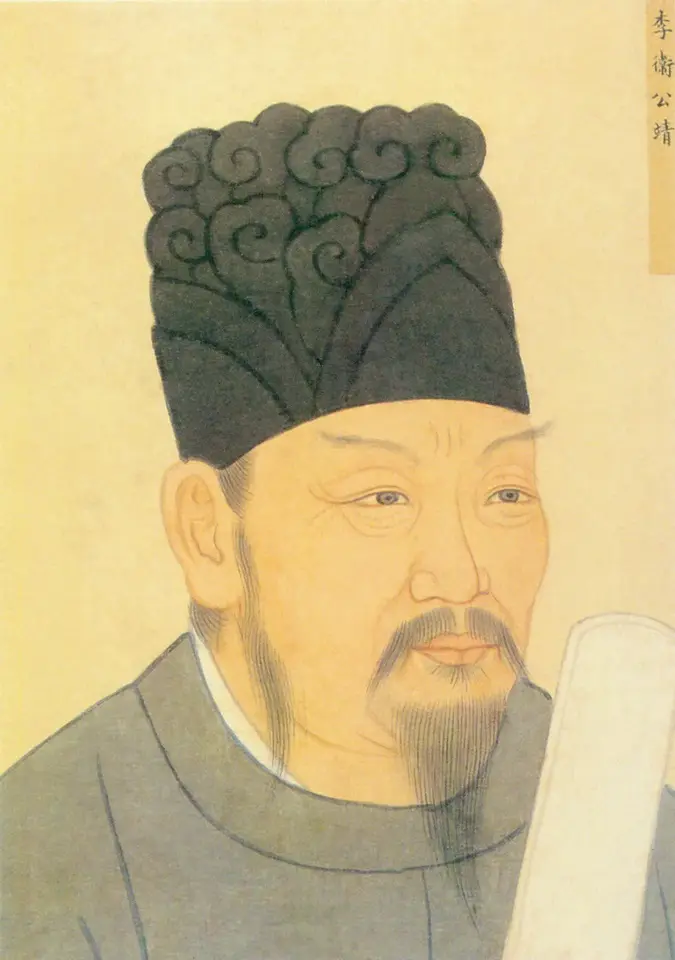
571 CE–649 CE
李靖
Li Jing (571–649 AD), courtesy name Yaoshi, was a native of Sanyuan, Yongzhou (present-day northeast of Sanyuan County, Shaanxi Province). He was an illustrious founding military commander, grand strategist, military theorist, and Chancellor of the Tang Dynasty. Honored as one of the Twenty-Four Meritorious Officials of Lingyan Pavilion, he served both Emperor Gaozu and Emperor Taizong, ascending to Right Vice Director of the…
Li Jing (571–649 AD), courtesy name Yaoshi, was a native of Sanyuan, Yongzhou (present-day northeast of Sanyuan County, Shaanxi Province). He was an illustrious founding military commander, grand strategist, military theorist, and Chancellor of the Tang Dynasty. Honored as one of the Twenty-Four Meritorious Officials of Lingyan Pavilion, he served both Emperor Gaozu and Emperor Taizong, ascending to Right Vice Director of the Department of State Affairs (Chancellor) and being ennobled as Duke of Wei, with the posthumous title of "Jingwu". Born into a prestigious aristocratic clan of the Guanlong region, Li Jing was the nephew of renowned Sui general Han Qinhu and mastered classical treatises on warfare from an early age. Entering Tang service under Li Shimin's patronage, he assisted Li Xiaogong in 621 AD by exploiting autumn floodwaters to stage a surprise naval descent down the Yangtze River, forcing Xiao Xian to surrender at Jiangling. In 623 AD, he commanded the campaign that eradicated Fu Gongshi's rebellion, fully pacifying southern China. In 629 AD, Emperor Taizong appointed Li Jing as General Administrator of the Dingxiang March to lead a counter-offensive against the Eastern Turkic Khaganate. Braving severe blizzards with three thousand elite cavalry in early 630 AD, Li Jing struck Dingxiang by surprise, routing Illig Khagan. He then spearheaded a daring strike at Mount Tieshan, crushing the main Turkic host and capturing Illig Khagan alive, thereby extinguishing the century-old nomadic hegemony and earning Emperor Taizong the exalted title of "Heavenly Khagan". In 634 AD, at the age of sixty-four, Li Jing led Tang forces across thousands of miles over the high-altitude Tibetan Plateau, vanquishing Tuyuhun at Bohai and Mount Jishi. Retiring prudently from public life in his twilight years, he died in 649 AD at the age of seventy-nine and was interred near the Zhao Mausoleum under mounds modeled after Mount Tieshan and Mount Jishi. Renowned for supreme tactical brilliance, Li Jing is revered in Chinese history as the quintessential "God of War".
Born in Sanyuan; his maternal uncle Han Qinhu lauded him as the sole contemporary capable of discussing the profound tactics of Sun Tzu and Wu Qi.
Served as Vice Governor of Mayi and attempted to warn the court of Li Yuan's ambition; captured after Chang'an fell, his bold speech moved Li Shimin to spare and recruit him.
Assisted Li Xiaogong in launching a surprise naval assault during torrential autumn floods, subjugating Xiao Xian and securing the middle Yangtze.
Commanded imperial forces against Fu Gongshi, cutting enemy supply lines and neutralizing fortified bastions to pacify Jiangnan.
Appointed General Administrator of Dingxiang March, commanding over one hundred thousand troops to confront the Eastern Turkic Khaganate.
Conducted a winter cavalry raid on Dingxiang and destroyed the Turkic host at Tieshan, capturing Illig Khagan; promoted to Chancellor.
Undertook a grueling expedition against Tuyuhun, marching across thousands of miles to conquer Bohai and Mount Jishi.
Died in Chang'an at seventy-nine; honored with burial beside the Zhao Mausoleum beneath twin tumuli symbolizing his northern and western victories.
Li Jing was born into an eminent Guanlong aristocratic clan. His grandfather Li Chongyi had served as a regional inspector during the Northern Zhou dynasty, while his father Li Quan served as Commandery Governor of Zhaojun under the Sui dynasty. From early youth, Li Jing demonstrated commanding presence and profound intellectual ambition, immersing himself in historical records and foundational treatises on the art of war. His maternal uncle was Han Qinhu, the famous Sui vanguard commander who spearheaded the conquest of the Chen dynasty. Whenever engaging in tactical debates regarding military formations, Han Qinhu frequently exclaimed with admiration: "Throughout the entire realm, only my nephew Li Jing is truly qualified to explore the profound methods of Sun Wu and Wu Qi!" Even senior Sui grandees such as Niu Hong and Yang Su were astonished by Li Jing's acute strategic foresight during state policy consultations.
During the chaotic close of the Daye era, Li Jing served as Vice Governor of Mayi, subordinate to Li Yuan, then Duke of Tang and garrison commander of Taiyuan. Discerning that Li Yuan was secretly amassing arms and recruiting vagrants with the intent of seizing the imperial throne, Li Jing disguised himself and attempted to travel south to Jiangdu to alert Emperor Yang. However, insurgent armies had severed the post roads, trapping Li Jing in Chang'an. In late 617 AD, Li Yuan's rebel forces took Chang'an, arrested Li Jing, and condemned him to execution. Standing upon the execution platform, Li Jing shouted fearless defiance into the sky: "The Duke of Tang raised righteous forces to deliver the realm from tyranny and violence; why then execute a man of valour over personal grievance before great deeds are achieved?" Impressed by his dauntless courage and towering intellect, Prince of Qin Li Shimin stepped forward to plead for his life, immediately inducting Li Jing into his private headquarters as a trusted military advisor.
In 621 AD, the Tang court resolved to eliminate rival warlord regimes in the southern Yangtze basin. Xiao Xian, who had proclaimed himself Emperor of Liang, commanded hundreds of thousands of troops headquartered at Jiangling. Emperor Gaozu dispatched Li Xiaogong as commander and Li Jing as vice commander to lead the campaign. Li Jing submitted ten comprehensive strategic points for pacifying the Jing and Xiang regions, all of which were eagerly adopted by the throne. In the ninth month of that year, sudden mountain torrents caused the Yangtze River to swell violently, generating treacherous rapids. While other generals counseled delay until the waters subsided, Li Jing argued decisively: "Speed is the soul of military warfare. The swollen current is our greatest tactical advantage! Xiao Xian will assume we cannot move through the flooded gorges and will leave his borders unprepared. If we descend with the rushing current, our fleet will appear before Jiangling before they even perceive our approach!"
Li Xiaogong approved the plan and guided the warships downstream. The Tang naval vanguard negotiated the turbulent Three Gorges at breakneck speed, smashing through enemy garrisons at Jingmen and Yidu to encircle Jiangling. Caught completely unprepared, Xiao Xian suffered crushing defeats outside his walls. Li Jing subsequently instructed his men to cast all captured enemy river vessels adrift downstream into the current. Confused officers questioned the measure, to which Li Jing replied: "Xiao Xian's provincial relief forces are stationed along the lower Yangtze. Seeing empty derelict vessels drifting down the river, they will mistakenly believe Jiangling has already fallen and will hesitate to advance." True to his prediction, the approaching relief armies ceased marching upon spotting the empty hulls. With external aid paralyzed, Xiao Xian surrendered unconditionally, transferring ninety-six prefectures across the Yangtze basin to Tang jurisdiction.
In 623 AD, Fu Gongshi declared himself Emperor of Song at Danyang (present-day Nanjing) and rebelled against the Tang. He entrenched heavily along Mount Bowang and fortified river barriers at Dangtu. Tang Gaozu once again mobilized Li Xiaogong and Li Jing. Assessing the strong defensive positions, Li Jing opted for an asymmetric operational approach: feigning weakness in frontal skirmishes while dispatching elite cavalry around the flanks to sever the enemy's logistical water routes. Starved and provoked into leaving their ramparts, Fu Gongshi's primary army was routed in the open field, and Fu Gongshi was captured shortly after fleeing. Southern China was completely pacified. Tang Gaozu patted his throne in jubilation, declaring: "Li Jing has been the fatal antidote to Xiao Xian and Fu Gongshi. Even Han Xin and Bai Qi of antiquity could not surpass his genius!"
Throughout the early Zhenguan era, the Eastern Turkic Khaganate posed an existential military menace along Tang China's northern frontier, launching destructive border incursions. Having stabilized internal governance and reorganized the military, Emperor Taizong determined to deliver a decisive strategic counterblow. In the eleventh month of 629 AD, Emperor Taizong commissioned Minister of War Li Jing as General Administrator of the Dingxiang March, coordinating multiple army corps totaling over one hundred thousand troops, including commanders Li Ji, Chai Shao, and Xue Wanche.
In the first month of 630 AD, severe blizzards paralyzed the northern frontier. Li Jing led three thousand elite armored cavalry directly from Mayi, charging undetected through blinding snowstorms to execute a surprise assault against Illig Khagan's royal camp at Dingxiang. Astounded by the sudden appearance of imperial cavalry in midwinter, Illig Khagan panicked, believing that the entirety of the Tang imperial army had encircled his camp. The Turkic host disintegrated in disorder, and Illig Khagan barely escaped north toward Qikou.
Subsequently, Illig Khagan dispatched envoys to Chang'an feigning submission, intending to bide his time until spring pasturage flourished before retreating into the deep desert. Penetrating the deception, Li Jing conferred secretly with Li Ji at Bingzhou, resolving to destroy the nomad force while their vigilance was relaxed. Leading ten thousand picked horsemen carrying twenty days' rations, Li Jing utilized dense morning mists to stage an overwhelming raid upon Illig's encampment at Mount Tieshan in the Yin Mountains. Tang vanguards shattered the royal guard, slaying over ten thousand Turkic warriors and capturing more than one hundred thousand pastoralists along with vast livestock herds. Illig Khagan fled into the wastes but was intercepted and captured alive by Tang general Zhang Baoxiang. The powerful nomadic khaganate that had dominated the northern steppes was permanently dismantled, and regional chieftains gathered in Chang'an to hail Emperor Taizong as the "Heavenly Khagan". For his peerless triumph, Li Jing was ennobled as Duke of Dai and elevated to Right Vice Director of the Department of State Affairs, directing imperial administration.
In 634 AD, the nomadic kingdom of Tuyuhun, ruled by Murong Fuyun, repeatedly raided the northwestern frontiers, pillaging border towns and severing crucial trade arteries along the Silk Road. Although over sixty years of age and suffering from a chronic foot ailment that had prompted his resignation from the chancellorship, Li Jing volunteered for service. Emperor Taizong appointed him Commander-in-Chief of the Western Sea March, heading an expeditionary force comprising Hou Junji, Li Daozong, Zhishi Sili, and Qibi Heli.
The Tuyuhun forces retreated into the high plateaus of Qinghai, burning pasturage across a thousand li to starve the Tang warhorses. Confronting freezing altitudes and severe oxygen deprivation, Li Jing split his forces: Hou Junji and Li Daozong traversed the desolate wetlands of Bohai, while Li Jing commanded the northern column across the jagged cliffs of Mount Jishi. Overcoming grueling mountain ascents, Li Jing achieved consecutive victories at Niuxindui and Mount Mantou, decapitating numerous enemy commanders. Abandoned by his chieftains, Murong Fuyun committed suicide in the wilderness, while his heir Murong Shun surrendered the remnants of his realm to Tang authority. The Silk Road corridor was definitively reopened.
Following his return to Chang'an, Li Jing adhered scrupulously to self-effacing prudence to avoid imperial suspicion. He withdrew entirely from political factions, closing his gates to visitors and leading an austere private life. In 643 AD, when Emperor Taizong established the Lingyan Pavilion to honor twenty-four founding giants of the dynasty, Li Jing's portrait was placed eighth in prestige. In 649 AD, Li Jing fell critically ill. Emperor Taizong visited his bedside in tears. On July 2, 649 AD, Li Jing passed away peacefully at the age of seventy-nine. Emperor Taizong bestowed the posthumous title "Jingwu" and granted imperial burial adjacent to his own Zhao Mausoleum, commanding that the earthworks above Li Jing's tomb be shaped into the contours of Mount Tieshan and Mount Jishi to immortalize his glorious campaigns against the northern steppes and western plateaus.
In 621 AD, Li Jing descended the Yangtze gorges during autumn floods to capture Jiangling and bring Xiao Xian's southern realm into the Tang fold.
In 623 AD, he crushed Fu Gongshi's rebellion and secured the lower Yangtze region.
In 630 AD, he led three thousand light horsemen through winter blizzards to seize Dingxiang and shatter Illig Khagan's court.
Coordinating with Li Ji, he routed the main Eastern Turkic host at Mount Tieshan and extinguished the northern khaganate.
At age sixty-four, he led Tang columns across Mount Jishi to defeat Tuyuhun and reopen the northwestern corridors.
FIGURES ASSOCIATED WITH THIS DYNASTY