Birth | Born in Chiyang, Yong Prefecture; son of Liu Sheng, Sui Governor of Hezhou
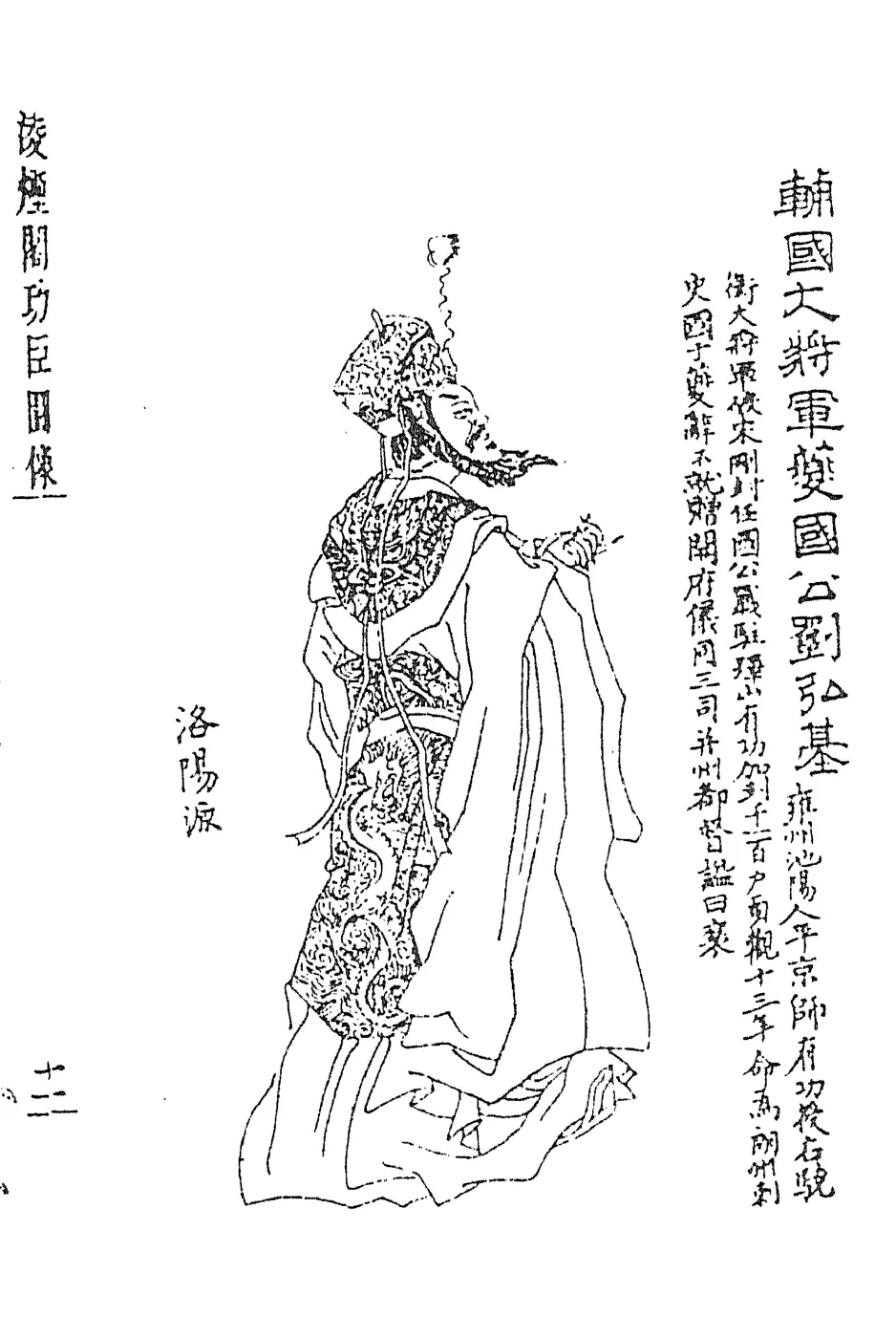
582 CE–650 CE
Early Tang general
Liu Hongji
刘弘基
Liu Hongji (582–650 CE), a native of Chiyang in Yong Prefecture (present-day Shaanxi), was an illustrious founding general and inner councilor of the Tang dynasty. Born into an official household during the Sui dynasty, poverty during the Goguryeo campaigns led him to intentionally get imprisoned to avoid execution for arriving late; upon release, he drifted as an outlaw before arriving in Taiyuan to join Li Yuan and forge a…
582 CE–650 CETang Dynasty
PROFILE
Liu Hongji (582–650 CE), a native of Chiyang in Yong Prefecture (present-day Shaanxi), was an illustrious founding general and inner councilor of the Tang dynasty. Born into an official household during the Sui dynasty, poverty during the Goguryeo campaigns led him to intentionally get imprisoned to avoid execution for arriving late; upon release, he drifted as an outlaw before arriving in Taiyuan to join Li Yuan and forge a deep friendship with young Li Shimin. When Li Yuan raised the banner of revolt in 617 CE, Liu raised ten thousand recruits in ten days and ambushed the suspicious Sui deputies Wang Wei and Gao Junya. During the march into Guanzhong, Liu decapitated Sui general Song Laosheng at Huoyi, spearheaded the river crossings, and broke into Chang'an. Across the wars of dynastic unification, Liu fought under Li Shimin against Xue Ju, Song Jingang, and Liu Heita; twice captured by enemy warlords, he remained unswervingly loyal and escaped back to Tang lines. In 643 CE, Emperor Taizong ranked him 11th on the Lingyan Pavilion. In 645 CE, he commanded the frontline vanguard during the Goguryeo expedition. Passing away in 650 CE at sixty-nine, he was awarded the posthumous name Xiang and granted burial near Zhaoling.
- Courtesy / Art Name
- Unknown
- Era
- Ancient times
- Dynasty
- Ancient times
- Identity
- Early Tang general
- Date of Birth
- 582
- Date of Death
- 650
- Ethnicity
- Han
- Ancestral Home
- Chiyang, Yongzhou (present-day the Jingyang and Sanyuan County area, Shaanxi)
- Place of Birth
- Chiyang, Yongzhou (present-day the Jingyang and Sanyuan County area, Shaanxi)
- Place of Death
- Unknown
- Lifespan
- 69 years
- Major Offices
- Bearer of the Privilege of Opening a Bureau with the Ceremonial of the Three Excellencies、Duke of Kui、Grand General of the Right Agile Guards、Chief Minister of the Guards、Grand General Who Supports the State;posthumously granted the title Commander-in-Chief of Bingzhou,Posthumous name: Xiang
- Peerage
- Duke of Ren
- Posthumous Name
- Xiang
- Major Achievements
- Key participant in the Taiyuan Uprising (617 CE), ambushing and executing Sui deputy commissioners Wang Wei and Gao Junya; spearheaded the western march into Guanzhong, slaying Sui champion Song Laosheng at Huoyi and capturing Chang'an; campaigned under Li Shimin to crush rival regimes of Xue Ju, Song Jingang, and Liu Heita; served as Vanguard Commander-in-Chief during the Liaodong campaign against Goguryeo; ranked 11th among the Twenty-Four Meritorious Officials of the Lingyan Pavilion
LIFE TIMELINE
Liu Hongji (582–650 CE) | Liu Hongji (582–650 CE), a native of Chiyang in Yong Prefecture (present-day Shaanxi), was an illustrious founding general and inner councilor of the Tang dynasty.
Wars of Unification and Surviving Double Captivity Following the founding of the Tang | ### Wars of Unification and Surviving Double Captivity Following the founding of the Tang dynasty in 618 CE, Emperor Gaozu appointed Liu General of the Right Agile Guard.
Age 32 | Faced with poverty during the Goguryeo mobilization, went to prison to escape penalty; later wandered the wilderness before reaching Taiyuan to join Li Yuan
Age 36 | Key leader of the Taiyuan Uprising, recruiting 10,000 men and ambushing deputies Wang Wei and Gao Junya; killed Song Laosheng at Huoyi and captured Chang'an
The Taiyuan Uprising and Conquest of Guanzhong In 617 CE | ### The Taiyuan Uprising and Conquest of Guanzhong In 617 CE, Li Yuan prepared to openly break with the Sui dynasty.
Age 37 | Appointed General of the Right Agile Guard; captured at Qianshui Plain after Xue Ju's surprise attack, remaining loyal until rescued upon Xue Ren'gao's destruction
Wars of Unification and Surviving Double Captivity Following the founding of the Tang | ### Wars of Unification and Surviving Double Captivity Following the founding of the Tang dynasty in 618 CE, Emperor Gaozu appointed Liu General of the Right Agile Guard.
Age 38 | Captured during Liu Wuzhou's invasion of Jinzhou; stole an elite horse and escaped a thousand li to return to court; joined Li Shimin in crushing Song Jingang
In 619 CE | In 619 CE, Liu Wuzhou invaded Shanxi with Turkic horsemen, capturing Jinzhou; Liu was captured a second time.
Age 41 | Campaigned under Li Shimin in Hebei to annihilate the rebel regime of Liu Heita
In 622 CE | In 622 CE, he campaigned in Hebei to crush Liu Heita, and in 624 CE guarded the northern passes against the Turks.
Age 43 | Commanded combined infantry and cavalry forces on the northern frontier to repel Eastern Turkic incursions
In 622 CE | In 622 CE, he campaigned in Hebei to crush Liu Heita, and in 624 CE guarded the northern passes against the Turks.
Age 46 | Stripped of offices due to personal association with the rebellious prince Li Xiaochang; restored to office a year later as Prefect of Yizhou
The Zhenguan Reign and the Lingyan Pavilion In 627 CE (1st year of Zhenguan) | ### The Zhenguan Reign and the Lingyan Pavilion In 627 CE (1st year of Zhenguan), following the treason of Li Xiaochang, Liu was impeached and stripped of titles due to his private correspondence with Xiaochang.
Age 54 | Ennobled as Duke of Ren Commandery; later appointed Chamberlain of the Imperial Insignia
Age 62 | Emperor Taizong commissioned his portrait for the Lingyan Pavilion, ranking him 11th among the Twenty-Four Meritorious Officials; advanced to Duke of Kui
In 643 CE | In 643 CE, Emperor Taizong honored the twenty-four supreme architects of the Tang empire on the Lingyan Pavilion; Liu was placed in the 11th position, advanced to Duke of Kui Commandery.
Age 64 | Appointed Commander-in-Chief of the Vanguard during the imperial expedition against Goguryeo, breaking enemy lines at Mount Zhubi
In 645 CE | In 645 CE, during the imperial expedition against Goguryeo, the elderly Liu was appointed Commander-in-Chief of the Vanguard, fighting with distinction at Mount Zhubi.
Age 69 | Passed away at his residence in Chang'an; Emperor Gaozong halted court for three days, granting posthumous rank of Area Commander of Bingzhou and title "Xiang"
Death | In 650 CE, Liu died in Chang'an at sixty-nine years of age.
BIOGRAPHY
Biography
Early Hardship and Joining Li Yuan Liu Hongji was born into an official family in Chiyang; his father, Liu Sheng, had served as Sui Governor of Hezhou. Endowed with a wild, unrestrained nature and a fondness for martial arts, Liu cared little for managing domestic estates. During the massive military mobilizations of Emperor Yang's Liaodong expeditions, Liu was too poor to purchase required horses and armor; facing execution for missing muster dates, he intentionally slaughtered an ox to be arrested for civil property damage, avoiding military conscription. Later released in an imperial amnesty, he drifted as an outlaw and horse dealer, eventually traveling east to Taiyuan. At Taiyuan, Li Yuan was gathering talented men. Liu Hongji approached the Li household and quickly established an intimate bond of brotherhood with young Li Shimin. Liu transitioned from a vagabond into a core architect of the nascent Tang rebellion. ### The Taiyuan Uprising and Conquest of Guanzhong In 617 CE, Li Yuan prepared to openly break with the Sui dynasty. Liu Hongji and Zhangsun Shunde were entrusted with secret recruitment, gathering nearly ten thousand battle-ready volunteers within ten days. When Sui deputy commissioners Wang Wei and Gao Junya plotted to arrest Li Yuan, Liu ambushed and decapitated both men in the palace forecourt, securing complete control over Taiyuan. Commissioned as Left Commandant, Liu marched with Li Shimin toward Guanzhong. At the Battle of Huoyi, facing veteran Sui general Song Laosheng, Liu led heavy cavalry into the enemy lines and personally decapitated Song Laosheng. He then spearheaded the Yellow River crossing, secured Fengyi, and advanced along the northern Wei River valley. When Sui defenders sallied out from Chang'an to disrupt the encirclement, Liu deployed his units and shattered the attack. Following the capture of Chang'an, Liu's battlefield merit was ranked among the foremost of all generals. ### Wars of Unification and Surviving Double Captivity Following the founding of the Tang dynasty in 618 CE, Emperor Gaozu appointed Liu General of the Right Agile Guard. In July 618 CE, Western Qin warlord Xue Ju attacked Jingzhou. In the ensuing clash at Qianshui Plain, Tang forces suffered a severe reverse; surrounded by enemy cavalry, Liu fought to his last arrow before being taken prisoner. Defying brutal threats from Xue Ju, Liu refused to switch allegiances. When Li Shimin obliterated Xue Ren'gao months later, Liu was restored to high office. In 619 CE, Liu Wuzhou invaded Shanxi with Turkic horsemen, capturing Jinzhou; Liu was captured a second time. Feigning compliance, he stole an exceptional stallion at midnight and galloped over a thousand li through enemy checkpoints back to Chang'an. Emperor Gaozu, overwhelmed by his unbreakable loyalty, granted him one hundred fine horses and a golden belt. Joining Li Shimin's counteroffensive, Liu helped shatter Song Jingang and reconquer Shanxi. In 622 CE, he campaigned in Hebei to crush Liu Heita, and in 624 CE guarded the northern passes against the Turks. ### The Zhenguan Reign and the Lingyan Pavilion In 627 CE (1st year of Zhenguan), following the treason of Li Xiaochang, Liu was impeached and stripped of titles due to his private correspondence with Xiaochang. Knowing his character, Emperor Taizong recalled him within a year as Prefect of Yizhou and Chamberlain of the Imperial Insignia. In 643 CE, Emperor Taizong honored the twenty-four supreme architects of the Tang empire on the Lingyan Pavilion; Liu was placed in the 11th position, advanced to Duke of Kui Commandery. In 645 CE, during the imperial expedition against Goguryeo, the elderly Liu was appointed Commander-in-Chief of the Vanguard, fighting with distinction at Mount Zhubi. ### Peaceful Death and Burial at Zhaoling In his final years, Liu was granted retirement with full ministerial stipends. In 650 CE, Liu died in Chang'an at sixty-nine years of age. Emperor Gaozong suspended court proceedings for three days, granting him burial near Emperor Taizong's Zhaoling and the posthumous honorific "Xiang" (The Resolute).
At the rising in Jinyang he took part in the planning and in the capture of Chang'an, being enfeoffed as Duke of Hejian for his service. He then campaigned with Li Shimin against Xue Ju, Liu Wuzhou, Wang Shichong and Dou Jiande with repeated merit. Under Taizong he held the posts of chief minister of the imperial household and general-in-chief, his portrait placed in the Lingyan Pavilion; among the founders of the early Tang he was one of those closest to Li Shimin.
In his last years he took part in government as a founding minister of high standing, and was buried after his death among the attendants at Zhaoling.
Major Activities
Decisive Role in the Taiyuan Uprising In 617 CE, Liu recruited 10,000 warriors in ten days and ambushed Sui officials Wang Wei and Gao Junya, securing the Taiyuan military base. ### Slaying Song Laosheng at Huoyi Spearheaded the shock assault that routed the Sui army at Huoyi, personally slaying commander Song Laosheng to unlock the gateway to Chang'an. ### Double Captivity and Unyielding Fidelity Twice captured by Western Qin and Liu Wuzhou forces, he refused all enemy inducements, escaped across enemy territory, and returned to serve the Tang altars. ### Enshrinement in the Lingyan Pavilion Honored as the 11th master of the Lingyan Pavilion in 643 CE, celebrating his foundational role in the founding and defense of the Tang dynasty.
Personal Relations
- Li Shimin (Emperor Taizong): Lifelong brother-in-arms and monarch who enshrined him in the Lingyan Pavilion.
- Li Zhi (Emperor Gaozong): Suspended court for three days upon Liu's demise. ### Comrades - Zhangsun Shunde: Key partner during the recruitment and initial coup in Taiyuan.
- Liu Wenjing and Yin Kaishan: Generals who served alongside Liu at Qianshui Plain.
- Li Xiaochang: Tang prince whose revolt temporarily implicated Liu. ### Foes - Wang Wei and Gao Junya: Sui officials executed by Liu in Taiyuan.
- Song Laosheng: Sui general slain by Liu at Huoyi.
- Xue Ju and Xue Ren'gao: Western Qin warlords who captured and failed to sway Liu.
- Song Jingang and Liu Wuzhou: Northern warlords crushed by Tang forces.
Historical Assessment
Contemporary and Dynastic Historians - Emperor Gaozu of Tang: "Whenever Liu Hongji faces mortal danger, he is always the first to charge the enemy. His fidelity never wavers; he is truly a grand champion of our empire."
- *Liu Xu, Old Book of Tang***: "Liu Hongji stood unyielding in the face of peril, achieving victory across desperate terrain. In the initial raising of righteous banners, he was the foremost mastermind. His likeness in the Lingyan Pavilion brings him unblemished glory!"
- *Song Qi, New Book of Tang***: "Hongji was brave, decisive, and strategically minded. He campaigned across all horizons with Taizong, never compromising hisministerial loyalty (ministerial loyalty) even when trapped in captivity." ### Modern Scholarly Perspective Modern historians recognize Liu Hongji as one of the most operationally effective tactical commanders of the early Tang founding group. Beyond his indispensable role in the initial coup at Taiyuan, his unbending loyalty during repeated enemy captures and battlefield tenacity formed an essential pillar of early Tang survival and ultimate imperial unification.
FIGURES ASSOCIATED WITH THIS DYNASTY
Bibliography
- Old Book of Tang*, Volume 58, Biography 8: "Biography of Liu Hongji"
- New Book of Tang*, Volume 90, Biography 15: "Biography of Liu Hongji"