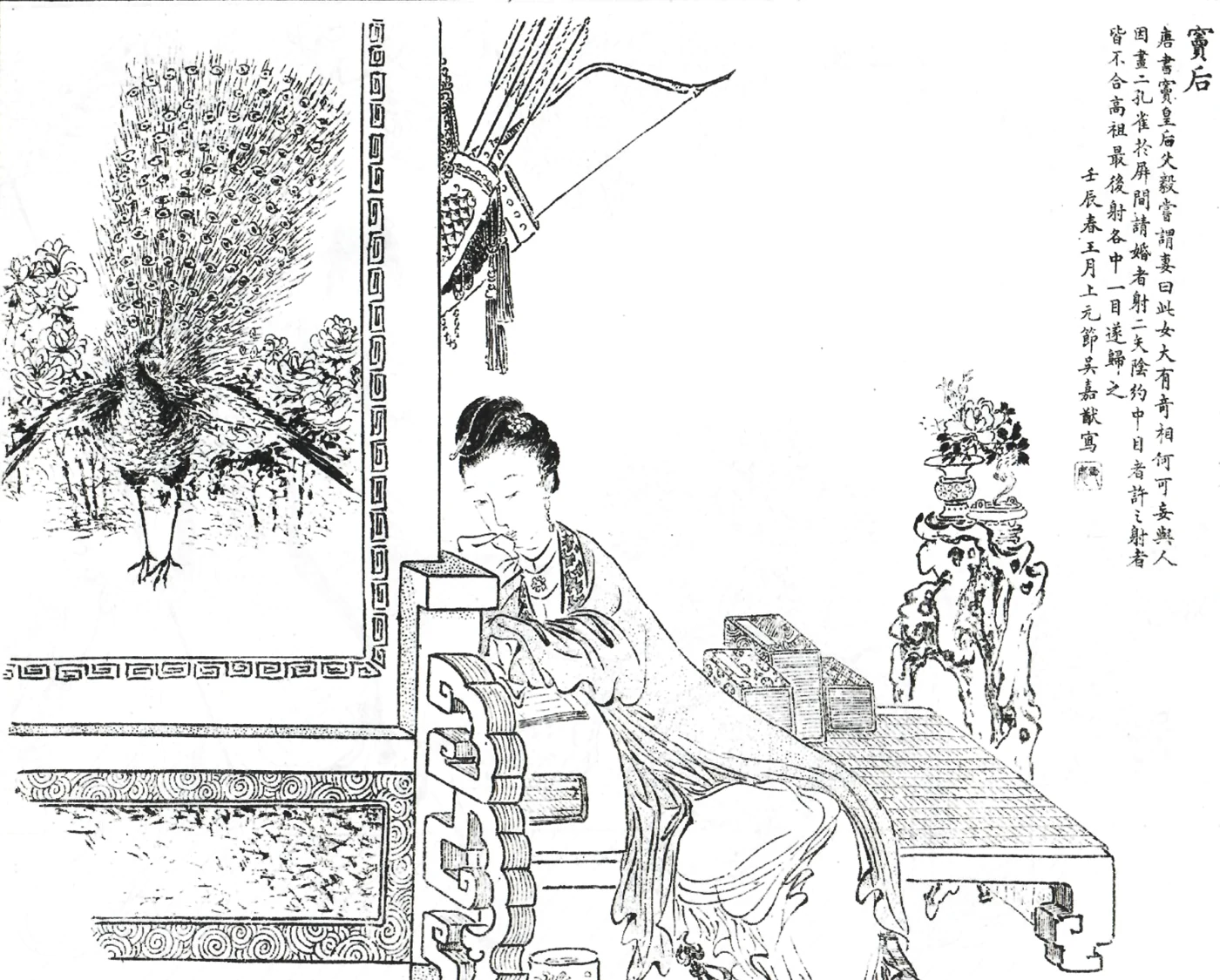
Empress Taimu, a nineteenth-century illustration by Wu Youru

569 CE–613 CE

Posthumously honored empress of Tangprincipal wife of Li Yuan

Dou

窦氏(唐太穆皇后)

Empress Taimu (c. 569–c. 613), née Dou, was the principal wife of Emperor Gaozu of Tang (Li Yuan) and the posthumously honored founding empress of the Tang dynasty. A native of Shiping, Jingzhao, she was the daughter of Dou Yi, Grand Pillar of State in Northern Zhou, and Princess Xiangyang, daughter of Yuwen Tai. Possessing extraordinary precocity and raised in the imperial palace, she famously advised her uncle Emperor Wu of…

569 CE–613 CENorthern Zhou

PROFILE

Empress Taimu (c. 569–c. 613), née Dou, was the principal wife of Emperor Gaozu of Tang (Li Yuan) and the posthumously honored founding empress of the Tang dynasty. A native of Shiping, Jingzhao, she was the daughter of Dou Yi, Grand Pillar of State in Northern Zhou, and Princess Xiangyang, daughter of Yuwen Tai. Possessing extraordinary precocity and raised in the imperial palace, she famously advised her uncle Emperor Wu of Northern Zhou at age seven to reconcile with Empress Ashina to appease the formidable Göktürk Khaganate, securing the empire's northern frontier. Upon reaching marriageable age, her father arranged an archery contest behind a screen painted with peacocks; Li Yuan struck both peacock eyes, giving rise to the celebrated idiom 'choosing a son-in-law by peacock screen'. She served her ailing mother-in-law Lady Dugu with legendary filial devotion, mastered calligraphy indistinguishable from her husband's, and gave birth to Li Jiancheng, Li Shimin (Emperor Taizong), Li Xuanba, Li Yuanji, and Princess Pingyang. During the Daye era, she sagaciously urged Li Yuan to present his prized horses to Emperor Yang of Sui to avert suspicion. She passed away in Zhuojun at age forty-five. Following the establishment of the Tang dynasty, Emperor Gaozu never remarried, posthumously consecrating her as Empress Mu and later Empress Taimu Shunsheng, interring her in Xianling.

Other names
Empress Taimu; Empress Taimu Shunsheng
Courtesy name
Not reliably recorded in the historical sources
Period
Northern Zhou, Sui, and Tang (posthumous honors)
Date of Birth
about 569
Date of Death
about 613
Dynasty / polity
Tang
Identity
Posthumously honored empress of Tang; principal wife of Li Yuan
Ethnicity / group
Not reliably confirmed by the available sources
Clan
Dou clan (the non-Han clan surname Hedouling)
Native place
Shiping, Jingzhao (present-day Xingping, Shaanxi)
Place of birth
Shiping, Jingzhao (present-day Xingping, Shaanxi)
Place of death
Zhuo Commandery (in the area of present-day Beijing)
Posthumous title
Empress Taimu Shunsheng
Mausoleum
Xianling
Highest status
Lady of the Duke of Tang; posthumously honored as Empress Taimu
Era
Ancient times
Dynasty
Northern Zhou to Sui dynasty (Posthumously honored in Tang dynasty)
Ethnicity
Xianbei (Hedouling clan sinicized to Dou)
Ancestral Home
Shiping of Jingzhao
Place of Birth
Shiping of Jingzhao
Place of Death
Unknown
Lifespan
45 years
Peerage
Prince Huai of Wei

LIFE TIMELINE

Miraculous Nativity | Born into prominent Guanlong aristocracy with haOpen

Miraculous Nativity | Born into prominent Guanlong aristocracy with hair past her neck, reaching floor length by age three; raised in the inner palace by Emperor Wu.

Sage Youthful Counsel | Secretly counseled uncle Emperor Wu to treat GOpen

Sage Youthful Counsel | Secretly counseled uncle Emperor Wu to treat Göktürk Empress Ashina kindly, securing northern peace against Chen and Northern Qi.

Mourning Imperial Uncle | Emperor Wu died on northern expedition; LadyOpen

Mourning Imperial Uncle | Emperor Wu died on northern expedition; Lady Dou mourned him deeply as if losing her own father.

Grief Over Fallen Zhou | Yang Jian usurped the throne to establish SuiOpen

Grief Over Fallen Zhou | Yang Jian usurped the throne to establish Sui; Lady Dou wept and lamented not being born a man to save her uncle's house, silenced by fearful parents.

The Peacock Screen Match | Dou Yi hosted an archery trial; Li Yuan shoOpen

The Peacock Screen Match | Dou Yi hosted an archery trial; Li Yuan shot two arrows precisely through both eyes of the painted peacock, winning her hand.

Devoted Filial Piety | Cared for her ailing and short-tempered mother-Open

Devoted Filial Piety | Cared for her ailing and short-tempered mother-in-law Duchess Dugu day and night without changing clothes for over a month.

Birth of Eldest Son | Managed household and gave birth to eldest son LOpen

Birth of Eldest Son | Managed household and gave birth to eldest son Li Jiancheng.

Birth of Second Son | Gave birth to Li Shimin (the future Emperor TaizOpen

Birth of Second Son | Gave birth to Li Shimin (the future Emperor Taizong) at the villa in Wugong.

Growing Family | Gave birth to Li Xuanba, Li Yuanji, and Princess PingOpen

Growing Family | Gave birth to Li Xuanba, Li Yuanji, and Princess Pingyang in subsequent years.

Nurturing the Heirs | Educated sons in classics and statecraft; excellOpen

Nurturing the Heirs | Educated sons in classics and statecraft; excelled in calligraphy mimicking Li Yuan's handwriting flawlessly.

Prescient Horse Counsel | Advised Li Yuan in Fufeng to surrender fine Open

Prescient Horse Counsel | Advised Li Yuan in Fufeng to surrender fine steeds to Emperor Yang; Li Yuan delayed and was demoted.

Passing in Zhuojun | Fell ill and passed away in Zhuojun at age forty-Open

Passing in Zhuojun | Fell ill and passed away in Zhuojun at age forty-five; Li Yuan followed her advice by presenting hunting beasts to secure trust.

Founding Posthumous Honor | Emperor Gaozu established Tang, refused toOpen

Founding Posthumous Honor | Emperor Gaozu established Tang, refused to appoint another empress, and posthumously honored her as Empress Mu.

Elevated by Son | Emperor Taizong bestowed the elevated posthumous titOpen

Elevated by Son | Emperor Taizong bestowed the elevated posthumous title Empress Taimu Shen upon his mother.

Final Imperial Epithet | Emperor Xuanzong conferred the grand title EmOpen

Final Imperial Epithet | Emperor Xuanzong conferred the grand title Empress Taimu Shunsheng.

In 749 CE | In 749 CE, Emperor Xuanzong finalized her posthumous titleOpen

In 749 CE | In 749 CE, Emperor Xuanzong finalized her posthumous title as 'Empress Taimu Shunsheng'.

BIOGRAPHY

Biography

Aristocratic Lineage and Imperial Affiliation

Lady Dou was born into the eminent Hedouling clan of the Xianbei people, originally belonging to the Molouhui tribe of Daibei. During the reign of Emperor Zhaocheng Tuoba Shiyijian of Northern Wei, the tribe adopted the name Hedouling. Following Emperor Xiaowen's sinicization reforms and relocation to Luoyang, the clan adopted the Chinese surname Dou and settled in Henan, eventually assimilating into the Fufeng Dou lineage as one of its most prestigious elite branches (the 'Three Ancestors' Branch). Her father, Dou Yi, was a top-tier general and minister across Western Wei and Northern Zhou. Rising through military merit, Dou Yi served as General of Chariots and Cavalry, Grand Master of Splendid Happiness, and Area Commander of Binzhou. Under Emperor Xiaomin, he was ennobled as Duke of Shenwu and appointed Grand Pillar of State and Grand Minister of War. Her mother was Princess Xiangyang, the beloved daughter of Western Wei paramount leader Yuwen Tai and elder sister to Emperor Wu of Northern Zhou (Yuwen Yong). Born as the niece of the emperor, Lady Dou resided at the very nexus of Guanlong aristocratic power. ### Extraordinary Child Prodigy Raised in Court From infancy, Lady Dou exhibited signs of celestial blessing. At birth, her dark hair extended past her neck; by the time she was three years old, her glossy tresses grew to equal her physical height. Endowed with ethereal beauty, she possessed astonishing intellectual faculties. Whenever classical texts such as Ban Zhao's Precepts for Women or Biographies of Exemplary Women were presented to her, she memorized them after a single reading and never forgot a phrase. Her uncle Emperor Wu cherished her exceptional intellect and arranged for her to be raised directly in the imperial palace alongside imperial princes. Among all nephews and nieces, Lady Dou received affection and honors surpassing all others. Immersed daily in the affairs of the court and witnessing supreme politics firsthand, she developed acute strategic insight far beyond her tender years. ### Seven-Year-Old Strategist and Göktürk Alliance During the Jiande reign of Northern Zhou, the empire stood in triangular contention with Northern Qi to the east and the Chen dynasty in the south. Positioned in the relatively barren Guanzhong region, Northern Zhou urgently required foreign allies. To neutralize the powerful Göktürk Khaganate, which commanded hundreds of thousands of steppe cavalry, Emperor Wu negotiated an alliance by marrying Princess Ashina, daughter of Muqan Qaghan, making her empress. However, Empress Ashina's proud nomadic demeanor alienated Emperor Wu, who treated her with marked coldness. The Göktürks grew deeply displeased, threatening cross-border skirmishes and jeopardizing the grand alliance. At this critical juncture, Lady Dou, who was only about six or seven years old, quietly approached Emperor Wu and advised: "The four frontiers remain unsettled, and the Göktürks remain overwhelmingly powerful. I beseech my imperial uncle to subdue personal inclinations, treat Empress Ashina with warmth and respect, and hold the livelihood of our people foremost in mind. If we can rely on Göktürk cavalry, neither Chen in the south nor Qi in the east can imperil us!" Emperor Wu was profoundly startled that a seven-year-old girl could comprehend the grand geopolitics of northern China. Straightening his robes, he adopted her counsel and transformed his behavior toward Empress Ashina. Appeased, the Göktürk rulers stabilized the alliance, enabling Emperor Wu to mount his victorious campaign that annihilated Northern Qi. Courtiers across the realm marveled at Lady Dou's extraordinary vision. ### Mourning the Sovereign and the Peacock Screen Match In 578 CE, Emperor Wu died suddenly during a northern campaign at the age of thirty-six. Lady Dou was heartbroken, weeping uncontrollably as though she had lost her biological father. Three years later, in 581 CE, Grand Chancellor Yang Jian deposed Emperor Jing of Northern Zhou to establish the Sui dynasty, launching a brutal purge of the Yuwen clan. Hearing that her uncle's dynasty had been extinguished, Lady Dou threw herself onto her bed and wept inconsolably: "I only regret that I was not born a man! Had I been born male, I would take up arms and ride forth to rescue my uncle's dynasty!" Terrified that her words might leak out, Dou Yi and Princess Xiangyang rushed forward and clamped their hands over her mouth, warning: "Hush, foolish child! Speak no such words, or you will bring extermination upon our entire clan!" Recognizing that his daughter possessed the courage, intellect, and virtue of an extraordinary hero, Dou Yi declared to his wife: "A daughter of such peerless intellect and beauty must never be given away lightly to any ordinary man. I shall find her a true champion of the age!" Dou Yi ordered artisans to paint a grand screen displaying two peacocks in full plumage. He invited prominent scions of Guanlong noble families to compete for her hand. Each suitor was given a bow and two arrows, instructed to loose them at the screen from a distance of a hundred paces, with the secret condition that only he who pierced both peacock eyes would win her hand. Dozens of aristocratic youths stepped forward, but not one struck the mark. Li Yuan, Duke of Tang, arrived and drew the bowstring taut as a full moon. Releasing two arrows in rapid succession, both shafts found their target, each piercing an eye of the painted peacocks. Dou Yi rejoiced, recognizing Li Yuan as a peerless man of destiny, and joyfully married Lady Dou to him. This romantic triumph gave birth to the enduring Chinese idiom 'Queping Zhongxuan' (choosing a son-in-law by the peacock screen), and Lady Dou became celebrated as the 'Peacock Lady'. ### Filial Devotion and Household Governance After marrying into the Li household, Lady Dou conducted herself with impeccable propriety, sharing deep mutual affection and respect with Li Yuan. Li Yuan's father had died early, leaving the management of the family entirely to his mother, Duchess Dugu (posthumously Empress Yuanzhen). Daughter of Grand Pillar of State Dugu Xin, Duchess Dugu suffered from chronic illnesses and possessed a notoriously severe and volatile temperament in her old age. Fearing her wrath, the other sisters-in-law pleaded illness and stayed away whenever the dowager fell ill. Only Lady Dou remained constantly at her bedside, personally preparing medicines and caring for her night and day without removing her shoes or clothes for over a month. Touched by her unyielding devotion, Duchess Dugu cherished her as her dearest daughter-in-law. Under Lady Dou's gentle guidance, peace and harmony reigned throughout the sprawling Li clan. Lady Dou was also an accomplished scholar and master of calligraphy. Practicing cursive and regular script daily, she learned to replicate Li Yuan's handwriting with uncanny precision. Her brushwork was so identical to her husband's that even Li Yuan's closest retainers and secretaries could not distinguish between them. Throughout Li Yuan's provincial tenures, Lady Dou served as his most trusted confidante, quietly guiding administrative affairs from behind the curtains. Under her careful nurturing, her children grew into exceptional leaders: Li Jiancheng (the Crown Prince), Li Shimin (the future Emperor Taizong), Li Xuanba (Prince of Wei), Li Yuanji (Prince of Chao), and Princess Pingyang (who later commanded the Women's Army during the conquest of Guanzhong). Longsun Chi, elder brother of general Longsun Sheng, recognized Lady Dou's peerless virtue and advised Longsun Sheng: "Lady Dou is a woman of celestial wisdom; her offspring are destined to conquer the realm. You must betroth your daughter (Empress Wende) to her second son, Li Shimin!" This betrothal united two historic lineages, setting the stage for the Zhenguan era. ### The Prescient Horse Counsel and Safeguarding the Clan During the reign of Emperor Yang of Sui (Yang Guang), the sovereign's paranoia toward Guanlong magnates intensified. Suspicious of rivals, Emperor Yang routinely executed senior courtiers over trivial offenses. While serving as Governor of Fufeng, Li Yuan assembled a stable of extraordinary thoroughbred horses. Recognizing the mortal danger, Lady Dou cautioned her husband: "The emperor has a well-known obsession with fine falcons and rare horses. These magnificent steeds in your possession are exactly what the sovereign covets. You must never keep them in your private stables! If imperial censors report this, accusing you of harboring imperial ambitions, disaster will engulf our house. I urge you to present them to the throne without delay!" Hesitant to surrender his prized steeds, Li Yuan vacillated. Within months, Emperor Yang learned of Li Yuan's horses and took offense, summarily demoting him. Shocked, Li Yuan realized the depth of Lady Dou's political foresight. Henceforth, Li Yuan actively scoured the realm for rare hunting dogs, falcons, and warhorses, showering the emperor with gifts. Emperor Yang concluded that Li Yuan was entirely consumed by hunting and harmless pleasures, lifting his suspicion and eventually appointing him Military Commander of Taiyuan, granting him the territorial base essential for the Tang founding. ### Passing in Zhuojun and Enduring Legacy Around 613 CE (the 9th year of the Daye era), Emperor Yang mobilized the empire for his third disastrous campaign against Goguryeo. Accompanying Li Yuan's garrison movement, Lady Dou fell gravely ill in Zhuojun (near modern Beijing) from accumulated exhaustion and severe climate. She passed away at the age of forty-five. Li Yuan wept inconsolably at her deathbed, grieving that she did not live to witness their ultimate triumph. Whenever discussing affairs with his sons, Li Yuan shed tears and confessed: "Had I listened to your mother's counsel earlier by presenting those horses without hesitation, I would not have endured so many tribulations!" In 618 CE, Li Yuan rose in Taiyuan, captured Chang'an, and founded the Tang dynasty. Remembering his beloved wife, Emperor Gaozu refused to elevate any consort to empress for the rest of his life. In the first year of the Wude era, he posthumously conferred upon her the title 'Empress Mu'. In 635 CE, Emperor Taizong elevated her honorific to 'Empress Taimu Shen', interring her alongside Gaozu in Xianling. In 749 CE, Emperor Xuanzong finalized her posthumous title as 'Empress Taimu Shunsheng'. Through the legendary episodes of the peacock screen, stabilizing the northern frontier, and presciently averting imperial wrath, Lady Dou stands immortalized as the premier matriarch whose wisdom birthed the glorious Tang dynasty.

Major Activities

Diplomatic Strategist of the Northern Frontier

At age seven, Lady Dou displayed profound geopolitical foresight by counseling Emperor Wu of Northern Zhou to treat Göktürk Empress Ashina with royal respect. This preserved the crucial northern military alliance, allowing Northern Zhou to concentrate its forces eastward and crush Northern Qi. ### The Historic Peacock Screen Archery Contest To select a worthy husband for his remarkable daughter, Dou Yi erected a screen adorned with two peacocks. Li Yuan struck both eyes with two consecutive arrows, inspiring the enduring Chinese idiom 'Queping Zhongxuan' and uniting two of China's most powerful aristocratic lineages. ### Exemplary Filial Duty and Domestic Order Faced with Duchess Dugu's severe illness and mercurial temper, Lady Dou attended her mother-in-law day and night for over a month without changing clothes. Her virtue unified the sprawling Li household and established a domestic foundation of harmony and loyalty. ### Nurturing Founding Dynastic Titans Lady Dou educated her sons and daughters in both martial prowess and Confucian ethics, producing Emperor Taizong Li Shimin, Crown Prince Li Jiancheng, and military commander Princess Pingyang. Her reputation for maternal wisdom inspired the betrothal of Empress Wende to Li Shimin, laying the human foundation for the Zhenguan era. ### Sagacious Counsel Preserving Dynastic Foundations When Li Yuan served as Governor of Fufeng, Lady Dou presciently warned him to surrender his fine horses to the suspicious Emperor Yang. Following her advice after an initial demotion, Li Yuan disarmed imperial paranoia through gifts of hounds and steeds, enabling his transfer to Taiyuan where he launched the Tang founding campaign.

Personal Relations

  • Great-Great-Grandfather: Dou Lue (Prefect of Pingliang under Northern Wei)
  • Grandfather: Dou Yue (Grand Master of Splendid Happiness under Northern Wei)
  • Father: Dou Yi (Grand Pillar of State, Duke of Shenwu, Area Commander in Sui)
  • Mother: Princess Xiangyang (Daughter of Yuwen Tai, sister of Emperor Wu)
  • Maternal Uncle: Emperor Wu of Northern Zhou (Yuwen Yong)
  • Spouse: Li Yuan (Emperor Gaozu of Tang)
  • Mother-in-Law: Lady Dugu (Empress Yuanzhen, 4th daughter of Dugu Xin)
  • Children: - Eldest Son: Li Jiancheng (Crown Prince Yin) - Second Son: Li Shimin (Emperor Taizong of Tang) - Third Son: Li Xuanba (Prince Huai of Wei) - Fourth Son: Li Yuanji (Prince La of Chao) - Daughter: Princess Pingyang Zhao (Commander of the Women's Army, married Chai Shao)
  • Daughter-in-Law: Empress Wende (née Longsun, daughter of Longsun Sheng)

Historical Assessment

  • Old Book of Tang: 'She served Empress Dowager Yuanzhen with renowned filial devotion. Skilled in calligraphy, her handwriting resembled Emperor Gaozu's so closely that none could tell them apart. She was gifted in poetry and composition, and was ever mindful of moral admonition.'
  • New Book of Tang: 'She excelled in calligraphy, literary compositions, and moral admonitions, writing in an elegant style. Her script matched Gaozu's so perfectly that observers could not distinguish them.'
  • Emperor Gaozu of Tang (Li Yuan): 'Had I followed your mother's counsel earlier, I would have held high office long ago.'
  • Emperor Wu of Northern Zhou: 'Though my niece is young, her vision is profound and grand; she is truly a blessing to the altars of state.'
  • Cai Dongfan: 'As for the daughter of Dou Yi, before reaching marriageable age, she lamented her inability to rescue her maternal house. Even as a woman, she understood righteousness. Should not those seven-foot-tall men who boast of their masculinity feel deeply ashamed before her?'

LOCAL NETWORK

Li Yuan↗Related entry

Original note (Chinese): 窦氏为李渊正妻,辅佐其成就帝业

Li Shimin↗Related entry

Original note (Chinese): 窦氏次子,唐太宗

Yuwen Yong↗Related entry

Original note (Chinese): 北周武帝,窦氏舅父,对其极为赏识

Li Jiancheng↗Related entry

Original note (Chinese): 窦氏长子,唐太子

Princess↗Related entry

Original note (Chinese): 窦氏之女,唐初女将

Yang Guang↗Related entry

Original note (Chinese): 隋炀帝,猜忌李渊,窦氏劝李渊避其锋芒

Northern Zhou↗Era association

Original note (Chinese): 北周至隋朝(唐朝追尊);唐

Sui Dynasty↗Era association

Original note (Chinese): 北周至隋朝(唐朝追尊);唐

Tang Dynasty↗Era association

Original note (Chinese): 北周至隋朝(唐朝追尊);唐

窦毅 · No matching entry available

北周上柱国,窦氏之父

李元吉 · No matching entry available

窦氏四子,封齐王

CONTEMPORARIES

Bibliography

  • Old Book of Tang, Volume 51, Biography 1 (Empress Taimu Dou)
  • New Book of Tang, Volume 76, Biography 1 (Empress Taimu Dou)
  • Zizhi Tongjian, Volume 171 (Chen Chronicles 5)
  • Zizhi Tongjian, Volume 182 (Sui Chronicles 6)
  • Tang Huiyao, Volume 3 (Empresses)
  • Book of Zhou, Volume 30, Biography 22 (Dou Yi)