Life and Career
Aristocratic Heritage and Strategic Resolution in the Capital
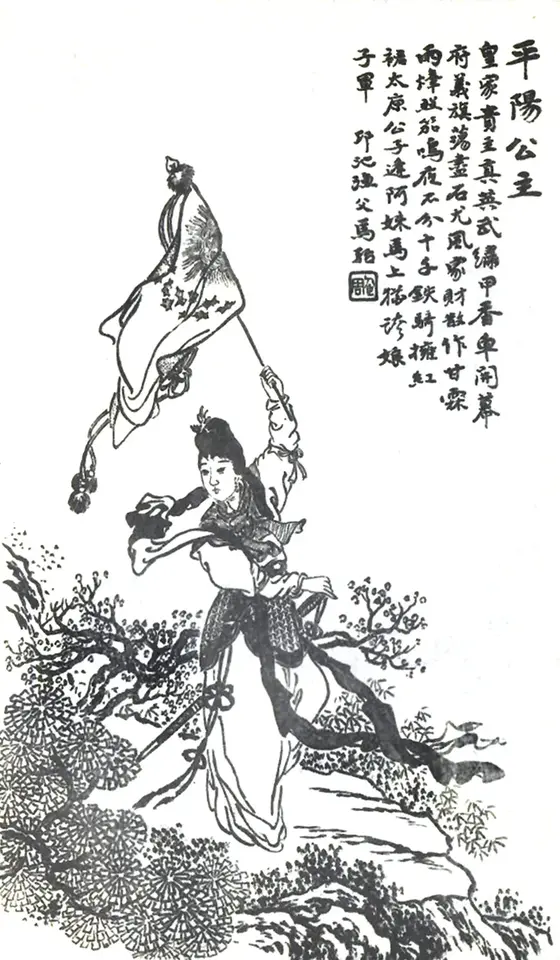
Princess Pingyang was born into the Longxi Li clan, the premier military aristocracy bridging the Northern Zhou, Sui, and Tang dynasties. Her father Li Yuan was a high-ranking Sui general and Duke of Tang; her mother Empress Taimu was the daughter of Dou Yi, Grand General of Northern Zhou, and Princess Xiangyang. Among Li Yuan's offspring, Princess Pingyang was the third daughter, sharing full parentage with Crown Prince Li Jiancheng, Emperor Taizong Li Shimin, and Prince Li Yuanji. From her early youth, she was distinguished not only by dignified beauty, but also by sharp strategic discernment and deep mastery of military theory, winning the unbounded affection of her parents.
Upon reaching maturity, Li Yuan arranged her marriage to Chai Shao, son of the esteemed general Chai Bili and a brave palace officer in the Sui imperial guard. Following their nuptials, the couple resided in the Sui imperial capital of Daxing (Chang'an). In early 617, Emperor Yang's disastrous campaigns against Goguryeo had plunged the empire into universal rebellion, with rival warlords carving up provinces. Serving as Garrison Commander of Taiyuan, Li Yuan conspired with his son Li Shimin to raise righteous banners and overthrow the collapsing dynasty. Li Yuan dispatched trusted couriers in secret to Chang'an, summoning Chai Shao and Princess Pingyang to return to Taiyuan immediately.
At that time, imperial scrutiny within Chang'an was suffocating, with gates heavily guarded. Confronting mortal danger, Chai Shao voiced his agonizing dilemma to the princess: "Your honored father is about to raise banners to sweep away dynastic turmoil, and I yearn to join his righteous vanguard. Yet if we depart together, our target will be too conspicuous and we will be captured; if I travel alone, I dread leaving you behind to face hostage captivity or slaughter. What should we do?" Princess Pingyang replied with serene courage and instant decisiveness: "My husband, hesitate no longer! You must ride post-haste to Shanxi to assist my father. As a woman, I can easily conceal my movements and blend among commoners. When danger arises, I will adapt flexibly and forge my own path!" Deeply moved by his wife's noble self-sacrifice, Chai Shao disguised himself and galloped along mountain trails toward Taiyuan.
Liquidating Assets to Raise Troops and Subjugating Rebel Hosts
Following her husband's departure, Princess Pingyang slipped disguised out of Chang'an and hastened to her family's rural estate in Hu County (modern Huyi District, Xi'an). At that time, devastating famines plagued northern China, leaving millions destitute. Disguising herself in male garments under the pseudonym "Master Li," the princess enacted a bold, compassionate policy: she sold all inherited lands and family treasures, opening granaries to distribute free food to starving refugees. This magnificent act of benevolence won the fierce loyalty of the local populace, enabling her to assemble a devoted vanguard of several hundred stalwart fighters within days.
Shortly thereafter, official word arrived that Li Yuan had executed imperial officials and launched his righteous revolt in Taiyuan. Recognizing that a few hundred retainers could never withstand the massive Sui garrisons stationed in the capital basin, Princess Pingyang resolved to absorb regional peasant armies operating in the Qinling Mountains. At Sizhuyan near Zhouzhi, a wealthy Central Asian merchant named He Panren had amassed tens of thousands of armed rebels, declaring himself a Commander-General. Princess Pingyang dispatched her resourceful family retainer Ma Sanbao to He Panren's camp. Ma Sanbao presented the geopolitical advantages of joining the house of Tang, emphasizing Li Yuan's celestial mandate to deliver peace to the empire. Overwhelmed by Princess Pingyang's royal stature and strategic generosity, He Panren pledged his entire army to her command.
Princess Pingyang combined martial vigor with exquisite diplomatic persuasion. Following her initial triumph in capturing the county seat of Hu, she dispatched Ma Sanbao to negotiate with other autonomous rebel bands entrenched in the Zhongnan Mountains, including forces led by Li Zhongwen, Xiang Shanzhi, and Qiu Shili. Awed by the princess's flawless integrity and royal charisma, these hardened bandit chiefs surrendered their independent commands, leading thousands of veteran warriors to join her standard. Within a mere three months, Princess Pingyang forged disparate, unruly mountain outlaws into a disciplined, unified regular army numbering more than seventy thousand soldiers, celebrated in history as the Army of the Princess.
Campaigning Across Guanzhong with Spotless Discipline
The Guanzhong basin formed the ancestral heartland of the Sui Empire. When the imperial viceroy Prince Yang You and Minister of Justice Wei Wensheng learned that Li Yuan's daughter was mobilizing massive armies at the gates of the capital, they dispatched tens of thousands of elite imperial troops in repeated crushing counter-offensives. Confronted by veteran regular armies, Princess Pingyang exhibited extraordinary tactical mastery. Braving arrow storms in the frontline, she established strategic ambushes and coordinated flanking maneuvers, repeatedly shattering the Sui columns and capturing key strongholds including Hu, Zhouzhi, Wugong, and Shiping.
Throughout these intense campaigns, Princess Pingyang was revered above all for her immaculate military discipline. In the chaotic collapse of the Sui, rival warlords and imperial armies routinely plundered captured towns, massacring civilians. In stark contrast, Princess Pingyang instituted draconian military edicts: any soldier who harassed commoners or seized a single blade of grass from civilians was instantly executed. Whenever her troops entered a city, market transactions continued undisturbed, and she immediately opened municipal granaries to relieve starving households.
Seeing her virtuous restraint and maternal benevolence, the gentry and peasantry of Guanzhong welcomed her columns with boundless joy, lining the highways with food and wine to celebrate her arrival. Countless local heroes eagerly enrolled in her ranks. Under her leadership, the Army of the Princess became an invincible force of liberation, dismantling Sui administrative control across the capital basin and securing all overland routes for Li Yuan's main army advancing from the east.
Joining Forces North of the Wei and Conquering Chang'an
In September 617, Duke of Tang Li Yuan led his main army across the Yellow River at Longmen, driving deep into the Guanzhong plains. Reaching Fengyi, Li Yuan was astonished to learn that his third daughter had already subdued massive territories and assembled seventy thousand troops to coordinate with his advance. Overjoyed, he marveled that his daughter's genius surpassed thousands of celebrated male commanders.
Princess Pingyang dispatched Ma Sanbao with elite cavalry to welcome her father, subsequently leading over ten thousand chosen shock troops from her army in a rapid march to Panxi, joining forces with her younger brother Li Shimin on the northern banks of the Wei River. The brother and sister reunited amidst the clashing arms of imperial encampments, while Chai Shao arrived with Li Shimin's vanguard, reuniting husband and wife in triumph. Princess Pingyang's encampment was organized with such immaculate precision and gleaming armor that imperial soldiers and civilian onlookers viewed her lines with awe, proudly referring to her command as the Army of the Princess.
Li Yuan assigned Princess Pingyang and Chai Shao to lead independent operational divisions, coordinating the final encirclement of Chang'an from the southeast. Under unified command, Princess Pingyang's troops erected siege ladders and fought with exceptional bravery in storming the battlements. In November 617, the capital collapsed, and Tang armies entered Chang'an in triumph. Princess Pingyang's proactive campaign had played a decisive role in delivering the Western Capital to the nascent dynasty. In May 618, Li Yuan formally ascended the imperial throne as Emperor Gaozu, establishing the Tang Dynasty. He granted his third daughter the royal title Princess Pingyang, showering her with fiefs, ceremonial honors, and imperial rewards that far exceeded those of any other imperial princess.
Garrisoning Weize Pass and the Immortal Renaming of Niangzi Pass
Following the founding of the Tang, northern China remained gripped by devastating civil wars. Formidable warlords including Wang Shichong in Luoyang, Xue Ju in the northwest, Dou Jiande in Hebei, and Liu Wuzhou in the north encircled the fledgling imperial state. The mountain passes traversing the Taihang range formed the critical strategic barrier shielding both the imperial capital Chang'an and the ancestral cradle of Taiyuan.
To safeguard this eastern gateway, Emperor Gaozu entrusted Princess Pingyang with commanding the main body of her Army of the Princess to garrison Weize Pass, a formidable defile situated along the border of modern Shanxi and Hebei provinces. Weize Pass occupied a breathtakingly rugged gorge where precipitous cliffs formed a natural gate that could be held by a handful of defenders against an army. Taking up her command, Princess Pingyang utilized her sharp topographical insight to fortify ramparts, construct watchtowers, and establish an intricate early-warning beacon network across surrounding peaks.
During the Wude era, Liu Heita, a ferocious rebel leader who rallied Dou Jiande's remnants in Hebei, repeatedly dispatched elite cavalry to breach the Taihang defiles and execute surprise raids against Taiyuan and central Shanxi. Stationed high upon the ramparts of Weize Pass, Princess Pingyang directed her archers and artillery catapults, hurling rolling boulders and raining arrows down upon the narrow ravines, crushing every enemy incursion and firmly severing hostile access to the imperial heartland. In profound gratitude for her heroic vigil, the local populace and imperial soldiers renamed this ancient gateway Niangzi Pass in her honor. Over the subsequent millennia, Niangzi Pass became celebrated across the globe as an immortal monument to female martial heroism.
Extraordinary State Funeral and Eternal Posthumous Honor
In February 623, after years of grueling military campaigns in defense of the realm, Princess Pingyang fell gravely ill and passed away in Chang'an. The tragic news plunged Emperor Gaozu into immense grief, while Li Shimin and the founding nobility of the Tang wept bitterly for the loss of their heroic sister and comrade.
In organizing her imperial obsequies, Emperor Gaozu issued an unprecedented imperial decree commanding that Princess Pingyang be laid to rest with the supreme honors of a full military state funeral. The emperor commanded the imperial Court of Imperial Sacrifices to mobilize forward and rear military drum bands, martial banners, grand ceremonial carriages, and an escort of forty armored warriors bearing swords and axes.
Confronted with this decree, conservative ritual officials protested: "According to ancient ritual statutes and dynastic precedents, the funerals of women have never incorporated martial drums, military music, or armored escorts. We implore Your Majesty to retract this order and bury the princess according to domestic rites." Emperor Gaozu was outraged, severely rebuking the ritualists: "Military drums and trumpets are the divine sounds of the battlefield! In the past, the princess personally beat the war drums, mobilized righteous armies, and braved flying arrows to capture cities and help Us establish the Great Tang! How can she be compared to ordinary women who dwell confined within domestic chambers? The princess achieved monumental battlefield glory; why should she not be accompanied by military drums at her burial?" The humiliated ritualists bowed their heads and complied without further objection.
Emperor Gaozu bestowed upon her the distinguished posthumous title Zhao, which according to traditional posthumous naming rules signified "one who possesses illustrious virtue and monumental merit." Historically revered as Princess Pingyang Zhao, she stands as the sole imperial princess in the two-thousand-year history of imperial China honored with a full state military funeral, accompanied to the grave by the thunder of martial drums and the salute of armored cavalry.
Major Achievements
Gathering the Righteous and Creating the Army of the Princess
In 617, when Li Yuan rose in Taiyuan, Princess Pingyang remained alone in the hostile capital region. She liquidated her private estates to feed the starving, rallied commoners, and diplomatically incorporated powerful independent leaders including He Panren, Li Zhongwen, Xiang Shanzhi, and Qiu Shili. Within months, she formed the Army of the Princess, an army exceeding seventy thousand seasoned troops, representing the largest female-led military force in medieval history. Her strict prohibition against civilian looting earned her universal popular devotion, decisively crippling Sui imperial authority in Guanzhong.
Securing Strategic Passes to Pave the Path for Dynastic Founding
Facing relentless counter-attacks by Sui regular armies, Princess Pingyang displayed brilliant tactical generalship. She captured strategic strongholds including Hu, Zhouzhi, Wugong, and Shiping, repelling imperial encirclements. When Li Yuan crossed the Yellow River, she led ten thousand shock troops to unite with Li Shimin, completing the envelopment of Chang'an and securing the founding of the Tang Dynasty.
Guarding the Frontier Pass and Bestowing the Name Niangzi Pass
Following dynastic establishment, Princess Pingyang led her Army of the Princess to garrison the critical Weize Pass along the Taihang mountain barrier. Her vigilant fortifications and tactical ambushes repulsed repeated assaults by Hebei rebel armies, preserving Taiyuan and the capital basin from invasion. Her heroic defense inspired the permanent renaming of the stronghold as Niangzi Pass, celebrated as China's premier female military monument.
Transcending Feudal Rites and Receiving a Unique Military State Funeral
Upon her demise in 623, Emperor Gaozu overruled orthodox Confucian ritualists to grant her an unprecedented full military state funeral with forward and rear martial drum bands, ceremonial banners, and forty armored warriors, granting the glorious posthumous title Zhao. She remains the sole imperial princess in Chinese dynastic history interred with military honors.