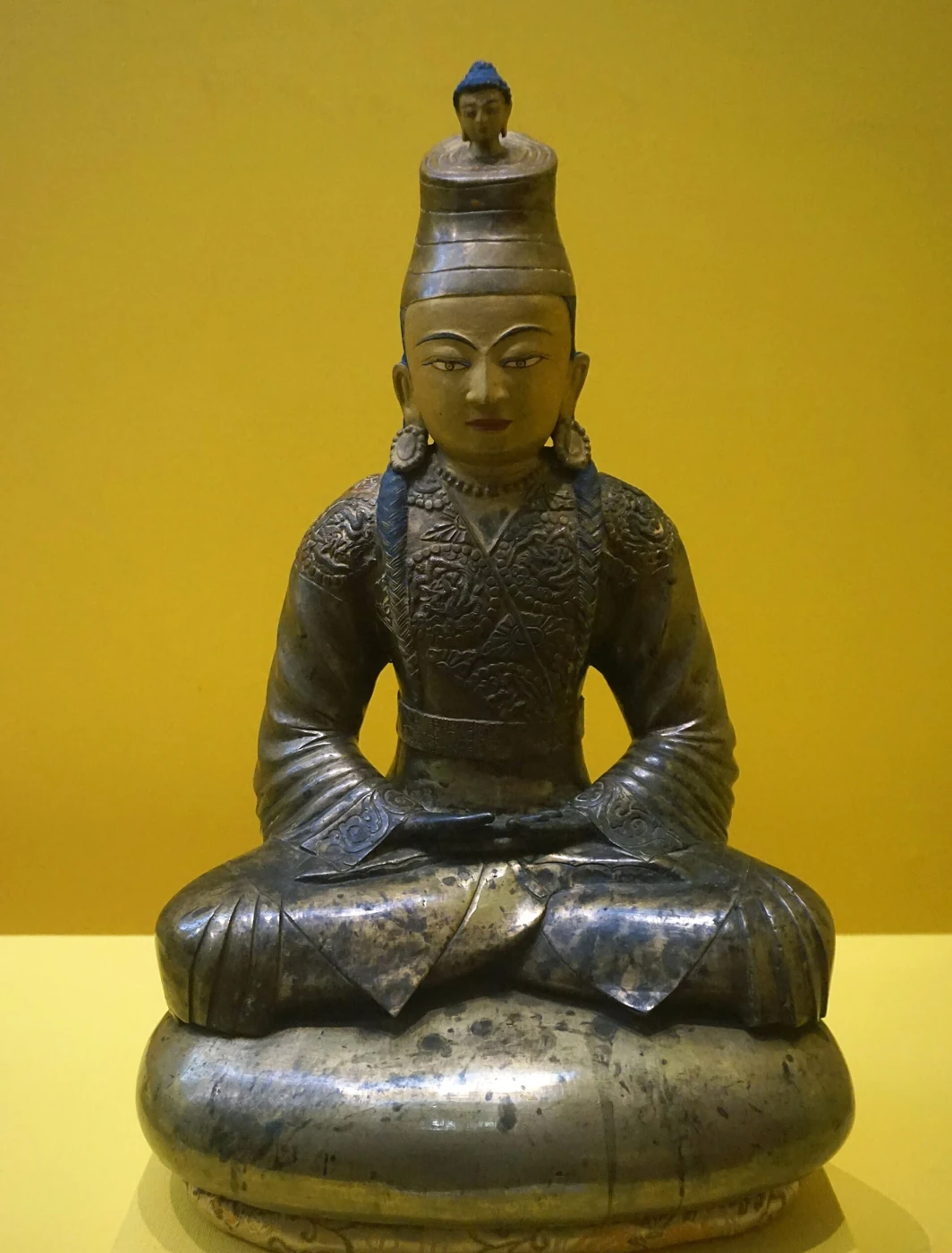
Biography
Family Background and Early Years Songtsen Gampo's original name was Chisongtsen. He was the only son of Namri Songtsen, the thirty-second Tsenpo of Tibet, and Queen Driza Tökar. He was born in 617, the first year of Yining under the Sui, at Jiangba Mujueling Palace in Yalong Zhaduigarden (present-day Jiama Township, Maizhokunggar County, Lhasa). During Namri Songtsen's reign, he led troops to destroy the Sumpa, rising from the ruler of a small polity in the Shannan region to become lord over the Tibetan tribes and laying the groundwork for Songtsen Gampo's later unification. Songtsen Gampo was described as intelligent, resolute, and versatile from childhood. His officials bestowed on him the honorific “Songtsen Gampo,” explained in Tibetan as meaning “Songtsen of profound mind.” From an early age he received rigorous training in riding, archery, swordsmanship, and martial arts, and after the age of ten was already said to be an exceptional warrior. Culturally, he could recite the lineage of the Tsenpos, knew heroic legends, enjoyed Tibetan folk songs, and was skilled in poetry, often composing verses spontaneously at banquets. He is described as one of the earliest authors represented in Tibetan literature. Namri Songtsen also emphasized moral education and chose companions for his son who were considered upright and virtuous, including the high minister Nyang Mangpoje Shangnang. Although a prince, Songtsen Gampo was said to treat friends with sincerity and to be open and generous rather than arrogant, winning broad support. ### Accession in Youth and Suppression of Internal Rebellion In 629, the third year of Zhenguan, Namri Songtsen relied on former Sumpa nobles, including Dba’s Dbyi tshab and Mnon ’Dron po, to annex the Kyichu River valley and other areas. He granted them estates and slaves. The rising status of these new nobles surpassed that of the older aristocracy, greatly strengthening royal authority but also provoking resentment among the old nobility. Rebellion was plotted, and regions such as Dapo, Kongpo, and Nyangpo fell into rebel hands. Zhangzhung to the west and the hostile Sumpa also coordinated with the old nobles. A Sumpa prince returned to his own base, raised troops, and expelled Tibetan officials and garrisons. The newly formed Tibetan kingdom thus faced a severe crisis. Songtsen Gampo was only twelve at the time. With the support of trusted ministers, including one of his uncles and Chancellor Nyang Mangpoje Shangnang, he ascended the throne as Tsenpo. While holding the Qonggyai–Tsetang area of Shannan, he also investigated the conspiracy that had poisoned his father and eliminated many hostile forces among the old nobility and within the court. The situation soon stabilized. He then personally crossed the Yarlung Tsangpo into the Kyichu valley, where nobles and commoners around Lhasa welcomed him, and people from Penyül presented tribute and pledged loyalty. He cultivated ties with middle and lower-ranking nobles, went among the populace to inquire about hardship, and generously rewarded soldiers. After three years, his army was described as highly effective. Around 632, the sixth year of Zhenguan, he began military operations to suppress the rebellions, quickly recovered rebel-held territory, forced the old aristocracy to surrender, and restored Tibetan unity. ### Moving the Capital to Lhasa and Unifying the Plateau After suppressing the rebellion, Songtsen Gampo began considering a transfer of the capital. Qonggyai and Tsetang in Shannan were the cradle of the Tibetan polity, but after Namri Songtsen's assassination he remained suspicious of the old nobles there. By contrast, the Kyichu valley was broad, and Lhasa, located on the lower reaches of the river, was protected by the Nyenchen Tanglha range to the north, connected eastward with Nyangpo and Kongpo, bordered Zhangzhung to the west, and lay north of the Yarlung valley. Its central position was more favorable for defense against the Sumpa to the north and Zhangzhung to the west. In 633, the seventh year of Zhenguan, Songtsen Gampo moved the capital from Qonggyai in Shannan to Lhasa. After the transfer, many tribes moved from the mountains to the plains, and more people took up agriculture, helping production develop. After moving the capital, Songtsen Gampo began a program to unify the Tibetan Plateau. He sent Nyang Mangpoje Shangnang against the Sumpa. Shangnang used conciliation, allowing Sumpa nobles to retain their lands so long as they paid prescribed tribute and taxes, and quickly secured the submission of the Sumpa groups. Tibetan territory thereby expanded into southern Qinghai. Songtsen Gampo then personally campaigned against Zhangzhung, which again submitted. To secure the relationship, he married his sister Sad-mar-kar to the Zhangzhung ruler Lig Myi-rhya. Lig Myi-rhya, however, remained unwilling to accept Tibetan domination and repeatedly engaged in anti-Tibetan activity. In 644, the eighteenth year of Zhenguan, Songtsen Gampo invaded Zhangzhung, killed its ruler, and brought its people under Tibetan control, completing the unification of the plateau. Thereafter economic and cultural relations between the people of Zhangzhung and other inhabitants of Tibet grew closer, and they gradually merged into a unified Tibetan people. ### Marriage Alliances with Nepal and the Tang Dynasty After the move to Lhasa, Nepal, south of the Himalayas, opened relations with Tibet. In 639, the thirteenth year of Zhenguan, Nepalese ruler Amshuvarman married his daughter Princess Bhrikuti to Songtsen Gampo. According to the source text, Bhrikuti brought to Tibet an image of Shakyamuni Buddha, a glass or crystal begging bowl, precious objects, and fine textiles. Songtsen Gampo built the Potala Palace in connection with the marriage and recruited many Nepalese craftsmen, helping advance Tibetan architecture, sculpture, painting, and other crafts. Songtsen Gampo had long admired the flourishing Tang state. In 634, the eighth year of Zhenguan, he sent envoys to Chang'an to establish relations with the Tang, and Emperor Taizong sent Feng Dexia with a letter in return. Learning that both the Turks and Tuyuhun had married Tang princesses, Songtsen Gampo sent another mission with Feng Dexia to request a marriage, but Taizong refused. The returning envoys claimed that the Tuyuhun ruler had slandered Tibet at court and caused the refusal. Enraged, Songtsen Gampo allied with Zhangzhung in 638 and attacked Tuyuhun, then personally led a large army against Songzhou. Emperor Taizong dispatched Minister of Personnel Hou Junji with fifty thousand infantry and cavalry. The Tang vanguard commander Niu Jinda launched a night attack on the Tibetan camp and reportedly took more than a thousand heads. Alarmed, Songtsen Gampo withdrew, sent an envoy to apologize, and again requested marriage. In 641, the fifteenth year of Zhenguan, Taizong married Princess Wencheng, a woman of the imperial clan, to him and ordered Li Daozong, Prince of Jiangxia and Minister of Rites, to oversee the marriage and escort her. Songtsen Gampo came with troops to Bohai to welcome her and treated Li Daozong with the deference due from a son-in-law. After Princess Wencheng entered Tibet, Songtsen Gampo built a walled settlement and palace for her, ordered the cessation of the Tibetan custom of painting the face red, replaced his felt and fur garments with silk clothing, sent sons of Tibetan nobles to the Tang National University to study the *Book of Songs* and *Book of Documents*, and asked literate Tang personnel to assist in managing Tibetan memorials and official communications. ### Later Years and Death In 647, the twenty-first year of Zhenguan, Tang envoy Wang Xuance was sent to India but was attacked by the usurper Arunasva in central India. Wang escaped alone to the western Tibetan frontier and requested aid. Songtsen Gampo sent 1,200 elite troops and also mobilized more than 7,000 troops from the subordinate state of Nepal, lending them to Wang Xuance for an expedition against India. The allied forces defeated the enemy, captured Arunasva alive, and rescued the Tang mission. In 649, the twenty-third year of Zhenguan, Emperor Taizong conferred on Songtsen Gampo the titles Commandant-Escort and Prince of Xihai Commandery. After Emperor Gaozong succeeded to the throne, he additionally conferred on him the title Prince of Cong. Songtsen Gampo died in 650, the first year of Yonghui, at the age of thirty-four. Different explanations of his death are recorded in the source text. One says that Princess Bhrikuti contracted an epidemic and infected him, after which he soon died at Zelmogang in Penyül, near present-day Pengbo Farm in Lhünzhub County, Tibet. Another says that he was assassinated by adherents of the Bon religion hostile to Buddhism. Tibet held a public memorial ceremony the following year and constructed a large tomb for him among the royal burial grounds at Qonggyai, corresponding to the present Valley of the Kings in Tibet.
Family, Boyhood and Taking the Throne at Twelve
Songtsen Gampo, originally named Chisongzan, was the only son and lawful heir of Namri Songtsen, the thirty-second btsan-po of Tibet. Legend has it that he "was clever, steadfast and accomplished in many arts from childhood," whence his ministers gave him the title Songtsen Gampo; the histories also praise him as "generous and heroic in talent," "unmatched in martial prowess," "full of great strategy" and "versed in crafts, calendrical reckoning and the martial arts." Such qualities came of his upbringing: from boyhood he was strictly trained in archery, swordsmanship and the martial arts, and by ten he was a warrior of outstanding skill; in letters he could recite the line of the btsan-pos and knew the tales of heroic ancestors, loved Tibetan folk song and excelled in composing verse, "often making poems impromptu at banquets, his works being the earliest in Tibetan literature that has come down to us." His father had used the strength of former Supi nobles such as Chen Zhanggu, Ba Yizebu and Nong Zhongbo to annex the Gyiqu river valley and others, granting them lands and slaves, so that the new nobles outranked the old and the royal power was much strengthened; but this offended the old nobles, roused the resentment of the old ministers and bred conspiracy. In 629 the old nobles rose together, and the regions of Dakpo, Kongpo and Nyangpo fell to the rebels.
At twelve, in this sudden crisis, Songtsen Gampo was raised to the throne by his uncle Lun Ke'er and the chancellor Shangnang and other trusted ministers. Holding the line about Qonggyai and Zedang in Shannan, he investigated those who had plotted to poison his father, found the ringleaders, destroyed many of the old nobles and the hostile faction within the court, and the situation was soon steadied. He then crossed the Yarlung Tsangpo himself to tour the Gyiqu valley, where the nobles and commoners of Lhasa welcomed and supported him, and the people of Pengyu brought tribute and pledged allegiance, "so that the north was consolidated." Seeing how wide his support was, he took heart for reuniting Tibet. As some great nobles, seeing him young, were overbearing, he played along with them so as to raise and train troops, and "the wilfulness of a prince was checked, and his character became silent and reserved, old beyond his years" — in Tibetan "songtsen" means dignified and "gampo" deep and grand, and the change matched the title. He attached the lesser nobles to him, went among the people, asked after their hardships and rewarded his soldiers richly; after three years "the army was very keen," and in about 632 he marched to put down the rebellion, which, "with men's hearts submitting and officers and men giving their lives," was soon quelled, the lands the rebels held taken, and the old nobles surrendering. Their lands, people and troops passed wholly under the btsan-po's rule, the unity of Tibet was restored, and the old nobles lost their former privileges.
Removing the Capital to Lhasa, Unifying the Plateau, and Relations with Tang
After the rebellion Songtsen Gampo thought of moving his capital. Touring Pengyu in the north he had come to the Lhasa region, whose "commanding geography, beautiful plains and towering Potala hill" delighted him; before the rebellion he had raised and trained troops there and formed deep ties with its tribal chiefs and people, his forces in the rebellion being drawn from those tribes, so that he could not hold them from far away; while at Qonggyai and Zedang in Shannan, though the cradle of Tibet with the ancestral tombs, he remained suspicious of the old nobles since his father's murder. Compared with the narrow Yarlung valley, the Gyiqu valley was broader, and Lhasa, at its lower reaches and the centre of Pengyu, had once been a Supi base and held the position of political centre of the plateau. In 633 he moved his capital from Qonggyai to Lhasa; with the move many tribes that had lived in the hills came down to the plains, more men took to farming, and herding gave way to settled pasturage, "promoting the growth of production," so that "after the move great fields appeared on the plains, with cattle and sheep everywhere and fat horses."
With the state growing strong he set about uniting the plateau. Of the Qiang peoples north of Tibet the greatest was Supi, whose threat remained after the rebellion, and he sent the capable chancellor Shangnang against it; after breaking its resistance Shangnang used conciliation, proclaiming the policy of receiving those who submitted, "treating the common people of Supi exactly as the households of Tibet proper, so that they lived at peace," and allowing the Supi nobles to keep their lands on fixed tribute, so that Supi's divisions soon submitted, "and from this Tibet's territory extended to southern Qinghai." In the southwest, Zhangzhung (also called Shangshung) south of Khotan had once been linked to Tibet by marriage; after the rebellion Songtsen Gampo campaigned against it in person and it submitted again, and he married his sister Semarkar to its king to bind him. In 638, when he attacked the Tuyuhun and moved against the Tang frontier, Zhangzhung sent troops with him. But its king would not accept subjection, resented the levies of goods and repeatedly acted against Tibet and clashed with it in arms, and being estranged from Semarkar and favouring his former queen, Semarkar too was resolved to destroy him; in 644 Songtsen Gampo marched into Zhangzhung, killed its king, and its people submitted and were registered as subjects, so that he "completed the unification of the Tibetan plateau," and Zhangzhung and the people of Tibet, in ever closer economic and cultural contact, gradually merged into the Tibetan people.
Relations with Tang turned on the Songzhou campaign of the autumn of 638. Songtsen Gampo attacked the Tang prefecture of Songzhou, and Taizong sent Hou Junji, minister of personnel, as grand commander with Zhi Shi Sili and others, "fifty thousand foot and horse, to strike him." Before the Tang main force moved, the vanguard under Niu Jinda had already beaten the Tibetans — with a small force he raided their camp and "still took more than a thousand Tibetan heads," and Songtsen Gampo, badly frightened, withdrew from Dangxiang, Bailan Qiang and Tuyuhun territory, sent envoys to apologize, and had his chancellor Gar Tongtsen present five thousand taels of gold and several hundred other treasures, whereupon Taizong agreed to the marriage. In 641 Tang sent Li Daozong, prince of Jiangxia and minister of rites, to escort Princess Wencheng into Tibet; Songtsen Gampo led his guards far out to meet her, meeting the party at Baihai near the source of the Yellow River, where "seeing Daozong he performed the rites of a son-in-law most respectfully," and said to those close to him: "Neither my father nor my grandfather ever married into the great nation; now that I have taken a princess of Great Tang, my good fortune is indeed great. I shall build a city for the princess, to show my descendants." He built a walled town and palaces for her; because she disliked the Tibetan custom of painting the face red he ordered it stopped, gave up his felt and furs for silk, sent sons of nobles to the Tang national academy to study the Odes and Documents, and asked for Chinese clerks to manage his memorials. After Taizong's return from Koguryo he had Gar Tongtsen memorialize in praise and present a golden goose seven feet high holding three hu of wine; in 648, when Wang Xuance's mission was plundered by Central India, Songtsen Gampo sent picked troops who, with Wang Xuance, broke Central India and sent captives to court. On Gaozong's accession he was made commandant of the imperial son-in-law, prince of Xihai, with two thousand bolts of silk; he wrote to the minister Changsun Wuji and others that "should any subject prove disloyal at the beginning of the emperor's reign, I shall lead troops to the capital to punish him," presented fifteen kinds of gold, silver and jewels to be placed before Taizong's tablet, and was advanced to prince of Cong, his likeness being carved in stone and set below the Dark Gate of the Zhaoling tomb.
Officials, Law, Army and Economy
His transformation of Tibetan institutions covered officials, law, army and economy. In the administration, where the court had had a single great minister (dalu) with immense power over home and foreign affairs, he added several chancellors, among them a lesser chancellor, a chancellor and commander-in-chief of the armies with the title of joint manager of state affairs, and a deputy commander with the same title, commanding the whole army; there were also four supreme officers over civil administration, all styled joint managers of state affairs, who with the great minister held the government, "all great matters of state being decided by the council of chancellors and submitted to the btsan-po for approval." Below them were officers of every kind: the nang-lun (inner minister) for appointments, equivalent to the minister of personnel; the chi-lun (outer minister), equivalent to the master of ceremonies, for foreign envoys; the ngang-ben (finance commissioner) for the treasury; the tsi-si-pa-che-pu (chief accountant) for taxes; and the yu-se-po-che-pu (chief judge), also called the great minister of rectification, for penal matters. These posts were held by nobles and passed from father to son, but "the nobles could not each go their own way, and the state's political and military business was administered uniformly by the court, strengthening its power." In law, the Tibetan histories say that "in Songtsen Gampo's reign, because subjects disputed and contended angrily before their lord, without courtesy or form, he made the Law of the Ten Virtues, so that the good should be encouraged and the wicked warned," and the code promulgated had twenty articles whose purport was that "the doer of good be encouraged, the doer of evil punished, the violent restrained by law, the poor and weak supported by law, and four armies set for guard"; it fixed weights and measures, laid out fields, taught the people to write, equipped horses and established ritual and right, with penalties such as fines for fighting, compensation for killing according to rank, eightfold restitution for theft, mutilation and exile for adultery and cutting out the tongue for lying — penalties of a harshness that answered to a society still at the slave stage. In the army he joined local administration to military organisation, dividing Tibet into four "ru" — the central, right, left and rear wings — adding a fifth (the Sumpa ru) after conquering Supi; each ru had two subdivisions and each subdivision four thousand-household commands, making thirty-two such commands and four lower ones in the four wings, besides four guard commands garrisoning the four wings, with the subdivisions distinguished by the colours of their banners and horses; units of about a hundred had a centurion, and the thousand-household commands in fact held about ten thousand men each. Each thousand-household was at once a military unit, a local administrative unit and a hereditary noble domain, its officers hereditary but appointed by the court; all soldiers were registered and controlled by the court, the whole army commanded by the commander-in-chief, and its movement authorised by the btsan-po's golden arrow. In the economy, Tibet being chiefly pastoral, Songtsen Gampo, taking a hint from the Tang equal-field system, applied a special form of it suited to local conditions: he first distributed the royal lands and part of the state property, such as livestock, to the poor free men, "opened waste land and laid out good fields and pastures," developing farming and herding according to the ground, and instituted a "green register" recording the households and cultivated area of commoners, with taxes fixed to the land. He also had his minister Thonmi Sambhota create the Tibetan script, learned it quickly and used it with ease, writing three works; the Mani Kabum, traditionally ascribed to him, contains his biography, the building of the Jokhang, the fetching of Princess Wencheng and of the statue of Shakyamuni, the practice of Avalokiteshvara and his final instructions, "a precious historical source combining history, religion, law and biography," though from its tantric practice and Madhyamaka thought it is very unlikely to be his. As for the Nepalese Princess Bhrikuti, scholars point out that Dunhuang Tibetan documents, Tibetan inscriptions and Chinese sources all record his marriage to Princess Wencheng and none his marriage to Bhrikuti, which appears only in Tibetan books abounding in the fabulous, so that its reliability is doubted.