Proclamation of Tang Yao
Tang Yao issued a general summons across six commanderies elevating Li Gao as Grand General and Duke of Liang; Li Gao inaugurated the Gengzi era and established his capital at Dunhuang.
400 CE–421 CE
西凉
The Western Liang (西凉; 400–421 CE) was an autonomous regional regime founded in the western reaches of the Hexi Corridor by the Han Chinese aristocrat Li Gao of the prestigious Longxi Li lineage during China's Sixteen Kingdoms era. The official state title was "Liang"; because it occupied the far western gateway of the corridor centering upon Dunhuang and Jiuquan, standard historiography designates it "Western Liang." Li Gao claimed direct patrilineal descent from the Western Han Dynasty…
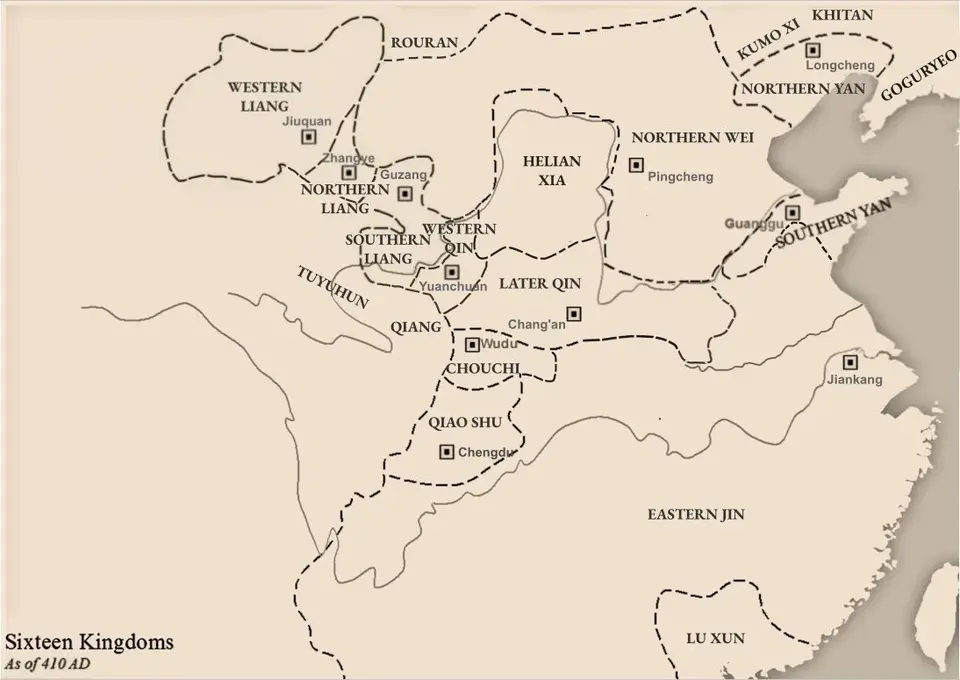
The Western Liang (西凉; 400–421 CE) was an autonomous regional regime founded in the western reaches of the Hexi Corridor by the Han Chinese aristocrat Li Gao of the prestigious Longxi Li lineage during China's Sixteen Kingdoms era. The official state title was "Liang"; because it occupied the far western gateway of the corridor centering upon Dunhuang and Jiuquan, standard historiography designates it "Western Liang." Li Gao claimed direct patrilineal descent from the Western Han Dynasty general Li Guang. In the wake of the disintegration of Later Liang and mounting rivalries among local warlords, Li Gao responded to the collective elevation by local Han gentry and regional ethnic chieftains, formally inaugurating the Gengzi era and establishing his capital at Dunhuang in 400 CE, before moving east to Jiuquan in 405 CE to establish a dual defensive posture against Northern Liang in the east while commanding the Tarim Basin in the west. During its twenty-two years of existence, Western Liang was governed by three sovereigns: Li Gao, Li Xin, and Li Xun. Under Li Gao's prudent seventeen-year reign, the court zealously promoted Confucian classical scholarship, established the Pan Palace academy alongside Erudites of the Five Classics, and directed comprehensive hydraulic canal digging and agricultural garrison colonies, making this isolated frontier a vital sanctuary for Huaxia cultural traditions amid nationwide turmoil. Following Li Gao's death, Li Xin succeeded to the throne, adopting draconian penal laws and reckless military adventurism that led to his fatal defeat at Liaoquan in 420 CE. His brother Li Xun rallied defenses at Dunhuang, but succumbed after Northern Liang diverted the Dang River to inundate the fortress in 421 CE, whereupon Li Xun committed suicide and the state collapsed. The imperial house of the Tang Dynasty later traced its direct ancestry to Li Gao, posthumously venerating him as Emperor Xingsheng.
Tang Yao issued a general summons across six commanderies elevating Li Gao as Grand General and Duke of Liang; Li Gao inaugurated the Gengzi era and established his capital at Dunhuang.
Li Gao dispatched Song Yao to conquer Liangxing and secure fortified settlements west of Yumen Pass, while Jiuquan and Liangning surrendered from Northern Liang.
Li Gao constructed the Hall of Reverent Respect at Dunhuang adorned with portraits of ancient sages and virtuous heroines to instruct officials and foster classical ritual governance.
Li Gao inaugurated the Jianchu era and transferred the dynastic capital to Jiuquan, forcibly relocating twenty-three thousand refugee households to establish expatriate commanderies.
Li Gao dispatched the Buddhist monk Faquan across desert trails to submit memorials to Eastern Jin, securing recognition as General Pacifying the West.
Li Gao directed the construction of the Mengshou and Yangkai canals to channel the Shule River, expanding extensive farming colonies across Yumen and Yangguan.
Li Gao entrusted state governance to Song Yao and passed away in Jiuquan; Crown Prince Li Xin succeeded to the throne, adopting the Jiaxing era and elevating Lady Yin as Queen Dowager.
Li Xin ambushed Northern Liang invaders at Liaoquan and decapitated seven thousand enemy troops, cultivating dangerous complacency and reckless military ambitions.
Li Xin fell into Juqu Mengxun's feigned retreat trap, suffered an ambush at Huaicheng, and was killed alongside his annihilated army at Liaoquan, leading to the capture of Jiuquan.
Juqu Mengxun diverted the Dang River to inundate Dunhuang; following an internal mutiny, Li Xun committed suicide and Western Liang was extinguished.
Li Gao traced his ancestral home to Chengji in Longxi, belonging to an illustrious gentry lineage that produced prominent commanders and civil governors from the Western Han hero Li Guang down through the Wei and Jin dynasties. During the Long'an era of Eastern Jin, Later Liang disintegrated amid internal strife, prompting Duan Ye and Juqu Mengxun to rebel and establish Northern Liang, under whom Li Gao served as Magistrate of Xiaogu. Following the death of Dunhuang Governor Meng Min, local military commanders Guo Qian and Suo Xian unanimously elevated Li Gao as Governor of Dunhuang. When Duan Ye subsequently assumed the title King of Liang, his advisor Suo Si attempted to assassinate Li Gao out of jealousy, but Li Gao launched a decisive counterattack and routed him. Duan Ye executed Suo Si in apology, partitioned Dunhuang to create Liangxing Commandery, and appointed Li Gao Commander-in-Chief West of Liangxing and General Pacifying the West, firmly consolidating his authority across Hexi.
In the second year of Tianxi under Northern Liang (400 CE), Tang Yao, the Governor of Jinchang, grew alienated by the oppressive suspicions of the Juqu clan and issued a general proclamation across six commanderies—Dunhuang, Jiuquan, Jinchang, Liangxing, Jiankang, and Qilian—proposing the joint elevation of Li Gao as Grand Commander-in-Chief, Grand General, Duke of Liang, Shepherd of Qin and Liang Provinces, and Colonel Protecting the Qiang. Acceding to the overwhelming public consensus, Li Gao ascended the altar, proclaimed an empire-wide amnesty, inaugurated the Gengzi era, and established his administrative capital at Dunhuang, formally giving birth to the Western Liang state. Appealing to traditional Wei-Jin institutional norms and Confucian learning, Li Gao quickly garnered enthusiastic support from local Han scholar-elites and tribal leaders, laying a durable political and popular foundation for regional autonomy.
In its fledgling years, Western Liang confronted acute geopolitical vulnerabilities marked by cramped frontiers and a sparse population. Li Gao appointed his trusted confidant Song Yao as General of Breaking Charges, directing him eastward to pacify Liangxing Commandery and westward to secure all fortified settlements beyond Yumen Pass, successfully incorporating the remnants of Suo Si's defeated forces. At that juncture, northern and central China were engulfed in relentless warfare; only Liang Province remained an island of relative tranquility, drawing an endless stream of scholar-gentry and displaced civilians from the Guanzhong and Central Plains regions. Li Gao implemented benevolent policies to resettle these refugee populations, extending Western Liang's frontiers to Yumen Pass, Yangguan, and the eastern threshold of the Tarim Basin. In 401 CE, internal mutinies struck Northern Liang, prompting Governors Wang Fei of Jiuquan and Jiao Lang of Liangning to surrender, extending Western Liang's eastern perimeter to the western approaches of Zhangye.
In 405 CE, Li Gao adopted the Jianchu reign title and, recognizing the necessity of controlling the Hexi agricultural core, decisively relocated the dynastic capital eastward from Dunhuang to Jiuquan, establishing a fortified forward hub against Northern Liang. Li Gao organized the eastward migration of more than twenty-three thousand Han and non-Han refugee households previously gathered in Dunhuang and Jinchang. He settled five thousand southern refugee households into the newly instituted expatriate Kuaiji Commandery, placed five thousand households from central China into Guangxia Commandery, and distributed the remaining thirteen thousand households across Wuwei, Wuxing, and Zhangye commanderies. This strategic transfer substantially augmented the defense capabilities and fiscal revenue of the new capital, while extending institutional protection to aristocratic refugee clans stranded in the northwest.
After establishing Jiuquan as the primary capital, Li Gao instituted a comprehensive national doctrine centered on promoting agriculture and hoarding grain as the fundamental strategy for enduring strength. He dispatched garrison troops to develop expansive military and civilian agricultural colonies around Yumen and Yangguan, and supervised the excavation of the Mengshou and Yangkai canals to divert river waters across arid lands. Western Liang witnessed consecutive years of abundant harvests, filling public granaries and fostering general prosperity. Li Gao personally reviewed twenty thousand elite cavalry in Jiandong; impressed by this martial display, the rulers of Shanshan and Anterior Cheshi sent tribute embassies bearing local specialties, prompting Western Liang to establish the Western Rong Colonelcy to supervise the Tarim Basin city-states. High-grade Hetian jade formerly dispatched to Later Liang was retained at Dunhuang and crafted into imperial seals, while Erudites of the Five Classics were posted to Gaochang to propagate classical learning throughout the oasis world.
To neutralize predatory incursions by the newly ascendant Rouran nomadic cavalry from the northern steppes, Western Liang constructed a layered northern defense perimeter. The court cultivated diplomatic ties with Dingling tribes while conducting large-scale restorations of ancient Han Dynasty earthen frontier ramparts, fortifying West Sea Commandery along the Ejin River basin, where diagnostic undulating-band pottery remains still mark the defensive trace. To counter southern raids by the Tuyuhun and affiliated Qiang tribes, Western Liang erected Ziting Fortress at the strategic Jinkou Pass between the Qilian and Altyn-Tagh ranges, guarding the ancient mountain corridor once pioneered by Western Han general Zhao Chongguo. This dual defensive architecture established an unyielding barrier against steppe nomads in the north and mountainous Qiang incursions in the south.
Throughout his reign, Li Gao consistently regarded the Eastern Jin court in Jiankang as the sole legitimate sovereign of the Huaxia civilized world, repeatedly dispatching the Buddhist monk Faquan across treacherous deserts and mountain paths to present tribute memorials and request imperial investiture to counterbalance Northern Liang. In 417 CE, the Eastern Jin court formally conferred upon Li Gao the exalted titles of Commissioner Bearing Credentials, Commander-in-Chief of Seven Commanderies, and General Pacifying the West. In the second month of that year, Li Gao fell gravely ill in the Jianan Palace at Jiuquan. On his deathbed, he issued a solemn admonition instructing his heirs to practice extreme restraint regarding warfare and focus on moral governance, entrusting the government of the Three Mansions to Chief Counselor Song Yao to guide Crown Prince Li Xin. Li Gao passed away at age sixty-seven, receiving the posthumous title King Wuzhao and the temple name Taizu, depriving the state of its sagacious founder.
Li Xin assumed the throne, adopted the Jiaxing reign title, and elevated his mother Lady Yin as Queen Dowager. In stark contrast to his father's benevolence and fiscal prudence, Li Xin was naturally impatient, arrogant, and obstinate. He pursued grandiose prestige projects, squandered treasury resources on lavish palaces and pleasure pavilions, filled his inner quarters with non-Han women from the Western Regions, and enacted draconian criminal punishments. Oppressive taxation and relentless corvee demands severely eroded agrarian productivity and alienated the civilian populace. Even when recurring earthquakes and meteorological anomalies struck Hexi—widely interpreted under classical omens as signs of imperial misrule—Li Xin remained contemptuous of counsel, causing the political foundations of Western Liang to deteriorate rapidly.
In 418 CE, Juqu Mengxun led thirty thousand Northern Liang troops in a major offensive against Western Liang. Li Xin personally donned armor, led the van, and sprung an ambush at Liaoquan, routing the invaders and decapitating over seven thousand enemy troops. This tactical triumph proved disastrous for Li Xin's strategic judgment, inflating his hubris and convincing him that Northern Liang could be crushed in a single campaign. Military counselor Zhang Xian and registrar Fan Cheng repeatedly submitted impassioned memorials urging him to cease palace construction, relieve tax burdens, and avoid reckless foreign expeditions. Queen Dowager Yin and elder statesman Song Yao wept bitterly in court, warning that another eastward march would precipitate national destruction, but Li Xin flew into a rage and dismissed all warnings.
In the seventh month of 420 CE, Juqu Mengxun exploited Li Xin's vanity by feigning an eastward assault against Western Qin, while secretly wheeling his elite strike forces back to lie in ambush at Chuanyan. Convinced that Northern Liang's capital at Zhangye lay defenseless, Li Xin declared total mobilization and led thirty thousand elite troops eastward. At Huaicheng, the Western Liang army was ambushed by concealed Northern Liang forces and thrown into utter disarray. Subordinate commanders desperately urged Li Xin to retreat into the fortified walls of Jiuquan to regroup, but he refused out of shame, insisting on an open-field clash at Liaoquan. Surrounded by superior enemy forces, his army was annihilated and Li Xin was slain in combat. Juqu Mengxun swiftly exploited the victory, storming and capturing the dynastic capital at Jiuquan.
Following Li Xin's death, his younger brother Li Xun, then serving as Governor of Dunhuang, retreated into Dunhuang to sustain the resistance, where local troops acclaimed him Champion General and Inspector of Liang Province, adopting the Yongjian reign title. In the spring of 421 CE, Juqu Mengxun led his victorious army westward to lay siege to Dunhuang, damming and diverting the waters of the Dang River to inundate the city walls. As supplies dwindled and water undermined the foundations, Li Xun dispatched emissaries to negotiate terms of surrender, which Juqu Mengxun adamantly rejected. Shortly thereafter, garrison commander Song Rong betrayed the fortress and surrendered, leaving Li Xun with no recourse but to draw his sword and commit suicide. Juqu Mengxun sacked the city, slaughtering thousands, and Western Liang was formally extinguished after twenty-two years of rule.
Following the fall of Western Liang, Li Gao's grandson Li Bao fled across the desert to Yiwu in the Tarim Basin alongside his uncle Tang Qi, establishing the Later Western Liang regime under the Longxing era and sheltering countless refugees. When the Northern Wei Dynasty conquered Northern Liang in 439 CE, Li Bao and his uncle Tang He submitted to Northern Wei, with Li Bao appointed General Pacifying the West and Equal to the Three Excellencies. Tang He assumed command of the renowned Western Troops of Gan and Liang, participating in campaigns against Yanqi and securing Western Regions garrisons for decades. Centuries later, the imperial house of the Tang Dynasty traced its royal patrilineal lineage directly to Li Gao, posthumously honoring him as Emperor Xingsheng and perpetuating the prestige of the Western Liang Li clan.
Western Liang administrative institutions were deeply rooted in the bureaucratic traditions of the Wei and Jin dynasties, featuring an executive structure centered on military command headquarters. During the founding phase, Li Gao established the Grand Commander-in-Chief's Mansion and the Grand General's Mansion, staffed with senior secretarial and military aides such as record clerks, chief clerks, adjutants, and attending retainers to coordinate military mobilization and civil administration. On his deathbed, Li Gao consolidated power by elevating elder statesman Song Yao to Oversee Affairs of the Three Mansions. Serving concurrently as General of the Martial Guard, Governor of Guangxia, and Libationer of Military Consultation, Song Yao exercised supreme executive authority over all civil and military affairs, performing a role equivalent to the Prefect of the Masters of Writing in traditional Wei-Jin courts.
In official recruitment and strategic consultation, Western Liang maintained the Nine-Rank System alongside traditional Han Dynasty filial and incorrupt recommendations, balancing aristocratic prestige with administrative capability. Li Gao instituted consultative offices including the Libationer of Military Consultation and Libationer of Confucian Scholars, appointing prominent local scholars as policy advisors and conferring high institutional standing on civilian elites. The administration deployed imperial colonels and supervisory censors to inspect local officials, curbing bureaucratic corruption and preventing aristocratic land encroachments. Under Li Gao's rule, this institutional framework maintained disciplined governance and responsive fiscal mobilization, balancing wartime military agility with civilian bureaucratic stability.
In local administration, Western Liang implemented a structured three-tier system comprising provinces, commanderies, and counties. Li Gao personally assumed the positions of Shepherd of Qin Province and Shepherd of Liang Province, designating Jiuquan, Dunhuang, Jinchang, and Liangxing as the core governing districts. Commanderies were governed by commandery governors who supervised local magistrates and maintained administrative control. Special military officers, including the Dunhuang Protector, Xingma Protector, and Protector of Barbarians, were posted to garrison strategic passes and oversee trade corridors. This integrated approach, combining civilian administrative divisions with regional defensive strongholds, enabled the regime to maintain firm control over the vulnerable oasis network of the Hexi Corridor.
To accommodate the influx of refugees fleeing warfare in the Central Plains and Han River basin, Li Gao implemented an innovative system of expatriate commanderies. The government established Kuaiji Commandery to shelter southern refugees, Guangxia Commandery for migrants from central provinces, and distributed eastern Hexi refugees across expatriate Wuwei, Wuxing, and Zhangye commanderies. Displaced households received dedicated household registrations, government land allotments, seeds, and agricultural tools, integrating them into the state tax base while preserving their distinct community structures. This resettlement strategy prevented disruptive property disputes with local clans and transformed thousands of refugee families into tax-paying yeoman farmers and disciplined military conscripts.
The political foundation of Western Liang rested on prominent Han aristocratic lineages rooted in the Longxi and Hexi regions. Well-versed in regional clan politics, Li Gao pursued a strategy of co-governance with established gentry families, forging enduring alliances with illustrious clans such as the Suo of Dunhuang, Zhang of Jiuquan, Yin of Wuwei, Fan of Dunhuang, and Linghu of Dunhuang. Setting aside prior hostilities, Li Gao patronized the descendants of Suo Si and appointed leading gentry scholars to high ministerial posts. Supported by Queen Dowager Yin, Li Gao reinforced these administrative alliances through strategic marital unions, creating a collaborative governing elite where Han scholar-officials steered policy in concert with prominent landowning clans.
Faced with a diverse population comprising Lushui Hu, Xianbei, Qiang, and Di communities, Western Liang adopted a dual system of governance emphasizing moral pacification and customary autonomy. Li Gao held the offices of Colonel Protecting the Qiang and Colonel Protecting Western Barbarians, and established the Western Rong Colonelcy to supervise frontier tribal groups. Chieftains of submitting nomadic tribes were granted honorary military general titles without disruptive interference in their internal tribal structures. The government strictly prohibited Han landowners from expropriating tribal horses and cattle, maintaining a measured policy of frontier conciliation that preserved regional interethnic harmony for nearly two decades.
The military apparatus of Western Liang inherited the hereditary military household system of the Han, Wei, and Jin dynasties, organized into three primary operational forces: private armed retinues fielded by powerful Han gentry clans, rotational garrison troops and agricultural conscripts raised from local commanderies, and auxiliary nomadic cavalry recruited from submitting Xianbei and Lushui Hu tribes. Li Gao instituted formal generalship titles, including General of the Martial Guard, General of Breaking Charges, and General Establishing Martial Prowess, to command elite palace guards and territorial provincial forces. At its zenith, the regular army maintained thirty to forty thousand cavalry and infantry, distinguished by hardy Hexi chargers and heavily armored horsemen capable of enduring severe desert operations.
Western Liang constructed a comprehensive defensive network designed to resist Northern Liang in the east, control western desert routes, deter northern nomads, and block southern mountain tribes. Jiuquan served as the forward defense bastion, featuring fortified ramparts, deepened moats, and reinforced watchtowers, while Dunhuang functioned as the rear strategic depot and gateway to Central Asian diplomacy. Along the northern frontier, engineers restored Han Dynasty ramparts and signaling towers; in the south, Ziting Fortress guarded the Jinkou Pass to prevent Tuyuhun raids. This integrated network of walled cities, mountain fortresses, and earthwork watchposts allowed Western Liang to maintain effective regional defense against numerically superior adversaries.
Western Liang remained firmly committed to Huaxia cultural traditions, regarding the Eastern Jin Dynasty in Jiankang as the sole legitimate authority over all China and actively maintaining diplomatic fealty. In 405 CE, Li Gao dispatched secretary Huang Shi across extensive sand routes to the southern capital, invoking the historical precedents of Dou Rong and Zhang Gui to reaffirm his dedication to imperial restoration. In 407 CE, the court sent the Buddhist monk Faquan through desert tracks to renew tributary relations. The Eastern Jin court responded by officially conferring upon Li Gao the titles of Commissioner Bearing Credentials, Commander-in-Chief of Seven Commanderies, General Pacifying the West, Colonel Protecting the Qiang, and Duke of Jiuquan, providing legal legitimacy that bolstered regional morale.
Confronting the strategic and demographic advantages of Juqu Mengxun's Northern Liang, Li Gao adhered to a defensive strategy of conserving strength and launching ambushes against overextended enemy forces. When Juqu Mengxun attacked Jiankang and abducted thousands of civilians, Li Gao led light cavalry on a flank pursuit, ambushing and routing the Northern Liang column at Mi'an to recover all captive households and property. In 410 CE, when Northern Liang breached peace agreements and attacked again, Crown Prince Li Xin intercepted the invaders, shattering their ranks and capturing the enemy commander Juqu Bainian. By avoiding rash offensives and maintaining defensive discipline, Li Gao protected the civilian population of Hexi from devastation.
Operating within the contested Hexi Corridor, Li Gao displayed sophisticated geopolitical acumen by forging a strategic partnership with Southern Liang to counterbalance Northern Liang. Following Southern Liang ruler Tufa Rutan's capture of Guzang and subsequent pressure from Northern Liang, the two regional states established diplomatic contact. Tufa Rutan secured safe passage through northern Xianbei territory to escort Li Gao's daughter Li Jing'ai back to Jiuquan. Li Gao reciprocated by dispatching envoys laden with western luxury goods, cementing a defensive alliance reinforced by political marriage. This diplomatic coordination exerted reciprocal pressure on Northern Liang's flanks, granting Western Liang a vital period of peace to develop internal agriculture and state defenses.
In Central Asian affairs, Western Liang operated through the Western Rong Colonelcy based at Dunhuang to restore imperial tributary ties with city-states across the Tarim Basin. Li Gao led cavalry formations on inspection tours near Jiandong, prompting the kings of Shanshan and Anterior Cheshi to send tributary missions and trade envoys. Following the fall of Western Liang, Li Gao's grandson Li Bao withdrew to Yiwu to establish the Later Western Liang state, while his kinsman Tang He mobilized the Western Troops of Gan and Liang under Northern Wei authority to pacify Yanqi and secure Tarim Basin trade routes. The military operations and diplomatic initiatives of Western Liang forces left an enduring cultural and institutional imprint across the Western Regions.
Situated within an arid oasis environment, Western Liang regarded agricultural production as the paramount foundation of state survival. The court implemented policies to encourage farming and support the military, lowering tax rates, offering incentives for land reclamation, and preventing official corvee demands from disrupting the planting seasons. Li Gao mobilized garrison troops and displaced families to establish extensive state farming colonies around Yumen Pass and Yangguan. By introducing advanced agricultural techniques, crop rotation, and fertilizer methods from central China, the regime transformed arid tracts into fertile fields, creating an era of agricultural self-sufficiency and full granaries that sustained regional autonomy.
The vitality of Hexi agriculture depended entirely on glacier-fed rivers and organized irrigation infrastructure. Li Gao directed major civil engineering initiatives across the Jiuquan and Dunhuang basins, mobilizing soldiers and civilians to construct the Mengshou, Yangkai, and Yin'an canals along the Dang and Shule rivers. These masonry-reinforced channels crossed arid soils to create an integrated irrigation network, ensuring reliable water supplies for tens of thousands of acres of arable land. The resulting agricultural security enabled farming, livestock breeding, and sericulture to flourish, fostering a peaceful rural landscape characterized by fortified farming manors and productive orchard gardens.
Since the Han and Wei dynasties, the Hexi Corridor had contained extensive natural salt lake deposits that served as an indispensable pillar of regional public finances. Western Liang restored and expanded government monopolies over salt production at Wuwei, Jiuquan, and West Sea, following historical methods implemented by the Wei official Xu Miao. Imperial administrators regulated salt extraction and established uniform market prices, exchanging surplus salt with adjacent nomadic tribes for war horses, cattle, and grain reserves. This commercial monopoly fulfilled the domestic needs of the local population while generating reliable revenue that replenished state treasuries through regulated border trade.
Beyond agriculture and mineral extraction, horse breeding and pastoral animal husbandry formed vital components of the Western Liang economy. Li Gao established specialized government agencies to manage expansive horse-breeding runs across the fertile foothill meadows of the northern Qilian Mountains. Incorporating equestrian techniques from submitting Xianbei and Lushui Hu pastoralists, the administration bred robust Hexi war horses that supplied both heavy cavalry units and agricultural transport. This coordinated management of livestock herds alongside crop cultivation established a balanced economic cycle supporting frontier defense and rural productivity.
Western Liang occupied the vital crossroads where the northern and southern branches of the ancient Silk Road converged. Recognizing the commercial value of international transit trade, Li Gao implemented favorable policies toward domestic and foreign merchants, reducing transit tolls and establishing official trading lodges along major desert routes to protect merchant caravans. Commercial missions from Gaochang, Shanshan, Kucha, and Khotan regularly arrived at Jiuquan and Dunhuang, importing gemstones, incense, textiles, and grape wines, while exporting Chinese silks, ironware, and lacquer products. This international commerce generated customs revenue and elevated Jiuquan into a major Central Asian trade emporium.
In market transactions and currency circulation, Western Liang did not mint dedicated dynastic coins, but relied on ancient Five Baht and other classical copper coins inherited from earlier imperial eras. Archaeological excavations at the Qijiawan cemetery near Dunhuang have uncovered western Hexi tombs containing inscribed funerary vessels from the fifth and eleventh years of the Jianchu era alongside caches of traditional copper coins, confirming the continued operation of a monetized commodity economy. The simultaneous circulation of minted coins, silk textiles, and grain measures demonstrated commercial vitality and market resilience amid the fragmented conditions of the Sixteen Kingdoms.
Amid the widespread devastation and civil warfare of the Sixteen Kingdoms period, Li Gao and Queen Dowager Yin maintained a deep commitment to preserving and continuing Huaxia cultural traditions. Upon establishing his initial capital at Dunhuang, Li Gao ordered the construction of the Hall of Reverent Respect outside the southern gates as an official hall for deliberating state affairs and reviewing military parades. Within the hall, artists painted commemorative portraits of ancient sage kings, loyal ministers, filial sons, and heroic women, with Li Gao personally composing prefaces and encomiums to encourage moral rectitude among royal kinsmen and senior ministers. The hall served as an architectural symbol of classical virtue and dynastic legitimacy.
To preserve canonical scholarship from disruption, Li Gao founded the Pan Palace classical academy at Dunhuang in 404 CE, enrolling over five hundred youths from aristocratic and commoner backgrounds to study classical texts, administration, and medicine. The court appointed Erudites of the Five Classics across all commanderies to teach the Classic of Poetry, Book of Documents, Book of Rites, I Ching, and Spring and Autumn Annals. Through this imperial patronage, classical learning flourished across the remote northwest, establishing Dunhuang as an intellectual sanctuary that preserved classical Chinese scholarly traditions during an era of division.
The tolerant and cultured governance of Western Liang transformed Dunhuang and Jiuquan into refuge sanctuaries for intellectuals across China. Following the collapse of the Western Jin capital, prominent Confucian scholars traveled to Hexi to seek patronage under Li Gao. The renowned educator Liu Bing established an academy at Jiuquan, tutoring thousands of disciples and authoring hundreds of scholarly treatises; the geographer Kan Yin completed the landmark geographical text Records of the Thirteen Provinces; and senior ministers including Song Yao and Fan Cheng produced works on classical history. This concentration of literary talent made Western Liang one of the foremost intellectual centers of the Sixteen Kingdoms era.
Li Gao possessed exceptional literary talent and intellectual refinement, composing celebrated works including the Rhapsody on Expressing My Aspirations, Rhapsody on the Locust Tree, and Admonitions to My Sons. The Rhapsody on Expressing My Aspirations conveyed his yearning for moral integrity and his enduring hope to serve the reunification of the empire. The Rhapsody on the Locust Tree reflected on the lone surviving locust tree at the Jiuquan Palace—planted during the Former Liang era when all others had perished—using its survival in barren soil as an allegory for perseverance in the frontier. These compositions represent enduring masterpieces of Wei-Jin literary expression in the northwest.
In the performing arts, Western Liang fostered the development of Western Liang Music, historically recorded as Qin-Han Entertainment. Following the Yongjia disorders of Western Jin, court musicians from the imperial Ministry of Ceremonies sought refuge in Liang Province, introducing classical ritual music to the northwest. Local musicians combined these ancient Chinese melodies with musical traditions from Kucha, India, and regional folk songs, producing a distinct musical style that blended traditional elegance with foreign vitality. When the Northern Wei conquered the region, they designated this musical tradition as the official National Music, which subsequently influenced the canonical court music of the Sui and Tang dynasties.
Western Liang musical performances featured vocal songs, instrumental compositions, and expressive dances, including famous melodies such as Joy of Eternal Ages and Western March. Popular local dances performed at Jiuquan and Dunhuang, notably the Sogdian Whirl and Sogdian Leap, were celebrated by later Tang poets for their athletic agility and rhythmic intensity. Cave 220 of the Mogao Grottoes at Dunhuang features an early Tang mural illustrating Western Liang musical ensembles, depicting twenty-eight musicians playing zithers, flutes, drums, and clappers alongside dancers performing on circular carpets, illustrating the cultural synthesis that flourished under the regime.
Li Gao, Li Xin, Li Xun.
| Monarch | Reign Period | Temple / Posthumous Title | Key Governance Achievements and Historical Legacy |
|---|---|---|---|
| Li Gao | 400–417 CE | Taizu / King Wuzhao (posthumously honored as Emperor Xingsheng by Tang) | Founding sovereign who established the capital at Dunhuang and later moved to Jiuquan. Promoted Confucian learning, directed hydraulic projects, maintained ties with Eastern Jin, and secured cultural stability across Hexi. |
| Li Xin | 417–420 CE | None / Lord of Xia | Second sovereign who enacted harsh penal codes and engaged in palace construction. Despite an initial victory at Liaoquan, he fell into an ambush at Huaicheng and was killed in battle, leading to the loss of Jiuquan. |
| Li Xun | 420–421 CE | None / Final Ruler | Younger brother of Li Xin who organized the defense of Dunhuang as Champion General and Inspector of Liang Province. Committed suicide when Northern Liang flooded the city, ending the dynasty. |
The Official History of the Jin Dynasty records the following assessment of Li Gao: He possessed remarkable foresight and broad learning in the classics and histories, cultivating benevolence and moral righteousness. He promoted agriculture, established schools to transform customs, conciliated distant peoples, and maintained order, leaving an enduring model of frontier administration.
In his commentary on the Comprehensive Mirror for Aid in Governance, Hu Sanxing noted: The Li clan of Western Liang rose in Longyou through classical learning. Their success in settling displaced populations and promoting Confucian education marked them as exemplary frontier sovereigns.
Centuries later, Emperor Taizong of Tang praised Li Gao's legacy during the compilation of the Jin annals. In 743 CE, Emperor Xuanzong of Tang formally issued an imperial decree honoring Li Gao as Emperor Xingsheng, acknowledging the Western Liang royal house as the direct ancestral root of the Tang imperial family. Throughout the tumultuous Sixteen Kingdoms era, Western Liang provided a sanctuary of classical governance, preserving ancient Huaxia texts and musical traditions at the gateway of the Silk Road and shaping the cultural history of northwest China.
 Western Liang (西凉)
Founding Monarch of the Western Liang Regime
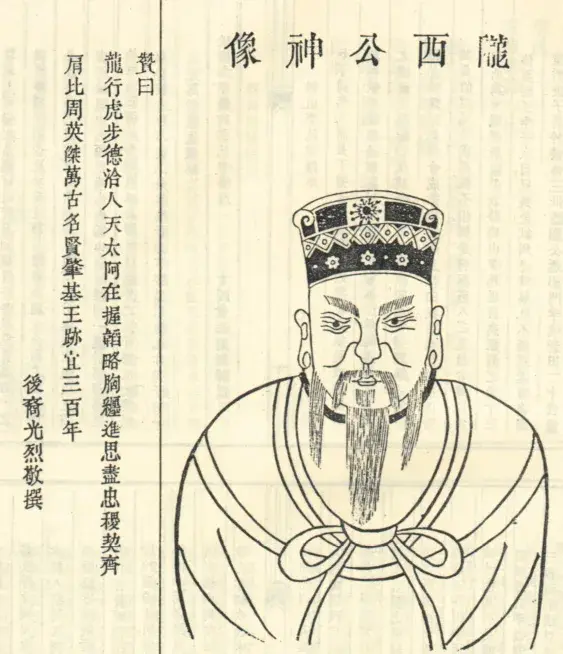
Li Gao (李暠, 351 – March 417), courtesy name Xuansheng and childhood name Changsheng, hailing from Didao in Longxi (modern Lintao, Gansu), was the sixteenth-generation descendant of the Han general Li Guang and the founding sovereign of Western Liang during the Sixteen Kingdoms period. Honored with the temple name Taizu and posthumous title King Wuzhao, he was later venerated by Emperor Xuanzong of Tang as Emperor Xingsheng. Renowned in his youth for mastering Confucian classics, military strategy, and archery, he served successively as Magistrate of Xiaogu and Administrator of Dunhuang under Northern Liang. In 400, following his victory over Suo Si, he was proclaimed Duke of Liang by local elites, establishing Western Liang and upholding the Eastern Jin as legitimate suzerain. Reigning for seventeen years, Li Gao relocated the capital to Jiuquan, repeatedly repelling incursions by Juqu Mengxun of Northern Liang. Domestically, he integrated military garrisons with agrarian cultivation, opening tens of thousands of mou of agricultural colonies along Yumen and Yangguan while resettling over 23,000 displaced households through tax relief. He established the Jinggong Hall to patronize scholars and erected imperial academies, making Hexi an enduring sanctuary for Han civilization amid northern turmoil. Diplomatically, he balanced relations with Eastern Jin and Later Qin while projecting authority over the Western Regions, revitalizing the Silk Road and laying deep aristocratic foundations for the rise of the Guanlong nobility in the Sui and Tang eras.
 Western Liang (西凉)
Second Ruler of Western Liang
Li Xin (李歆, c. 385–420), courtesy name Shiye (士业) and childhood name Tongzhui (桐椎), was a native of Didao County, Longxi Commandery (modern Lintao County, Gansu Province). He was the second ruler of the Western Liang regime during the Sixteen Kingdoms period, the second son of founding monarch King Wuzhao Li Gao, and a prominent patrilineal ancestor of the Tang dynasty imperial house. In his youth, Li Xin served in military campaigns alongside his father, earning renown for martial valor and operational decisiveness. In 399, he spearheaded the defeat of Northern Liang commander Suo Si, securing Dunhuang as the territorial cradle for the Li family. In 404, following the premature death of his elder brother Li Tan, Li Xin was formally invested as Crown Prince. In 410, when Juqu Mengxun of Northern Liang breached the peace covenant and raided border districts, Li Xin routed the invaders and captured rebel commander Qiequ Bainian. In 417, following Li Gao's demise, Li Xin succeeded to regional leadership, promulgated the Jiaxing era, honored his mother Lady Yin as Empress Dowager, and received official confirmation from the Eastern Jin court as General Who Defends the West and Duke of Jiuquan. Early in his reign, he unmasked Juqu Mengxun's feigned defection plot and achieved a crushing triumph at the Battle of Jiezhijian, decapitating over seven thousand hostile warriors. However, Li Xin gradually developed an autocratic and reckless disposition, enforcing harsh criminal statutes and exhausting state revenues to construct luxurious palatial compounds while dismissing candid admonitions from officials such as Zhang Xian. In 420, Juqu Mengxun feigned an expedition westward toward Haowei to lure Li Xin into the field. Disregarding Empress Dowager Yin's weeping entreaties from the palace ramparts and the urgent remonstrances of Senior Adviser Song Yao, Li Xin mobilized all available provincial units to assault Zhangye. Falling into an ambush at Liaoquan, his army was utterly surrounded and annihilated at Huaiquan. Overcome by remorse and refusing to retreat toward Dunhuang, Li Xin charged into enemy formations and died in combat at the age of approximately thirty-five. Northern Liang subsequently overran Jiuquan, bringing about the collapse of the Western Liang state.
 Western Liang (西凉)
Final Sovereign of Western Liang (Duke of Liang)
Li Xun (c. 390 – 421), courtesy named Shiru, was the sixth son of King Wuzhao (Li Gao), younger brother of the Later Sovereign Li Xin, and the final ruler of the Western Liang dynasty during the Sixteen Kingdoms period. Distinguished by his modest composure, benevolence, and consideration for the common people, Li Xun served as Governor of Dunhuang during his brother's reign, earning immense admiration from local elites and commoners alike. In 420, Northern Liang king Juqu Mengxun ambushed and killed Li Xin at Liaoquan and captured the Western Liang capital of Jiuquan. Li Xun and his surviving brothers sought refuge in the northern mountains. Following the conquest, Juqu Mengxun installed the tyrannical officer Suo Yuanxu as Governor of Dunhuang, whose extortion and brutality enraged the populace. In the winter of 420, Dunhuang gentry leaders Song Cheng and Zhang Hong secretly contacted Li Xun, welcoming him back into Dunhuang. Li Xun expelled Suo Yuanxu and was acclaimed by the regional populace as Champion General, Inspector of Liangzhou, and Duke of Liang. He initiated benevolent civic policies aimed at restoring peace and order. In the spring of 421, Juqu Mengxun led an army to lay siege to Dunhuang, damming and diverting the Dang River to inundate the city walls. After enduring months of siege under extreme starvation, local officials conspired to surrender the breached fortress. Refusing to endure humiliation and capture, Li Xun drew his sword and committed suicide at the age of approximately thirty-one, marking the final extinction of Western Liang.