Born into a Scholarly Family
Born in Qi County, Taiyuan Commandery; his father Wen Junyou served as Scholar of the Wenlin Hall under Northern Qi and Administrative Aide of Sizhou under the Sui.
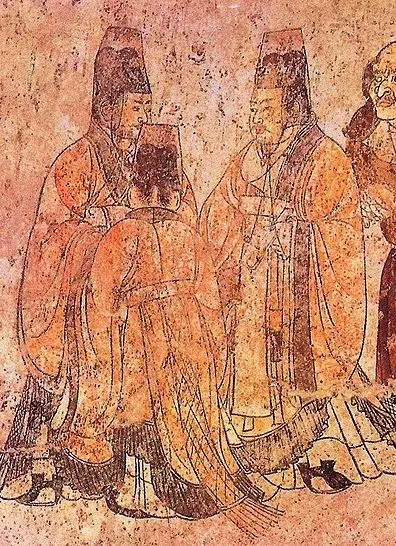
?–628 CE
温大雅
Wen Daya (温大雅), courtesy name Yanhong (彥弘), a native of Qi County in Taiyuan Commandery (modern Qi County, Jinzhong, Shanxi), was a founding minister and historian of the early Tang dynasty. Born into the scholarly Taiyuan Wen clan, he and his younger brothers Wen Yanbo and Wen Dayou were celebrated for their literary brilliance as the "Three Heroes of the Wen Clan." After serving under the Sui as Scholar of the Eastern…
Wen Daya (温大雅), courtesy name Yanhong (彥弘), a native of Qi County in Taiyuan Commandery (modern Qi County, Jinzhong, Shanxi), was a founding minister and historian of the early Tang dynasty. Born into the scholarly Taiyuan Wen clan, he and his younger brothers Wen Yanbo and Wen Dayou were celebrated for their literary brilliance as the "Three Heroes of the Wen Clan." After serving under the Sui as Scholar of the Eastern Palace and Defender of Chang'an County, he resigned to mourn his father and settled in Taiyuan. Recruited by Li Yuan in 616, Wen Daya served as Clerical Adjutant of the Grand General's Headquarters during the Jinyang Uprising of 617, taking sole charge of confidential correspondence and helping orchestrate the abdication rites that established the Tang dynasty. Appointed Gentleman Attendant at the Palace Gate while his brother Wen Yanbo served as Vice Director of the Secretariat, he requested a transfer to Vice Minister of Works out of modesty and subsequently served Prince of Qin Li Shimin as Minister of Works of the Grand Branch Department of State Affairs in Luoyang, securing Henan for Li Shimin during the Xuanwu Gate Incident of 626. Under Emperor Taizong, he became Minister of Rites and Duke of Li before dying in 629 at the age of fifty-seven (fifty-eight by traditional reckoning), receiving the posthumous title "Xiao." His three-scroll Court Journal of the Founding of the Great Tang (Da Tang Chuangye Qijuzhu) remains a primary eyewitness source on the founding of the Tang.
Born in Qi County, Taiyuan Commandery; his father Wen Junyou served as Scholar of the Wenlin Hall under Northern Qi and Administrative Aide of Sizhou under the Sui.
Appointed Scholar of the Eastern Palace for his literary talent and later Defender of Chang'an County before retiring in mourning for his father and residing in Taiyuan.
Warmly recruited in Jinyang by Li Yuan, Garrison Commander of Taiyuan, and his sons Li Jiancheng and Li Shimin.
Appointed Clerical Adjutant of the Grand General's Headquarters in the seventh month, managing confidential edicts during the march on Chang'an and the enthronement of Yang You.
Appointed Gentleman Attendant at the Palace Gate upon the founding of the Tang, serving alongside his brother Wen Yanbo in the central secretariat.
Requested transfer in the fourth month to avoid holding dual family power at the court center, becoming Vice Minister of Works and later Minister of Works of the Shandong Grand Branch Department under Li Shimin.
Dispatched by Li Shimin in the sixth month to secure Luoyang prior to the Xuanwu Gate Incident; promoted to Minister of Rites and enfeoffed as Duke of Li.
Died of illness in Chang'an and was granted the posthumous title "Xiao"; posthumously promoted to Right Vice Director of the Imperial Secretariat in 654.
Wen Daya belonged to the prestigious Taiyuan Wen clan of Qi County, Taiyuan Commandery (modern Qi County, Jinzhong, Shanxi). His father Wen Junyou served as a Scholar of the Wenlin Hall under the Northern Qi and as Administrative Aide of Sizhou under the Sui dynasty before retiring on grounds of illness late in the Daye era. Cultured and erudite from youth, Wen Daya and his younger brothers Wen Yanbo (courtesy name Dalin) and Wen Dayou (courtesy name Yanjiang) won empire-wide renown for their scholarship and family refinement. Comparing them to his own three talented sons, the scholar Yan Zhitui praised the pair of families, giving rise to the contemporary acclaim of the "Three Heroes of the Yan Clan" and the "Three Heroes of the Wen Clan."
Toward the end of the Kaihuang era under Emperor Wen of Sui, around the age of thirty, Wen Daya was appointed Scholar of the Eastern Palace in recognition of his literary gifts. Late in the Daye era under Emperor Yang of Sui, he served briefly as Defender of Chang'an County before resigning to observe mourning upon his father's death. As rebellions spread across the empire, Wen Daya and his third brother Wen Dayou settled in Jinyang (Taiyuan).
In the twelfth year of Daye (616), when Duke of Tang Li Yuan arrived as Pacification Commissioner and Garrison Commander of Taiyuan, he and his sons Li Jiancheng and Li Shimin treated Wen Daya with exceptional courtesy, consulting him frequently on the state of the empire. In the fifth month of the thirteenth year of Daye (617), as Li Yuan prepared to raise his banner against the Sui, he appointed Wen Daya Clerical Adjutant of the Taiyuan Garrison; when Li Yuan formally established the Grand General's Headquarters in the seventh month, Wen Daya and his brother Wen Dayou were both named Clerical Adjutants, with Wen Daya alone entrusted with all confidential military correspondence and proclamations.
During the Jinyang Uprising, Wen Daya drafted Li Yuan's key manifestos and interpreted popular ballads such as the Song of Peaches and Plums—explaining that "peach" (tao) referred to the ancient Taotang territory of Taiyuan and "plum" (li) to the Li clan—to rally public support across Shanxi, where thousands of volunteers joined the army daily. Accompanying Li Yuan's forces westward across the Yellow River to capture Chang'an in the tenth month of 617, Wen Daya worked alongside Dou Wei and Chen Shuda to arrange the court rituals for placing Yang You on the throne as Emperor Gong of Sui and preparing the subsequent abdication to Li Yuan.
In the fifth month of 618, when Li Yuan ascended the throne as Emperor Gaozu to found the Tang dynasty, Wen Daya was appointed Gentleman Attendant at the Palace Gate in the Chancellery, while his younger brother Wen Yanbo became Vice Director of the Secretariat. With the two brothers occupying key posts in the Chancellery and Secretariat simultaneously, Emperor Gaozu praised their literary brilliance before the court. Mindful of the envy that such concentrated family authority might provoke, Wen Daya repeatedly petitioned to step aside and was transferred in the fourth month of the second year of Wude (619) to Vice Minister of Works. Soon thereafter, at the request of Prince of Qin Li Shimin, he was appointed Minister of Works of the Grand Branch Department of State Affairs of Shandong Circuit, assisting Li Shimin in administering the eastern plains from Luoyang.
Between the third and eighth years of Wude (620–625), drawing directly upon the archives and his personal observations from the 357 days between Li Yuan's uprising at Jinyang and his imperial enthronement in Chang'an, Wen Daya compiled the two-scroll Record of the Officials of the Grand Chancellor and King of Tang, the six-scroll Record of the Royal Enterprise of His Present Majesty, and the three-scroll Court Journal of the Founding of the Great Tang (Da Tang Chuangye Qijuzhu), preserving invaluable primary documents of the Tang founding.
Toward the end of Emperor Gaozu's reign, rivalry between Crown Prince Li Jiancheng and Prince of Qin Li Shimin reached a breaking point. Because Luoyang commanded the strategic approaches and veteran troops of the eastern plains, Li Shimin dispatched Wen Daya in the sixth month of the ninth year of Wude (626)—just prior to the Xuanwu Gate Incident—to hold Luoyang and take full charge of the Prince of Qin's forces in Henan, mentre Wen Daya also submitted confidential strategic advice to Li Shimin.
After ascending the throne as Emperor Taizong, Li Shimin rewarded Wen Daya's loyal service by promoting him to Minister of Rites and enfeoffing him as Duke of Li. In 628, when Wen Daya reburied his grandparents at a site where a diviner warned that the geomancy would harm the eldest brother while blessing the younger brothers, Wen Daya declared: "If my younger brothers enjoy lasting prosperity, I shall enter the earth with a smile!" He died of illness a year later in the third year of Zhenguan (629) at the age of fifty-seven (fifty-eight sui) and was granted the posthumous title "Xiao." In the fifth year of Yonghui (654), Emperor Gaozong posthumously promoted him to Right Vice Director of the Imperial Secretariat.
FIGURES ASSOCIATED WITH THIS DYNASTY