Birth and Fosterage
Born in the second lunar month in Jiangling, capital of Western Liang; due to southern taboos against second-month births, fostered first by her uncle Xiao Ji, Prince of Dongping, and then by her maternal uncle Zhang Ke.
585 CE–648 CE
萧氏(隋炀帝皇后)
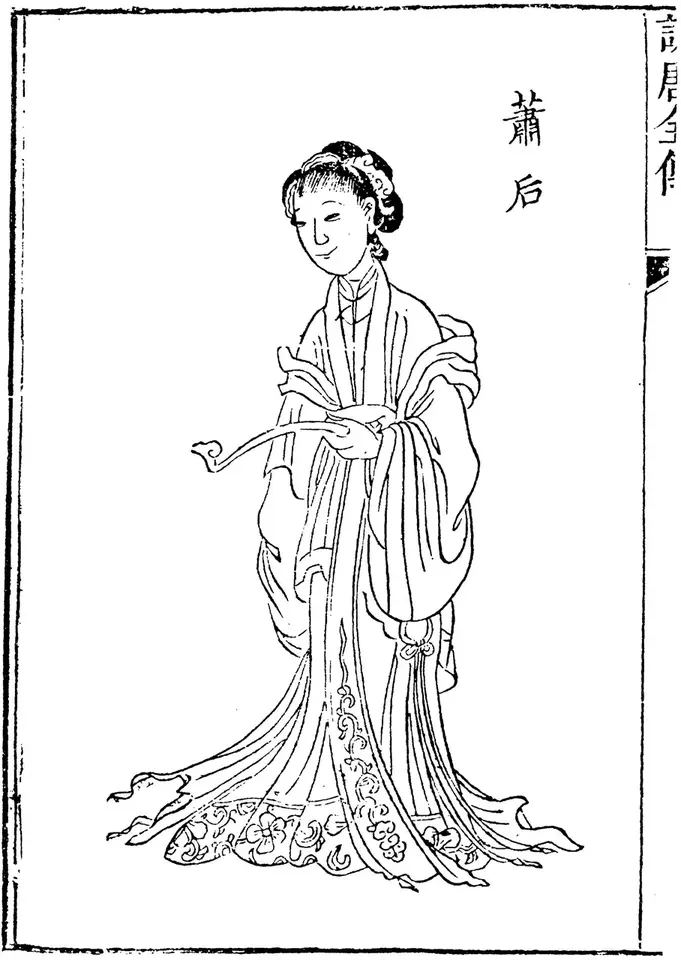
Empress Xiao (萧氏(隋炀帝皇后), 567–647), historically known as Empress Min (愍皇后) of Emperor Yang of Sui or simply Empress Xiao (萧后), was a native of Southern Lanling Commandery (modern Changzhou, Jiangsu, born in Jiangling). Descended from the imperial house of the Southern Liang dynasty, she was the great-granddaughter of Crown Prince Zhaoming (Xiao Tong) and the daughter of Emperor Xiaoming of Western Liang (Xiao Kui) by Empress…
Empress Xiao (萧氏(隋炀帝皇后), 567–647), historically known as Empress Min (愍皇后) of Emperor Yang of Sui or simply Empress Xiao (萧后), was a native of Southern Lanling Commandery (modern Changzhou, Jiangsu, born in Jiangling). Descended from the imperial house of the Southern Liang dynasty, she was the great-granddaughter of Crown Prince Zhaoming (Xiao Tong) and the daughter of Emperor Xiaoming of Western Liang (Xiao Kui) by Empress Zhang. Because she was born in the second lunar month—regarded by southern custom as inauspicious—she was raised in childhood first by her uncle Xiao Ji and then by her impoverished maternal uncle Zhang Ke. In the second year of the Kaihuang era (582), after divination yielded an auspicious sign, Emperor Wen of Sui selected her as the consort of his second son Yang Guang, Prince of Jin. After marriage she helped Yang Guang win over southern aristocratic clans and eminent Buddhist monks, and during the succession struggle she cultivated Empress Dugu's palace attendants and shielded Yang Guang's secret consultations, assisting him in becoming Crown Prince in 600. After Yang Guang ascended the throne, he invested her as Empress. Facing Emperor Yang's later extravagance and misrule, she dared not remonstrate bluntly out of fear, instead composing the Rhapsody on Stating My Aspirations (Shuzhi Fu) to offer gentle admonition. Following the Jiangdu coup in 618, she was carried off successively into the camps of Yuwen Huaji and Dou Jiande before travelling to the Eastern Turks at the invitation of her sister-in-law Princess Yicheng. In the fourth year of the Zhenguan era (630), after Emperor Taizong of Tang destroyed the Eastern Turks, he welcomed her back to Chang'an with high courtesy. Upon her death at age eighty-one in 647, the Tang court buried her with full empress rites alongside Emperor Yang in Yangzhou and conferred upon her the posthumous title Empress Min.
Born in the second lunar month in Jiangling, capital of Western Liang; due to southern taboos against second-month births, fostered first by her uncle Xiao Ji, Prince of Dongping, and then by her maternal uncle Zhang Ke.
When Emperor Wen and Empress Dugu sought a bride in Western Liang for Yang Guang, Prince of Jin, divinations for all other princesses proved inauspicious; only hers proved auspicious, and she was invested as Princess Consort of Jin.
Gave birth to her eldest son Yang Zhao (later Crown Prince Yuande) in the guest quarters of Daxing Palace in the first month, followed later by her second son Yang Jian and eldest daughter Princess Nanyang.
Having long won Empress Dugu's favor through attentiveness to her maids and shielded Yang Guang's secret meetings with Guo Yan under the pretext of medical treatment, became Crown Princess when Yang Guang was named Crown Prince.
Formally invested as Empress in the year after Yang Guang's accession; members of her Lanling Xiao clan were promoted according to talent, and she accompanied Emperor Yang on his tours to Jiangdu and across the empire.
After Yuwen Huaji assassinated Emperor Yang in the Jiangdu coup, used bed boards to make a coffin for Emperor Yang before being taken north to Liaocheng, where Dou Jiande rescued her and settled her in Wuqiang.
At the invitation of Princess Yicheng, wife of Chuluo Qaghan of the Eastern Turks, traveled north with her young grandson Yang Zhengdao and resided at Dingxiang.
After Emperor Taizong of Tang defeated Illig Qaghan of the Eastern Turks, the sixty-four-year-old Empress Xiao and Yang Zhengdao were welcomed back to Chang'an with honor.
Died in Chang'an at age eighty-one; Emperor Taizong ordered her buried with the full rites of an Empress alongside Emperor Yang in Yangzhou and conferred the posthumous name Empress Min.
Empress Xiao was born into the Lanling Xiao imperial house of the Southern Liang dynasty as the great-granddaughter of Crown Prince Zhaoming (Xiao Tong, eldest son of Emperor Wu of Liang), the granddaughter of Emperor Xuan of Western Liang (Xiao Cha), and the daughter of Emperor Xiaoming of Western Liang (Xiao Kui) by Empress Zhang. She was born in the second lunar month of the sixth year of the Tianbao era (567) in Jiangling. Because folk custom south of the Yangtze considered children born in the second month inauspicious to raise in their parents' household, her father Xiao Kui entrusted her to his sixth brother Xiao Ji, Prince of Dongping. Within less than a year, however, both Xiao Ji and his wife died, so the infant was transferred to the household of her maternal uncle Zhang Ke. Although Zhang Ke served on the staff of Xiao Yan, Prince of Anping, his family was poor, and thus despite her status as a royal princess, the young Lady Xiao personally performed household chores and spinning, cultivating a gentle, diligent, and modest disposition.
In the second year of the Kaihuang era (582), Emperor Wen of Sui (Yang Jian) and Empress Wenxian (Dugu Qieluo) arranged a marriage alliance with the client state of Western Liang, sending envoys to Jiangling to select a consort for their second son Yang Guang, Prince of Jin. Emperor Xiaoming of Western Liang presented the horoscopes of the princesses in the palace for divination, but every single one yielded an inauspicious omen. Left with no alternative, Xiao Kui summoned Lady Xiao back from her maternal uncle Zhang Ke's home to have her fortune divined; hers alone proved auspicious, and Emperor Wen formally invested the sixteen-year-old Lady Xiao as Princess Consort of Jin.
After her marriage to the young Prince of Jin, Yang Guang, the couple enjoyed deep harmony and affection. Shortly after their wedding in 582, she accompanied Yang Guang to his post as Regional Chief Commander of Bingzhou in Jinyang. Intelligent, gentle, well-read, skilled in literary composition, and well versed in prognostic divination, she won high favor and esteem from both Emperor Wen and Empress Dugu. On the second day of the fourth month of the third year of the Kaihuang era (583), Emperor Wen dreamed that a heavenly deity descended from the sky and announced that it would be reborn into the Yang imperial house; soon afterward word arrived from Bingzhou that the Princess Consort of Jin was pregnant, and Emperor Wen joyfully welcomed her back to the capital Daxing, lodging her in the guest quarters of Daxing Palace. In the first month of the fourth year of the Kaihuang era (584), she gave birth to her eldest son Yang Zhao (later Crown Prince Yuande), whom Emperor Wen and Empress Dugu raised personally inside the palace; in 585 and 586 she gave birth to her second son Yang Jian (Prince of Qi) and her eldest daughter Princess Nanyang.
When Yang Guang was subsequently stationed in Yangzhou (Jiangdu) to govern the Jiangnan region and win the allegiance of southern aristocratic clans and eminent Buddhist masters, Lady Xiao's prestigious lineage as a direct descendant of the Liang imperial house and her devout Buddhist background greatly aided his efforts, helping him forge close ties with Tiantai Patriarch Master Zhiyi and southern literati families. Around the fifteenth year of the Kaihuang era (595), when she fell gravely ill for a prolonged period, Yang Guang instructed his advisor Liu Guyan to write to Master Zhiyi requesting prayers on her behalf; Master Zhiyi led his monks in a seven-day vegetarian fast and Golden Light repentance ritual, after which she recovered, prompting Yang Guang to celebrate lavishly.
When Yang Guang resolved to supplant his elder brother Yang Yong as Crown Prince, Lady Xiao gave him her full support behind the scenes. Wishing to consult his confidant General Guo Yan on plans for the succession without arousing suspicion through frequent unexplained visits, Yang Guang used the pretext that Lady Xiao was treating Guo Yan's wife for an illness, enabling Guo Yan and his wife to travel regularly to Jiangdu to exchange secret counsels. Moreover, whenever Empress Dugu sent palace maids to visit the Prince of Jin's residence and observe his household, Lady Xiao invariably shared her own bedchamber and meals with the maids, winning their complete devotion so that they praised the couple's filial piety and frugality before Empress Dugu. Just before Emperor Wen decided to depose Crown Prince Yang Yong, he even sounded out Chancellor Gao Jiong by remarking that the Princess Consort of Jin was skilled in divination and that a spirit had possessed her to foretell that the Prince of Jin would surely possess the realm. In the twentieth year of the Kaihuang era (600), Yang Guang was formally invested as Crown Prince, and Lady Xiao became Crown Princess.
In the seventh month of the fourth year of the Renshou era (604), Emperor Wen died at Renshou Palace and Yang Guang ascended the throne as Emperor Yang of Sui. In the seventh month of the first year of the Daye era (605), Emperor Yang issued an edict praising Lady Xiao's lifelong cultivation of womanly virtue and formally invested the thirty-nine-year-old consort as Empress. Following her elevation to the central palace, her natal Lanling Xiao clan received generous imperial favor: her eldest brother Xiao Cong was enfeoffed as Duke of Liang, and all kinsmen of Xiao Cong within the five degrees of mourning were promoted to office according to their abilities, placing members of the Xiao family throughout the court.
After ascending the throne, Emperor Yang increasingly indulged in extravagance, grand construction projects, repeated military campaigns against Goguryeo, and lavish dragon-boat tours to Jiangdu, on all of which Empress Xiao accompanied him. Witnessing Emperor Yang's growing lapses in virtue and the rising distress of the realm, the cautious and gentle Empress Xiao knew that her husband was suspicious and autocratic—harboring mistrust even between father and sons—and that blunt remonstrance would only incur his wrath. She therefore composed the Rhapsody on Stating My Aspirations (Shuzhi Fu) to admonish him indirectly. In the rhapsody she recalled her humble childhood in her uncle's home and the immense grace that had raised her to the position of Empress, invoking ancient examples to urge humility, frugality, reliance on loyal ministers, and compassion for the populace.
In the twelfth year of the Daye era (616), Emperor Yang led his consorts and officials south to Jiangdu for the third time. As peasant uprisings engulfed the empire and the Sui regime disintegrated, Emperor Yang lingered in Jiangdu while his homesick northwestern guards grew mutinous. A palace maid reported to Empress Xiao: "Outside, I hear that everyone wants to rebel." Empress Xiao told her to report the matter directly to the Emperor; when the maid did so, however, Emperor Yang flew into a rage, declared that such words were not for a maid to utter, and had her executed on the spot. Later, when another palace maid came to tell Empress Xiao that the imperial palace guards were gathering in small groups to plot rebellion, Empress Xiao sighed: "Matters of the realm have reached this point and are beyond recovery; what is the use of reporting it? It would only add to His Majesty's distress!" From then on, no one dared speak to the Emperor of the impending mutiny.
In the third month of the fourteenth year of the Daye era (618), General Yuwen Huaji and Sima Dekan launched the Jiangdu coup, strangling Emperor Yang in his travelling palace and slaughtering imperial princes including Yang Jian (Prince of Qi) and Yang Gao (Prince of Zhao). Amid the chaos, the fifty-two-year-old Empress Xiao led palace attendants in dismantling lacquered bed boards to fashion makeshift coffins, burying Emperor Yang and Yang Jian beneath the Liuzhu Hall in the western courtyard of the Jiangdu Palace. Yuwen Huaji then proclaimed himself Grand Councilor and marched north with Empress Xiao, her young grandson Yang Zhengdao, and the palace women, retreating after repeated defeats to Liaocheng in Shandong.
In the spring of the second year of the Wude era (619), the Hebei ruler Dou Jiande, King of Xia, stormed Liaocheng and executed Yuwen Huaji. Entering the city, Dou Jiande paid respectful court as a subject to Empress Xiao, mourned Emperor Yang in plain robes, and placed Empress Xiao in protective residence at Wuqiang while releasing former Sui officials. At that time Princess Yicheng—a Sui imperial clanswoman who was both Yang Guang's cousin and Empress Xiao's sister-in-law, and who was married to Chuluo Qaghan of the Eastern Turks—sent envoys south to welcome Empress Xiao to the steppe. Not daring to refuse the powerful Eastern Turks, Dou Jiande escorted Empress Xiao, the young grandson Yang Zhengdao, and the imperial state seal northward. Chuluo Qaghan and Princess Yicheng received her with high honors, established Yang Zhengdao as "King of Sui" over more than ten thousand Sui refugees in the steppe, and settled them at Dingxiang.
In the spring of the fourth year of the Zhenguan era (630), the Tang general Li Jing crushed the Eastern Turkic Qaghanate of Illig Qaghan. Emperor Taizong of Tang (Li Shimin) ordered Li Jing to escort Empress Xiao and Yang Zhengdao back to the Central Plains with full courtesy. Returning to Chang'an at age sixty-four after twelve years in the steppe, Empress Xiao was treated with generous respect by Emperor Taizong, housed comfortably in the Xingdao Ward of Chang'an, and saw her grandson Yang Zhengdao appointed Chief Steward of the Imperial Wardrobe. After living peacefully in Chang'an for seventeen years, Empress Xiao died in the third month of the twenty-first year of the Zhenguan era (647) at the age of eighty-one. Emperor Taizong suspended court, ordered officials of the ninth rank and above to escort her cortege outside the Yanxing Gate, had her buried with full empress rites alongside Emperor Yang in Yangzhou, and bestowed upon her the posthumous title Empress Min. Between 2012 and 2013, archaeologists in Caozhuang, Yangzhou excavated Tomb M2 next to the tomb of Emperor Yang of Sui, uncovering an elaborate gilt-bronze phoenix crown, white jade tablets, and a complete set of sixteen bronze chime bells and twenty stone chimes, confirming the historical record of her imperial joint burial.
FIGURES ASSOCIATED WITH THIS DYNASTY