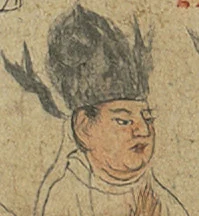
Later artistic depiction of Piluoge in a historical painting or book illustration.
Image credits唐吉訶德的侍從 · CC BY-SA 4.0Image sourceCC BY-SA 4.0

728 CE–748 CE

Ruler of Nanzhao

Piluoge

皮逻阁

Piluoge (697–748), also recorded under the Chinese variant names Kuai Lejue and Zhuoluoji, and as Meng Guiyi, was the fourth ruler of Mengshe Zhao, the predecessor of Nanzhao, and the founding ruler of the Nanzhao state. During his reign from 728 to 748, and with support from the Tang court, he annexed the other five zhao, unified the Erhai region, and established the Nanzhao regime. Emperor Xuanzong of Tang granted him the…

728 CE–748 CETang Dynasty

PROFILE

Piluoge (697–748), also recorded under the Chinese variant names Kuai Lejue and Zhuoluoji, and as Meng Guiyi, was the fourth ruler of Mengshe Zhao, the predecessor of Nanzhao, and the founding ruler of the Nanzhao state. During his reign from 728 to 748, and with support from the Tang court, he annexed the other five zhao, unified the Erhai region, and established the Nanzhao regime. Emperor Xuanzong of Tang granted him the title King of Yunnan and Duke of Yue and bestowed on him the name Meng Guiyi. Piluoge moved his capital to Taihe City, in present-day Taihe Village, Dali, Yunnan, and gradually extended his power into eastern Yunnan, laying the foundations for Nanzhao's later expansion across Yunnan and surrounding regions.

Period
Tang
Date of Birth
Not recorded in historical sources
Date of Death
748
Dynasty / Regime
Tang
Identity
Ruler of Nanzhao
Ethnicity / Group
Not recorded in historical sources
Native Place
Not recorded in historical sources
Place of Birth
Not recorded in historical sources
Place of Death
Place of death unknown
Reign
728–748
Predecessor
Not applicable (first King of Yunnan after unifying the Six Zhaos)
Successor
Geluofeng
Highest Office
See Biography and Major Activities

LIFE TIMELINE

Birth | BornOpen

Birth | Born

Emperor Xuanzong of Tang granted Piluoge the title King of Taideng ComOpen

Emperor Xuanzong of Tang granted Piluoge the title King of Taideng Commandery | Emperor Xuanzong of Tang granted Piluoge the title King of Taideng Commandery

His father Shengluopi died and Piluoge succeeded him | His father ShenOpen

His father Shengluopi died and Piluoge succeeded him | His father Shengluopi died and Piluoge succeeded him

Defeated the Heman and seized Taihe City | Defeated the Heman and seizOpen

Defeated the Heman and seized Taihe City | Defeated the Heman and seized Taihe City

Emperor Xuanzong bestowed the name Meng Guiyi and granted him the titlOpen

Emperor Xuanzong bestowed the name Meng Guiyi and granted him the titles Duke of Yue and K | Emperor Xuanzong bestowed the name Meng Guiyi and granted him the titles Duke of Yue and King of Yunnan; he moved the capital to Taihe City

With Tang support | With Tang support, annexed the Eastern and WesternOpen

With Tang support | With Tang support, annexed the Eastern and Western Cuan and expanded power into eastern Yunnan

Death | Died after a reign of twenty years; the source states that he Open

Death | Died after a reign of twenty years; the source states that he was sixty-eight years old

BIOGRAPHY

Biography

Family Background and Early Years

Piluoge was born into the ruling house of Mengshe Zhao. Mengshe Zhao, located around present-day Weishan Yi and Hui Autonomous County in Yunnan, was one of the Six Zhao around the Erhai region. His ancestor Shelóng, also recorded as Longjiadu, had originally lived in the Ailao Mountains before moving to the Mengshe River valley, and the family thereafter held the rulership of Mengshe Zhao. Piluoge's father Shengluopi was the third ruler of Mengshe Zhao and, during his reign, submitted to the Tang dynasty and repeatedly sent tribute missions to court.

The source gives Piluoge's birth as 697, the first year of the Shengong era under Wu Zetian. Little is recorded about his early life. According to Hu Wei's version of the *Unofficial History of Nanzhao*, he was also recorded under the Chinese variant names Kuai Lejue and Zhuoluoji. In 713, the first year of the Kaiyuan era, Emperor Xuanzong granted him the title King of Taideng Commandery, indicating that he already held a significant position within Mengshe Zhao. He grew up in a tribal political environment and became familiar with military and intergroup affairs, experience that later aided his consolidation of the Six Zhao.

Succession and Unification of the Six Zhao

In 728, the sixteenth year of the Kaiyuan era, Shengluopi died and Piluoge succeeded him. He continued the policy of maintaining allegiance to the Tang court. At the time, six zhao existed around the Erhai region. Each was relatively weak, and the region was frequently affected by pressure from Tibet. Piluoge chose to use Tang support in an effort to unify the Six Zhao.

In 737, the twenty-fifth year of the Kaiyuan era, Piluoge defeated the Heman and seized Taihe City, in present-day Taihe Village, Dali. The following year Emperor Xuanzong issued an edict bestowing on him the name Meng Guiyi and advancing him to the rank of King of Yunnan. The investiture document stated that the Erhai groups had secretly maintained relations with Tibet and that Meng Guiyi had rendered service by campaigning against them.

In 738, Piluoge sought to annex the remaining five zhao. Acting on Zhang Jiancheng's advice, he gave substantial gifts to Wang Yu, the military governor of Jiannan, and asked that the Six Zhao be combined under one ruler. Wang Yu presented the request to the court and received approval. An imperial order sent to Wang Yu stated that Meng Guiyi had shown loyalty and rendered military service against the southwestern groups, while the five other zhao had maintained ties with both Tang and Tibet and therefore deserved to be broken. During the process of unification, the Tang court sent the palace envoy Wang Chengxun and the censor Yan Zhenghui to take part in the military operations. Piluoge first destroyed Yuexi Zhao, then the Three Lang zhao—Langqiong Zhao, Shilang Zhao, and Dengdan Zhao—and finally Mengxi Zhao, completing the unification of the Erhai region.

Move to Taihe City and Tang Investiture

In 738, the Tang court granted Piluoge the titles Duke of Yue and later King of Yunnan and bestowed on him the name Meng Guiyi. In the same year he moved his capital from Weishan to Taihe City. At this point Nanzhao expelled Tibetan influence from the Erhai region, unified the Six Zhao, and established a southwestern regional regime whose population included ancestors of the Yi and Bai peoples.

After moving to Taihe City, Piluoge adopted measures to develop production. The source states that he promoted ox-plowing and opened hillside fields, increasing grain output and strengthening the economy. At the same time, he continued friendly relations with the Tang dynasty and repeatedly sent tribute missions to the imperial court.

Expansion and Later Years

In the early Tianbao era, from 742 to 747, Piluoge and his son Geluofeng, with Tang support, gradually annexed the Eastern and Western Cuan and extended Nanzhao power from western into eastern Yunnan. The *New Book of Tang* records that Anning City had five salt wells from which local people made their living, and that Emperor Xuanzong ordered He Lüguang, bearing the title of Specially Advanced, to use troops to secure territory in the Nanzhao region, take Anning City and its wells, and re-erect Ma Yuan's bronze pillar before returning. The source interprets this as evidence of Tang military assistance in Nanzhao's seizure of Anning and the salt wells, facilitating further expansion.

Piluoge died in 748, the seventh year of the Tianbao era, after a reign of twenty years. The source states that he died at the age of sixty-eight. His eldest son Geluofeng succeeded him.

Major Activities

Unification of the Six Zhao

Piluoge's most important achievement was the unification of the Six Zhao: Mengshe Zhao, also called Nanzhao; Mengxi Zhao; Yuexi Zhao; Langqiong Zhao; Shilang Zhao; and Dengdan Zhao. These polities were distributed around the Erhai region. Piluoge made use of the rivalry between Tang and Tibet, secured Tang support by giving substantial gifts to Jiannan military governor Wang Yu, and successively destroyed Yuexi Zhao, the Three Lang zhao, and Mengxi Zhao, bringing the Erhai region under a single authority.

Investiture by the Tang Court

Piluoge consistently maintained a policy of submission to the Tang dynasty. In 738, Emperor Xuanzong bestowed on him the name Meng Guiyi and granted him the titles Specially Advanced, King of Yunnan, Duke of Yue, and Grand Commander Equal to the Three Excellencies; he was later also granted the rank of Supreme Pillar of State and gifts including a set of music from Kucha and a golden Buddhist image. This investiture marked Nanzhao's formal position as a Tang-recognized regional polity.

Moving the Capital to Taihe City

After unifying the Six Zhao, Piluoge moved the royal capital from Weishan to Taihe City, in present-day Taihe Village, Dali. Taihe City occupied a defensible position on the western shore of Erhai Lake and provided an important base for Nanzhao's later development.

Expansion into Eastern Yunnan

In the early Tianbao era, Piluoge expanded into eastern Yunnan with Tang support by annexing the Eastern and Western Cuan and taking Anning City and its salt wells. This expansion laid foundations for Nanzhao's later rule over a much larger part of Yunnan.

Development of Production

The source states that Piluoge promoted ox-plowing and opened hillside fields, increasing grain output and strengthening Nanzhao's economic base.

Personal Relations

  • Father: Shengluopi, third ruler of Mengshe Zhao
  • Sons: Geluofeng, eldest son and fifth ruler of Nanzhao; Chengjie, second son, exiled after losing a succession struggle; Chong, third son; Chengjin, fourth son
  • Emperor Xuanzong of Tang: Tang emperor who invested Piluoge as King of Yunnan
  • Wang Yu: military governor of Jiannan who accepted Piluoge's gifts and presented the request to combine the Six Zhao
  • Wang Chengxun: Tang palace envoy who participated in military operations involving Nanzhao
  • Yan Zhenghui: Tang censor who participated in military operations involving Nanzhao
  • Zhang Jiancheng: advised Piluoge to give substantial gifts to Wang Yu and request the consolidation of the Six Zhao
  • Lady Baijie: wife of the ruler of Dengdan Zhao and, in legend, a victim of the Songming Tower incident

Historical Assessment

Tang / Contemporary

  • Emperor Xuanzong's investiture edict praised Piluoge, under the bestowed name Meng Guiyi, for “showing loyalty and rendering service in campaigning against the southwestern groups,” affirming his actions in the process of unifying the Six Zhao.
  • The *New Book of Tang* records that at the time the other five zhao were weak while Guiyi alone was strong, and that he gave generous inducements to Jiannan military governor Wang Yu in order to obtain permission to combine the Six Zhao into one, a request the court approved.

Song and Yuan Periods

  • Song historians compiling the *New Book of Tang* placed Nanzhao in the biographies of the southern peoples and gave a relatively detailed account of Piluoge's unification of the Six Zhao, recognizing his place as Nanzhao's founding ruler.
  • Yuan-period scholars who organized historical materials on Yunnan frequently mentioned Piluoge and treated him as an important founder of a regional polity in Yunnan.

Ming and Qing Periods

  • The Ming-period Yunnan work *Unofficial History of Nanzhao*, in the version associated with Hu Wei, records Piluoge in detail as the fourth ruler of Nanzhao and gives a reign of twenty years.
  • Qing scholars studying Yunnan history generally regarded Piluoge as a founder of the Nanzhao regime and considered his unification of the Six Zhao an important development in Yunnan history.

Modern Period

  • Modern scholars generally regard Piluoge as one of the most important rulers in Nanzhao history. Before his succession, Mengshe Zhao was only one of the Six Zhao; through his consolidation and expansion, he unified the Erhai region, advanced into Cuan territory and the Dianchi region, and transformed Nanzhao from one zhao into a name for the unified Erhai power and eventually a southwestern regime ruling much of Yunnan and neighboring regions.
  • Some scholars emphasize that Piluoge's success depended heavily on Tang support and that the unification of the Six Zhao formed part of the larger Tang–Tibetan competition in southwestern China.

LOCAL NETWORK

Sheng Luopi↗Related entry

Original note (Chinese): 盛逻皮是皮逻阁之父,蒙舍诏第三代诏主,开元十六年(728年)去世,皮逻阁继位。

Geluofeng↗Related entry

Original note (Chinese): 阁罗凤是皮逻阁长子,南诏第五代王,天宝初年与父共同兼并东爨西爨,皮逻阁去世后继位。

Li Longji↗Related entry

Original note (Chinese): 唐玄宗封皮逻阁为台登郡王、云南王、越国公,赐名蒙归义,支持其统一六诏。

Geluofeng↗Linked from this entry

Original note (Chinese): 阁罗凤之父,南诏第四代王,在唐朝扶持下统一六诏,受封云南王。

诚节 · No matching entry available

诚节是皮逻阁次子,因争夺王位失败遭放逐。

王昱 · No matching entry available

剑南节度使,接受皮逻阁厚赂,代为向朝廷奏请合六诏为一。

王承训 · No matching entry available

唐朝中使,受唐玄宗派遣参与南诏统一六诏的军事行动。

严正诲 · No matching entry available

唐朝御史,受唐玄宗派遣参与南诏统一六诏的军事行动。

张建成 · No matching entry available

建议皮逻阁厚赂剑南节度使王昱,请求合六诏为一。

白洁夫人 · No matching entry available

邓赕诏主之妻,传说中松明楼事件的受害者,皮逻阁欲纳其为妃,她投洱海殉节。

CONTEMPORARIES

Bibliography

  • *New Book of Tang*, Biography 147A, “Southern Barbarians I”
  • Hu Wei recension of the *Unofficial History of Nanzhao*
  • Modern research works on the history of Nanzhao