Aristocratic Birth | Born in Wannian into the illustrious Langya Yan lineage; fifth-generation descendant of Master Yan Zhitui; father Yan Yuansun was Prefect of Haozhou.
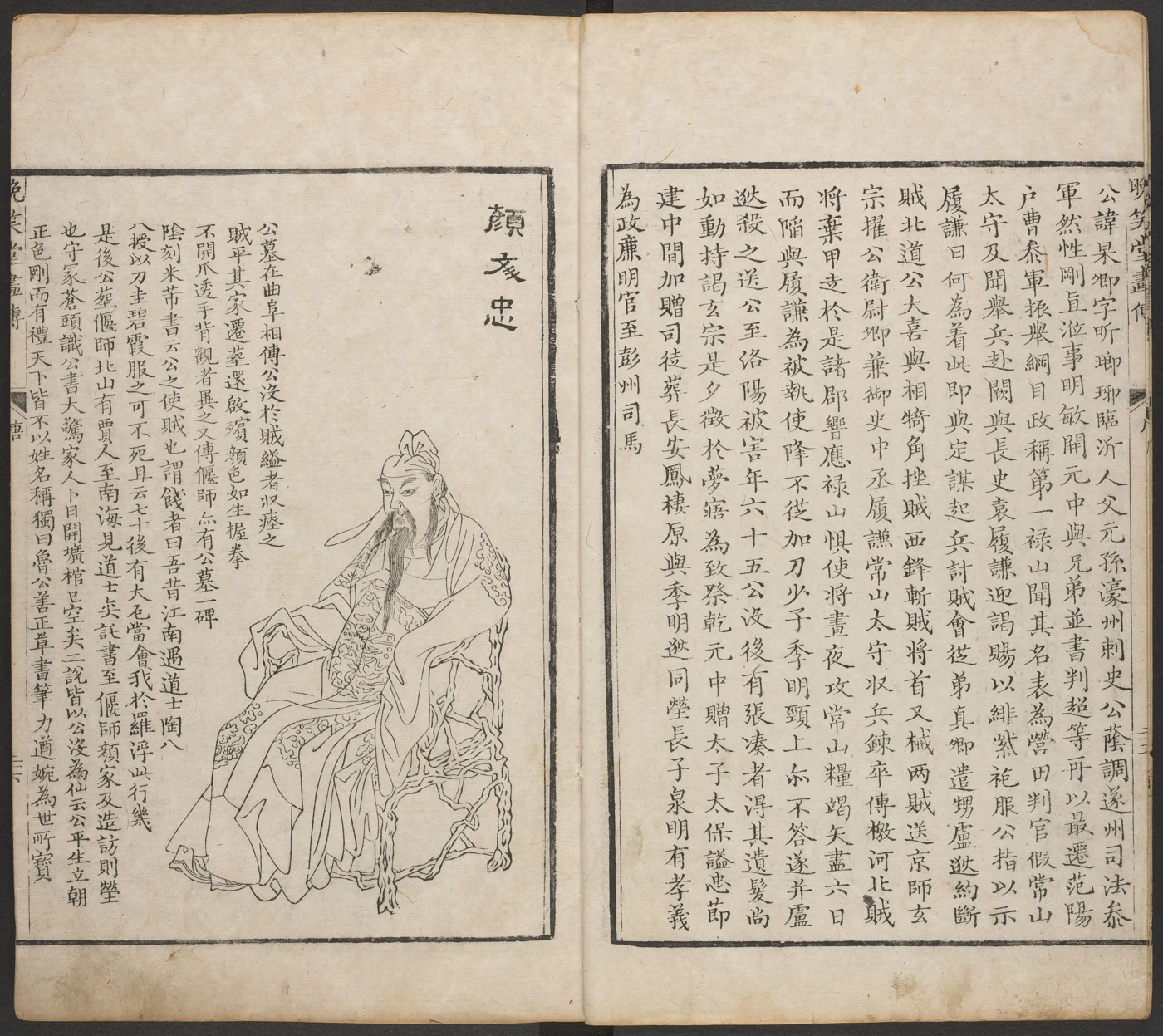
692 CE–756 CE
Loyalist MartyrCommanderPrefect of Changshan
Yan Gaoqing
颜杲卿
Birthplace qualification: locations retained below as native place, ancestral origin, or family background do not establish a confirmed birthplace. Yan Gaoqing (692–756 AD), courtesy name Xin, hailing from Wannian in Jingzhao (ancestral home Linyi in Langya), was a preeminent loyalist official, martial hero, and iconic martyr of the Tang dynasty who was the fifth-generation descendant of Master Yan Zhitui and the son of…
692 CE–756 CETang Dynasty
PROFILE
Birthplace qualification: locations retained below as native place, ancestral origin, or family background do not establish a confirmed birthplace. Yan Gaoqing (692–756 AD), courtesy name Xin, hailing from Wannian in Jingzhao (ancestral home Linyi in Langya), was a preeminent loyalist official, martial hero, and iconic martyr of the Tang dynasty who was the fifth-generation descendant of Master Yan Zhitui and the son of Prefect Yan Yuansun. Renowned for unyielding rectitude and administrative excellence, he served as Acting Prefect of Changshan Commandery when the catastrophic An Lushan Rebellion erupted in 755 AD. In the enemy's heartland, Yan Gaoqing and his cousin Yan Zhenqing (Prefect of Pingyuan) raised the righteous banner of imperial resistance, brilliantly executing rebel commander Li Qincou, capturing vanguard generals Gao Miao and He Qiannian, and recapturing the strategic Tumen Pass (Jingxing), inspiring seventeen commanderies across Hebei to pledge allegiance to the Tang dynasty. In early 756 AD, besieged at Changshan by Shi Siming with twenty thousand elite cavalry, Yan Gaoqing held the citadel for eight days until starvation and betrayal broke the defenses. Conveyed in chains to Luoyang, Yan Gaoqing glared fiercely at An Lushan, denouncing the usurper until the tyrant severed his tongue, dying as an immortal martyr at age sixty-five. Posthumously honored as Chancellor (Situ) with the posthumous title Zhongjie (Loyal and Principled), his sacrifice inspired the cultural idiom 'the tongue of Yan of Changshan' commemorated in Wen Tianxiang's Song of Righteous Spirit.
- Courtesy Name
- Xin
- Historical Era
- Middle Tang dynasty (High Tang to An Lushan Rebellion)
- Dynasty / Regime
- Tang dynasty
- Identity
- Loyalist Martyr, Commander, Prefect of Changshan
- Date of Birth
- 692 CE(1st year of the Wuzetianchangshou era, Tang)
- Ethnicity
- Huaxia (Han Chinese)
- Native Place
- Wannian, Jingzhao (present-day Xi'an, Shaanxi Province; ancestral home Linyi, Shandong)
- Place of Birth
- Unconfirmed; native place or family origin is not treated as an explicitly recorded birthplace
- Place of Death
- Luoyang (present-day Luoyang, Henan Province)
- Age at Death
- 65
- Highest Office
- Prefect of Changshan (Acting); Posthumous Grand Master, Chancellor (Situ)
- Major Offices
- Prefect of Changshan, Census Officer of Fanyang, Military Counselor of Weizhou, Judicial Officer of Suizhou
- Posthumous Honors
- Grand Tutor to the Crown Prince (758 AD), Chancellor (Situ, 782 AD)
- Posthumous Name
- Zhongjie (Loyal and Principled)
- Major Achievements
- Raised the banner of resistance in the enemy rear at Changshan upon the outbreak of the An Lushan Rebellion; allied with cousin Yan Zhenqing to sever the rebel logistics; ambushed and executed Li Qincou and captured generals Gao Miao and He Qiannian; liberated Tumen Pass, inspiring seventeen Hebei commanderies to rally behind Tang; defended besieged Changshan to the last arrow; denounced An Lushan facing dismemberment and tongue-cutting, immortalized as 'the tongue of Yan of Changshan'
LIFE TIMELINE
Yan Gaoqing (692–756 AD) | Yan Gaoqing (692–756 AD), courtesy name Xin, hailing from Wannian in Jingzhao (ancestral home Linyi in Langya), was a preeminent loyalist official, martial hero, and iconic martyr of the Tang dynasty who was the fifth-generation descendant of Master Yan Zhitui and the son of Prefect Yan Yuansun.
Early Office | Entered civil service through ancestral privilege as Judicial Officer of Suizhou, renowned for inflexible integrity.
Top Administrative Performance | Appointed Military Counselor of Weizhou, earning first rank across the commandery for judicial rectitude.
Superior Exam Distinction | Placed first alongside his brothers in the advanced judicial examinations, appointed Census Officer of Fanyang.
Acting Prefect of Changshan | Appointed Acting Prefect of Changshan; in November, An Lushan launched his rebellion, sacking Luoyang in December.
Uprising at Changshan | Formed a secret pact with Staff Officer Yuan Lüqian and cousin Yan Zhenqing, raising loyalist troops at Changshan.
When An Lushan assumed command over the three northern frontier circuits | When An Lushan assumed command over the three northern frontier circuits, he noted Yan Gaoqing's towering administrative renown and appointed him Field Reclamation Judge, subsequently promoting him in 755 AD to Acting Prefect of Changshan Commandery (modern Zhengding, Hebei).
When An Lushan assumed command over the three northern frontier circuits | When An Lushan assumed command over the three northern frontier circuits, he noted Yan Gaoqing's towering administrative renown and appointed him Field Reclamation Judge, subsequently promoting him in 755 AD to Acting Prefect of Changshan Commandery (modern Zhengding, Hebei).
Recovering Tumen Pass | Ambushed and decapitated rebel general Li Qincou, captured generals Gao Miao and He Qiannian, and recaptured the Tumen Pass, rallying seventeen Hebei commanderies.
Siege of Changshan | Besieged by Shi Siming with twenty thousand cavalry; dispatched son Yan Quanming for aid, but Taiyuan Military Commissioner Wang Chengye withheld reinforcements.
Martyrdom at Luoyang | Changshan fell after eight days; son Yan Jiming was beheaded; conveyed to Luoyang, Yan Gaoqing denounced An Lushan until his tongue was severed, dying an immortal martyr at age sixty-five.
In January 756 AD | In January 756 AD, Shi Siming's horsemen completely encircled Changshan.
Posthumous honours | He was posthumously granted the office of Junior Guardian of the Heir Apparent with the posthumous name Zhongjie.
Posthumous honours #3 | He was posthumously granted the office of Junior Guardian of the Heir Apparent with the posthumous name Zhongjie.
Elevation to Chancellor | Emperor Dezong elevated him posthumously to Chancellor (Situ), enshrining his name in imperial temples.
In 782 AD | In 782 AD, Emperor Dezong elevated Yan Gaoqing to Chancellor (Situ).
BIOGRAPHY
Biography
Aristocratic Lineage and Incorruptible Youth Yan Gaoqing, courtesy name Xin, was a native of Wannian in Jingzhao (modern Xi'an, Shaanxi Province), with ancestral roots in Linyi of Langya Commandery (modern Linyi, Shandong Province). The Langya Yan clan was an intellectual dynasty celebrated across Chinese history for classical scholarship, calligraphy, and statecraft. His fifth-generation ancestor was the Northern Qi master Yan Zhitui, author of the immortal Family Instructions of the Yan Clan (Yanshi Jiaxun); his great-grandfather was the early Tang master scholar Yan Shigu, commentator on the Book of Han; his father, Yan Yuansun, served as Prefect of Haozhou and authored the lexical standard Ganlu Zishu. Yan Gaoqing was the first cousin of the immortal calligrapher and statesman Yan Zhenqing. Imbued with rigid Confucian ethics, Yan Gaoqing entered the civil service through ancestral privilege during the Kaiyuan era, appointed Judicial Officer of Suizhou. When the provincial prefect berated administrative clerks, Yan Gaoqing stepped forward, analyzing legal statutes with fearless composure and refusing to compromise. Later, competing alongside his brothers Yan Chunqing and Yan Yaoqing in the imperial judicial examinations, all three brothers achieved supreme distinction, prompting Vice Minister of Personnel Xi Yu to sigh: "The talent and moral backbone of the Langya Yan house are truly unrivaled under heaven!" Promoted to Military Counselor of Weizhou, Yan Gaoqing reorganized regional administration, disciplined corrupt local gentry, and eradicated banditry, earning the premier rating in regional civil evaluations. In late Kaiyuan, he was transferred to Census Officer of Fanyang. When An Lushan assumed command over the three northern frontier circuits, he noted Yan Gaoqing's towering administrative renown and appointed him Field Reclamation Judge, subsequently promoting him in 755 AD to Acting Prefect of Changshan Commandery (modern Zhengding, Hebei). ### The Outbreak of Chaos and the Changshan Uprising In November 755 AD, An Lushan launched his catastrophic rebellion from Fanyang with one hundred and fifty thousand nomadic and border cavalry, advancing southward with terrifying speed. By December 12, the eastern capital of Luoyang fell, and Emperor Xuanzong dispatched armies to hold Tongguan Pass. Terrified by the barbarian onslaught, civil officials across Hebei capitulated or fled, turning the northern plains into a rebel stronghold. Changshan occupied a vital strategic nexus at the eastern foothills of the Taihang Mountains, controlling Tumen Pass (Jingxing), the solitary military artery linking Hebei to Taiyuan and the imperial capital Chang'an. Prior to marching south, An Lushan posted his fierce general Li Qincou with thousands of elite troops at Tumen Pass, while placing Gao Miao and He Qiannian to patrol and monitor Changshan. Surrounded by rebel garrisons, Yan Gaoqing's heart burned with righteous indignation. Terrified that An Lushan would burst through Tongguan to capture the Son of Heaven, Yan Gaoqing assembled Staff Officer Yuan Lüqian and Magistrate Feng Qian, weeping: "Our lineage has enjoyed imperial favors for generations. In this hour of national agony, how can we serve barbarian dogs! We must raise the righteous banner, sever the traitor's throat, and die for the state!" The garrison wept and swore allegiance. Simultaneously, his cousin Yan Zhenqing was serving as Prefect of Pingyuan. Aware of An Lushan's treasonous ambitions, Yan Zhenqing had already deepened moats and amassed grain. Yan Gaoqing dispatched his eldest son, Yan Quanming, across the Taihang passes to forge a mutual assistance pact with Yan Zhenqing. The two cousins swore to strike the rebels in an anvil-and-hammer vice. ### The Decapitation of Li Qincou and the Recovery of Tumen In late December 755 AD, Yan Gaoqing initiated his masterstroke. He sent secret emissaries to Li Qincou at Tumen Pass, feigning that imperial rewards and secret communiques had arrived from An Lushan in Luoyang, requesting his presence at Changshan. Overconfident, Li Qincou rode into Changshan with merely a handful of guards. Yan Gaoqing and Yuan Lüqian hosted a lavish banquet. As Li Qincou fell into a drunken stupor, Yan Gaoqing smashed his cup as a signal: hidden swordsmen burst from the drapery, decapitating Li Qincou on the spot. Without pause, Yan Gaoqing dispatched Feng Qian carrying Li Qincou's severed head to Tumen Pass. Paralyzed with terror, the rebel garrison dissolved, and loyalist forces recaptured the impregnable pass. Simultaneously, rebel commanders Gao Miao and He Qiannian approached along the postal highways. Yan Gaoqing laid ambushes, capturing both commanders alive. Yan Gaoqing dispatched his eldest son Yan Quanming and Magistrate Jia Shen to convey Li Qincou's head and the prisoners Gao Miao and He Qiannian across the mountains to Chang'an. The news of the Changshan victory detonated across Hebei like thunder. Local populations arose, and seventeen commanderies across Hebei—including Gaocheng, Julu, Guangping, Xindu, and Qinghe—executed rebel administrators and pledged allegiance to Tang. With seventeen commanderies mobilizing over two hundred thousand loyalists, An Lushan's rear supply line was severed, paralyzing his advance on Tongguan and granting Tang central forces under Guo Ziyi and Li Guangbi irreplaceable months to mobilize. ### The Treachery of Wang Chengye and the Fall of Changshan In Chang'an, Emperor Xuanzong rejoiced, praising Yan Gaoqing as an "unrivaled champion of heroic virtue" and promoting him to Director of the Imperial Guard and Prefect of Changshan. However, treachery loomed. Taiyuan Military Commissioner Wang Chengye, an envious and cowardly commander, intercepted Yan Quanming at Taiyuan. Coveting the glory, Wang Chengye confiscated the prisoners Gao Miao and He Qiannian, forged reports claiming the victory as his own, and detained Yan Quanming's escort troops. In Luoyang, An Lushan was panicked by the revolt in his rear. He dispatched his fiercest general, Shi Siming, alongside Cai Xide with twenty thousand elite cavalry to retake Tumen Pass. In January 756 AD, Shi Siming's horsemen completely encircled Changshan. Within the walls, Yan Gaoqing commanded fewer than several thousand militiamen with depleted grain. Yan Gaoqing donned armor day and night, standing on the battlements to direct defensive fire, repelling over a dozen assaults. By the sixth day, all arrows were spent and grain exhausted. Looking west toward Taiyuan, Yan Gaoqing prayed for Wang Chengye's relief columns; but Wang Chengye held his tens of thousands of troops stationary, watching Changshan fall. Shi Siming captured Yan Gaoqing's younger son Yan Jiming and nephew Lu Ti outside the walls. Binding them beneath the ramparts, Shi Siming shouted: "Surrender immediately, or your son will be sliced to pieces!" Looking down upon his son, Yan Gaoqing wept blood, shouting curses at the rebels and refusing to surrender. Enraged, Shi Siming beheaded Yan Jiming and Lu Ti before his eyes. Yan Gaoqing roared in anguish, directing the starving garrison to throw masonry to continue the fight. ### The Tongue of Yan of Changshan and Martyrdom On January 8, 756 AD, after eight days of horrific siege, all defenders were slain or exhausted, and a treacherous subordinate threw open the gates. Yan Gaoqing and Yuan Lüqian were taken prisoner and conveyed in heavy iron chains to Luoyang. In the imperial palace of Luoyang, An Lushan berated him: "I promoted you to Prefect; why did you betray me!" Stripped to the waist and drenched in blood, Yan Gaoqing stood erect, his eyes blazing like lightning. He roared: "You barbarian dog! You were an illiterate herder in Yingzhou who received boundless grace from the Son of Heaven! What did the Emperor ever do to harm you that you should raise treacherous arms and ravage the realm! My house has served the Tang as loyal ministers for generations; how could I join dogs and swine like you! I regret only that I failed to cut off your head to display to the realm!" Paralyzed with fury, An Lushan ordered guards to bind Yan Gaoqing to a stone pillar at Tianjin Bridge, commanding executioners to carve his flesh with daggers. Enduring excruciating torture, Yan Gaoqing never ceased cursing An Lushan, his voice echoing across the imperial bridges. Terrified, the executioner seized pliers and severed Yan Gaoqing's tongue, sneering: "Can you curse now!" Spitting blood from his mouth, Yan Gaoqing continued to roar with muffled thunder until his last breath, dying an immortal martyr at the age of sixty-five. Yuan Lüqian was executed beside him. ### Immortal Legacy and the Song of Righteous Spirit Following the suppression of the rebellion, Emperor Suzong posthumously conferred upon Yan Gaoqing the rank of Grand Tutor to the Crown Prince and the posthumous title Zhongjie (Loyal and Principled). Yan Zhenqing personally journeyed to the battlefield, recovering Yan Jiming's skull and Yan Gaoqing's bones, and penned the world-renowned calligraphic masterpiece, Draft of a Requiem to My Nephew (Ji Zhi Wen Gao). In 782 AD, Emperor Dezong elevated Yan Gaoqing to Chancellor (Situ). Five centuries later, Southern Song martyr Wen Tianxiang composed the immortal Song of Righteous Spirit (Zhengqi Ge) while imprisoned in Khanbaliq, celebrating Yan Gaoqing as the ultimate moral benchmark: "For Zhang Suiyang, it was his teeth; for Yan of Changshan, it was his tongue." Yan Gaoqing's sacrifice stands as an immortal pillar of Chinese patriotic courage.
Major Activities
The Changshan Uprising In late 755 AD, Yan Gaoqing launched the first loyalist counteroffensive in the enemy rear at Changshan, breaking the myth of rebel invincibility and initiating nationwide resistance. ### Decapitating Li Qincou and Liberating Tumen Pass Through brilliant deception, he executed Li Qincou and captured Gao Miao and He Qiannian, recapturing Tumen Pass and severing An Lushan's logistics along the Taihang Mountains. ### Rallying Seventeen Hebei Commanderies Coordinating with Yan Zhenqing at Pingyuan, he inspired seventeen Hebei commanderies to revolt against An Lushan, mobilizing two hundred thousand loyalists and buying indispensable strategic time for Tang central armies. ### Sacrifice of Kin at the Changshan Siege Confronting twenty thousand elite cavalry under Shi Siming without external relief, he witnessed his son Yan Jiming beheaded beneath the battlements, steadfastly choosing dynastic loyalty over familial survival. ### The Defiance of Tianjin Bridge Tied to the pillar of Tianjin Bridge, he endured slicing and the severance of his tongue, denouncing An Lushan to his dying breath and establishing the cultural archetype 'the tongue of Yan of Changshan'.
Personal Relations
- Great-Grandfather: Yan Shigu, early Tang grand scholar and commentator on the Book of Han.
- Father: Yan Yuansun, Prefect of Haozhou and author of Ganlu Zishu.
- First Cousin: Yan Zhenqing, legendary calligrapher and statesman, Prefect of Pingyuan, Duke of Lu.
- Eldest Son: Yan Quanming, recovered the remains of his father and brother.
- Younger Son: Yan Jiming, beheaded by Shi Siming beneath Changshan walls.
- Nephew: Lu Ti, died heroically defending Changshan. ### Sovereigns and Monarchy - Emperor Xuanzong of Tang: Praised Yan Gaoqing as an unrivaled hero of loyalty.
- Emperor Suzong of Tang: Conferred Grand Tutor and the posthumous title Zhongjie.
- Emperor Dezong of Tang: Posthumously elevated him to Chancellor (Situ). ### Comrades and Adversaries - Yuan Lüqian: Staff Officer of Changshan who died alongside Yan Gaoqing.
- An Lushan: Traitorous usurper who ordered Yan Gaoqing's torture.
- Shi Siming: Rebel general who besieged Changshan and murdered Yan Jiming.
- Wang Chengye: Taiyuan Military Commissioner whose cowardly treachery sealed Changshan's doom.
Historical Assessment
Dynastic and Historiographical Tributes - Emperor Xuanzong of Tang: "With a heart of pure loyalty, you raised the righteous banner, slew the generals, and secured the passes; you are an unrivaled champion of heroic virtue!"
- Yan Zhenqing (Draft of a Requiem to My Nephew): "Treacherous ministers withheld aid; the isolated fortress was encircled. Father captured, son perished; the nest overturned, the eggs shattered. Remembering your tragic destruction, a hundred bodies cannot redeem you! Alas, how profound is the sorrow!"
- Liu Xu et al. (Old Book of Tang): "Yan Gaoqing stood unbent, facing death like a return home. Viewing barbarians as dogs and swine, spitting blood from a severed tongue, his heroic spirit illuminates ten thousand generations!"
- Ouyang Xiu et al. (New Book of Tang): "When the Central Plains dissolved and ministerial virtue vanished, the two Yan brothers arose in Hebei. Tearing his flesh upon the pillar of Tianjin, his righteousness rivaled the brilliance of the sun and moon!" ### Classical Cultural Legacy - Wen Tianxiang (Song of Righteous Spirit): "For Zhang Suiyang, it was his teeth; for Yan of Changshan, it was his tongue."
- Wang Fuzhi (On the Comprehensive Mirror for Aid in Government): "When An Lushan rebelled, all collapsed. Alone, Yan Gaoqing arose in Changshan and Yan Zhenqing in Pingyuan, rallying eighteen commanderies. That Tang did not perish is due entirely to the two Yans!"
- Cai Dongfan (Romance of the Tang Dynasty): "Changshan fell, yet Gaoqing cursed the traitors unto death, unbent even with his tongue severed. His loyalty shines alongside Zhang Xunacross eternity!"
FIGURES ASSOCIATED WITH THIS DYNASTY
Bibliography
- Liu Xu et al., Old Book of Tang, Vol. 187B, "Biographies 137: Loyalists Part 2: Biography of Yan Gaoqing", Beijing: Zhonghua Book Company, 1975.
- Ouyang Xiu, Song Qi, New Book of Tang, Vol. 192, "Biographies 117: Loyalists Part 2: Biography of Yan Gaoqing", Beijing: Zhonghua Book Company, 1975.
- Sima Guang, Zizhi Tongjian, Vols. 217–219, "Tang Records", Beijing: Zhonghua Book Company, 1956.
- Wen Tianxiang, Complete Works of Master Wenshan: Song of Righteous Spirit, Beijing: Zhonghua Book Company, 1985.
- Wang Fuzhi, Du Tongjian Lun, Vol. 24, "Tang", Beijing: Zhonghua Book Company, 1975.