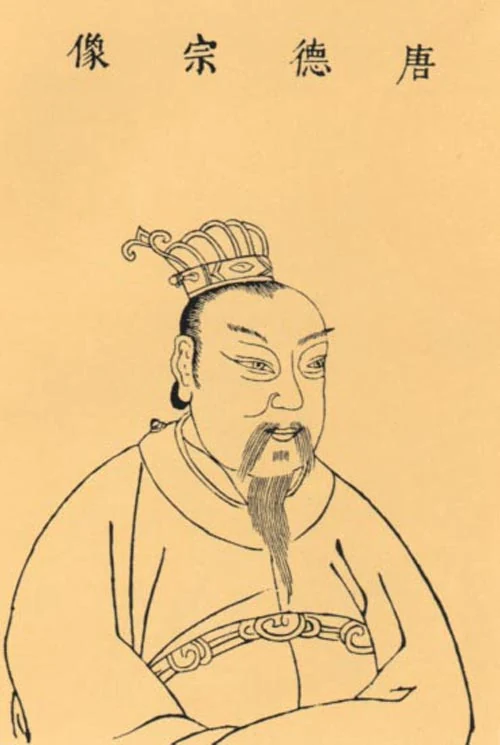
Biography
Family Background and Early Life
Emperor Dezong Li Shi was born on May 27, 742, the nineteenth day of the fourth lunar month in the first year of the Tianbao era, in the Eastern Palace within the imperial palace at Chang'an. He was the eldest grandson of Emperor Suzong Li Heng, the eldest son of Emperor Daizong Li Yu, and the son of Empress Ruizhen, Lady Shen. According to the *Tang Huiyao*, Li Shi was appointed Tejin and made Prince of Fengjie Commandery in the twelfth lunar month of the year of his birth. His father Li Yu was then Prince of Guangping, while Lady Shen was a consort of the prince.
In the eleventh lunar month of 755, the fourteenth year of the Tianbao era, the An Lushan Rebellion broke out when Li Shi was fourteen. The following year Chang'an fell, Emperor Xuanzong fled to Sichuan, and the realm descended into turmoil. Li Shi, together with other members of the imperial family, directly experienced the hardships of war and the suffering of the dynasty. These experiences had a lasting influence on his later rule.
Years as Crown Prince
In the fourth lunar month of 762, the first year of the Baoying era, Emperor Daizong ascended the throne. In the fifth lunar month, Li Shi was appointed Supreme Commander of the Armies of the Realm and retitled Prince of Lu, giving him responsibility for the final struggle against the An-Shi rebels. In the eighth lunar month he was retitled Prince of Yong, and in the tenth he was sent to command at Shanzhou. In 763, the second year of the Baoying era, the rebellion was finally suppressed. For his service, Li Shi was appointed Director of the Department of State Affairs and granted an actual fief of two thousand households; together with Guo Ziyi, Li Guangbi, and six others, he received an iron certificate and had his portrait placed in Lingyan Pavilion.
In the first lunar month of 764, the second year of the Guangde era, Li Shi, as the emperor's eldest son, was made crown prince, with the formal investiture held in the second lunar month. During his years as heir apparent he observed court government closely and developed a deep awareness of the problems created by Emperor Daizong's policy of accommodating the military governors, foreshadowing the policies he would pursue after taking the throne.
Accession and Reform
In the fifth lunar month of 779, the fourteenth year of the Dali era, Emperor Daizong died and Li Shi ascended the throne at the age of thirty-eight. During mourning he carefully followed ritual prescriptions. On one occasion he summoned Prince Han Li Jiong to dine and ate only purslane soup, without salt or dairy products, to show his grief. In the first lunar month of 780, the first year of the Jianzhong era, his officials presented him with the honorific title "Sacred, Divine, Civil and Martial Emperor."
At the beginning of his reign, Li Shi appointed Cui Youfu as chancellor. Government was simple and restrained and contemporaries believed there were signs of a dynastic revival reminiscent of the Zhenguan era. After Cui Youfu recommended Yang Yan as chancellor and then died of illness, Yang Yan came to dominate policy. Li Shi accepted Yang Yan's proposal for the Two-Tax System, abolishing the poll-centered system of equal-field taxation and corvée and replacing it with summer and autumn levies based on property and landholding, thereby broadening the tax base. Yang Yan, however, was narrow-minded and allowed private resentments to interfere with public affairs, framing Liu Yan and causing his death, which aroused widespread criticism.
Campaign against the Military Governors and Rebellions
In 781, the second year of the Jianzhong era, Li Shi appointed Lu Qi as chancellor. Lu Qi catered to the emperor, envied capable officials, and successively brought down Yang Yan, Yan Zhenqing, Yan Ying, Zhang Yi, Li Kui, Du You, and others. In the same year, Li Shi decided to use force against the military governors in order to end hereditary succession within the regional commands and their refusal to obey court orders. At first the policy achieved notable success: Liang Chongyi of Shannan and Li Weiyue of Chengde were killed, two commands were recovered, and Tian Yue of Weibo suffered severe losses.
However, Li Shi's policy relied on using one military governor against another, causing resentment among many commanders who had taken part in the court's campaigns. By the end of 782, the third year of the Jianzhong era, Zhu Tao of Lulong declared himself Prince of Ji, Wang Wujun of Chengde Prince of Zhao, Li Na of Ziqing Prince of Qi, and Tian Yue of Weibo Prince of Wei. The "Four Garrisons" united against the court. Li Xilie of Huaixi also styled himself Supreme Commander of the Realm and joined their rebellion.
In the tenth lunar month of 783, the fourth year of the Jianzhong era, the Jingyuan Mutiny erupted. The mutineers occupied Chang'an and proclaimed Zhu Ci emperor. Li Shi fled first to Fengtian, present-day Qian County in Shaanxi, and then to Liangzhou. Li Mi, Li Sheng, Hun Jian, and others fought to restore the dynasty. In the first lunar month of 784, the first year of the Xingyuan era, Li Shi issued an edict taking responsibility for his own failings, proclaimed a general amnesty, changed what would have been the fifth year of Jianzhong to the first year of Xingyuan, and pardoned Li Xilie, Tian Yue, Wang Wujun, Li Na, and others, restoring their titles.
Later Years and Conservative Turn
After the rebellions were suppressed and he returned to the capital, Li Shi's governing style became more conservative. He generally accommodated the military governors, placed eunuchs in command of the palace armies, and helped establish the practice of eunuch supervision of the military. After adopting the era name Zhenyuan, he grew increasingly avaricious and self-interested, frequently transferring tax revenues from the state treasury to the palace treasury, tolerating eunuchs who compelled local officials to send tribute, and even operating palace-market procurement in Chang'an to enrich the imperial household. To make up central fiscal shortfalls, the government also imposed additional taxes on tea and other goods across the empire, deepening popular resentment.
Nevertheless, during Dezong's reign the Tang allied with the Uyghurs and Nanzhao against the Tibetan Empire, successfully reversing the strategic disadvantage the dynasty had suffered against Tibet. These developments created a more favorable external environment for the Yuanhe Restoration under Emperor Xianzong. In the first lunar month of 805, the twenty-first year of the Zhenyuan era, Li Shi died at the age of sixty-four. He received the posthumous name Emperor Shenwuxiaowen and the temple name Dezong and was buried at Chongling.
His Birth and the Rites of an Heir
The Institutional History of the Tang records that three days after Li Kuo's birth his great-grandfather Emperor Xuanzong came to see him, with the heir Li Heng (later Emperor Suzong) and his son Li Yu (later Emperor Daizong) standing by in order; the nurse brought Li Kuo wrapped in swaddling-clothes and showed him to them, and he being of no fair complexion and leaning forward, Li Heng and Li Yu disliked the look of him, and so in turn held him up for Xuanzong to see; and Xuanzong, looking at him, said that "he is truly my son", and then to Li Heng that "you are not his equal", and to Li Yu that "you are not his equal either; he is like me". In the troubles of An Lushan, when Xuanzong took refuge in Sichuan, he said on the way that "Tiaolang (Li Kuo's boyhood name) will have to make this journey too", and in after years Li Kuo did indeed pass through Hancheng in Shaanxi. Of his filial care there is the affair of the funeral: when Emperor Daizong was to be buried, Li Kuo escorted the hearse himself, and seeing that it did not go in the middle of the road but kept somewhat to the side, he asked the reason, and the officials answered that "Your Majesty's natal sign is at the hour of Wu, pointing to the centre, and we dared not run counter to it", and Li Kuo weeping said that "how could one wrong the imperial hearse to seek one's own advantage?", and ordered the hearse turned to go straight by the centre of the road. The histories note the change of temper at this time, that "Suzong and Daizong both loved the spirits and the gods of yin and yang, and on every matter, great or small, consulted the diviners, so that Wang Yu and Li Gan advanced by heterodox arts", while Li Kuo "did not believe in them at all, and for the mausoleum took only the date of the seventh month, beginning the work when all was ready without choosing a day".
The Humiliation at Shanzhou and His Command as Marshal
In the first year of Baoying Li Kuo went out to Shanzhou as marshal of the armies of the realm, and was humiliated in his dealings with the Uighurs. By the Comprehensive Mirror, "the prince of Yong, Li Kuo, reached Shanzhou, where the Uighur qaghan was encamped north of the river, and Li Kuo went with several dozen horsemen of his suite to see him. The qaghan reproached him for not bowing and dancing, and Yao Zi'ang answered that the rites did not require it; and the Uighur general Chebi said that 'the Son of Heaven of Tang and our qaghan swore brotherhood, so the qaghan is the prince of Yong's uncle, and how should he not bow and dance?', and Yao Zi'ang answered that 'the prince of Yong is the emperor's eldest son and now marshal; how should the heir of China bow and dance to a foreign qaghan? And moreover the two palaces are in mourning, and dancing is not proper'. The contention went on a long while, and then Chebi had Yao Zi'ang, Wei Ju, Wei Shaohua and Li Jin each given a hundred lashes, and, on the ground that the prince was young and unacquainted with affairs, sent him back to camp, and Wei Ju and Wei Shaohua died within the night." Afterwards the mother of the Mouyu qaghan came to apologise and herself escorted Li Kuo back on horseback; and when the Tang armies would have joined to attack the Uighurs, Li Kuo, because the troubles of An Lushan were not yet put down, restrained them. This matter rankled in Li Kuo's mind for long, and as late as the Zhenyuan years, when Li Bi discussed peace with the Uighurs, it was still the ground of dispute.
The Two-Tax Reform
The two-tax reform arose from Yang Yan's reading of the collapse of the rent-corvée-cloth system after Xuanzong. Yang Yan "advocated the two-tax law, proposing to replace the principle of 'measuring income to fix expenditure' with that of 'measuring expenditure to fix income'; to replace taxation by poll with taxation by property; to levy in money rather than in kind; and to merge the categories of corvée and concentrate the terms of payment", and "the officials in charge of the taxes opposed Yang Yan's proposal, holding that the rent-corvée-cloth system had been in force more than four hundred years and that the old rules could not lightly be changed", while Li Kuo "expressed his support and had it carried out". The Old Tang History gives Yang Yan's own words: that "of all the expenses of the various corvées and the levies of a single cash, the amount should first be reckoned and then assessed on men, measuring expenditure to fix income; households, whether resident or guest, should be registered by their actual dwelling; men, whether of age or not, should be graded by wealth; those who have no fixed dwelling but trade abroad shall be taxed one in thirty in the prefecture where they are, and the burden made equal with that of residents, so that there be no unfair advantage; the tax of residents shall be levied twice, in autumn and summer; the rent, corvée and miscellaneous levies shall all be abolished, but the register of adult males shall not be dropped, and reports of increase and decrease shall be made as before; the tax on fields shall be levied equally on the acreage of the fourteenth year of Dali; the summer tax not later than the sixth month and the autumn tax not later than the eleventh; and after the change, where households increase and the tax grows lighter, or men scatter and the levy loses its balance, the long and subordinate officials shall be promoted or dismissed, the department of revenue presiding over all." Li Kuo "approved and carried it out, proclaiming it within and without", and though "those in charge of the taxes obstructed it as unprofitable, saying that the rent-corvée ordinance had stood four hundred years and the old system could not lightly be changed", yet he "carried it out without doubt, and the world found it convenient", so that "men were settled on the land without being registered anew, the taxes rose without harsher levy, the registers were not made yet the true numbers were known, and the greedy clerks were not rebuked yet found no way to rob; and from this time the power of lightening and weighting began to return to the court". The Comprehensive Mirror records the essence of the law as "first following Yang Yan's proposal, ordering the commissioners of promotion and the observers and governors to 'agree with the people on their households and property, fix the grades and make the two-tax law; all the old and new categories of levy of every kind are abolished, and whoever levies a single cash beyond the two taxes shall be punished as a perverter of the law'", and traces the evil from which it sprang, that "at the beginning of Tang the method of taxation was called rent, corvée and cloth: with land there was rent, with person corvée, with household cloth. At the end of Xuanzong's reign the registers decayed and were mostly untrue; and when the armies rose at Zhide, the taxes were exacted in haste with no fixed standard; the offices of taxation multiplied without any head, each adding levies at will and making categories of its own, old and new piling up past all counting. The rich households had many adult males, and mostly became officials or monks to escape the levies, while the poor households, having many males, had nowhere to hide, so that the upper households were favoured and the lower toiled. The clerks nibbled away and the people, paying by the ten days and delivering by the month, could not bear the distress and mostly fled to become floating households, until of the settled people not four or five in a hundred remained" — and so the law was made.
The Grudge of Yang Yan, the Villainy of Lu Qi, and the Exactions
Yang Yan's fall began in private grudge. The Old Tang History records that he "was grateful to Yuan Zai and devoted himself to carrying out Zai's old designs in requital", and that "when Zai was condemned, the left vice director Liu Yan examined and impeached him; when Yuan Zai was executed Yan too was degraded, and therefore hated Yan deeply", so that "having framed a charge against Liu Yan and degraded him, and the minister of agriculture Yu Zhun being at odds with Yan, Yan had him made governor of Jingnan and hinted that he should falsely accuse Yan of rebelling in Zhongzhou, and had him killed, his wife and children banished to Lingnan, so that the court and the world looked askance". In the first year of Jianzhong Yang Yan "wished to carry out Yuan Zai's old design, to wall Yuanzhou and open the Lingyang canal", and the emperor asked Duan Xiushi whether it could be done, and he held that "in spring earthworks must not be begun; let it wait for the slack season of farming", whereupon Yang Yan, "taking it as an obstruction of his plan, had him made minister of agriculture" and gave the governorship of Jingyuan to Li Huaiguang of Binning "for the expansion of the west"; but "before long Liu Wenxi rebelled, and the wall was never built". The villainy of Lu Qi was worse: "once in the chancellorship, he hated ability and envied worth, and by open slander and secret harm brought to death every man who would not follow him, that he might raise his power and enforce his authority and long keep it"; and Yang Yan, "finding Lu Qi of low appearance and no understanding, yet seated with him in the same office, was much displeased, and was slandered by Qi and driven out to Yazhou". When the emperor was at Fengtian and Cui Ning "spoke of the times with tears", Lu Qi, disliking it, "slandered him to the emperor, saying that Cui Ning had sworn an oath with Zhu Ci and so delayed, and Cui Ning was put to death"; and "hating Yan Zhenqing for his plain speaking, he had him sent as envoy to Li Xilie, so that he died among the rebels". The prefect of the capital, Yan Ying, being at odds with Yang Yan, "Lu Qi promoted him to censor-in-chief to overthrow Yang Yan; and when Yang Yan was degraded and died, he in turn disliked Yan Ying and plotted to remove him"; and the chancellor Zhang Yi, "loyal and upright and of ability, trusted by the emperor, Lu Qi much disliked", and when Cai Tingyu set the brothers Zhu Tao and Zhu Ci at odds and was degraded, the palace censor Zheng Zhan sent an officer to escort him and Cai Tingyu drowned himself; whereupon Lu Qi memorialised that the three offices should try Zheng Zhan, "and since the censors act by the order of the chief censor, Yan Ying too should be tried"; and Zheng Zhan being a friend of Zhang Yi, "and often going to him while Lu Qi slept by day", Lu Qi knew of it, and one day "feigning deep sleep, waited for Zheng Zhan to come and, while he was speaking with Zhang Yi, suddenly entered Zhang Yi's chamber, and Zheng Zhan hastened to avoid him, and Lu Qi at once spoke of secret matters", and Zhang Yi said that "the palace censor Zheng is here", and Lu Qi feigned amazement that "what I spoke of is not for other ears"; and while the three offices were trying Zheng Zhan and Yan Ying, "before the case was made he memorialised for the death of Zheng Zhan and the degradation of Yan Ying to governor of Huanzhou", and Zhang Yi "was soon removed from the chancellorship and sent out to Fengxiang"; and Li Kui, an old and virtuous man, "fearing that the emperor might use him again, was sent as envoy to the Tibetans, at which the world wrung its hands in grief and anger, but none dared speak"; and the vice minister of revenue and commissioner Du You, "much favoured by the emperor, was defamed by Lu Qi and degraded to governor of Raozhou".
His exactions were worst in the levies on merchants, the borrowing of deposits, and the house and transaction taxes. The Old Tang History records that "from this Hebei and Henan had no rest from war", and Du You, commissioner of revenue, "reckoned that the monthly cost of the armies of the several circuits was more than a million strings, and the capital's treasuries could not last many months; and that with five million strings the armies could hold out for half a year", whereupon Lu Qi made the vice minister of revenue Zhao Zan commissioner, and Zhao Zan, "having no plan, schemed with his party, the court scholar Wei Dubin and others, to levy by search, holding that the coin of the realm was gathered in the hands of the rich merchants, and that those with ten thousand strings should keep ten thousand for their business and lend the surplus to the state for the army, hoping to get five million strings"; the emperor allowed it, "promising to repay out of public money when the war was over"; and when the edict came down, "the junior prefect of the capital, Wei Zhen, drove it hard, and the magistrate of Chang'an, Xue Cui, riding in a cart with his cangue about his neck, searched men's goods, and where he thought the account false at once flogged them, so that men could not bear the wrong and pain and some hanged themselves, and the capital was in uproar as if plundered by robbers", while "the whole valuation of the houses, lands, slaves and servants of the rich households came to only eight hundred and eighty thousand strings"; and then "the goods and grain deposited with brokers and pawnshops were borrowed to the extent of a quarter and their strong-rooms sealed, so that Chang'an closed its markets, and the people in crowds of thousands and ten thousands waylaid the chancellor in the road to complain", and Lu Qi "at first soothed them but could not restrain them and galloped away", the two expedients together yielding "only two million strings"; and the emperor, "knowing the people's resentment, decreed their abolition, yet the armies were in the field and needed daily supply". In the sixth month of the next year Zhao Zan asked further for the house tax and the transaction tax: "every two beams of a roof counted as one room, in three grades — the best two thousand cash a room, the middle a thousand, the lowest five hundred; the clerks entered men's houses with tally and brush to count them, and one room concealed was punished with sixty blows and the informer rewarded with fifty strings. By the transaction law all public and private payments and dealings, formerly taxed twenty cash in a string, were taxed fifty, and where goods were exchanged the value was reckoned and taxed accordingly; the market brokers were given stamped papers, and every sale was written down and reckoned the next day... and where a hundred cash were concealed they were confiscated, where two thousand, sixty blows, and the informer rewarded with ten thousand cash at the offender's cost. When the law was in force the brokers seized the power and mostly concealed and robbed, so that of what the state took not half in a hundred came in, and the murmur of complaint filled the world."
The Four Garrisons, the Rebellion and the Edict of Repentance
In the fourth year of Jianzhong the mutiny of the Jingyuan troops broke out: "the Jingyuan troops marching to the front against the rebels passed through Chang'an, and getting none of the rewards they longed for, and being served coarse rice and vegetables, the soldiers mutinied", and Li Kuo "fled in haste to Fengtian", while the mutineers "set up Zhu Tao's elder brother, the grand commandant Zhu Ci, who had once commanded the Jingyuan army, as emperor, first of Qin and then of Han, with the reign-title Yingtian", and Zhu Ci besieged Fengtian. The fighting had many turns: by the Comprehensive Mirror Ma Sui, Li Baozhen and Li Sheng "broke Tian Yue utterly at Linming"; Li Xilie "led his troops up the Han and joined the other armies", and Liang Chongyi sent Zhai Hui and Du Shaocheng against him at Manshui and was beaten, and beaten again at Shukou, and the two officers asking terms, "Chongyi shut his city and held it, but the defenders opened the gate and struggled out and could not be stopped", and he "threw himself into a well with his wife, and his head was sent to the capital"; Tian Yue sent Fu Lin with three hundred horse, and Fu Lin's father Lingqi told him that "I am old, and I have seen the rebels from An and Shi's time — where are they now? Can the house of Tian last? If you take this chance to leave rebellion for allegiance, it is you who will make your father's name known to later ages", and biting his own arm in farewell; and Fu Lin with his deputy Li Yao surrendered to Ma Sui, and Tian Yue "destroyed his family, and Lingqi died cursing him"; and Li Yao's father Zai Chun surrendered Bozhou, Tian Yue's cousin Ang surrendered Mingzhou and Wang Guangjin Changqiao; and Wang Wujun, having got out of Hengzhou, told Wei Changning that "I have happily escaped the tiger's mouth and shall not go back", and Changning urged him to turn his weapons on Li Weiyue, "for the son to obtain it, to turn disaster into fortune, is the work of a moment", and Wujun thought it right, and with Xie Zun and Wang Shizhen, "at dawn Wujun with several hundred horsemen burst into the gate of the headquarters", and Shi Zhen answered from within and killed more than ten; and Wujun ordered that "the lord is a rebel and the officers return to allegiance; whoever resists shall have his clan destroyed", and none dared move, and they seized Li Weiyue and killed Zheng Shen, Bi Hua and Wang Tannu; and as Weiyue was the son of an old envoy Wujun would have sent him alive to Chang'an, but Changning said that "if he sees the Son of Heaven he will lay the crime of rebellion at the censor's door", and so he was strangled and his head sent to the capital. In the second month the governor of Dingzhou under Li Weiyue, Yang Zhengyi, surrendered, "and Hebei being all but settled, only Weizhou was not taken", and the court made Zhang Xiaozhong governor of the three prefectures of Yi, Ding and Cang, Wang Wujun commissioner of Heng and Ji, and Kang Rizhi commissioner of Shen and Zhao, "giving the two prefectures of De and Lin to Zhu Tao and ordering him back to his post".
In the first month of the first year of Xingyuan Li Kuo issued his edict of repentance. The Old Tang History gives its words, that "in setting up government and raising civilisation one must deal in good faith; to forget oneself for others one grudges not to amend", and that he himself "grew up in the depth of the palace and was ignorant of the business of governing the state... knowing not the hardship of sowing and reaping, nor pitying the toil of the campaigns", so that "the war-carts were taken and the horses registered, and far and near were in uproar; those who went carried their loads and those who stayed escorted them, and the multitudes toiled; the labour never ceased and the fields lay fallow", until "Heaven rebuked above and I did not wake, men murmured below and I did not know", and "with shame of face the guilt is indeed mine"; and he ordered that "henceforth no memorial from within or without shall use the title 'holy, divine, cultured and martial'", and proclaimed a general amnesty, changing the fifth year of Jianzhong into the first year of Xingyuan; and of Li Xilie, Tian Yue, Wang Wujun and Li Na, that "all being old servants of merit who held the frontiers, I governed them amiss and caused their doubt and fear, and all this arose from the ruler losing his way and the people suffering its calamity; let all be washed clean, their ranks restored and they themselves treated as before"; but of Zhu Ci that "he has overturned the constants of Heaven, stolen the sacred vessels and violated the tombs, which I cannot bear to speak of, and having offended the ancestors I dare not pardon him", so that "besides Ci, all shall be forgiven"; and that "the officers and men who came to Fengtian and recovered the capital shall be named the Meritorious of the Settlement of Difficulties at Fengtian"; and that "the former taxes of house and transaction and the taxes on bamboo, wood, tea and lacquer are all abolished", Fengtian being raised to the rank of a metropolitan county. By the New Tang History, afterwards "Li Huaiguang was made grand commandant and Huaiguang rebelled", and in the fourth month "Li Baozhen and Wang Wujun fought Zhu Tao at Jingcheng and beat him", "Shang Kugu fought Zhu Ci west of Lantian and beat him", "Li Sheng beat him again north of the park and again at Baihua, and the capital was recovered", and in the sixth month "Yao Lingyan was executed" and "Zhu Ci was executed"; while in the first year of Zhenyuan "Hun Jian fought Li Huaiguang at the Changchun palace and beat him" and "Ma Sui fought him at Taocheng and beat him", and in the eighth month "Li Huaiguang was executed".
The Years of Famine, the Eunuchs, and His Last Government
After the troubles came years of famine, and the Old Tang History records that "at that time east of the passes there was great famine and the taxes did not come in, so that the state's funds were the more straitened; in the passes locusts ate up all the grass and trees, the drought was extreme, the Ba river was nearly dry and the wells mostly without water", and the officials reckoned that "the money and grain of the revenue office could last only seventy days", whereupon Li Kuo decreed that "of late calamities have gathered, the rains have not come down through three seasons and locusts have followed, filling a thousand li", and that "I now perceive that prayer in the temples is no art of averting calamity, nor words the way of answering the reproach", and that therefore "it is right to withdraw from the principal hall, to lessen the table, to economise, to be lenient in punishments, and by personal amendment to observe the warning of Heaven", ordering that "from now I shall not hold court in the principal hall, that the officials shall reduce the imperial table, and that all unnecessary business shall cease", and that "all rations of every kind, save for the officers and men of the armies, shall be discussed and reduced by the heads of the several offices to meet the famine". As to the eunuchs, their employment began with the troubles at Fengtian: "the trustworthiness of the eunuchs and the untrustworthiness of the court generals gave Li Kuo a deep shock; and by degrees Li Kuo began to entrust the command of the guards to Dou Wenchang and Huo Xianming and others, which shows that he had begun to change the attitude of his early reign, when he kept the eunuchs at a distance." In the Zhenyuan years "the power of the eunuchs lifted its head again", and "they gained control of the guards and were exceedingly insolent in the court".
The abuses of the palace market and the tribute have their stories too: the eunuchs, under the name of the "palace market", "paid very little at their own will and then required the owner to bring the goods into the palace, and extorted from them the 'gate money' and the 'foot money'"; and once a farmer brought firewood into the city on a donkey and an eunuch took it under the name of the palace market, "gave him only a few feet of silk, then demanded the 'gate money' and had his donkey taken into the palace with the wood", and the farmer, weeping, "would rather have given up the silk", but the eunuch said that "your donkey must carry the wood inside", and the farmer answered that "I have parents, wife and children who depend on this to eat; now I have given you the wood without taking its price and yet you will not let me go; I have nothing left but to die", and struck the eunuch; and Li Kuo, hearing of it, "dismissed the eunuch and gave the farmer ten bolts of silk, but the palace market went on as before". And the Comprehensive Mirror records his hunting visit: "the emperor hunted at Xindian and entered the house of the commoner Zhao Guangqi, asking whether the people were happy, and he answered that they were not; and when the emperor said that the year had been fruitful and asked why they were not, he answered that 'the edicts are not kept. It was said before that beyond the two taxes there was no other corvée, but now the exactions that are not taxes are nearly more than the taxes. Then it was said to be a purchase by agreement, but in truth it was taken by force, and not a coin was ever seen. First it was said that the grain bought would be delivered by the roadside, and now it is sent to the western camp, hundreds of li away, until the carts break and the oxen die and the household is ruined and cannot bear it. In such distress, what joy is there? Whenever there is an edict of relief, it is an empty writing. We fear the sage lord in the depth of his ninefold palace knows nothing of it.' And the emperor ordered his household exempted from taxes." Sima Guang comments that "how hard it is to awaken the Tang Dezong... he was fortunate, in hunting, to reach a commoner's house and to find Guangqi bold enough to speak and knowing the people's distress, which is a meeting once in a thousand years", yet "this he would not do, but only exempted Guangqi's household; for with the breadth of the four seas and the multitude of the people, how can every man speak to the Son of Heaven and every household be exempted from its levies?" As to the welcoming of the Buddha's bone, since the "true-body pagoda" was "opened once in thirty years", the lawful season for the Tang imperial house to receive the relic, Li Kuo "followed the custom, decreeing that the finger-bone of the Buddha be brought out from the Wuyouwang temple in Qizhou, that is Famen temple, and brought into the palace at Chang'an for worship, and afterwards to the great temples of the city; within and without the capital families came out in crowds", and in the second month "he sent an inner envoy to return the bone to Famen temple and bury it again in its old place". In his later years he also loved letters, thirteen or more of his poems surviving, among them the poems for the Zhonghe festival and for the banquets of the Double Ninth and the Linde hall; and the third series of Rongzhai records that "Tang Dezong, on his birthday each year, summoned Buddhists and Daoists to debate in the Linde hall, with the supervising secretary Xu Dai and Zhao Xu, Xu Mengrong and Wei Qumou to speak, and at first the three schools seemed to contradict one another but at last agreed in good, at which the emperor was greatly pleased and gave them gifts in degree". The Institutional History also records that in the second year of Zhenyuan he decreed that "of the candidates of every kind, those able to master the Kaiyuan Ritual shall be classed with those of one classic... and those who pass all shall be given office out of the ordinary course, those who pass seventy articles and two essays of policy being allowed to graduate", and in the ninth year that "those who study the Kaiyuan Ritual shall be asked a hundred articles of the great meaning and three essays of policy, those passing all being of the first class, and those passing eighty articles and two essays of the second, all else being treated by the rule of the three rites, this to be the standing rule for ever".
Honouring His Mother and the Search for Her
Li Kuo's mother, the Empress Rui Zhen of the Shen family, was lost in the troubles of An Lushan, and "Daizong sent envoys to seek her, but for more than ten years nothing was heard". On taking the throne Li Kuo at once issued a decree seeking her, saying that "he who serves his father with filial piety serves Heaven with understanding, and he who serves his mother with filial piety serves Earth with discernment; so to serve Heaven one must first honour the father, and to serve Earth one can do no more than honour the parent", and that "the inner court stands empty and the rite of inquiring after her is wanting, so that I am filled with grief and sorrow all the year"; wherefore "the ministers and grand officers should examine the old precedents and offer the empress dowager her honoured title". In the eleventh month of the first year of Jianzhong he "remotely honoured his holy mother the Lady Shen as empress dowager, performing the ceremony in the courtyard of the Hanyuan hall as at the new year", coming out himself in imperial robes from the eastern side gate to stand in the east while the ministers took their places, with a patent saying that "of kindness none is weightier than that of her who nursed me, and of rites none is nobler than the honoured title, whereby above the way of love and reverence is displayed and below the sense of the Spring and Autumn is corrected", and Li Kuo "bowed twice, choking so that he could not master himself, and all about him wept". The palace secretary Gao Can advised that "on taking the throne Emperor Wen of Han sent Bo Zhao to welcome the empress dowager from Dai; now the Han precedent should be followed, and the officials should choose a day and send the Shen clan into the prefectures to seek her out, to declare the emperor's filial thought and hope that Heaven may send down blessing", and Li Kuo accordingly made the prince of Mu, Li Shu, commissioner to welcome her, with the minister of works Qiao Lin as his deputy and the princess of Shengping attending her, "envoys going out to all the realm". Impostors appeared more than once: first "a daughter of the late eunuch Gao Lishi, who could speak of matters in the palace and had once attended the empress with the female official Li Zhenyi", was "of about her years and likeness", and since the Lady Shen "had once cut dried meat to feed the emperor and injured her left finger", and Gao "had also cut a melon and hurt her finger", and "there was then no one in the palace who knew the empress", she was "brought back to the Shangyang palace and the news sent in haste, at which the emperor rejoiced and all the ministers congratulated him", until "Gao Lishi's son, knowing she was not she, told the whole truth, and an edict pardoned her". There was also "an adopted daughter, who, being of like age and appearance to the Lady Shen and having had some dealings with her in the palace, was tempted by profit to impersonate her", and though all about Li Kuo "were indignant and asked that she be punished", he "not only did not punish her but said to those about him that 'so long as I can find my true mother, I do not mind being deceived a hundred times'". The histories record his words as "I would rather be deceived a hundred times in hope of finding the true one"; and "from this time the impostors grew more numerous, yet to the end of Dezong's life the true Lady Shen was never found".
The Return of Nanzhao and the Victories in the West
In his foreign policy Li Kuo adopted the plan of "peace with the Uighurs in the north, communication with Yunnan in the south, and alliance with the Arabs and India in the west" against the Tibetans. Earlier, when the king of Nanzhao, Yimouxun, came to the throne, he "invaded with all his host of two hundred thousand in concert with the Tibetans", "one column toward Maozhou over Wenchuan to disturb Guankou, one toward Fu and Wen to plunder Fangwei and Baibai, and one against Li and Ya to strike the Qionglai pass", and ordered his men to "take Shu for me as the eastern capital, and send all the craftsmen to Lhasa, and pay a tax of one length of silk a year"; "and so they took cities and villages, and the people fled to the hills". Li Kuo "sent the guards and the Youzhou army to relieve Dongchuan, and joining with the army of Shannan, broke Yimouxun's host utterly, beheading six thousand and taking many prisoners and wounded, and those who fell from the cliffs were near a hundred thousand", at which Yimouxun, in fear, "moved to Jumie city and built it fifteen li in extent", and the Tibetans made him king of the East. Afterwards Nanzhao asked to submit again, sending "his brother Cou Luodong and the pure official Yin Choukuan with twenty-seven others to present maps and products and ask to be named Nanzhao again", and Li Kuo "gave them gifts beyond measure, made Yin Choukuan cavalier attendant of the left and prince of Gaoxi"; and "in the sixth month of the following summer he invested Yimouxun as king of Nanzhao", with the minister of sacrifices Yuan Zi as commissioner, the junior prefect of Chengdu Pang Qi as his deputy, Cui Zuoshi as secretary and Ju Wenzhen as commissioner of comfort, "giving a gold seal inscribed with the words 'seal of the investiture of Nanzhao in the Zhenyuan period'". The ceremony of investiture was solemn: "the usher led Yimouxun from his place, and he knelt to receive the patent and seal and bowed twice, and received also the robes and gifts", and retiring he said that "in the Kaiyuan and Tianbao periods my great-grandfather and grandfather were both invested as kings, and fifty years have passed since; the Zhenyuan emperor has washed away the stain and recorded the merit, and restored the title, and to my sons and grandsons for ever I shall be a servant of Tang", and so gathered his people to feast the envoys, bringing out "two silver-inlaid horse-head dishes" and telling Yuan Zi that "these were given by the emperor when my late father was on guard as junior minister of foreign affairs in the Tianbao years", and there were "flute-players and singing girls, all white-haired", whom he showed to Yuan Zi, saying that "when my late father returned to his realm the emperor gave him two sets of Hu and Kucha music, and now almost all are dead, and only these two remain"; and when the wine went round Yuan Zi received the cup and said that "Nanzhao should think deeply on the work of its ancestors, holding loyalty and exhausting sincerity, and be for ever the bulwark of the southwest, so that its heirs be not cut off", and Yimouxun bowed and said that he would not fail to obey the envoy's command.
The victories in the west were chiefly Wei Gao's. In the tenth month of the fifth year of Zhenyuan, Wei Gao "sent his general Wang Youdao with troops to fight the eastern Man, the Lianglin Man and the Tibetan commands of Qinghai and Lacheng at Taideng valley in Suizhou, breaking them utterly, beheading two thousand and casting countless more from the cliffs and into the water", and killing "their grand marshal of horse and foot, Qizang Zhezhe", who "was a brave general of the Tibetans, and being dead, no city or stockade Wei Gao attacked failed to fall", so that "in a few years the whole territory of Suizhou was recovered"; and the Yuanhe gazetteer records that Suizhou "was lost to the Tibetans in the second year of Zhide and recovered by the governor Wei Gao in the thirteenth year of Zhenyuan". In the ninth year, "when the Son of Heaven walled Yanzhou, expecting that the Tibetans would come to disturb it, he ordered Wei Gao to lead out his army to hold them off", and Wei Gao "ordered his generals Dong Mian and Zhang Fen to march out separately from the western hills and Lingguan, to break Ehe, Tonghe and Dinglian city, to cross the Debo ridge, and so to invest Weizhou, striking Qiji and taking three cities including Yangxi, and burning the camp at Jianshan", so that the Tibetan marshal of the southern road, Lun Mangre, came to the rescue and "was fought and beaten, and Baian taken, and Yanzhou was walled". By the Old Tang History, "from the eighth month when the armies went out together to the tenth month they broke a hundred and sixty thousand of the Tibetans, taking seven cities, five military garrisons and three thousand households, with six thousand prisoners and more than ten thousand heads, and so advanced against Weizhou; reinforcements came again, and fighting over a thousand li the Tibetan armies were beaten in succession", and the Tsanpo "sent Lun Mangre, inner grand minister and commissioner of the eastern frontier and of the five circuits with the office of chief of herds, with a hundred thousand mixed barbarians to raise the siege of Weizhou"; and the Shu army of ten thousand "held the passes and laid ambushes, sending out a thousand to challenge", and Lun Mangre, "seeing our few, pursued with all his host", whereupon they "sprang the ambush and beat the drums like thunder, so that the Tibetans broke of themselves, and Lun Mangre was taken alive, and of the hundred thousand half were destroyed". Of the campaign in Shu the Comprehensive Mirror records that Ma Lin, envying the fame of Li Sheng, the commander of the Jingyuan troops, "sent him into the guards as commander of the right Shence", and Li Kuo "sent out four thousand guards under Li Sheng and five thousand troops of Bin, Long and Fanyang under the general of the golden guards, Qu Huan of Anyi, to relieve Shu"; the eastern command marched from Jiangyou against Baibai, joined the army of Shannan and broke the Tibetans and Nanzhao, the Fanyang troops came up with them at Qipan and broke them again, "and so took the two prefectures of Wei and Mao", and Li Sheng "pursued beyond the Dadu river and broke them again", so that "of the Tibetans and the men of Nanzhao eighty or ninety thousand died of cold and hunger in the gorges". At that time the court had thought of going to Chengdu: the Old Tang History records that "Shannan being poor and its food hard to supply, the chancellors proposed that the emperor should go to Chengdu", but "Zhen memorialised that 'Shannan touches the capital region, and Li Sheng is just planning its recovery and needs the support of the six armies; if Your Majesty goes to Xichuan there will be no date for Li Sheng's recovery; let Your Majesty consider it further'", and before the debate was settled Li Sheng's memorial arrived, "asking that the imperial carriage halt at Liang and Yang to plan the recovery, and the debate ceased".
Li Bi on the Uighurs, the Tibetan Rescripts, and Distant Envoys
The peace with the Uighurs owed much to Li Bi. Li Kuo, having adopted the plan of "peace with the Uighurs in the north, communication with Yunnan in the south, alliance with the Arabs and India in the west", "agreed on the whole but refused repeatedly where the Uighurs were concerned", the reason being the humiliation at Shanzhou: "Li Kuo thought that Wei Shaohua and the others had died for his sake", but Li Bi pointed out that "the Mouyu qaghan who had caused Wei Shaohua's death had been killed by the Qaghatulu qaghan, so that the Qaghatulu qaghan was in fact of service to Dezong", and comparing the Tang general Zhang Guangsheng's killing of Tuodong and more than nine hundred men with "the Qaghatulu qaghan's not daring to kill the Tang envoys", held that the Qaghatulu qaghan was "indeed without guilt"; and he went further, saying that Wei Shaohua and the others "should not rashly have let Li Kuo go to the Uighur camp, still less have let him meet the Mouyu qaghan without first settling the ceremony of meeting", so that "it was Wei Shaohua and the others who were at fault towards Li Kuo", and that Li Kuo "had not bowed to the Mouyu qaghan and had not submitted", while the Mouyu qaghan's mother "had herself apologised to Li Kuo", so that there was no case of Li Kuo having "yielded" to the Mouyu qaghan. Li Bi's argument, by the Comprehensive Mirror, was that "he who killed Wei Shaohua was the Mouyu qaghan, and on Your Majesty's accession he raised troops and invaded, and had not passed beyond his own borders when the present Qaghatulu qaghan killed him; so that the present qaghan has deserved well of Your Majesty and should receive enfeoffment and reward — where is the ground of resentment?", and that "Your Majesty was then at Shan and in the vigour of youth, and such as Wei Shaohua did not think deeply and brought the heir of ten thousand chariots straight into his camp without first agreeing on the ceremony of meeting, letting him give rein to his insolence — was it not they who failed Your Majesty? Death would not repay their fault", and asking whether, "had the qaghan kept Your Majesty in his camp and feasted him for ten days, the world would not have been appalled?" Li Kuo then said to Li Sheng and Ma Sui that "old friends should not meet; I always resented the Uighurs, but now that I hear Li Bi speak of the affair of Xiangji I find myself somewhat in the wrong". Li Bi asked to fix the terms by letter, that they "call themselves vassals and sons of Your Majesty, that their envoys come no more than two hundred at a time, that their tribute horses be no more than a thousand, and that they carry no Chinese and no foreign merchants beyond the passes", since, if all five conditions were met, "the emperor will surely grant the marriage, and so your majesty will be feared in the northern deserts and awe the Tibetans beside, enough to satisfy your majesty's old heart". With the Tibetans there was the affair of the altered rescript: in the twelfth month of the second year of Zhenyuan "the memorandum official of the mission to Tibet, Chang Lu, and the Tibetan envoy Lun Xinuoluo came from Tibet", and the Tsanpo first had the imperial letter taken from them, and then "sent to say to Cui Hanheng that 'the letter says: the tribute you have brought we have received; now we send our nephew a small token, to be received; but our Great Tibet and Tang are uncle and nephew, so how can we be treated as vassals? And as to the frontier you wish to fix, west of Yunzhou let the Helan mountains be the boundary; and for the oath let it follow the letter of the second year of Jinglong, that when a Tang envoy reaches us the nephew first swears, and when a Tibetan envoy reaches you the uncle also swears in person'", whereupon Cui Hanheng was asked to send to have it settled, and "when Chang Lu returned and reported it, the letter was altered, changing 'tribute' to 'present', 'bestow' to 'send', and 'receive it' to 'receive'". Of the distant nations there is also the audience of six kings and the embassy to the Arabs: the Old Tang History records that "the kings of six states of the western hills of Jiannan — Tang Lizhi king of the Qiang women, Dong Woting king of Gelin, Luo Tuocong king of Baigou, Dong Bihe king of Ruoshui, Deng Gaozhi brother of the king of Buzu, and Shang Xinang nephew of the king of Nanshui — came of themselves to offer tribute; these six states had at first adhered to the Tibetans, and because Wei Gao attacked the western hills and chastised the Tibetans they submitted, and each was given rank and sent home"; and there is also the record of the envoy sent abroad, that "in the early Zhenyuan years, the troubles being cleared and the world at peace and the four seas without waves, interpreters of nine languages came to court", and so "in the fourth month of the first year of Zhenyuan, he was given the crimson fish-bag and made envoy for the mission to the Arabs, with secretaries and attendants, receiving the credentials and the edict"; "he set out on the command, not shrinking from the distance; reaching the southern sea he left land for a ship... and cutting off his hair he sacrificed to the waves and swore to his men by the sun, and so the god of the waves calmed the swell and the wind-god ordered the breezes... two years and more he passed through ten thousand lands... and returned on the appointed day, his mission unbroken".