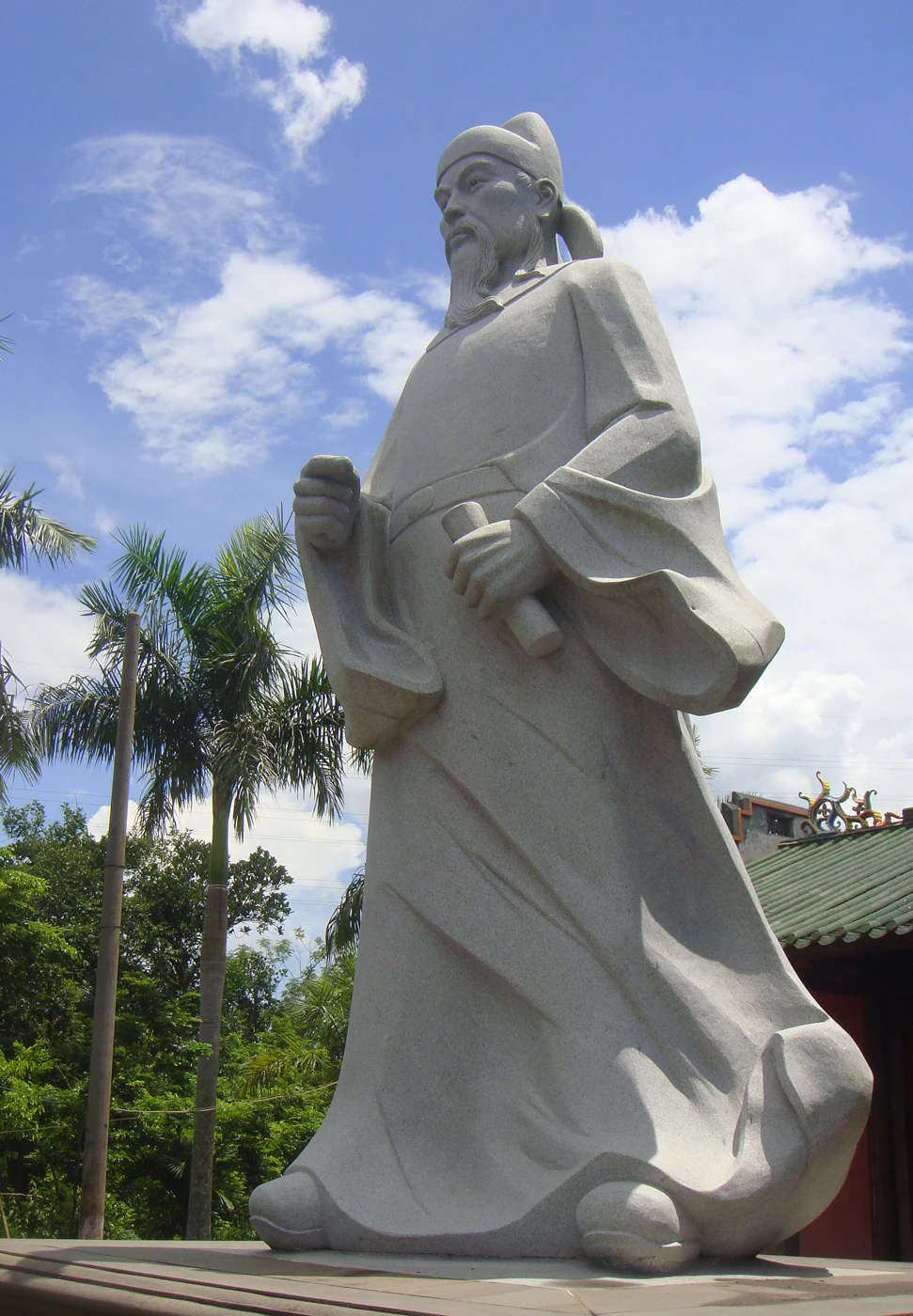
Biography
Family Background and Early Years
Wei Zhiyi belonged to the Longmen branch of the Jingzhao Wei clan, one of the most prestigious aristocratic lineages of the Tang. The Jingzhao Wei had been a prominent Guanzhong family since the Western Han, and by the Tang they were associated with the saying, "The Wei and Du south of the city stand only a foot and five inches from Heaven." Wei Zhiyi was exceptionally intelligent from childhood and showed literary talent. He entered the jinshi examination at sixteen and passed it at age eighteen in 782, the third year of the Jianzhong era. In 785, the first year of the Zhenyuan era, he placed first in the special examination for men "Virtuous and Upright, Forthright in Remonstrance" and was appointed Right Remonstrator in the tenth month. Still in his twenties, he entered the Hanlin Academy as a Hanlin Academician and enjoyed Emperor Dezong's favor.
While at the Hanlin Academy, Wei Zhiyi frequently exchanged poems with Emperor Dezong and, together with Pei Yanling and Wei Qumou, entered and left the inner palace as advisers. His literary ability and quick responses brought him considerable favor during Dezong's reign. He later left office to observe mourning for his mother. After completing the mourning period, he returned to service as a bureau official in the Department of State Affairs.
Alliance with Wang Shuwen and Appointment as Chancellor
Late in the Zhenyuan era, Hanlin attendant Wang Shuwen won the confidence of Crown Prince Li Song and became involved in affairs of the Eastern Palace. He secretly cultivated a group of noted men who became close political associates. On one of Emperor Dezong's birthdays, Crown Prince Li Song presented a Buddhist image as a congratulatory gift. Dezong ordered Wei Zhiyi to compose a laudatory inscription for it and instructed the crown prince to reward him with silk. When Wei Zhiyi went to the Eastern Palace to express thanks, the crown prince praised Wang Shuwen as a "great talent," after which Wei Zhiyi became closely associated with Wang Shuwen.
In 803, the nineteenth year of the Zhenyuan era, Left Reminder Zhang Zhengyi submitted a memorial and received an imperial audience. Wang Zhongshu, Wei Chengji, Liu Bochu, and others who had worked with Zhang and were friendly with him went to his residence to congratulate him. Rumors, however, claimed that they intended to impeach Wei Zhiyi and Wang Shuwen for factionalism. Wei Zhiyi believed the reports and secretly memorialized Emperor Dezong first, accusing them of forming a faction. Dezong ordered the Imperial Guard to investigate. After learning that the men frequently met and banqueted together, he demoted Wei Chengji and the others. The actual reason was not known publicly at the time, but the episode shows how closely Wei Zhiyi had already become tied to Wang Shuwen's group.
In 805, the twenty-first year of the Zhenyuan era, Emperor Dezong died and Crown Prince Li Song succeeded as Emperor Shunzong. Shunzong, however, was seriously ill and unable to manage government directly. Wang Shuwen operated from the Hanlin Academy and exercised political authority, recommending Wei Zhiyi as chancellor so that he could carry out decisions in the outer court. At the time Wei Zhiyi held the ranks and offices of Chaoyilang, Director in the Ministry of Personnel, and Cavalry Commandant. He was promoted to Left Vice Director of the Department of State Affairs and granted the designation Participant in Determining Government Matters, becoming a chancellor, and was awarded a purple robe and a gold-fish pouch. In the third month he was transferred to Vice Director of the Secretariat while retaining the same chancellorial designation.
Conflict and Struggle while Chancellor
Although Wei Zhiyi owed his chancellorship to Wang Shuwen, pressure from public opinion often led him to disagree with Wang. The two clashed over cases involving Investigating Censor Dou Qun, Xuanshe circuit official Yang Shie, and Liu Pi, deputy fiscal commissioner of Jiannan. Wang Shuwen wanted Yang Shie and Liu Pi killed, but Wei Zhiyi insisted that this should not be done and had them merely demoted. He sought in this way to obscure his dependence on Wang Shuwen, yet afterward he would send someone to apologize, saying, "I do not dare violate our agreement; I only wanted to help you achieve your purpose." Wang Shuwen did not believe him, grew resentful, and the relationship between the two deteriorated.
When Wang Shuwen later left office to mourn his mother, Wei Zhiyi became even less willing to follow his wishes and ignored many of his requests. Wang Shuwen was furious and, together with his supporters, plotted day and night to return to office. Wei Zhiyi in turn became the first person Wang intended to eliminate if he regained power.
Exile to Yazhou and Death
In the eighth month of 805, the first year of the Yongzhen era, Emperor Xianzong ascended the throne and honored Emperor Shunzong as Retired Emperor. Wang Shuwen and his followers were demoted out of the capital. Because Wei Zhiyi had previously disagreed with Wang Shuwen and was the son-in-law of Chancellor Du Huangshang, he was not immediately demoted, though he lost his former power. Knowing that disaster was approaching, he remained a chancellor but was constantly anxious, reportedly becoming so frightened that even the sound of approaching footsteps alarmed him.
In the eleventh month of that year, Wei Zhiyi was demoted to Sima of Yazhou. According to the *Old Book of Tang*, even when he held low office Wei Zhiyi had feared the names of Lingnan prefectures. When he and colleagues looked at maps, he would have maps of Lingnan removed and close his eyes rather than look at them. After becoming chancellor, he once saw a map hanging on the wall of the government hall and avoided looking at it for seven or eight days. When he finally did so, it proved to be a map of Yazhou, which he regarded as an ill omen. He was later in fact exiled to Yazhou and died there. In 812, the seventh year of the Yuanhe era, Wei Zhiyi died in Yazhou in his forties. His father-in-law Du Huangshang petitioned the court to have his coffin returned home for burial.
Major Activities
Yongzhen Reform
During Emperor Shunzong's reign, Wei Zhiyi was appointed chancellor and assisted Wang Shuwen in carrying out a program of reform later known as the Yongzhen Reform. Its principal measures included:
Abolition of the palace-market system: The "Five Bureaus boys," attendants attached to the falcon, hawk, eagle, dog, and related imperial animal bureaus, were dismissed. Under the palace-market system of Emperor Dezong's reign, eunuchs forcibly bought private goods at low prices, while the Five Bureaus personnel harassed the population under the pretext of supplying birds and animals for the court.
Ending extraordinary tribute: Local officials were prohibited from presenting additional offerings beyond established tribute quotas.
Action against corrupt officials: Li Qi, Surveillance Commissioner of Zhexi, was stripped of his concurrent fiscal and salt-iron commission, and Jingzhao governor Li Shi was demoted.
Measures against eunuch power: Fan Xichao was appointed military governor of the Western Capital Shence armies and Han Tai marching army Sima, with the intention of recovering control of the imperial guard from eunuchs.
Restraint of military governors: The court rejected Western Sichuan military governor Wei Gao's demand to control the three Jiannan regions of Western Sichuan, Eastern Sichuan, and Shannan West Circuit.
During the reform, Wei Zhiyi operated from the Secretariat, implemented Wang Shuwen's decisions, and drafted official documents. When Emperor Shunzong issued an order, it had to pass from his favored consort Niu Zhaorong to the eunuch Li Zhongyan, from Li Zhongyan to Hanlin attendant Wang Pi, then from Wang Pi to Wang Shuwen, and finally to Wei Zhiyi for execution. Conversely, memorials from officials had to pass successively through Wei Zhiyi, Wang Shuwen, Wang Pi, Li Zhongyan, and Niu Zhaorong before reaching Shunzong.
Literary Contributions
Wei Zhiyi was known for literary ability. He entered the Hanlin Academy in his twenties and often exchanged poems with Emperor Dezong. During the Yongzhen Reform he was responsible for drafting official proclamations, indicating the quality of his prose. In the appointment edict issued by Emperor Shunzong, he was praised as one whose "substantial merit was rooted in learning and whose brilliance was expressed in public service." Although most of his poetry and prose has been lost, his careers as Hanlin Academician and chancellor gave him a place in Tang literary history.
Places Associated with His Life
Wei Zhiyi's life was centered mainly on Jingzhao, Chang'an, and Yazhou, in what is now Haikou, Hainan. Born into the Wei clan of Duling in Jingzhao, he took the examinations and began his career in Chang'an, serving successively as Hanlin Academician, bureau official in the Department of State Affairs, and Director in the Ministry of Personnel before becoming chancellor in the Yongzhen era. After the reform failed, he was exiled as Sima of Yazhou, where he ultimately died.
Contemporary Associations
Wei Zhiyi was closely associated with Wang Shuwen and owed his elevation to the chancellorship largely to Wang's recommendation. Their relationship nevertheless combined cooperation with conflict, and political disagreement and struggles over authority eventually turned them against each other. Under Emperor Dezong, Wei Zhiyi also served alongside Pei Yanling and Wei Qumou as palace advisers. He married a daughter of Chancellor Du Huangshang, who continued to protect him after his exile and requested the return of his remains after his death.
His passage from Hanlin academician to chancellor and then to adjutant of Yazhou runs parallel with the rise and fall of the Yongzhen reform.
His time at his place of exile in Yazhou is recorded in the *Old Book of Tang*.
After his demotion to adjutant of Yazhou he died in exile.
His part in the Yongzhen reform contrasts with the attitude of his father-in-law Du Huangshang.
His poems and memorials are scattered through Tang documents.
His relations with Wang Shuwen and the others are recorded in the *Veritable Records of Shunzong*.
His career around the Yongzhen reform can be set out by year: a Hanlin academician at the end of the Zhenyuan period, he was on good terms with Wang Shuwen; in the second month of 805 (twenty-first year of Zhenyuan), after Emperor Shunzong's accession, he took part in the reforms and was appointed left vice director of the Secretariat and joint manager of state affairs; in the eleventh month of the same year (first year of Yongzhen) he was demoted to adjutant of Yazhou; and he died afterwards in exile. His relations with Wang Shuwen, Liu Zongyuan and Liu Yuxi are recorded in the *Veritable Records of Shunzong* and the two Books of Tang, his poems and memorials being scattered through Tang documents. His official rise and fall run parallel with the reform's, and his time at Yazhou is recorded in the *Old Book of Tang*.
Yazhou, his place of exile, was in Tang times among the remote and unhealthy districts of Lingnan.
His measures as chancellor were bound up with the policies of Wang Shuwen's group.
His demotion after the reform's failure is part of the affair of the two Wangs and eight simas.
His writings and movements at Yazhou appear only in scattered records.
His measures as chancellor are bound up with the politics of Shunzong's reign.
The two Books of Tang differ slightly on his demotion and the year of his death.
His official documents and memorials as chancellor appear in scattered Tang records.
His years in the Hanlin Academy and his association with Wang Shuwen and Wang Pei are recorded.
His posts as left vice director of the Secretariat and joint manager of state affairs were those of a chancellor.
His family, the Longmen branch of the Jingzhao Wei, appears in Tang genealogies and biographies.
His demotion to adjutant of Yazhou is listed with those of seven others at the same time.
Less than a year separated his advancement under Shunzong from his demotion after Xianzong's accession.
The record of his death in exile appears in his biography in the *Old Book of Tang*.
His association with Liu Zongyuan and Liu Yuxi appears in Tang collected works and notes.
His poems and prose are gathered in the *Complete Tang Poems* and the *Complete Tang Prose*.
His part in the Yongzhen reform differed from the more cautious line of his father-in-law Du Huangshang.
After his demotion his father-in-law Du Huangshang became chancellor under Xianzong, and the relations of the two families are recorded.
As a Hanlin academician he discussed affairs with Wang Shuwen and was one of the participants in the Yongzhen reform.
The reforms he and Wang Shuwen carried out consisted chiefly of abolishing the palace market, forbidding the five-fang attendants and demoting corrupt officials.
Under Shunzong he also held key financial posts in the revenue and salt and iron administrations.
His place of exile in Yazhou is connected with the history of Hainan's development.
The records of his demotion and death differ slightly in the two Books of Tang, and the entry sets them out as the sources give them.
His reform proposals as chancellor are connected with the abuses of Dezong's reign.
After the failure of the Yongzhen reform he was listed with Liu Zongyuan and the others among the eight simas.
His time at Yazhou corresponds to the records of the culture of exile in the Tang.
The edict of his demotion was issued together with the banishment of the two Wangs and eight simas.
As chancellor he advocated restraining the provincial commands and the eunuchs.
His relations with Wang Shuwen have a separate notice in the *Old Book of Tang*.
His demotion to adjutant of Yazhou places him with the "eight simas" of Tang records.
Entering office on his family's privilege, Wei Zhiyi served as a remonstrator and Hanlin academician in the Zhenyuan era and shared Emperor Shunzong's confidence with Wang Shuwen and Wang Pi. As chancellor he pressed to abolish the palace market, ban tribute levies and dismiss corrupt officials, checking both eunuchs and warlords, but the political tide turned and the reforms were scrapped. After Emperor Xianzong ascended, the reformers were exiled one by one; Wei was sent as adjutant of Yazhou and died there, counted with his fellows as the "eight simas".