Birth | Born at the official residence of the military commissioner’s secretary in Xuzhou; the source’s lead gives Zhending as an alternative birthplace.
989 CE–1052 CE
Officialpolitician
Fan Zhongyan
范仲淹
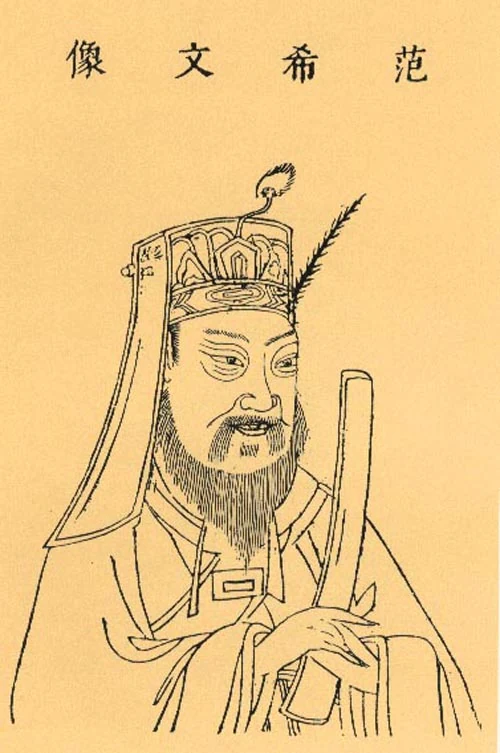
Fan Zhongyan (989–1052), courtesy name Xiwen, was a native of Wu County, Suzhou and a Northern Song statesman and writer. His father died when he was young, and he followed his mother when she remarried into the Zhu family, for a time bearing the name Zhu Yue. After passing the jinshi examination, he successively served in local government, remonstrance offices, and senior court posts. He directed restoration of the Taizhou…
989 CE–1052 CENorthern Song
PROFILE
Fan Zhongyan (989–1052), courtesy name Xiwen, was a native of Wu County, Suzhou and a Northern Song statesman and writer. His father died when he was young, and he followed his mother when she remarried into the Zhu family, for a time bearing the name Zhu Yue. After passing the jinshi examination, he successively served in local government, remonstrance offices, and senior court posts. He directed restoration of the Taizhou coastal dike and worked on local flood-control projects. During the Song–Western Xia Wars, he and Han Qi jointly managed frontier affairs in Shaanxi and adopted measures including military farming and prolonged defense. In 1043(3rd year of Qingli), he became Assistant Grand Councilor and took part in the Qingli Reforms. After the reforms faltered, he served in Dengzhou, Hangzhou, Qingzhou, and other places. Among his best-known prose and verse are Yueyang Tower Record and the line “Be the first to worry about the world’s troubles and the last to enjoy its pleasures.” In 1052(4th year of Huangyou), he died of illness while traveling to take up office in Yingzhou.
- Other Names
- Fan Xiwen; Duke Wenzheng Fan
- Courtesy Name
- Xiwen
- Period
- Song · Northern Song
- Dynasty/Polity
- Song · Northern Song
- Identity
- Official; politician
- Ethnicity/People
- Not reliably confirmed in the available sources
- Native Place
- Wu County, Suzhou (present-day Suzhou, Jiangsu)
- Place of Birth
- Unknown
- Major Achievement
- A prominent minister associated with the ideal of “worrying before all under Heaven worry”; born into reduced circumstances and active in frontier affairs and reform during the reign of Emperor Renzong.
- Courtesy name
- Xiwen;Song; Northern Song
- Dynasty/polity
- Song; Northern Song;Official, statesman
- Ethnicity
- Not reliably confirmed in the available sources;Wu County, Suzhou (present-day Suzhou, Jiangsu)
- Major achievements
- Directed restoration of the coastal dike at Taizhou; participated in the Shaanxi frontier defense and implemented a strategy of military farming and prolonged defense; participated in the Qingli Reforms; wrote prose, poetry, and Yueyang Tower Record, among other works.
- Date of Death
- June 19, 1052 CE(20th day of the 5th lunar month, 4th year of Huangyou)
- Date of Birth
- October 1, 989 CE(29th day of the 8th lunar month, 2nd year of Duan’gong;one account places his birth at Gaoping village in Zhending)
LIFE TIMELINE
Childhood | His father Fan Yong died of illness; his mother Lady Xie remarried Zhu Wenhan of Changshan, and his name was changed to Zhu Yue.
Studies | Learned of his family background, tearfully took leave of his mother, and went to the Yingtian Prefectural Academy to study.
Early office | Passed the jinshi examination on the list headed by Cai Qi under the name “Zhu Yue” and was appointed Judicial Assistant of Guangde Military Prefecture.
Early office | Promoted to Wenlin Lang and Judicial Officer of the Jiqing Military Commission; returned to his original clan and surname and changed his name to Fan Zhongyan.
Local office | Supervised the Xixi salt storehouse in Taizhou and submitted a proposal to rebuild the sea-defense dike.
Local office | Transferred to serve as magistrate of Xinghua County and placed in full charge of the dike-restoration project.
Mourning | His mother Lady Xie died; he resigned to observe mourning.
Teaching | At the invitation of Yan Shu, took charge of teaching at the Yingtian Academy.
Court appointment | Submitted the ten-thousand-character Memorial to the Senior Councillors; on the recommendations of Wang Zeng and Yan Shu, was summoned as Academician of the Secret Archive.
Remonstrance | Memorialized against Emperor Renzong leading the civil and military officials in celebrating Empress Dowager Liu’s birthday and asked the empress dowager to return authority; the memorials received no response.
Local office | Requested to leave the capital and became Controller-General of Hezhong Prefecture; the following year he was transferred as Controller-General of Chenzhou.
Remonstrance | After Emperor Renzong began personal rule, was recalled as Right Admonition Censor; because he opposed the deposition of Empress Guo, was demoted to prefect of Muzhou.
Local administration | Transferred as prefect of Suzhou; after successful flood-control work, appointed Vice Director of the Ministry of Rites and Reader-in-Waiting at the Tianzhang Pavilion.
Exile | Came into conflict with Lü Yijian over the “Chart of the Hundred Officials” affair, was demoted to prefect of Raozhou, and later transferred to Runzhou and Yuezhou.
Frontier service | With the outbreak of the Song–Western Xia Wars, served with Han Qi as Deputy Shaanxi Circuit Commissioner for Military Affairs, Pacification, and Suppression and as Prefect of Yan.
Battle of Haoshuichuan | Song forces suffered a major defeat at the Battle of Haoshuichuan, and he and Han Qi were both demoted; he subsequently promoted the strategy of “military farming and prolonged defense.”
Court appointment | Recalled as Deputy Commissioner of Military Affairs and appointed Assistant Grand Councilor; submitted Ten Matters in Response to the Imperial Edict and initiated the Qingli Reforms.
Qingli Reforms | Facing opposition to the reforms, requested to leave the capital, became prefect of Binzhou, and concurrently served as Pacification Commissioner for the Four Shaanxi Frontier Circuits.
Regional appointment | Removed from the Shaanxi four-circuit pacification post and transferred as prefect of Dengzhou.
Prefect of Dengzhou | At Dengzhou, wrote Yueyang Tower Record at the request of Teng Zongliang.
Literary work | Transferred as prefect of Hangzhou and promoted to Vice Minister of Rites.
Regional service | Promoted to Vice Minister of Revenue and appointed prefect of Qingzhou.
Final appointment | Appointed prefect of Yingzhou; while traveling to take office despite illness, died at Xuzhou and was buried at the southern foot of Wan’an Mountain in Yichuan, Luoyang.
BIOGRAPHY
Biography
Family Background and Early Years Fan Zhongyan came from a family with a record of official service. The History of Song traces his family to the Tang chancellor Fan Lübing and records its later residence in Wu County, Suzhou. According to the History of Song, his ancestor Fan Lübing was a Tang-dynasty chancellor, and the family had long resided in Binzhou (present-day Binzhou, Shaanxi). His great-great-grandfather Fan Sui served as county vice-magistrate of Lishui in Chuzhou during the Xiantong era of Emperor Yizong of Tang. Unable to return home because of warfare in the Central Plains, he settled in Wu County, Suzhou. During the Five Dynasties, Fan Zhongyan’s great-grandfather Fan Mengling and grandfather Fan Zanshi both served the Wuyue state. His father Fan Yong served Wuyue in his early career and, after following King Qian Chu of Wuyue in submitting to Song in 978(3rd year of Taiping Xingguo)(3rd year of Taiping Xingguo), became secretary to the military commissioner of the Wuning Army. The existing text dates Fan Zhongyan’s birth to October 1, 989 (29th day of the eighth lunar month), while the source gives September 17, 989 (12th day of the eighth lunar month); this discrepancy remains unresolved. He was born at the official residence of the secretary to the military commissioner in Xuzhou. His mother was Lady Xie. In 990(1st year of Chunhua), Fan Yong died of illness at Xuzhou while traveling to a new posting. Lady Xie, with Fan Zhongyan not yet two years old, remarried Zhu Wenhan, a native of Changshan in Zizhou, Shandong; Fan Zhongyan accordingly took the Zhu surname and the given name Yue. Fan Zhongyan grew up in the Zhu household and did not know his own family background when young. According to his chronological biography, he once urged the Zhu brothers to be frugal and was mocked with the words, “I spend the Zhu family’s money; what concern is that of yours?” Through this he learned that he had originally been a member of the Fan family. Deeply affected, he resolved to establish himself independently, took leave of his mother with his qin and sword, and went to study at Yingtian Prefecture in the Southern Capital, present-day Shangqiu in Henan. At the Yingtian Prefectural Academy, Fan Zhongyan studied under the prominent Confucian scholar Qi Tongwen and worked day and night. The Records of the Words and Deeds of Famous Song Officials says that for “five years he never undressed to sleep; when drowsy at night, he would pour water over his face.” His life was extremely austere, and “often even his porridge was insufficient, and he did not eat until the sun had declined.” During these difficult years he mastered the essentials of the Six Confucian Classics and formed the aspiration expressed as “one should be the first to worry about the world’s troubles and the last to enjoy its pleasures.”
Fan Zhongyan, styled Xiwen, is recorded in the Song History as a descendant of Fan Lübing, chancellor of the Tang, whose forebears came from Binzhou and afterward moved to Jiangnan, the family becoming natives of Wu county in Suzhou. His father Fan Yong, a native of Wu county, first served the state of Wuyue; when Wuyue submitted to the Song in 978 he came over with Qian Chu, held military commissions and in the Duangong years was secretary of the Chengde army at Zhending. That year his wife of the Chen family died of hemorrhage after childbirth, and Fan Yong, through the good offices of friends, married again, taking a daughter of the Xie family of Gaoping village, where the couple settled; in the eighth month of 989 Fan Zhongyan was born in the official lodging of the Xuzhou secretaryship. Soon after, Fan Yong was transferred to be secretary of the Wuning army; in bitter cold over a long road he fell ill before reaching his post, and after holding on for some ten days at Xuzhou he died. The next year the widowed lady Xie, with no means of support, married Zhu Wenhan of Changshan in Zizhou, taking the not-yet-two-year-old Fan Zhongyan with her, so that he took the surname Zhu and the name Yue.
His family and the institution he founded for it are essential to understanding the man. His father Fan Yong came over to the Song with Qian Chu of Wuyue and held the secretaryship of the Wuning army, being posthumously honored as grand tutor and duke of Zhou; his grandfather Fan Zanshi served Wuyue, entered office as a boy of nine and ended as director of the palace library; his great-grandfather Fan Mengling was an administrative aide of Zhongwu, and by his chronicle the line ran back to the Tang chancellor Fan Lübing, the family remaining in Wuzhong after the disorders of the Five Dynasties left them unable to return north. Once in office Fan Zhongyan petitioned to resume his surname, had honors granted to his forebears, and supported his kin from his salary. In 1049 at Hangzhou he used his savings to buy a thousand mu at Suzhou as a clan estate and drew up its rules: a pint of rice a day and a bolt of silk a year to the poor of the clan, help for marriages and funerals, and support for schooling and examinations, the estate administered by a manager chosen from the clan with its accounts open. The arrangement turned the duty to kindred into a permanent institution and is taken as an early model of clan property and family charity in China, imitated in estates elsewhere down to modern times.
Two years old and fatherless, as the Song History puts it, he was raised in the Zhu household under another name. As a boy he had aspiration and character; when he remonstrated with the Zhu brothers for their extravagance and was told that they were spending Zhu money and it was no concern of his, he learned the truth of his birth, took it deeply to heart, resolved to make his own way, took his lute and sword and went straight to Nandu, entering the school of Qi Tongwen at Yingtianfu. There he studied for years through cold and hunger, not undressing for five years together, dashing cold water on his face when he grew drowsy at night, and living on gruel when he could get nothing else, which others could not have borne but he did not find hard, until he had mastered the essentials of the six classics and conceived the ambition of benefiting the empire, often repeating to himself that one should be first in worrying over the empire's troubles and last in enjoying its pleasures — words that became the motto of his life. In 1015 he sat the examinations under the name Zhu Yue, took the second class in the ninety-seventh place on the list headed by Cai Qi, and was made an assistant in the judicial administration of Guangde army in charge of prisons and cases, a post of the ninth rank, whereupon he brought his mother to live with him. About 1017, having won his superiors' regard for the impartiality and integrity with which he managed judicial business, he held further posts and petitioned to resume the surname Fan, taking the name Zhongyan.
His early years of study shaped the manner of his whole life. By the varying accounts in the record of famous officials and in Lou Yue's chronicle, he studied at a Buddhist hostel on Mount Changbai in Zizhou and afterward at the school at Yingtianfu, reading day and night, not undressing for five years, dashing cold water on his face when drowsy, and often going without gruel until past noon — cutting cold rice into blocks and eating it with pickles, the practice later known as "chopping the pickles and dividing the gruel". From this came the frugality he kept when in office: living simply himself and spending most of his income on clansmen, old friends and guests, and keeping a lute beside him, so that tradition remembers the lute and sword of the boy who left home.
Entry into Office and Local Achievements In 1015(8th year of Dazhong Xiangfu), the twenty-seven-year-old Fan Zhongyan entered the imperial examination system under the name “Zhu Yue,” and sat the examinations, passing as the ninety-seventh jinshi in the second class on the list headed by Cai Qi, and was appointed Judicial Assistant of Guangde Military Prefecture, in present-day Guangde, Anhui, with responsibility for litigation and criminal cases. He was regarded as impartial and upright in handling cases, frequently disputing questions of right and wrong with his superior and refusing to bend before power. In 1017(1st year of Tianxi), he was promoted to Wenlin Lang and Judicial Officer of the Jiqing Military Commission, whereupon he returned to his original clan and surname and adopted the name Fan Zhongyan. In 1021(5th year of Tianxi), Fan Zhongyan was transferred to supervise the Xixi salt storehouse in Taizhou. Xixi bordered the Yellow Sea, where an old coastal dike originally built by Li Cheng in the Tang dynasty had fallen into disrepair. Seawater flooded inland, brine spread across the land, fertile fields were submerged, salt stoves were destroyed, and local people suffered severely. Fan Zhongyan wrote to Zhang Lun, the Jianghuai transport official, setting out the importance of the dike and proposing that the sea-defense dike be rebuilt. In 1025(3rd year of Tiansheng), after Zhang Lun reported the matter to the court, Fan Zhongyan was transferred as magistrate of Xinghua County and placed in full charge of the works. In the eighth lunar month of 1026(4th year of Tiansheng), his mother Lady Xie died and Fan resigned to observe mourning; Zhang Lun then supervised completion of the project. The dike transformed “marshy saline land along the coast into fertile fields, allowing the people to settle securely,” and in gratitude the people called it the “Dike of Lord Fan.” During mourning Fan Zhongyan resided in Ningling County, Yingtian Prefecture. Yan Shu, then Military Commissioner of the Southern Capital and prefect of Yingtian, had heard of his reputation and invited him to direct teaching at the Yingtian Academy. Fan supervised study diligently, taught by personal example, and encouraged discussion of current affairs and government. The academy’s intellectual climate changed markedly: “at that time the scholar-officials strove for integrity and high principle, and Zhongyan was the one who initiated it.”
For twenty years after passing the examinations his career followed the same pattern again and again: local service, remonstrance at court, and banishment to the provinces. He served first in the judicial administration of the Guangde army and then as a military adviser at Jiqing; about 1021 he was in charge of the salt store at Xixi in Taizhou, where the sea tide ruined fields, houses and salt works, and he memorialized for a sea wall, being made magistrate of Xinghua to carry it out: built over several years from Funing in the north to Lüsi in the south, several hundred li long and protecting tens of thousands of acres, it was afterward called the Fan dyke. He then held posts in the imperial library and as a remonstrating secretary, distinguished for plain speaking: in 1033, when Emperor Renzong wished to depose the empress Guo, he and Kong Daofu led the censors in opposing it and he was sent out to Muzhou; he was afterward posted to Suzhou, Raozhou and Runzhou, and at Suzhou he directed the dredging of five rivers to carry the waters of Lake Tai to the sea, ending the local floods. In 1036, having presented his chart of officials satirizing the chancellor Lü Yijian's appointments, he was banished again to Raozhou, and friends such as Ouyang Xiu and Yin Zhu were implicated, in what was called the factional quarrel of the Jingyou years.
Later, overseeing the salt depot at Xixi in Taizhou, he saw that on the coast of Tong, Tai and Hai the tide came to the city walls and the salt land could not be farmed, and proposed a sea wall. In 1024, as magistrate of Xinghua, he directed the work, mustering over forty thousand men from four prefectures to build a dyke some two hundred li long across Tong, Tai and Chu. A great snowstorm and surging tide scattered the workers and drowned more than a hundred; the court sent an inspector and was about to abandon the work, but the Huainan transport commissioner Hu Lingyi insisted it continue, and when Fan Zhongyan left office on his mother's death Zhang Lun asked to supervise in person; the dyke was finished the following year and, as the record puts it, the people enjoy its benefit to this day. It came to be called the Fan dyke, some families in Xinghua taking Fan as their surname, and shrines were built to him at Rugao.
In the eighth month of 1026 his mother died and he left office to mourn, residing at Yingtian prefecture, where Yan Shu asked him to direct the prefectural school. He taught diligently and led by example, encouraging discussion of current affairs and speaking out on the empire's business regardless of consequences, and the correction of scholar-official manners later ages credited to his initiative began with him. Yan Shu's recommendation brought him into the academy as a collator. At the winter solstice of 1029, when Renzong was to lead the hundred officials in congratulating the empress dowager Zhangxian on her birthday, he memorialized that the son of heaven has the way of serving parents but not the rite of a subject, and the position of facing south but not of facing north, holding the ceremony to confuse family and state ritual and to diminish the throne, and again asked that the dowager return the government; neither was answered, and a further memorial the next year was sharper still. For offending the dowager he was sent out as an assistant prefect of Hezhong and then moved to Chenzhou. At Hezhong he asked that the building works at Zhaoying and Shouning be stopped, since lavish construction ruined the people's livelihood and could not accord with heaven's mind, and he sought a reduction in the number of counties to lighten labor service, citing the Han founder's consolidation of four hundred counties.
In 1034 he moved to Suzhou, where months of rain and overflowing lakes and rivers had left the water undrained and the fields wasted, and he proposed opening five channels between Kunshan and Changshu to lead the water into Lake Tai and so to the sea, combining embankments, dredging and sluices. The method was praised at the time, and the officials who managed the water of the two Zhe circuits from the Southern Song through the Yuan and Ming largely followed it. In 1036 he was recalled to direct the state college and to administer Kaifeng, and presented his Chart of the Hundred Offices, setting out the order in which the chancellor advanced or demoted men, some raised beyond their rank and some sent down, and citing the Han emperor who trusted Zhang Yu and brought on the usurpation of Wang Mang to urge the emperor to hold appointments in his own hands. Lü Yijian called him pedantic and accused him of speaking out of turn, forming a faction and setting ruler against minister, and the censor Han Du asked that the names of his faction be posted in the court; he was banished to Raozhou, the third time. No remonstrating official dared speak afterwards, but Yu Jing and Yin Zhu memorialized or asked to share his punishment and Ouyang Xiu wrote to the remonstrating official Gao Ruona, and all three were banished in turn; of the court officials none dared see him off for fear of the chancellor except Li Hong and Wang Zhi, who drank with him outside the city, Wang Zhi coming out to the capital gate feast despite illness and staying to talk for nights together. After an earthquake Ye Qingchen spoke up, the emperor began to regret it, and the talk of factions took root. Three times dismissed and never altering his conduct, he spoke of his three banishments himself, and later ages made a proverb of them.
Court Career and Three Demotions In 1028(6th year of Tiansheng), after completing his mourning period, Fan Zhongyan submitted the ten-thousand-character Memorial to the Senior Councillors, requesting reform of official administration, reduction of redundant posts, and better treatment of commanders. Chancellor Wang Zeng was impressed, and after Yan Shu recommended him, Fan was summoned to the capital as Academician of the Secret Archive. In 1029(7th year of Tiansheng), the nineteen-year-old Emperor Renzong planned to lead the officials in celebrating Empress Dowager Liu’s birthday in Huiqing Hall. Fan Zhongyan memorialized against the plan, arguing that “the Son of Heaven has the way of serving his parent, but not the rites of a subject; he occupies the position facing south, not the ceremonial posture facing north,” and that confusing household ritual with state ritual would damage imperial dignity. He also wrote directly to Empress Dowager Liu, asking her to return authority to Renzong. Neither memorial received a response. Yan Shu, who had recommended him, was alarmed and reproached him for recklessness. Fan replied in Letter to Vice Director Yan of the Policy Council, declaring: “In serving the ruler, one may offend but must not conceal; one may remonstrate but must not slander. If dying benefits the ruler, one should do it.” In 1030(8th year of Tiansheng), Fan asked to leave the capital and became Controller-General of Hezhong Prefecture, moving the following year to the same post in Chenzhou. In 1033(2nd year of Mingdao), Empress Dowager Liu died and Renzong began personal rule. Fan Zhongyan was recalled as Right Admonition Censor. That same year, after Empress Guo accidentally injured Renzong’s neck, the emperor wished to depose her. Chancellor Lü Yijian, seeking to please Renzong, explicitly forbade officials from discussing the matter. Fan Zhongyan, Censor Kong Daofu, and others went directly to Chuigong Hall seeking an audience. After being refused, they returned the next day to the waiting court to remonstrate with Lü Yijian, and Fan was consequently demoted from the capital to serve as prefect of Muzhou. By 1036(3rd year of Jingyou), Fan had been transferred to Suzhou. For successful flood-control work he was appointed Vice Director of the Ministry of Rites and Reader-in-Waiting at the Tianzhang Pavilion and was later recalled to the capital as Acting Governor of Kaifeng. Dissatisfied with Lü Yijian’s favoritism in appointments, he presented a “Chart of the Hundred Officials” accusing the chancellor of unfair personnel practices, and the two also clashed sharply over a proposal to move the capital to Luoyang. Lü Yijian characterized Fan and his supporters as a “faction,” giving rise to the Northern Song’s first major “factional controversy.” Fan was again demoted, first to Raozhou and later to Runzhou and Yuezhou.
Fan Zhongyan's postings and his three dismissals are a thread that runs through both his character and the politics of the mid-Northern Song. Having passed the examinations in 1015, he began as a judicial assistant in Guangde army, in charge of litigation. Wang Zao's shrine record says he carried the case files in his arms each day and argued right and wrong with the prefect, who repeatedly raged at him without bending him; coming home he wrote the exchanges on a screen until at his departure there was no space left, and having but one poor horse he sold it and walked when he left office. That done he brought his widowed mother to live with him. In 1017 he became a military commissioner's assistant at Jiqing and only then petitioned to take back the surname Fan and change his name, having until his mother agreed kept the surname Zhu so as not to wound the family that had raised him.
When the dowager died in 1033 and Renzong took over the government, Fan Zhongyan was recalled as a remonstrating official. Whereas the court competed in denouncing her regency, he alone said she had received the late emperor's charge and protected the throne for more than ten years, and that her small faults should be covered for the sake of her great virtue, at which the emperor was deeply moved and forbade further talk of the matter; when the emperor would have made the consort Yang dowager empress with a share in military affairs, he objected that dowager is a mother's title and none had ever been set up for having nursed an emperor, and the emperor accepted it. That winter, over the deposing of the empress Guo, he and the censor Kong Daofu led the remonstrance officials to the gate of the Chui-gong hall to protest, and when the doorkeepers closed it Kong Daofu pounded the bronze ring and shouted that the empress was being deposed and the remonstrance would not be heard; because Lü Yijian had ordered that no petition from the censors be accepted the memorial never got in, and the next day Fan Zhongyan was banished to be prefect of Muzhou. In Muzhou he repaired the shrine of Yan Ziling and wrote its record, and in a poem on his banishment he declared that to honor the father one must honor the mother and that setting the state right begins with setting the family right.
Northwestern Frontier Service In 1038(5th year of Jingyou), Li Yuanhao of Western Xia proclaimed himself emperor and rebelled, and the Song–Western Xia Wars began. In 1040(1st year of Kangding), Fan Zhongyan was restored to service and, together with Han Qi, became Deputy Shaanxi Circuit Commissioner for Military Affairs, Pacification, and Suppression under the chief commander Xia Song. He was promoted to Academician of the Longtuge. With many forts in the Yan region lost, Fan volunteered to go to the front and was made Director of the Ministry of Revenue while concurrently serving as Prefect of Yan. Fan reformed the existing military structure, dividing 18,000 prefectural troops into six divisions, each under one commander, strengthening training, and allowing flexible response according to enemy conditions. He advocated “military farming and prolonged defense,” while Han Qi favored concentrating troops for a major counterattack. In 1041(2nd year of Kangding), at the Battle of Haoshuichuan, Song troops attacked according to Han Qi’s plan, were ambushed, and suffered a major defeat. The commander Ren Fu and fifteen other generals were killed, together with more than ten thousand soldiers. Thereafter Song forces adopted Fan Zhongyan’s defensive strategy, building walls and fortified positions north of Yan, removing the old and weak from the fighting force, imposing strict training, and promoting capable commanders such as Di Qing and Zhong Shiheng. Toward minority groups along the frontier, Fan followed a conciliatory policy while establishing strict systems of rewards and punishments. After several years of sustained effort in the northwest, the Song frontier against Western Xia gradually became more solid. A frontier song circulated: “There is one Han in the army, and the western enemy trembles at the news; there is one Fan in the army, and the western enemy is terrified.” In the tenth lunar month of 1042(2nd year of Qingli), Fan Zhongyan and Han Qi were both promoted to Academician of the Privy Council and Right Remonstrance Counsellor. In 1044(4th year of Qingli), Song and Western Xia reached a peace settlement, to which Fan’s defensive strategy made an important contribution.
In 1040, when the Tangut invaded and the Song armies were beaten, he was recalled as transport commissioner of Shaanxi and given Yan prefecture, serving with Han Qi as deputy military commissioner of Shaanxi for the defense of the Fuyan and Huanqing lines. There he reformed the army, dividing the troops of Yan prefecture into six divisions for training and rotations in battle, repaired forts, conciliated the Tibetan tribes and set up military farms, following the policy of building forts and walls and taking the defensive as a form of offense. The frontier was said to have it that with one Fan in the army the western bandits were frightened out of their wits, and the Tibetan peoples called him the Old Master of the Dragon Chart. In 1042 he submitted his plan for the offense and defense of Shaanxi and Hebei, arguing for the defensive, and proposing economic and ethnic measures to conciliate the frontier tribes; the next year peace was made with the Tangut and the war quieted. In 1043 he entered the government as vice privy councillor and then as assistant chancellor, and when Renzong opened the Tianzhang pavilion, gave him a handwritten edict and asked for a statement of the errors of the time, he submitted his ten points on government: clarity in promotion and demotion, restraint of the exaltation of favorites, improvement of the examinations, careful choice of officials, equitable distribution of public fields, encouragement of farming and silk, repair of armaments, reduction of labor service, the carrying out of amnesties and the weight of orders — the reform of the Qingli years.
His arrangements in the northwest at Yan prefecture were much cited afterward: he abolished the rule that the lower-ranking officers take the field first and divided the garrison into six divisions of three thousand, each under a commander responsible for training and taking its turn in action, avoiding the old evil of a general advance and a general rout; he repaired and built such forts as Qingjian and Dashun to shelter the military farms and cut the Tangut routes; and he conciliated the Tibetan clans of the Huan and Qing and Fuyan regions, giving land, remitting part of their taxes and service and allowing their chiefs to inherit, several hundred tents coming over by the record, so that the Tangut lost guides and eyes. He promoted military farming on the frontier so that part of the grain was raised locally, cutting transport from the interior; and in his memorial on the offense and defense of Shaanxi and Hebei he argued for the defensive as a form of offense, holding that while the state's strength and cavalry were inferior the long-term policy must be forts, stored grain and conciliated tribes rather than deep raids — a line followed in the frontier policy toward the Tangut and the Khitan for long after.
In 1040, when the Tangut ruler Li Yuanhao took the imperial title and attacked the frontier and the stockades of Yanzhou had largely fallen, Fan Zhongyan asked to go to the border and was made vice minister of revenue and prefect of Yanzhou. His first act was to reform the army. Under the old arrangement the garrison was split among a commander with over ten thousand men, a cavalry and infantry controller with five thousand and an inspector with three thousand, and in battle the officer of lowest rank went out first. Fan Zhongyan said that to pick no generals but let rank decide the order was the way to defeat, and after a grand review of the prefectural troops he formed eighteen thousand men into six brigades of three thousand, trained them separately and sent them out in turn according to the enemy's strength, so that the frontier army took on a new aspect. For defense he adopted Zhong Shihang's plan to wall Qingjian and block the enemy's road, opened military farms to spare the cost of transport, and because the people were worn out carrying grain far asked that Fucheng be made an army command so that the tax grain of the middle and lower households of Hezhong, Tongzhou and Huazhou could be delivered near at hand. He repaired the stockades at Chengping and Yongping, brought back the displaced, settled the guard posts, cleared the scouts' lines and walled twelve stockades in all, so that Tangut and Chinese alike returned to their work and the frontier steadied.
At Qingzhou he built the great Shun fortress at a vital point, reaching Rouyuan and finishing the walls in ten days; Zhang Zai's inscription on it says that it is deep as a spring and towering as a mountain and that a million lions could not come past. Once Dashun stood, the enemy at Baibao and Jintang did not dare attack and raiding in the Huanqing circuit fell away. He conciliated the Tangut tribes along the border by good faith rather than force, settling the Mingzhu and Miezang clans. His policy is set out in his own memorial: hold the frontier towns strictly so that they can be defended at length, fill the interior of the passes so that no opening is left, and when the enemy comes clear the countryside and refuse a great battle; if the interior is well filled the enemy will not dare go deep, and being able neither to fight nor to penetrate he will weaken himself within two or three years — the highest course. That policy of the defensive as offense ran through his whole handling of the frontier.
The frontier did not go smoothly. In 1041 the Song were heavily beaten at Haoshuichuan, and in the intercalary ninth month of 1042 the Jingyuan commander Ge Huaimin, marching to intercept the enemy at Dingchuan stockade, was crushingly defeated, Ge Huaimin and sixteen officers dying and more than nine thousand four hundred men lost, which shook the region of the passes. In the tenth month Fan Zhongyan led six thousand troops from Binzhou and Jingzhou to the rescue and the Tangut withdrew beyond the border. When news of Dingchuan first reached the court, the emperor laid his hand on the map and told those about him that if Fan Zhongyan went to the rescue he had nothing to fear. In 1044 Yuanhao sent envoys to discuss peace, acknowledged himself a subject and accepted the calendar, and a treaty restored quiet to the northwest. On the frontier Fan Zhongyan relied on walled posts, military farms, conciliated tribes and the promotion of generals, among them Di Qing, Zhong Shihang, Zhang Kang and Zhou Mei, and the troops he trained were still a strong force in the Song army at the end of the Northern Song.
The Qingli Reforms and Later Years In 1043(3rd year of Qingli), Emperor Renzong recalled the western commanders Xia Song, Han Qi, and Fan Zhongyan to the capital. Fan became Deputy Commissioner of Military Affairs and was subsequently appointed Assistant Grand Councilor, effectively a deputy chancellor. In the ninth lunar month he joined Fu Bi, Han Qi, and others in implementing reform and submitted Ten Matters in Response to the Imperial Edict. The ten proposals called for clarifying promotion and demotion, curbing favoritism, improving the examinations, selecting local officials carefully, equalizing official fields, strengthening agriculture and sericulture, improving military preparedness, reducing corvée, extending trust and favor, and giving weight to commands. They became known as the Qingli Reforms. The reforms centered on rectifying the bureaucracy, and Fan removed many officials he considered unqualified. Fu Bi sympathized with those dismissed and said, “Lord Fan merely draws a stroke through their names. How can you know that their whole families are not weeping?” Fan replied, “Better one household weep than an entire circuit.” The reforms, however, affected many vested interests and met fierce opposition from Xia Song and others. In 1044(4th year of Qingli), Fan Zhongyan and Fu Bi requested to leave the capital to inspect the regions. In 1045(5th year of Qingli), Renzong issued an edict abandoning the reforms. Fan was removed as Assistant Grand Councilor, appointed Academician of the Zizheng Palace and prefect of Binzhou, and concurrently made Pacification Commissioner for the Four Shaanxi Frontier Circuits. In the eleventh lunar month of the same year, he was relieved of the four-circuit pacification post and transferred as prefect of Dengzhou. In 1046(6th year of Qingli), while at Dengzhou Fan Zhongyan wrote the celebrated Yueyang Tower Record at the request of his friend Teng Zongliang, declaring his ideals in the line “Be the first to worry about the world’s troubles and the last to enjoy its pleasures.” He later served as prefect of Dengzhou, Hangzhou, Qingzhou, and other places. In 1052(4th year of Huangyou), he was appointed prefect of Yingzhou but, already ill, died at Xuzhou while traveling to take up office, reported in the source as sixty-four by the traditional reckoning. Emperor Renzong personally wrote the inscription “Stele in Praise of the Worthy,” posthumously granted him the office of Minister of War, and gave him the posthumous name Wen Zheng. In the twelfth lunar month of the same year he was buried at the southern foot of Wan’an Mountain in Yichuan, Luoyang. In 1127(1st year of Jingkang), he was posthumously enfeoffed as Duke of Wei.
The rise and failure of the Qingli reform show the classic features of Northern Song factional politics. In the ninth month of 1043 Renzong summoned Fan Zhongyan and Fu Bi to the Tianzhang pavilion and gave them a handwritten edict asking for a statement of the urgent affairs of the day, and Fan Zhongyan submitted his ten points: clarity in promotion and demotion, restraint of favorites, improvement of the examinations, careful choice of officials, equitable public fields, encouragement of farming and silk, repair of armaments, reduction of labor service, the carrying out of amnesties and stability of commands. A reforming group took shape about him — Fu Bi, Han Qi, Du Yan, Ouyang Xiu, Cai Xiang, Yu Jing and Wang Su — known as the Qingli partisans, and the measures went forward: the assessment of officials changed, hereditary privilege and indiscriminate reward were restrained, schools were founded in the prefectures, the examinations gave more weight to policy essays and less to verse, and the selection and review of local officials grew stricter. Shi Jie wrote a poem on the virtues of the Qingli court which made the affair still more prominent and the opposition angrier.
The counterattack came from several directions: Xia Song, Wang Gongchen and others attacked the reformers as a faction pursuing private ends; in 1044 the case of Su Shunqin, who had used the receipts office's waste paper to pay for a banquet, was used to impeach his associates, Su Shunqin being struck from the rolls and more than ten others banished; and complaint spread that old ministers were being driven out and institutions overturned. Fan Zhongyan asked repeatedly to be sent out, and in the sixth month of 1044 went out as commissioner to Shaanxi and Hedong, losing the assistant chancellorship the next year and being posted to Binzhou, while the measures lapsed one by one and the Qingli partisans were largely sent to the provinces. He kept to his own ideas in local office: at Binzhou he lightened taxes and service and relieved famine; at Dengzhou he built waterworks and encouraged farming, and there wrote the Record of the Yueyang Pavilion.
He was moved afterwards to Runzhou and Yuezhou. When war broke out with the Tangut, the emperor, holding Fan Zhongyan to be the man in whom the gentry placed their hopes, brought him back as an attendant of the Tianzhang pavilion and administrator of Yongxing army, then as Shaanxi transport commissioner, then prefect of Yanzhou and of Qingzhou, sharing the Shaanxi command with Han Qi. Recalled in 1043, he became vice commissioner of military affairs and then assistant administrator of state. In the first month of 1045 he was relieved of that office and sent to Binzhou as a scholar of the Zizheng hall with authority over the four frontier circuits of Shaanxi; that winter, pleading illness, he asked for Dengzhou and was raised to the rank of supervising secretary. In his three years there he rebuilt the Lanxiu pavilion, raised the Chunfeng hall and established the Huazhou academy, teaching there in his leisure so that learning flourished in Dengzhou; his friend Yin Zhu, banished to Junzhou and gravely ill, was brought to Dengzhou to be nursed, and on his deathbed entrusted his two sons to him. In 1048 an edict moved him to Jingnan, but the people of Dengzhou blocked the envoy and asked that he stay and he was willing, so he remained, serving three years in all. In 1049 he went to Hangzhou, in 1051 to Qingzhou as vice minister of revenue with authority over the Yan, Zi and Wei prefectures, and in the first month of 1052 to Yingzhou; he set out ill, and on the twentieth day of the fifth month, reaching Xuzhou, he died, aged sixty-four.
Two things in his last years are much recalled. The first is the Fan clan estate: in 1049, at Hangzhou, he used his savings to buy a thousand mu of land at Suzhou and set it up as an estate for his kin, its rents supporting the poor of the clan — a pint of rice a day and a bolt of silk a year to each, with extra help for marriages and funerals — under a dozen or so rules drawn up for the purpose and administered by the clansmen together. The institution made the family's duty a permanent and organized one and is regarded as an early example of clan charity and communal property in China, imitated by estates elsewhere down to modern times. The second is his relief of a great famine at Hangzhou by public works and by encouraging spending: he had boat races held, temples and official buildings built, so that, as it was said, the traders, cooks, craftsmen and laborers who lived by public and private employment numbered some tens of thousands a day, and the famine was eased — a case recorded by Shen Kuo in his brush talks and often cited in the history of famine relief.
He died at Xuzhou on the twentieth day of the fifth month of 1052, aged sixty-four, leaving a final memorial. During his illness the emperor had often sent medicine and inquiries, and at his death lamented long, sending again to console the family; after the burial the emperor wrote with his own hand on the tomb tablet the words "Stele of Commended Worth". Several hundred Tangut chiefs, hearing of his death, wept for him as for a father and fasted three days before leaving. He had held the offices of commissioner of the Chengde army and others, scholar of the Zizheng hall, grand master of the golden purple, vice minister of revenue, and was ennobled as duke of Runan with a fief of twenty-three hundred households and six hundred in actual revenue; he was given posthumously the ministry of war and the name Wenzheng, and later the titles grand tutor, director of the secretariat and director of the department of state affairs, with the fief of duke of Chu. In the twelfth month he was buried at the foot of Mount Wan'an in Yinfan village, Luoyang county, Henan, his sons having Fu Bi write the epitaph and Ouyang Xiu the spirit-way inscription, the two texts on which later knowledge of his life chiefly rests.
Fan Zhongyan was attentive all his life to recognizing and raising men of ability, and the list of his friends and protégés is almost a map of Northern Song learning and politics in its first century. Directing the prefectural school at Yingtian he taught his students the classics and current affairs and scholars came from every quarter; Hu Yuan, who later taught at Huzhou, and Sun Fu, who taught on Mount Tai, both corresponded with him, and later writers name him with Hu Yuan and Sun Fu as setting the fashion of Song learning. Zhang Zai of Hengqu, who as a young man loved to talk of war, presented a memorial to him at twenty-one, and Fan Zhongyan saw at once that his capacities were large, told him that a Confucian had the joy of true teaching and need not busy himself with arms, and urged him to read the Doctrine of the Mean; Zhang Zai turned to scholarship and became one of the great masters. In the Qingli years he served with Han Qi, Fu Bi, Ouyang Xiu, Yu Jing, Cai Xiang and Wang Su, four of whom were known as the four remonstrating officials, and their letters discuss frontier affairs and the people's livelihood; Ouyang Xiu and others jointly urged that Fan Zhongyan had the makings of a chancellor and asked that Wang Juzheng be replaced by him, but Fan Zhongyan declined, asking how the administration could be obtained through the censors.
His teaching of his clan and his sons followed the same principle as his ambition for the empire. He told the younger men of his family that the clan in Wu was numerous and that near and distant kin there certainly were, but seen from the ancestors' side they were all descendants alike and he could not leave them cold and hungry; that for a hundred years the family had accumulated virtue and only now had it issued in him, and if he alone enjoyed wealth and office without caring for the clan, how should he face the ancestors below the ground or enter the ancestral hall. He therefore shared his stipend and grants among the clansmen and bought land at Suzhou with the remainder as a clan estate, supporting kin without distinction of nearness, food daily and clothing yearly, with help for marriages and funerals. In his last years at Hangzhou his sons took the occasion to propose buying a house and garden at Luoyang for his old age, and he refused sharply, saying that a man who has the joy of principle can put even his own body aside, let alone a dwelling; that in the western capital the gardens of the officials stood one after another and their owners could not often walk in them, so why must a thing be his own before it could please him, and that the surplus of his salary ought to go to the clan. His instructions to his family came mostly to this: no craving for gardens and houses, and steadfast care for kin, and the precepts to the younger generation long remembered derive from these words.
Fan Zhongyan had four sons, all of whom kept his manner. The eldest, Fan Chunyou, entered office by his father's privilege and rose to be an assistant director of works, dying young. The second, Fan Chunren, passed the examinations in 1049 and rose to be vice director of the right of the secretariat and vice director of the chancellery, that is to the chancellorship, and was given the posthumous name Zhongxuan; in government he favored leniency and was repeatedly dismissed for plain speaking without changing his conduct, and observers thought him very like his father. The third, Fan Chunli, rose to be vice director of the right of the department of state affairs, and the fourth, Fan Chunzui, to be a scholar of the Longtu pavilion and prefect of frontier prefectures such as Qingzhou. Two generations of the family were known in the middle and later Northern Song for caring for the people, speaking out and integrity, and the Fan clan accordingly stood high among the scholar-officials.
What later ages valued most in the family was the long survival of the Fan clan estate at Suzhou. Founded in 1049 with a thousand mu of land to support the clan under written rules, it was enlarged by later generations, its rules revised and its lands extended under the Yuan, Ming and Qing, with a manager chosen from the clan, accounts open, a clan school for the young and grain from the estate used to relieve kin in famine years. The institution lasted nearly nine hundred years without a break and was still working in modern times, and is taken as the longest-lived example of clan common property in Chinese history. As for commemoration, the Zhonglie shrine to Fan Wenzheng at Tianping hill in Suzhou, the Fan tomb park and shrine at Yichuan in Luoyang, the shrine at Zouping in Shandong and those at Taizhou and Xinghua in Jiangsu were repeatedly repaired over the centuries; the shrine at Tianping hill and the tomb park at Yichuan survive and are protected monuments, and before the tomb stands the stele written by the emperor Renzong.
As to his family, he resumed his surname and honored his forebears when he rose, and his four sons — Chunyou, Chunren, Chunli and Chuncui — all had official careers, Chunren rising to be chancellor and known as the chancellor in plain cloth, the household teaching passing down with his motto inscribed among the family rules. He repeatedly asked the court for tablets and sacrificial land for his kin and spent much of his salary on clansmen and friends. In 1052, transferred from Qingzhou to Yingzhou, he died at Xuzhou at sixty-four and was buried at the foot of Mount Wan'an by the Yi river in Luoyang beside his mother's grave, honored by the court with a posthumous military office and the name Wenzheng. Later dynasties added honors, a shrine was endowed in the Southern Song and temples built in many places, among them the shrine at Tianping hill in Suzhou and the tomb park in Yichuan in Henan, both preserved today.
On the honors and commemoration after his death the record is specific. He was given posthumously the office of minister of war and the name Wenzheng, and was buried in Luoyang at the foot of Mount Wan'an beside his mother's grave, his son Fan Chunren having Ouyang Xiu write the tomb inscription and Fu Bi the epitaph. In the Southern Song his shrine received the title Zhonglie, and later dynasties built shrines and steles at Tianping hill in Suzhou, at Yichuan in Henan, at Zouping in Shandong, at Taizhou in Jiangsu for the dyke and at Yueyang in Hunan for the pavilion; the shrine at Tianping hill and the Fan tomb park at Yichuan survive as protected monuments. Among the sources, Lou Yue's chronicle, the record of famous officials and the biography in the Song History are the chief accounts, the last grouping him with the great ministers of the Northern Song on the strength of his own words about worry and joy and his conduct of the Qingli reform.
Major Activities
Literary Contributions The History of Song says that Fan Zhongyan “had broad mastery of the Six Classics and excelled in the Book of Changes.” His prose, poetry, lyrics, and memorials were later collected in the Collected Works of Lord Fan Wen Zheng. Representative works include Yueyang Tower Record, Yujia Ao: Autumn Thoughts, and Su Muzhe: Nostalgia. His best-known prose work is Yueyang Tower Record. Its line “Be the first to worry about the world’s troubles and the last to enjoy its pleasures” became widely celebrated. The attitude expressed in “not delighted by external things, not saddened by personal circumstances” presents an ideal of scholar-official character. Another work, Record of the Shrine of Master Yan of Tonglu Commandery, praises the integrity of Yan Ziling with the lines: “The clouded mountains are vast, the river waters boundless; the Master’s moral influence stands as high as the mountains and endures as long as the waters.” Only a small number of Fan Zhongyan’s ci survive. Yujia Ao: Autumn Thoughts opens with the line “When autumn comes beyond the frontier, the scenery is different,” depicting the bleak frontier and soldiers’ homesickness; “Men cannot sleep; the general’s hair is white, and conscript soldiers shed tears” has a desolate, forceful tone and is often discussed for its forceful frontier imagery. Ouyang Xiu called it a lyric that “exhausts the character of the frontier beyond the passes.” Su Muzhe: Nostalgia begins “Blue clouds fill the sky, yellow leaves cover the earth” and presents autumn scenery with deep, restrained feeling; it has long been widely recited. Fan also wrote many political essays, including Memorial to the Senior Councillors, Ten Matters in Response to the Imperial Edict, and Memorial on Two Strategies of Attack and Defense, whose arguments directly addressed contemporary problems. His Rhapsody on the Spirit Crow, written in response to his friend Mei Yaochen, uses the declaration “I would rather cry out and die than remain silent and live” to express the scholar-official’s resolve to speak for the people.
The Record of the Yueyang Pavilion and its occasion are the key to his political ambition. Governing Dengzhou in 1045, he was asked by his friend Teng Zongliang, then under censure at Yuezhou, to write about the rebuilt pavilion, and produced the piece: it first describes the lake and the shifting moods of the travelers, then offers the idea that one should be moved neither by outward things nor by one's own fortune, distinguishes the sorrow of the man high in government for the people from that of the man far in the wilds for his prince, and closes with the words on being first in worry and last in joy. At once a landscape and a statement of purpose, it subordinates personal rise and fall to the people's and the state's fortunes, and has long been read as a manifesto of the Northern Song scholar-official; the phrase that "one must say" marks it as an ideal he set up rather than a claim to have reached it, which later readers have weighed for themselves.
His writings bear out his public life. The collected works survive in twenty rolls with two of government memorials and three of letters besides, and among them the Record of the Yueyang Pavilion, the Record of the Shrine of Mr Yan and others are at once representative prose of the Northern Song and direct sources for his political thought. The closing words of the pavilion record became the standard formulation of the scholar-official's stance, and the lines on the grey hills and the broad river and the teacher's spirit high as the hills and long as the river are equally remembered. In lyric verse the Fisherman's Pride on the frontier autumn, describing the frontier scene and the soldiers' longings, is counted a forerunner of the heroic manner, while other lyrics of travel and parting are somber in tone; and such poems as that on the fishermen of the river, with its plain words on the hardship of the people, answer to his political concern.
Fan Zhongyan's writing belongs with his official career, many of his famous pieces being composed in banishment or on frontier duty. The Record of the Yueyang Pavilion was written in the ninth month of 1046, when he was prefect of Dengzhou, at the request of his old examination companion Teng Zijing, prefect of Yuezhou, working from a painting of the lake in late autumn; its closing turn from not rejoicing in things nor grieving for oneself to being first in worry and last in joy for the empire condenses the principle of his life. As prefect of Muzhou he repaired the shrine of Yan Ziling and wrote its record, whose closing song — the clouds and hills are blue, the river vast, the master's spirit high as the hills and long as the water — is among the famous lines of his prose; at Yuezhou he cleared a disused well below the western cliff of the government office, drew spring water, and built a pavilion called Clear and White, writing its record to take purity for his own standard. After his banishment in 1036 his friend Mei Yaochen sent him a piece on the spirit crow advising him to hold his tongue, and he answered with a piece of the same title containing the line that he would rather cry out and die than keep silent and live, an apt gloss on his three dismissals.
His poems and lyrics take travel, the frontier and the people's livelihood for their matter. The Fisherfolk on the River is four lines only, contrasting those who cross the water and love the taste of the perch with the single leaf of a boat that comes and goes in the wind and waves; the lyric on the frontier, written while he commanded in the northwest, describes the desolation of the border and the soldiers' longing for home, and Ouyang Xiu jested that it was the song of a poor frontier commander; the lyrics remembering the past, opening with blue clouds and yellow leaves, are among the earlier Song lyrics that use a wide landscape for deep and delicate feeling. Calligraphy was one of his accomplishments: Huang Tingjian judged that his brush fell with vigor and composure, very close to the men of Jin and Song, and his letter on the Daoist robe and his colophon on Wang Xizhi's text on Boyi survive, while in his last years he studied the small regular script of the Yue Yi lun. He left no collected works in his lifetime; after his death his son Fan Chunren and others gathered his writings into a collection of twenty volumes, with four more of additional pieces, two of memorials from office and three of letters, and Lou Yue compiled his chronicle, so that his memorials, family letters and local records survive complete as first-hand material for the politics, frontier defense and scholar-official life of the mid-Northern Song.
The words most often quoted from Fan Zhongyan are those on being first in worry and last in joy for the empire. They come from the closing passage of the Record of the Yueyang Pavilion, written of how a scholar-official should conduct himself whether in the wilds or at court, and because they are confirmed by the whole course of his life they have been among the most cited statements of political ethics among Chinese scholar-officials since the Song. From the Southern Song on, writers judging the temper of officialdom used him as a measure, praising honest officials of their own day with his phrase or reproaching the self-seeking with it, and in Ming and Qing examination essays and academy lectures it was a standing topic, so that it outgrew one man and one essay to become a general statement of public duty. Two related passages belong with it: the line from his answer to the piece on the spirit crow, written after his banishment in 1036, that he would rather cry out and die than keep silent and live, often cited as the spirit proper to a remonstrating official; and his insistence on clean administration in the Qingli reform, for later writers on Northern Song reform treat Qingli as the beginning and Xining as its continuation, with Fan Zhongyan as the point of origin. Taken together with the clan estate as an expression of duty to kin, these give the received picture of the man: not famous for letters alone, but with his writing matched by the conduct of his life.
His writings and thought were foundational for the scholar-officials of the Northern Song. His collected works survive in twenty rolls with two of government memorials and three of letters besides; his essays, mostly argument and record, belong to letters and political writing at once, the Record of the Yueyang Pavilion and others long being standard pieces, and the lyric on the frontier autumn being counted a beginning of the heroic manner in Northern Song verse. In thought he stood for a Confucianism of practical use, against empty talk of nature and destiny, insisting on the scholar-official's duty toward the state and the world; his words on being first in worry and last in joy became the summary of that spirit, and the program of "using the classics as the art of government" which he urged with Sun Fu, Hu Yuan and Shi Jie directly prepared the way for Song learning, for Wang Anshi's reforms and for the questions that occupied the Cheng-Zhu school.
Political Activity Fan Zhongyan’s political career spanned the reign of Emperor Renzong and was marked by outspoken remonstrance. While serving as Academician of the Secret Archive, he memorialized against Renzong leading all officials to celebrate Empress Dowager Liu’s birthday and also asked the empress dowager to return authority. As Right Admonition Censor, he was again demoted after opposing the deposition of Empress Guo. As Acting Governor of Kaifeng, he used the “Chart of the Hundred Officials” to accuse Chancellor Lü Yijian of unfair appointments, triggering the first major factional controversy of the Northern Song. In 1043(3rd year of Qingli), Fan became Assistant Grand Councilor and led the Qingli Reforms, advancing ten reform proposals covering official evaluation, the examination system, allocation of official fields, agricultural development, military construction, and reduction of corvée. The reforms centered on rectifying official administration and sought to eliminate redundant offices and expenses. The reforms encountered opposition and were abandoned after little more than a year. Fan also had a record of local administration. As prefect of Suzhou he managed floods and undertook water-control works; at Dengzhou he promoted education and cultivated talent; and at Qingzhou he provided disaster relief and aid to the population and won strong local support.
The Qingli reform lasted little more than a year, but its content and approach deeply influenced Northern Song politics. The ten points fall into three groups: the reform of officialdom — clarity in promotion by merit rather than seniority, restraint of the privileges of hereditary appointment, improvement of the examinations toward policy essays and practical learning, the careful selection of prefectural and county officials, with the equitable grant of official fields to assure their livelihood; the promotion of production and lightening of burdens — encouragement of farming and silk with waterworks, and the reduction of labor service by merging prefectures and counties; and the strengthening of armaments and of government orders — a militia near the capital, the carrying out of proclaimed amnesties, and stability in commands. He held that reform must begin with the discipline of officials, that to rectify the root one must begin at the court, and he therefore concentrated on appointments, assessment and the system of hereditary privilege.
In the eighth month of 1043 Fan Zhongyan moved from vice commissioner of military affairs to assistant administrator of state, at a moment when the Northern Song suffered at once from too large a bureaucracy of low efficiency and from the Tangut threat in the northwest. The emperor gave him a handwritten edict in the Tianzhang pavilion asking what the pressing business of the age was, and he presented his ten points: strictness in promotion and demotion, curbing of favor, reform of the examinations, selection of magistrates, equitable public fields, attention to farming, repair of armament, reduction of corvee, extending grace, and respect for orders, covering politics, economy, military affairs, education and recruitment. The emperor adopted them all, issuing as edicts whatever should become standing law. He held that reform must begin with the discipline and selection of officials: strict promotion would reform the old system of periodic advancement so that none rose by routine without real merit; curbing favor would cut the hereditary privilege of office; reform of the examinations would test policy essays rather than mere literary skill; selection of magistrates would choose the county and prefectural officers and send inspectors to judge their worth; equitable public fields would provide salary fields to keep officials honest. Reduction of corvee meant consolidating prefectures and counties and returning labor service to the fields, attention to farming meant encouraging agriculture, repair of armament meant a gradual return to soldiers who were also farmers, and extending grace with respect for orders meant that the court should honor its own amnesties and edicts.
Within a few months the political scene had changed: the bureaucracy began to be trimmed, the examinations stressed practical argument, men of unusual ability were promoted out of course, and schools were set up throughout the empire. But the reform touched many private interests. In 1044 criticism multiplied and the charge that Fan Zhongyan and his colleagues formed a faction rose again; the record says that the changes were made without gradation and on too broad a plan so that men thought them unworkable, that the inspectors impeached many and made men uneasy, and that since hereditary privilege had been thinned and the rules of advancement tightened those who had profited by them found the new order inconvenient, so that slander spread and talk of a faction reached the emperor's ear. Xia Song and others attacked the reformers as a party and the emperor grew suspicious. In the sixth month of 1044 Fan Zhongyan asked to go out as pacification commissioner of Shaanxi and Hedong, and in the first month of 1045 he was relieved of the assistant administration and sent to Binzhou; Fu Bi and Han Qi followed him out of the capital, and the reform, which had lasted little more than a year, was dismantled piece by piece; the measures he had carried out in the secretariat were, as the record has it, gradually halted. At Binzhou he submitted four policies — peace, defense, war and preparation — and seven points to be carried out, including secret planning, reconsideration of military farming and the specialized appointment of generals, insisting that frontier preparation must never be relaxed for a day. Yet though it lasted only a year, the reform set the fashion for change in the Northern Song, and its concern with clean administration, finance and frontier defense was inherited by the later reform of the Xining period.
Once under way the reform was opposed violently by Xia Song, Wang Gongchen and others whose interests as officials and holders of hereditary privilege it touched, and was attacked as factionalism; in 1044 he was removed from the assistant chancellorship and sent out to Binzhou, and the measures lapsed one by one; the next year he was moved to Dengzhou. There he wrote his Record of the Yueyang Pavilion, with its lines that one should not be gladdened or saddened by outward things, that in the high seats of government one should grieve for the people and far away in the wilds for one's prince, and closing with the words that one should be first in worrying over the empire's troubles and last in enjoying its pleasures — a summary of his ambition and character. He afterward governed Hangzhou and Qingzhou, and in 1052, on his way to Yingzhou, died at Xuzhou at sixty-four, with the posthumous name Wenzheng; his writings were collected as the Works of the Duke of Wenzheng Fan, with his memorials and letters besides.
One further matter of internal order belongs here. In 1043 Wang Lun raised a rising in the eastern capital region and turned on Huainan, while Zhang Hai and others were active about Mount Shang in the western capital region, disturbing more than ten prefectures and shaking the court. In his memorials Fan Zhongyan argued that conciliation by good faith should come first, holding that people rose chiefly because excessive taxes and labor service and rapacious officials provoked them, and that if troops hunted them down without removing the causes the disorder would not end; he therefore asked that honest officials be appointed, exactions lightened, and the court's amnesties honored without pressing for arrears, a view at one with his point on extending grace. Wang Lun and Zhang Hai were put down in time, but the argument he pressed that the sources of disorder must be removed remained an inseparable part of his political thinking.
Famine relief shows his method of government better than any other part of his career, for it did not stop at opening the granaries but joined relief to public works and the emergency to the long term. In the seventh month of 1033, when drought and locusts had spread over the empire and the regions of Huai and the eastern capital suffered worst, he asked that commissioners be sent out and, receiving no answer, put it to the emperor in audience: if those within the palace went half a day without food, what then, and could several circuits in want be left uncared for? In the eighth month he was sent to pacify Huai and the south, and wherever he went he opened the granaries, relieved the destitute and forbade licentious cults, petitioning to remit the commuted tea levy of Lu and Shu and the salt poll tax of Jiangdong. Seeing famine victims eating a kind of wild grass, he gathered it and presented it at court for the palace ladies and favored kin to see, as a curb to extravagance, and he set out eight measures against abuses which the emperor approved. He characteristically brought the plain facts of disaster directly before the throne.
In 1050 a great famine struck Wu, the roads lined with the dying. In charge of western Zhe, he distributed grain and paid men to take provisions, and did more besides. The people of Wu loved boat racing and Buddhist works, so he let them race and feasted daily on the lake, the town emptying to watch from spring to summer; he called the heads of the monasteries and told them that in a famine year wages were cheapest and great building could be undertaken, and the temples began work at once; he also rebuilt granaries and offices, employing a thousand men a day. The inspectors accused him of neglecting relief, of feasting without measure and of wasting the people's strength on public and private building, and he set out in reply that the feasting and building were meant to draw out surplus wealth for the poor. Of those who lived by trade, food, craft and labor under the state and the rich there were, he reckoned, tens of thousands a day, and as a measure of famine policy nothing exceeded it. That year Hangzhou alone in the two Zhe stayed quiet and its people did not wander. Shen Kuo recorded the whole affair, noting that the practice of releasing the state grain in a famine and hiring the people to works of profit had since become law, so that the emergency had been turned into permanent benefit. When famine later struck north of the Yellow River he applied the same method at Qingzhou, steadying grain prices and carrying the people through the lean season.
Water control belonged to the same habit of mind. Beyond the Taizhou sea wall and the five channels at Suzhou, he held that embankments, dredging and sluices must be used together so that storage and discharge were both provided for. Zhu Changwen quotes a letter of his: on the edges of rivers and seas the ground lies high, and however many channels there are, the water will not flow out unless they are opened; if nothing dams it the harm can be lessened, and if they are deepened the tide will come in, so that in drought ten thousand fields can be watered and flood and drought alike become profitable. The point of water conservancy, for him, was not to block water but to guide it so that both wet and dry seasons turned to use. In taxation and labor service the same direction appears: at Hezhong he asked to consolidate counties and lighten service, in Huai he remitted the commuted tea levy and the salt poll tax, and in the Qingli reform he urged equitable public fields, attention to farming and reduction of corvee. He never treated relief as a passing grace but as institutional frugality and construction serving the long term, and for that reason later discussions of famine policy in China habitually cite his Hangzhou measures as the model of relief joined to local development.
His thought may be seen on three levels: the scholar-official's duty, the point of entry for institutional reform, and the long-term policy on the frontier. First, he held that officials should take the empire's affairs as their own, and his words about being first in worry and last in joy were no abstract moral slogan but tightly bound to his "classics as the art of government": a gentleman's cultivation should issue in the concrete business of governing the people, managing finance and running an army, without which the talk of worry and joy has nothing to rest on. Second, he held that reform must begin with the discipline and selection of officials: five of his ten points concern this, the logic being that once those who hold power are well chosen and strictly assessed the other measures will follow, and he therefore opposed suppressing critics under the name of faction, holding with Ouyang Xiu's argument on parties that gentlemen too may form one. Third, on the frontier he argued for the defensive as a form of offense and for peace as the end: while the state's strength and cavalry were inferior to the Tangut's, the answer lay in forts, military farms and grain, conciliated tribes and a cleared countryside rather than deep raids — a view found both in his memorial on offense and defense in Shaanxi and Hebei and in his actual dispositions.
Later judgment has varied in emphasis. In his own dynasty it fixed on his plain speaking and integrity: Ouyang Xiu said he had great principles from youth, Sima Guang that loyalty and righteousness filled the court; Zhu Xi joined his learning to his public service, calling him the finest spirit of the age and dating the revival of Northern Song scholar-official morale from him. The Yuan historians placed him with Han Qi and Fu Bi among the great ministers, summing up his life in his own words. Under the Ming and Qing the court added honors and scholars took him as the model of a Confucian who accomplished things, and in discussing Song learning they often named him with Hu Yuan and Sun Fu as one who set the fashion. Modern research places him more firmly in the conditions of mid-Northern Song politics and society, treating the failure of the Qingli reform, the frontier choices in the standoff with the Tangut and the clan estate as important clues to understanding scholar-official politics and local society in the Song.
Military Contributions After the Song–Western Xia Wars began, Fan Zhongyan and Han Qi jointly managed the Shaanxi frontier. Fan reformed the old military structure, dividing Yan’s forces into six divisions, each under one commander, replacing the earlier defect in which lower-ranking officers were expected to engage first. He adopted the strategy of “military farming and prolonged defense,” built forts and fortified positions along the frontier, strengthened the defensive line, and also conciliated groups of the Qiang people along the frontier in order to divide Western Xia’s support. Fan was also known for identifying military talent. During his frontier service, Fan promoted commanders including Di Qing and Zhong Shiheng. He implemented military farming on the frontier to reduce logistical pressure, helping Song forces gain a more sustainable position in a prolonged conflict and ultimately contributing to the Song–Western Xia peace settlement.
His frontier practice was one working-out of the Song's defensive policy. Arriving at Yan prefecture, he first abolished the rule by which the lower-ranking officers had to advance first and the higher ones last, dividing the garrison into six divisions of three thousand men each with commanders responsible for training and for taking their turn in battle; this arrangement was adopted in Shaanxi by Ouyang Xiu and Han Qi and foreshadowed the reform of the "general's law" under Shenzong. Second he advanced by building forts and stockades step by step: in 1041 and 1042 he and Han Qi built the Dashun fort and others in Qing prefecture, the system of forts protecting the military farms and isolating the Tangut posts, while conciliating the Tibetan tribes of the Huan and Qing region and binding their chiefs by kindness and good faith, several hundred clans coming over by the record, so that the Tangut lost their guides and eyes. He also held that grain in the army came before numbers, and set up military farms in the frontier districts so that supplies were in part local, cutting the cost of transport from the interior.
Educational Contributions Fan Zhongyan valued education throughout his life. When he directed teaching at the Yingtian Academy, he supervised study diligently, encouraged political discussion on current affairs, and trained a number of students. During local appointments he also promoted schools: as prefect of Suzhou he memorialized for establishment of a prefectural school, and at Dengzhou he founded the Huazhou Academy. In advocating “improvement of the examinations,” he sought reform of the imperial examination system and emphasized practical learning. Fan also invited eminent scholars to teach students in Guangde Military Prefecture and other localities, so that “those who subsequently attained the jinshi degree followed one another in that time,” helping expand local education.
His influence on education and letters was equally concrete. He had taught at the Yingtianfu academy in his youth and at Suzhou gave land for a school, putting Hu Yuan in charge, whose method of teaching the classics and practical affairs in separate halls was adopted for the imperial college under the Qingli reform; the lecturing at academies of the Suiyang type also flourished through him, and the Northern Song fashion of founding schools to train officials grew from this. In literature he is known for such essays as the Record of the Yueyang Pavilion and the Record of the Shrine of Mr Yan, for such lyrics as the Fisherman's Pride on the frontier autumn and the Waterbag Song, and for the poem on the fishermen of the river; his prose, turning from the parallel style of the early Song toward practical concerns, is counted a forerunner of the ancient-style movement of the Northern Song. Zhu Xi called him the finest spirit of the age, and Su Shi and Wang Anshi rated him highly; the Yuan, Ming and Qing praised him in turn, the posthumous name Wenzheng being itself the highest honor for a civil official, while his words on being first in worry and last in joy became a watchword of the scholar-official's spirit.
In education his work at the Yingtianfu academy and the Suzhou school led to the institutionalization of schools in the prefectures: the decree of 1044 ordering every prefecture to found a school has its origin in the Qingli reform's insistence on the examinations and on schooling. In war and defense his combination of forts, military farms and conciliation of the frontier tribes at Yan and Qing was adopted repeatedly in the later wars with the Tangut, and his preference for defense with peace as the end remained one basis of Northern Song policy in the northwest. The clan estate and his famine measures left their mark in institutional history besides. In sum, later ages describe him as statesman, soldier, teacher and man of letters at once, while the two emblems of his character and work remain his saying about worry and joy and the sea wall called the Fan dyke.
Education was the other side of his influence. He lectured at the Yingtianfu school and at Suzhou gave land for a school under Hu Yuan, who there created the Suzhou-Huzhou method of teaching: one hall for the meaning of the six classics, another for practical subjects such as waterworks, frontier defense and calendar reckoning, each student pursuing one and learning one besides. The scheme supplied the model for the decree of 1044 ordering schools in every prefecture and for the imperial college. His program with Sun Fu, Hu Yuan and Shi Jie of using the classics as the art of government turned Confucian learning from philology toward contemporary problems and is taken as the beginning of Song learning, while his friendships with Han Qi, Fu Bi, Ouyang Xiu and Yin Zhu formed the group of Qingli partisans whose habit of taking the empire's affairs as their own deeply marked the political culture of the middle and late Northern Song. The reform lasted little more than a year, but its concern for discipline in office, for schools and for the examinations echoed later in Wang Anshi's reforms and in the school system of the Southern Song.
His promotion of learning and institutions can be summed up in three ways. First the use of the classics as the art of government: his lecturing and discussion with Sun Fu, Hu Yuan and Shi Jie turned Confucian learning from philology toward contemporary problems, the beginning of Song learning, to which Wang Anshi's new learning and the Cheng-Zhu school both stand in relation. Second the school system: his work at the Yingtianfu academy and the Suzhou school led to the decree of 1044 ordering schools in every prefecture, and Hu Yuan's method was brought into the imperial college, schooling for the training of officials becoming a standing institution of the Song. Third his concrete methods in frontier defense and famine relief — the six divisions at Yan prefecture, the forts and military farms and the conciliation of the tribes, and the relief of Hangzhou by public works — were repeatedly cited by later Song officials. As to the influence of his character, Zhu Xi called him the finest spirit of the age, and Su Shi, Wang Anshi and Sima Guang, from their different standpoints, all esteemed him; the Yuan, Ming and Qing praised him without break, the posthumous name Wenzheng being reckoned the highest honor of a civil official, while his words on worry and joy and the dyke that bears his name remain the two emblems of the man and his work.
Relations with Contemporaries Fan Zhongyan owed important recommendations to Yan Shu. When Yan was prefect of Yingtian he invited Fan to teach at the academy and later recommended him for court office. When Yan reproached Fan for remonstrating too boldly, Fan replied with a reasoned defense; the two ultimately retained mutual understanding. Fan and Han Qi worked together in the northwest for many years. Although they disagreed over military strategy, they continued to respect one another. Fan was also a close friend of Teng Zongliang, also known as Teng Zijing. After Teng was demoted to Yuezhou and rebuilt Yueyang Tower, he asked Fan to compose an inscription, resulting in Yueyang Tower Record. Fan had a close relationship with Ouyang Xiu, who was a political ally and later wrote the inscription for Fan’s spirit-way stele. Fu Bi worked with him as a central figure in the Qingli Reforms and later became a leading chancellor. Fan also exchanged poetry and prose with Mei Yaochen; the Rhapsody on the Spirit Crow was written in response to Mei. Lü Yijian was Fan Zhongyan’s political opponent. The two clashed repeatedly over the “Chart of the Hundred Officials” affair and the proposed move of the capital, although in his later years Lü also came to appreciate Fan and gave support when he was restored to service.
Personal Relations
- Father: Fan Yong; served Wuyue and, after its submission to Song, became secretary to the military commissioner of the Wuning Army.
- Birth mother: Lady Xie.
- Stepfather: Zhu Wenhan; a native of Changshan in Zizhou.
- Wife: Lady Li; niece of Assistant Grand Councilor Li Changling.
- Eldest son: Fan Chunyou.
- Second son: Fan Chunren; a leading Northern Song chancellor, posthumously named Zhongxuan.
- Third son: Fan Chunli; rose to Right Vice Director of the Department of State Affairs.
- Fourth son: Fan Chuncui; born to the concubine Lady Zhang. - Teacher: Qi Tongwen, prominent scholar at the Yingtian Academy.
- Patron and recommender: Yan Shu, who invited him to teach while prefect of Yingtian and later recommended him for court office.
- Close friend: Han Qi, colleague in the northwest and fellow central figure in the Qingli Reforms.
- Close friend: Teng Zongliang (Teng Zijing), who asked him to write Yueyang Tower Record.
- Close friend: Mei Yaochen, with whom he exchanged poetry and prose.
- Colleague: Ouyang Xiu, political ally who wrote his spirit-way stele inscription.
- Colleague: Fu Bi, colleague in the Qingli Reforms.
- Officers promoted by him: Di Qing, Zhong Shiheng, and others. - Ruler: Emperor Renzong Zhao Zhen of Song, who placed considerable trust in him but grew more distant in the later phase of the reforms.
- Conflict: Empress Dowager Liu, whom he petitioned to return authority.
- Political opponent: Lü Yijian, whose dispute with Fan over the “Chart of the Hundred Officials” contributed to the factional controversy.
Representative Works
- Yueyang Tower Record (1046(6th year of Qingli)), whose “Be the first to worry about the world’s troubles and the last to enjoy its pleasures” expresses a scholar-official’s sense of public responsibility.
- Yujia Ao: Autumn Thoughts, a frontier lyric about the landscape and the feelings of soldiers serving there.
- Su Muzhe: Nostalgia, which opens with “Blue clouds fill the sky; yellow leaves cover the earth.”
- Record of the Shrine of Master Yan of Tonglu Commandery, honoring the integrity of Yan Ziling.
- Rhapsody on the Spirit Crow, expressing a resolve to speak out, written in response to Mei Yaochen.
- Collected Works of Lord Fan Wen Zheng, a later compilation of his poetry, prose, and memorials.
Anecdotes
The Collected Works of Lord Fan Wen Zheng: Records of Words and Deeds, juan 2, relates that when Fan Zhongyan reviewed officials, he crossed the names of those he considered unfit from the register. Fu Bi warned that “one stroke through a name makes one household weep.” Fan replied, “Better one household weep than an entire circuit.” This later-recorded exchange is often used to illustrate his view that appointments should be judged by their effects on the people; it does not establish the details of every individual dismissal.
Historical Assessment
Northern Song and Contemporary Records - Ouyang Xiu’s Spirit-Way Stele of Lord Fan Wen Zheng praises Fan Zhongyan’s moral resolve and his enduring ambition to serve the realm.
- Fu Bi’s Epitaph for Fan Zhongyan, Lord Fan Wen Zheng records his emphasis on secure frontier defenses, beacon towers, scouting, orders, and rewards and punishments, and says that the soldiers respected and loved him.
- Emperor Renzong personally wrote the inscription “Stele in Praise of the Worthy,” posthumously granted Fan an office, and gave him the posthumous name Wen Zheng.
Later Historiography - Juan 314 of the History of Song records Fan Zhongyan’s command of the Six Classics, his tireless teaching, and his support for itinerant scholars, alongside his local administration, frontier service, and the Qingli Reforms.
FIGURES ASSOCIATED WITH THIS DYNASTY
Bibliography
- Toqto’a et al., comp., History of Song, juan 314, “Biography of Fan Zhongyan,” and relevant annals.
- Collected Works of Lord Fan Wen Zheng*, “Records of Words and Deeds,” juan 1–2.