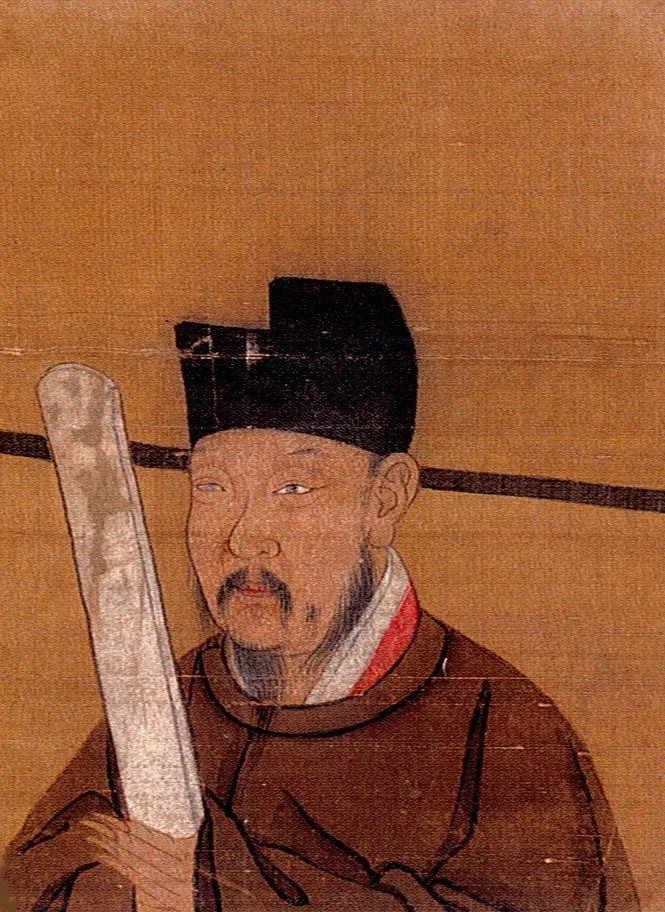
Biography
Family Background and Early Life
Yan Shu was born in 991, the second year of the Chunhua era of Emperor Taizong of Song, in Linchuan County, Fuzhou, Jiangnan West Circuit. His family was not one of the most prominent aristocratic houses but had lived in Jiangxi for generations and belonged to the local gentry. His great-great-grandfather Yan Yong (835–891), great-grandfather Yan Yanchang (860–926), grandfather Yan Gao (890–971), and father Yan Gu (945–1017) did not attain high office at court.
Yan Shu displayed exceptional intelligence from childhood and was already able to write at the age of seven, becoming locally known as a “child prodigy.” Zhang Zhibai, the Jiangnan judicial and pacification commissioner, heard of his reputation and recommended him to the court in 1004. The following year Yan sat the palace examination together with more than a thousand jinshi candidates. He remained composed and completed his composition rapidly, winning Emperor Zhenzong’s approval and receiving equivalent jinshi status. Chancellor Kou Zhun attempted to disparage him on the ground that “Yan is a man from beyond the Yangtze,” but Zhenzong replied, “Was Zhang Jiuling not also from beyond the Yangtze?” showing the emperor’s esteem for him.
During a subsequent examination in poetry, fu, and policy essays, Yan memorialized: “this matter has always been a subject of the palace examinations, and I beg you to question me on another topic。” Zhenzong admired his refusal to take advantage of prior preparation, repeatedly praised him, promoted him to Corrector in the Palace Library, and kept him in the palace library for study. When the emperor later learned that Yan’s poverty prevented him from joining banquets and excursions with his colleagues, he valued his honesty still more and increasingly favored him.
Career under Emperor Zhenzong
In 1006 Yan was summoned for examination in the Secretariat and promoted to Ceremonial Usher in the Court of Imperial Sacrifices. In 1008, during Zhenzong’s eastern ritual journey to Mount Tai, he was promoted to Assistant Director of the Court of Imperial Entertainments and then served as Collator in the Jixian Institute. When his father died, he returned to Linchuan for mourning. Before the mourning period was complete, however, he was recalled to office and accompanied Zhenzong to sacrifice at the Taiqing Palace. He was then ordered to help compile the imperial instructions and concurrently served in the Court of Imperial Sacrifices. His mother died soon afterward; his request to complete the full mourning period before resuming office was denied. He later became Assistant Director in the Court of Imperial Sacrifices, Left Remonstrator, and Direct Official of the Historiography Institute.
In 1018 Zhenzong’s sixth son Zhao Shouyi was made Prince of Sheng, and Yan was chosen as secretary in the prince’s household while continuing as Left Remonstrator and Direct Official of the Historiography Institute. In the ninth month Zhao Shouyi was named heir apparent and renamed Zhao Zhen. Yan was promoted to Vice Director of Revenue and concurrently Palace Secretary to the Heir Apparent, receiving the privilege of gold and purple. He later served as Drafter of Imperial Edicts and supervisor of the Jixian Institute, then as Hanlin Academician, an official of Jingling Palace, Left Assistant to the Heir Apparent, supervisor of the Court of Imperial Sacrifices, and head of the Office of Ritual Ceremonies.
Zhenzong trusted Yan deeply. Whenever he sought Yan’s opinion, he wrote his question in tiny characters on a small slip of paper. Yan wrote his response and sealed it together with the original note before returning it. The emperor greatly appreciated this care and discretion.
Rise and Setbacks under Emperor Renzong
In 1022 Emperor Zhenzong died and Zhao Zhen succeeded as Emperor Renzong. Because Renzong was young, his adoptive mother Empress Dowager Liu governed. Chancellor Ding Wei and Military Affairs Commissioner Cao Liyong each sought to monopolize power, and court debate was intense. Yan proposed that when officials presented matters to the empress dowager, she should listen from behind a curtain so that none of them saw her directly. The arrangement helped stabilize the early regency. Yan was subsequently promoted to Right Remonstrance Official and Hanlin Reader-in-waiting. Since Empress Dowager Liu regarded him as an old official from the heir apparent’s household, she additionally appointed him Supervising Secretary, deputy official of Jingling Palace, and adjudicator of personnel selection. He later participated in compiling the *Veritable Records of Emperor Zhenzong*, lectured to Renzong on the *Book of Changes* in Chongzheng Hall, rose to Vice Minister of Rites and head of the Bureau for the Review of Officials, and was later appointed Deputy Military Affairs Commissioner.
In 1027 Yan memorialized against appointing the favored Zhang Qi as Military Affairs Commissioner, thereby opposing Empress Dowager Liu’s wishes. He had also once angrily struck an attendant with his court tablet at Yuqing Palace and broken the man’s tooth. After impeachment by the censors, Yan, then Vice Minister of Justice, was demoted to govern Xuanzhou. A few months later he was transferred to Yingtian Prefecture. There he vigorously promoted education and invited Fan Zhongyan to lecture, inaugurating an official revival of schooling after the Five Dynasties period.
Yan was later recalled to court as Censor-in-chief while concurrently Vice Minister of Justice. In the second month of 1029 he was appointed Vice Minister of Military Affairs, Academician of the Zizheng Hall, Hanlin Reader-in-waiting, and Director of the Palace Library, and Renzong granted him embroidered ceremonial dress as a mark of favor. In 1030 he presided over the Ministry of Rites examinations. In 1031 he became Finance Commissioner and later served a second term as Deputy Military Affairs Commissioner. In 1032 he was appointed Assistant Grand Councilor and additionally Left Vice Director of the Department of State Affairs.
In 1033 Empress Dowager Liu wished to visit the ancestral temple in imperial sacrificial robes. When she asked Yan for his opinion, he cited the section on empresses’ dress in the *Rites of Zhou* to remonstrate. She died in the third month and Renzong assumed direct rule. Earlier, Yan had been ordered to compose the tomb inscription for Renzong’s biological mother, Consort Chen Li, but the text said only that she had borne a daughter who died young. When Renzong learned the truth about his parentage, he produced Yan’s inscription and wanted to hold him responsible. Although Chancellor Lü Yijian interceded, Yan was still sent out as Minister of Rites and governor of Jiangning, soon transferred to Bozhou, and later to Chenzhou while retaining the title of Minister of Justice.
Chancellorship and Later Years
Yan was later recalled and became Minister of Justice and Censor-in-chief, then served a second term as Finance Commissioner. In 1038, after the Tangut ruler Li Yuanhao proclaimed himself emperor and founded Western Xia, the northwest frontier entered a crisis. Yan analyzed the situation and submitted four major proposals for strengthening the military: abolish eunuch army supervisors so commanders could decide military matters themselves; recruit and train archers; release accumulated palace wealth to support frontier military expenditure; and recover resources appropriated by government offices to replenish the treasury. Emperor Renzong adopted all four.
In 1040 Yan was placed in charge of the Bureau of Military Affairs and in the ninth month was additionally granted the honorific title Acting Grand Preceptor, formally becoming Military Affairs Commissioner. In the third month of 1042, while serving as Minister of Justice, Grand Academician of the Jixian Hall, and Military Affairs Commissioner, he was additionally appointed Participant in Determining Government Matters and formally entered the chancellorship.
In the ninth month of 1044 remonstrance officials Sun Fu and Cai Xiang impeached him. The accusations included the old Consort Chen Li epitaph affair, use of government soldiers to repair his private residence, and excessive weakness toward Western Xia. He was sent out as Minister of Works and governor of Yingzhou. Thereafter he successively governed Chenzhou and Xuzhou while holding the titles of Minister of Rites and Minister of Justice. At the age of sixty, as Minister of Revenue and Grand Academician of the Guanwen Hall, he became military commissioner of Yongxing Command, present-day Xi'an, and served as regional commander and pacification commissioner. He later governed Henan Prefecture and concurrently served as Western Capital Regent, then became Minister of Military Affairs. His honorific rank rose to Commander Unequalled in Honor and Supreme Pillar of State, and he was enfeoffed as Duke of Linzi.
In the sixth month of 1054, Yan asked to return to Kaifeng for medical treatment and proposed resuming an outside posting after recovery. Renzong instead retained him in the capital to lecture and explain the classics, allowing him an audience every five days and continuing to treat him with the ceremonial status of a chancellor. On the twenty-eighth day of the first month of 1055, Yan died at the age of sixty-five. Renzong suspended court for two days, posthumously granted him the offices of Minister over the Masses and Attendant, bestowed the posthumous name Yuanxian, and personally wrote the four characters “Model of Old Learning” for the head of his memorial stele.
Yan Shu could write prose at seven, and in 1004 Zhang Zhibai, pacification commissioner of Jiangnan, recommended him to court as a prodigy. The next year he sat the palace examination with more than a thousand candidates, showed no fear, finished his paper at a stroke and was granted the status of a presented scholar. When the chancellor Kou Zhun objected that Yan Shu was a man from beyond the river, Emperor Zhenzong answered that Zhang Jiuling had not been a man of the inner provinces either. Two days later, retested in poetry, rhapsody and discourse, Yan Shu said he had privately practiced that rhapsody and asked for another topic; the emperor loved his honesty, made him a proofreader of the Secretariat and had him read in the imperial library. In 1008 he was advanced for the eastern sacrifice to the bureau of ceremonials and the institute of worthies; thereafter he was recalled from mourning for his father at Linchuan and his request to complete mourning for his mother was refused. He served as assistant in the court of sacrifices, left remonstrator and diarist, and was chosen as recorder for the household of the Prince of Sheng, rising within a year to vice director of the revenue ministry, household attendant of the heir apparent, drafter of edicts, and in time Hanlin academician. Zhenzong would send him questions written small on a scrap of paper, and Yan Shu returned his answers with the original scrap enclosed, a discretion the emperor prized.
On Zhenzong's death in 1022 the young Renzong succeeded, and when the chancellor Ding Wei and the privy commissioner Cao Liyong each sought to report to the empress dowager alone, with no one daring to decide, Yan Shu proposed that she hear memorials from behind a screen with no private audiences, and the matter was settled. He rose to right remonstrator and academician of the lectern, helped compile the veritable records of Zhenzong and became vice commissioner of the privy council. He then memorialized against Zhang Qi's appointment as privy commissioner, offending the empress dowager Liu, and when on a visit to the Yuxing Zhaoying Palace he struck out a follower's tooth with his tablet in anger, the censors impeached him; in 1027 he was sent out as administrator of Xuanzhou and a few months later of Yingtianfu. There he invited Fan Zhongyan to teach the students and greatly promoted schooling; the *History of Song* says that with the schools of the realm ruined since the Five Dynasties, public education began again with him. Recalled in 1029 as censor-in-chief and made vice minister of war, academician of the Hall of Governance and imperial lecturer, he received a special embroidered saddle from Renzong, presided over the 1030 examinations of the Board of Rites, became finance commissioner and then vice privy commissioner, and was made assistant administrator of state affairs without taking up the privy post.
In 1033, when the empress dowager Liu was to visit the ancestral temple and some proposed she wear the imperial sacrificial robe, Yan Shu cited the *Offices of Zhou* on the empress's dress to dissuade her. She died that third month and Renzong took power; Yan Shu was then sent out to Jiangning, Bozhou and Chenzhou because the tomb inscription he had drafted for the emperor's birth mother, Lady Li, had said nothing of her having borne the emperor. In 1038, when the Tangut chief declared himself emperor and fighting spread into Shaanxi, Yan Shu set out four measures: to withdraw eunuch supervisors so that commanders could decide attack and defense; to recruit and train archers; to release treasure long stored in the palace to support the frontier; and to recover goods misappropriated by the bureaus for the treasury — all of which the emperor carried out. In 1040 he became director of the privy council and privy commissioner, and in 1042, as minister of justice and privy commissioner, was made concurrently a chancellor. In 1044 remonstrators secured his removal, and he was reduced to minister of works and sent to Yingzhou, then Chenzhou and Xuzhou, and later to Yongxingjun and Henanfu, rising to the rank of opened office of the three excellencies, pillar of state, and Duke of Linzi. In 1054 illness brought him back to the capital for treatment; Renzong kept him at the lectern with an audience every fifth day and the escort of a chancellor, and he died in the first month of the next year at sixty-five, honored as grand tutor and palace attendant with the posthumous name Yuanxian; Renzong attended the mourning in person, regretted not having visited him in his illness, suspended court for two days and inscribed his stele "the stone of an old teacher."
Yan Shu was known for promoting talent: Fan Zhongyan and Kong Daofu came from his school, and Fu Bi and Yang Cha were his sons-in-law. The *History of Song* says he loved worthies and, as chancellor, pressed all the harder to advance them, so that Fan Zhongyan, Han Qi and Fu Bi were employed and the bureaus filled with men of the time. As a local official he valued academies: the Yingtianfu academy, also called Suiyang, ranked with the White Deer Grotto, Shigu and Yuelu among the four great academies of the early Song, and as chancellor in 1043 he joined Fan Zhongyan in urging schools in every prefecture and county with reformed curricula and professors, from the capital to the districts, the beginning of the great expansion of Song schooling. A student to old age, he wrote above all in the lyric, and the *Zhuyu* collection, following Feng Yansi of the Southern Tang while shedding the perfumed style of the *Huajian* school, made him one of the founders of the Northern Song lyric of delicate restraint; lines such as "flowers fall, and there is nothing to be done; swallows return, as if we had met before" and "last night the west wind withered the green trees; alone I climb the high tower and gaze to the end of the earth" were long remembered, the latter cited by Wang Guowei as the first of the three stages of great achievement. The *History of Song* calls him upright and plain, frugal in his habits, a good judge of men, and rich and ornate in writing, especially skilled in poetry with a leisurely and thoughtful air, and judges that among his contemporaries, tireless in promoting and delighting in good men, he was the finest.