Humble Birth
Born into an impoverished farming household in Xihe; manifested physical strength and exceptional horse-archery skills.
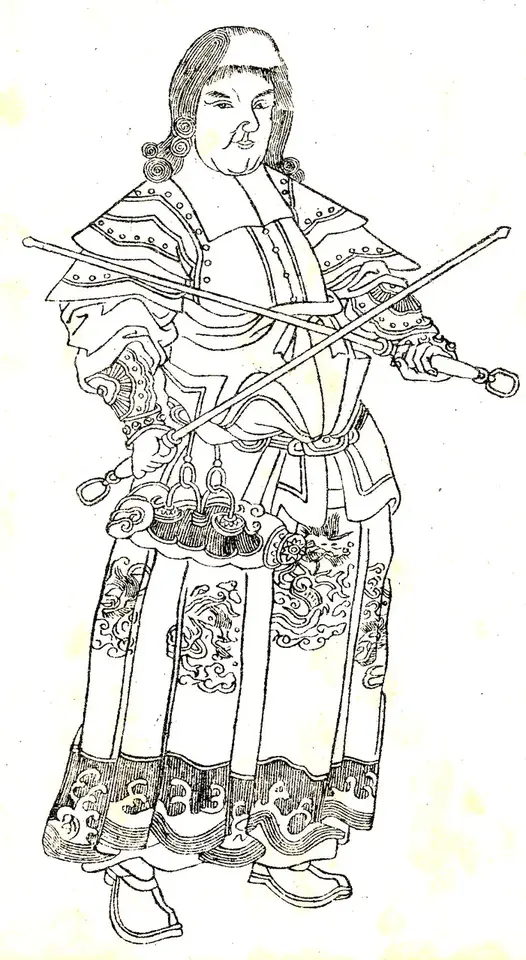
1008 CE–1057 CE
狄青
Di Qing (1008–1057 AD), courtesy name Hanchen, was a native of Xihe, Fenzhou (present-day Fenyang, Shanxi Province). He was an illustrious military supreme commander and national hero of the Northern Song Dynasty. Rising from the common ranks to become Commissioner of the Bureau of Military Affairs and Military Commissioner of Zhanghua, he was posthumously honored as Director of the Chancellery with the title "Wuxiang".…
Di Qing (1008–1057 AD), courtesy name Hanchen, was a native of Xihe, Fenzhou (present-day Fenyang, Shanxi Province). He was an illustrious military supreme commander and national hero of the Northern Song Dynasty. Rising from the common ranks to become Commissioner of the Bureau of Military Affairs and Military Commissioner of Zhanghua, he was posthumously honored as Director of the Chancellery with the title "Wuxiang". Enduring facial tattooing upon enlistment in his youth and proudly keeping the marks throughout his ministerial career, he was celebrated across the empire as "The Tattooed General". Born into rural poverty, Di took punishment for his elder brother at sixteen, receiving face tattoos and being banished to the penal imperial cavalry. During the Baoyuan era, when Western Xia declared independence, Di served as Post Officer in Yanzhou, participating in twenty-five bitter engagements. In battle, he routinely unfastened his hair, donned a terrifying bronze mask, and charged solo into the enemy center, striking terror into nomadic forces. The eminent statesman Fan Zhongyan recognized his strategic potential, presenting him with the Zuo Zhuan and encouraging him to study classical statecraft, transforming Di into an erudite field marshal. In 1052 AD, when Nong Zhigao rebelled and swept across Lingnan, Di volunteered to lead the southern expedition. On the night of the Lantern Festival in 1053 AD, Di feigned wine banquets to deceive rebel scouts, marching his cavalry secretly through blinding rain and fog to take the impregnable Kunlun Pass by surprise. At the climactic Battle of Guirenpu, he enveloped the rebel host with heavy cavalry, annihilating the insurrection within months. Rewarded with appointment as Commissioner of the Bureau of Military Affairs, Di became a rare commoner-soldier to attain the pinnacle of imperial defense. However, Song civil supremacy culture generated intense paranoia among civil bureaucrats. Beset by slanders from Chancellor Wen Yanbo and imperial censors, he was dismissed to Chenzhou in 1056 AD and died of illness and anxiety a year later at age fifty. Di remains a legendary exemplar of martial valor and Confucian loyalty.
Born into an impoverished farming household in Xihe; manifested physical strength and exceptional horse-archery skills.
Took punishment for his brother's brawl at sixteen; face tattooed and banished into the palace cavalry regiments.
Fought Western Xia forces at Yanzhou; charged with hair loose and wearing a bronze mask, slaying enemy generals.
Handed the Zuo Zhuan by Commissioner Fan Zhongyan, devoting himself to historical statecraft and military strategy.
Volunteered to command the southern expedition against Nong Zhigao's Lingnan rebellion, restoring iron discipline.
Stormed Kunlun Pass by night during the Lantern Festival; annihilated the rebels at Guirenpu to pacify Lingnan.
Appointed Commissioner of the Bureau of Military Affairs, breaking civil monopoly over supreme military leadership.
Targeted by Chancellor Wen Yanbo and imperial censors fearful of martial influence; demoted to Prefect of Chenzhou.
Died of anxiety and ulcers at age fifty; Emperor Renzong mourned bitterly, awarding posthumous rank as Director of the Chancellery.
Di Qing was born into an impoverished agrarian family in Xihe, Fenzhou. When Di was sixteen years old, his elder brother Di Su became embroiled in a violent altercation with village peers. Under Song penal law, the culprit was sentenced to facial tattooing and military exile. Bound by deep fraternal devotion, Di Qing stepped forward to confess to the offense in his brother's stead. The magistrate had his cheeks branded with permanent black ink tattoos and enrolled him as a penal recruit in the imperial capital cavalry.
Stationed in Kaifeng, Di served as a palace cavalier. Tall, muscular, and quiet of demeanor, he practiced horse archery until he could shoot arrows through the square holes of copper coins from a galloping steed using either hand. His extraordinary martial proficiency and disciplined conduct earned him rapid promotion to junior squad leader.
In 1038 AD, Tangut chieftain Li Yuanhao declared himself Emperor of Western Xia and broke with Song, launching destructive assaults across the northwestern frontiers. The thirty-year-old Di was promoted to Post Officer of Yanzhou, stationed along the frontline defense network of Shaanxi. Over the next four years, serving under commissioners Han Qi and Fan Zhongyan, Di engaged in twenty-five pitched battles against the Tangut Iron Sparrow heavy cavalry.
Before every assault, Di loosed his long black hair across his shoulders, tied a terrifying bronze mask featuring snarling fangs over his face, and charged solo into the dense enemy ranks wielding a heavy spear. Bewildered by what appeared to be an immortal demon descending from the clouds, Tangut ranks panicked and scattered. Though wounded numerous times by arrows, Di refused to leave the field. In the battle of Anyuan Fort, heavily bandaged, he spearheaded the counter-attack, capturing dozens of fortified Tangut encampments and decapitating thousands of enemy warriors. Tangut forces dreaded his presence, referring to him as the "God with the Bronze Face".
Observing the northwestern operations, Regional Commissioners Fan Zhongyan and Han Qi noticed that while other officers avoided battle, Di's units were impeccably disciplined and fearless. Fan summoned Di to his command headquarters. Pointing to a copy of the Zuo Zhuan upon his desk, Fan admonished him: "If a general does not master ancient history and grand strategy, relying merely upon individual physical courage, he will never rise above a petty squad commander!" Fan presented the classical volume to Di as a personal gift.
Profoundly moved, Di immersed himself in the Confucian classics, the Zuo Zhuan, and ancient treatises on warfare, studying by candle-light after long hours in the saddle. Within several years, he mastered historical battle arrays, transforming himself from an individual brawler into a cultured strategist of panoramic vision. Later, when Emperor Renzong granted him an imperial audience, observing the dark criminal tattoos upon Di's face, the emperor sympathetically urged him to use court medicinal ointments to dissolve the marks. Di knelt and declined with profound humility: "Your Majesty did not despise my humble penal origins and elevated me to high command. That I achieved modest deeds is entirely due to these tattoos inspiring my troops! I desire to keep them so every common soldier knows the throne does not discard humble men!" Renzong was deeply touched by his noble character.
In the fifth month of 1052 AD, Nong Zhigao, chieftain of the indigenous Zhuang communities of Guangyuan, revolted against Song authority. Seizing Yongzhou (present-day Nanning, Guangxi), Nong proclaimed himself Emperor of the Great South. His riverine forces swept down the Yu River, taking nine commanderies and besieging Guangzhou for fifty-seven days. Imperial relief detachments were repeatedly ambushed and annihilated.
Confronted with the southern crisis, Di, then serving as Vice Commissioner of the Bureau of Military Affairs, submitted a memorial requesting frontline deployment: "I rose from the humble ranks and possess no skill except archery and warfare. I request ten thousand cavalry to march south and deliver Nong Zhigao's head to the palace!" Emperor Renzong appointed Di as Supreme Field Commander of the Southern Expedition. Arriving at Binzhou in early 1053 AD, Di discovered that previous defeats stemmed from lack of coordination. He immediately executed thirty-one insubordinate officers, including Garrison Commander Chen Shu, instilling iron discipline across the entire force.
Nong Zhigao fortified the precipitous mountain bastion of Kunlun Pass, believing its sheer cliffs were impassable. Di utilized tactical misdirection: upon reaching the front, he ordered his troops to halt and construct defensive stockades, announcing a grand three-day banquet to celebrate the Lantern Festival. On the nights of the fourteenth and fifteenth of the first lunar month, Di hosted extravagant banquets, keeping lanterns ablaze and music playing throughout the night. Rebel scouts reported that the Song army was absorbed in hedonistic revelry.
On the evening of the sixteenth, Di feigned illness and retired early to his tent. In total secrecy, Di had assembled his elite cavalry. Cloaked by torrential night rains and dense river fog, Di led his cavalry through uncharted mountain defiles, scaling vertical ravines on foot and capturing the summit of Kunlun Pass before dawn. When the morning mist cleared, rebel defenders saw Song imperial banners fluttering over the battlements and fled in sheer terror.
At the subsequent Battle of Guirenpu outside the pass, Nong Zhigao deployed his elite spearmen in dense defensive squares. Di unleashed his heavy cavalry around both flanks, supported by devastating volleys from Song divine-arm crossbows. The pincers closed, slaughtering thousands of rebel warriors and killing rebel commanders. Nong Zhigao set fire to Yongzhou and fled into Dali. Within months, the catastrophic Lingnan rebellion was completely pacified.
In the sixth month of 1053 AD, Di returned to Kaifeng in triumph. In recognition of his southern victory, Emperor Renzong elevated Di to Commissioner of the Bureau of Military Affairs, the supreme office in imperial defense. In an empire founded upon the institutional doctrine of "elevating civil culture while repressing the military", the promotion of a tattooed soldier to supreme ministerial rank ignited intense anxiety across the civil bureaucracy.
Throughout his four years directing the military bureau, Di was humble, discreet, and unfailingly polite, avoiding all ostentation. Yet senior civil ministers, led by Chancellor Wen Yanbo and imperial censors Ouyang Xiu and Liu Chang, subjected him to relentless surveillance. Censors submitted absurd memorials claiming that "red light appeared above Di Qing's roof" and that "his charger was growing dragon scales", even blaming summer floods upon a military officer holding executive office. Wen Yanbo urged Emperor Renzong to remove Di, citing the founding emperor's rise as a loyal general who ultimately seized power. When Di confronted Wen Yanbo to ask what crime he had committed, Wen replied with chilling detachment: "No crime at all; merely that you are a military man, and the court cannot help but suspect you!"
In 1056 AD, Emperor Renzong succumbed to bureaucratic pressure, removing Di from the Bureau of Military Affairs and exiling him to serve as Prefect of Chenzhou. In Chenzhou, the imperial court dispatched imperial messengers every fortnight under the pretext of extending greetings, keeping his household under suffocating surveillance. Tormented by constant dread, Di's health collapsed. In the third month of 1057 AD, Di passed away in his official quarters at age fifty. Emperor Renzong wept uncontrollably, suspended court assemblies, and bestowed posthumous honors as Director of the Chancellery. Emperor Shenzong later hung Di's portrait in the inner palace, mourning that the realm possessed no general of his peerless stature.
At age sixteen, Di Qing voluntarily took responsibility for his brother's village brawl, accepting facial tattooing and military conscription.
Serving for four years against Western Xia, he fought twenty-five battles wearing a bronze mask and loose hair, suffering eight arrow wounds.
Encouraged by Fan Zhongyan and Han Qi to study the Zuo Zhuan, he mastered classical military strategy and historical statecraft.
In 1053 AD, he used three nights of Lantern Festival banquets to mask a night march through mountain rain and seize Kunlun Pass.
Deploying cavalry flanking maneuvers at Guirenpu, he crushed Nong Zhigao's main force and pacified the Lingnan rebellion.
Elevated to Commissioner of the Bureau of Military Affairs, he was later transferred to Chenzhou due to civil bureaucratic suspicion and died in 1057 AD.
FIGURES ASSOCIATED WITH THIS DYNASTY