Birth | Born in the Hetu Ala area of the Jianzhou Left Guard; his father was Taksi and his mother was of the Hitara clan.
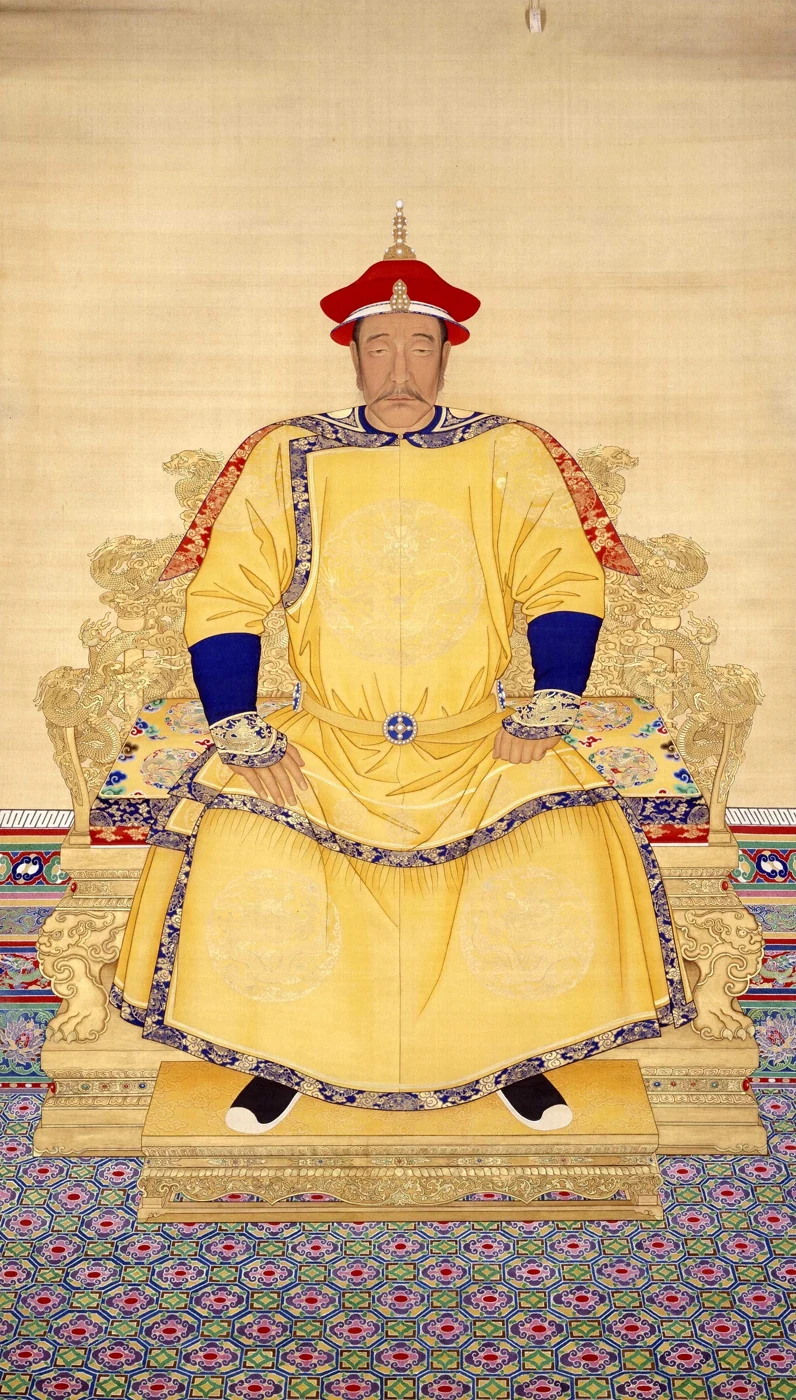
1559 CE–1626 CE
Khan of the Later Jinfounder of the regime
Aisin Gioro Nurhaci
爱新觉罗·努尔哈赤
Aisin Gioro Nurhaci (1559–1626) was a Jurchen leader in the late Ming period and Great Khan of Later Jin, and was later honored as Emperor Taizu of Qing. His father Taksi and grandfather Giocangga were killed amid the Ming attack on Gure fortress in 1583(11th year of the Wanli reign). Nurhaci subsequently rose in arms with inherited armor and followers, gradually unifying the Jianzhou Jurchens while conquering or accepting…
1559 CE–1626 CEMing Dynasty
PROFILE
Aisin Gioro Nurhaci (1559–1626) was a Jurchen leader in the late Ming period and Great Khan of Later Jin, and was later honored as Emperor Taizu of Qing. His father Taksi and grandfather Giocangga were killed amid the Ming attack on Gure fortress in 1583(11th year of the Wanli reign). Nurhaci subsequently rose in arms with inherited armor and followers, gradually unifying the Jianzhou Jurchens while conquering or accepting the submission of Haixi and East Sea Jurchen groups. For several decades after taking up arms, he continued to accept offices conferred by the Ming Dynasty and accumulated resources through tribute and frontier trade. In 1616(44th year of the Wanli reign), he founded the Later Jin at Hetu Ala and adopted the era name Tianming. Later Jin then openly broke with the Ming Dynasty. Nurhaci won the Battle of Sarhu and captured a number of cities in Liaodong; in 1622 he captured Guangning and advanced farther west. His attack on Ningyuan failed in 1626(11th year of Tianming), and he died later that year. The Eight Banners, administrative and deliberative institutions, and systems for managing agriculture, commerce, the military, and local populations that developed under his rule formed important components of Later Jin state building; these measures also accompanied wars of conquest, coercive population control, and social conflict.
- Other Names
- Emperor Taizu of Qing; Nurhaci
- Era
- Late Ming and Later Jin period
- Dynasty/Regime
- Later Jin
- Identity
- Khan of the Later Jin; founder of the regime
- Date of Birth
- 1559 CE(38th year of the Jiajing era, Ming)
- Date of Death
- September 30, 1626 CE(11th year of the Houjintianming era, 8th month, 11th day)
- Ethnicity
- Jurchen (later incorporated into the Manchu identity)
- Clan
- Aisin Gioro clan
- Ancestral Home
- Not reliably confirmed in historical sources
- Place of Birth
- Hetu Ala area of the Suksuhu River branch of the Jianzhou Left Guard, present-day Xinbin Manchu Autonomous County, Liaoning
- Reign
- 1616–1626 (Khan of the Later Jin)
- Successor
- Aisin Gioro Hong Taiji (eighth son)
- Predecessor
- Not applicable (founding khan of the Later Jin)
- Era Name
- Tianming
- Temple Name
- Taizu
- Posthumous Name
- Not reliably recorded in historical sources
- Major Achievement
- Founder of the Later Jin, unifier of the Jurchen groups, victor at Sarhu, and founder of the political base from which the Qing emerged.
- Other names
- Nurhaci; "Old Khan" (popular appellation); Emperor Taizu of Qing (posthumous honorific)
- Period
- Late Ming Dynasty and early Later Jin
- Dynasty/polity
- Jianzhou Left Guard of the Ming Dynasty; Later Jin
- Ethnicity/people
- Jurchen (later known as Manchu); terminology varies according to historical context
- Native affiliation
- Suksuhu River tribe of the Jianzhou Left Guard
- Place of birth
- Hetu Ala (in the area of present-day Yongling Town, Xinbin Manchu Autonomous County, Liaoning Province)
- Place of death
- Aijibao (in the area of present-day Shenyang, Liaoning Province; sources differ on the exact location)
- Era name
- Tianming
- Temple name
- Taizu (posthumously conferred)
- Posthumous Title
- Initially Emperor Wu, later repeatedly augmented; in the Qing Dynasty the settled form was Emperor Taizu Gao
- Mausoleum
- Fu Mausoleum (Shenyang)
- Highest office
- Assistant Commissioner-in-Chief of the Jianzhou Guard under the Ming; Great Khan of Later Jin
- Ming title
- Dragon-Tiger General
- Khan title
- Yingming Khan (full title: Chengfeng Tianming Yangyu Lieguo Yingming Khan)
- Age at death
- Approximately 68 (calculated from the birth and death years)
- Major achievements
- Unified the Jianzhou Jurchens and expanded into the Haixi and East Sea Jurchen groups; founded Later Jin; consolidated the niru organization and established the Eight Banners; ordered the creation of the Manchu script; defeated Ming forces at the Battle of Sarhu; advanced Later Jin expansion into the Liaodong–Shenyang region
LIFE TIMELINE
Rising in arms | After his father and grandfather were killed amid the Ming attack on Gure fortress, Nurhaci rose in arms with inherited armor and followers and attacked Nikan Wailan.
Establishment of an initial governing order | Built Fe Ala and issued prohibitions, beginning to "establish the affairs of state."
Jianzhou expansion | Solgo, Hohori, Hūrhan, and others led their followers in submitting to Nurhaci, and the principal Jianzhou Jurchen groups were gradually consolidated.
Ming appointment | Received the office of Assistant Commissioner-in-Chief and continued to interact as a frontier-guard official of the Ming Dynasty.
Battle of Gure Mountain | Defeated a nine-tribe coalition including Yehe and captured Bujantai, expanding his influence among the Jurchen groups.
Appointment as Dragon-Tiger General | The Ming court conferred the title Dragon-Tiger General; Nurhaci continued to maintain tributary relations.
Institutional and script development | Ordered Erdeni and others to use the Mongolian alphabet to write the Jurchen language, creating the unpointed Manchu script.
Organization into niru | Organized his followers into niru, which became the basis of the later Eight Banners organization for military administration.
Move to Hetu Ala | Moved his political center to Hetu Ala.
Annexation of Hoifa | Destroyed the Hoifa group and continued to expand his power.
Annexation of Ula | Defeated Ula and incorporated its people.
Establishment of the Eight Banners and deliberative offices | Formally established the Eight Banners and appointed the Five Councilors for Administration and Adjudication, together with jargūci and other offices.
Establishment of Later Jin | Proclaimed himself khan at Hetu Ala, established a state called Jin, and adopted the era name Tianming.
War against the Ming | Issued the "Seven Grievances" and attacked Fushun and other places.
Battle of Sarhu | Concentrated his forces to defeat separate advancing Ming armies; also annexed Yehe that year.
Occupation of Shenyang and Liaoyang and transfer of the capital to Liaoyang | Later Jin captured Shenyang and Liaoyang, moved its capital to Liaoyang, and began directly governing large numbers of people in Liaodong.
Capture of Guangning | Later Jin forces advanced on Guangning amid discord in the Ming Liaodong command; Ming forces withdrew, extending Later Jin control westward
Co-governance arrangement | Issued an edict establishing joint deliberation of state affairs by the Eight Hošoi Beile.
CE(3rd year of the Tianming era, the Later Jin; 46th year of the
1618 CE(3rd year of the Tianming era, the Later Jin; 46th year of the Wanli era, Ming) | Transfer of the capital to Shenyang | The political center of Later Jin moved to Shenyang.
CE(4th year of the Tianming era, the Later Jin; 47th year of the
1619 CE(4th year of the Tianming era, the Later Jin; 47th year of the Wanli era, Ming) | Battle of Ningyuan | Withdrew after failing to take Ningyuan in the first lunar month.
Final campaign | Led an expedition against the Inner Khalkha in the fourth lunar month and defeated them; this was the last military campaign of his life.
CE(6th year of the Tianming era, the Later Jin; 1st year of the T
1621 CE(6th year of the Tianming era, the Later Jin; 1st year of the Tianqi era, Ming) | Death | Died at Aijibao on the 11th day of the eighth lunar month; the beile deliberated over the succession.
CE(7th year of the Tianming era, the Later Jin; 2nd year of the T
1622 CE(7th year of the Tianming era, the Later Jin; 2nd year of the Tianqi era, Ming) | In 1622(7th year of Tianming) | In 1622(7th year of Tianming), personnel were also assigned specifically to adjudication, granaries and household management, frontier reconnaissance, weapons, and military horses.
CE(7th year of the Tianming era, the Later Jin; 2nd year of the T
1622 CE(7th year of the Tianming era, the Later Jin; 2nd year of the Tianqi era, Ming) | In 1622(7th year of Tianming) | In 1622(7th year of Tianming), personnel were also assigned specifically to adjudication, granaries and household management, frontier reconnaissance, weapons, and military horses.
CE(10th year of the Tianming era, the Later Jin; 5th year of the
1625 CE(10th year of the Tianming era, the Later Jin; 5th year of the Tianqi era, Ming) | In 1625(10th year of Tianming) | In 1625(10th year of Tianming), Nurhaci moved the capital to Shenyang, which became the new political center of Later Jin.
CE(11th year of the Tianming era, the Later Jin; 6th year of the
1626 CE(11th year of the Tianming era, the Later Jin; 6th year of the Tianqi era, Ming) | In the first lunar month of 1626(11th year of Tianming) | In the first lunar month of 1626(11th year of Tianming), Nurhaci led an attack on Ningyuan, where Ming forces under Yuan Chonghuan defended the city using European-style cannon.
CE(11th year of the Tianming era, the Later Jin; 6th year of the
1626 CE(11th year of the Tianming era, the Later Jin; 6th year of the Tianqi era, Ming) | In the first lunar month of 1626(11th year of Tianming) | In the first lunar month of 1626(11th year of Tianming), Nurhaci led an attack on Ningyuan, where Ming forces under Yuan Chonghuan defended the city using European-style cannon.
CE(11th year of the Tianming era, the Later Jin; 6th year of the
1626 CE(11th year of the Tianming era, the Later Jin; 6th year of the Tianqi era, Ming) | Death | In the first lunar month of 1626(11th year of Tianming), Nurhaci led an attack on Ningyuan, where Ming forces under Yuan Chonghuan defended the city using European-style cannon.
BIOGRAPHY
Biography
Family Background and Early Life
Nurhaci was born at Hetu Ala in the Suksuhu River tribe of the Jianzhou Left Guard. His father Taksi was a son of Giocangga, and his mother was of the Hitara clan. Later Qing genealogical sources trace the Aisin Gioro lineage back to Möngke Temür and earlier ancestors. Qing texts also preserve ancestral legends such as the story of a heavenly maiden swallowing a red fruit. Modern studies have proposed other accounts of the family's early genealogy, surname, and origins; such traditions should be distinguished from facts directly established by contemporary evidence. Nurhaci lost his mother when he was young; she died when he was around ten, after which he was raised by his father and family. He received little property when the household was divided when he was about nineteen and at one time supported himself by collecting forest products and trading at the Fushun horse market. Later accounts state that he had been taken in by the Ming general Li Chengliang as an attendant, but the relevant evidence is disputed and this cannot be treated as a certain episode. In his early years he formed ties with Eidu and Anfiyanggû, both of whom later became important Later Jin commanders.
The Surname, the Ancestry and Family Legends
On Nurhaci's surname the documents and the unofficial writings are so various that six readings are on record: Tong, Tung, Cui, Que, Gioro and Aisin Gioro; the Qing imperial house, taking its stand on myth, held that the surname Aisin Gioro was given from heaven. Ming and Korean sources mostly give Tong or Tung: Sin Chung-il's Record of the Journey to Jianzhou notes that in the first month of 1596 Nurhaci's reply to the king of Korea styled him "Tong Nurhaci, master of the Jurchen of the Jianzhou guard of the Jurchen state," a letter he himself reviewed before it was sent, and so first-hand; Korean sources more often write the surname as "Tong" rather than "Tung." Zhang Binglin's Separate Record of the Founding of Qing mentions a view that Tong was originally a Chinese surname, later often assumed by barbarians to pass as Chinese. In fact Tung and Tong were common Jurchen surnames borrowed from the Chinese: whoever became a tribal chief and had dealings with the Ming took Tong or Tung as his surname, so that it became a kind of common surname of Jurchen chiefs. Nurhaci, as an officer of the Ming's Jianzhou guard, went to Beijing eight times in tribute, and Ming writers and scholars of the Ming-Qing transition say a great deal about his surname Tong.
According to the Veritable Records, the Qing emperors all held themselves to be surnamed Aisin Gioro, and there is a legend attached: three maidens were bathing in a pool when a sacred magpie dropped a fruit on the clothing of the third, who could not put it down and swallowed it, conceived, and bore a boy of strange appearance who could speak at birth, and who was told by the maiden that his surname was Aisin Gioro. One explanation of the surname Que, "magpie," is drawn from this, the Manchus having taken the crow and magpie as a totem; another scholar derives the surname Cui from the Korean pronunciation of Cui, between the Chinese que and chui, close to the "Gio" of Gioro. A further explanation has Nurhaci's mother swallow a bird's egg before bearing him, but the Qing did not so record it: the three Veritable Records of Taizu note only that his mother carried him thirteen months, and say nothing of a swallowed egg. As to the meaning of "Nurhaci," one reading is "wild boar skin," his brother Šurhaci being "little wild-boar skin" and Yarhaci "leopard skin," children being named for the animal skins they wore in infancy, a custom still kept in the nineteenth century among the peoples east of Lake Baikal.
Qing official genealogy traced the Aisin Gioro back to Mentemu and earlier ancestors, but this pedigree has been questioned since the fall of the Qing by Japanese and some Chinese scholars. Dun Binghe, examining the Genealogical Register of the Gioro of the Fuling, held that Nurhaci was not a descendant of the Mentemu family; molecular anthropology has conversely shown that Nurhaci's lineage and the Fuling Gioro share a paternal origin, both in the C2a1a3a2a-F14735 branch, with a common ancestor in the last years of the Yuan. Scholars infer that Nurhaci's forebears may have entered the Mentemu family by adoption or marriage and so acquired the inheritance of its line and the rule of the three Jianzhou guards. As for the story that he served Li Chengliang in his youth, the Account of the Conferment of Office on the Jianzhou Barbarians says that when Li Chengliang broke the Gule stockade Nurhaci "clung to Chengliang's horse's leg and begged to die; Chengliang pitied him and did not kill him, but kept him in his tent, sheltering him like an adopted son, and taking him to the capital whenever he went," after which Ming and Qing unofficial writings commonly call him Li Chengliang's adopted son or household retainer. Scholars using source criticism on the documents from the late Ming to the early Qing point out that the adoption story first appears in the late Ming and grows more absurd as it is repeated, and may be connected with the custom of Jurchen chiefs sending hostages to Liaodong commanders; but many scholars since Meng Sen still hold that Nurhaci served in Li Chengliang's tent in his youth, seeking thus to fill the blank between his mother's death when he was ten and his setting up his own household at nineteen.
Deaths of His Father and Grandfather and His Rising in Arms
In the early Wanli period, conflict was frequent along the Liaodong frontier. In 1574(2nd year of the Wanli reign), Ming forces defeated Wang Gao, who was sent to the Ming court and put to death; his son Atai later continued to resist the Ming Dynasty from Gure fortress. In 1583(11th year of the Wanli reign), Li Chengliang led troops against Gure fortress. Giocangga entered the fortress to rescue Atai's wife, while Taksi joined the Ming force besieging it in an effort to rescue his father; both died in the fighting. Nurhaci later petitioned Ming frontier officials, who compensated him with patents and horses but did not hand over Nikan Wailan. Nurhaci connected the deaths of his father and grandfather with Nikan Wailan. Together with leaders including Gahašan Hashū, Changshu, and Yangshu, he attacked Turun in the fifth lunar month of that year. His ally Nomiina failed to participate as agreed, and Nikan Wailan escaped; Nurhaci subsequently strengthened his position through warfare and alliances. Nurhaci rose with armor inherited from his father and grandfather and a following of several dozen people. Accounts differ: some say thirteen suits, some thirty, and some describe thirteen inherited suits supplemented by seventeen provided by allies. The figure of thirteen inherited suits later became an emblematic account of his early rise; it cannot be used to calculate the actual size of his forces.
The Early Campaigns
On the deaths of his father and grandfather the Ming documents can be set beside the Qing accounts. Around 1588 Gu Yangqian, grand coordinator of Liaodong, reporting an inquiry made under Li Chengliang, wrote that "Nurhaci is the grandson of Cangchang and the son of Tashi. In former years Cangchang and Tashi were both loyal and gave their strength for China, and first brought Wang Tai to seize Wang Gao. Afterwards Wang Gao's son Atai detained Cangchang in his stockade and ordered him to submit and join in a plot to avenge his father. Cangchang refused, and Atai would not let him go. When the great army attacked Atai, and the stockade was pressed hard, Tashi, because his father was inside, rushed in confusion to rescue him and was mixed in among the troops. Cangchang was burned to death within the stockade and Tashi was killed by our soldiers in error." The Ming afterwards recovered Tashi's body and handed it to his followers, together with "twenty commissions and twenty horses taken in the stockade," and admitted that the killing had been a mistake. Nurhaci blamed the affair on the machinations of Nikan Wailan, petitioned the Ming frontier officers, and asked that Nikan Wailan be handed over; the Ming compensated him with commissions and horses but refused to give up the man, and meant instead to build him up as chief of the Jianzhou Jurchens.
Allies in the first days were unreliable. Nurhaci enlisted Nomina of the Sarhu division and the chief of the Jiamuhu stockade to attack the city of Tulun; but Longdun, a man of Nurhaci's own clan, advised Nomina not to offend Nikan Wailan, who had Ming backing, and Nomina withdrew before the rising. Nurhaci attacked Tulun in the fifth month as planned; Nikan Wailan, unable to hold, fled to Jiaban. In the eighth month Nurhaci attacked Jiaban, and Nomina again leaked word, so that Nikan Wailan made his way to the Hekou terrace southeast of Fushun to throw himself on the Ming, who would not receive him, while Nurhaci, thinking the Ming troops had come to help Nikan Wailan, withdrew. Soon after, Nomina and his brother Naikada proposed to attack the city of Barda and invited Nurhaci to join; Nurhaci pretended to agree, asked Nomina to attack first, and when he refused, asked him to hand over his armour and weapons so that Nurhaci might attack first. Nomina, not seeing the trap, gave them up, and Nurhaci, instead of attacking the city, turned and killed the brothers.
In 1586 Nurhaci took the stockade where Nikan Wailan lived. Wounded by thirty arrows in the assault, he fought on, took the place, put to death nineteen Chinese within it and captured six men who had been hit by arrows. Nikan Wailan was not in the town and fled with his household toward the Ming. Nurhaci had the arrows in the six wounded driven deeper and sent them, arrows and all, to the Ming to demand Nikan Wailan; the Ming envoy asked him to come and deal with the matter himself, was refused, and then asked him to send a few men to receive him, whereupon Nurhaci sent Zhaisa with forty men to the Ming frontier, who killed Nikan Wailan and brought back his head.
One wounding and pardon in these years shows how he handled men. On the way back from a campaign, Sunzhaqin Guanggun of the Wanggia division asked his help against the town of Wengguoluo, and Nurhaci agreed, to make up for his failure to take Qijida. In the assault an arrow struck his head, but his helmet stopped it at a finger's depth, and he fought on wounded; then an arrow pierced the throat-piece of his mail and the blood poured from his neck, and he gave over for a time after fainting again and again. When his wound healed he pressed the siege, took the town, and pardoned Erguoni and Luoke, who had shot him in the head and neck.
In the second month of 1585 Nurhaci attacked the city of Jiefan with twenty-five armoured men and fifty soldiers, and gained nothing, the defenders being ready. On the way back, at Tailangang south of Jiefan, the lords of the four cities of Jiefan, Sarhu, Donggia and Barda came after him with four hundred horse, and Neshen and Bamuni, beaten commanders of the Maerdun stockade, pressed closest. Nurhaci turned his horse alone to meet them; Neshen cut through his whip, and Nurhaci, wheeling, struck him across the back with his sword and cut him in two, then turned and shot Bamuni dead. The pursuers, seeing their leader fall, stood still. Nurhaci himself brought up the rear, and with seven of his men hid their bodies and showed only their helmets, making a show of an ambush; the enemy, having lost their leader, wavering in spirit and fearing a trap, did not dare pursue. Beating a superior force with a handful of men was a method he used again and again in the years of unifying Jianzhou.
At the end of the fifth month of 1588 a Jurchen named Keshiwu killed Liu Fu, commander of the Chaihe fort of the Ming, and in the seventh month made his way to Nurhaci. On the Ming's demand, Nurhaci had him killed on the twenty-seventh of the tenth month and sent his head, his wife and a letter in Chinese into the Ming frontier, at the same time recounting his own services in returning thirteen Chinese, and asking for reward and promotion in his capacity as "commissioner commanding the five hundred tribute-paying Jurchens of Jianzhou." The Ming officers, Gu Yangqian among them, concluded that "Nurhaci has merit in every generation, and is not a petty barbarian risen from nothing with no title to his name," and on the precedent in the Collected Statutes that "the title of commissioner is reserved for those who can kill rebellious chiefs," recommended that he be raised to the rank of commissioner and given new commissions, so that he might "control the eastern barbarians and be a fence for us" — the Ming at first took Nurhaci for a frontier client to be built up.
Unification of the Jianzhou Jurchens
From 1584(12th year of the Wanli reign of the Ming Dynasty) to 1588(16th year of the Wanli reign), Nurhaci repeatedly attacked Jianzhou groups and their fortified settlements. Early campaigns included attacks on Zhaojia, Ma'erdun, Wengkeluo, and the Jecen group. In 1585(13th year of the Wanli reign), he repelled pursuers at Tailangang and led a small force to defeat a numerically larger coalition. After capturing the fortified settlement where Nikan Wailan was staying in 1586(14th year of the Wanli reign), Nurhaci sent Zhaisa to the Ming frontier, where Nikan Wailan was killed. In 1587(15th year of the Wanli reign), Nurhaci built Fe Ala and issued prohibitions against disorder and theft, establishing an initial legal order. In 1588(16th year of the Wanli reign), Solgo, Fiongdon, Hohori, Hūrhan, and others led followers in submitting to Nurhaci. Through military conquest, marriage alliances, and the acceptance of defectors, Nurhaci expanded his coalition, and the principal Jianzhou Jurchen groups gradually came under his control. In 1593(21st year of the Wanli reign), Yehe, Hada, Ula, Hoifa, Khorchin, and other groups formed a coalition and attacked him. Nurhaci defeated the coalition at Gure Mountain and captured Bujantai. The battle raised his standing among the Jurchen groups, but alliances and warfare continued for many years; unification was not completed by a single battle.
Annexation of Haixi and East Sea Groups and Relations with the Ming
Nurhaci continued to expand through war, marriage alliances, trade, and the acceptance of submissions. After annexing Hada in 1599(27th year of the Wanli reign), the Ming court for a time demanded that the Hada polity be restored. Nurhaci sent descendants of its ruling line back, but later incorporated its people again. He destroyed Hoifa in 1607(35th year of the Wanli reign) and Ula in 1613(41st year of the Wanli reign); warfare against Yehe continued until 1619(4th year of Tianming). He also repeatedly campaigned in or accepted submissions from the East Sea Jurchen regions, extending his influence toward the Heilongjiang and coastal areas. With Mongol groups such as Khorchin, he combined marriage alliances with frontier trade and political alliances. Nurhaci did not break with the Ming immediately after taking up arms. He inherited offices associated with the Jianzhou Left Guard, was appointed Assistant Commissioner-in-Chief in 1589(17th year of the Wanli reign) and Dragon-Tiger General in 1595(23rd year of the Wanli reign), and continued tribute and frontier trade. Ming Dynasty appointments and trade brought him political recognition and economic resources. At the same time, friction persisted over borders, the scale of tribute, the affiliation of subordinate groups, and land in Liaodong. In 1618(3rd year of Tianming), Nurhaci proclaimed the "Seven Grievances," swore an oath before Heaven, and captured Fushun, Qinghe, and other places, marking Later Jin's open war against the Ming Dynasty.
Annexation of the Haixi Groups and the War of the Nine Divisions
The Jurchen fell broadly into the Jianzhou and Haixi groups and the "wild" Jurchen of the far Amur and coastlands, who were remote and little to be feared; the four Haixi divisions — Hada, Yehe, Ula and Hoifa, also called the Hūlun — held the rich plains beyond Kaiyuan and were strong. Hada, which the Ming called the South Pass, had long been supported by the Ming and stood highest among the Jurchen divisions; Nurhaci's stepmother was a daughter of the Hada chief. Though Nurhaci married into two of the great Haixi houses, as his power grew and Jianzhou was unified the quarrel with Haixi sharpened: the Haixi could neither tolerate a new Jianzhou neighbour nor give up their place as broker between the Ming and the Jurchen.
Yehe moved first. In 1591 Nalinbulü, a lord of Yehe, sent to demand that Nurhaci cede one of two places, Elemin or Jakumu, and then joined Hada and Hoifa in sending envoys to press him; Nurhaci refused in strong terms. On the Ming side the policy of the day served his expansion: in the fourth month of 1588, after punishing Yehe by arms, the Ming arranged a marriage between Nurhaci and Hada to secure the latter and urged Hada to hand over the fugitive Zhang Hai, and Nurhaci married the granddaughter of the Hada khan. Gu Yangqian's memorial records the Ming's design — to let Daisan "marry to Nurhaci, leaning within on China and outwardly weighting himself with the marriage, so that the northern pass's schemes be laid to rest," and to reconcile the chiefs of the two passes so that "they may support Daisan, whose strength can control Nurhaci, and he may not, on the pretext of the marriage, open the quarrel of swallowing them." The Ming hoped to hold Jianzhou in check by a marriage; in the event it gave Nurhaci the standing to marry into the Haixi and meddle in their affairs.
Of Nurhaci's own skill in archery there is a vivid record from this time. In the fourth month of 1588, waiting at Dongcheng to receive Aminzheje, granddaughter of the Hada khan, he saw a horseman pass by with a bow. Learning that this was Niowengjin of the Donggo division, famed for his shooting, Nurhaci had him brought over, praised him, and pointed to a willow a hundred paces off, asking him to show his art. Niowengjin dismounted calmly and loosed five arrows: three struck and two missed, and the three that struck fell unevenly. Nurhaci then rose, set arrow to string and drew the bow to the full, loosed five arrows, and hit with every one, the five falling close together, at which those with him shouted and gave him their admiration.
The two sides at last met in war. In the sixth month of 1593 the four Haixi divisions raided the Jianzhou stockade of Hubuqa and were beaten; they then joined with the Mongol Korcin, Sibe and Gūwalca and with the two remaining Changbai divisions, Jusheri and Neyen, in a confederate army of more than thirty thousand, said to be of nine divisions, which attacked in the ninth month. Nurhaci met them coolly, first scouting their line of march and then laying an ambush in the broken country of Gure Mountain; the Yehe and the rest, not knowing the trap, marched straight into the ambush, and Nurhaci's troops burst out and broke the confederate army at a stroke. Bujai, a lord of Yehe, was killed when his horse fell, and Bujantai, lord of Ula, was taken alive; Nurhaci spared and kept him, and years later sent him back to rule Ula, planting an agent within it. The victory at Gure Mountain greatly raised Nurhaci's standing among the Jurchen, though the leagues and wars went on for years, and unity was not won in a single battle.
The fate of Hada shows how little restraint the Ming now had over him. Hada had been the Ming's client since the days of the Hada khan; when Nurhaci destroyed it the Ming intervened, and he restored Menggebulu's son in the first month of 1601, only to annex Hada again in the same year, which the Ming let pass. Swallowing Hada was a political gain and an economic one: from the annexation of 1599 he took three hundred and sixty-three of the South Pass commissions, and with them the scale of his trade and revenue from the Ming.
The wars with Ula and Yehe ran on for more than twenty years. In 1607 Cemutehei, lord of Feiyou town of the Warka division, unable to bear Ula's oppression, sent to submit to Nurhaci and prepared to bring his people over, and Nurhaci sent his eldest son Cuyen and his second son Daišan with troops to receive them, beating Ula and taking the Warka for himself. In the ninth month of the same year, having failed to obtain Bujantai, he campaigned against Yehe, broke nineteen stockades including Usu, and withdrew when the Ming sent Ma Shinan with a thousand men to Yehe's aid. Ula was destroyed in 1613, Bujantai fleeing to Yehe; and the war with Yehe lasted until the eighth month of 1619, when Nurhaci sent the four great beile, Daišan among them, by a roundabout road against the eastern town of Yehe and led the main army himself against the eastern town where Gintaisi lived; after hard fighting both towns fell and Yehe was no more. By then "from the Eastern Sea to the Liaodong frontier, from the Nen river of Mongolia in the north to the Yalu of Korea in the south, all who speak one tongue were subdued," and the unification of the Jurchen was essentially complete.
Establishment of Later Jin and Institutional Development
In 1616(44th year of the Wanli reign), Nurhaci proclaimed himself khan at Hetu Ala, founded the Jin dynasty and adopted the era name Tianming; later generations called the polity Later Jin. Its state structure was still taking shape, and its official system was not complete from the outset. Nurhaci handled government through deliberation by the beile and a system of non-royal ministers. In 1615(43rd year of the Wanli reign), he appointed the Five Councilors for Administration and Adjudication and jargūci, whose duties covered administration, justice, and military affairs. After 1620(5th year of Tianming), offices such as zongbingguan (hereditary military rank), deputy general, assistant general, guerrilla commander, defense officer, and chiliarch were established. In 1622(7th year of Tianming), personnel were also assigned specifically to adjudication, granaries and household management, frontier reconnaissance, weapons, and military horses. These institutions remained relatively rudimentary and were further adjusted under Hong Taiji. After difficulties over the appointment and removal of heirs, Nurhaci issued an edict in 1622(7th year of Tianming) providing for the Eight Hošoi Beile to deliberate jointly on political, military, economic, and judicial affairs. Arrangements such as monthly duty by the Four Senior Beile concentrated practical power in the hands of a smaller number of beile. The system provided for collective deliberation, but did not give every beile fully equal power; Nurhaci retained final authority. The Eight Banners system was based on the niru organization and combined military, administrative, and production functions. Nurhaci reorganized his people into niru in 1601(29th year of the Wanli reign) and in 1615(43rd year of the Wanli reign) formally established the Plain Yellow, Plain White, Plain Red, Plain Blue, Bordered Yellow, Bordered White, Bordered Red, and Bordered Blue Banners. The banner system combined population, military, and production organization and became a foundation of Later Jin warfare and rule. Its military structure also changed in response to battlefield conditions: Later Jin forces, initially more heavily reliant on infantry, gradually strengthened their cavalry; when confronting Ming firearms and fortified defenses, they also developed armored infantry, siege equipment, war carts, and firearm units. The surviving accounts give differing figures for troop strength and firearm allocations, so the discussion here describes the direction of military change without treating those estimates as settled statistics.
Economic, Legal, Script, and Religious Policies
Before the founding of Later Jin, Nurhaci traded forest products such as ginseng and sable pelts with the Ming Dynasty in exchange for silver, draft animals, iron tools, and other goods. Tribute rewards, trade, and resources gained through the incorporation of other groups all supported the growth of his power. Around 1599(27th year of the Wanli reign), gold and silver mining and ironworking developed; after the creation of the niru organization, he promoted military agricultural colonies and grain storage. After war with the Ming began in 1618(3rd year of Tianming) and Ming Dynasty trade was cut off, Later Jin turned toward trade with the Mongols and Korea. After entering the Liaodong–Shenyang region, Nurhaci introduced measures including the allocation of land according to registered adult males, organization into estates, and commercial taxation in an attempt to organize agricultural production, military service, and fiscal administration. These measures increased Later Jin's capacity to obtain supplies, but also subjected many Han Chinese in Liaodong to coercive control and heavy burdens, intensifying social conflict. Nurhaci began issuing prohibitions against theft and disorder in 1587(15th year of the Wanli reign). In 1615(43rd year of the Wanli reign), Councilors for Administration and Adjudication and jargūci were appointed to handle cases; major cases could be referred to the beile for deliberation or decided by Nurhaci. The system rested primarily on customary law and khan's edicts and did not form a comprehensive written code. Later Jin law was not applied equally to Jurchens and Han Chinese. After taking control of Liaodong, Later Jin at times required different treatment of Jurchens and Han Chinese, reflecting a clear hierarchy of status in its governance. In 1599(27th year of the Wanli reign), Nurhaci ordered Erdeni and others to use the Mongolian alphabet to write the Jurchen language, creating the unpointed Manchu script and providing a standardized written tool for orders, records, and translation. Economic policies also addressed agricultural seasons, protection of farmland, mining and metallurgy, handicrafts, commercial taxes, and currency. In religion, Nurhaci honored shamanic rites while also building Buddhist and Daoist temples and receiving monks. In 1621(6th year of Tianming), he ordered the Eight Banners to appoint instructors for their children and created positions for teaching Chinese, reflecting arrangements for education and communication of government orders as his rule expanded. These institutions did not all emerge at once under Nurhaci but developed progressively during Later Jin state building.
The Battle of Sarhu and the Break with the Ming
In 1615 Nurhaci sent his last tribute mission to the Ming, Dazhen and others, only fifteen men, and after that the friction between the two sides grew. On the morning of the sixteenth day of the first month of 1618 a yellow light pierced the moon, broad as a bolt of cloth, extending more than two rods above and a rod below; Nurhaci called his beile and ministers together and said: "Do not slacken, my mind is made up. This year I shall certainly raise troops against the Ming, and will not stop." On the thirteenth of the fourth month he sacrificed to heaven and swore the "Seven Great Grievances," and took Fushun and other places. In the fifth month his troops took eleven forts, large and small, including Fu'an fort, Huabaochong and Sancha'er fort, gathered the grain of the country and withdrew, killing Zhang Chengyin, commander-in-chief of Liaodong, who came in pursuit. With Fushun, the tribute-and-market relationship of more than thirty years between Later Jin and the Ming came to an end.
After the fall of Fushun, Li Rubai, the new commander-in-chief of Liaodong, sent two officers to Later Jin to say that if the two states wished for peace, the captives should be sent back and envoys exchanged. Nurhaci answered: "Those taken in war — why should they be returned? If you think me in the right, then besides the captives you should send me gold, silver and silk; if you think me in the wrong, I do not sue for peace, and shall go on attacking as before." From that time he was wholly at war with the Ming and had no open dealings with it again. In the seventh month his troops took Qinghe, killing Zou Chuxian, the brigade commander defending it, and more than ten thousand soldiers and civilians; in the early ninth month the Ming killed seventy Later Jin men at their ploughing, and on the twenty-fifth of that month Nurhaci took Hui'an fort, capturing a thousand people, killing three hundred grown men before the Ming frontier gate and leaving one alive with both ears cut off to carry a letter into Ming territory: "If you do not hold me just and wish for war, then fix a day, come out of the border, ten days or fifteen, and fight it out... if the soldiers of your great state secretly kill a hundred of my ploughmen, I shall certainly kill a thousand of yours." Reprisal with the lives of frontier peasants as counters became the normal state of things after the break.
The Ming's answer was a war of the whole empire. In 1618 the court made Yang Hao grand coordinator of Liaodong, called up troops from every province and, with Korea and Yehe, moved against Nurhaci. By the second month of 1619 a hundred thousand men had at last been assembled, said to be four hundred and seventy thousand, to advance in four columns from east, west, south and north. Nurhaci had no more than sixty thousand, but he knew the Ming's date of advance, and so waited at ease and acted on the principle "however many roads you come by, I go by one," concentrating his force and breaking the columns one at a time. On the first day of the third month Du Song's western column was destroyed at Sarhu; then Ma Lin's and Liu Ting's were broken in turn, the Ming suffering heavily, and Li Rubai's column withdrew. In the campaigns that followed, Later Jin took Kaiyuan and Tieling, and the balance in Liaodong turned.
After Sarhu the Ming made Xiong Tingbi grand coordinator of Liaodong, strengthened the defences and steadied the position. During his tenure Nurhaci, apart from raiding Yilu, Puhe and the neighbourhood of Shenyang after the death of the Wanli emperor, did not move in force; in the tenth month of 1620 he moved his seat from Jiefan to the city of Sarhu, pushing his centre of rule a stage westward. Ming judgments of him at this time became sharply divided: Xiong Tingbi urged holding firm, while others at court wanted a quick decision, to which the later disaster in Liaodong was not unrelated.
In the third month of 1621 Later Jin attacked Liaodong in force. He Shixian, defending Shenyang, went out rashly against the enemy, was beaten back, and the Mongol troops in the city whom Nurhaci had bought as agents cut the drawbridge, so that He Shixian could not re-enter and died under the wall; the Later Jin army entered Shenyang with the pursuit. Nurhaci stayed five days in Shenyang and then went on against Liaoyang, the administrative centre of Liaodong. On the twenty-first of the third month Liaoyang fell, the grand coordinator Yuan Yingtai hanged himself, and Nurhaci, taking over his office, sent men to call for surrender; more than seventy towns large and small east of the Liao river shaved their heads and submitted. Later Jin had changed from a frontier military league into the direct ruler of Liaodong's towns and their many Chinese inhabitants.
In the first month of 1622, exploiting the disagreement between Xiong Tingbi, grand coordinator, and Wang Huazhen, provincial governor, of Liaodong, Nurhaci moved on Guangning. Ligdan Khan of the Chahar had written warning him not to attack Guangning, and Nurhaci detained his envoy; when the Later Jin troops came the Ming withdrew, Guangning fell, and his control reached further into western Liaodong. For several years afterwards he did not move west in force: he had to digest the newly annexed Liaodong and put down Chinese resistance, and to manage his alliances and marriages with the Korcin and the Inner Khalkha. Judging Shenyang more important than Liaoyang for campaigns against both the Ming and Korea, with "mountains near and game plentiful" for hunting and fish to be had in the Hun river, he moved his capital to Shenyang in the third month of 1625, and Shenyang became the new political centre of Later Jin.
The handling of the Chinese of Liaodong was the most important and the most criticised part of his later years. After taking Liaodong and Shenyang in the third month of 1621 he posted a proclamation: "Let every commander bring his town and fort to surrender; and as for the people of the villages, though they flee west to Shanhaiguan, my troops will come after them; better to come to me and keep your households whole." Toward the Chinese he adopted a policy of "keeping and feeding," appointing many surrendered Ming officials and ruling Chinese by Chinese; toward the people of Liaodong he set out four principles — each to keep his old calling, land granted by the count of adult males, a ban on Jurchens bullying Chinese, and rich reward for the obedient. But the premise of his not slaughtering them was the compulsion to shave the head, which wounded Chinese self-respect, and the banner nobles went on seizing Chinese as slaves, so that he never won the hearts of Liaodong's people. They rose quickly, and helped the Ming general Mao Wenlong in his surprise coup at Zhenjiang fort; to prevent a repetition Nurhaci several times moved whole populations from frontier towns and from the districts where anti-Jin action had occurred, and after taking Guangning assigned the captured people to the banners, in the eleventh month of 1621 ordering Chinese and Jurchens to "eat and live together," which in substance required the Chinese to support the Jurchens.
Resistance and reprisal then escalated. Liaodong people put poison in wells and food, so that many Jurchens died, and even at a banquet Nurhaci held while inspecting Haizhou eight Chinese were found attempting to poison him, all of whom took poison and died when discovered; meanwhile people kept fleeing to Mao Wenlong, who had moved into Korea, and Mao sent agents to subvert Later Jin's Chinese officials, even Nurhaci's most trusted Liu Xingzuo. His later years brought error after error: harsh exercise of authority and ill-judged policy, the division of fields and seizure of houses, the auditing of grain, the slighting of scholars and slaughter of Chinese literati, and the pride that led to defeat at Ningyuan; and the slaughter of Liaodong's people in 1625 did grave damage to the productivity of the region. The later verdict that his merits outweighed his faults sets his achievement — uniting the Jurchen and founding Later Jin — against precisely this series of errors in his last years.
War against the Ming, Administration of Liaodong and Shenyang, and the Battle of Ningyuan
In 1619(4th year of Tianming), the Ming court organized several armies to advance against Later Jin. Nurhaci concentrated his forces and defeated the commands of Du Song, Ma Lin, Liu Ting, and others in succession at Sarhu and related battlefields. Ming forces suffered heavy losses, while Li Rubai's command withdrew. Later Jin then captured Kaiyuan, Tieling, and other cities in succession. Also in 1619(4th year of Tianming), Nurhaci destroyed Yehe, further weakening his Jurchen rivals. In 1621(6th year of Tianming), Later Jin forces entered the Liaodong–Shenyang area, captured Shenyang and Liaoyang, and moved the capital to Liaoyang. Later Jin shifted from a frontier military coalition toward direct government of Liaodong towns and large numbers of Han Chinese residents, establishing institutions to administer Chinese-populated areas and organizing military agricultural colonies and taxation and corvée. Military occupation and coercive measures triggered resistance and also increased the burden on the regime of maintaining order. In 1622(7th year of Tianming), Nurhaci exploited the disagreement between Ming Liaodong commander Xiong Tingbi and governor Wang Huazhen and advanced on Guangning. After Ming forces withdrew, Later Jin extended its control farther west into Liaodong. In 1625(10th year of Tianming), Nurhaci moved the capital to Shenyang, which became the new political center of Later Jin. In the first lunar month of 1626(11th year of Tianming), Nurhaci led an attack on Ningyuan, where Ming forces under Yuan Chonghuan defended the city using European-style cannon. Later Jin failed to take Ningyuan and withdrew. The Battle of Ningyuan was an important military setback late in Nurhaci's life. In the fourth lunar month, Nurhaci led an expedition against the Inner Khalkha and defeated them; identifies this as his final campaign. Later accounts attribute Nurhaci's death either to illness or to worsening health after an injury during the Ningyuan campaign; the surviving evidence does not establish a cannon wound as the sole cause.
The Battle of Ningyuan and the Cause of His Death
In the first month of 1626 Nurhaci attacked Ningyuan, held by Yuan Chonghuan with red-barbarian cannon. Han Yuan, a Korean interpreter who came with an embassy, saw the fighting from Yuan's headquarters and recorded that though the ordering of the army could not be known, "within the camp all was very quiet, and Chonghuan merely chatted with two or three secretaries"; when the alarm came Yuan went on discussing antiquity and letters with Han Yuan without a trace of anxiety, and presently a gun was fired that shook heaven and earth, at which Yuan laughed and said, "The enemy have come," and opening the window looked down on "enemy troops advancing over the whole plain, while in the city not a sound was to be heard." That night the Later Jin troops entered the outer city, which Yuan had deliberately emptied to draw them in; once inside they attacked the inner wall with all their strength, and the Ming fired their great guns again, fires blazing on the wall and lighting the sky, arrows and stones falling together. In the thick of it huge wooden boxes were pushed out from the battlements, half within and half without, filled with armoured men who stood on them and shot down; this was done again and again, and from the wall were thrown dry grass, oil and cotton waste, until the mines went off, "and from outside the city to within, earth and stone flew up, and in the firelight the barbarians were seen, men and horses, tossed into the air, countless numbers falling in confusion, and the enemy drew off badly beaten." The Later Jin army could not take Ningyuan and withdrew, and the battle became the great military reverse of his last years.
The next morning, seeing the Later Jin troops gathered on one side of the plain, crouched like a single leaf, Yuan Chonghuan sent an envoy with gifts to thank him and to say: "The old general has ranged the world for many years; to be beaten today by a youngster — is it not fate?" Nurhaci returned the courtesy and fixed a date to fight again. The Chunpotang rilu attaches to this the words that "Nuerchi, already gravely wounded, at once sent gifts and fine horses in return thanks, asking leave for another date of battle, and died of chagrin and rage" — one of the documentary grounds for the later theory that he died of his wound. The defeat at Ningyuan broke the run of victories since Liaodong and Shenyang, and left him unable to move on western Liaodong again in his lifetime.
In the fourth month of 1626 Nurhaci also campaigned in person against the Inner Khalkha and defeated them, this being his last expedition. The Inner Khalkha had earlier made a league with the Ming general Ma Lin and sent troops to help the Ming, and had been broken by Nurhaci with Jaisai and others taken; though the group allied with Later Jin to ransom Jaisai, it rebelled in the end, and after this defeat it never recovered, breaking up soon afterwards under the double blows of Hong Taiji and Ligdan Khan. To close a life of campaigning with a victory over the Mongols answered to the path he had followed in uniting the Jurchen and standing against the Ming.
As to his death, the official histories of the Ming, of Jin (Qing) and of Korea all say he died of illness. The Manchu archives and the Veritable Records of the Qing founder built on them mention only that he fell ill, that his condition worsened on the way to the Qinghe hot springs for treatment, and that he died on the road back; the Ming accounts likewise say only that he was ill. In the twentieth century scholars, on the strength of Han Yuan's testimony in the Chunpotang rilu, advanced the theory that he died of his wound, which Xiao Yishan accepted; Meng Sen opposed it, but until the 1980s the wound theory remained the mainstream, after which Meng Sen's pupil's lecture "The Qing Founder Did Not Die at the Battle of Ningyuan" gained ground. A middle view also appeared, Yan Chongnian holding that Nurhaci died of "an unhealed wound with a sudden abscess," a thesis argued further by Teng Shaozhen and Zou Lanxin; Sun Wenliang and Li Zhiting held that though Nurhaci was not wounded at Ningyuan, the shock of defeat was more than he could bear, and grief made him ill. The surviving records do not suffice to establish a gunshot wound as the only cause of death.
Folk Legends and Afterlife
Among the Manchus many tales were told of "the Old Khan" Nurhaci; of the early-life tales the best known are "Little Han's Flight," "Mother of Peace," "Big Blue and Second Blue," "The Yellow Dog Saves His Master," "The Crows Save the Emperor" and "The Origin of the Soro Pole." They tell how the young khan served Li Chengliang as a tea boy and let slip that he had seven red moles on the sole of his foot, at which Li Chengliang recognized the true son of heaven with "the seven stars underfoot" whom he had been ordered to arrest, and had a prison cart built overnight to send him to the capital; Li Chengliang's concubine pitied the boy, opened the garden gate, and put him on the horses Big Blue and Second Blue with the yellow dog, and fled with him by night; Li Chengliang had the concubine beaten to death, and the boy was saved at the last moment by the dog and the crows. He fled into the Changbai mountains, gathered men and rose, and in the end entered the palace of heaven; in gratitude to the people and animals who saved him the Old Khan laid down rules for his descendants — which is the origin of the Manchu household worship of the "Mother of Peace," of the protection of dogs and the taboo on eating dog meat, and of the soro pole in the courtyard for the crows. Other tales, such as "The Khan's Ruse Destroys Yehe," "The Guala Princess" and "The Old Khan Kills His Son," tell of his rise in arms and his achievements, while "The Khan Enters Beijing Well Content" reflects his later life. Such tales sketch his figure from many angles and preserve the side of Manchu life of the day, and have considerable value for folklore as well as history.
His tomb and relics also became objects of later record. The Fuling lies on Tianzhu hill east of Shenyang, commonly called the East Tomb, and is the mausoleum of Nurhaci and of his empress Xiaoci Gao, Yehe Nara; built in 1651, the eighth year of Shunzhi, with additions under Kangxi and Qianlong, it covers 194,800 square metres. In the centre of the south front is the Zhenghong gate with huabiao columns, stone lions, a stone arch and dismounting tablets before it; within the gate a straight processional way is lined with stone lions, horses, camels and tigers; past the 108 steps stands the stele tower built in 1689, holding the stele of his merit and virtue composed by the Kangxi emperor; behind it the castle-like square city is the main structure, with four corner towers on its walls, the Ming tower with a stele to the north, the Long'en gate and hall in the middle, and beyond the square city the treasure city and crescent city, whose underground palace holds the coffins and ashes of Nurhaci and Yehe Nara. From Hong Taiji's time the Qing court painted at least six portraits of Nurhaci, of differing likeness, of which the earliest and closest to his true appearance is the most valued; and there is a sword of Taizu's, of fine steel with a yellow metal hue, its hilt ornamented with the motifs "advancement in office and emolument" and "the jade hare brings auspiciousness," said to have been presented when the Ming conferred on him the title of Dragon-Tiger General in 1595, fitted with a leather strap under Qianlong and inscribed in Manchu and Chinese that "this is one sword used by Taizu the High Emperor, formerly kept at Shengjing."
Major Activities
Consolidation of the Jurchen Groups and Establishment of Later Jin
Through warfare, alliances, marriages, and the acceptance of submissions, Nurhaci first unified the Jianzhou Jurchens, then annexed Hada, Hoifa, Ula, Yehe, and other Haixi Jurchen groups, while extending his influence into the East Sea Jurchen regions. The consolidation involved tribal warfare, population movements, and the reorganization of surrendered communities. The establishment of Later Jin in 1616(44th year of the Wanli reign) marked a key transition from an expanding coalition of leaders toward the construction of a polity.
Commissions, Tribute and the Economy toward the Ming
A commission was originally the Ming court's patent of office to a Jurchen chief in the guard system; in later years its chief use was as a warrant for tribute and trade at the Ming capital. Nurhaci began with thirty commissions inherited from his father and grandfather and took more by annexing other divisions: by 1588, when he sent men to pay tribute, he "held five hundred commissions and received the annual gifts in cash and goods"; and in 1599, annexing Hada, he took a further three hundred and sixty-three commissions. Xiong Tingbi afterwards wrote that "from the union of Jianzhou's power the chief began to be strong, and from the five hundred commissions' tribute and reward the chief began to be rich." The number of commissions fixed the scale of his trade and his profit, and one object of his wars on the Jurchen divisions was to seize them.
Nurhaci went to Beijing to pay tribute, on the record, eight times: 1590, 1592, 1593, 1597, 1598, 1601, 1608 and 1611, and each time gained large profits through the return gifts and the trade, accumulating the means for his later stand against the Ming. The size of his embassies became a burden on the post stations: the Jianzhou tribute mission once numbered fifteen hundred men, and in passing the five stations from Fengrun onward ten men used one cart, besides a "cart price" in silver which rose from four or five taels a cart to eighteen, "a sum never provided in the budget, coming not from the officials but from the people," so that the five stations paid over fifteen hundred taels and the station men "pawned their wives and sold their children, ruined beyond bearing." In the first month of 1607 the station heads laid a complaint before the Board of Rites that the Liaodong escort officers had taught the envoys to extort; Li Tingji, vice-minister of rites, secretly sent Li Weikui, a usher of the interpreters, to Liaodong to speak with Nurhaci himself before the grand coordinator and the regional commander — an occasion that led the Ming to weigh Jianzhou's strength afresh.
Alongside the tribute trade went the nibbling away of the Liaodong frontier. Nurhaci bribed Han Zonggong, son-in-law of the Liaodong commander-in-chief Li Chengliang, and through him argued that holding the six new forts beyond Fushun — Kuandian, Dadian, Changdian, Yongdian, Xindian and Zhangqihala Dianzi — "would breed frontier trouble," and Li Chengliang withdrew their sixty thousand soldiers and civilians in 1605. Nurhaci thus came into eight hundred li of land without lifting a hand, and was even rewarded by the Wanli emperor for his part in calling back the fugitives; the land became his bridgehead for the invasion of Liaodong.
The Ming's most effective restraint on him was economic. Nurhaci paid tribute in the winter of 1608, and in the second month of the next year his envoy Huoha and others, at audience, came forward with a letter containing "disrespectful words," taken as obstruction of the frontier survey; the court then suspended tribute for 1609 and 1610, and more than a hundred thousand catties of ginseng rotted in store. Mao Yuanyi's treatise on arms records that "tribute was refused for two years, their ginseng rotted to more than a hundred thousand catties, and the chief too was at a loss, and so agreed to the survey and gave back part of the old land, but of the two hundred li at Hengjiang and the seventy li at Yalu Pass he yielded nothing." Nurhaci was forced to give way: he agreed to stop extorting cart money, to cut his embassy from fifteen hundred men to three hundred, and to return Zhangqihala Dianzi, in exchange for the resumption of tribute. Ginseng being the lifeline of the Jurchen trade with the Ming, his later change from steeping to boiling and drying the root to keep it longer was a lesson learned from this embargo.
Ming alarm at Nurhaci rose sharply after 1607. Li Weikui, returning from Jianzhou, "spoke greatly of the strength of the Jianzhou barbarians," and the whole court took fright, replacing grand coordinators and commanders and buying horses and recruiting troops; in the twelfth month of that year Xiao Chun, censoring the Shandong circuit, reported that Nurhaci's "posture is unfathomable," and urged that he be destroyed by five columns once he gave cause, "to stop the trouble before it sprouts," and the Board of War agreed; in the third month of the next year the Board of Rites noted that though Jianzhou had not come to court, Nurhaci and his brothers were "full of schemes and practised in arms, sure in rewarding and punishing, and presumptuous in their self-esteem; their ambition is not small," and that envoys must be sent to reprove them. In the sixth month of 1609 Xiong Tingbi reported that Nurhaci "knows well that our troops are few and our generals weak, our walls fallen and our forts decayed, and that nothing among us can stand against him, and so he has begun to think again of his old enterprise, and his ambition has grown presumptuous and without scruple... he broods and hunts after it, and has not for a single day forgotten the country west of the Yiwulü mountains," the sharpest warning of the age against Jianzhou. By 1615, Nurhaci's last tribute mission, that of Dazhen and others, numbered only fifteen men; the governors of Ji and Liao read it as a sign of renewed docility, while the Board of War kept its doubts, asking "how can we be sure of a hundred years of docility?"
Military Administration and Legal Governance
The niru and Eight Banners combined military organization, population administration, and production. The Councilors for Administration and Adjudication, jargūci, deliberation by the beile, and later central and specialized officials formed mechanisms for handling government affairs. Nurhaci issued prohibitions against theft and other offenses, arranged the adjudication of cases and frontier security, and after the occupation of the Liaodong–Shenyang region expanded administration of households, granaries, military agricultural colonies, taxation, and military service. These institutions remained underdeveloped and also reflected differential governance of Jurchens and Han Chinese.
The Eight Banners, the Niru and Military Development
The banner system was at once a union of administration and arms, "ruling men by banner, that is, ruling soldiers by banner," and a social order of soldiers and people together, "prepared for war when they go out, and for farming when they stay in," with the three functions of civil administration, military expedition and the organisation of production. It grew out of the niru, the hunting organisation of the Jurchen: on a hunt every ten men formed a niru with one as its head, the niru ejen. Nurhaci reorganised the niru in 1601 — the ancestor of the banners — and in 1615, as those submitting multiplied, formally created the banner system, establishing the yellow, white, red and blue banners and the bordered yellow, bordered white, bordered red and bordered blue, with Nurhaci and his sons and nephews as the ruling beile of each banner. The niru, organised primarily by locality and secondarily by blood, brought the scattered Jurchen divisions under the banners for production and war; besides the varying numbers of bayara in each banner, Nurhaci kept a personal guard of more than five thousand picked horse.
The hunt was the most direct training ground of this organisation. Nurhaci loved hunting and issued regulations for the battue as early as 1615. So that every man of a niru might have his chance at the game within the ring, the hunt was formed in units of ten niru, unlike the five niru to a unit used on campaign, and those who broke from their unit were punished, with four great ministers appointed to keep order. Hunting like a campaign strengthened the horse-archery, coordination, fighting power and discipline of the Later Jin army, and had a lasting effect on the hunts of the Qing. He also fixed the standard for armoured men: only those between twenty-five and forty-five were enrolled, others being rejected; and in ordinary times they "practised stone-throwing and long jumping to train their strength, and slaughtered cattle to feast the soldiers and bind their hearts."
Changes in the enemy brought changes in the army. Early Later Jin forces were mainly infantry, but after annexing Ula, whose strength lay in cavalry, Nurhaci began to develop horse on a large scale; in the campaign of Fushun in 1618 he took nine thousand good horses in Liaodong and had between fifteen and twenty thousand cavalry, and it was on cavalry that he won at Sarhu and, at Tieling, broke the Mongol horse that came to the rescue, gaining the advantage over the Mongols. Afterwards the Ming gave weight to fortifications and quantities of firearms to stop cavalry, and Nurhaci adjusted again, forming a strong infantry "in thick armour, working siege engines," to act as a punch, break the dense fire and tear open the front, after which the armoured horse was thrown in to sweep the field. This change produced the new tactic of the "cotton-armour troops" combined with war carts, with which he overran Liaodong before the Ming brought up red-barbarian cannon.
The absorption of firearms was a further expansion of the army. Taking Liaodong and Shenyang in 1621, he captured quantities of firearms and for the first time tried to introduce them into his forces, raising each niru from a hundred to a hundred and fifty armoured men and creating fifty armoured garrison troops including gunners, archers and musketeers. In the fourth month of 1623 he extended firearms to the whole army, twenty-two pieces to every hundred armoured men, with the white and red bayara and the Black Camp also receiving them; these became forces of firearms and cart-shields, the Black Camp taking over the cotton armour and most siege equipment and carrying two great guns to every jalan as a specialist siege force. Scholars note, however, that Nurhaci had no long view of firearms, and that the measure was a makeshift, perhaps existing only on paper.
In intelligence and the use of agents he excelled, and Wang Zaijin wrote that he was "the most crafty in his schemes, the most generous in his spending, the most secret in his use of men," and that "from Qing, Fu, Kai and Tie to the fall of the river's east and west, which of them came otherwise than by hidden agents?" His early plunder and accumulated wealth let him buy Liaodong men and train them as agents, so that "the whole of Liaoyang was full of spies," and he built a complete network in Liaodong and Beijing. All his later campaigns relied on agents to gather intelligence in advance and on fifth columnists to wreck, spread rumour and open the gates from within; among his famous agents were Liu Bao, Wu Changchun, Zeng Yougong and Huang Yi. At Sarhu it was he who knew the Ming's date of advance, and so could wait at ease and act on the principle "however many roads you come by, I go by one," concentrating his force and breaking the Ming columns one after another.
Behind this machine stood a body of long-serving commanders. In the war with the Canggiyan (Zhechen) division, Eidu made a night attack on the town of Barda, crossing the river with his men roped together one behind another, and in the assault, though wounded in more than fifty places, would not fall back and took the town at the last rush; Nurhaci then led his troops against Dongcheng, whose lord Jai surrendered, and the Zhechen division was wholly annexed. Fiongdon, Hoohori and Hurhan came over in turn, and with Eidu and Anfiyanggū, who had followed him from the first, were known as the Five Great Ministers, the pillars of his regime. Ming observers confirm the point: men said of him that "he is sure in rewarding and punishing; of his soldiers who shoot well he will strip off his fur coat and give it to them, or cut off his own beloved and give her as wife. But if one breaks the law, though he be a milk-father, he will weep and behead him without the least forgiveness. With reward and punishment thus clear, all give their lives."
Law, Punishment and Judicial Governance
In 1615 Nurhaci established the five ministers for the administration of government and the hearing of suits, and the ten jarguci. Criminal and civil cases were first heard by the jarguci, then reviewed by the five ministers, and then reported to the beile; ordinary cases were closed after discussion among the beile, while in grave cases, "the general opinion being settled," and "still fearing that injustice might remain," Nurhaci himself examined and decided, holding the final authority. Forty judges were also appointed and eight administrative ministers recommended, to manage city defence and rural affairs. Justice, administration and arms were thus joined in one structure, the basic mechanism by which Later Jin handled public business; it was still crude, and its refinement came only under Hong Taiji.
Nurhaci's legal thought rested on traditional Jurchen customary law and also absorbed Chinese legal culture, mingled the remnants of clan democracy and the religious idea of reverencing heaven, and expressed the growth of autocratic authority. There was as yet no written code; scattered ordinances were formed through his "khan's decrees." Against the prevalent theft he ordered in 1619: "A petty man who steals a great thing, let his ears and nose be pierced. He who steals a thing of the second order, let him be shot at with ten blunted arrows. He who steals a small thing, let him be slapped in the face ten times." In 1623 he made the law that "if the husband steals, the wife dies": "Henceforth if a man commits theft, let the woman tread on red-hot charcoal and carry a heated iron cauldron on her head, and be put to death. If she fears the punishment, let her admonish her husband well; if he will not listen to admonition, let her inform against him." After taking Liaodong he ordered, to tighten social control, that no one might walk abroad except in a company of ten, on pain of arrest and fine. Such decrees were numerous by the end of the Tianming years and laid the ground for legal development under Hong Taiji.
The law did not apply equally to all. After ruling the Chinese lands of Liaodong, Nurhaci stressed in a secret instruction of the fourth month of 1623 that Jurchens and Chinese must be treated differently: a Jurchen who committed a crime might be pardoned for his services, while a Chinese was to be punished severely. This principle of graded treatment by status, together with the policies of "eating and living together" and of the manorial estates, formed the basic character of Later Jin rule in Liaodong, and was one cause of the frequent Chinese risings of the day.
The manner of governance also shows the character of an early regime. Qing accounts record that after taking the era name Nurhaci "laboured ever more at state affairs, by day and night without pause, holding court every fifth day, burning incense and announcing to heaven, reading aloud the good words and good deeds of antiquity and the causes of the rise and fall of states, to instruct his people"; the five deliberative ministers took part in secrets of state and the ten administrative ministers divided ordinary business. When a man had a suit, the administrative ministers heard it first, then it was reported to the deliberative ministers for re-examination, and then to the beile; "the general opinion being settled, and still fearing injustice might remain," the litigant was made to kneel before Nurhaci and questioned again in detail. Such accounts come from Qing official compilations and cannot be used to measure how the government actually worked, but they show that in its first years Later Jin drew on the political and ritual experience of China and joined justice, deliberation and the proclamation of heaven's will.
Military Development and Tactical Adjustment
Nurhaci's early expansion relied on mobile followers and mounted archery. As Later Jin came to control more people and horses, it strengthened its cavalry. The requirements of siege warfare and confrontation with Ming firearms also led to the development of armored infantry, war carts, siege equipment, and firearm detachments. At the Battle of Sarhu, Later Jin used intelligence and concentrated forces to engage and defeat the separate advancing Ming armies in succession. In 1622, it captured Guangning, extending its control into western Liaodong. The Battle of Ningyuan, by contrast, showed that its forces were not always able to prevail against strong fortifications and artillery defenses.
Military Colonies, Commercial Taxes and Handicrafts
In the economy Nurhaci followed a policy of military colonies joining soldier and farmer. As early as 1593 he "established colonies by the precedent of the several divisions, having their chiefs oversee the sowing and the harvest, and taking what was needed from the division while it was stationed"; in 1613 he ordered each niru to supply men and oxen to break waste land and set up granaries against famine; in 1615 he ordered each company to farm and store grain, the old archives recording that "every three hundred grown men form a niru, with one ejen, two daise beneath him, four janggin and four village bosoku," that eight great men were chosen to oversee all village affairs, and that each niru supplied ten men and four oxen for public labour, breaking waste land for the colonies.
After entering Liaodong the land and service systems were extended. In the seventh month of 1621, to secure Later Jin rule there, Nurhaci took the Ming military colonies of Liaodong as his model and, combining them with the niru colonies he already had, issued the "land grant by count of adult males": some three hundred thousand ri about Haizhou and Liaoyang — a ri being six mu — were distributed to Manchus and Chinese, each grown man receiving six ri, five for grain and one for cotton; the tax was one ri of official land worked by every three men, and one soldier and one labourer drawn from every twenty. In the tenth month of 1625 he issued the "estate decree," providing that every estate of the khan and the beile should have thirteen men and seven oxen and a hundred ri of land, twenty ri of it paying grain to the state and eighty supplying the estate — the manorial system. The grants and estates gave Later Jin grain and revenue, and also subjected the conquered Chinese of Liaodong to forced registration and heavy burdens, sharpening social conflict.
In commerce and taxation, in the sixth month of 1621 Nurhaci set up a market in the western suburb of Liaoyang and appointed officers to manage commercial taxes after the Ming model, but he levied one part in ten, far above the Ming's one in thirty; he forbade travelling merchants and kept close watch on settled ones, requiring each to have the owner's name carved before his shop on pain of punishment. Trade with the Mongols and Korea grew rapidly after the break with the Ming and the end of Ming trade. Alongside commerce went a mass of small ordinances protecting farming: no campaigns in the farming season; no tethering of cattle or horses to fruit trees lest the bark be gnawed; thirty lashes for the herdsman whose cattle damage a field; "if the horse of a soldier enters a field, seize it at once"; a tael of silver for each animal that tramples a field. These prohibitions show how completely the regime's finances and army grain depended on the harvest.
The standing of artisans was peculiar in his policy. He regarded craftsmen as "treasures of the state," like worthy men, and any artisan entering Jurchen territory was "received with pleasure, given goods generously, oxen and horses too." Under his encouragement Jurchen textiles, salt-boiling and vehicles all advanced; above all, from the third month of 1599 he began smelting iron and opening gold and silver mines, and after entering Liaodong succeeded in making yellow gunpowder and mastering welding, so that handicraft developed quickly. The change from steeping to boiling and drying ginseng, to keep it longer and serve the trade, was another such technical improvement, and it preserved the economic lifeline through the crisis of the suspended tribute.
Agriculture, Trade, and Rule in Liaodong
Nurhaci promoted military agricultural colonies, farming, and grain storage in the Jurchen regions and encouraged mining, ironworking, and handicrafts, while accumulating resources through tributary trade with the Ming Dynasty. After war with the Ming began, Later Jin shifted toward developing trade with the Mongols and Korea. Following the occupation of the Liaodong–Shenyang region, land allocation by registered adult males, estate organization, taxation and corvée, and commercial taxes became important instruments of the new rule. These measures provided food and revenue for Later Jin's fiscal administration while also increasing the burdens on conquered populations and producing continuing social antagonism.
Script, Education and Religion
In 1599 Nurhaci ordered Erdeni and others to write the Jurchen language in Mongol letters, creating the unpointed Manchu script and giving his government a single instrument for orders, records and translation, which strengthened the reach of his commands and the state's record-keeping, and was a crucial step in the formation of the Manchu people. Qing official accounts list "creating the national script" alongside "establishing the military system, appointing officials and tightening the law" among the founding achievements, which shows its place in the building of the state.
In education, in the seventh month of 1621 Nurhaci appointed eight men — Juntoyi, Bobohi, Sahaliyan, Ubatai, Yasingga, Kebe, Jahai and Hundai — as masters for the Eight Banners, to teach the sons of the banners, and set up "Chinese clerks" to teach Chinese, which shows his arrangements for education and the transmission of orders after his rule expanded. The Bogu dianhui records that he "could read and write, and liked the stories of the Three Kingdoms and the Water Margin, claiming to have strategy of his own"; the Manchu archives repeatedly record him explaining the history of the dynasties of China to his troops in camp, and he appointed men who knew Chinese to handle documents and negotiations. Reading the Three Kingdoms and the Water Margin as manuals of war and statecraft was common to all the Liaodong groups of the day; Nurhaci turned that reading to the command of armies and the conduct of negotiations.
In religion the core of his worship was the shamanic tangse, to which he led his ministers on every campaign, triumph, oath and great festival; he also honoured Buddhism and Daoism, building seven temples, among them the Dizang and Yuhuang temples, east of Hetu Ala in the fourth month of 1615. He was especially devout toward Buddhism, and Koreans who saw him noted that he often "told his beads in his hand, with a scarf about his neck from whose end the beads hung." In 1621 the Tibetan lama Nangsu came to Later Jin from the Korcin Mongols, and Nurhaci feasted him, treated him with great courtesy, gave him estates and made him state preceptor, the White-Robed Monk. Legend also has it that in his early days he asked the Ming for divine images and was given the Earth God, which the knowing read as a sign that the Ming would "offer up its land of itself," and that on asking again he was given Guanyin and the Demon-Queller, that is Guan Yu; for Guan Yu he had a special reverence, calling him "Guan Mafa," mafa being grandfather in Manchu. As to what the tangse enshrined, later unofficial accounts often say it was originally the temple of General Deng, built by Nurhaci in gratitude to a Ming general of that name, but the object of worship is unclear, the legends vary, and scholars dispute the reliability of such records.
Script, Education, and Religion
The creation of the Manchu script improved the transmission of government orders and the keeping of state records. Nurhaci honored shamanic rites but also received Buddhist monks and built Buddhist and Daoist temples. He also appointed instructors for Eight Banner children and arranged Chinese-language teaching. These activities show that Later Jin governance involved not only military conquest but also institutional, written, and cultural administration.
Relations with the Mongol Groups
At the turn of the seventeenth century the Mongols were divided and each went its own way, and both the Haixi Jurchen and the Ming had joined Mongols against Nurhaci, so his Mongol policy was complex. He married into Mongol houses sixteen times, taking two Mongol wives himself, and after taking the title of khan made three alliances with the Mongols: in the eleventh month of 1619, holding Jaisai and others as hostages, an offensive and defensive league against the Ming with the five Inner Khalkha divisions; in the second month of 1624, a league with the Korcin, threatened by the Chahar, against the Chahar; and in the fifth month of 1626, when Obai, chief of the Korcin, came to court, a league against the Ming and the Chahar. The league with the Inner Khalkha broke, but that with the Korcin held, and the Korcin became the Mongol group closest to the Qing. He repeatedly told the Mongols that "the Ming and Korea, though their speech differs, wear their hair and dress alike, and these two count as one state; Mongolia and our two states, though our speech differs, are alike in dress and custom," which shows his particular feeling for the Mongols.
The price of drawing the Mongols over was constant relief. The Mongol groups depended heavily on the Ming economically, and to compete with the Ming for them Nurhaci had to pay: he ordered grain and money from local finances to comfort those who came over, the four prefectures of southern Liaodong bearing the heaviest burden, since these Mongols did not work, ate their way through Fuzhou and moved on to Jinzhou when the food was gone; and he often rewarded Mongol princes who fled to him with python brocade, gold and silver, a single bestowal in 1622 amounting to more than three thousand taels of silver, nearly a hundred taels of gold, eighty-seven bolts of python brocade of various sizes and over a hundred fur garments. Few Mongols came over when the banners were first formed, and the first record of a Mongol niru appears only in 1621; later Minggan beile, Enggeder taiji and fifteen others came over with their people, some three thousand households, and Nurhaci wrote to the beile who had come over: "I intend that the beile who have come from the Khalkha be made one banner, and those who have come from the Chahar another. Because you have come over I make you two banners." The two Mongol banners thus came into being, changing the single Manchu Eight Banners; but while Later Jin showed favour by giving the Mongols banners of their own, it did not let Mongol beile share in the highest decisions, so the two banners remained dependents, and only under Hong Taiji were the Mongol Eight Banners properly formed.
Toward Ligdan Khan of the Chahar, Nurhaci likewise combined force with marriage. After Sarhu the Ming had sought to join Ligdan against Jin; when Jaisai was taken, Ligdan wrote warning Nurhaci not to attack Guangning, and Nurhaci detained his envoy and took Guangning in the first month of 1622 before Ligdan's relief force could arrive. Later, as the Korcin drew closer to Nurhaci, Ligdan attacked them in 1625, and the Korcin appealed to Later Jin, which sent troops to their help. Against the Inner Khalkha he first used force to overawe them: in 1623 he campaigned against the Jarud tribe of Anggan, who had waylaid and killed his envoys, killing Anggan and his son; and in 1626 he campaigned in person against the Inner Khalkha and badly mauled them, after which the league never recovered.
Relations with the Mongols and Korea
Nurhaci sought support from Mongol groups through marriage alliances, trade, and political agreements, while also facing disputes over borders, commerce, and military aid. In the fourth lunar month of 1626(11th year of Tianming), he led an expedition against the Inner Khalkha and defeated them; this was his final campaign. On the Korean frontier, Jurchen ginseng gathering and other border incidents led to negotiations. During the Battle of Sarhu, Korean troops fought alongside the Ming; after their defeat, the force led by Gang Hong-rip surrendered to Later Jin. Later relations between Later Jin and Korea combined military pressure with negotiation.
Relations with Korea
Once Jianzhou was largely unified Nurhaci bordered on Korea. His ginseng-gatherers often crossed into Korean territory and were killed by Korean frontier officers; in 1595, on the pretext that twenty-seven Jurchen gathering ginseng at Wiyuan in Korea had been killed, he threatened to send troops in reprisal. To quiet the affair the Korean king Yi Yon asked the Ming official Hu Dashou to send his subordinate Yu Xiyuan to Nurhaci to "proclaim the imperial will," the Korean Jurchen interpreter Ha Seguk going with him; in the winter of the same year Yi Yon sent Sin Chung-il, a secretary of the southern bureau, on a mission to Jianzhou, and friendly relations were agreed, though frontier crossings went on. When Japan invaded Korea in 1592 and Korea appealed to the Ming, Nurhaci twice offered to bring troops to Korea's aid during the Japanese invasions; Korea always refused his help, but he gained the Ming's confidence by the offers.
Many Warka Jurchens lived in Korea at the time — the "Ulianghai" or "frontier barbarians" of Korean usage — receiving Korean support year by year, and Nurhaci coveted them. In 1601 he asked Korea to give him office on the frontier-barbarian precedent and to let him come to Seoul to pay his respects, and Korea refused on the ground that he already held Ming office; Korea nevertheless feasted his envoys at Manpo on the frontier-barbarian precedent. Meanwhile Bujantai of Ula began to lay hands on the Warka, broke the Koreans at Gyeontoe and took the Warka under his wing; the Warka turned to Nurhaci instead, and the conflict that followed in Korean territory in 1607 ended in Nurhaci's victory, the Warka passing to him. Korea appealed to the Ming, and the Ming saw that "the fence of Korea is gone and it is exposed on back and shoulder — will the chief's eyes spare Korea either?" and could only order the Liaodong officers to urge Nurhaci to "keep to his own frontier and not trouble one another," which had no effect. Whether he sent men across the border for ginseng or annexed Korea's "frontier barbarians," Korea was in no position to resist.
Kwanghaegun Yi Hwi pursued a neutral diplomacy of "not turning his back on the Ming and not angering Jin," neither accepting Nurhaci's advances nor sending troops to help the Ming; but the Ming being Korea's suzerain, Yi Hwi in the end had to send Kang Hong-rip, commander of the capital, with more than ten thousand men under Liu Ting against Nurhaci. When the Ming army was beaten Kang Hong-rip surrendered with the survivors, and Nurhaci held them as hostages to put pressure on Korea. Yi Hwi, though he no longer helped the Ming and did make secret contact with Later Jin, even recognizing Nurhaci as "khan of the Later Jin state," could never accept Nurhaci's demand that Korea break with the Ming; and after the problem of Mao Wenlong appeared, Jin-Korean relations became thornier still, so that the negotiations made no real progress, and in 1623 Yi Hwi was deposed. Though relations with Korea were never good, Nurhaci rejected in 1621 the proposal of his beile and ministers to attack Korea, to avoid making too many enemies at once.
The Use of Men and His Later Reputation
Contemporary observers agreed closely on how Nurhaci used men and governed. The Ming described him as "crafty and full of schemes, sure in rewarding and punishing"; of soldiers who shot well "he will not scruple to strip off his fur coat and clothe them, or to cut off his own beloved and give her as wife. But if one breaks the law, though he be a milk-father, he will weep and behead him without the least forgiveness," so that "with reward and punishment clear, all give their lives." They noted that he chose his armoured men "between twenty-five and forty-five years of age; any outside these are rejected," and that in ordinary times they "practise stone-throwing and long jumping to train their strength, and slaughter cattle to feast the soldiers and bind their hearts," with weapons and siege engines beyond counting. Later Jin records summed it up as "to the obedient he gives virtue, to the rebellious he brings arms," and "he grudges no talent or courage, employing even an enemy; he weighs merit and fault, punishing even a kinsman." One Ming writer analysed the reason for his beating numbers: "the chief is good at using his small force, while we are bad at using our great one... the chief has selected and trained for twenty years, keen and strong, and his orders are exceedingly strict... he throws his whole force on the weak point, and when one army breaks the others lose heart." This method of war, founded on clear reward and punishment, let Later Jin win again and again though far inferior to the Ming in men and resources.
Nurhaci's person is described very differently by different observers. The Koreans wrote that he had "phoenix eyes and large ears, a face like jade, a tall body, a majestic frame, clear and bright speech and a ringing voice; once heard, not forgotten; once seen, not mistaken; he walks like a dragon and steps like a tiger, and his bearing is awe-inspiring." Qing official accounts say that "from youth he drank no wine, was upright of heart and of virtue, deep in strategy and skilled in war," and that "from the age of twenty-five he rose alone, with only thirteen men in armour," and levelled the divisions. Modern verdicts diverge still more: some scholars summarize his life as "ten merits and four faults," the faults not dimming the merits, and call him an outstanding statesman, strategist and national hero in the development of the Chinese nation; others use harsh words, holding that where his horsemen passed there was "no advanced productive force, no national product, no economic trade, only corpses over the fields and broken roofs, farmland turned to waste and commoners turned into slaves"; others again hold that one should "neither raise him up unduly into a perfect hero for the present age to worship, nor attack and belittle him without measure," but judge him with a due sense of proportion. The more general judgment is that Nurhaci made the Manchu rise and brought the northeast out of years of disorder into unity and order, laying the ground for the country's future great unification and stability — the chief aspect of his life — while the unwisdom, slaughter and perversity of his later years nearly wrecked what he had founded; neither side should be passed over.
Personal Relations
- Giocangga: grandfather; died in the fighting at Gure fortress in 1583(11th year of the Wanli reign).
- Taksi: father; died in the fighting at Gure fortress in 1583(11th year of the Wanli reign).
- Hitara clan: his mother's clan; she was posthumously honored by the Qing as Empress Xuan.
- Šurhaci: younger full brother; participated in early political and military affairs before his relationship with Nurhaci deteriorated.
- Eidu: an early associate who later became an important Later Jin minister.
- Anfiyanggû: an early associate who later participated in Jianzhou expansion and Later Jin military affairs.
- Daišan: Nurhaci's son; one of the Four Senior Beile in early Later Jin.
- Hong Taiji: eighth son; succeeded Nurhaci and later changed the state name to Qing.
- Cuyen: eldest son; was once considered as a successor but lost his position after relations with the beile and ministers deteriorated, and died in 1615(43rd year of the Wanli reign).
- Dorgon: fourteenth son; Prince Regent in the early Qing period and not Nurhaci's successor.
- Monggo Jerjer: daughter of a Yehe leader, mother of Hong Taiji, and later posthumously honored as Empress Xiaocigao.
- Abahai: of the Ula Nara clan, Nurhaci's senior consort late in his life; accounts of her forced death after Nurhaci's death are connected with Later Jin succession politics.
- Li Chengliang: Regional Commander of Liaodong under the Ming Dynasty; participated in the attack on Gure fortress in which Nurhaci's father and grandfather died.
- Nikan Wailan: a Jianzhou leader supported by the Ming Dynasty; one of Nurhaci's principal early opponents, later killed.
- Wang Gao: leader of the Jianzhou Right Guard and father of Atai; his uprising and defeat formed part of the frontier setting of Nurhaci's early life.
- Bujantai: leader of Ula; fought Nurhaci, was captured, and later left his control.
- Yuan Chonghuan: Ming commander who defended Ningyuan; his forces repelled the Later Jin army with fortifications and firearms.
- Yang Hao: Ming military commissioner and commander of Ming forces in the Battle of Sarhu.
- Du Song, Ma Lin, and Liu Ting: Ming commanders who separately led forces against Later Jin during the Battle of Sarhu.
- Gang Hong-rip: Korean commander; after the defeat at Sarhu, he led the remnants of his force in surrendering to Later Jin.
Historical Assessment
Frontier officials of the Ming Dynasty and officials of its military administration generally recorded the growth of Nurhaci's power from the perspective of frontier security. Their records include his receipt of Ming appointments, tribute missions, and frontier trade, as well as growing concern over his annexation of other groups, cross-border military actions, and eventual war against the Ming. From the perspective of the Ming Dynasty, he developed from a frontier-guard leader into the openly hostile khan of Later Jin and became a major opponent in defence policy in Liaodong and in the Ming–Qing wars. Qing official historiography, through posthumous temple and honorific titles and the compilation of veritable records, portrayed Nurhaci as the founder who laid the foundations of the Qing Dynasty. Its accounts of his ancestry and rise also reflect the construction of dynastic legitimacy. These official narratives can be used to understand how the Qing court remembered its forebears, but their ancestral legends and family genealogy should not automatically be treated as uncontested contemporary facts. Nurhaci unified Jurchen groups, founded Later Jin, and advanced the formation of military and administrative institutions, changing the political order of northeast China in the late Ming period. The conflicts produced by the conquest of Liaodong, population control, labor and tax obligations, and differential governance also form part of his legacy. His victory at Sarhu and setback at Ningyuan show both the reach and limits of his military expansion, while the Eight Banners developed as an organization over time under his rule.
FIGURES ASSOCIATED WITH THIS DYNASTY
Bibliography
Bibliographic information is not yet available for this entry.