Birth in Hetu Ala
Born as the fourteenth son of Nurhaci to Lady Abahai of the Ulanara clan.
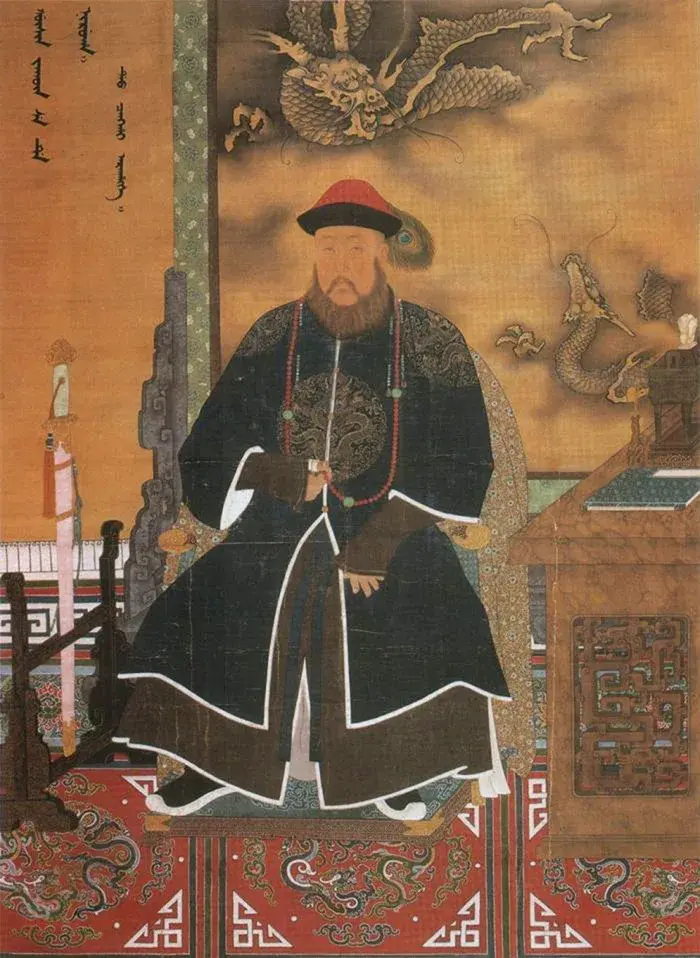
1612 CE–1650 CE
爱新觉罗·多尔衮
Aisin Gioro Dorgon (1612–1650), the fourteenth son of Nurhaci born to Lady Abahai, was the prominent statesman, military strategist, Prince Regent, and master architect of the Qing conquest of China. Campaigning under his brother Hong Taiji in his youth, Dorgon subdued the Chahar Mongols, securing the ancient Imperial Jade Seal of the Yuan dynasty, and was created Prince Rui of the First Rank in 1636. In the pivotal Battle of…
Aisin Gioro Dorgon (1612–1650), the fourteenth son of Nurhaci born to Lady Abahai, was the prominent statesman, military strategist, Prince Regent, and master architect of the Qing conquest of China. Campaigning under his brother Hong Taiji in his youth, Dorgon subdued the Chahar Mongols, securing the ancient Imperial Jade Seal of the Yuan dynasty, and was created Prince Rui of the First Rank in 1636. In the pivotal Battle of Songjin, Dorgon directed the siege of Songshan, annihilating the 130,000-strong Ming field army under Hong Chengchou and opening the way to Shanhai Pass. Following Hong Taiji's sudden death in 1643, Dorgon averted civil war by orchestrating a political settlement that placed the six-year-old Fulin (the Shunzhi Emperor) on the throne, assuming executive authority as Prince Regent. In 1644, seizing upon the fall of Beijing to Li Zicheng, Dorgon led the Eight Banners south, allied with General Wu Sangui at Shanhai Pass, routed the Da Shun army at the Battle of Yipianshi, and captured Beijing. He transferred the Qing capital from Shenyang to Beijing, establishing the Qing Dynasty as an imperial ruler over China. During his regency, Dorgon instituted the Grand Secretariat memorial drafting system, integrated Manchu and Han officials in administration, and reinstated civil service examinations, establishing early Qing governance; however, his coercive edicts regarding mandatory queue tonsure and land enclosures sparked bitter resistance across southern China. Dorgon died while on a hunting expedition at Karasun in 1650 at age thirty-nine. Posthumously stripped of honors in 1651, he was rehabilitated in 1778 by Emperor Qianlong as the foremost architect of the dynastic conquest, restoring his Prince Rui title with sacrifices in the Imperial Ancestral Temple.
Born as the fourteenth son of Nurhaci to Lady Abahai of the Ulanara clan.
Nurhaci passed away; Lady Abahai was forced to commit suicide; fourteen-year-old Dorgon inherited Plain White Banner nirus.
Accompanied Hong Taiji against the Chahar Mongols; awarded the honorary title "Mergen Daicing" (Wise Warrior).
Commanded troops at Dalinghe, charging enemy entrenchments and cutting down Ming relieving units.
Subdued Ejei Khan of the Chahar Mongols, obtaining the hereditary Imperial Jade Seal of the Yuan Dynasty.
Hong Taiji proclaimed the Great Qing; twenty-four-year-old Dorgon was elevated to Prince Rui of the First Rank.
Appointed Generalissimo, penetrating 5,000 li beyond the Great Wall, storming Jinan, and taking 260,000 captives.
Directed the protracted siege of Songshan, crushing 130,000 veteran Ming troops under Hong Chengchou.
Settled succession deadlock upon Hong Taiji's death by placing young Fulin on the throne as co-regent.
Allied with Wu Sangui at Shanhai Pass, defeated Li Zicheng at Yipianshi, and established Beijing as the imperial capital.
Dispatched Princes Dodo and Ajige to eliminate Shun remnants and capture Nanjing, extinguishing the Southern Ming Hongguang court.
Attained the pinnacle of despotic authority, honored as "Imperial Father Prince Regent" with custody of imperial seals.
Died on a hunting expedition at Karasun at age thirty-nine and was posthumously venerated as Emperor Chengzong (stripped of titles in 1651 and rehabilitated by Emperor Qianlong in 1778).
Aisin Gioro Dorgon was born on November 17, 1612 (the 25th day of the 10th lunar month, 40th year of Wanli) in Hetu Ala, Jianzhou Left Guard. He was the fourteenth son of Nurhaci, the founding Grand Khan of Later Jin, born to Lady Ulanara (Abahai), who was Nurhaci's favored Grand Consort. Dorgon's full elder brother was Ajige and his full younger brother was Dodo. Endowed with a striking countenance and sharp intellect, Dorgon displayed early physical vigor and mental resilience. In 1620, at age eight, he was designated a banner prince (Hoshoi Ejen), initiating his training in administrative and military arts.
In August 1626, Nurhaci passed away following his setback at the Battle of Ningyuan. Exploiting the succession vacuum, Senior Beiles Hong Taiji, Daišan, Amin, and Manggūltai coerced the thirty-seven-year-old Lady Abahai to commit suicide, depriving fourteen-year-old Dorgon and his brothers of maternal protection. Facing intense political vulnerability, Dorgon mastered political discipline and emotional restraint. Rallying around the military strength of their inherited fifteen nirus in the Plain White Banner, Dorgon and Dodo displayed unswerving fealty to their newly enthroned brother Hong Taiji, seeking to build their status through battlefield distinction.
In 1628, sixteen-year-old Dorgon accompanied Hong Taiji on an expedition against the Duolote clan of the Chahar Mongols. In frontline combat, Dorgon charged directly into enemy cavalry ranks, routing their detachments and capturing thousands of horses and cattle. Impressed by his younger brother's tactical acumen and physical valor, Hong Taiji bestowed upon him the Manchu honorary title "Mergen Daicing" (Wise Warrior). In 1629, Dorgon took part in the grand campaign bypassing the Great Wall through Da'ankou, penetrating the environs of Beijing and distinguishing himself in heavy fighting outside Guangqumen against the Guanning cavalry of Yuan Chonghuan. In 1631, during the Battle of Dalinghe, Dorgon led the Plain White Banner against General Zu Dashou's fortresses, maintaining frontline command despite sustaining serious wounds.
In 1635, Hong Taiji dispatched Dorgon to lead an expedition across the Gobi Desert to pacify the remaining Chahar Mongol factions. Employing military pressure alongside skillful diplomacy, Dorgon encircled the headquarters of Ejei Khan, son of the late Ligdan Khan, securing the surrender of the Chahar tribes without bloodshed. Crucially, Dorgon recovered the legendary Imperial Jade Seal of the Yuan dynasty, which had been preserved across generations. Dorgon presented the imperial artifact to Hong Taiji, providing the Qing dynasty with moral and historical authority over China and the Mongol steppes. In 1636, when Hong Taiji declared the Qing Dynasty in Shenyang, twenty-four-year-old Dorgon was elevated to Prince Rui of the First Rank, becoming the head of the Board of Personnel and an influential leader among the imperial nobility.
In the winter of 1638, Hong Taiji designated Dorgon as Generalissimo to direct an expeditionary force through the Great Wall into the Ming heartland. Breaching the fortifications at Dongjiakou, Dorgon led his army across Zhili and Shandong for over five thousand li. Over several months, his forces captured thirty-six cities, received the surrender of six others, defeated Ming armies in seventeen engagements, stormed the strategic regional capital of Jinan, and captured Prince Lu (Zhu Yipai), returning to Manchuria with over 260,000 captives and vast wealth, dealing a devastating blow to the Ming defensive infrastructure.
Between 1640 and 1642, the decisive military confrontation between the Ming and Qing empires unfolded: the Battle of Songjin. The Ming court mobilized 130,000 elite troops from eight regional commands under Minister of War Hong Chengchou to relieve the besieged fortress of Jinzhou. Hong Taiji dispatched Dorgon to command the primary encirclement trenches surrounding Songshan. Dorgon demonstrated strategic patience, ordering his troops to excavate deep concentric trench works that severed communication lines between Songshan, Jinzhou, and coastal supply ports. Over twenty months of siege warfare, imperial relieving forces broke against Dorgon's entrenched perimeter. In March 1642, Dorgon stormed Songshan, capturing Hong Chengchou alive, which compelled General Zu Dashou to surrender Jinzhou. The destruction of the 130,000-man Guanning army eliminated the Ming frontier defense system, leaving the road to Shanhai Pass undefended.
On September 21, 1643 (the 9th day of the 8th lunar month, Chongde 8), Hong Taiji died suddenly in Shenyang without naming an heir, triggering a succession crisis. Prince Su Hooge, Hong Taiji's eldest son, commanded the allegiance of the Plain Yellow and Bordered Yellow Banners alongside the Plain Blue Banner. Dorgon, supported by his full brothers Ajige and Dodo, commanded the two White Banners. Both factions assembled armed retinues at the Chongzheng Hall, threatening civil war.
Recognizing that open hostilities would destroy the dynasty on the eve of the conquest of China, Dorgon devised a compromise. He renounced his claims to the throne, proposing that Hong Taiji's ninth son, six-year-old Fulin, ascend the throne, with Prince Zheng Jirgalang and himself serving as co-regents. This political settlement reconciled competing banner interests, averted military confrontation, and preserved the unity of the Eight Banners, while elevating Dorgon to supreme executive authority as Senior Prince Regent.
In April 1644, historic upheavals shook China. Li Zicheng's Da Shun rebel army stormed Beijing, causing the Chongzhen Emperor to hang himself on Jingshan Hill. At the strategic Shanhai Pass, Ming General Wu Sangui rebelled against the Shun and requested Qing military intervention. Recognizing the historic opportunity, Dorgon acted upon the counsel of scholar Fan Wencheng to pursue the conquest of China under the banner of avenging the fallen Ming emperor. He mobilized the Eight Banners, ordering strict prohibitions against plunder, and marched south.
On May 27, 1644, the Qing expeditionary army reached the Shanhai Pass along the Shi River. Dorgon ordered Wu Sangui's forces to engage the main body of Li Zicheng's army directly. After hours of fierce fighting that exhausted both sides, a blinding dust storm swept across the battlefield. Dorgon unleashed tens of thousands of elite Manchu heavy cavalry against the Da Shun flank. Caught off guard, the Shun formations collapsed into a chaotic rout. Dorgon pursued the retreating forces, breaking Li Zicheng's army and securing the strategic key to Northern China.
On June 5, 1644, Dorgon entered Beijing. Demonstrating administrative pragmatism, he prohibited his troops from looting, staged elaborate imperial funerals for the Chongzhen Emperor and Empress, and declared three days of public mourning, winning over the scholar-gentry class. Rejecting the counsel of conservative banner nobles who wished to return to Manchuria with their plunder, Dorgon established Beijing as the permanent capital of the Qing Dynasty. In October 1644, Dorgon received young Emperor Shunzhi in Beijing, presiding over the formal enthronement ceremony that proclaimed the Qing as the legitimate imperial successor throughout China.
Following the transfer of the capital to Beijing, Dorgon directed the military conquest of Southern China. He deployed Princes Dodo and Ajige in a two-pronged offensive. The northern army drove Li Zicheng across Shaanxi into Hubei, where the rebel leader died at Jiugong Mountain. The southern army marched down the Grand Canal, besieged Yangzhou, and crossed the Yangtze to capture Nanjing, taking captive the Southern Ming Hongguang Emperor (Zhu Yousong). Qing forces then swept across Zhejiang, Jiangxi, and Fujian, crushing the Longwu and Shaowu regimes.
In administrative policy, Dorgon adapted the Ming institutional apparatus. He maintained the Grand Secretariat, instituting the memorial drafting system for imperial decrees, staffed the Six Ministries with both Manchu and Han officials, and held imperial civil service examinations in 1646 to recruit Han scholars. However, to compel absolute obedience, Dorgon enforced the Haircutting Edict (Tifa Ling), decreeing that all males shave their foreheads and braid their hair in the Manchu queue under penalty of death. He also instituted Banner Land Enclosures (Quandi) and the Runaway Slave Law (Taoren Fa), dispossessing millions of Han peasants and provoking ferocious resistance across Jiangnan and Sichuan.
Within the imperial court, Dorgon's authority became increasingly autocratic. Honored successively as Uncle Prince Regent, Imperial Uncle Prince Regent, and finally "Imperial Father Prince Regent" in 1648, he governed from his private palace rather than the Forbidden City. Memorials were submitted directly to his residence, the imperial seals were kept in his chambers, and court ministers knelt in his presence. Dorgon eliminated political rivals, imprisoning Prince Su Hooge until his death, marginalizing Co-Regent Jirgalang, and concentrating power within his personal White Banner faction, sowing seeds of resentment within the young Shunzhi Emperor.
In November 1650, suffering from respiratory illness and physical exhaustion from decades of campaigning, Dorgon traveled to Karasun near Gubeikou for rest. On December 31, 1650, he died at Karasun at age thirty-nine. The grief-stricken Shunzhi Emperor initially bestowed upon him the posthumous title of Emperor Chengzong, ordering imperial sacrifices in the Imperial Ancestral Temple.
However, Dorgon's posthumous honors proved short-lived. In February 1651, upon assuming personal rule, the thirteen-year-old Shunzhi Emperor and marginalized banner princes launched a political purge. Dorgon was posthumously charged with conspiracy, treason, and usurpation of imperial prerogatives. Shunzhi stripped Dorgon of all imperial titles and noble rank, disinherited his adopted heir Dorbo, confiscated his estates, and ordered his tomb excavated, subjecting his remains to public desecration.
It was not until 1778, 127 years later, that Emperor Qianlong formally revisited early Qing history and rehabilitated Dorgon. In an imperial edict, Qianlong declared that Dorgon had displayed unmatched loyalty in placing the young Shunzhi on the throne, affirming that "in establishing the imperial capital and conquering the realm, Prince Rui's merit was foremost." Qianlong rescinded the treason charges, restored his title as Prince Rui of the First Rank with the posthumous title "Zhong" (Loyal), rebuilt his ancestral tomb, and ordered his tablet re-enshrined in the Imperial Ancestral Temple.
Dorgon's most celebrated battlefield triumph was his direction of the Battle of Songjin between 1640 and 1642. Confronting Minister of War Hong Chengchou and 130,000 elite soldiers of the Guanning army, Dorgon implemented a strategy of concentric trench isolation and interdiction of maritime supply lines. Resisting multiple breakout attempts, his siege forces wore down the imperial garrison over twenty months. The capture of Songshan and Hong Chengchou, alongside the surrender of Zu Dashou at Jinzhou, annihilated the last operational Ming field armies in the Northeast, breaking the Guanning defensive perimeter and opening the road to the North China plain.
The sudden death of Hong Taiji in 1643 precipitated an existential succession crisis within the Qing state. With the Yellow and Blue banners rallying behind Prince Hooge and the White banners supporting Dorgon, the dynasty stood on the brink of civil war. Demonstrating strategic vision, Dorgon withdrew his claim and proposed the enthronement of Hong Taiji's six-year-old son Fulin under joint regency. This compromise preserved the cohesion of the Eight Banners, prevented internal bloodletting, and unified the Manchu leadership at the threshold of the conquest of China.
At the historical juncture of 1644, Dorgon recognized the collapse of the Ming dynasty as a strategic opportunity. Marching the Eight Banners south, he formed an alliance with Wu Sangui at Shanhai Pass. In the Battle of Yipianshi, he deployed Manchu heavy cavalry against the Da Shun flank, shattering Li Zicheng's army. Entering Beijing, Dorgon enforced military discipline, honored the fallen Chongzhen Emperor, and transferred the Qing capital from Shenyang to Beijing, transforming the Qing from a regional frontier power into the ruling dynasty of China.
As Prince Regent, Dorgon laid the administrative foundations of early Qing imperial governance. He adopted the Ming bureaucratic model, establishing the Grand Secretariat drafting protocol, instituting parallel Manchu and Han appointments across the Six Ministries, and organizing civil service examinations to integrate Confucian literati into the administrative apparatus. He promulgated the Great Qing Code and supervised multi-pronged campaigns that subdued the Da Shun, Da Xi, and early Southern Ming resistance, establishing the institutional and territorial framework for the consolidation of Qing rule.
FIGURES ASSOCIATED WITH THIS DYNASTY