Birth | Born in Jingren Palace in the Forbidden City, Beijing, as the third son of the Shunzhi Emperor Fulin
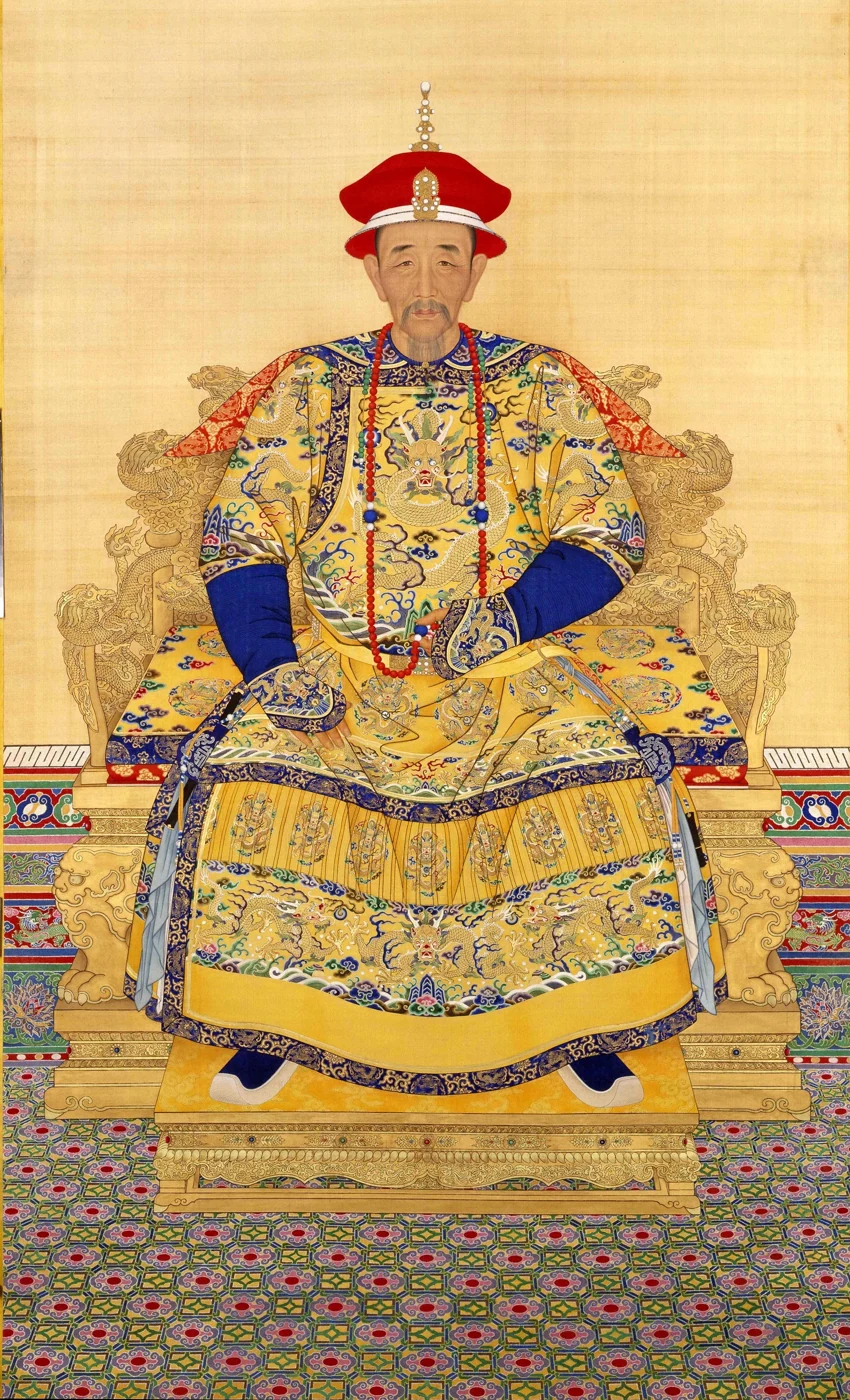
1654 CE–1722 CE
Qing emperorfourth emperor of the Qing Dynasty
Aisin Gioro Xuanye
爱新觉罗·玄烨
Aisin Gioro Xuanye was born on 4 May 1654(18th day of the third lunar month, Shunzhi 11) and died on 20 December 1722(13th day of the 11th lunar month, Kangxi 61). He was known by the era name Kangxi and temple name Shengzu, and was the fourth emperor of the Qing Dynasty, reigning from 1661(Shunzhi 18) to 1722(Kangxi 61). Xuanye ascended the throne as a child and was initially assisted by four regents. After taking personal…
1654 CE–1722 CEQing Dynasty
PROFILE
Aisin Gioro Xuanye was born on 4 May 1654(18th day of the third lunar month, Shunzhi 11) and died on 20 December 1722(13th day of the 11th lunar month, Kangxi 61). He was known by the era name Kangxi and temple name Shengzu, and was the fourth emperor of the Qing Dynasty, reigning from 1661(Shunzhi 18) to 1722(Kangxi 61). Xuanye ascended the throne as a child and was initially assisted by four regents. After taking personal control of government, he had Oboi arrested and then confronted the Revolt of the Three Feudatories, the Ming-Zheng regime, border conflict with Russia, and the expansion of the Dzungars. During his reign, the Qing incorporated Taiwan into its administrative system, concluded the Treaty of Nerchinsk with Russia, and strengthened frontier governance through the Dolonnor Assembly and the dispatch of troops into Tibet. Xuanye also promoted measures involving taxation, river works, maritime trade, and cultural projects; at the same time, problems of official administration and imperial succession became prominent in his later years. His reign was closely connected with the consolidation of the Qing from a regime newly established within the passes into a dynasty ruling on a nationwide scale.
- Other names
- Kangxi Emperor; Emperor Shengzu of Qing; self-styled Master of Tiyuan
- Period
- Early Qing Dynasty
- Dynasty / regime
- Qing Dynasty
- Identity
- Qing emperor; fourth emperor of the Qing Dynasty
- Ethnicity / affiliation
- Manchus(described as Manzhou in Qing-period sources)
- Clan
- Aisin Gioro clan
- Ancestral origin
- No reliable record has been found
- Date of birth
- 4 May 1654(18th day of the third lunar month, Shunzhi 11)
- Place of birth
- Jingren Palace, Forbidden City, Beijing
- Date of death
- 20 December 1722(13th day of the 11th lunar month, Kangxi 61)
- Place of death
- Qingxi Study, Changchun Garden, Beijing
- Reign
- 1661(Shunzhi 18)–1722(Kangxi 61)
- Era name
- Kangxi
- Temple name
- Shengzu
- Posthumous title
- Hetian Hongyun Wenwu Ruizhe Gongjian Kuanyu Xiaojing Chengxin Gongde Dacheng Ren Huangdi
- Mausoleum
- Jing Mausoleum, Eastern Qing Tombs
- Predecessor
- Aisin Gioro Fulin(Shunzhi Emperor)
- Successor
- Aisin Gioro Yinzhen(Yongzheng Emperor)
- Principal office
- Emperor
- Major achievements
- Suppressed the Revolt of the Three Feudatories; incorporated Taiwan into the Qing administrative system and established Taiwan Prefecture; concluded the Treaty of Nerchinsk; strengthened Qing governance over Mongolia and Tibet; sponsored the compilation of major works and nationwide cartographic surveys
LIFE TIMELINE
Accession in childhood | Enthroned in the Hall of Supreme Harmony; Sonin, Su Ke Sa Ha, Ebilun, and Oboi served as regents
Assumption of personal rule | Formally began ruling in person at fourteen sui(traditional East Asian age reckoning) and started handling state affairs
Removal of a powerful minister | Ordered palace guards to arrest Oboi and recovered control of the court
Withdrawal of feudatories and outbreak of war | Approved withdrawal of the feudatories; Wu Sangui rebelled, beginning the Revolt of the Three Feudatories
Suppression of the Three Feudatories | Qing forces captured Kunming; Wu Shi Fan committed suicide and the revolt ended
Submission of Taiwan | Shi Lang led Qing forces to defeat the Zheng fleet at Penghu, and Zheng Keshuang surrendered
Administrative incorporation of Taiwan | The Qing court established Taiwan Prefecture and counties under Fujian Province
Battle of Albazin | Qing forces captured Albazin and subsequently withdrew part of their troops
Siege of Albazin | Qing forces again besieged the fortress, compelling the Russian side to negotiate
Conclusion of a boundary treaty | The Qing and Russia concluded the Treaty of Nerchinsk, delimiting the eastern section of the frontier
First personal campaign | After the Battle of Ulan Butung, Dzungar forces withdrew
Dolonnor Assembly | Met leaders of the Khalkha Mongol groups and reorganized their political relationship with the Qing court
Second personal campaign | Qing forces defeated Galdan at the Battle of Jao Modo
Renewed Qing campaign | Xuanye ordered another campaign, and Qing forces continued to advance; Galdan died amid defections and military reverses
First deposition of the crown prince | Deposed Crown Prince Yinreng, bringing the succession issue into the open
Restoration of the crown prince | Reinstalled Yinreng as Crown Prince
Second deposition of the crown prince | Deposed Yinreng again and did not establish another Crown Prince thereafter
Completion of cartographic survey | The Huangyu Quanlan Tu was completed
Qing troops enter Tibet | Ordered Yunti to lead troops into Tibet, expel the Dzungar forces, and leave Qing troops stationed there
Death | Died at Qingxi Study in Changchun Garden; his fourth son Yinzhen succeeded to the throne
BIOGRAPHY
Biography
Family Background and Early Years
Xuanye was born on 4 May 1654(18th day of the third lunar month, Shunzhi 11) in Jingren Palace in the Forbidden City, Beijing. His mother, Empress Xiaokangzhang of the Tunggiya clan, was then a lower-ranking consort. At Xuanye's birth, the Shunzhi Emperor was chiefly devoted to Noble Consort Donggo and paid limited attention to the young prince.
Soon after birth, Xuanye contracted smallpox. The Shunzhi Emperor entrusted him to a wet nurse to be raised outside the palace, so he was unable to grow up at his parents' side. Many years later, the Kangxi Emperor still expressed regret about this. The smallpox did not endanger his life, leaving only fine pockmarks on his face and giving him lifelong immunity. His experience of surviving smallpox later became one factor favoring his succession to the throne.
Xuanye began learning to read and write at the age of five and soon showed a reputation for diligence in study. Historical records describe him as handsome in appearance and possessing a strong, resonant voice. At the age of six, he and his brothers paid respects to their father. When the Shunzhi Emperor asked the princes what they most wished to do, the second prince Fuquan said that he hoped to become a worthy prince, whereas Xuanye said that he wished to emulate his father. The Shunzhi Emperor therefore held him in high regard.
The Kangxi Emperor later described his own studies: at the age of eight he studied the commentaries on the Great Learning and the Doctrine of the Mean, refusing to be satisfied until he understood their general meaning; whatever he read each day he required himself to recite word for word. After mastering the Four Books, he studied the Book of Documents, seeking in its canonical discourses and explanations the ancient rulers' persistent concern for good government. He then studied the Book of Changes, examining images and divination and finding its principles deeply engaging. From then on he developed the habit of studying late into the night without tiring. When he was seventeen or eighteen, he studied so intensely that he coughed up blood but still refused to stop.
Accession in Childhood and Regency by the Four Ministers
In 1661(Shunzhi 18), the twenty-four-year-old Shunzhi Emperor died. He had not appointed a crown prince during his lifetime. Near death, he accepted the advice of the missionary Johann Adam Schall von Bell and selected Xuanye as heir because Xuanye had survived smallpox and possessed immunity to the disease. By a testamentary edict, Xuanye was appointed Crown Prince, and Sonin, Su Ke Sa Ha, Ebilun, and Oboi were designated as the four regents.
On 7 February 1661(9th day of the first lunar month, Shunzhi 18), Xuanye was enthroned in the Hall of Supreme Harmony. He was not yet seven years old by Western reckoning, or eight by traditional East Asian reckoning. He proclaimed a general amnesty and ordered that the following year be the first year of Kangxi. Two years later his biological mother, Lady Tunggiya, became gravely ill. Xuanye "attended her reverently morning and evening, personally tasted her medicines, did not close his eyes, and did not remove his clothes"; when his mother died while he was ten, he kept vigil day and night, took neither food nor water, and wept without cease.
The joint regency of the four ministers did not last long in its original form. Among them, Oboi gradually monopolized effective power. Although he ranked last among the four, he refused to remain subordinate and repeatedly overstepped his position to seize authority. Sonin was old, Ebilun was weak, and Su Ke Sa Ha had limited standing; Su Ke Sa Ha disapproved of Oboi's conduct but could not effectively oppose him. Oboi was forceful and had extensive military achievements. He acted arbitrarily, repeatedly initiated major prosecutions, and caused even his fellow regents to fear him.
In June 1667(Kangxi 6), the senior regent Sonin died. On the seventh day of the seventh lunar month of the same year, the Kangxi Emperor, aged fourteen sui(traditional East Asian age reckoning), formally assumed personal rule, receiving congratulations in the Hall of Supreme Harmony and proclaiming a general amnesty. Only ten days later, however, Oboi had fellow regent Su Ke Sa Ha and his sons and clansmen executed without authorization. Several days after that, Oboi and Ebilun were both promoted to first-class duke, and in practice the political situation was still not under the emperor's direct control.
Arrest of Oboi and Effective Personal Rule
At the time, the Kangxi Emperor frequently summoned young guards to the palace to practice buku, or wrestling. On 14 June 1669(16th day of the fifth lunar month, Kangxi 8), when Oboi came for an audience, the emperor suddenly ordered the guards to arrest him. Ministers deliberated thirty serious charges against Oboi and requested the execution of his clan. Remembering Oboi's past service, the Kangxi Emperor commuted the death sentence to confinement, although many of Oboi's nephews, followers, and factional associates were executed. Oboi died in detention not long afterward. Ebilun, the only other surviving regent, was stripped of his titles of Grand Preceptor and first-class duke because of his long association with Oboi.
The Kangxi Emperor thereby fully recovered central authority and entered the stage of effective personal rule. He reviewed officials, rehabilitated Su Ke Sa Ha and others who had previously been executed under manipulated imperial orders, encouraged officials to submit memorials on state affairs, and prohibited abuses such as land enclosure. During Oboi's ascendancy, Yang Guangxian of the Imperial Astronomical Bureau had allied with Oboi in opposing Western astronomy, leading to the calendar case in which Johann Adam Schall von Bell was sentenced to death. The Kangxi Emperor used the opportunity to rehabilitate Schall.
Suppression of the Three Feudatories
In March 1673(Kangxi 12), Shang Kexi, Prince of Pingnan, requested retirement to Liaodong but asked that his son Shang Zhixin remain in Guangdong. This prompted intense debate over whether the feudatories should be withdrawn. The Kangxi Emperor ultimately judged that "feudatories that long command heavy forces become too powerful at the periphery and are not in the state's interest," and ordered their withdrawal. In the seventh lunar month, Wu Sangui formally requested permission to withdraw his feudatory in a feigned gesture, and the emperor approved it.
In the 11th lunar month of 1673(Kangxi 12), Wu Sangui raised the slogan of opposing the Qing and restoring the Ming, killed Yunnan governor Zhu Guozhi, and in the following year sent generals into Hunan, capturing Changde, Changsha, Yuezhou, Lizhou, Hengzhou, and other places. Many regional officials, including Guangxi commander Sun Yanling and Sichuan governor Luo Sen, also turned against the Qing; Geng Jingzhong in Fujian followed. Within a few months Yunnan, Guizhou, Hunan, Guangxi, Fujian, and Sichuan were lost, creating an acute crisis. Wang Fuchen in Shaanxi and Shang Zhixin in Guangdong later also rebelled, extending the uprising into Guangdong, Jiangxi, Shaanxi, Gansu, and other regions.
The Kangxi Emperor's strategy was to strike decisively at Wu Sangui and refuse negotiations or compromise with him, while opening the door to surrender for other rebels so as to divide the opposing forces and weaken Wu's support. He made Hunan the main focus of military operations, ordering Lergiyen and others to bring large forces to Jingzhou and Wuchang to contain Wu Sangui from the front and advance into Hunan, while Prince An Yolo moved from Jiangxi toward Changsha to attack Hunan from another direction. He also made extensive use of Han Chinese generals and troops.
In 1676(Kangxi 15), Wang Fuchen in Shaanxi and Geng Jingzhong in Fujian surrendered in succession under Qing attack. In 1677(Kangxi 16), Shang Zhixin in Guangdong also surrendered. Shaanxi, Fujian, Guangdong, and Jiangxi were successively pacified. Wu Sangui was increasingly confined to Hunan, while external support diminished and the prospect of defeat became clear.
In the third lunar month of 1678(Kangxi 17), Wu Sangui proclaimed himself emperor at Hengzhou and named his state Zhou, granting titles to his generals. He soon became ill and died in the eighth lunar month. His commanders installed his grandson Wu Shi Fan as successor and withdrew into Yunnan and Guizhou. Qing forces subsequently recovered Hunan, Guangxi, and Sichuan. In the winter of 1681(Kangxi 20), Qing forces captured Kunming; Wu Shi Fan committed suicide, and the Revolt of the Three Feudatories was suppressed.
Incorporation of Taiwan
After the Revolt of the Three Feudatories was suppressed, incorporation of Taiwan into the Qing realm was placed on the agenda. During Wu Sangui's rebellion, Zheng Jing had already contacted Geng Jingzhong and sent forces to land on the Fujian coast and seize territory. Geng Jingzhong soon returned to Qing allegiance, leaving Zheng Jing isolated; he withdrew to Taiwan. In 1680(Kangxi 19), Qing forces recovered Kinmen and Xiamen, which the Zheng regime had held, leaving it unable to mount another offensive. Zheng Jing returned to Taiwan and neglected government affairs, while indulging in drinking and sensual pleasures. His father-in-law Feng Xifan took the opportunity to seize effective power, an indication that the Zheng regime was entering decline.
Zheng Jing died in 1681(Kangxi 20), after which a coup occurred within Taiwan. His twelve-year-old successor Zheng Keshuang inherited the title Prince of Yanping, while effective power was held by Feng Xifan and Liu Guoxuan. Fujian Governor-General Yao Qisheng judged the moment favorable for an attack on Taiwan and recommended Shi Lang to the Kangxi Emperor. Court opinion was divided. Some officials opposed using force, arguing that the realm had only just been stabilized after the Wu Sangui rebellion and that another war should not be opened. Grand Secretary Li Guangdi, Fujian Governor-General Yao Qisheng, and Governor Wu Xingzuo were leading advocates of war and urged that Taiwan be taken while the opportunity existed. They strongly recommended Shi Lang for command because he had a longstanding feud with the Zheng family, knew maritime conditions, possessed strategic ability, and held a strong reputation at sea.
After hearing the various opinions, the Kangxi Emperor decided to order an expedition against Taiwan and formally appointed Shi Lang admiral of the Fujian naval forces with full authority. In 1683(Kangxi 22), Shi Lang sailed against Taiwan and defeated the Zheng navy led by Liu Guoxuan at Penghu, after which the Ming-Zheng regime surrendered its territory to the Qing. In 1684(Kangxi 23), the Qing government established one prefecture, Taiwan Prefecture, and three counties on Taiwan: Taiwan County(present-day Tainan), Fengshan County(present-day Kaohsiung), and Zhuluo County(present-day Chiayi), all under Fujian Province. The Qing also established a circuit intendant, one regional commander, two deputy generals, and 8,000 troops on Taiwan, with another deputy general and 2,000 troops stationed in Penghu. These measures strengthened central administration over Taiwan and promoted its economic and cultural development.
Conflict with Russia and the Treaty of Nerchinsk
After Qing forces entered the passes, Russian expeditionary forces repeatedly entered the Heilongjiang River basin, killing and plundering and gradually encroaching on Chinese territory. In the ninth lunar month of 1683(Kangxi 22), the Qing court ordered Russian forces occupying Albazin and other places to withdraw from Qing territory. The Russians refused and instead moved troops toward Aihun, or Aigun, to plunder. Qing commander Sabusu defeated them and destroyed Russian positions in the lower Heilongjiang region, leaving Albazin isolated.
On the 23rd day of the first lunar month of 1685(Kangxi 24), to eliminate the Russian threat, the Kangxi Emperor ordered commander Pengchun to proceed to Aihun; within days he captured Albazin and then withdrew. In the autumn of 1685, Russian forces returned and reoccupied the fortress. On the 24th day of the seventh lunar month of 1686(Kangxi 25), more than 2,000 Qing troops reached Albazin and laid siege. In the eighth lunar month the Qing began assaulting the fortress, and the Russian commander Tolbuzin was killed. Of 826 Russian troops, only 66 ultimately remained. With Albazin close to falling, the Russian regent Sophia urgently asked the Qing court to lift the siege and sent envoys to negotiate a boundary settlement.
On the 24th day of the seventh lunar month of 1689(Kangxi 28), the two sides concluded the Treaty of Nerchinsk. It used the Gorbitsa River and the adjoining mountain range as boundary markers, assigning to the Qing the river valleys flowing from the southern slopes into the Amur and to Russia those flowing from the northern slopes. The treaty left the jurisdiction of certain lands between the Uda River and the mountains, extending to the sea, open for later settlement. It constrained Russian expansion in the Amur region but did not settle the status of Sakhalin and all other Far Eastern territories.
Three Campaigns against Galdan and Governance of Mongolia and Tibet
In 1690(Kangxi 29), Galdan, leader of the Dzungars, advanced south under the pretext of pursuing the Khalkha, with Russian support, and penetrated as far as Ujimqin in Inner Mongolia. The Kangxi Emperor decided to lead the army in person. The Qing and Dzungar forces fought at Ulan Butung, after which Galdan withdrew; accounts differ in how they assess the battle, so it should not be presented as an unambiguous Qing victory. In 1696(Kangxi 35), the emperor personally campaigned for a second time, and Qing forces decisively defeated Galdan at the Battle of Jao Modo; Galdan escaped with only a few dozen riders. In 1697(Kangxi 36), Xuanye ordered another campaign, and Qing forces continued to advance. Galdan died amid defections and military reverses.
The Kangxi Emperor used the Dolonnor Assembly in place of further warfare to draw together the Mongol groups and strengthen Qing rule over the Khalkha and Inner Mongolia. In his later years he also fought the Dzungar leader Tsewang Rabtan. In 1720(Kangxi 59), he ordered his fourteenth son Yunti, serving as General-in-Chief for Pacifying the Frontier, to lead an army into Tibet, expel the Dzungar forces that had killed Lhazang Khan of the Khoshut Khanate, restore order in Tibet in what later became known as the campaign to expel the Dzungars and protect Tibet, and leave Qing troops stationed there. The Qing army remained in Tibet and took part in local political arrangements. Qing military presence and administrative involvement in Lhasa became more institutionalized in the following years.
Later Years and Death
In his later years, the Kangxi Emperor became relatively lax in domestic administration and stated such views as "fewer affairs are better than many," "government should be lenient and affairs reduced," and "there are many matters that should not be investigated too deeply." He failed to impose strict prohibitions on excessive expenditures and customary fees and tolerated local surcharge practices and fiscal deficits. At the same time, he presented his government as benevolent and generally treated officials leniently. This contributed to slackened administration, official corruption, treasury shortages, and a situation in which "officials high and low habitually neglected their duties, and favoritism became especially severe," with unrest and disturbances occurring in some areas. In 1710(Kangxi 49), a censor impeached senior Board of Revenue official Xifuna and others for embezzling more than 640,000 taels of silver from an internal granary of the board, implicating as many as 112 officials. The Kangxi Emperor said that he had "thought it over repeatedly and could not sleep through the night; if all of them were interrogated, very many people would be found guilty." In the end, only Xifuna was dismissed, while the others were given deadlines to repay the money.
The repeated installation and deposition of the Crown Prince exposed the problems of the system of succession by the eldest legitimate son and of publicly designating an heir. The succession struggle lasted an unusually long time, involved an unusually large number of participants, and had exceptionally broad consequences for both the dynasty and the emperor personally.
On 20 December 1722(13th day of the 11th lunar month, Kangxi 61), the Kangxi Emperor died at Qingxi Study in Changchun Garden in the capital. By traditional East Asian age reckoning he was sixty-nine, bringing a sixty-one-year reign to an end. Longkodo, commander of the capital infantry, acted on the emperor's testamentary edict and enabled the fourth imperial son Yinzhen to inherit the throne as the Yongzheng Emperor. Xuanye received the temple name Emperor Shengzu of Qing and the posthumous title Hetian Hongyun Wenwu Ruizhe Gongjian Kuanyu Xiaojing Chengxin Gongde Dacheng Ren Huangdi, and was buried in Jing Mausoleum at the Eastern Qing Tombs.
The Regency of the Four Ministers and the Case of Oboi
The regency of the four ministers was at first sustained by old merit and office. The Draft History of the Qing records that "Soni was old, Ebilun dull and weak, and Suksaha of small standing, disapproving of what Oboi did but unable to contend with him; Oboi was violent, and being an old general with many war merits yet named last, he was overbearing in affairs and raised great cases again and again, so that even his colleagues looked at him askance". In the eleventh month of the sixth year of Kangxi Oboi "falsely accused the grand secretary and acting minister of revenue Sunahai, the governor-general of Zhili Zhu Changzuo and the governor Wang Denglian of crimes over the redistribution of enclosed land, and had them thrown into prison" — a plain example of a regent killing great ministers. By the eighth year Xuan Ye, having long known Oboi's tyranny, "feared only that his great strength made him hard to control, and so chose young and strong guards and attendants to practise the game of wrestling"; on the day Wushen he "decreed the arrest of the regent Oboi for trial by the court", and when Oboi came to audience "he at once had the guards seize and bind him", "and from this came the institution of the wrestling camp, commanded by a close minister". Afterwards the princes and ministers, debating Oboi's case, "set out thirty great crimes and asked the destruction of his clan"; the decree said that "Oboi is foolish and without understanding and truly deserves the extinction of his clan; but remembering his long service and his repeated war merits, I spare him death, confiscate his property and confine him". His brothers Murima and Sebende, his nephew Nemo, and his partisans the grand secretary Bumbursan, the ministers Asiha, Gachuha and Jishi, the vice minister Taibitu and the scholar Wugesai were all put to death, "and the rest degraded in due degree", only his brother Bahā, "a guard of honest simplicity", and Zhuobutei, "who had war merit", escaping complicity. The prince of Jingjin, Lanbu, was reduced to duke of the state, and Ebilun was stripped of his titles of grand tutor and duke of the first rank.
The Pacification of the Three Feudatories
The completion of the pacification is recorded in the veritable records: in the eleventh month of the twentieth year of Kangxi a decree was issued that "of those who followed the rebels, save those who openly resisted the royal army, all shall be stripped of office and sent home"; and it was reported by the prince of the blood Zhangtai, commander of the pacifying army, and by the generals Laita, Zhao Liangdong and Cai Yurong that "on the twenty-eighth day of the tenth month the royal army entered the city of Yunnan, Wu Shifan killed himself and his head was sent in, Wu Sangui's bones were scattered and shown within and without, the false chancellor Fang Guangchen was put to death and the rest of the party surrendered, and Yunnan was pacified".
The Debate over Taiwan
On the taking of Taiwan opinion was divided. Zheng Jing "returned to Taiwan and would not attend to government, giving himself up to wine and women and taking pleasure in idleness", and his father-in-law Feng Xifan "seized the power and ruled all", so that the Zheng regime declined. In the court some "opposed sending troops, holding that the troubles of Wu Sangui had just been settled and the world newly pacified, and that a new war should not be opened; and among the high officials in Fujian especially, the naval commander Wan Zhengse opposed it most strongly, saying flatly that 'Taiwan is on no account to be taken'". Others held that "the seas are perilous and far and the winds and waves unfathomable, and that a long advance to certain victory could not be reckoned on"; and "some even doubted Shi Lang's loyalty, concluding that in attacking Taiwan he 'would surely rebel'". Against them the grand secretary Li Guangdi, the governor of Fujian Yao Qisheng and the governor Wu Xingzuo stood for war, "urging that the occasion be seized to take Taiwan and end the trouble for ever", and "guaranteeing that Shi Lang was equal to the great charge, since he had a family feud with the Zheng, so that his heart could be trusted, and knowing the sea and having strategy, his fame had shaken the seas". Xuan Ye "heard every opinion and at last decided to issue the order to march on Taiwan, formally appointing and employing Shi Lang as admiral of the Fujian fleet with full authority to command the armies and take Taiwan".
The Siege of Albazin and the Early Negotiations with Russia
At Albazin the Qing took the town by siege: "the invaders held Albazin stubbornly, waiting for relief, and reckoning that with the ice closing in deep winter the movement of ships and the supply of horses and grain would be difficult, they dug trenches about the town on the south, north and east, and patrolled the river west of the town with warships, cutting off outside aid. The invading army, thus besieged, lost many to wounds and sickness; of eight hundred and twenty-six Russian troops only sixty-six remained." The town being on the point of falling, the Russian regent asked for the siege to be raised and for envoys to fix the frontier. Yet the negotiations had their earlier turns: as Russia pressed on, Xuan Ye "had to send troops to Heilongjiang to defend it and protest to Russia, demanding the return of Gantimur and an end to raids on the border"; but Russia "not only did not return Gantimur but sent the envoy Milovanov to Beijing to proclaim a secret decree of the Russian tsar demanding that the Kangxi emperor pay tribute to Russia". Milovanov, arriving in Beijing, "seems not to have produced the tsar's secret decree, nor explained that the Russians had occupied Nerchinsk, and even bowed to the Kangxi emperor", and his submissive manner led Xuan Ye "mistakenly to think that the frontier conflict did not come from the Russian government but only from a few Cossacks", so that he wrote to the tsar asking him to restrain the Cossacks. Then came the Niegelai mission, which "raised the question of the reception ceremony: under the scheme of the 'tribute rite' Niegelai and his suite would naturally be treated as tribute envoys, and a tribute envoy entering the realm should produce his credentials and memorial to prove his rank", but Niegelai "declared himself plenipotentiary of the tsar, willing to speak only with the Chinese emperor, and held the Chinese officials too low to have any right to examine the Russian credentials". Xuan Ye still allowed him to come to Beijing to negotiate, but on arrival the court "required Niegelai first to hand over the Russian credentials and to perform the kneeling ceremony at audience"; Niegelai "insisted on presenting the credentials in person and required that at audience the Kangxi emperor should stand and inquire after the Russian tsar, as between equals", so that "over the ceremony of presenting credentials the two sides stood at a deadlock". At last the court of colonial affairs "set a table covered with yellow silk at the Wu gate, on which Niegelai laid the Russian credentials for a grand secretary to convey to the emperor", and on the question of the audience Niegelai also yielded, "agreeing to kneel to the Kangxi emperor", who received him in the Taihe and Baohe halls with banquets and gifts; but the conditions proposed — the surrender of Gantimur, the observance by Russian envoys of Chinese rites, and the restraining of the borderers — were refused, "and he had to leave the capital and return home". Xuan Ye "perceived from this that the 'tribute rite' could not be applied to Russia, and understood clearly that Russia was already a power able to contend with the Qing empire". After the Treaty of Nerchinsk, "Russia still dealt secretly with the Dzungars and there were many cases of borderers fleeing", which the Qing much resented; and when a Russian mission came to Beijing, the court of colonial affairs protested to the envoy Izbrants Ides, "demanding that Russia punish the borderers and return the fugitives in accordance with the treaty, and hoping for negotiations to fix the boundary between Khalkha and Russia"; Ides "agreed to perform the kneeling ceremony and so obtained audience of the Kangxi emperor, and put forward six Russian demands", of which "the court of colonial affairs granted only the return of prisoners and rejected the return of fugitives, the exchange of envoys and the admission of Chinese merchants to trade abroad".
The Dispute over the Succession and the Laxity of His Last Years
After the deposing of the heir the dispute ran on. In the fifty-second year "the minister of revenue Zhao Shenqiao memorialised for the setting up of an heir again, and the Kangxi emperor refused"; in the fifty-fourth year "Yinreng, in confinement, took the occasion of his treatment to write a secret letter in alum water to the prince of the blood Puqi, asking him to recommend him as grand general and several confidants as generals, the letter being carried by the imperial physician", and the matter coming out, Puqi was punished; in the fifty-sixth year "the Chinese grand secretary Wang Shan and the censor Chen Jiayou and others memorialised one after another for the restoration of Yinreng", and Xuan Ye "reproved them in anger, calling it 'planting a faction to seek favour', and sent them to the northwest"; and in the fifty-seventh year the Hanlin reviser Zhu Tianbao memorialised that "the succession is a weighty matter and cannot be shifted like a chess piece", urging Yinreng's filial piety and asking for his restoration, and "was reproved by the Kangxi emperor and beheaded". The eighth son Yinreng's earlier plot had failed; "after Yinreng was deposed, Yinreng again plotted to succeed him, and the Kangxi emperor detected it"; in the eleventh month of the fifty-third year, when Xuan Ye went on progress beyond the passes and halted at Yaoting, Yinreng, going to sacrifice to his dead mother, sent a eunuch to Yaoting to inquire after the emperor, at which Xuan Ye was enraged, "called it 'contempt for my person', had the eunuch questioned with the rack before the tent, and investigated Yinreng's faction", then proclaimed to the princes that Yinreng had once plotted the murder of Yinreng, and said that "Yinreng hopes to accomplish his first design, and with wicked ministers and rebels has formed a faction and secretly done treacherous things, thinking that I am old and my years few, and that when I am gone, since he has been recommended by men, none will dare dispute it, and so he thinks himself safe"; and that "I fear that hereafter there must be sons like dogs and swine who, relying on his favour, will raise troops and make trouble, and compel me to abdicate and set up Yinreng", so that he "feared at every moment that a prince would raise a coup, called Yinreng 'greatly wicked and greatly evil' and watched him closely". The fourteenth son, Yinti, was in the fifty-seventh year "made grand general for the pacification of the far regions to march against the Dzungars; before setting out the Kangxi emperor gave him the seal in person and ordered the use of the plain yellow banner", so that "at court it was said that Yinti had 'silently received the hope of the succession', and the succession being long undecided, the ministers talked at large".
His government in old age inclined to laxity. In the third month of the fiftieth year, when the governor of Pian-Yuan, Pan Zongluo, took leave of him, Xuan Ye instructed him that "now that the world is at peace and without trouble, it is best to give rise to nothing, for to promote one benefit is to create one abuse; the ancients said that 'much business is worse than little', and this is the meaning... in ruling subordinates one should be lenient, for leniency wins the many; and a great officer who clings to his own view and is over-exacting, how can his subordinates bear it?" And the veritable records give his words that "there are very many things that must not be probed to the bottom. Even a magistrate's one part of melting-loss should not lawfully be taken, and ordinary intercourse of ten or twenty taels of silver should not lawfully be received; but if all were measured by this rule and men judged by it alone, then all would be guilty and none would know where to put hand or foot. And as with the money and grain long stored in the treasury of the ministry of revenue, whose accounts are extremely hard to clear: when the stores were one or two million and the ministry was ordered to check case by case, there were found more than two hundred thousand over. So too with the grain of the granaries, piled up year after year and heaped on heaps, with no small surplus. Dishonest officials and clerks who rob silver and grain there have always been; yet if a check be made, the number is still complete. In short, where the standing rule applies, offence must be punished; but in these small matters there is no need to probe. Most things are of this kind."
Honouring Confucius and the Learned and Eminent Examination
Xuan Ye's government took the honouring of Confucius as the root of civil order. On the fifteenth day of the fourth month of the eighth year of Kangxi he "adopted the proposal of the Chinese officials and, disregarding Oboi's opposition, for the first time led the ministers of the board of rites to the imperial college to study and held the great ceremony of the Lin Yong, to show his determination to honour Confucius and the scholars and to promote right government"; and then "without Oboi's consent restored the rule of the Shunzhi reign by which the descendants of Confucius, Mencius, Zengzi and Yan Hui were sent to study at the college, and himself designated Kong Xingxun and fourteen others to study there". After Oboi's arrest he "spared no effort in carrying out his policy of honouring Confucius, building the Hall of the Transmission of the Mind in the palace for sacrifices to Confucius alone". In the eleventh month of the twenty-third year, "returning from his first southern tour through Qufu in Shandong, he went in person to the temple of Confucius, performed the three kneelings and nine prostrations, and gave the tablet inscribed 'Teacher of Ten Thousand Ages' to be hung in the Dacheng hall, and decided to rebuild the temple"; and "he himself wrote the inscriptions for the temples of Confucius, Mencius and the duke of Zhou and the eulogies of Confucius, Yan Hui, Zengzi, Zisi and Mencius", and "afterwards, whenever he left the capital on progress, he would write tablets for the temples and schools along the way".
For drawing in scholars the special examination was chief. In the fifteenth year of Kangxi, the war of the three feudatories having turned, "the last hope of the Ming loyalists for a restoration was gone", and he "seized the good occasion, in the first month of the seventeenth year, to proclaim a special examination combining recommendation and testing, the 'learned and eminent' examination", in which "every man of note, however old, however ill, however stubborn in attitude, was caught and held; more than a hundred and seventy were recommended and a hundred and fifty-three sat the examination", and "the summoned scholars, on reaching the capital, were given favourable treatment in their living conditions, in the arrangement of the examination and in the offices granted after it". His words to the board of officials were that "when a generation rises there must be learned and eminent men to rouse the fortunes of letters and expound the classics and histories as counsellors; in the leisure of my myriad affairs I long for men of broad learning to assist my study, and where there are men of both learning and conduct, of outstanding literary skill, whether in office or not, the ministers within and without shall each recommend those they know, and I will examine them myself". At the first examination held in Beijing that year, "a hundred and thirty-four famous scholars of the realm took part, and the Kangxi emperor himself passed fifty and gave them office in due degree, the rest all taking part in the compilation of books", and "those who were passed were mostly scholars of outstanding literary talent and solid learning; and not a few of them had formerly borne a strong anti-Qing feeling, but once employed, with high office, ample food and clothing and various privileges, they wavered in their old resolve and by degrees abandoned it".
One Family of Manchu and Han, the Ending of Land Enclosure and the Levelling of Ranks
Xuan Ye's principle in dealing with the peoples was, "in a word, 'one family of Manchu and Han, one body within and without'", the word "without" meaning "not foreign lands but other peoples, broadly all the peoples within China other than the Manchu"; for he held that "Manchu and Han are one family and the Manchu and all the peoples within the realm are one system", saying that "I have inherited the great foundation and pacified the world; Manchu and Han soldiers and people I have never regarded with difference", that "I rule the wide realm, near and far one body, kindly nurturing the ten thousand peoples and wishing them all to share in peace", and that "in ruling the world I must make one body of within and without my business". After taking the government, to soften national and class contradictions he "first put an end to the violence of land enclosure, checked the desire of the Manchu nobles to seize Han land and steadied the Han people in their work": in the eighth year of Kangxi he decreed the ending of enclosure, saying that "Manchu and Han soldiers and people I have never regarded with difference; in recent years the people's houses and lands have again been enclosed for the banners, so that the people have lost their livelihood, which is deeply pitiable; henceforth the enclosure of the people's houses and lands shall be stopped for ever, and what has been enclosed this year shall all be restored"; and he also carried out the "renamed fields", by which "part of the land seized by the Ming princes was given back to those who had tilled it". Politically he first adjusted the ranks of the Han officials: "under Shunzhi the political standing of Manchu and Han officials was unequal, the Manchu grand secretary being of the first rank and the Han grand secretary of the fifth, and officials with the same duties being treated differently by descent, which must inflame the old contradiction; to remove it, in the ninth year of Kangxi he adjusted the ranks of Manchu and Han officials and stressed that 'Manchu and Han officials great and small, holding the same duties, should have their ranks made uniform'". In the twelfth year he "decreed the employment of the 'recluses of the hills and forests'", that is, "drawing out to office those Han scholars who had refused to serve the Qing and lived in retirement", and in the eighteenth year opened the learned and eminent examination again, "drawing large numbers of Han scholars into office", which "removed the Manchu-Han contradiction and strengthened the sense of common purpose while promoting the growth of science and culture".
The Sixteen Maxims, Land Reclamation, Relief and Grain Storage
In the ninth year of Kangxi the court issued the Sixteen Maxims on the basis of the earlier Six Instructions, "as the programme of Kangxi's government", their content being "to make filial piety and brotherly duty the root of human relations, to make the clan and lineage harmonious, to make the villages peaceful and end litigation, to value farming and sericulture for food and clothing, to prize frugality in the use of wealth, to exalt learning and correct the conduct of scholars, to reject heresy and honour true learning, to teach the law and warn the foolish, to make courtesy the rule of manners, to keep men to their proper work, to instruct sons and younger brothers against wrongdoing, to end false accusations to preserve the good, to forbid concealment and so avoid implication, to pay taxes so as to save the trouble of collection, to join the bao and jia for the suppression of robbers, and to end grudges and prize life". In agriculture, "at the beginning of the Qing the reclamation of waste land was exempted from tax for three years, afterwards for six; and in the twelfth year of Kangxi it was reaffirmed that newly reclaimed fields should be taxed after ten years. This policy spurred the farmers to reclaim, so that the cultivated area increased rapidly", and "as for the land the farmers tilled that had formerly belonged to the Ming imperial house, the Kangxi emperor decreed that the farmers need not pay a price for it but might till it as before, and that where the 'conversion silver' had been paid it might be deducted from the general tax of the following year". Of relief, "to relieve in every calamity and so prevent disorder was the principle the Kangxi emperor always followed, even in the years when the suppression of the rebellion left the army desperately short of provisions", and its methods "were chiefly grants from the treasury, grain from the granaries, remission of the taxes of the stricken districts, and gruel-sheds for the boiling and distribution of gruel"; thus "in the seventeenth year of Kangxi, when Henan and Shandong suffered, the court on the one hand remitted part of the fixed taxes of the stricken districts and on the other sent the vice minister of revenue Cha Ku and others to carry out relief, gathering money and grain to relieve the starving", and "in the thirtieth year, when Shaanxi suffered a great drought and in some districts the people fled in crowds, and Shaanxi being the land where Li Zicheng's rising had broken out at the end of the Ming, the Kangxi emperor took it very seriously, sending officers at once to Shaanxi to examine the suffering and the flight, and deciding on 'a great outpouring of grace' to 'relieve the distress everywhere'". For grain storage he adopted the rule of "nine years' tillage and three years' surplus", "that is, for nine years of tilling there should be three years of surplus grain stored against famine"; in the sixth month of the eighteenth year he "instructed the board of revenue, requiring all local officials to urge the people to lay up grain by this rule against famine", holding that if the people were frugal and stored grain they could "provide against famine"; and "for more than twenty years thereafter he unremittingly urged the officials and people to give and store grain in the ever-normal, charitable and community granaries"; yet "in every famine the people still starved and wandered, and the court had to issue money and grain from the treasury before it could be relieved", so that "about the forty-second year, after his southern and western tours, he gradually came to feel that the plan of nine years and three was impracticable", and came to hold "that the existing stores of the state and the unceasing grain transport by canal would suffice against famine".
River Works, the Coastal Removal and the Opening of Trade
River work he counted one of the great matters of state: "at the beginning of the Qing the Yellow river flooded again and again, breaking its banks in Henan and Anhui, and afterwards actually changed its course to join the Huai and enter the sea through northern Jiangsu, which both hindered the grain transport and turned much good farmland into sandbanks, gravely threatening the revenue and the people's livelihood; in view of this the Kangxi emperor counted the three feudatories, the river work and the grain transport as the three great matters of the time, writing them out in his own hand and hanging the scroll on the great pillar of the Qianqing palace." Of the rivers of the capital region there is another task: "the Yongding river was formerly called the Hun river, and also the 'Little Yellow river', and where it flows near Beijing it often silted and caused disaster; in the thirty-seventh year of Kangxi the government recruited more than a hundred thousand labourers and dug a new channel two hundred li long from Liangxiang near the Lugou bridge to Dong'an, turning the old salt land into fertile fields, and the Kangxi emperor inspected it in person and changed the name of the Hun river to the Yongding." The sea ban was relaxed by stages: "the government marked out a coastal zone — at first about thirty li from the sea, afterwards forty or fifty, and even two or three hundred — set up boundary stones and even built boundary walls, forcibly removing the coastal dwellers within it, killing without mercy those who did not move and those who crossed the line"; but in the seventh year of Kangxi "the emperor sent the commandant Tejin and others to survey the coast of Guangdong, posting troops for defence and letting the people return to their work", and the governor-general of the two Guangs, Zhou Youde, memorialised that "the people moved inland have suffered much from losing their work, and now hearing that troops are posted on the coast and that the removed households may return to their old land, they all leap and shout for joy; but the seaboard is wide, and if the boundary must first be fixed before the settling is arranged, much time will pass and the poor cannot wait; let the officials of the prefectures and counties restore the old holdings according to the registers of the removed households at the time when the boundary is surveyed and the troops posted, to secure their livelihood", which was approved. When the Zheng house submitted, in the twenty-second year of Kangxi he "opened maritime trade", his decree saying that "to open maritime trade is of benefit to the people of the coasts of Fujian and Guangdong; if the two provinces are supplied and their goods circulate, all the provinces will profit; and since trade abroad is not for the poor, but for great merchants to exchange what is abundant here for what is scarce there, a light tax will not burden the people but may supply the pay of the Fujian and Guangdong troops, sparing the interior provinces the labour of transport and aid; the interior provinces having grain and money to spare, the common people will also be at peace, and so maritime trade is opened"; and in the twenty-third year he decreed that "now that the seas are one and the realm at peace, and Manchu and Han are one body alike, let trade go abroad, to display the government of plenty", ordering maritime trade to be opened, and in the following year "at Macao in eastern Guangdong, at Zhangzhou in Fujian, at the prefecture of Ningbo in Zhejiang and at Yuntai hill in Jiangnan" setting up the Guangdong, Fujian, Zhejiang and Jiangnan maritime customs "to manage foreign trade".
The Accounts of His Death and His Mausoleum
On his death the official and private accounts differ. The veritable records state that "on the thirteenth day the Kangxi emperor's illness grew worse, and he ordered his sons summoned at once to the imperial couch, and transmitted the throne to Yongzheng", and add that "in his last years Kangxi had Yongzheng perform the suburban sacrifices in his place, from which it may be seen that the heir he had chosen was Yongzheng"; another record says that at the point of death the fourth prince "brought a bowl of ginseng broth, and for no known reason the late emperor died", "and Yinzhen took the throne", "that is to say, Yongzheng poisoned his father"; and the Italian Matteo Ripa, then at the Changchun garden, recalled that "on the night the emperor died there were cries and lamentation in the garden and a state of unrest", which "means that even if there was no poisoning, something like 'a sudden great change' certainly took place". A wilder tradition says that "at the point of death Kangxi summoned the ministers into the palace, and when no one came for a long time, he suddenly opened his eyes, found the fourth prince Yinzhen standing before him, was enraged, and taking the jade beads he wore threw them at Yinzhen; soon after, Kangxi died; and Yinzhen produced the altered testamentary edict, announced to his brothers and the officials that his father had transmitted the throne to him, and offered the beads as proof". Some scholars, "judging by the official histories, especially the Veritable Records of the Shengzu as edited by Yongzheng, hold that Kangxi died of illness": from the winter of the forty-seventh year "he was afflicted with illness, aged and weak, with palpitations that several times endangered him, a failing right hand, dizziness and swelling of the legs", "rising a little early his hand shook and his head nodded, unseemly to look upon", and "when his heart beat his countenance altered at once", so that he "had perhaps a disease of the heart and circulation of the aged and died rather suddenly". His tomb, the Jingling, "lies one kilometre east of the Xiaoling of the Qing and was built between the fifteenth and twentieth years of Kangxi; its plan follows the Xiaoling for a model with innovations in part, such as the two stelae set in the pavilion of the stele of the sacred virtue and divine merit; its architectural style and burial form were imitated by later ages, and within it lie the Kangxi emperor, the four empresses Xiaocheng, Xiaozhao, Xiaoyi and Xiaogong, and the imperial concubine Jingmin, six in all".
His Habits of Health, His Consorts and Foreign Observers
On the care of the body Xuan Ye laid much stress on cleanliness: "clean clothing and a warm room; to love cleanliness and make hygiene a habit was the friend of Kangxi's health. He held that at home or abroad men should form the good habit of neatness, for if one attends to personal cleanliness the clear and fresh air attaches to the body, while otherwise one's own pure and bright air is gradually replaced by the foul; yet though he urged cleanliness he opposed too great a nicety and the making of a fetish of it." Among his consorts there is the consort De of the Uya clan, "born on the nineteenth day of the third month of the seventeenth year of Shunzhi, chosen on the sixth day of the twelfth month of the fourteenth year of Kangxi at the selection of bondmaids of the imperial household and entering the palace on the thirteenth day of the same month, her rank meanwhile unknown; in the eighteenth year she was made a lady of honour and on the thirteenth day of the tenth month made consort De, and on the twentieth day of the twelfth month of the twentieth year made consort De of the third rank". The observations of the neighbouring kingdom have another face: the Veritable Records of King Sukjong of Korea record that on the day Gengyin of the ninth month of the third year of Sukjong (the sixteenth year of Kangxi), when the memorial envoy returned from Beijing and was given audience, Kwon Tae-jae said that "his decrees and measures are like those of a band of vagabonds: the emperor with his guards often bathes with them in the Taiye pool and swims for sport; and he is given up to wandering and sightseeing, going out and in without rule, wearing the same colour as his guards and galloping with them, so that men do not know which is the emperor. Such is his want of measure, and none below remonstrates; from the governing ministers down, corruption is the fashion and bribery is open. The emperor knows only the Manchu writing and does not understand Chinese, so that in all documents he is wholly ignorant of the matter and leaves it to the will of the board. How can he long hold the world?"
His Guard against the Eunuchs and Other Matters
Xuan Ye not only set up institutions to guard against the eunuchs but showed them warnings too: the Jing Shi Fang, "from the day of its establishment, was subordinate to the imperial household department and could not issue documents on its own", and in the fortieth year of Kangxi he "ordered the destruction of the shrines of the Ming eunuch chiefs who had ruined the state", as a plain warning that eunuchs were not to take part in government. Besides this, his reign saw the reversal of the calendar case, the appointment of banner commandants and the restoration of the rule admitting the descendants of the sages to the imperial college, all good measures of the time.
Major Activities
Reorganization of the Central Government and Consolidation of Imperial Power
In the early period of personal rule, Xuanye first dealt with power problems inherited from the regency. On 14 June 1669(16th day of the fifth lunar month, Kangxi 8), he arranged for young palace guards to arrest Oboi. He then weakened Oboi's faction and rehabilitated Su Ke Sa Ha and others who had previously been wrongfully punished. The court subsequently strengthened the emperor's control over military and administrative affairs by reorganizing inner-court decision-making channels and limiting interference by powerful ministers and imperial clansmen in banner affairs. In 1679(Kangxi 18), the Qing court standardized the offices of commanders and deputy commanders of the Eight Banners and placed appointments under imperial authority. After the Southern Study was established, selected Hanlin scholars took part in drafting confidential documents and imperial edicts. These measures increased the emperor's direct involvement in government and reduced some of the influence of the Deliberative Council of Princes and Ministers and other outer-court institutions.
Xuanye balanced court factions by appointing and restraining different officials. Songgotu and Mingju successively developed strong political influence. Xuanye used appointments, investigations, and disciplinary measures to restrict their power. In 1703(Kangxi 42), Songgotu was detained on charges involving factionalism and activities connected with the succession and later died in confinement; Mingju was likewise removed from the position of Grand Secretary after impeachment. In the emperor's later years, succession disputes and accumulated administrative abuses reduced the effectiveness of such efforts, becoming part of the background to reforms under the Yongzheng reign.
Official Administration, Moral Instruction, and Inspection Tours
After taking personal control of government, Xuanye restored official evaluation systems such as the metropolitan inspection and the grand evaluation, and used inspection tours to learn about local affairs. In addition to six southern tours, he made eastern and western tours and repeatedly inspected the capital region and Mongol areas. These journeys involved river works, granaries, disaster relief, local administration, and reports on popular conditions. Ferdinand Verbiest and others recorded that the emperor allowed ordinary people to approach and present complaints. Such accounts reflect the perspectives of court and missionary observers and cannot by themselves establish the effects of local governance everywhere.
In 1670(Kangxi 9), the Qing court promulgated the Sacred Edict of Sixteen Maxims, covering filial piety, kinship, neighborhood relations, agriculture and sericulture, frugality, schools, law, taxation, and the baojia system as principles for local moral instruction and social governance. Xuanye also recruited scholars through the civil service examinations, recommendations, and compilation projects. In 1679(Kangxi 18), a special examination for broadly learned scholars was held, bringing together scholars of the classics and literature for examination and compilation work. These measures broadened the sources of civil talent available to the Qing court while also serving political integration and official cultural construction.
Land, Taxation, and Disaster Relief
After taking personal rule, the Qing court halted further enclosure of privately held land and ordered some previously enclosed land returned to its original owners. It also lengthened tax exemptions for newly cultivated land in order to encourage reclamation. These policies attempted to mitigate conflict between the expansion of banner land and popular livelihoods. The Qing court also addressed taxation of former Ming imperial-clan estates and reclaimed land, but implementation varied by locality, and imperial orders cannot be treated as proof that all farming households benefited equally.
Xuanye repeatedly ordered tax remissions for disaster-stricken regions, released grain from state granaries for relief, and required local authorities to store grain against famine. In 1712(Kangxi 51), the Qing court fixed the poll-tax quota at the level of 1711(Kangxi 50) and announced that newly added population would no longer incur additional poll tax, later summarized by the phrase "the flourishing population shall never again be subject to increased taxation." The measure fixed the poll-tax burden on newly registered population, but separate land and poll taxes, local surcharges, and regional differences in implementation remained. The fusion of the poll tax with the field tax was expanded only under the Yongzheng reign and should not be attributed in advance to Xuanye.
River Works, Grain Transport, and Maritime Trade
Flooding on the Yellow and Huai rivers affected agriculture and grain transport. Xuanye treated river conservancy and the grain transport system as major state concerns, appointing Jin Fu as Governor-General of the Rivers and supporting the river official Chen Huang in planning. From 1677(Kangxi 16), the Qing court carried out long-term works on the Yellow and Huai rivers, building dikes, dredging channels, and adjusting diversions. The projects improved flood discharge and grain transport in some sections, but did not permanently eliminate Yellow River flooding. In 1698(Kangxi 37), the court also organized works on the Hun River near Beijing, renaming it the Yongding River and improving its channel.
While the Zheng regime controlled Taiwan, the Qing imposed coastal evacuation and restrictions on shipping and trade, forcing coastal residents to move inland and causing losses of livelihood. Beginning in 1668(Kangxi 7), restrictions were gradually relaxed in some areas. After the Zheng regime surrendered, the Qing court opened maritime trade in 1684(Kangxi 23) and in the following year established customs offices at Macao, Zhangzhou, Ningbo, and Yuntaishan to administer commerce and taxation. This policy shift expanded coastal trade and reflected a balance among military security, fiscal revenue, and coastal livelihoods.
Culture, Education, and Compilation of Books
Xuanye used Confucian learning and ritual to support the integration of Qing rule. In 1669(Kangxi 8), he visited the Imperial University to perform the Linyong rite. During a southern tour in 1684(Kangxi 23), he visited Qufu, offered sacrifice to Confucius, and inscribed a plaque. In 1679(Kangxi 18), the court held the special examination for broadly learned scholars; it subsequently organized the compilation of the Kangxi Dictionary, the Complete Collection of Illustrations and Writings from the Earliest to Current Times, Complete Tang Poems, Peiwen Yunfu, and other works. These compilation projects both preserved and organized traditional texts and incorporated them into a framework of official review and cultural governance. The Kangxi period also saw literary inquisitions such as the Nanshan Ji case, showing that the promotion of scholarship coexisted with ideological control.
Contact with Western Learning and Cartography
Xuanye studied mathematics, astronomy, geometry, and calendrical science. He employed missionaries including Ferdinand Verbiest, Joachim Bouvet, and Jean-François Gerbillon in work involving calendrical calculation, instruments, and translation, and at one point instructed missionaries to recruit scholars in Europe. Around 1707(Kangxi 46), the Qing court organized missionaries and Chinese scholars to conduct surveys in various regions, culminating in the completion of the Huangyu Quanlan Tu in 1718(Kangxi 57). Xuanye also supported compilation of calendrical and mathematical works such as the Lüli Yuanyuan. His support for Western learning was concentrated mainly in court and state projects and was constrained by missionary policy and the rites controversy; it cannot be generalized as a comprehensive opening of scientific education to society.
Frontier Governance and Foreign Relations
During Xuanye's reign, the Qing court suppressed the Three Feudatories, compelled the Zheng regime to surrender, and in 1684(Kangxi 23) established Taiwan Prefecture and its counties under Fujian Province. Conflict between the Qing and Russia in the Heilongjiang region led to the Albazin campaigns and negotiations, after which the two sides concluded the Treaty of Nerchinsk in 1689(Kangxi 28), delimiting the eastern section of the frontier. The treaty resolved some boundary disputes of the time, but the northwestern frontier and subsequent negotiations remained unsettled.
In 1691(Kangxi 30), Xuanye met leaders of the Khalkha Mongol groups at Dolonnor and adjusted their political and military relationship with the Qing court. Warfare against the Dzungar leader Galdan involved repeated campaigns; in 1696(Kangxi 35), Qing forces defeated Galdan at Jao Modo, and he died the following year. In 1713(Kangxi 52), the Qing court granted the Fifth Panchen Lama Lobsang Yeshe the title "Panchen Erdeni." After Dzungar forces entered Tibet, Xuanye ordered Yunti to lead Qing troops there in 1720(Kangxi 59), expel the Dzungar forces, and leave troops stationed in Tibet, thereby increasing Qing involvement in Tibetan affairs. The character and long-term effects of these measures need to be considered together with later institutional developments.
The Reorganisation of the Banners, the Control of the Eunuchs and the Suppression of Factions
Xuan Ye took the power of the banners firmly into his hands. The Manchu title for the banner commander was rendered "banner lord" and changed to "commandant", which "was not simply a change of name but a change by which it was shown that the eight banners had only one master, the emperor"; in the eighteenth year of Kangxi the offices of commandant and deputy commandant were formally set up in the eight banners "to proclaim the orders and teach and train, to keep the soldiers in order and to govern the bannermen", and "the commandants and deputy commandants were all appointed directly by the emperor and obeyed the emperor, and the princes of the several banners had no right to interfere in banner affairs, which further weakened the power of the princes of the eight banners and the former banner lords"; and in the fifty-seventh year he "sent his own sons to manage the affairs of the banners, further strengthening his control", telling the deliberative princes and ministers that "in the present commandant of the Manchu plain blue banner, the affairs of the three banners, Manchu, Mongol and Chinese, shall be managed by the tenth prince; and the commandant of the plain white banner, Heli, being sent to Yunnan, the affairs of the three banners shall be managed by the twelfth prince Yintao; and so the other banners will follow and strive the more diligently". In the control of eunuchs there was the Jing Shi Fang, "the office which managed all affairs within the palace and governed the eunuchs and palace women, and the only eunuch office established from the Kangxi reign; its duties were to manage the lives of the emperor, empresses, princes and princesses, to be responsible for the furnishing, sweeping and guarding of the palace, to transmit the orders of the imperial household department and to handle correspondence with its offices. It can be seen that the Jing Shi Fang managed only the concrete affairs of the palace and stood far from the government of the court, so that the eunuchs had little chance to interfere in politics; and from its establishment it was subordinate to the imperial household department and could not issue documents on its own"; and in the fortieth year of Kangxi he "ordered the destruction of the temples of the Ming eunuch chiefs who had ruined the state". As to court factions, Suo'etu, "whose niece was the Kangxi emperor's first empress, had won merit in the destruction of Oboi's power and was promoted grand secretary, from which time he became the greatest power among the ministers; his influence swelled and many ministers attached themselves to him, directly threatening the imperial power", whereupon in the sixteenth year Xuan Ye promoted the minister of revenue to check him; and "when the affair of the disputed succession came out, the Kangxi emperor, on the charge of 'discussing affairs of state and forming factions and acting at will', had him confined by the court of the imperial clan, where he soon died; and he had Suo'etu's sons arrested and confined under his brothers Xinyu and Fabao, and likewise confined the ministers Ma'ertu, Eku Li and Wendai who had attached themselves to Suo'etu". Mingju, "after becoming grand secretary of the Wuying hall, also grew in power, and those who attached themselves to him increased daily".
His Study of Western Learning, the Survey and His Dealings with Europe
Xuan Ye laboured much at Western science. His teachers of mathematics, "the Western missionaries Nan Huairen of Belgium, Anto, the Portuguese Xu Risheng and Su Lin, and the French Zhang Cheng and Bai Jin, explained to him astronomy, the calendar and calculation with the related principles of Euclid and the geometry of Archimedes, and demonstrated the use of astronomical and mathematical instruments". Bai Jin's life of the Kangxi emperor "describes in vivid detail how the emperor studied mathematics", saying that "in the study of mathematics His Majesty already felt the greatest pleasure... the emperor listened carefully, practised again and again, drew the figures with his own hand, and at once asked questions where he did not understand, so that he spent whole hours with us; and then he kept the papers by him and read them over in his private rooms. At the same time he practised the operations and the use of the instruments, reviewed the chief propositions of Euclid and tried to remember their proofs. After five or six months of this study the Kangxi emperor had mastered the principles of geometry and made such progress that at the sight of the figure of a proposition he would at once recall the proposition and its proof. Besides these lessons he also mastered the whole use of the proportional compass and the use of the chief mathematical instruments and several applications of geometry and arithmetic." He "also coined the Chinese renderings of the algebraic terms 'yuan', 'ci' and 'gen', which are still used and have benefited countless students"; and "in the last ten years of his reign he selected a group of young Manchu and Han men to be taught by the Jesuit missionaries, and these together compiled a series of works on mathematics, the calendar and music called the Origins of Pitch and Calendar", so that "through his encouragement Western learning was fashionable for a time" and the "Western learning" or "heavenly learning" that had arisen in the late Ming became "one of the subjects most eagerly discussed and studied by the best scholars of the early Qing". His dealings with Europe appear in Bai Jin's mission: in the thirty-second year of Kangxi he "sent Bai Jin to France to recruit scientists and had him carry valuable gifts for Louis XIV", an act Bai Jin describes as "His Majesty sent me to France to ask Your Majesty to send him as many missionaries as possible, especially Jesuits of the same attainments as those about him, for he values such missionaries very highly"; and Bai Jin returned to France in 1697, "wrote his Life of the Kangxi Emperor on the way and presented it to Louis XIV", who "supported him and approved the coming east of Bai Jin with his companions Dominique Parrenin, Joseph de Prémare, Jean-François Régis and more than ten others on the frigate Amphitrite, carrying gifts for the Kangxi emperor, the party returning to Guangzhou in the thirty-seventh year of Kangxi" — "Bai Jin's 'embassy' being the direct communication between the Kangxi emperor and Louis XIV". Thereafter "the scholar-missionaries sent by Louis XIV and their predecessors together fired the Kangxi emperor's zeal for Western science, and he employed the missionaries Régis, Bai Jin and Tadeo and Chinese scholars to survey the provinces and the frontiers and to draw a national map province by province, taking more than ten years and completing the Complete Map of the Imperial Territories in the fifty-seventh year of Kangxi". His collection of clocks may be noted too: "how fine and how numerous were the clocks the Kangxi emperor collected may be seen from what Matteo Ripa observed on the thirteenth of March, 1720; ordered to accompany the Russian envoy Ismailov to see the collection, he entered the room and was astonished at the number and variety, took them for imitations, and discovering on examination that they were all of the finest, and that these were for giving away, since the emperor had far more besides."
Foreign Accounts, the Question of the Wall and His Own Words
Western writers also recorded the markets and livelihoods of the Qing. Du Halde's General Description of China says that "each province of China is like a kingdom of Europe, and they trade with their own products, with a tendency to league for protection that fills all the cities", so that "Huguang and Jiangxi supply rice to all the provinces that do not grow it; Zhejiang produces the finest silk; Jiangnan abounds in lacquer, ink and ingenious workshops; Yunnan, Shaanxi and Shanxi produce iron, copper and other metals and are rich in horses, mules and furs; Fujian produces sugar and the best tea; Sichuan abounds in plants, medicines and rhubarb". The same book records that "apart from the poorest households with a little property, the Chinese all live comfortably through their commercial dealings", and that "Chinese merchants always appear sincere in their dealings, especially with foreigners; they always raise the price of their goods as much as they can, and usually have no scruples in pushing them". Of the Russian negotiations the documents survive in the Manchu-Chinese Record of Foreign Lands, which traces Russia's rise from "the time of Ivan Vasilievich, when the clans quarrelled among themselves and fell into disorder, and he, being very weak, sought help from the king of Sweden, who promised him eight thousand troops and provisions, wishing to take the Russian town of Narva, and Ivan agreed and gave Narva to Sweden, and by these forces subdued his own people and made himself khan — three hundred years ago, from which time they grew strong", and names the reigning tsar as "Tedor Erikesiye Feichi, forty-one years of age and in the twenty-eighth year of his reign, whose capital city is called Moscow", and describes his war with Sweden. As to the Great Wall, it is said that Xuan Ye "perceived that the Wall was adverse to the unity of the state and especially to the political integration of the peoples of the three northern regions, and so rejected the proposal to build it; summing up the lessons of past dynasties in wall-building, he grasped that only by 'keeping well' the people could the root of government be had and the frontier be secure of itself, so that he demolished the wall between the Chinese and the peoples of the three northern regions, so that there was no longer an inside and an outside, and a multi-national state of unprecedented unity was quickly formed". Of trade with Japan there were fixed quotas: "the total of trade, that Chinese ships should not trade beyond six thousand strings of silver and Dutch ships not beyond three thousand; once the total passed six thousand strings, no further Chinese ship entering harbour that year might trade but must carry its goods back, so that Chinese ships arriving late were often barred and had to return, though many carried on smuggling along the Japanese coast". His own words in old age are recorded: "I have been strong from childhood, of good bodily strength, able to draw a bow of fifteen forces and shoot an arrow of thirteen hands, and in war and arms I have excelled; yet in all my life I have not killed a man at random; the pacification of the three feudatories and the clearing of the northern desert were all planned by my own single mind. The silver of the board of revenue, save for the use of armies and the relief of famine, I have not dared to spend at will, since it is the people's fat and grease. All the lodges for my progresses were without painted ornament, and each cost no more than ten or twenty thousand in gold, not one per cent of the three million spent yearly on river work. From childhood, reading, I knew that wine and women were to be shunned and petty men guarded against, and so to old age I have been well." And again: "I am near seventy and have reigned more than fifty years, the world roughly at peace and the four seas tranquil; though I have not changed customs or made every house sufficient, yet I have striven with care, cautious night and day, and for decades have exhausted mind and strength as on a single day... Zhuge Liang said that he would bend his back to the task until his dying day; among subjects there has been only one Zhuge Liang. But as a ruler the burden is heavy and cannot be shifted to another, how should a subject be compared to him? A subject may take office or leave it, and when old may retire, hold his grandsons and be at ease; the ruler toils his whole life and has no rest." Of his appearance, Li Ming's Present State of China records that "the emperor is a little taller than common, of comely bearing, a little stouter than ourselves, though not to the degree the Chinese call portly; his face rather broad and marked with smallpox, his forehead broad, his nose and eyes smaller than is common among the Chinese; his mouth fine, his countenance kindly, his motions gentle, and all his bearing that of a monarch, drawing attention at a glance".
Scholarly Judgements and a Letter to a Minister
Joseph Needham, in his Science and Civilisation in China, remarks on the decline of Ming mathematics that "none of these Ming mathematicians understood the algebra of the Song and Yuan. That algebra was entirely abandoned, and only long after the Jesuit missionaries and others had introduced European algebra did Mei Gucheng and others become aware of the medieval Chinese mathematics hidden under unfamiliar language and begin to study it again", a passage that may serve as a note on the background of Western learning in Xuan Ye's time. Of the scholars he gathered, Xu Qianxue wrote to him that "last year I had the honour of your letters, which were as the joy of plain friends; long has it been since the great and the noble came down to scholars, and how fortunate that we should stand in such a flourishing time. Now the sage lord has specially summoned you to take part in secret counsels, an honour such as scholars of any age have rarely met; a name for five hundred years is seen in our day, and court and country congratulate you and watch with expectation the peace, a matter not like the ordinary issuing of a patent that has no bearing on the fortunes of the age... Now that the age of slaughter has receded, all within the seas cherish the sound of virtue; the emperor's kindly influence is strong, ending the present calamity of war and removing the future mass of suffering, and scholars and gentlemen raise their lutes and zithers in their lecture halls, a thing most rare to be met with at this time."
Personal Relations
- Aisin Gioro Fulin: father; Emperor Shizu of Qing and holder of the Shunzhi era name.
- Empress Xiaokangzhang of the Tunggiya clan: mother; honored as Empress Xiaokangzhang after Xuanye's accession.
- Empress Xiaozhuangwen: grandmother; an important court political figure in the early Qing period.
- Yinreng: second son; twice installed as Crown Prince and twice deposed.
- Aisin Gioro Yinzhen: fourth son; succeeded to the throne as Emperor Shizong of Qing and the Yongzheng Emperor.
- Aisin Gioro Yunti: fourteenth son; ordered in 1720 to lead troops into Tibet.
- Oboi: regent who accumulated power before and after Xuanye began personal rule; later arrested.
- Sonin: one of the four regents and their senior member before Xuanye's personal rule.
- Su Ke Sa Ha: one of the four regents; later executed by Oboi and rehabilitated after Xuanye took control.
- Ebilun: one of the four regents; later punished for his relationship with Oboi.
- Wu Sangui: Prince of Pingxi; launched the Revolt of the Three Feudatories and fought the Qing court.
- Shi Lang: admiral of the Fujian naval forces who was ordered to lead the campaign against Taiwan.
- Jin Fu: Governor-General of the Rivers who directed works on the Yellow and Huai rivers.
- Johann Adam Schall von Bell: Jesuit who participated in Qing calendrical work and advised the Shunzhi Emperor on the choice of heir.
- Ferdinand Verbiest: Jesuit who participated in calendrical science, firearms work, and the transmission of scientific knowledge.
Representative Works
- Tingxun Geyan: a collection of Xuanye's instructions to imperial sons and officials.
- Shengzu Ren Huangdi Yuzhi Wenji: a collection of edicts, prefaces, prose, poetry, and other writings.
- Huangyu Quanlan Tu: a nationwide map produced through surveys organized by the Qing court and completed in 1718(Kangxi 57); Xuanye was one of the principal sponsors of the project.
Historical Assessment
The "Basic Annals of Emperor Shengzu" in the Draft History of Qing praises Xuanye's governmental, military, and cultural activities during his reign and characterizes him as diligent in government, caring toward the people, accomplished in civil affairs, and successful in military affairs. Such evaluations in officially compiled histories reflect Qing official summaries of the legitimacy and achievements of his rule. Laudatory assessments from the Qing period and later times often emphasize his suppression of internal rebellion, frontier expansion, attention to Confucian learning, and personal diligence in study.
Modern research discusses both the role of his reign in political integration, frontier governance, agricultural recovery, and cultural construction, and problems involving coastal evacuation and maritime restrictions, literary inquisitions, monarchical centralization, late-reign official administration, and the imperial succession crisis. Assessments of his interest in Western learning also differ. On one hand, he sponsored or supported calendrical science, cartography, and major compilations; on the other, these activities were chiefly court-sponsored and did not develop into institutions for spreading scientific education broadly through society. Evaluation of Xuanye therefore requires distinguishing his personal interests, court policy, and long-term social effects rather than substituting a single narrative of a "prosperous age" for specific analysis.
FIGURES ASSOCIATED WITH THIS DYNASTY
Bibliography
- Zhao Erxun et al., Draft History of Qing, vol. 6, "Basic Annals of Emperor Shengzu," and related biographies.