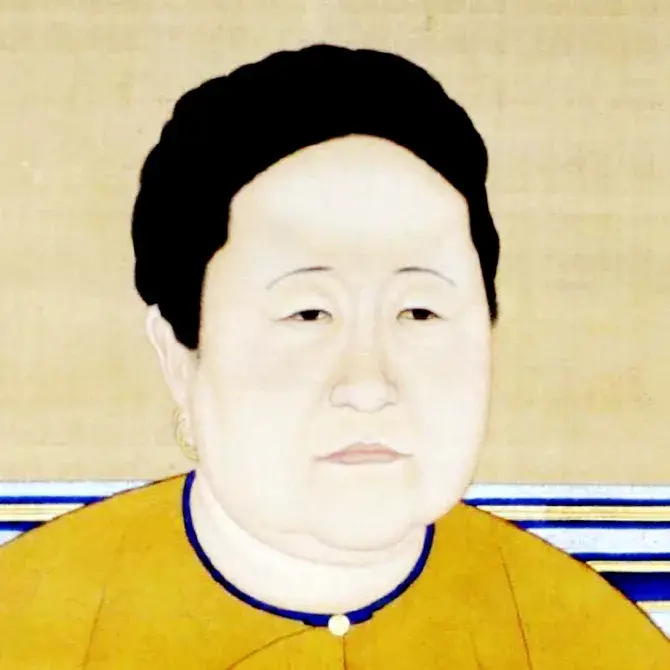
PROFILE
Borjigit Bumbutai (博尔济吉特·布木布泰, March 28, 1613 – January 27, 1688), of the Borjigit clan, personal name Bumbutai (布木布泰), a native of the Mongol Khorchin (科尔沁) tribe (modern Khorchin Left Wing Middle Banner, Tongliao, Inner Mongolia Autonomous Region) and daughter of Khorchin Beile Jaisang (Buhe), was a consort of Emperor Taizong Hong Taiji, biological mother of the Shunzhi Emperor (顺治帝) Fulin, and grandmother of the Kangxi Emperor (康熙帝) Xuanye, known posthumously as Empress Xiaozhuang Wen (孝庄文皇后). Married to Hong Taiji as a secondary consort in the tenth year of the Tianming era of the Later Jin (1625), she was invested as Consort Zhuang of Yongfu Palace in the first year of the Chongde era (1636) and gave birth to the ninth imperial son Fulin in the third year of the Chongde era (1638). After Hong Taiji died suddenly in the eighth year of the Chongde era (1643), she mediated among the Manchu princes to secure Fulin's accession, becoming Empress Dowager; during the Shunzhi reign, she issued the Principles of Rulership to instruct the young sovereign, adopted Kong Sizhen, and arranged marriages with Han feudatory princes. Upon the Shunzhi Emperor's death in the eighteenth year of the Shunzhi era (1661), she selected the eight-year-old third imperial prince Xuanye to ascend the throne, becoming Grand Empress Dowager, refusing to rule from behind a lowered curtain while backing the Four Regents. During the Kangxi reign, she nurtured the young emperor, saved Johann Adam Schall von Bell during the Calendar Case, supported the arrest of Oboi, donated palace savings to reward troops during the Revolt of the Three Feudatories, and recommended General Tuhai to crush the Chahar rebellion before dying on January 27, 1688, at age seventy-five and being interred at the Zhaoxi Mausoleum in 1725.
- Aliases
- Bumbutai (布木布泰), Empress Xiaozhuang Wen (孝庄文皇后), Empress Dowager Zhaosheng, Grand Empress Dowager Zhaosheng
- Posthumous Name
- Empress Xiaozhuang Wen (孝庄文皇后, full posthumous title Empress Xiaozhuang Renxuan Chengxian Gongyi Zhide Chunhui Yitian Qisheng Wen)
- Birthplace
- Khorchin (科尔沁) Mongol Tribe (modern Khorchin Left Wing Middle Banner, Tongliao, Inner Mongolia Autonomous Region)
- Birth Date
- 8th Day, 2nd Month, 41st Year of the Wanli Era (March 28, 1613)
- Death Date
- 25th Day, 12th Month, 26th Year of the Kangxi Era (January 27, 1688)
- Dynasty
- Qing Dynasty (清朝)
- Historical Period
- Late Ming and Early Qing
- Role
- Secondary Consort of Emperor Taizong Hong Taiji (Consort Zhuang of Yongfu Palace), Biological Mother of the Shunzhi Emperor, Grandmother of the Kangxi Emperor, Outstanding Female Stateswoman of the Early Qing
- Highest Office
- Grand Empress Dowager (太皇太后)
- Principal Offices
- Secondary Consort, Western Palace Consort, Consort Zhuang of Yongfu Palace, Empress Dowager (皇太后), Grand Empress Dowager (太皇太后)
- Noble Titles
- Consort Zhuang (庄妃) of Yongfu Palace (永福宫)
BIOGRAPHY
Chronology
- 1613 (41st Year of the Wanli Era) | Birth on the Steppe | Born on the eighth day of the second month into the family of Khorchin Mongol Beile Jaisang (Buhe), a nineteenth-generation descendant of Genghis Khan's younger brother Qasar.
- 1625 (10th Year of the Tianming Era) | Marriage to Hong Taiji | Escorted at age thirteen in the second month by her elder brother Ukšan to Shengjing to marry Fourth Beile Hong Taiji of the Later Jin as a secondary consort.
- 1629 (3rd Year of the Tiancong Era) | Birth of Eldest Daughter | Gave birth on the eighth day of the first month to Hong Taiji's fourth daughter Yatu (later Princess Yongmu of the First Rank), followed in subsequent years by fifth daughter Atu and seventh daughter Shuzhe.
- 1636 (1st Year of the Chongde Era) | Invested as Consort Zhuang | After Hong Taiji proclaimed himself emperor in Shengjing and instituted the Five Palaces of the Chongde era, she was named Western Secondary Consort of Yongfu Palace in the fifth month and formally invested as Consort Zhuang of Yongfu Palace in the seventh month.
- 1638 (3rd Year of the Chongde Era) | Birth of Fulin | Gave birth during the Xu hour on the thirtieth day of the first month in Yongfu Palace at Shengjing to Hong Taiji's ninth son Fulin (the future Shunzhi Emperor).
- 1643 (8th Year of the Chongde Era) | Accession of the Child Emperor | Mediated among Dorgon, Hooge, and the Eight Banner princes after Hong Taiji's sudden death in the eighth month, securing the accession of six-year-old Fulin and receiving the title of Empress Dowager.
- 1644 (1st Year of the Shunzhi Era) | Relocation to Beijing | Moved with the young Shunzhi Emperor from Shengjing into the Forbidden City in Beijing in the ninth month, establishing Qing rule over the Central Plains.
- 1651 (8th Year of the Shunzhi Era) | Issuing Imperial Precepts | Received the honorific title Empress Dowager Zhaosheng Cishou upon the Shunzhi Emperor's assumption of personal rule in the second month and issued the Principles of Rulership to instruct him in governance.
- 1661 (18th Year of the Shunzhi Era) | Enthronement of the Kangxi Emperor | Championed the succession of the eight-year-old third prince Xuanye upon the Shunzhi Emperor's death in the first month, became Grand Empress Dowager, declined curtain regency, and established the Four Regents council.
- 1669 (8th Year of the Kangxi Era) | Fall of Oboi | Intervened to save Johann Adam Schall von Bell during the Calendar Case and supported the young Kangxi Emperor and Songgotu in arresting the domineering regent Oboi.
- 1675 (14th Year of the Kangxi Era) | Recommending Tuhai | Donated inner palace funds to reward soldiers during the Revolt of the Three Feudatories and recommended Grand Secretary Tuhai to swiftly crush the Chahar rebellion of Burni.
- 1688 (26th Year of the Kangxi Era) | Death at Cining Palace | Died of illness in Cining Palace on the twenty-fifth day of the twelfth month (January 27, 1688) at age seventy-five; her coffin was placed in the Hall of Temporary Peace at the Eastern Qing Tombs (rebuilt as the Zhaoxi Mausoleum in 1725).
Biography
Manchu-Mongol Marriage Alliance and Consort Zhuang of Yongfu Palace
Borjigit Bumbutai was born on the eighth day of the second month of the forty-first year of the Wanli era (March 28, 1613) in the Khorchin tribe of the Mongols, as a nineteenth-generation descendant of Genghis Khan's younger brother Qabuqtu Qasar. Her grandfather was Prince Fu of the First Rank Manggūs of the Khorchin tribe, her father was Khorchin Beile Jaisang (Buhe, posthumously enfeoffed as Prince Zhong of the First Rank), and her mother was Secondary Consort Boli (posthumously honored as Consort Xian of the First Rank). In the early seventeenth century, Later Jin Khan Nurhaci and his eighth son Hong Taiji vigorously pursued a policy of Manchu-Mongol marriage alliances to secure their northern strategic rear and unite the Mongol tribes against the Ming dynasty. In the forty-second year of the Wanli era (1614), when Bumbutai was just two years old, her fifteen-year-old aunt Jerjer (the future Empress Xiaoduan Wen) had already married Hong Taiji. In the second month of the tenth year of the Tianming era of the Later Jin (1625), thirteen-year-old Bumbutai was escorted by her elder brother Ukšan to Shengjing (modern Shenyang, Liaoning Province) and formally married Hong Taiji as a secondary consort.
After Hong Taiji succeeded to the position of Khan in the eleventh year of the Tianming era (1626) and inaugurated the Tiancong era (1627–1636), he invested Jerjer as Grand Consort of the Central Palace while naming Bumbutai Western Secondary Consort (Western Palace Consort), ranking second in the inner palace immediately after her aunt Jerjer. On the eighth day of the first month of the third year of the Tiancong era (1629), Bumbutai gave birth to the fourth imperial daughter Yatu (later Princess Yongmu of the First Rank); on the twelfth day of the second month of the sixth year of the Tiancong era (1632), she bore the fifth imperial daughter Atu (later Princess Shuhui of the First Rank); and on the sixteenth day of the eleventh month of the seventh year of the Tiancong era (1633), she bore the seventh imperial daughter (later Princess Shuzhe of the First Rank). During these years, as Jarud Borjigit entered the palace as Eastern Palace Consort in 1632, Bumbutai's twenty-six-year-old elder sister Harjol married Hong Taiji in the tenth month of 1634 and monopolized his favor, and Chahar Lindan Khan's widow Namjung married Hong Taiji in the seventh month of 1635, Bumbutai's standing in the inner palace repeatedly declined.
In the first year of the Chongde era (1636), Hong Taiji proclaimed the Great Qing dynasty in Shengjing, assumed the imperial title, and instituted the Five Palaces of the Chongde era (the Five Grand Consorts). Bumbutai was first named Western Secondary Consort of the secondary western palace, Yongfu Palace (meaning "Palace of Blessings" in Manchu, hūturingga boo), in the fifth month, and in the seventh month she was formally invested as Consort Zhuang of Yongfu Palace (meaning "Dignified Consort," jingji fujin), ranking fifth behind Central Palace Consort Jerjer of Qingning Palace, Consort Chen Harjol of Guanju Palace, Consort Gui Namjung of Linzhi Palace, and Consort Shu Batmadzoo of Yanqing Palace. During the Xu hour on the thirtieth day of the first month of the third year of the Chongde era (March 15, 1638), Bumbutai gave birth to Hong Taiji's ninth son Fulin in Yongfu Palace. Although fifth in palace rank, she paid close attention to Hong Taiji's governance and military strategy. After Qing forces captured Ming Supreme Commander of Jiliao Hong Chengchou at the Battle of Song-Jin in the third month of the seventh year of the Chongde era (1642), popular Qing accounts widely credited Consort Zhuang with visiting the Sanguan Temple bearing ginseng broth to persuade the hunger-striking Hong Chengchou to surrender—a tradition that, while absent from official histories, reflected contemporary recognition of her political acumen in assisting Emperor Taizong to found the dynastic enterprise.
Securing the Shunzhi Succession and Guiding the Young Sovereign
On the ninth day of the eighth month of the eighth year of the Chongde era (1643), Emperor Taizong Hong Taiji died suddenly in Qingning Palace at Shengjing without leaving a will designating his successor. An acute succession crisis immediately erupted within the Qing court: Nurhaci's fourteenth son Prince Rui of the First Rank Dorgon commanded the elite Two White Banners, while Hong Taiji's eldest son Prince Su of the First Rank Hooge enjoyed the backing of generals from the Two Yellow Banners and the Plain Blue Banner. In the immediate aftermath of Hong Taiji's death, Consort Zhuang Bumbutai offered to follow the late emperor in death, prompting the princes and ministers to jointly implore her to remain alive to raise her young son Fulin, thereby stabilizing the position of mother and child. Initially, ministers of the Two Yellow Banners loyal to Hong Taiji proposed enthroning Hooge with Fulin as crown prince, but fierce opposition from the Two White Banners shifted their stance to insisting that an imperial son be enthroned. Assessing the balance of power, Bumbutai actively mediated with Prince Li of the First Rank Daišan, Prince Zheng of the First Rank Jirgalang, and Dorgon, persuading Dorgon to step back from claiming the throne himself in order to avoid internecine conflict and agree to enthrone six-year-old Fulin under the joint regency of Jirgalang and Dorgon. On the twenty-sixth day of the eighth month, Fulin ascended the throne in Shengjing as the Shunzhi Emperor, and Bumbutai was honored alongside her aunt Empress Xiaoduan Wen Jerjer as Empress Dowager.
In the ninth month of the first year of the Shunzhi era (1644), Bumbutai accompanied the young Shunzhi Emperor from Shengjing to Yanjing (modern Beijing), inaugurating Qing rule over China proper. Following Regent Dorgon's death in the winter of the seventh year of the Shunzhi era (1650), the fourteen-year-old Shunzhi Emperor assumed personal rule in the first month of the eighth year of the Shunzhi era (1651), conferring upon his mother the honorific title Empress Dowager Zhaosheng Cishou in the second month and adding "Gongjian" in the eighth month; further additions in 1654 and 1656 expanded her title to Empress Dowager Zhaosheng Cishou Gongjian Anyi Zhangqing, making her the first formally titled Empress Dowager of the Qing dynasty. In the second month of 1651, Bumbutai issued a comprehensive imperial precept to guide her son, reminding him that the sovereign's supreme position was arduous and that the common people formed the foundation of the state: a ruler must appoint worthy talents to govern the people, draw close to loyal officials while shunning flatterers, base appointments on true insight, judge state affairs with thorough deliberation and firm resolve, maintain fair rewards and punishments, shun extravagance, study diligently, and handle state affairs tirelessly. Revering this edict as his personal motto, the Principles of Rulership, the Shunzhi Emperor frequently visited the Inner Three Courts to discuss historical governance with Han grand secretaries, punished corrupt officials, and commissioned Grand Secretary Fu Yijian under his mother's decree to compile the Extended Meaning of the Domestic Regulations (Neize Yanyi).
Throughout the Shunzhi reign, Bumbutai played a stabilizing role in major military, political, and palace affairs. To conciliate the Han feudatory princes, when Prince Dingnan Kong Youde died in battle at Guilin in the ninth year of the Shunzhi era (1652) leaving only his orphaned daughter Kong Sizhen, Bumbutai broke precedent by adopting her into the palace as a Princess of the First Rank (Heshuo Gege); when she intended to make Kong Sizhen an imperial consort in 1656 but learned that her father had already betrothed her to Sun Yanling, Bumbutai respected Kong Sizhen's wishes, summoned Sun Yanling to Beijing to wed her, and granted them a residence outside Donghua Gate. In the tenth year of the Shunzhi era (1653), she married Hong Taiji's fourteenth daughter Princess Kechun to Wu Sangui's son Wu Yingxiong, and in the seventeenth year (1660) she married Prince Chengze Šose's palace-reared daughter Princess Roujia to Shang Kexi's son Shang Zhilong, binding the powerful Han feudatories by affection while keeping their sons-in-law in Beijing as political hostages.
In managing the Shunzhi Emperor's inner palace marriages and imperial clan honors, in accordance with Manchu-Mongol marriage custom, Bumbutai's Khorchin niece Erdeni Bumba was installed as the Shunzhi Emperor's first empress in the eighth month of 1651; when marital discord led the emperor to demand her deposition against the objections of Manchu and Han ministers, he reported to the Empress Dowager in the tenth month of 1653 to demote her to Consort Jing, and in the sixth month of 1654 installed Bumbutai's grandniece (daughter of Khorchin Duke Chuoerji) as Empress Xiaohuizhang. When Bumbutai's mother Boli died in the second month of 1654, the Shunzhi Emperor dispatched officials to offer sacrifices and in the fifth month posthumously enfeoffed his maternal grandfather Buhe as Prince Zhong of the First Rank and Boli as Consort Xian of the First Rank. Later, when the Shunzhi Emperor doted passionately on Consort Donggo, Bumbutai accommodated her son's wishes by approving her elevation to Consort Xian, Imperial Noble Consort, and posthumously Empress Xiaoxian. Meanwhile, Bumbutai practiced strict frugality in the palace, donating forty thousand taels of palace silver for disaster relief in 1654 and thirty thousand taels for Zhili flood victims in 1656. In the seventh month of 1659, when Zheng Chenggong's fleet captured Zhenjiang and besieged Nanjing, the panicked Shunzhi Emperor first wanted to abandon Beijing and retreat beyond Shanhai Pass—earning a stern rebuke from Bumbutai—and then struck his desk with his sword demanding to lead troops in person, which Bumbutai prevented only through urgent persuasion alongside his wet nurse and missionaries. When Consort Donggo died in 1660 and the grief-stricken emperor sought to shave his head and become a monk, Bumbutai again restrained him and preserved the stability of the court.
Major Achievements
Enthroning the Kangxi Emperor and Resolving the Regency Crisis
In the early first month of the eighteenth year of the Shunzhi era (1661), the twenty-four-year-old Shunzhi Emperor contracted smallpox and his condition rapidly deteriorated. At this critical juncture for the imperial succession, the dying emperor initially considered passing the throne to an adult cousin or his second son Fuquan so that the state would have a mature ruler, but Empress Dowager Bumbutai firmly insisted on enthroning the eight-year-old third imperial son Xuanye. With farsighted judgment, Bumbutai—supported by the counsel of Directorate of Imperial Astronomy Director Johann Adam Schall von Bell—pointed out that Xuanye was not only exceptionally intelligent but had already survived smallpox in early childhood, giving him lifelong immunity against the deadly disease. Yielding to his mother's decision, the Shunzhi Emperor summoned former Academician Maleji and Academician Wang Xi to Yangxin Hall on the sixth day of the first month (the day before his death) to draft his final testament naming third son Xuanye Crown Prince.
At the same time, drawing on the bitter lesson of Imperial Clansman Regent Dorgon's autocratic domination during the early Shunzhi years, Bumbutai directed that the imperial testament exclude royal princes from the regency and instead appoint four veteran ministers from the Upper Three Banners—Sonin, Suksaha, Ebilun, and Oboi—as the Four Regents. All four had enjoyed Bumbutai's special trust during the Shunzhi Emperor's personal rule: Sonin had long served as Chief Minister of the Imperial Household Department and Chamberlain of the Imperial Bodyguard, while Oboi and Ebilun served as Commanders of the Imperial Bodyguard of the Upper Three Banners and Deliberative Ministers, regularly relaying Bumbutai's instructions to the emperor and guarding her day and night during her illness. On the seventh day of the first month, the Shunzhi Emperor died, Xuanye ascended the throne as the Kangxi Emperor, and Bumbutai was honored as Grand Empress Dowager, receiving the honorific title Grand Empress Dowager Zhaosheng Cishou Gongjian Anyi Zhangqing Dunhui in the eighth month of the first year of the Kangxi era (1662). When Tongcheng County licentiate Zhou Nan traveled to Beijing in the third month of 1661 to submit a ten-point memorial urging her to "rule from behind a lowered curtain," Bumbutai flatly refused on the grounds of Manchu ancestral institutions, choosing instead to maintain political stability from behind the scenes through the Four Regents system.
During the early Kangxi years, serious rifts emerged among the Four Regents, with Oboi of the Bordered Yellow Banner growing increasingly domineering and factional, yet Bumbutai repeatedly used her supreme authority to defuse crises and safeguard imperial power. Early in the fourth year of the Kangxi era (1665), when the court deliberated on selecting an empress for the Kangxi Emperor, Bumbutai chose Lady Hešeri (Empress Xiaochengren), granddaughter of senior regent Sonin, in order to counterbalance Oboi with the strength of Sonin's clan. Oboi fiercely opposed the match, threatening that weapons would be drawn if Gabula's (Sonin's son's) daughter were made empress, declaring that the daughter of a Manchu subordinate could never become empress, and pressuring Ebilun and Suksaha to join him in protesting at Cining Palace; Bumbutai sternly rebuffed him on the spot—"Why cannot a Manchu daughter be established as Empress? My mind is made up; there shall be no further discussion!"—quelling the dispute and securing the absolute loyalty of Sonin's family for the young sovereign.
Subsequently, Oboi and his follower Ebilun clashed sharply with Plain White Banner regent Suksaha over the forced exchange of Banner lands enclosed in the early Qing. Unwilling to be drawn into their feud, Sonin joined Oboi in the third month of the sixth year of the Kangxi era (1667) in memorializing for the Kangxi Emperor to assume personal rule; considering the emperor still young, Bumbutai initially instructed them to wait another year or two, but after Sonin died of illness in the sixth month, she decreed in the seventh month that the fourteen-year-old Kangxi Emperor assume personal rule while instructing the remaining regents to continue assisting him. Refusing to relinquish power, Oboi had Suksaha executed against the emperor's wishes and backed conservative officials in the ensuing Calendar Case, sentencing Johann Adam Schall von Bell—compiler of the Shixian Calendar—and others to death by slow slicing. When an earthquake struck Beijing and a fire broke out in the palace, Bumbutai personally intervened, summoning the regents to declare: "Johann Adam Schall von Bell is a meritorious minister of the late Emperor who has committed no fault in twenty years; is it not excessive for you to put him to death? He must be released immediately in response to Heaven's warning." Her intervention saved Schall von Bell's life. In the fifth month of the eighth year of the Kangxi era (1669), with Bumbutai's covert backing, the Kangxi Emperor transferred Sonin's second son Songgotu from Vice Minister of Personnel to First-Class Imperial Bodyguard at his side and used young guardsmen to arrest Oboi in Wuying Hall, eliminating the regent's faction.
Nurturing the Kangxi Emperor, Pacifying Rebellions, and Posthumous Honors
Orphaned of his father at age eight and of his mother (Empress Xiaokangzhang of the Tongjia clan) at age ten in 1663, the Kangxi Emperor Xuanye was raised and educated directly by his grandmother Bumbutai. As the Kangxi Emperor later recalled, from the moment he learned to walk and speak he received the benevolent instruction of his imperial grandmother. Deeply fond of books and histories herself, Bumbutai combined warm affection with strict discipline regarding his moral cultivation and daily conduct, requiring that his diet, speech, and deportment conform to ritual propriety and rebuking any lapse. Under her personal guidance, the Kangxi Emperor developed a lifelong passion for study, reading day and night through winter and summer to the point of forgetting food and sleep—immediately reclaiming his books whenever his wet nurse Lady Piao hid them out of concern for his health—so that Bumbutai half-anxiously chided him for studying like an examination candidate despite being the Son of Heaven.
When the eight-year-old Kangxi Emperor first ascended the throne, Bumbutai asked him in front of the assembled ministers what desire he held as lord of the realm, to which the boy emperor replied: "Your subject has no other desire, wishing only that the realm be at peace, the people rejoice in their livelihoods, and all share the blessings of tranquility"—an exchange the emperor remembered fifty years later in an edict to the Ministry of Revenue. After the Kangxi Emperor assumed full personal rule, Bumbutai upheld the principle of non-interference in routine administration, yet whenever major appointments or state policies arose, the emperor visited Cining Palace before or after morning court—sometimes up to three times a day—to pay his respects and receive her strategic counsel. At the end of the eleventh year of the Kangxi era (1672), she admonished him to "remember peril in times of peace and maintain military training during leisure," adding that "the way of a ruler lies above all in impartial and open-minded judgment." When the Hanlin Academy presented the printed Manchu translation of the Extended Meaning of the Great Learning (Daxue Yanyi) in the second month of 1673, Bumbutai rejoiced and awarded one thousand taels of inner palace silver to the translators to encourage her grandson in self-cultivation and statecraft.
After Wu Sangui and others launched the Revolt of the Three Feudatories in the winter of the twelfth year of the Kangxi era (1673), Bumbutai firmly supported the Kangxi Emperor's campaign to suppress the rebellion, repeatedly donating silver saved from Cining Palace expenses to the Ministry of War to reward frontline soldiers and disbursing palace savings to relieve famine victims during years of drought or flood. In the spring of the fourteenth year of the Kangxi era (1675), taking advantage of the southward deployment of Qing main forces against the Three Feudatories and the weakened defenses of the capital, Burni of the Chahar Mongols stationed at Yizhou beyond Shanhai Pass rose in rebellion, directly threatening Beijing. Seeing the Kangxi Emperor's deep anxiety, Bumbutai calmly nominated a commander: "Tuhai possesses outstanding talent and strategy; he can bear this responsibility!" The Kangxi Emperor immediately appointed Zhonghe Hall Grand Secretary Tuhai as General Who Pacifies the Distant, who led tens of thousands of elite household bondservants of the Eight Banners beyond the pass and crushed Burni's rebellion within months, averting a two-front crisis. Upon the complete suppression of the Revolt of the Three Feudatories in the twentieth year of the Kangxi era (1681), the Kangxi Emperor declined his ministers' request to confer an honorific title upon himself and insisted on elevating his grandmother's title; though Bumbutai modestly demurred that as a woman she had no merit toward officials or people, she ultimately accepted the twenty-character honorific title Grand Empress Dowager Zhaosheng Cishou Gongjian Anyi Zhangqing Dunhui Wenzhuang Kanghe Renxuan Hongjing.
Having lived in close companionship for over thirty years, Bumbutai shaped everything from the Kangxi Emperor's statecraft to his personal habits of abstaining from tobacco and limiting alcohol, forging an extraordinary bond between grandmother and grandson. During his eastern tour to Shengjing in the spring of 1682, the Kangxi Emperor sent couriers almost daily to inquire after her health and sent silver carp and crucian carp he had caught himself sealed in sheep fat to Beijing for her table; when accompanying her to Mount Wutai in the autumn of 1683, he alighted from his palanquin at every steep slope to walk beside and steady her carriage. When seventy-five-year-old Bumbutai fell critically ill on the twenty-first day of the eleventh month of the twenty-sixth year of the Kangxi era (1687), the emperor waited upon her day and night in Cining Palace for over thirty consecutive days—attending court at Qianqing Gate only during the Chen hour before returning immediately, consulting medical texts, personally preparing her medicine, sleeping on the floor without unfastening his belt, and instructing the Grand Secretariat to report only urgent state matters—and even led princes and ministers on foot to the Temple of Heaven to weep and pray that Heaven shorten his own life to prolong his grandmother's years.
On the twenty-fifth day of the twelfth month of the twenty-sixth year of the Kangxi era (January 27, 1688), Bumbutai died peacefully in Cining Palace at age seventy-five. In her final testament, she urged the Kangxi Emperor to restrain his grief for the sake of myriad state affairs and instructed: "The mountain mausoleum of Emperor Taizong Wen has long been at peace and must not be lightly disturbed on my account; moreover, in my heart I cannot bear to part from you father and son, so choose a burial site near the Xiao Mausoleum." Grief-stricken, the Kangxi Emperor lived on a mat in a temporary tent outside Qianqing Gate for nearly half a year before her coffin was moved to the Eastern Tombs, and mourned her for the rest of his life, often dreaming of her counsel during his campaigns against Galdan and the deposition of Crown Prince Yinreng. Honoring her wish, the Kangxi Emperor did not send her coffin to the Zhao Mausoleum in Shengjing, instead dismantling five bays of her favorite Eastern Hall of Cining Palace and rebuilding them outside the Great Red Gate of the Eastern Qing Tombs in Zunhua, Hebei as the "Hall of Temporary Peace" while conferring the posthumous title Empress Xiaozhuang Wen (later expanded to twenty characters under the Yongzheng and Qianlong emperors). Thirty-seven years later, in the third year of the Yongzheng era (1725), the Yongzheng Emperor converted the Hall of Temporary Peace into the highest-ranking independent empress mausoleum of the Qing dynasty—the Zhaoxi Mausoleum—and interred her coffin in the underground palace in the twelfth month. Modern historians led by Meng Sen (Verification of the Empress Dowager's Remarriage) have demonstrated that late-Qing rumors claiming she remarried Regent Dorgon originated from satirical poems by Ming loyalist Zhang Huangyan, as the title "Imperial Father Regent" paralleled ancient honorifics like "Uncle Father" (Zhongfu) or "Revered Father" (Shangfu) and her separate burial stemmed from Empress Xiaoduan Wen already resting in the Zhao Mausoleum.
Personal Relationships
- Husband: Aisin Gioro Hong Taiji (Emperor Taizong Wen of Qing, second Khan of the Later Jin and founding emperor of the Qing dynasty, who married Bumbutai as a secondary consort in 1625 and invested her as Consort Zhuang of Yongfu Palace in 1636)
- Son: Aisin Gioro Fulin (Emperor Shizu of Qing, the Shunzhi Emperor, ninth imperial son born to Bumbutai and Hong Taiji, who ascended the throne at age six in 1643 through his mother's mediation and honored her as Empress Dowager)
- Grandson: Aisin Gioro Xuanye (Emperor Shengzu of Qing, the Kangxi Emperor, third son of the Shunzhi Emperor, whom Bumbutai selected for the throne and raised for over thirty years, honoring her as Grand Empress Dowager)
- Father: Borjigit Buhe (also known as Jaisang, Beile of the Khorchin Mongol tribe, posthumously enfeoffed by the Qing court in the fifth month of 1654 as Prince Zhong of the First Rank)
- Mother: Boli (Secondary Consort of the Khorchin Mongol tribe and biological mother of Bumbutai, posthumously honored as Consort Xian of the First Rank after her death in 1654)
- Aunt: Borjigit Jerjer (Empress Xiaoduan Wen, Grand Consort of the Central Palace under Hong Taiji, honored alongside her niece Bumbutai as Empress Dowager during the Shunzhi reign)
- Elder Sister: Borjigit Harjol (Primary Consort Minhui Gonghe, invested as Consort Chen of Guanju Palace in 1636 and deeply favored by Hong Taiji)
- Elder Brother: Borjigit Ukšan (Prince Joriqtu of the First Rank of the Khorchin tribe, who escorted his thirteen-year-old sister Bumbutai to Shengjing to marry Hong Taiji in 1625)
- Adoptive Daughter: Kong Sizhen (orphaned daughter of Prince Dingnan Kong Youde, adopted into the palace by Bumbutai in 1652 as a Princess of the First Rank and married to Sun Yanling in accordance with her own wishes)
- Confidential Attendant: Sumalagu (originally named Sumoer, Khorchin-born personal attendant who accompanied Bumbutai for over sixty years and served as the young Kangxi Emperor's Manchu tutor)
- Brother-in-Law and Political Ally: Aisin Gioro Dorgon (Prince Rui of the First Rank, younger half-brother of Hong Taiji, who relinquished his bid for the throne in 1643 through Bumbutai's mediation to support Fulin and served as Regent in the early Shunzhi reign)
- Senior Regent: Sonin (Duke of the First Class and Chief Minister of the Imperial Household Department, appointed by Bumbutai as head of the Four Regents in 1661 and grandfather of the Kangxi Emperor's Empress Xiaochengren)
- Domineering Regent: Oboi (one of the Four Regents of the early Kangxi reign who opposed the empress selection and instigated the Calendar Case before being arrested by the Kangxi Emperor in 1669 with Bumbutai's backing)
Historical Evaluations
- Aisin Gioro Xuanye (the Kangxi Emperor), Veritable Records of Emperor Shengzu Ren of the Great Qing (Da Qing Shengzu Ren Huangdi Shilu, Volume 131), prayer and investiture text: "Reverently considering My sacred grandmother Empress Dowager Zhaosheng Cishou Gongjian Anyi Zhangqing, her benevolence upholds the virtue of Heaven and her compliance harmonizes with the model of Earth. She assisted My imperial grandfather Emperor Taizong Wen in founding the great enterprise, and guided My imperial father Emperor Shizu Zhang in establishing the capital in the Central Plains... Recalling from My tender years when I lost both parents early, I waited upon My grandmother for more than thirty years, nurtured and instructed until I reached maturity. Had it not been for My grandmother the Grand Empress Dowager, I could never have achieved what I have today; such boundless grace can hardly be repaid in a lifetime."
- Aisin Gioro Yinzhen (the Yongzheng Emperor), Veritable Records of Emperor Shizong Xian: "She united the filial devotion of two reigns and reached the pinnacle of revered kinship across three generations."
- Zhao Erxun et al., Draft History of Qing (Qing Shi Gao, Volume 214, "Biographies of Empresses and Consorts"): "Both Shizu and Shengzu ascended the throne in early childhood, yet under Empress Xiaozhuang no one at the time ever proposed ruling from behind a lowered curtain. Through deep solicitude she enlightened the sage sovereigns, thereby pacifying the Central Plains and achieving an era of great peace."
Related Entries
- Aisin Gioro Hong Taiji
- Aisin Gioro Fulin
- Aisin Gioro Xuanye
- Empress Xiaoduan Wen
- Aisin Gioro Dorgon
- Sonin
- Oboi
- Zhaoxi Mausoleum