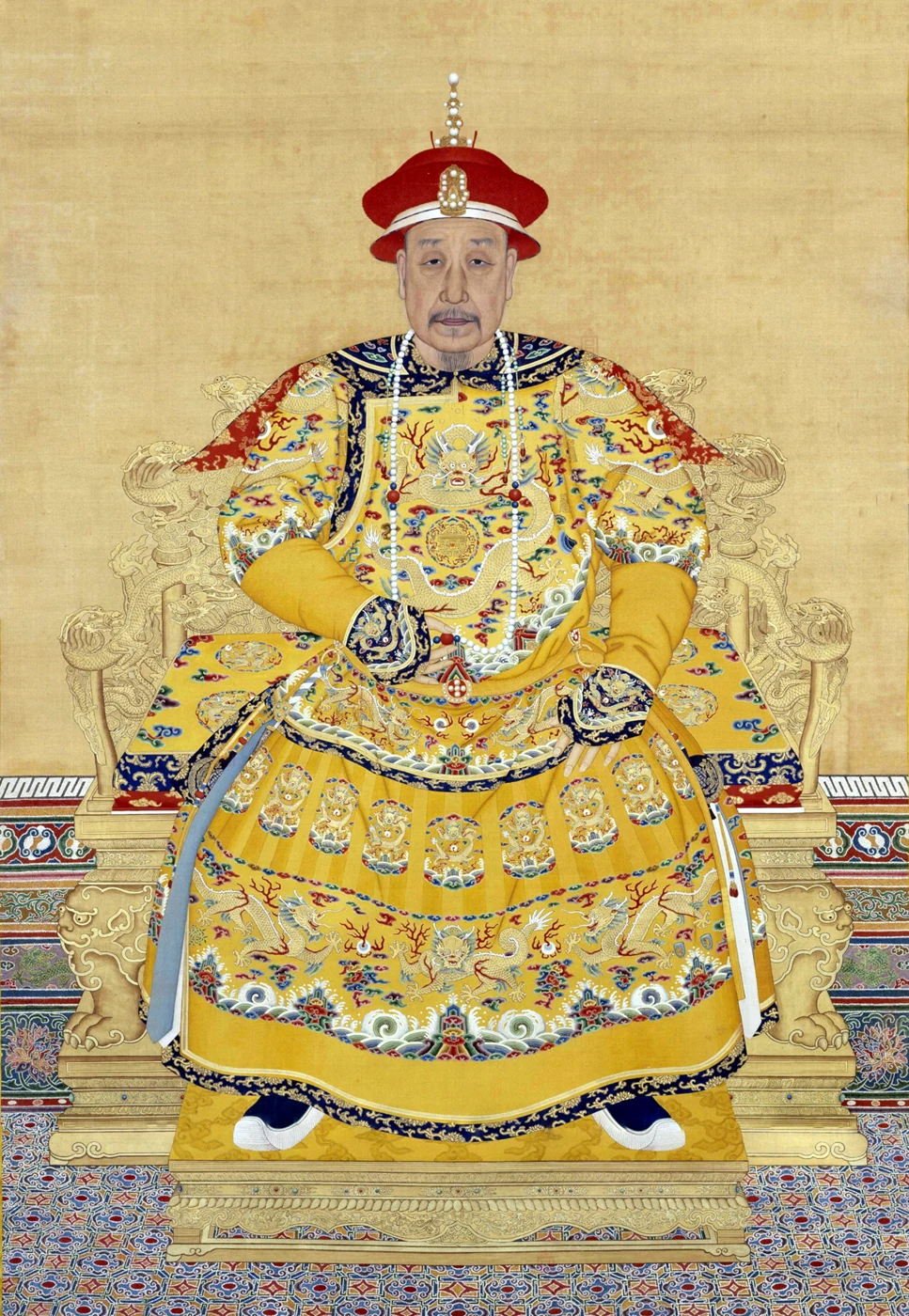
Later artistic depiction of Aisin Gioro Hongli in a historical painting or book illustration.

1711 CE–1799 CE

Emperor

Aisin Gioro Hongli

爱新觉罗·弘历

Aisin Gioro Hongli (September 25, 1711–February 7, 1799) was an Emperor of the Qing Dynasty whose era name was Qianlong and whose temple name was Gaozong. He was the fourth son of the Yongzheng Emperor. He ascended the throne in 1735. In 1795 he announced Yongyan, his fifteenth son, as heir and set the date for his abdication the following year. He transferred the throne to Yongyan on February 9, 1796, and continued to handle…

1711 CE–1799 CEQing Dynasty

PROFILE

Aisin Gioro Hongli (September 25, 1711–February 7, 1799) was an Emperor of the Qing Dynasty whose era name was Qianlong and whose temple name was Gaozong. He was the fourth son of the Yongzheng Emperor. He ascended the throne in 1735. In 1795 he announced Yongyan, his fifteenth son, as heir and set the date for his abdication the following year. He transferred the throne to Yongyan on February 9, 1796, and continued to handle military and state affairs as a retired emperor until his death in 1799. During the early and middle portions of his rule, the Qing court strengthened its control over parts of the northwestern and southwestern frontiers through repeated wars and institutional adjustments. The court also remitted taxes and grain levies, carried out disaster relief and water control works, and sponsored the compilation of the *Siku Quanshu*. These policies and military operations were accompanied by the costs of warfare and requisition, as well as book prohibitions, destruction of texts, and literary inquisitions. In the later Qianlong period, Heshen rose in favor, problems in administrative reform intensified, and uprisings including those associated with the White Lotus exposed difficulties in local governance and the system of military administration. Any assessment of Hongli therefore needs to consider both the expansion of Qing rule, institutional development, and cultural projects and the costs of autocratic control, warfare, and late-reign political problems.

Era
Qing
Dynasty/Regime
Qing
Identity
Emperor
Date of Birth
September 25, 1711 CE(50th year of the Kangxi era, 8th month, 13th day)
Date of Death
February 7, 1799 CE(4th year of the Jiaqing era)
Ethnicity
Manchu
Clan
Aisin Gioro clan
Ancestral Home
Not reliably confirmed in historical sources
Place of Birth
Place of birth unknown
Reign
Reign dates unknown
Period
Qing Dynasty;Qing
Birthplace
Prince Yong's residence in Beijing (another tradition places his birth at the Chengde Mountain Resort; the question remains disputed);February 7, 1799(third day of the first month, fourth year of Jiaqing)
Place of Death
Hall of Mental Cultivation, Forbidden City, Beijing;October 18, 1735–February 9, 1796(third day of the ninth month, 13th year of Yongzheng–first day of the first month, first year of Jiaqing); continued to direct major military and state affairs after abdication until 1799
Posthumous Title
Fati Longyun Zhicheng Xianjue Tiyuan Liji Fuwen Fenwu Qinming Xiaoci Shensheng Chun Huangdi;Emperor Emeritus (after abdication in 1796)
Predecessor
Aisin Gioro Yinzhen (Yongzheng Emperor);Aisin Gioro Yongyan (Jiaqing Emperor)
Mausoleum
Yuling, Eastern Qing tombs;Emperor; Emperor Emeritus
Main Achievements
Conducted the Dzungar–Qing Wars and campaigns in the southern Tianshan region and expanded frontier administration of the Qing Dynasty; adjusted parts of the administrative systems in Tibet and Xinjiang; sponsored the compilation of the *Siku Quanshu*; repeatedly remitted taxes and grain levies and promoted water control and disaster-relief measures

LIFE TIMELINE

Birth | The Kangxi Emperor met Hongli at Prince Yong's residence and oOpen

Birth | The Kangxi Emperor met Hongli at Prince Yong's residence and ordered that he enter the palace for study and receive training in riding, archery, and firearms.

Heir apparent period | The Yongzheng Emperor secretly designated HonglOpen

Heir apparent period | The Yongzheng Emperor secretly designated Hongli as heir and placed the sealed edict behind the "Zhengda Guangming" plaque in Qianqing Palace.

Imperial prince | Married Empress Fuca, later Empress Xiaoxianchun.Open

Imperial prince | Married Empress Fuca, later Empress Xiaoxianchun.

Imperial prince | Enfeoffed as Prince Bao of the First Rank and took pOpen

Imperial prince | Enfeoffed as Prince Bao of the First Rank and took part in military affairs and matters concerning the Miao frontier.

Eve of accession | The Yongzheng Emperor died at the Old Summer PalaceOpen

Eve of accession | The Yongzheng Emperor died at the Old Summer Palace; after the secret succession edict was opened, Hongli was proclaimed successor.

Accession | Hongli ascended the imperial throne in the Hall of SupremeOpen

Accession | Hongli ascended the imperial throne in the Hall of Supreme Harmony; the following year became the first year of Qianlong.

Military action | Qing forces launched the First Jinchuan campaign andOpen

Military action | Qing forces launched the First Jinchuan campaign and, after years of mobilization, brought the Greater Jinchuan area under control; the war imposed substantial military expenditure and personnel losses.

Tibetan politics | Gyurme Namgyal launched a rebellion; the Qing courtOpen

Tibetan politics | Gyurme Namgyal launched a rebellion; the Qing court subsequently sent troops to suppress it and adjusted the political system in Tibet the following year.

Frontier administration | The Qing court reorganized Tibetan administrOpen

Frontier administration | The Qing court reorganized Tibetan administration, established the Kashag, and defined its political relationship with the imperial residents in Tibet and the Dalai Lama.

Military action | Qing forces entered Dzungar territory and defeated fOpen

Military action | Qing forces entered Dzungar territory and defeated forces associated with Dawachi and Amursana, after which the court continued to reorganize local administration.

Military action | Qing forces suppressed the Revolt of the Altishahr KOpen

Military action | Qing forces suppressed the Revolt of the Altishahr Khojas in the southern Tianshan region and subsequently established institutions of military administration there.

Foreign war | Qing hostilities with Burma ended in a negotiated settleOpen

Foreign war | Qing hostilities with Burma ended in a negotiated settlement. Qing armies had suffered heavy losses in repeated campaigns, and the result cannot be reduced to a unilateral victory.

Frontier resettlement | After the Torghuts returned east, leaders inclOpen

Frontier resettlement | After the Torghuts returned east, leaders including Ubashi came to court; the Qing conferred titles on them and arranged grazing lands for their followers.

Military action | Qing forces launched the Second Jinchuan campaign anOpen

Military action | Qing forces launched the Second Jinchuan campaign and, after prolonged fighting, brought Greater and Lesser Jinchuan under control; military expenditures and personnel losses were heavy.

Cultural project | Ordered the establishment of a bureau to compile thOpen

Cultural project | Ordered the establishment of a bureau to compile the *Siku Quanshu*, a project that took many years of copying, editing, and collation.

Military action | The Qing court dispatched troops to suppress the LinOpen

Military action | The Qing court dispatched troops to suppress the Lin Shuangwen uprising in Taiwan and ultimately restored control over the island.

Foreign war | Qing forces entered Annam and initially reached Thăng LoOpen

Foreign war | Qing forces entered Annam and initially reached Thăng Long, but after facing a counterattack the Qing court turned to negotiations with the regime of Nguyễn Huệ.

Frontier war | Gurkha forces twice entered Tibet; Qing armies counteraOpen

Frontier war | Gurkha forces twice entered Tibet; Qing armies counterattacked and compelled a settlement, after which the Qing court adjusted Tibetan defence policy and regulations.

Diplomatic event | A British mission led by George Macartney came to tOpen

Diplomatic event | A British mission led by George Macartney came to the Qing court; the British side did not obtain the ritual and commercial arrangements it sought.

Succession announced | Declared his fifteenth son Yongyan crown princeOpen

Succession announced | Declared his fifteenth son Yongyan crown prince and set the transfer of the throne for the following year.

Abdication | Transferred the throne to Yongyan, who became the JiaqingOpen

Abdication | Transferred the throne to Yongyan, who became the Jiaqing Emperor, and assumed the title Emperor Emeritus while retaining control over major state affairs.

Death | Died in the Hall of Mental Cultivation in the Forbidden City aOpen

Death | Died in the Hall of Mental Cultivation in the Forbidden City and was buried at Yuling; he had continued to exercise effective decision-making authority during his period as a retired emperor.

During the Annam war of 1788–1789 | During the Annam war of 1788–1789,Open

During the Annam war of 1788–1789 | During the Annam war of 1788–1789, Qing forces initially entered Thăng Long but encountered a counterattack, after which the court negotiated with Nguyễn Huệ.

Gurkha forces entered Tibet in 1788 and again in 1791. | Gurkha forcesOpen

Gurkha forces entered Tibet in 1788 and again in 1791. | Gurkha forces entered Tibet in 1788 and again in 1791.

In 1793 | In 1793, the Macartney Embassy came to the Qing court, and dOpen

In 1793 | In 1793, the Macartney Embassy came to the Qing court, and disagreements arose over court ritual and British requests concerning trade.

On October 15 | On October 15, 1795, he declared his fifteenth son YonOpen

On October 15 | On October 15, 1795, he declared his fifteenth son Yongyan crown prince and set the date for abdication the following year.

Abdication | On February 9, 1796, he transferred the throne to YongyanOpen

Abdication | On February 9, 1796, he transferred the throne to Yongyan, the Jiaqing Emperor, and assumed the title Emperor Emeritus.

Death | Hongli died on February 7, 1799, in the Hall of Mental CultivaOpen

Death | Hongli died on February 7, 1799, in the Hall of Mental Cultivation in the Forbidden City.

BIOGRAPHY

Biography

Family Background, Education, and Experience as Heir Hongli was born on the 13th day of the eighth month in the 50th year of Kangxi. The *Draft History of Qing* records him as the fourth son of Emperor Shizong, born to Empress Xiaoshengxian, and states that he was born at Prince Yong's residence. the "Ruyi Room" of the eastern study in the residence, while The existing sources do not resolve the dispute over his birthplace. The information card therefore follows the *Draft History of Qing* and one account while not expanding the alternative tradition into a certain fact. According to the *Draft History of Qing*, after meeting Hongli, the Kangxi Emperor ordered him to enter the palace for study under the Hanlin scholar Fumin and to learn riding, archery, and firearms. In 1723, the Yongzheng Emperor secretly designated Hongli as heir. In 1733, Hongli was enfeoffed as Prince Bao of the First Rank. In the later Yongzheng period, he became involved in affairs concerning the Miao frontier and military matters in the northwest. These experiences indicate that he had already taken on government responsibilities before accession, although the details should remain limited to what the cited sources record. ### Accession and Early Government On October 8, 1735, the Yongzheng Emperor died at the Old Summer Palace. Hongli succeeded under the secret-heir system and on October 18 of the same year formally ascended the imperial throne in the Hall of Supreme Harmony, designating the following year as the first year of Qianlong. His mother, of the Niohuru clan, was honored as Empress Dowager Chongqing. Early in his reign, Hongli handled some unfinished business from the Yongzheng period in a relatively lenient manner while retaining centralized imperial control over appointments, memorials, and military and state affairs. Sources summarize his early approach as a combination of leniency and severity and record measures including correcting auspicious-omen memorials, handling political cases inherited from the previous reign, and providing relief during droughts. His government was not simply lenient: the court continued to strengthen decision-making control through the Grand Council and the bureaucracy at all levels, while literary inquisitions and bans on books increasingly became instruments of rule. ### Frontier Wars and Expansion of the Area under Qing Rule Several wars in the middle Qianlong period changed the Qing court's control over the northwestern and southwestern frontiers. After Qing forces entered Dzungar territory in 1755, fighting continued around Amursana's resistance. From 1758 to 1759, Qing armies then suppressed the Revolt of the Altishahr Khojas in the southern Tianshan region. After the wars, the Qing established garrisons and administrative institutions in Xinjiang, employed local begs in governance, and maintained rule through a combination of imperial residents, military forces, and existing local institutions. The military victories enlarged the area under the control of the Qing Dynasty, but the ensuing garrison troops, provisions, transport, and local administration created long-term costs. The administration of Tibet also underwent institutional changes. In 1750, the Gyurme Namgyal incident produced political turmoil in Lhasa. After the incident was suppressed, the Qing court reorganized Tibetan administration in 1751, established the Kashag, and strengthened institutional arrangements for participation by the imperial residents in government affairs. Gurkha forces entered Tibet in 1788 and again in 1791. Qing armies under Fuk'anggan and others counterattacked and reached a settlement in 1792. The Qing court subsequently promulgated the *Imperially Approved Regulations for the Better Governing of Tibet*, adjusting frontier defence and external affairs and prescribing institutions including selection by the Golden Urn. These policies increased Qing intervention, but they should not be equated with direct central administration of every aspect of local society. Hongli called himself the "Old Man of the Ten Complete Victories" and collectively described ten military operations as the Ten Great Campaigns. They included campaigns against the Dzungars, the Revolt of the Altishahr Khojas, the two Jinchuan wars, the Lin Shuangwen uprising in Taiwan, and wars involving Burma, Annam, and the Gurkhas. Their outcomes differed. The Dzungar and southern Tianshan campaigns brought changes in territory and governing structures. The two Jinchuan wars lasted for years and consumed large amounts of money and manpower. The Burma war ended in negotiation. In Annam, Qing forces entered Thăng Long but then encountered a counterattack, after which the court shifted to a settlement with Nguyễn Huệ. The Gurkha wars ended with a Qing counterattack and an agreement by the other side. "Ten Complete Victories" was therefore Hongli's own collective description of these wars; it does not mean that every campaign ended in the same kind of victory or at proportionate cost. ### Economic Measures, Relief, and Local Administration Hongli continued Qing policies emphasizing agriculture and encouraging land reclamation. the amount of recorded cultivable land increased from more than 6.83 million qing in 1724(second year of Yongzheng) to more than 7.41 million qing in 1766(31st year of Qianlong). This figure reflects the statistical basis used by the source and cannot directly be treated as evidence that land productivity increased at the same rate. The court also encouraged migration and cultivation, promoted high-yield crops, and carried out water control and river works in different regions. During Hongli's six southern tours, he repeatedly inspected water control works and sea walls. The tours also served purposes of travel, ritual, and relations with local elites, while the supply requirements of the imperial entourage and construction along the routes imposed burdens on localities. The Qing court repeatedly remitted land taxes and grain tribute during the Qianlong reign and used soup kitchens, grain relief, and work relief in response to disasters. relief regulations were formulated in 1740(fifth year of Qianlong) and that work relief was implemented in various years in Zhili, Shandong, Jiangxi, Henan, Gansu, and other areas. Such policies show sustained court involvement in famine relief, but whether tax remission and aid reached disaster victims also depended on local officials and the condition of fiscal collection. As problems in local fiscal administration and administrative reform worsened late in the reign, institutional arrangements did not eliminate embezzlement, concealment, and other abuses at the local level. ### Cultural Projects and Ideological Control In 1773, Hongli ordered the compilation of the *Siku Quanshu*. Organized into the four traditional divisions of Classics, Histories, Masters, and Collections, the project involved collecting books, collation, copying, and compilation over many years and produced a vast imperially sponsored collection. Different sources give somewhat different totals for the number of works and the date of completion, so this article does not merge them into a single precise figure. The Qianlong court also compiled institutional texts, geographical works, and catalogues of antiquities. Hongli himself left a very large body of poetry and prose, inscriptions on painting and calligraphy, and collectors' seals. The scale of his literary production was enormous, but quantity alone does not determine literary quality. The compilation of the *Siku Quanshu* was accompanied by bans and destruction of books. the Qianlong court prohibited and destroyed many works on grounds such as offensive or rebellious content and that numerous literary inquisition cases occurred. These policies served imperial authority and control over historical narratives, resulting in the loss of texts and encouraging scholars to avoid risk. Hongli thus both supported imperially sponsored textual and court culture and restricted writings judged unacceptable to the regime; both aspects should be presented together. ### Later Years, Abdication, and Death In the later Qianlong period, Heshen accumulated considerable power. Hongli did not entirely refrain from punishing corruption; the sources cite cases such as the Gansu false-relief scandal. Yet in the later part of his reign, a network centered on court strongman figures and corruption among local officials continued to expand. Historical materials on the later Qing Dynasty also criticize the late administration and the aging emperor's failures of oversight. In the 1790s, the court committed military forces to suppress uprisings including those associated with the White Lotus, revealing pressures in fiscal administration, military administration, and local governance beneath an earlier appearance of prolonged stability. Hongli had promised not to reign longer than the Kangxi Emperor. On October 15, 1795, he declared his fifteenth son Yongyan crown prince and set the date for abdication the following year. On February 9, 1796, he transferred the throne to Yongyan, the Jiaqing Emperor, and assumed the title Emperor Emeritus. Although the Jiaqing Emperor was now formally on the throne, Hongli continued to control major military and state decisions and important appointments, and the palace for a time continued to use the Qianlong calendar. Hongli died on February 7, 1799, in the Hall of Mental Cultivation in the Forbidden City. He was later given the temple name Emperor Gaozong of Qing and buried at Yuling in the Eastern Qing tombs.

His Life Before the Throne and the Kangxi Emperor's Favour

Hongli's accession was closely bound up with the favour of his grandfather, the Kangxi Emperor. The Qing shi gao, in the first annals of Gaozong, records that Hongli had a high nose and a tall body, and that the Sage Ancestor, seeing him, loved him and had him study in the palace under the Hanlin bachelor Fu Min, reciting from memory what he had read; that he learned archery from the prince Yunxi and firearms from Prince Zhuang, Yunlu. In the autumn hunt at Mulan he was ordered by the emperor's guard to shoot at a bear; no sooner had he mounted than the bear started up, and Hongli held the reins unmoved, while the Sage Ancestor shot the bear with his own gun and, entering the military tent, turned and told the Dowager Consort Wenhui that his destiny was precious and his fortune would surpass his own. Some scholars hold that Yongzheng's accession owed much to Hongli, and that it was because Kangxi thought well of Hongli that Yongzheng became emperor; that Kangxi had ninety-seven grandsons of whom very few were brought up in the palace and taught in person, and Hongli was one; that at their first meeting Kangxi felt a great affection for him and loved him greatly; and that Hongli afterwards wrote poems several times in his imperial collections recalling the harmony between grandfather and grandson. His being marked out by the Sage Ancestor so early was one important link in his later succession.

The Beginning of His Reign and the Restraint of the Imperial Clan

In the eighth month of the thirteenth year of Yongzheng, on the dinghai day, the Shizong Emperor fell ill while in residence at the Yuanming Yuan, and Hongli and the Prince of Harmony, Hongzhou, attended him morning and evening with care; on the wuzi day, as his illness grew critical, he summoned Prince Zhuang Yunlu, Prince Guo Yunli, the grand secretaries E'ertai and Zhang Tingyu, the grand minister of the imperial bodyguard Fengsheng'e and Necin, and the minister of the household and vice minister of revenue Haiwang, to receive his deathbed charge; and on the jichou day he died. The princes and great ministers asked to bring the late emperor's body back to the palace, and Prince Zhuang Yunlu and the others opened the sealed document of the crown prince established in the first year of Yongzheng and proclaimed the edict of accession. The restraint of the imperial clan followed at once: on the jichou day of the tenth month, Prince Zhuang Yunlu and the Prince of Li, Hongxi, and others having been implicated in a matter, the Court of the Imperial Clan deliberated the deprivation of rank and confinement, and Hongli said that Prince Zhuang should be pardoned; that the Prince of Li Hongxi, the Beile Hongchang and the Beizi Hongpu should all be deprived of rank; that Hongsheng should be confined for life; and that Hongjiao's princely title, having been granted by special edict of the late emperor, should be kept with a remission of stipend. Afterwards, in selecting officials, he also took care to choose men of humble birth with no deep ties to the high bureaucracy, and he had the tablets of certain men already placed in the Shrine of the Worthy removed; and after a period of adjustment there was formed a body of officials with the sovereign at its centre.

The Eastern Progress of the Thirteenth Year and the Rites at Queli

Hongli made an eastern progress to Shandong and performed the sacrifice of libation at Queli, as recorded in the second annals of Gaozong in the Qing shi gao: on the jimao day of the second month of the thirteenth year of Qianlong, the sacrifice of libation being completed, the emperor visited the Kong forest and offered sacrifices at the tomb of Shaohao and the temple of the Duke of Zhou; he ordered the yellow parasol with the curved handle to be kept for the Great Completion Hall, and feasted the Duke Yansheng Kong Zhaohuan and the court scholars; on the renwu day he halted at Tai'anfu; and on the guiwei day he sacrificed at the temple of Mount Tai and, supporting the Empress Dowager, ascended Mount Tai. That the emperor in his dignity should visit the Kong forest in person, sacrifice at the tomb of Shaohao and the temple of the Duke of Zhou, keep the yellow parasol for the Great Completion Hall and feast the Duke Yansheng, shows his reverence for Confucian learning and his courtesy to the sage's descendants; and to sacrifice at Mount Tai and ascend it supporting the empress dowager was an instance of his progresses with his mother. In the Qianlong reign there were six progresses to Jiangsu and Zhejiang, four visits to Shengjing and repeated visits to Mount Wutai, Shandong and Tianjin, in which rites and the affairs of the people went on together.

Leniency and Severity Together and the Reform of Official Discipline

In the early Qianlong years Hongli did not conceal that his nature was mild and relaxed, yet said that mildness could not be boundless and must be tempered with severity; sometimes he said openly that government should be by magnanimity and that magnanimity was better than severity, and in a poem of his later years he said that government should indeed be mild rather than harsh; but on most occasions he named mildness and severity together, holding the two to vary with the times and to complete each other, so that mildness tempers severity and severity tempers mildness and government is thereby harmonious, this being the one method he held infallible for rule. On the one hand he adjusted the various relations within the ruling class and broadened his own basis of rule, and on the other he took steps to correct or abandon certain mistaken policies and measures carried out by the Yongzheng Emperor, and adjusted the rather tense relations between the central government and the local gentry that had formed since the Yongzheng reign. In the early and middle Qianlong years he gave weight to official discipline: first to the selection of officials, insisting that they should be in the prime of life, that those over fifty-five be examined in detail and those over sixty-five be brought for presentation, their continuance in office being decided by himself; and he divided unfit officials into eight classes — the aged, the sick, the frivolous, the incompetent, the weak and ineffective, the indiscreet, the corrupt and the cruel — with different treatment for each. At the end of the Yongzheng reign a number of officials who had been convicted had been restored together, cases of corruption left unpunished and the assessment of officials relaxed, so that discipline again decayed and the wind of corruption rose once more; Hongli, perceiving it, began from the third year of Qianlong to deal severely with cases of embezzlement and, where the offence was grave and the facts verified, to execute the offenders at once, putting to death in the sixth year of Qianlong a man who had taken a thousand taels in bribes.

The Mulan Hunt and the Beginning of the Reform of the Army

With considerable courage Hongli corrected certain mistaken policies of the Yongzheng reign while inheriting and developing all that was positive in them, so that the politics and economy of the Qianlong reign went on developing on the foundations of the Kangxi and Yongzheng reigns. Though he began to adjust political and economic policy at the very start of his reign and achieved some result, he was not blindly optimistic, and repeatedly reprimanded his commanders for the love of ease and the neglect of armament among the troops, so that the Mulan autumn hunt of the sixth year of Qianlong had an important significance as an opening. His aim of a government like that of Cheng and Kang was pursued not only through the Mulan hunt as a means of reforming the army but also through solving the gravest economic trouble of the day, the rise in grain prices and the hardship of the people's food: at first he thought the cause of rising prices was waste, especially the distilling of spirits, and therefore issued a prohibition on distilleries, which in the end became a dead letter, while grain prices soared and riots over rice broke out one after another.

General Remissions and the Relief System

During his reign Hongli repeatedly granted general remissions, their number recorded in his testamentary edict: five general remissions of the land tax, three of the tribute grain and twice of arrears; and remissions granted to individual provinces for famine and other causes were more numerous still. By this practice the agriculture, handicrafts and commerce of every region developed by no small measure, the cultivated area was extended, the population greatly increased and the treasury filled. The relief system was an important part of Qing famine policy: in the fifth year of Qianlong, seeing that the quantities of relief grain in the several provinces varied and there was no settled rule, a regulation was to be drawn up; in the early Qianlong years the system of assessing households was carried out, and the giving of relief was joined to the grading of poor households; and relief to the distressed was sometimes given by work for relief, as in the second year of Qianlong in Zhili and Shandong, in the third in northern Anhui, in the seventh in Jiangxi, in the thirteenth on the Yi River embankment in Shandong, in the twenty-second in Henan, in the twenty-fifth in Zhili and in the forty-second in Gansu. With the building and accumulation of the Kangxi and Yongzheng reigns, the gruel relief of the Qianlong reign continued to be used as an important measure against famine, and the most important institutional work of this period was to adjust and perfect the term of gruel relief according to the circumstances of each famine, to add further gruel stations, and to lay down detailed rules for the number and siting of relief stations, the choosing and rewarding or punishing of relief personnel, and the order and manner of receiving and eating the gruel, together with fixed quantities of grain and firewood for the gruel. So thorough was this institution that it brought gruel relief to the height of its history in China.

The Pacification of the Zunghars and the Muslim Regions

Among the campaigns of the Qianlong reign the pacification of the Zunghars and of the Muslim regions was the most important. The Qing shi gao, in the second annals of Gaozong, records that on the dingchou day of the first month of the spring of the twentieth year the frontier left deputy general Amursana was ordered to advance by the northern route with the assistant minister the imperial son-in-law Sebastambaljur, the prince of the second grade Chingunjab, the minister Mamut and the Shengjing general Alantai, while the frontier right deputy general Salar was ordered to advance by the western route with the assistant minister Prince Banjur, the beile Jalafunga and the minister Eruongan, the two routes advancing together and so settling Ili. Afterwards, when the Zunghars had been subdued and rebelled again, Amursana fled into Russian territory seeking protection, and the Court of Colonial Affairs wrote to the Russian Senate asking the governor of Siberia to hand him over, but the Senate refused on the ground that the Zunghars were not subject to the Qing, so that relations between China and Russia became tense; and as the Qing completely pacified the Zunghars the question of the Sino-Russian border came to the surface again. The campaign in the Muslim regions appears in the third annals of Gaozong in the Qing shi gao: on the first day of the seventh month of autumn, the first day being jiyou, Zhaohui and the others memorialised that the Muslim peoples of Kashgar and Yarkand had come over and surrendered, and that Buranidun and Khwaja Jahan had fled to Badakhshan; Ali Gun and others were ordered to attack Bachu, and on the gengxu day Zhaohui and the others were told to pursue Buranidun and Khwaja Jahan, while Chebudengjabu was ordered to garrison Ili to prevent Khwaja Jahan and the others from entering Russia. The order of the pacification was first the Zunghars and then the Muslim regions, and with both campaigns accomplished Xinjiang entered the empire.

Tibetan Affairs and the Revolt of Gyurmed Namgyal

In the early Qianlong years there were troubles in Tibet. The Qing shi gao, in the second annals of Gaozong, records that on the guichou day Gyurmed Namgyal plotted rebellion, and the garrison commander of Tibet, Fu Qing, and the left censor-in-chief, Labudun, lured him out and killed him; that his party Chonir Lobzang Tashi and others led the people in revolt, and Fu Qing and Labudun were killed. On the jiayin day Celeng and Yue Zhongqi were ordered to lead troops to Tibet, Yinjishan was transferred to Sichuan to manage provisions, and the vice minister Namujal was ordered with Bandi to be stationed in Tibet; Ji Shan was arrested and brought to the capital, Shuming was ordered to be stationed in Qinghai and Zhongfobao to act in his place; on the yimao day a proclamation was issued declaring Gyurmed Namgyal's killing of his elder brother Chebudeng and his rebellious conduct, and Fu Qing and Labudun were posthumously granted the title of count of the first rank, with Fu Qing's son Mingren and Labudun's son Gendun made viscounts of the first rank with hereditary succession; and the vice minister Zhaohui was ordered to Tibet to settle the aftermath with Celeng. Before the sixteenth year of Qianlong Tibet had been under the separation of church and state, with the policy of ruling Tibet through the Mongols or through the Tibetans; after this change the Qing court from the sixteenth year of Qianlong carried out the policy of uniting church and state, and through the resident minister in Tibet strengthened its direct administration of Tibet.

The Gurkha Campaign and the Institution of the Golden Urn

The last of the campaigns of Hongli's later years was that against the Gurkhas. The Qing shi gao, in the sixth annals of Gaozong, records that on the bingxu day of the eighth month of the fifty-seventh year Fu Kang'an and the others memorialised the taking of the stockaded posts of Galela and Duibumu, Aman Tai and Moergenbao falling in battle, and Chengde and others taking Lidi and the stockades of Dashan; and that on the wuzi day Fu Kang'an memorialised that the Gurkha chief Rana Bahadur and the others asked to surrender, and the emperor, since they repented of their crime and asked to submit, granted it and ordered the army to withdraw. On the jihai day of the ninth month of the same year the emperor returned to the capital; on the jiyou day the merit of the Gurkha campaign was reckoned, Fu Kang'an being given the title of light chariot commandant of the first rank, Hailancha advanced from duke of the second rank to the first, and Sun Shiyi and the others being noted according to their degrees; and on the bingwu day the emperor ordered Fu Kang'an and Sun Shiyi and the others to deliberate on the settlement of Tibet, and sent the imperial guard Hui Lun and others with the golden urn to Tibet, to receive the names of the incarnations and have them drawn publicly by the Dalai Lama and the others; and on the renzi day the titles of the Gurkha princes were restored and a tribute once in five years was fixed. The institution of the golden urn was the starting point of the rule, fixed from this time, that the reincarnations of the great living Buddhas such as the Dalai and Panchen Lamas must be determined by drawing lots from the golden urn under the auspices of the resident minister in Tibet, and was indeed a key institution in the Qing administration of Tibet. After driving back the Gurkha invasion of Tibet, and in view of the neglect into which armament had fallen and the soldiers' love of ease, Hongli argued repeatedly in such pieces as the Record of the Ten Complete Victories that his ten campaigns were not the wanton use of arms, saying that without them the rivers and mountains opened by his fathers and grandfathers could not be secured nor the unity of the empire consolidated.

The Campaigns in Burma, Annam and Taiwan

In the middle and later Qianlong years there were campaigns on the frontiers and the coasts. The Qing shi gao, in the fourth annals of Gaozong, records for the second month of the thirty-third year of Qianlong that on the bingyin day an edict on the Burmese campaign admitted that the enemy had been slighted and the army worsted, taking the fault upon himself, and ordered Mingrui and the others to withdraw, while Eledenge and Tan Wuge were deprived of office and arrested for questioning, Ening was ordered back to Yunnan and Ali Gun made acting governor-general of Yunnan and Guizhou at Yongchang; that the Burmese took Mubang, where Zhuluna died; and that on the bingxu day Mingrui and the others were defeated at Mengyu and died there, whereupon Agui was called to the capital, Yiletu made acting general of Ili, and Fuheng made commissioner with Ali Gun and Agui as deputy generals and Shuhede as assistant minister, going to Yunnan. The campaign in Annam is in the sixth annals of Gaozong: in the twelfth month of the fifty-third year, on the jichou day, Fulihun and Yade were released; Sun Shiyi memorialised a victory over the rebels at the Shouchang River and on the guisi day another at the Shiqiu River; on the bingshen day Licheng was recovered and Li Weiqi was again enfeoffed as King of Annam, Sun Shiyi being made Duke of Mouyong of the first rank and Xu Shiheng viscount of the first rank; and on the wushen day Sun Shiyi was ordered to withdraw. As for Taiwan, there was the affair of Lin Shuangwen: on the xinwei day of the first month of the fifty-second year Lin Shuangwen took Zhuluo and Zhugian, on the guiyou day Ehui was made acting governor-general of Sichuan, on the yihai day Fulihun was pardoned, on the dingchou day Li Shiyao was transferred to be governor-general of Fujian and Zhejiang, Changqing made governor-general of Huguang while remaining in Fujian to direct military affairs, and Shuchang made acting in his place; on the guiwei day Lin Shuangwen took Fengshan and the magistrate Tang Daquan died there; and on the jiashen day Changqing reported that the garrison commander Chen Bangguang had led the loyal people in holding Lukang and recovering Zhanghua; and in the second month, on the renyin day, Lin Shuangwen again took Fengshan and attacked the prefecture of Taiwan, where Chai Daji led soldiers and people to resist him. Of these campaigns, Burma ended in withdrawal, Annam in re-enfeoffment, and Taiwan in the suppression of a revolt within the empire; their successes and failures differed, and all were counted among the ten complete victories.

The Making of the Complete Library and the Edicts for Books

Hongli gave great weight to culture and resolved to arrange the whole of the extant literature of the time, first collecting books widely and continually issuing edicts for their presentation. In these edicts he instructed the local officials of every rank to treat the seeking of books as a matter of importance, and laid down specific policies for seeking out rare works: that those in the bookshops should be paid for according to their value; that for those in private hands copies might be made without impropriety, the originals being returned; and he ordered that all should be managed well and that the clerks should not be given occasion to make trouble. In the eleventh month of the fourteenth year of Qianlong he issued another edict: that now that the seas were at peace learned men and officials could devote themselves to their proper studies, and that among those who had spent their years in veneration of the Confucian worthies there must be no lack of men, and it was not right that they should grow old beneath their windows while the garden of letters lacked scholars of the classics; that the grand secretaries and the nine ministers within and the governors and inspectors without should publicly recommend those they knew, without regard to whether they were presented scholars, provincial graduates, students or retired or idle persons, and that those who could give their minds to the study of the classics should be carefully sought, old and sincere and simple men of wide learning being chosen to answer the selection, and not carelessly. After this edict was issued, and after some time of seeking, more than forty men were obtained, and after further examination and review a number were chosen; on a progress to Mount Wutai nine men including Long Ruyan were obtained; and a special examination of the Ma Zhou type was opened at Yangcheng for scholars whose ambition had not been fulfilled and who had hidden in caves or placed themselves under a patron. The wide development of education at every level, together with further examinations of the broad learning and eloquence type and recommendations for the study of the classics, directly advanced the culture of the Qianlong reign.

His Seventieth-Birthday Account and His Testamentary Edict

At seventy the Qianlong Emperor summed up his achievements: that below the three dynasties only six men had been Sons of Heaven who reached the rare age of seventy; that as to the rectitude of his obtaining the empire, the breadth of his extension of territory, the universality of the submission to him and the peace of the people, though it could not be called perfect it might be called a moderate prosperity; and that the causes of the fall of former dynasties, the powerful fiefs, the foreign dangers, the overmighty ministers, the relatives by marriage, the singing women, the palace eunuchs, the wicked ministers and the favourites, were now all without a semblance among them. His testamentary edict said that since his accession he had been each day more careful, and in an age of accumulated prosperity had not dared to hold the view that all was great and abundant; that in reverent thought the virtue of a ruler lay only in revering Heaven, following the ancestors, diligently attending to government and loving the people, and that of these the knowledge was not hard but the practice was; that for decades he had been grave and reverent, unwearied and ever more devout, never resting at ease because of his growing years, and attending in person the great sacrifices at the suburban altars with the fullest purity; that in the interval he had four times been to Shengjing to visit the ancestral tombs in reverence, ever mindful of the hardship of founding and the more fearful of preserving what was won; that he took the myriad affairs of state into his own hands, rising early and retiring late without weariness, receiving his ministers and answering memorials without a single empty day; that the rain and sunshine and the plenty or dearth of every province were ever in his heart; that six times he had made progresses to Jiangsu and Zhejiang, measuring the works on the rivers and the sea walls, mindful of the people's reliance as if guarding an infant; that he had five times made general remissions of the land tax, three of the tribute grain and twice of arrears, and that where flood or drought or local calamity occurred he remitted and relieved together, to no less than hundreds of millions, wishing only to store wealth among the people and bring government to the highest order; that relying on the favour of Heaven and the ancestors he had enjoyed peace throughout the seas and extended his territories, pacifying Ili, the Muslim regions and the two Jinchuan, receiving tribute from Burma, the submission of Annam and the settlement of the Gurkhas, so that wherever ships and ladders could reach men bowed their heads and offered their sincerity, while those who raised disorder of their own doing were all destroyed; and that all these repeated achievements were wars he had not been able to avoid; and that having been long on the throne and seen much, his heart of awe had grown daily more urgent, and he had never dared to say that the state was already well governed and at peace, or to give way in the least to complacency. In the first month of the fourth year of Jiaqing Hongli died at the age of eighty-nine.

His Empresses and His Sons

The inner palace of Hongli and his sons are recorded chiefly in the Qing shi gao's lives of the empresses and of the princes. Chapter 214 of the Qing shi gao, in the first series of biographies, records that the Xiaoxian Chun empress of Gaozong was of the Fucha clan, daughter of Li Rongbao, commandant of Chahar; that when Gaozong was a prince, in the fifth year of Yongzheng the Shizong Emperor made her his principal consort, and in the second year of Qianlong she was made empress; that she was frugal and modest, adorning herself in ordinary life with flowers of the pith of the tongcao plant and not wearing pearls or kingfisher feathers, and that at the seasons she made purses of fawn fur to present to the emperor in imitation of the old Manchu practice beyond the passes, to show that she did not forget her origins, for which the emperor held her in great regard; and that in the thirteenth year, following the emperor on his eastern progress, on the return on the yiwei day of the third month, she died in the boat at Dezhou at the age of thirty-seven. The empress who succeeded her was of the Nara clan, daughter of the company commander Narbu, who had been a secondary consort of Gaozong's household in the Yongzheng period, was enfeoffed as Consort Xian in the twelfth month of the second year of Qianlong, advanced to Noble Consort Xian in the eleventh month of the tenth year, to Imperial Noble Consort with charge of the six palaces in the fourth month of the fourteenth year, and made empress in the eighth month of the fifteenth year; in the first month of the thirtieth year she cut off her own hair and offended the emperor's will, and on the fourteenth day of the seventh month of the thirty-first year of Qianlong she died, and was buried with the rites of an imperial noble consort; and the Qing shi gao adds that in the thirtieth year, following the emperor on his progress south to Hangzhou, she offended his will and cut her hair, at which the emperor was the more displeased and ordered her to return to the capital first, and that she died on the jiawu day of the seventh month of the thirty-first year. Of his sons, chapter 221 of the Qing shi gao records that the Prince Ding'an, Yonghuang, was Gaozong's first son, and that in the thirteenth year of Qianlong, when the emperor made his progress south and on the return halted at Dezhou, where the Xiaoxian Chun empress died, Yonghuang came to receive the mourning and the emperor reproached him for want of propriety and sharply rebuked him; that he died in the third month of the fifteenth year, the emperor saying in an edict that the eldest prince had been born in the eastern palace and stood first in order of age, was past his coming of age and had begotten imperial grandsons, and that his death from illness grieved him, so that the full rites of an adult should be prepared, and he was posthumously made Prince Ding with the name An. The same chapter records that the Duenhui heir apparent, Yonglian, was Gaozong's second son, who died in the tenth month of the third year of Qianlong at the age of nine, and that in the eleventh month an edict said that Yonglian, born of the empress, was his son by the principal wife, intelligent, precious and of uncommon bearing; that the late emperor in naming him had hinted at the intention of his succeeding to the dynastic vessel; that after his accession he had kept to the established form, writing a secret edict in his own hand and summoning the great ministers to deposit it behind the tablet reading "Bright and Great" in the Qianqing Palace, so that although not formally installed he had been appointed heir apparent; and that now that he had died all the rites should be conducted according to the ceremonies of an heir apparent, and he was accordingly posthumously made heir apparent with the name Duenhui. To deposit a secret edict behind the tablet "Bright and Great" because a son by the principal wife had died young was an instance of the Qing practice of secret designation of the heir; and the changes of the inner palace and the early deaths of his sons were the actual condition of the court in the Qianlong reign.

The Building of the Yuling and What Came After

Hongli's tomb is the Yuling, at Shengshuiyu west of the Xiaoling; its building began at the hour of the ox on the tenth day of the second month of the eighth year of Qianlong and was completed in the seventeenth year, at a cost of more than one million seven hundred and eighty thousand taels of silver. The tomb lies in the eastern tomb region with the Xiaoling and Jingling, and is of great scale, its underground palace being a type of the age. Its later fortunes may be recorded too: in 1928 occurred the sensational and shocking case of Sun Dianying's robbery of the eastern tombs, when the underground palace of the Yuling was broken open and plundered; in 1975 the palace was cleared; in 1977 the buildings of the Yuling were thoroughly repaired; and in 1978 the Yuling and its palace were opened to the public. That an imperial tomb should meet such fortunes over several centuries is one aspect of its aftermath amid the turmoils of modern China.

His Daily Diligence and the Speed of His Endorsements

Hongli's diligence in government, the order of his daily life and the swiftness of his endorsements were recorded by men of the time. It is recorded that Hongli generally rose very early, when in summer the day was already light and in winter not until the fifth watch had ended; that of the more than ten men on duty in the Grand Council one was kept on duty each night, and lest there should be business at dawn too much for one man, another was added in the morning shift each day, also from the fifth watch; and that ordinarily no one knew when Hongli rose, but after the twenty-fourth day of the twelfth month, when Hongli came out of his sleeping chamber, a firecracker was set off at every gate he passed, whereby it was known that the imperial carriage had arrived. His handling of military reports shows his diligence most of all: from the jiaxu year onward, in the campaigns that pacified the western regions, recovered the Muslim lands and in the Burmese and Jinchuan affairs, whenever there was a military report the emperor endorsed it at once, penetrating its advantages and harms, seeing ten thousand li away as if watching a beacon, and never missing the mark; and at every midnight he would send a eunuch out to ask whether there was any report, and would himself sit wrapped in his clothes waiting the whole night, so that the close ministers of the secretariat dared not retire to eat — such was his diligence. That one man should thus labour day and night for decades without change is rare even among emperors, and shows both his vigour and the strictness of his self-discipline.

The Ten Complete Victories

Of the campaigns Hongli waged in his life he himself fixed the number at ten complete victories, which may be listed: besides the two Zunghar campaigns and the one Muslim campaign, there were the two pacifications of Jinchuan, which were against native chieftains; the one pacification of Taiwan, within the empire; one campaign each in Burma and Annam; and two against the Gurkhas, which were against a foreign power. The Qianlong Emperor repeatedly declared that his ten complete victories were not the wanton use of arms, and that without them the rivers and mountains opened by his fathers and grandfathers could not be secured nor the unity of the empire consolidated; and after driving back the Gurkha invasion of Tibet, in view of the neglect into which armament had fallen and the soldiers' love of ease, he argued the same point again and again in such pieces as the Record of the Ten Complete Victories. Toward the distant regions and foreign states he used awe, that is, the deterrent of arms or, when necessary, the dispatch of an army to resist foreign insult, pacify the frontiers and maintain the unity of the state's territory and sovereignty. In the two Jinchuan campaigns, in the first the governor Zhang Guangsi and the commissioner Necin were executed for losing the opportunity, and in the second the frontier general Wenfu died in defeat with very heavy losses, yet these too were counted among the ten complete victories, showing how firmly he held to the list he had fixed himself.

The Flourishing of Civil Government and the Arts

In the civil government of Hongli's reign there were, besides the compiling of the Complete Library of the Four Treasuries, several matters to record. The Veritable Records of Gaozong say that his writings set forth the profound meaning of the six classics, that his poems opened the orthodox line of a hundred generations, and that his great works and pieces written at leisure alike took the teaching of the classics as their source and were mindful of the people's livelihood, the abundance of his complete imperial poems and prose surpassing a hundred schools; and they say also that he opened the Four Treasuries to gather the books, cut the stone classics to benefit the scholars, gathered the surviving text of the stone drums, restored the ancient institution of the Biyong, refined the six pitch pipes and compiled the many collections. For an emperor to collate and print the stone classics, to copy and gather the stone drums, to restore the Biyong and to refine music were all substantial achievements of civil government in one reign. At the same time the popular arts developed greatly, the Peking opera beginning to take shape in the Qianlong years; and Han learning too developed greatly, with the opening of the broad learning and eloquence examinations and the compiling of the Complete Library, so that the study of the classics and of textual criticism flourished among the scholars of the day. As for his later years, the Veritable Records of Gaozong record that the Retired Emperor was wise from Heaven and received his mandate from Heaven, bearing Heaven's deep favour and matching the whole of Heaven; that Heaven's mirror appeared in the words said of him at twelve that his fortune would surpass his grandfather's, and Heaven's gift in his sincerity of heart at twenty-five in offering incense; and that so in sixty-three years he attained the highest order of government and handed on the great work, accumulating thirty-one thousand nine hundred and more days, so as to enjoy in his own person the sight of four reigns and seven generations, the blessing of ninety years and a plan transmitted to ten thousand leaves.

Siam and Its Investiture

In the Qianlong reign there were many investitures and exchanges with the states of the southern frontier. It is recorded that when the envoys of Siam came, the Qianlong Emperor, on the report, held that a foreign state offering its sincerity should be permitted to bring tribute as a sign of conciliation; that when the envoys brought the tribute and the letter, Bayan and the others should appoint proper officers to send them to the capital; and that the edict would be issued after they had been presented. On the twenty-first day of the twelfth month the envoys of Siam, accompanied by officers appointed by the governor-general of the two Guangs, came to the capital with a great quantity of tribute, and on the memorial of the Ministry of Rites received gifts in return according to the precedent of the thirty-first year of Qianlong; and in the first month of the forty-seventh year of Qianlong the envoys of Siam entered the palace to present their tribute and were received in friendship. Because the mission sent by Taksin had not formally asked for investiture, the Qing histories refer to him only as Zheng Zhao, the chief of Siam. When Rama I came to the throne he at once sent men to the Qing court asking to send envoys to China as of old, which the Qianlong Emperor allowed; in the fifty-first year of Qianlong Rama I sent envoys to China asking for a title and bringing a great quantity of tribute, and the Qianlong Emperor formally enfeoffed Zheng Hua as King of Siam, ordering the Ministry of Rites to cast a gilt silver seal with a camel-knob and hand it to the envoys to take back, and on the sixth day of the second month of the fifty-second year of Qianlong formally issued the document of investiture. Thereafter the Bangkok dynasty of Siam had close and friendly relations with the Qing, Rama I alone sending as many as fifteen missions to China in his twenty-eight years on the throne.

The Rites of Investiture and the Envoys of the Four Quarters

The foreign relations of the Qianlong reign took the tribute rite as their form, while in substance there were investiture, gifts, markets and boundary settlement: with Korea, Annam, Siam, Burma, the Gurkhas and the Western states there were instances of each; with Russia there were the market at Kyakhta and the dispute over the supplementary articles of the treaty; and with England the audience of Macartney and the refusal of his demands. Though the form still followed the old tribute system, in substance it could already not but be moved by the modern intercourse of states, and this was the actual condition of foreign relations in the Qianlong reign.

The Outline of His Frontier Institutions and His Art of Government

Taking the frontier institutions of Hongli's reign together, his methods were three: first, to settle the land by force, as in pacifying the Zunghars and the Muslim regions, in the two pacifications of Jinchuan and in the campaigns in Burma, Annam and against the Gurkhas; second, to rule the people by institutions, as in establishing the resident minister in Tibet and the institution of the golden urn, in carrying out the Muslim farms and the pul coinage in Xinjiang and in replacing native chieftains in the southwest; and third, to divide their strength by separation, as in the division of the Torghuts and their organisation into banners and leagues. His art of government was leniency and severity together, varying with the times, and taking as its essence the personal grasp of the main lines and diligence in endorsing memorials; in remissions there were general remissions and the remissions and relief of local calamity; and in relief there were the assessment of households, work for relief and the detailed rules of gruel relief. Seen together, these show how he took the foundations of the Kangxi and Yongzheng reigns and enlarged them, bringing both the territory and the institutions of the Qing to their height.

An Outline of His Life

Hongli was the fourth son of the Shizong Emperor of the Qing, born in the fiftieth year of Kangxi. Favoured by the Sage Ancestor, he was brought up in the palace; in the first year of Yongzheng he was secretly designated crown prince, and in the eighth month of the thirteenth year, on Shizong's death, he came to the throne by the sealed edict and changed the era name to Qianlong. At the beginning of his reign he adjusted certain policies of the Yongzheng period and governed with leniency and severity together; in the sixth year of Qianlong he reformed the army through the Mulan autumn hunt, and thereafter repeatedly remitted the land tax of the empire. In the twentieth and twenty-fifth years he pacified the Zunghars and the Muslim regions, bringing Xinjiang into the empire; in the thirty-sixth year the Torghuts returned from the east; in the forty-first year he pacified the two Jinchuan; and in the fifty-seventh year he drove back the Gurkhas and settled the institution of the golden urn. He reigned sixty years, and after his abdication directed the government for three years more, dying in the first month of the fourth year of Jiaqing at the age of eighty-nine with the temple name Gaozong.

Major Activities

Military Operations and Frontier Institutions Important military operations during Hongli's period centered on the Dzungars, the southern Tianshan region, Jinchuan, Taiwan, Burma, Annam, and the Gurkhas. After internal conflict in the Dzungar Khanate, the Qing court successively fought forces associated with Dawachi and Amursana. After suppressing the Revolt of the Altishahr Khojas, the Qing established garrison and administrative systems in Xinjiang and incorporated local offices including the begs into grassroots administration. After the Torghuts returned east in 1771, the Qing accepted and resettled them and conferred titles on their leaders. This was both a migration and political-submission event and an episode in the Qing court's organization of Mongol groups. In Tibet, the administrative restructuring of 1751 and the regulations issued after the Gurkha war of 1792 strengthened the responsibilities of the imperial residents in government, frontier defence, and external negotiations. The Second Jinchuan campaign of 1771–1776 ended with Qing control over Greater and Lesser Jinchuan, but years of fighting imposed substantial financial and personnel costs. The Burma war of 1767–1769 did not produce a unilateral Qing victory and ended in negotiation. During the Annam war of 1788–1789, Qing forces initially entered Thăng Long but encountered a counterattack, after which the court negotiated with Nguyễn Huệ. The suppression of the Lin Shuangwen uprising in Taiwan, the Jinchuan wars, and the foreign campaigns all show the Qing court's use of force to maintain political order, but the personnel, fiscal, and transport costs should not be omitted from a narrative of military achievement. ### Fiscal, Agricultural, and Famine-Relief Measures The Qianlong court carried out broad tax remissions, postponed levies, distributed relief grain, organized work relief, and built or repaired works along the Yellow River, Grand Canal, and sea walls. These policies aimed to reduce pressure in disaster years, protect grain transport by waterways, and sustain agricultural production. The court encouraged land reclamation and migration for cultivation, and recorded cultivated acreage increased. At the same time, population growth and frontier wars increased demands for food, transport, and fiscal mobilization. Evaluating these measures requires distinguishing between policy goals stated in imperial orders, the effects of local implementation, and long-term economic change; the number of tax remissions alone cannot demonstrate that all people benefited equally. ### Textual Compilation, Collecting, and Censorship Hongli sponsored the compilation of the *Siku Quanshu* and other imperially commissioned works and organized catalogues of palace paintings, calligraphy, antiquities, and rare books. The project preserved and assembled a large body of material while also using collection, review, and prohibition to define the range of knowledge accepted by the court. Literary inquisitions and book-banning policies during the Qianlong reign placed pressure on scholarly expression and textual preservation and form an inseparable part of any assessment of his cultural policy. ### Imperial Tours and Foreign Relations Hongli made six southern tours. Publicly stated purposes included inspecting water control works and sea walls, reviewing local administration, and reassuring the population. The tours also involved large ceremonial entourages, attendants, and construction of temporary palaces, resulting in substantial fiscal expenditure and local supply burdens. In 1793, the Macartney Embassy came to the Qing court, and disagreements arose over court ritual and British requests concerning trade. the ritual arrangements differed across separate ceremonial contexts and cannot be reduced to one uniform outcome. The mission did not obtain the British objectives of expanded trade and a permanent diplomatic establishment. The episode reflected an institutional gap between the Qing court's use of established tributary ritual institutions to frame foreign relations and the diplomatic and commercial arrangements sought by Britain.

His Early Study of Languages and His Command of Many Tongues

In the study of languages Hongli applied himself diligently, as he says himself in the note to his poem Guxi in the eightieth chapter of the fourth collection of his imperial poems: that he had learned the national language from childhood, and the books of Han from the age of six; that he began to learn Mongol in the eighth year of Qianlong; that on pacifying the Muslim regions in the twenty-fifth year he learned the Muslim tongue; that on pacifying the two Jinchuan in the forty-first year he learned the Tibetan tongue; and that in the forty-fifth year, because the Panchen Lama came to audience, he learned also the Tangut tongue; that Mongol and Muslim he now knew thoroughly, and of Tibetan and Tangut he could understand names of things and numbers, though not yet perfectly, being unable to express the whole course of a matter, yet that with the national language and Chinese he had now command of six tongues. He added that had he not learned these four tongues from the eighth year he would to this day have had to rely on interpreters, could not have known the true circumstances, and would merely have idled away these decades; whence it appeared that in all things a man must not set limits to himself and neglect study. That an emperor should command the Manchu, Chinese, Mongol, Muslim, Tibetan and Tangut tongues, and record in detail the order in which he learned them and his degree of mastery, shows how much he exerted himself in this one matter of language for the government of a multi-people state; and his words that a man must not set limits to himself and neglect study show how strictly he schooled himself.

The State of the Society and Economy and the Growth of Population

Of the development of society and economy in the Qianlong period the figures may be cited: in the thirty-first year of Qianlong the cultivated land of the empire reached seven hundred and eighty million mu; the population rose from more than a hundred and forty million in the early Qianlong years to nearly three hundred million by the sixtieth year, that is 1795; and the silver in the treasury long remained between sixty and seventy million taels, almost twice the total annual revenue from taxes, so that the whole economy presented a new aspect of unprecedented prosperity. The development of agriculture appeared also in the general rise of grain yields and the wide planting of high-yielding crops: through the building of irrigation works and the practice of intensive cultivation the yield per unit of area rose markedly, the rice lands of the south generally yielding two or three piculs a mu, and in many cases five or six or even seven or eight. Seen together, the doubling of the population, the wide opening of land and the fullness of the treasury made the economic scale of the Qianlong reign greater than any before; and the sharp increase in population was bound up with the spread of high-yielding crops and the working of relief, so that later ages discussing the population problem of the Qing have all taken this as their starting point.

The Two Jinchuan Campaigns and the Replacement of Native Chieftains

Among the campaigns of the Qianlong reign the two Jinchuan campaigns, before and after, were the most prolonged and laborious. On the xinchou day of the third month of the twelfth year of Qianlong Qingfu was called to the Grand Secretariat, Zhang Guangsi was transferred to be governor-general of Sichuan and Shaanxi, the Yunnan-Guizhou governor-generalship was restored with Zhang Yunsui in it, Tu'erbing'a was made governor of Yunnan and Sun Shaowu of Guizhou, and relief was given for the floods in Henan; and because the chieftain of Great Jinchuan plundered the chieftains of Gebushizan and Mingzheng and disturbed the garrisons, Qingfu was ordered to remain in Sichuan to consult with Zhang Guangsi on the campaign and Zhang Guangsi was instructed to conciliate the tribes of Guoluoke, Ququwu, Zhandui and Batang. The details of the campaign appear in the Qing shi gao's life of Qingfu: in the tenth year Qingfu with the governor Ji Shan and the provincial commander Li Zhisui memorialised for troops to attack, and the emperor ordered that all should be conciliatory, thorough and without the least negligence; Qingfu then sent troops, Li Zhisui advancing to Dong'eluo to hold the great defile between the two Zhandui, the deputy commander Ma Liangzhu of Kuizhou going out from Litang by the southern road, the Songpan commander Song Zongzhang from Ganzi by the northern road and the Jianchang commander Yuan Shibi from Shajinlong by the central road, all to advance on the appointed day. Silang came to Song Zongzhang's camp and surrendered; Yuan Shibi advanced from Kuochengtop toward Narge and fought the tribesmen at Jiashe and other places with repeated success; Ma Liangzhu attacked Chamasa, burning three of its stockades, and when the mines were fired many tribesmen died. Upper and lower Zhandui lay on either side of the river, Silang dwelling at Sadun on the west bank, his nephew Ken Zhu at Ru'er on the east bank and Banguu also on the west at Rulang, the Mulugong of the east being the key defile. Silang having surrendered, Song Zongzhang's troops crossed Sadun and camped at Asai, several tens of li from Rulang, and Ma Liangzhu also pressed toward Rulang, Li Zhisui sending troops to support him, while Banguu resisted strongly. Song Zongzhang detached troops from Ziranduo to join Yuan Shibi, took Lage and broke Dizhu, and Ma Liangzhu also brought forty-six tribal stockades to submission; Banguu asked to surrender and Qingfu would not allow it, and on the memorial being presented the emperor ordered him not to trust to victory and slight the enemy. By the first month of the fourteenth year of Qianlong an edict ordered Fuheng to accept the surrender and withdraw within four months; on the dingsi day Fu'erdan, Dale Dang'a, Shuhede, Yinjishan and Celeng were made assistants in the Great Jinchuan campaign; on the jiazi day Fuheng was recalled to the capital; on the dingmao day, because Sharoben and Langka of Great Jinchuan asked to surrender, Fuheng was ordered to withdraw the army and was specially enfeoffed as Duke of Zhongyong; and on the bingzi day Fuheng was told to receive the surrender of Sharoben and the others. In the first Jinchuan campaign the governor Zhang Guangsi and the commissioner Necin were executed for losing the opportunity; in the second, the frontier general Wenfu died in defeat and the losses were very heavy. About the thirty-sixth year of Qianlong the frontier general Wenfu with the deputy generals Agui and Fengsheng'e took in succession the stockaded posts of Ludingzong, Kameser, Borgen Mountain, Wengu'erbong, Deli, Bangjia, Lazong, Senggezong, Mingguozong, Meinuo, Bulangguozong and Dimuda, and Zewang surrendered while Senggesang fled to Jinchuan. With Jinchuan pacified, Hongli carried out in the Great and Little Jinchuan regions the replacement of native chieftains by appointed officials, and among the economic measures promoted military farming in various forms, which had its effect on the Qing government's rule in the Rgyalrong Tibetan region and on the stability of the southwestern frontier.

The Development of Xinjiang and the Return of the Torghuts

Once Xinjiang had entered the empire its development took three forms. The first was military farming, which the Qing greatly extended north of the Tianshan, with both soldier farms and civilian farms. The second was the Muslim farms and the coinage: the Muslim population south of the Tianshan was large and its agriculture comparatively developed, with little land left to open, and from the middle of the Qianlong reign the court encouraged and supported the Muslims in going north of the Tianshan to build cities and farm near Ili, which was called the Muslim farms, nine in number, with the city of Ningyuan built for them, Muslims being chosen to head them, together with the coinage system known as the pul. The third was the relief and settlement of the peoples who returned. Of these the greatest was the return of the Torghuts from the east: their tribe had been an early pasturing area, rich in grass and water and fit for herding, and the Qing government, in view of their poverty on their return, gave them great quantities of supplies, as the Qianlong Emperor recorded: within and beyond the Gansu frontier and in the cities of the Muslim regions more than fifty-one thousand sheepskin coats, more than sixty-one thousand bolts of cloth, more than fifty-nine thousand catties of cotton and more than four hundred felt tents were purchased, the felt and cotton clothing and cloth paid out from the treasury not being counted. Toward the nobles of the Torghuts the Qing government granted titles according to the size of each chief's following, his part in the return and his standing in the tribe: on the eighth day of the ninth month of the thirty-sixth year of Qianlong Ubashi and the others had audience with Gaozong at the Mulan hunting ground; on the nineteenth day the emperor received Ubashi and the others again at the Mountain Resort, making Ubashi khan and Tsebekdorji a prince, so that they should not be joined to one another, thereby in the disposition of territory bringing about the division of their strength, which laid the basis for the eventual organisation into banners and leagues. In the thirty-eighth year of Qianlong the pastures of Ubashi's followers were moved to Zhuledusi and the princes' followers were settled separately north and south of the Tianshan without connection to one another, so that the organisation into banners and leagues could be carried out: Ubashi's followers were called the old Torghuts and those led by Shereng the new Torghuts; the old Torghuts were divided into four leagues, south, north, east and west, with ten banners in all, placed respectively at Karashahr, Bukesaili, Jinghe county and Kurkawusu; the new Torghuts were given two banners, placed in Kobdo and the Altai region; and the Khoshut Gungge who came with them were given four banners, placed about the Bosten Lake.

The Kyakhta Market and the Negotiations with Russia

After the Zunghar question was settled, negotiations arose again between China and Russia over fugitives and the frontier market. Amursana fled into Russian territory, and the Court of Colonial Affairs wrote to the Russian Senate asking for his return without success, so that relations became tense; and since the question of collecting customs duties could not be settled for a long time, the Qianlong Emperor decided to punish Russia, closing the Kyakhta market, stationing troops instead, withdrawing all Chinese merchants, so that China and Russia were as good as cut off from one another. But the closing of the Kyakhta trade inflicted great losses on both sides, so that negotiations had to be hurried on to solve the closing and restore the exchange. In the negotiations the question of how to address the Russian empress became one of the chief points in the discussion of the supplementary articles of the Treaty of Kyakhta: the Qianlong Emperor laid stress on the question of name and status, insisting that China stood above Russia, and preferring the failure of the negotiations to any concession; the Russian representative Kropotov, unwilling that they should fail, amended the draft in three places — the address of the Chinese emperor being changed from "His Holiness" to "His Imperial Majesty" and set flush at the head of the line; the address of the Russian empress changed from "Empress" to "Her Imperial Majesty" and set flush at the head; and both "China" and "Russia" set flush at the head. The Russian and Manchu versions were written differently: in the Russian draft the names of the states and the titles of the sovereigns, in which both sides took an interest, were given as Majesty, and the words China and Russia were both set flush at the head, to which Hutu Ling'a and the others seemed to consent; but in the Manchu draft which Hutu Ling'a handed to the Russians, the words China, His Imperial Majesty, vice minister and the Qianqing Gate were set flush at the head, while Russia and the Empress were not, and Kropotov likewise consented to the Manchu draft without protest. Comparing the two versions, it appears that the Qing paid no attention to the Russian text and would sign provided the Manchu draft followed the form of a memorial from a vassal. The Qianlong policy toward Russia thus had two sides, the practical, in not quarrelling with Russia and reopening the Kyakhta market, and the formal, in laying stress on status, insisting that China stood above Russia, no longer permitting a formal Russian embassy to negotiate at the capital, and destroying the official records of the two embassies sent to Russia in the Yongzheng reign to return the courtesy.

The Powers of the Resident Minister in Tibet and the Growth of Lamaism

In the settlement of Tibet the establishment of the powers of the resident minister was the chief matter: the appointment of Tibetan officials both ecclesiastical and secular was to be memorialised by the resident minister together with the Dalai Lama; promotion, degradation, reward and punishment were to be wholly in the resident minister's hands; Tibetan foreign affairs were to be entirely his responsibility; and Tibetan finances were to be audited and checked by him. Through the resident minister the Qing court strengthened its direct administration of Tibet, so that after the sixteenth year of Qianlong the system uniting church and state could function. In the Tibetan regions, especially after the policy of uniting church and state was carried out in the sixteenth year of Qianlong, this had the double significance of strengthening both intellectual and political control, and it was under the encouragement of this policy that Lamaism in the Tibetan regions developed rapidly: by incomplete statistics, in the Kangxi, Yongzheng and Qianlong periods the monasteries under the Dalai Lama numbered three thousand and fifty with more than three hundred and two thousand five hundred monks, and those under the Panchen Lama three hundred and twenty-seven with more than thirteen thousand seven hundred monks; that is, the Tibetan monasteries numbered three thousand three hundred and seventy-seven with more than three hundred and sixteen thousand Tibetan monks, an average of some ninety in each, the Tibetan monasteries forming about fifty-nine and a half per cent, that is nearly sixty per cent, of all five thousand six hundred and seventy-seven Lamaist monasteries.

The Government of the Muslim Regions and the Use of Muslims Against Muslims

The general policy of the Qing toward the Muslim faith of certain peoples was to respect it; in the Qianlong Emperor's time circumstances changed, and divisions appeared within Islam, whereupon Hongli, according to their attitude toward the Qing, adopted the policy of supporting one faction and restraining and attacking the other, that is, using Muslims against Muslims. In the seventeenth century the Islam of the Uyghurs of the southern Tianshan had split into the White Mountain, or white cap, faction and the Black Mountain, or black cap, faction, and the struggle between them was fierce; from about the twenty-first year of Qianlong the Qing court accordingly chose one side to support. As to the actual government of the Muslim regions, it was carried out through Muslim farming and the coinage known as the pul: after the unification of the northern and southern routes of the Tianshan in the Qianlong years the Qing greatly extended farming north of the Tianshan, with both soldier farms and civilian farms; the Uyghurs of the southern route were numerous and their agriculture comparatively developed, with little land left to open, and from the middle of the reign the court encouraged them to go north to build cities and farm near Ili, which was called the Muslim farms, nine in number, with the city of Ningyuan built for them and Uyghurs chosen to head them. To settle them by farming, to circulate their goods by coinage and to divide their strength by faction was the outline of Qianlong's government of the Muslim regions.

The Destruction of Books and the Cases of Literary Imprisonment

Alongside the compiling of the Complete Library of the Four Treasuries in the Qianlong years there went a destruction of books: whatever was held by the Qing rulers to contradict ethical norms, to be inconsistent with principle and the teaching of names, to disparage the Manchu ancestors or to endanger the rule of the dynasty was included in the destruction; in twenty years these "offensive" works were either wholly destroyed or partly cut, the books destroyed numbering nearly three thousand titles and more than a hundred thousand copies. Literary imprisonments too were most numerous in the Qianlong reign: from the opening of the bureau for the Complete Library in the thirty-eighth year of Qianlong to the emperor's retirement in the sixtieth, there were more than fifty cases of literary imprisonment of various kinds, and those of every class who were implicated for the calamity of words far exceeded earlier periods both in the extent of the realm covered and in numbers; by one reckoning there were in the whole Qianlong reign about a hundred and ten cases of literary imprisonment of every kind, almost seventy per cent of all such cases in the whole Qing dynasty. The closeness of the net in this period went together with the abundance of its collecting and compiling: to seek widely for rare books and make a great collection, and to search strictly for offensive matter and forbid its circulation, were two sides of one cultural policy. Hence those who later discussed the culture of the Qianlong reign could not but set against its abundance of compiling the severity of its destruction.

The Decay of Official Discipline and the Succession of Corruption Cases

From the middle of the Qianlong reign there formed in official circles a series of established abuses one upon another: when a subordinate official came to see his superior he had to send money, and on festivals and birthdays he had to send gifts, officials joining and supporting one another; and though the Qianlong Emperor punished the chief offenders in every case of corruption with the utmost severity, the wind of corruption did not abate, but on the contrary its malignant growth left the officials of every rank gravely impure and their quality as administrators generally lowered, so that the ruin of official discipline led directly to the decline of the government in the later Qianlong years. Of the cases that may be traced, the Qing shi gao's life of Gao Heng records that Gao Heng, being salt commissioner, memorialised for the advance issue of salt certificates to the amount of two hundred thousand to four hundred thousand a year, which was approved, and further had the merchants pay three taels a certificate as public funds, which he privately kept, none of the matter being reported to the ministry; that in the thirty-third year the Lianghuai salt commissioner You Bashich exposed the abuse and the emperor deprived Gao Heng of office, ordering the Jiangsu governor Zhang Bao with You Bashich to investigate; that the salt merchants stated that the annual tribute and the preparation of the imperial progresses south had together used more than four million six hundred and seventy thousand taels; that the emperor, finding the account incomplete, sent the case down to the Ministry of Punishments for confirmation, and that Gao Heng having taken money from the salt merchants was condemned and executed. The case of the false famine relief in Gansu recorded in the life of Wang Danwang was even greater: Agui's memorial exposed the greed and license of Wang Sui, intendant of Hang-Jia-Hu, and the fraudulent extravagance of the former Jiaxing prefect Chen Yusheng, whereupon the emperor said that on his progress south the year before he had seen the luxury as soon as he entered Zhejiang and had questioned Danwang, who said it was Yusheng's doing, and that now Wang Sui and the others under the name of the imperial progress were greedy and fraudulent, and Danwang must have shielded them; and he ordered Wang Sui arrested and strictly examined. It happened that the Muslim Su Sishisan of Hezhou rose in rebellion and Lue'erjin was repeatedly defeated and also arrested; the grand secretary Agui went out to inspect the troops but had not yet arrived, and the minister Heshen was sent ahead, and Heshen memorialised that he met rain as soon as he entered the province while Agui's reports of the army's march also repeatedly mentioned rain, whereupon the emperor suspected that the repeated reports of drought from Gansu were untrue and ordered Agui and the governor-general Li Shiyao to report the truth. Agui and Li Shiyao memorialised the facts that Danwang and the others had had the grain of the supervisory granaries commuted to silver and had falsely cancelled relief grain for their own profit, and the emperor, greatly angered, sent the vice minister Yang Kui to Zhejiang to join the governor Chen Huizu in summoning Danwang to a strict examination and confiscated his household, obtaining more than a million in gold and silver. The emperor went to Rehe and had Danwang, Lue'erjin and the Gansu provincial administration commissioner Wang Tingzan brought to the travelling court for the great ministers to examine together; Danwang confessed to having proposed the commutation of the granary grain to silver, to having had the Lanzhou prefect Jiang Quandi instruct the prefectures and counties to report drought falsely and to having forced the subordinate officials to sign and transmit the reports; that in office he had been extravagant, with the Gaolan magistrate Cheng Dong as his provider, and that the gifts and bribes of the prefectures and counties ran to tens of millions. When the case was settled the emperor ordered Danwang beheaded, Lue'erjin given to take his own life, Tingzan sentenced to strangling, and Quandi beheaded at Lanzhou; and Agui was then ordered to investigate the prefectures and counties, so that all whose false relief reached twenty thousand or more should die, whereby Cheng Dong and twenty-one others were beheaded and the rest dismissed or degraded in varying degrees. The emperor said that the death of those twenty-two was brought on by Danwang, who had led them into the law, and was no different from Danwang's killing them, and ordered that Danwang's sons Qiu and the others be deprived of office and sent to Ili, and that his young son be thrown into the prison of the Ministry of Punishments and sent away in turn on reaching twelve, any who fled to be beheaded.

His Imperial Poems and His Collections of Antiquities

The Qianlong Emperor was a ruler of deep cultivation in the tradition of Han culture, and he devoted his life to collecting antiquities, a collecting that was joined to his connoisseurship, arrangement and transmission of them and to his own artistic creation, forming a rich and varied cultural activity. His imperial poems were extremely numerous: as to content, the fitness of the seasons and of farming, the ceremonies of holding court and of sacrifices, and the sights of his progresses, the scenery of mountains and rivers and the manners of the people were all given form in song and their outlines recorded, an inclusiveness beyond the reach of most men of letters of the day; as to artistic character they may be summed up as the grand manner of the ancient poems, the neatness of the regulated verse and the clarity of the quatrains; and as to models, he affirmed on the one hand the tradition of the Book of Songs in recording, teaching and figuration and praised the poems of Du Fu and Bai Juyi, while on the other he opposed the use of poetry merely to describe the wind and dew, and approved Han Yu's saying that when the breath is full the length of the phrases and the rise and fall of the tones will all be fitting, holding it equally apt for judging poetry and that Han Yu's poems and prose alike achieved a fullness of breath in which nothing was unfitting. His collecting places included the Forbidden City and elsewhere; in the Qianlong period the seals engraved numbered about a thousand, a considerable part of them being Qianlong connoisseurship seals such as Qianlong Chenhan, Bide, Langrun, Half a Couch of Lute and Books, the Rare Old Man, the Retired Emperor, the Rare Old Man of the Hall of Five Blessings and Five Generations, and Daily Diligence. The objects of the Qianlong period often bear inscriptions, of many kinds: made in the Qianlong reign of the Great Qing, the Great Qing Qianlong imitation of antiquity, made in the Qianlong reign, for the imperial use of Qianlong, made by imperial order of Qianlong, for the imperial amusement of Qianlong, for the refined amusement of Qianlong, in regular, clerical and seal script alike. There is also his painting of the Old Man Star, with his own note that in the month of the summer solstice of the bingzi year he made a painting of the Old Man Star to wish the empress mother long life, sealed with the round vermilion Qian and the square vermilion Long seals and other seals; the work was made in the twenty-first year of Qianlong for the sixty-fifth birthday of the Empress Dowager Chongqing to wish his mother long life, and the Old Man Star depicted is the god of longevity, often used to celebrate the birthdays of elders. To an emperor's person to inscribe paintings and calligraphy everywhere, seal them with connoisseurship marks and make his own paintings to wish his mother long life was a cultural activity more abundant than that of any other reign.

The Power of Heshen and the Government of His Later Years

In the politics of the later Qianlong years the ascendancy of Heshen was one marked feature. This comes from the mouth of a Korean envoy of the later Qianlong period: that Heshen the grand secretary had held power for nearly twenty years, his authority and favour his own, his greed daily greater, so that within, the ministers and high officials, and without, the governors and commanders, all came from his gate; that those who bribed and flattered him obtained pure and important posts, while those who stood neutral and independent, if not convicted of crime, must be ruined; and that from the princes on high to the meanest runners below, none did not look askance and spit curses. It is recorded that Hongli in his later years was very lonely, and that it was owing to Heshen's acting as a channel up and down that the machinery of state kept running and the emperor was not left to solitude; that Heshen could also do many things for the emperor that others could not, take blame on the emperor's behalf and find sources of money for the ageing Hongli's extravagance, so that Hongli could not do without him, and Heshen gradually became the pivot of the court. The prosperity of corruption went together with the cases of Gao Heng and Wang Danwang already mentioned: though the chief offenders of every case were punished with the utmost severity, the wind of corruption did not abate, but rather left the officials of every rank gravely impure and their quality as administrators generally lowered, so that the ruin of official discipline led directly to the decline of the government in the later Qianlong years. As for his foreign relations in later years, there was the coming of the British envoy Macartney: the Qing shi gao records that on the renyin day of the seventh month of the fifty-eighth year the English tribute envoys were ordered to lodge in the Hongya Yuan, with Jin Jian and Yiling'a to install the tribute objects separately at the Yuanming Yuan; that on the jiyou day, because of drought, the Ministry of Punishments was ordered to clear the prisons and reduce sentences below transportation; and that on the gengwu day the emperor sat in the great tent of the Ten Thousand Trees Garden while the English ambassadors Macartney and Staunton were received in audience. The demands put forward by the English side included the reduction of the transit duties between Guangzhou and the interior or their remission according to the rates of 1782, the prohibition of further exactions upon British merchants beyond the customs duties, the grant of an island with a fortified post near Chusan for British merchants to live and store goods upon, the grant of a place near Guangzhou where British merchants might live and pass freely to and from Macao, and permission for the English freely to preach; most of these demands the Qing court did not grant, and the frictions between China and England deepened thereafter.

The Stories of His Parentage and Their Examination

About the parentage of Hongli there are various popular tales, such as that he was in fact a son of the Chen family of Haining in Zhejiang: it is said that on the day the consort of Prince Yong, that is Yongzheng, gave birth, it happened that the wife of the elder Chen also bore a child, but that the former was a girl and the latter a boy; that Yongzheng, hearing of it, secretly ordered the elder Chen to be brought to him and insisted that the child be brought too, and then on the pretext that the consort wished to see the child had it brought into the inner chamber and exchanged his own girl for the Chen family's; and that the Chen family afterwards found the matter amiss but dared not make it known, and that afterwards, because a wet nurse talked too much and let Hongli learn of his origins, he secretly went to Haining to visit his kin on one of his six progresses to the south. This tale may be examined: Yongzheng was then in the midst of the struggle over the succession, in a perilous position, and how would he have dared to exchange children with another and leave a handle to his political enemies; and since blood descent has always been valued in Confucian human relations, it was impossible for the dignity of the imperial house to exchange a son with an ordinary subject and so confound the imperial blood, so that scholars hold that the mystery of Hongli's parentage may be positively said to be without foundation. Other scholars hold that Yongzheng's accession owed much to Hongli, and that it was because Kangxi thought well of Hongli that Yongzheng became emperor; that Kangxi had ninety-seven grandsons of whom very few were brought up in the palace and taught in person, and Hongli was one; and that at their first meeting Kangxi felt a great affection for him and loved him greatly, so that Hongli afterwards wrote poems several times in his imperial collections recalling the harmony between grandfather and grandson. The tales and the examination stand side by side, and what may be trusted must still rest on what the histories record.

The Jiaqing Emperor's Retrospect

Among the accounts of Hongli after his death the most detailed is the appraisal of the Jiaqing Emperor, which says that he grasped the myriad affairs of state, diligent morning and evening, loving the people and diligent in government, his benign grace widely spread, five times granting general remission of the land tax, three times of the tribute grain and twice of arrears; that he inquired after the rain and sunshine, the court in his breast morning and evening; that when flood or drought or partial calamity came he remitted and lent together, and that in building sea walls to hold back the tide and completing the river defences he never stinted expense in the design of guarding the people's lives, the silver issued amounting to no less than hundreds of millions. As for his sole grasp of the levers of government and his reform of official discipline, his reading of memorials, his reception of his ministers, his admonishing and rousing of them so that all knew integrity and law, his courtesy to the old and meritorious and his kindness to the imperial clan, and his wide advancement and nurture of talent. In punishing the disobedient he pacified the Zunghars and the Muslim regions, opening more than twenty thousand li of land; the Torghuts came over with their whole tribe; he campaigned against the Great and Little Jinchuan, took their chiefs and presented their severed ears, and their land was entered in the registers; while Burma, Annam and the Gurkhas, remote in the wild frontier, at the point of his spears offered their tribute and declared their submission; and wherever in Taiwan and elsewhere disorder arose it was at once destroyed — this was the record of the ten complete victories, the height of military achievement beyond all bounds. And being sagely wise and endowed with many abilities, wise by nature from Heaven, his writings set forth the profound meaning of the six classics and his poems opened the orthodox line of a hundred generations, his great works and his pieces written at leisure alike taking the teaching of the classics as their source and mindful of the people's livelihood, the abundance of his complete imperial poems and prose surpassing a hundred schools; and he opened the Four Treasuries to gather the books, cut the stone classics to benefit the scholars, gathered the surviving text of the stone drums, restored the ancient institution of the Biyong, refined the six pitch pipes and compiled the many collections. This one retrospect covers the five heads of his diligence, his remissions, his official discipline, his military achievements and his civil government; and its words about opening more than twenty thousand li and entering the land in the registers are a true record of the scale of the empire in the Qing.

The Two Sides of His Cultural Policy

Taking the cultural policy of Hongli's reign as a whole, two sides existed together: on the one hand he sought rare books widely and opened a bureau to compile them, producing the great collection of the Complete Library of the Four Treasuries, and he cut the stone classics, gathered the text of the stone drums, restored the Biyong, refined the six pitch pipes and opened examinations in broad learning and eloquence and in the study of the classics, so that Han learning flourished greatly; on the other hand he searched strictly for offensive matter and, alongside the compiling, carried out the destruction of books, and overawed the scholars with cases of literary imprisonment, so that the thought and culture of two or three generations were constrained by it. Both came from one reign, and both had far-reaching effects on the flourishing and the decline of culture under the Qing.

An Outline of His Deeds

Hongli's deeds may be divided into arms, internal government and letters. In arms he pacified the Zunghars and the Muslim regions, extending his territory more than twenty thousand li; twice pacified Jinchuan, carrying out there the replacement of native chieftains and military farming; and campaigned in Burma, Annam and Taiwan against Lin Shuangwen and against the Gurkhas, fixing the number himself at ten complete victories and declaring that in all of them war had been unavoidable. In internal government he five times granted general remission of the land tax, three times of the tribute grain and twice of arrears; he established the assessment of households, work for relief and gruel relief, perfecting the relief system; and he reformed official discipline by examining officials over fifty-five and presenting those over sixty-five, his later years being marked by the corruption cases of Wang Danwang and Gao Heng and by the ascendancy of Heshen. In letters he opened a bureau for the Complete Library of the Four Treasuries and sought out rare books, while at the same time destroying offensive works and bringing literary imprisonment; he cut the stone classics, gathered the text of the stone drums, restored the Biyong and refined the six pitch pipes, the abundance of his imperial poems and of his collector's seals being unequalled in any reign; and he insisted on the Manchu language and archery and commanded the Mongol, Muslim, Tibetan and Tangut tongues.

Personal Relations

  • Aisin Gioro Yinzhen (Yongzheng Emperor): Father and predecessor as emperor; secretly designated Hongli as heir.
  • Niohuru clan (Empress Xiaoshengxian): Mother; honored as Empress Dowager Chongqing after Hongli's accession.
  • Aisin Gioro Xuanye (Kangxi Emperor): Grandfather; arranged for Hongli's palace education and personally examined him.
  • Empress Fuca (Empress Xiaoxianchun): Hongli's principal consort and empress.
  • Empress Nara (Step Empress): Hongli's empress; the hair-cutting incident occurred during one of his southern tours, and the subsequent status of their relationship is recorded in the cited sources.
  • Empress Weigiya (Empress Xiaoyichun): Hongli's imperial consort, posthumously honored as empress; her son Yongyan succeeded to the throne.
  • Aisin Gioro Yongyan (Jiaqing Emperor): Fifteenth son and successor; received the throne in 1796 while Hongli retained effective authority during the early part of his reign.
  • Aisin Gioro Hongzhou: Hongli's younger brother; took part in palace affairs around the death of the Yongzheng Emperor.
  • Ortai: Senior official of the Yongzheng and Qianlong reigns who assisted during Hongli's accession.
  • Zhang Tingyu: Grand Secretary and regency minister who participated in government after Hongli's accession.
  • Fuheng: Senior Qianlong official involved in northwestern and other affairs of military administration.
  • Agui: Important general and minister of the Qianlong period who took part in several frontier wars and government affairs.
  • Heshen: Powerful favorite in Hongli's later years; his political influence and corruption became important features of late-Qianlong politics.
  • George Macartney: Envoy of the 1793 British mission who negotiated with the Qing court over ritual and trade requests.

Historical Assessment

The *Draft History of Qing*, in its annals of Emperor Gaozong of Qing, describes Hongli as working energetically at government, expanding the frontiers, and repeatedly campaigning against those who resisted the court, while also criticizing his later years as a period in which old age reduced his diligence and allowed him to be obscured by palace favourites. The assessment itself therefore combines praise of earlier achievements with criticism of late-reign politics. During Hongli's rule, the Qing court expanded direct control over several frontier regions, established or adjusted local governing institutions, carried out water control and relief projects, and organized large imperially sponsored textual projects. These outcomes involved officials, armies, local communities, and many ethnic groups, and they were accompanied by the costs of warfare, local burdens, and coercive governance. An assessment of Qianlong cultural policy cannot rest on the scale of the *Siku Quanshu* alone. Large-scale compilation proceeded alongside book prohibitions and literary inquisitions, combining preservation of texts with destruction and restrictions on expression. In the later Qianlong period, Heshen's growing power, expanding corruption, and local uprisings showed that prolonged rule did not prevent imbalances of power or declining administrative capacity. Hongli's historical role therefore includes both expansion of the Qing Dynasty's territory and institutions and the costs of autocratic censorship, military campaigning, and late-reign problems in administrative reform.

LOCAL NETWORK

Aisin Gioro Xuanye↗Related entry

Original note (Chinese): 弘历祖父,康熙六十年初见弘历,见而钟爱,令养育宫中,亲授书课。康熙帝的宠爱使弘历之父胤禛在储位争夺中处于有利地位。

Empress Xiaoxianchun↗Related entry

Original note (Chinese): 富察氏,雍正五年与弘历成婚,乾隆十三年逝世,追谥孝贤。

Niohuru Heshen↗Related entry

Original note (Chinese): 乾隆晚年宠臣,权势隆盛,货赂公行,乾隆死后被嘉庆帝赐死。

Empress Weigiya↗Related entry

Original note (Chinese): 弘历的妃嫔,颙琰之母,死后追尊为皇后。

雍正帝 · No matching entry available

弘历之父,雍正元年密立弘历为储君,精心培养,封和硕宝亲王,令参与军务。

孝圣宪皇后 · No matching entry available

弘历生母钮祜禄氏,雍正朝封熹妃,乾隆即位后尊为崇庆皇太后。

嘉庆帝 · No matching entry available

皇十五子颙琰。1795年被立为皇太子并定次年归政;1796年受禅即位。弘历尊为太上皇后仍掌握军国重务。

弘昼 · No matching entry available

和亲王,弘历之弟,雍正十三年与弘历一同办理苗疆事务。

张廷玉 · No matching entry available

雍正朝重臣,乾隆初为辅政大臣之一,后因未曾亲自谢恩被削伯爵。

鄂尔泰 · No matching entry available

雍正朝重臣,乾隆初为辅政大臣之一,后因胡中藻案被撤出贤良祠。

傅恒 · No matching entry available

孝贤皇后之弟,乾隆朝重臣,参与平定准噶尔等战事。

阿桂 · No matching entry available

乾隆朝重臣,参与平定大小金川、准噶尔等战事,以廉洁著称。

福敏 · No matching entry available

弘历早年教师,教授汉文,过目成诵。

允禄 · No matching entry available

庄亲王,教弘历火器使用,乾隆初为辅政大臣之一。

允禧 · No matching entry available

贝勒,教弘历弓马骑射。

弘皙 · No matching entry available

理亲王,乾隆四年结党营私案主角,被削爵圈禁。

胡中藻 · No matching entry available

鄂尔泰亲信,乾隆二十年因坚磨生诗抄案被处死。

马戛尔尼 · No matching entry available

英国使臣,乾隆五十八年访华,因觐见礼仪发生争执,后对清朝实力作出重要评估。

那拉氏(继皇后) · No matching entry available

弘历的继皇后;南巡期间发生剪发事件,之后后位关系及过程按来源记载。

CONTEMPORARIES

Bibliography

  • Zhao Erxun et al., *Draft History of Qing*, vol. 10, "Annals of Gaozong I", and vol. 11, "Annals of Gaozong II"; used to verify Hongli's identity, family background, accession, and Qing historical assessments.
  • Veritable Records of the Qing, Qianlong Reign*; used to verify Qianlong-era edicts and specific government affairs..