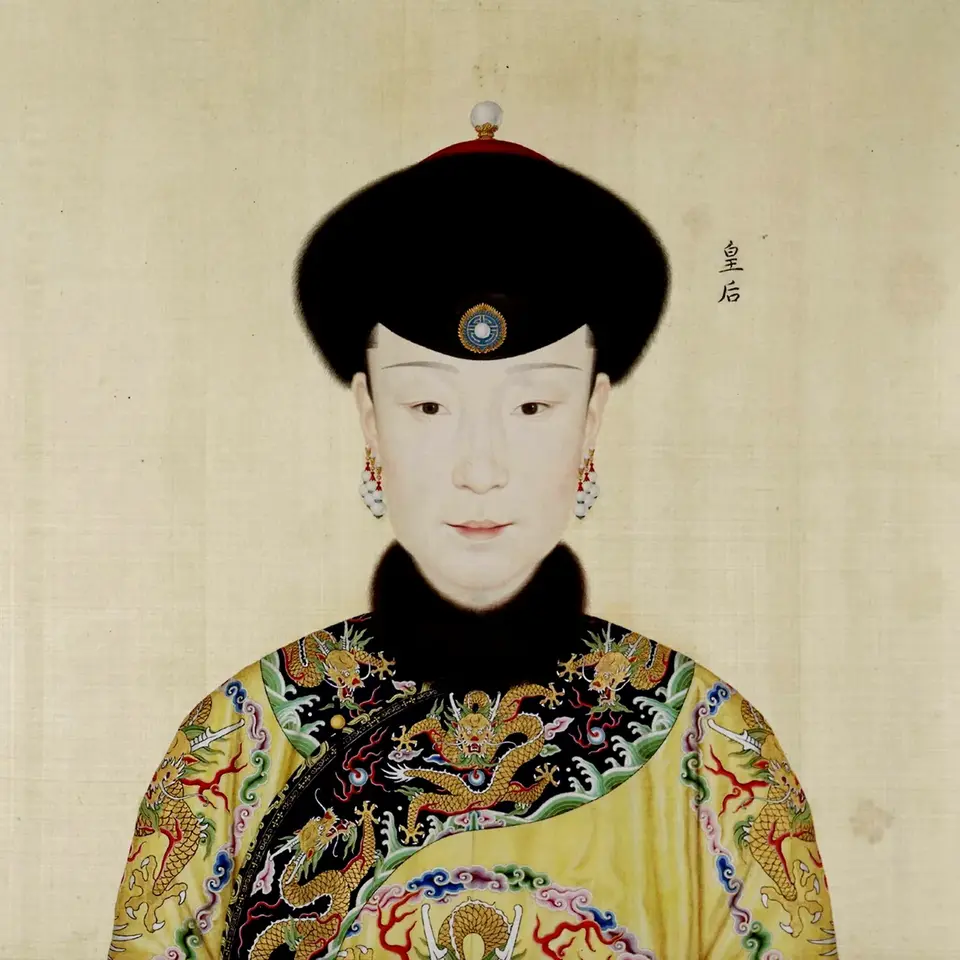
Life Story
Noble Lineage and Imperial Betrothal
Lady Fuca was born on March 28, 1712, into one of the most distinguished Manchu noble houses of the Bordered Yellow Banner. Her clan originated from the Shaji settlement in Manchuria, having submitted to Nurhaci during the early unification wars of the Later Jin. Her great-grandfather, Hashitun, achieved military nobility under Huangtaiji and Shunzhi, serving as a Grand Minister of the Internal Affairs and receiving the rank of First Class Baron. Her grandfather, Mishan, served as Minister of Revenue under the Kangxi Emperor for seven years, staunchly championing the suppression of the Three Feudatories.
Her father, Lirongbao, served as Supervisor of Chahar, while her prominent uncles included Grand Secretary Maci and Grand Minister of the Guards Mawu, both ranking as premier statesmen of the Kangxi and Yongzheng eras. Her clan stood among the foremost lineages of the Manchus. Her brothers and nephews, including Fuqing, Fuheng, Mingrui, Kuilin, Mingliang, and Fuk'anggan, rose to the highest civil and military offices as grand secretaries, generals, and commanders of the realm.
In the fourth year of Yongzheng, Lady Fuca participated in the triennial imperial draft of Eight Banner maidens. The Yongzheng Emperor was deeply struck by her refined grace, solemn modesty, and calligraphic learning. Recognizing her as an ideal consort for his secretly designated heir Hongli, Yongzheng personally betrothed her to Prince Bao of the First Rank. On September 3, 1727, the wedding was solemnized in the Forbidden City, and the newlywed couple established their residence in the Western Second Courtyard (later renamed Chonghua Palace).
Princely Life and Early Matrimony
During their eight years in Chonghua Palace prior to Qianlong's accession, Hongli and Lady Fuca cultivated an exceptionally affectionate and harmonious relationship. Lady Fuca managed the domestic household with quiet authority, ensuring that the young prince could focus uninterruptedly on his Confucian studies, statecraft tutoring, and administrative duties.
In October 1728, Lady Fuca gave birth to their first child, an imperial daughter who died in infancy. On July 17, 1730, she gave birth to Hongli's second son, named Yonglian by the Yongzheng Emperor. The character Lian signified the jade vessel of ancestral temples, implicitly marking the newborn infant as a destined imperial successor. In May 1731, she delivered her third daughter, Princess Gurun Hejing, who survived to adulthood and remained a lifelong favorite of the Qianlong Emperor.
When the Yongzheng Emperor died in October 1735, Hongli ascended the imperial throne as Emperor Gaozong of Qing. In his inaugural decrees, Qianlong proclaimed Lady Fuca as the primary Empress. In January 1737, the court dispatched Grand Secretary Ortai to conduct the grand formal investiture, enthroning Empress Fuca as mother of the realm and designating Changchun Palace as her central residence.
Inner Court Governance and Imperial Sericulture
As manager of the imperial palace, Empress Fuca distinguished herself by practicing strict simplicity and discouraging court extravagance. In contrast to customary imperial splendor, she avoided gold filigree, pearls, and precious gems, decorating her hair only with handmade velvet flowers and seasonal blossoms. Her austere habits established a refined, unpretentious tone throughout the inner palaces.
Empress Fuca consistently reminded the emperor of their northern ancestral roots. On one occasion, noticing that Qianlong reminisced about early Qing campaigns, she fashioned a pouch from coarse deer velvet, replicating the equipment carried by Manchu warriors beyond the Great Wall. Deeply touched by her symbolic reminder against complacency, Qianlong wore the pouch continually and cited it as an exemplary lesson for the imperial clan.
In April 1744, Empress Fuca revived the ancient rite of the Imperial Sericulture Ceremony. Leading imperial consorts and noblewomen to the Sericulture Altar in the northern gardens, she personally made offerings to the Goddess of Sericulture, harvested mulberry leaves, and unwound silk cocoons. This marked the very first time in Qing history that an empress officiated over this state ceremony, creating an enduring dynastic institution later immortalized in court paintings.
Maternal Bereavements and Physical Decline
Despite her preeminent status, Empress Fuca experienced profound personal sorrow through the loss of her sons. In November 1738, nine-year-old Yonglian contracted an illness and died suddenly. Overcome with grief, Qianlong made public his secret succession decree, posthumously honoring Yonglian as Crown Prince Duanhui and conducting royal funerary rites of unprecedented scale. Empress Fuca endured devastating emotional distress that initiated long-term health complications.
In May 1746, Empress Fuca gave birth to her seventh son, Yongcong. Delighted by the birth of another legitimate son, Qianlong privately resolved to groom him as imperial heir. However, on New Year's Eve of January 1748, the twenty-month-old infant succumbed to smallpox, receiving the posthumous name Prince Daomin. The catastrophic loss of two successive crown prince heirs within a decade shattered Empress Fuca's physical constitution, plunging her into incurable sorrow.
In February 1748, seeking to console his grieving mother and ailing wife, Qianlong organized an extensive eastern progress to Shandong to offer sacrifices at Mount Tai and the Temple of Confucius in Qufu. Empress Fuca insisted on accompanying the imperial retinue despite her fragile condition, anxious to attend upon Empress Dowager Chongqing and pray for ancestral protection atop Mount Tai.
Demise at Dezhou and Dynastic Mourning
During the Shandong tour, Empress Fuca's health deteriorated rapidly after ascending Mount Tai in cold spring winds. Reaching Jinan, she developed high fever and respiratory exhaustion. Although the court halted for several days to allow royal physicians to treat her, she urged the emperor to resume the return journey to avoid delaying public affairs and inconveniencing the Empress Dowager.
The imperial retinue boarded boats at Dezhou to travel by water. On the night of April 8, 1748, Empress Fuca died aboard the imperial vessel at Dezhou at the age of thirty-seven. Qianlong was utterly devastated. Refusing to leave her remains, he ordered the imperial court into emergency mourning, escorted her casket back to Beijing, and insisted that the massive boat on which she perished be hauled overland into the Forbidden City as Minister of Works Haiwang ingeniously designed vegetable-greased wooden tracks over the city walls, an event recorded by Zhaolian in Miscellaneous Notes of Xiaoting.
Extraordinary State Funeral and Political Storm
The emperor composed the famous Shubei Fu (Rhapsody on Expressing Grief), lamenting twenty-two years of shared devotion. Her death precipitated an unprecedented political storm: imperial princes Yonghuang and Yongzhang were stripped of succession rights for showing insufficient grief, senior ministers including Grand Secretary Akdun were demoted or sentenced to death for mistranslating posthumous patents, and dozens of provincial governors were purged for shaving their heads within the hundred-day national mourning period.
Yu Mausoleum Interment and Lifelong Remembrance
In November 1752, following the completion of the underground chambers of the Yu Mausoleum at the Eastern Qing Tombs, Empress Fuca's imperial casket was formally entombed with sovereign honors. Qianlong personally attended the interment rites, pouring libations before her vault.
Qianlong's devotion to Empress Fuca remained undiminished across the remaining five decades of his life. He ordered Changchun Palace preserved exactly as she had left it, leaving her clothing, jewelry boxes, and furniture untouched. Every year on her death anniversary and traditional festivals, the emperor visited her spirit hall to offer sacrifices and compose elegies. Whenever imperial tours passed near Jinan, Qianlong refused to enter the city walls, calling Jinan a perpetual place of heartbreak.
Marital Devotion and Imperial Elegies
Even in his eightieth year, visiting her tomb in 1790, Qianlong wept before her tomb, writing that while the world celebrated his longevity, his only regret was that his beloved consort had not lived to grow old beside him.
Major Achievements
Exemplar of Dynastic Austerity and Moral Motherhood
Empress Fuca established a revered paradigm of female domestic virtue in imperial Chinese history. In an era of burgeoning imperial wealth during the High Qing, she consciously rejected luxury, setting an example of simplicity that restrained inner court expenses and influenced Eight Banner nobility.
Her presentation of the deer-velvet pouch symbolized her dedication to preserving founding Manchu values of diligence and martial frugality. Her serene temperament, respectful service to Empress Dowager Chongqing, and compassionate treatment of palace consorts created an unusually cohesive and tranquil atmosphere within the early Qianlong court.
Institutionalization of the Imperial Sericulture Ceremony
Empress Fuca's ceremonial legacy was the complete institutionalization of the Imperial Sericulture Ceremony in 1744. Prior to her reign, Qing empresses had not personally conducted the ancient agrarian silk rites.
By studying canonical precedents and petitioning the emperor to construct the Sericulture Altar in the imperial gardens, she formalized the ritual protocols, attire, musical compositions, and sacrificial prayers. Her leadership elevated women's productive role in the agrarian state, transforming the ceremony into a permanent pillar of dynastic statecraft.
Political Significance of the Fuca Lineage
Empress Fuca's prestige elevated her natal family into the foremost aristocratic house of the mid-Qing empire. Her younger brother Fuheng and nephew Fuk'anggan became the most trusted civil and military leaders of the Qianlong reign, commanding major frontier campaigns in Jinchuan, Burma, Taiwan, and Tibet.
The enduring imperial trust enjoyed by the Fuca clan was directly rooted in Qianlong's veneration of the empress. Her sons, Prince Yonglian and Prince Yongcong, represented the supreme dynastic aspiration to unite legitimate imperial lineage through an empress's biological son, profoundly shaping early Qianlong political history.