Birth in Tay Son
Born in Qui Nhon Prefecture with ancestral roots in Nghe An; youngest of the three Tay Son brothers.
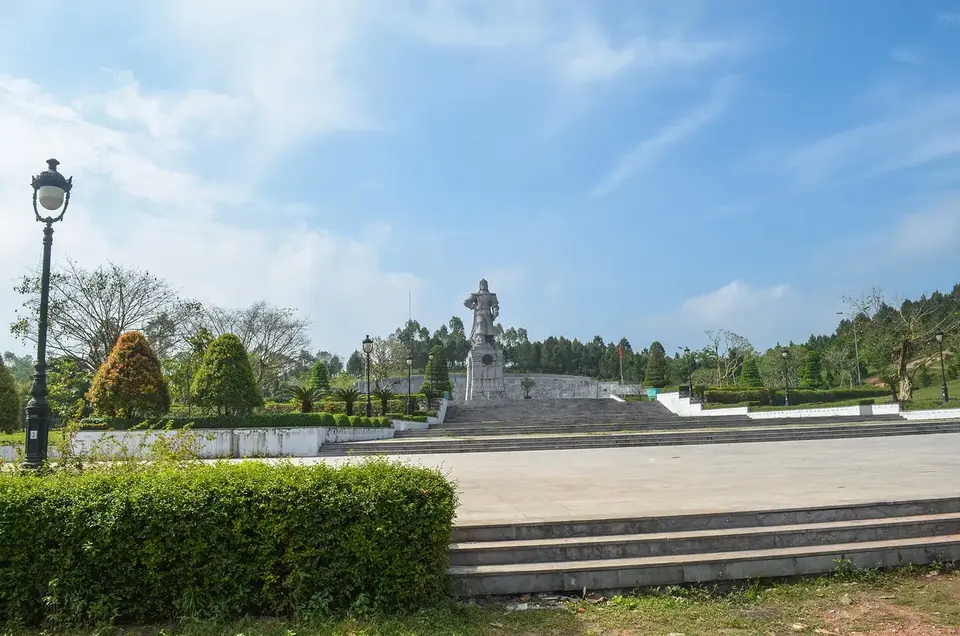
1753 CE–1792 CE
阮惠
Nguyen Hue (阮惠, 1753–1792), also known as Nguyen Van Hue and Nguyen Quang Binh, was a native of Tay Son Village in Qui Nhon Prefecture (modern Tay Son District, Binh Dinh Province, Vietnam) and the second emperor of the Tay Son Dynasty (reigned 1788–1792), celebrated as one of Vietnam greatest military commanders and national heroes. In 1771, Nguyen Hue alongside his elder brothers Nguyen Nhac and Nguyen Lu launched the Tay…
Nguyen Hue (阮惠, 1753–1792), also known as Nguyen Van Hue and Nguyen Quang Binh, was a native of Tay Son Village in Qui Nhon Prefecture (modern Tay Son District, Binh Dinh Province, Vietnam) and the second emperor of the Tay Son Dynasty (reigned 1788–1792), celebrated as one of Vietnam greatest military commanders and national heroes. In 1771, Nguyen Hue alongside his elder brothers Nguyen Nhac and Nguyen Lu launched the Tay Son Rebellion under the populist banner of wealth equalization, decisively destroying the entrenched feudal dominance of the southern Nguyen Lords. In January 1785, Nguyen Hue orchestrated a masterclass in riverine warfare at the Battle of Rach Gam-Xoai Mut, annihilating an invasion fleet of three hundred Siamese warships and thirty thousand troops along the Mekong River. The following year, he spearheaded a lightning northern campaign under the motto of upholding the Le and destroying the Trinh, capturing Thang Long (modern Hanoi), extinguishing the two-hundred-year reign of the Trinh Lords, and marrying Princess Le Thi Ngoc Han. In December 1788, when the Qing Empire dispatched veteran armies to restore Emperor Le Chieu Thong, Nguyen Hue ascended the imperial throne at Mount Ngu Binh, adopting the era name Quang Trung. Conducting an audacious winter forced march, Emperor Quang Trung unleashed a synchronized lunar new year counter-offensive in early 1789, shattering the Qing forces under Governor-General Sun Shiyi at the Battle of Dong Da and liberating Thang Long within six days. Demonstrating consummate statesmanship, he negotiated diplomatic normalization with Emperor Qianlong, securing formal investiture as King of Annam. Domestically, he pioneered land equalization and elevated the indigenous Chu Nom script into the official state administrative language. He died abruptly of illness in September 1792 at age forty, leaving an immortal legacy of martial genius and patriotic defense.
Born in Qui Nhon Prefecture with ancestral roots in Nghe An; youngest of the three Tay Son brothers.
Raised the banner of rebellion with his brothers against the oppressive lordship of the Nguyen clan.
Captured Gia Dinh and executed lords Nguyen Phuc Duong and Nguyen Phuc Thuan, ending southern feudal rule.
Lured Siamese invasion fleets into a riverine ambush, destroying three hundred warships overnight.
Captured Phu Xuan and Thang Long, destroying the Trinh lordship and marrying Princess Ngoc Han.
Enthroned as Emperor Quang Trung at Mount Ngu Binh on December 22 to mobilize the nation against invasion.
Shattered the Qing expeditionary army at Dong Da Fortress on the fifth day of the Lunar New Year.
Reconciled diplomatically with the Qing Dynasty; formally invested by Emperor Qianlong as King of Annam.
Died suddenly of acute illness in Phu Xuan Palace at age forty; granted temple name Taizu.
In 1753, Nguyen Hue was born in Tay Son Village in Qui Nhon Prefecture, with family roots originating in Hung Nguyen District, Nghe An Province. Originally surnamed Ho, his ancestors had been captured and relocated southward by the Nguyen Lord forces during the seventeenth-century civil wars, subsequently adopting the surname Nguyen. Nguyen Hue was the third son, with elder brothers Nguyen Nhac and Nguyen Lu, collectively remembered as the legendary Three Tay Son Brothers. From early youth, Nguyen Hue studied classical military treatises and martial arts under renowned masters, developing formidable physical strength, penetrating eyes, and a commanding voice that inspired deep loyalty among peasant communities.
During the late eighteenth century, southern Vietnam languished under the corrupt and autocratic rule of the Nguyen Lords. Dominant minister Truong Phuc Loan levied predatory taxes on salt, agriculture, and trade, casting ordinary households into destitution and starvation. In 1771, witnessing widespread misery, the Tay Son brothers unfurled the banner of armed insurrection at Tay Son Village. Proclaiming the radical slogans of equalizing wealth and expelling the corrupt regent Truong Phuc Loan, the rebellion won instantaneous acclaim among dispossessed peasants, highland minorities, and urban merchants, spreading across southern plains like wildfire.
Demonstrating precocious operational genius at age eighteen, Nguyen Hue displayed exceptional battlefield agility during initial campaigns. He led insurgent units in mobile warfare, repeatedly ambushing elite governmental garrisons across Binh Dinh and Qui Nhon. In 1773, Nguyen Hue executed an ingenious stratagem to capture the fortified stronghold of Qui Nhon, severing royal supply lines and opening a southern corridor for general expansion. His bold leadership earned him undisputed respect among frontline fighters, elevating him into the foremost military commander of the insurrectionary forces.
Alarmed by the Tay Son advance, the northern Trinh Lords exploited the crisis by dispatching northern armies south, capturing the Nguyen capital of Phu Xuan (Hue) in 1774. The southern Nguyen court fled toward Gia Dinh, trapped between two hostile fronts. Tay Son leader Nguyen Nhac strategically offered nominal submission to the Trinh court to secure his northern border, while deploying his main striking force southward to annihilate remaining Nguyen Lord strongholds. The resolute young commander Nguyen Hue was appointed supreme frontline commander, leading joint naval and terrestrial divisions southward.
In 1777, twenty-four-year-old Nguyen Hue directed an overwhelming amphibious assault against the final Nguyen Lord redoubt at Gia Dinh (modern Ho Chi Minh City). Driving war fleets rapidly up the Mekong tributaries, his forces dismantled enemy palisades and overran urban fortifications within days. During furious fighting, Tay Son troops captured and executed lord Nguyen Phuc Duong and former lord Nguyen Phuc Thuan, bringing a decisive conclusion to over two centuries of feudal dominion by the southern Nguyen house.
Following the fall of Gia Dinh, royal scion Nguyen Phuc Anh escaped through mangrove waterways with assistance from French missionary Pigneau de Behaine and loyalist remnants. Between 1778 and 1783, Nguyen Hue launched three subsequent punitive expeditions against Gia Dinh, invariably dispersing Nguyen Phuc Anh counter-revolutionary insurgencies with lightning speed. Repeatedly routed, Nguyen Phuc Anh fled to Phu Quoc Island and eventually took refuge at the royal court of Bangkok, pleading for foreign military intervention to reclaim his ancestral lordship.
In 1784, King Rama I of Siam sought to exploit the turmoil to expand Siamese dominion over the fertile Mekong delta, dispatching generals Chao Fa Krom Luang Thepharirak and Phraya Wichinarong with thirty thousand naval troops, three hundred galleys, and twenty thousand land soldiers to reinstall Nguyen Phuc Anh. Advancing through western waterways, the Siamese invaders captured strategic towns including Tra Vinh and Ba Sac, perpetrating widespread atrocities, massacres, and looting against civilian populations, sparking fierce anti-foreign fury throughout southern communities.
Confronting this national crisis, Nguyen Hue received supreme command to march southward from Qui Nhon. Arriving at the delta front, he personally inspected the riverine topography and perceived that the Siamese army had overextended its supply lines while falling into fatal complacency. Resolving to utilize tactical deception, Nguyen Hue dispatched minor naval detachments to feign disorderly retreat along the My Tho River, enticing the arrogant Siamese fleet into pursuing deep into an inland river trap prepared between the Rach Gam and Xoai Mut tributaries.
During the moonless night of January 19, 1785, Nguyen Hue concealed heavy warships, camouflaged artillery, and fireships among dense riverine thickets along the narrow waterway. As the concentrated Siamese armada entered the kill zone, Nguyen Hue unleashed the signal for general assault. Hidden artillery batteries and archers poured devastating barrages of cannonballs, fire arrows, and explosive missiles from both shores, while drifting fireships set the tightly packed enemy galleys ablaze, transforming the river into a roaring inferno.
Caught between fiery barriers and relentless crossfire, the Siamese naval formations dissolved into complete panic, with soldiers drowning by thousands in desperate attempts to reach the banks. Tay Son amphibious shock troops boarded the burning vessels in fierce hand-to-hand combat. By daybreak, nearly the entire Siamese fleet of three hundred vessels had been incinerated or captured, with only a few thousand shattered survivors fleeing overland back to Bangkok. Nguyen Phuc Anh escaped into Siamese exile once more, and southern Vietnam was definitively secured from foreign invasion.
The Battle of Rach Gam-Xoai Mut ranks among the most dazzling triumphs in Vietnamese military history. Through masterful tactical coordination and exploitation of riverine tides, Nguyen Hue obliterated an overwhelming foreign invasion armada within a single evening, decisively crushing Siamese expansionist ambitions. This resounding victory elevated Nguyen Hue into an undisputed national hero and military titan, establishing an unshakeable geopolitical foundation for the future unification of the country.
With the southern frontier pacified, elder brother Nguyen Nhac declared himself Emperor Thai Duc at Qui Nhon, appointing Nguyen Hue as General of Dragon Soaring. In the north, the rival Trinh lordship had fallen into fatal decay following the death of Trinh Sam, paralyzed by succession disputes, child rulers, and mutinous palace guards. In May 1786, recognizing an unprecedented strategic opportunity, Nguyen Hue advocated an immediate northern offensive. Adopting the counsel of scholar Nguyen Huu Chinh, he marched northward under the legitimate motto of supporting the imperial Le house and destroying the usurpative Trinh.
Phu Xuan was heavily fortified and garrisoned by veteran Trinh troops under commander Pham Ngo Cau. Arriving before the citadel, Nguyen Hue employed psychological warfare to sow discord between Trinh commanders, while directing continuous combined naval and land artillery bombardments against the battlements. Overwhelmed with terror, Pham Ngo Cau surrendered the fortress. Within days, Tay Son forces liberated all of Thuan Hoa, eliminating the primary southern garrison of the Trinh. Disregarding conservative orders from Qui Nhon to halt, Nguyen Hue impetuously crossed the Gianh River boundary to march directly on Thang Long.
The northern advance unfolded with miraculous speed, sweeping aside provincial defense garrisons in unbroken succession. Trinh attempts to mount defensive cordons were shattered by Nguyen Hue charging elephant brigades and iron cavalry. In June 1786, Tay Son spearheads enveloped Thang Long. Finding himself abandoned, Lord Trinh Khai fled the capital and committed suicide following his capture. The Trinh lordship, which had dominated northern Vietnam for over two hundred and forty years, collapsed entirely, ending centuries of territorial partition.
Entering Thang Long in triumph, Nguyen Hue scrupulously honored his pledge to support the royal house. He attended a solemn audience with the aged Emperor Le Hien Tong, restoring sovereign authority and imperial regalia to the monarch. In recognition of his loyalty, the emperor granted him the title Grand Marshal Pacifier of the South and bestowed his cherished youngest daughter, Princess Le Thi Ngoc Han, as his bride. Following Le Hien Tong death, Nguyen Hue installed prince Le Duy Ky as Emperor Le Chieu Thong before withdrawing his armies south to Phu Xuan.
Upon his return, severe dynastic tensions erupted within the Tay Son leadership. Fearing that his brother growing military fame would overshadow his throne, Emperor Thai Duc mobilized forces against Nguyen Hue. In 1787, Nguyen Hue invested Qui Nhon, prompting Nguyen Nhac to plead tearfully from the ramparts for reconciliation. The brothers negotiated a tripartite partition of the realm: Nguyen Nhac governed central Vietnam from Qui Nhon, Nguyen Hue was invested as King of Beiping governing northern territories from Phu Xuan, and Nguyen Lu held Gia Dinh.
As King of Beiping at Phu Xuan, Nguyen Hue dedicated himself to military restructuring and administrative rehabilitation. He recruited eminent Confucian scholars including Ngo Thoi Nhiem and Phan Huy Ich, creating an enlightened and efficient administrative bureaucracy. Meanwhile in Thang Long, the petulant Emperor Le Chieu Thong alienated loyal supporters, initiating armed clashes that plunged the north back into factional turmoil and invited catastrophic foreign military intervention from the Qing Empire.
In 1788, Emperor Le Chieu Thong fled Thang Long and sent imperial envoys to China seeking armed support. Governor-General of Liangguang Sun Shiyi seized the pretext to petition Emperor Qianlong for an expedition to restore the Le monarch. Granting approval, Qianlong appointed Sun Shiyi supreme commander of twenty thousand elite troops from Guangdong, Guangxi, Yunnan, and Guizhou, coordinating with royalist Vietnamese auxiliaries to invade the northern borders in three separate columns.
Encountering minimal initial resistance, the Qing forces advanced smoothly. Adhering to Nguyen Hue predetermined strategic doctrine, Tay Son northern commanders Ngo Van So and Ngo Thoi Nhiem evacuated Thang Long without giving battle, establishing an impregnable defensive redoubt at the Tam Diep mountain pass. Sun Shiyi entered Thang Long unopposed in November, installing Le Chieu Thong as vassal king. Convinced that the Tay Son had been intimidated into submission, Sun Shiyi established sprawling winter camps, intending to celebrate the Lunar New Year before launching further offensives.
Receiving intelligence at Phu Xuan, Nguyen Hue realized that the geopolitical situation had fundamentally changed. To unify national resistance and formally dissolve the defunct legitimacy of the Le Dynasty, he accepted the petitions of his military council to claim the imperial mandate. On December 22, 1788, Nguyen Hue erected a sacrificial altar at Mount Ngu Binh south of Phu Xuan, ascending the throne as Emperor Quang Trung and proclaiming a holy national crusade to protect the territorial integrity of Vietnam.
Immediately following the coronation, Emperor Quang Trung led an expeditionary army of one hundred thousand infantry, cavalry, and hundreds of war elephants northward on a relentless forced march. Conducting grand military reviews at Nghe An and Thanh Hoa, he delivered famous proclamations that ignited fierce patriotic fervour throughout the ranks. Arriving at Tam Diep, he rendezvoused with the garrison forces of Ngo Van So, finalizing an audacious operational plan to envelop and annihilate the foreign expeditionary corps.
Aware that the Qing forces were celebrating the new year in relaxed complacency, Emperor Quang Trung planned a devastating multi-pronged surprise attack. Addressing his assembled commanders before departure, the sovereign boldly declared that his armies would crush the enemy during the new year festivities and enter Thang Long on the fifth day of the first lunar month to feast in celebration. Organizing his forces into five mobile strike columns combining war elephants, riverine fleets, and crack infantry, he advanced silently toward Thang Long under winter mists.
On the eve of the Lunar New Year of 1789, while imperial camps in Thang Long were immersed in banquets, Emperor Quang Trung spearheaded the central column across the Gian River. Advancing with astonishing velocity under heavy night fog, Tay Son shock units overran forward river outposts. By dawn on the third day of the new year, his assault units encircled the fortified Qing bastions at Ha Hoi and Ngoc Hoi, employing damp mud-covered wooden mantlets to absorb musketry and grapeshot before storming the palisades in fierce hand-to-hand combat.
At dawn on the fifth day of the first lunar month, the climactic engagement erupted at Dong Da Fortress, the southwestern gateway to Thang Long. Donning a red battle headband, Emperor Quang Trung personally directed more than a hundred heavily armored war elephants to smash into the enemy earthworks. The pachyderms trampled palisades while howdah-mounted artillery and musket squads rained fire upon the defenders. Veteran Qing Provincial Commander Xu Shiheng and Brigadier Shang Weisheng fell in desperate combat, and the Dong Da garrison was completely routed with catastrophic casualties.
When catastrophic news reached Thang Long headquarters, Governor-General Sun Shiyi panicked. Fleeing without his armor or horse saddle, he galloped northward across the Red River pontoon bridge. The panicked garrison forces collapsed into an undisciplined stampede to cross the river, causing the pontoon bridge to buckle and collapse under the immense weight. Thousands of soldiers and horses drowned, choking the river currents. Emperor Le Chieu Thong fled in terror toward the northern frontier, while Sun Shiyi ordered border river bridges severed to halt pursuit.
At noon on the fifth day of the first month, Emperor Quang Trung entered Thang Long at the head of victorious columns, his battle armor blackened with gunpowder, fulfilling his prophetic promise to celebrate the new year within the liberated capital. In a whirlwind campaign of six days, the Tay Son army had routed an imperial invasion force, liberated the northern capital, and permanently extinguished the puppet Le regime, achieving the crowning masterpiece of Vietnamese military history known as the Victory of Dong Da.
Following this triumph, Emperor Quang Trung demonstrated profound diplomatic statesmanship. Recognizing that prolonged hostility with the vast Qing Empire would exhaust Vietnam with ceaseless warfare, he immediately released captured Qing officers and soldiers, oversaw honorable burials for fallen imperial troops, and dispatched deferential embassies to the frontier offering tribute and expressing sorrow for the clash, seeking an honorable settlement based on mutual respect.
Recognizing that Sun Shiyi arrogance had engineered the debacle, Emperor Qianlong wisely abandoned military retribution, dismissing Sun Shiyi and appointing Duke Fu Kang'an as Governor-General to negotiate peace. In July 1789, Qianlong officially recognized Emperor Quang Trung as King of Annam. During Qianlong eightieth birthday celebrations in 1790, an imperial Vietnamese delegation led by an imperial surrogate was received with extraordinary pomp at the Chengde Mountain Resort, inaugurating a golden era of peaceful border commerce and diplomatic harmony between both nations.
Emperor Quang Trung ranks among the most brilliant commanders in East Asian and Southeast Asian military history, maintaining an unbroken record of operational victory across dozens of campaigns. At the Battle of Rach Gam-Xoai Mut, his sophisticated exploitation of tidal rhythms and ambushes with fireships annihilated the Siamese invasion fleet overnight, establishing a definitive precedent of riverine combined-arms warfare that permanently shielded southern Vietnam from foreign encroachment.
During the Dong Da Campaign, his operational tempo and strategic audacity reached their pinnacle. Marching one hundred thousand soldiers over hundreds of kilometers in winter terrain, crossing swollen rivers on festival nights, and orchestrating synchronized assaults against fortified bases, he achieved overwhelming concentration of force at decisive points. His revolutionary integration of war elephants with mobile field artillery and infantry charges revolutionized traditional siegecraft, creating a textbook model of lightning maneuver warfare during the transition between cold weapons and gunpowder.
Emperor Quang Trung military leadership was characterized by rigorous discipline, shared hardship with common soldiers, and unmatched personal courage. In every decisive engagement, he fought in the vanguard under enemy fire, inspiring an unbreakable collective will to victory. By harmonizing military resolve with political magnanimity and diplomatic realism, he embodied the quintessential virtues of an enlightened patriotic sovereign whose strategic genius preserved national independence.
Throughout his four-year reign as sovereign, Emperor Quang Trung introduced radical structural reforms across the political, cultural, and socioeconomic landscape. In the cultural sphere, he broke the ancient monopoly of classical Chinese characters in state examinations, declaring the indigenous vernacular script Chu Nom as the supreme national language for court edicts, official registers, and imperial civil service examinations, catalyzing an unprecedented flowering of Vietnamese native literature and fostering an enduring national consciousness.
In economic administration, Emperor Quang Trung implemented an extensive land reform program based on equal field distribution, redistributing uncultivated or monopolized lands to landless peasants while offering substantial tax exemptions to war-torn provinces. To reconstruct civic registries and mobilize defense resources, he instituted the mandatory Shin Pai (Identity Badge) system, requiring every adult male above age sixteen to carry an official wooden seal, successfully curtailing vagrancy and aristocratic tax evasion while establishing formidable state mobilizing capacity.
Tragically, while formulating strategic blueprints for an ultimate southern campaign to extinguish remaining insurgent forces in Gia Dinh, his health deteriorated rapidly. On September 16, 1792, Emperor Quang Trung passed away abruptly of an acute cerebral seizure in Phu Xuan Palace at the youthful age of forty, receiving the temple name Taizu and posthumous title Emperor Wu. Although his untimely demise precipitated the eventual collapse of the Tay Son Dynasty under his young successor, his monumental military victories and transformative vision remain immortalized in the collective memory of the Vietnamese people.
FIGURES ASSOCIATED WITH THIS DYNASTY