Birth | Born at Tiandi Yijiachun in the Old Summer Palace; originally named Yongyan
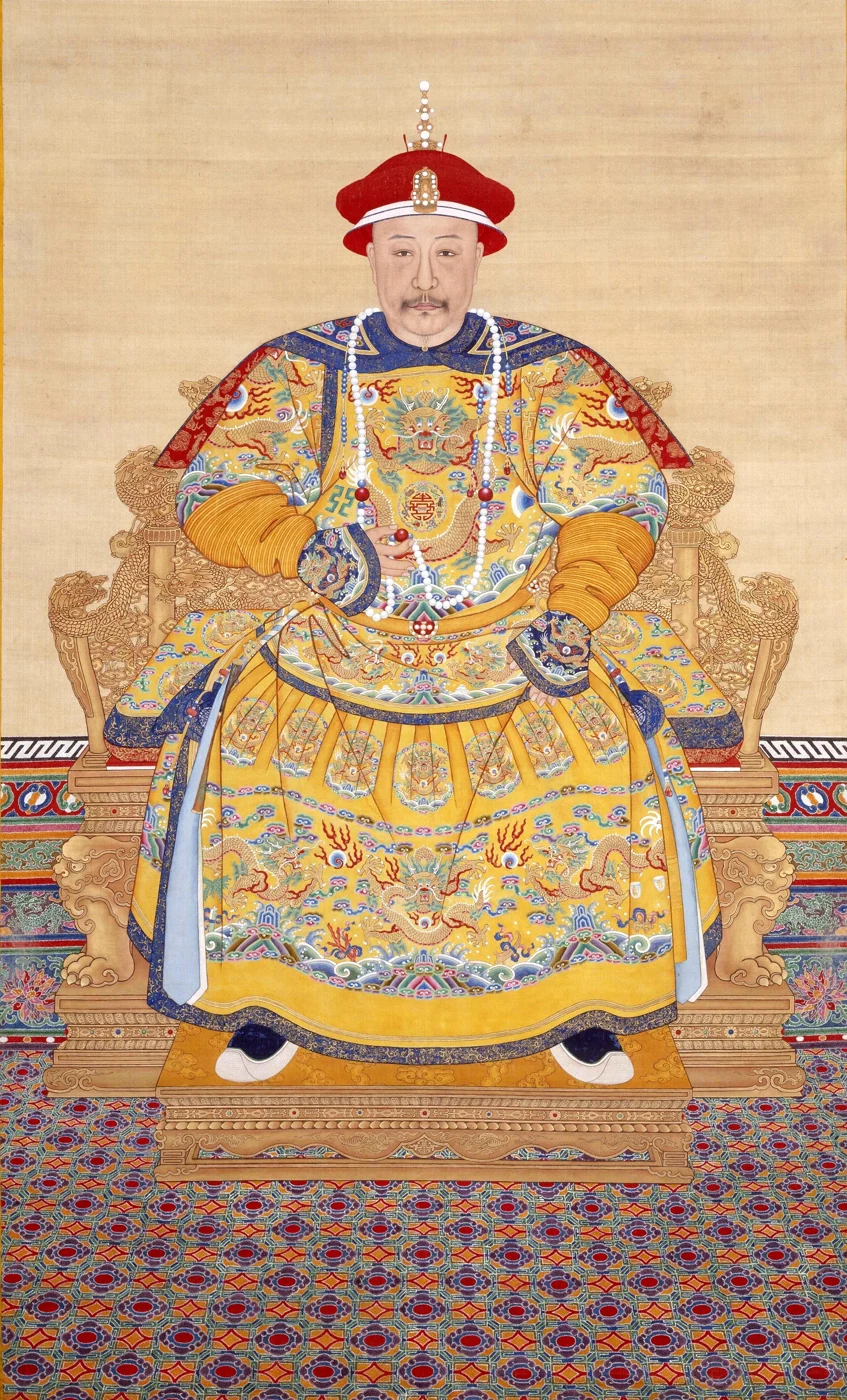
1760 CE–1820 CE
Emperor
Aisin Gioro Yongyan
爱新觉罗·颙琰
Aisin Gioro Yongyan (November 13, 1760–September 2, 1820), originally named Yongyan, was the fifteenth son of the Qianlong Emperor, Emperor Gaozong of Qing. His mother was Empress Xiaoyichun of the Weigiya clan. He was the seventh emperor of the Qing dynasty and the fifth after the Qing entry through the passes. In 1795, the sixtieth year of Qianlong, he was named crown prince. He ascended the throne after the Qianlong…
1760 CE–1820 CEQing Dynasty
PROFILE
Aisin Gioro Yongyan (November 13, 1760–September 2, 1820), originally named Yongyan, was the fifteenth son of the Qianlong Emperor, Emperor Gaozong of Qing. His mother was Empress Xiaoyichun of the Weigiya clan. He was the seventh emperor of the Qing dynasty and the fifth after the Qing entry through the passes. In 1795, the sixtieth year of Qianlong, he was named crown prince. He ascended the throne after the Qianlong Emperor abdicated in 1796, the first year of Jiaqing, although the retired emperor continued to control government. Only after Qianlong's death in 1799 did Yongyan begin personal rule. He immediately executed the powerful minister Heshen and attempted to rectify official administration and reverse Qing decline. Yet the Jiaqing reign was marked by repeated internal and external crises, including the White Lotus Rebellion and the Eight Trigrams uprising, growing opium imports, and entrenched bureaucratic corruption. Qing power steadily weakened, a trend later described as the “Jiaqing-Daoguang decline.” Yongyan died at the Chengde Mountain Resort in the seventh lunar month of 1820, the twenty-fifth year of Jiaqing, aged sixty-one. His temple name was Renzong, his posthumous name was Emperor Rui, and he was buried at Changling in the Western Qing Tombs.
- Alternative Names
- Jiaqing Emperor Yongyan; Emperor Renzong of Qing
- Era
- Qing
- Dynasty/Polity
- Qing
- Identity
- Emperor
- Date of Birth
- November 13 1760
- Date of Death
- September 2 1820
- Ethnicity
- Manchu
- Clan
- Aisin Gioro clan
- Ancestral Home
- Not reliably confirmed in historical sources
- Place of Birth
- Place of birth not specified
- Reign
- February 9, 1796–September 2, 1820
- Era Name
- Jiaqing
- Temple Name
- Renzong
- Posthumous Name
- Short form: Emperor Rui
- Major Achievements
- Qing emperor who succeeded the Qianlong Emperor; executed Heshen in an effort to curb corruption, but inherited a dynasty already declining from its high point
- Predecessor
- Emperor Qianlong, Aisin Gioro Hongli
- Successor
- Emperor Daoguang, Aisin Gioro Minning
LIFE TIMELINE
Age six | Began studying under Feng Kuan, Vice Minister of War
Age thirteen | Able to read the Five Classics and secretly designated heir by the Qianlong Emperor
Age fourteen | The Qianlong Emperor selected a woman of the Hitara clan as his principal consort
Age twenty | His tutor Zhu Gui left to serve as education commissioner in Fujian and presented him with the “Five Admonitions”
Age twenty-nine | Created Prince Jia of the First Rank
Age thirty-five | Publicly announced as crown prince and changed his personal name to Yongyan
Age thirty-six | The Qianlong Emperor abdicated; Yongyan ascended the throne and honored Qianlong as Retired Emperor
Age thirty-nine | Qianlong died and Yongyan began personal rule
Age thirty-nine | Ordered Heshen to die, confiscated his property, and dismissed his associates
Age forty-two | Most of the Sichuan-Chu White Lotus Rebellion was suppressed
Age forty-three | Chen De attempted to assassinate the emperor and was captured
Age forty-four | White Lotus Rebellion fully suppressed after military expenditures of two hundred million taels of silver
Age forty-nine | Cai Qian's rebellion was suppressed
Age fifty-three | Eight Trigrams rebels entered the Forbidden City; Yongyan issued an edict blaming himself
Age fifty-six | Rejected requests associated with the British Amherst embassy, including expanded trade and territorial concessions
Age sixty | Died at the Chengde Mountain Resort
— | Buried at Changling in the Western Qing Tombs
BIOGRAPHY
Biography
Family Background and Early Years Yongyan was born on November 13, 1760, the sixth day of the tenth lunar month in the twenty-fifth year of Qianlong, at Tiandi Yijiachun in the Old Summer Palace. He was the Qianlong Emperor's fifteenth son and was initially named Yongyan. His mother, Lady Wei, later Empress Xiaoyichun, was originally from a Han banner family and was later transferred into a Manchu banner and given the clan name Weigiya. Although of modest origin, she enjoyed considerable favor after entering the palace in 1745 and bore four sons and two daughters to the Qianlong Emperor. Yongyan was her seventh child. Yongyan began studying at age six under Feng Kuan, Vice Minister of War. At seven he visited Empress Xiaoshengxian, the Qianlong Emperor's mother, at the Panshan traveling palace and was greatly favored by his grandmother. The Veritable Records of the Jiaqing Reign described the young prince as affectionate and pleasing and noted that he received exceptional favor from childhood. By thirteen he could read the Five Classics. He studied regulated verse with Xie Yong, Vice Minister of Works, and classical prose and old-style poetry with Hanlin lecturer Zhu Gui. He was praised for composing readily and in accordance with literary models. As he grew older he especially enjoyed histories and the Comprehensive Mirror in Aid of Governance, becoming familiar with the rise and fall of earlier dynasties. The Qianlong Emperor had experienced repeated frustration in succession planning. Following the secret succession system established by the Yongzheng Emperor, he had privately selected Yonglian and Yongcong, sons of Empress Xiaoxianchun of the Fuca clan, but both died young. By 1773 only seven sons remained alive. Yongrong and Yongcheng had been adopted into collateral branches, while Yongji was effectively excluded because his mother, Empress Ula Nara, had fallen from favor. The practical candidates were Yongxuan, Yongxing, Yongyan, and Yonglin. Yongxuan was older but considered ill-disciplined; Yongxing was talented but regarded as miserly; Yonglin was young and not studious. After weighing the choices, the Qianlong Emperor secretly designated the steady and diligent fifteenth son Yongyan as heir in the winter of the thirty-eighth year of Qianlong. Among Yongyan's teachers, Zhu Gui had the greatest influence. A jinshi of the thirteenth year of Qianlong, Zhu was known for broad learning and upright conduct. In 1780, before leaving for his post as education commissioner of Fujian, he presented Yongyan with five admonitions: cultivate the mind, respect oneself, be diligent in one's duties, remain modest, and maintain sincerity. Yongyan treated them as lifelong maxims. Even after beginning personal rule, he kept them nearby as constant reminders. ### Heir Apparent and Accession In 1789 Yongyan was created Prince Jia of the First Rank. On October 15, 1795, the third day of the ninth lunar month in the sixtieth year of Qianlong, the eighty-five-year-old Qianlong Emperor publicly announced Yongyan as crown prince and, to observe naming taboo, changed his personal name to Yongyan with a different first character. On February 9, 1796, the first day of the first lunar month in the first year of Jiaqing, the Qianlong Emperor held an abdication ceremony at the Hall of Supreme Harmony and handed the imperial seal to Yongyan. Yongyan ascended the throne and honored Qianlong as Retired Emperor. Qianlong, however, remained in effective control as retired emperor: major military and state affairs still required his decision, and court almanacs continued to use the Qianlong era name. At the beginning of his reign Yongyan lived at Yuqing Palace and behaved with extreme caution. Joseon envoy Min Jonghyeon recorded that when seated beside the retired emperor, Yongyan watched Qianlong's every movement and scarcely turned his gaze, reflecting his careful restraint. On the fourth day of the first lunar month of the first year of Jiaqing, Yongyan installed his principal consort of the Hitara clan as empress. In the same year White Lotus uprisings erupted in Zhijiang, Yidu, and other places in Hubei, beginning the nine-year Sichuan-Chu White Lotus Rebellion. During the next two years Yongyan was emperor in name, but military and political decisions remained with Qianlong. Heshen, Qianlong's most favored minister, continued to dominate government, leaving Yongyan in a largely ceremonial position. ### Personal Rule and Elimination of Heshen On February 7, 1799, the third day of the first lunar month in the fourth year of Jiaqing, the retired Qianlong Emperor died and Yongyan finally began personal rule at age forty. Five days later he ordered Heshen arrested, quickly announced twenty major crimes, ordered him to commit suicide, and confiscated his property. According to archival memorials from the Grand Council cited in the Chinese source, Heshen's holdings included 33,551 taels of gold, 3,014,095 taels of silver, 1,001 houses in and around Beijing, and 126,600 mu of land, for a total estimated value of roughly 3.5 million taels of silver. The popular saying “When Heshen fell, Jiaqing ate his fill” was exaggerated, but the confiscation did ease fiscal pressure on the court. Yongyan then dismissed or imprisoned Heshen's close associates, called for frank remonstrance, reopened channels of criticism, restored or commended officials punished for speaking out during the Qianlong reign, ended extravagant tribute practices, and promoted frugality. He demanded that local officials report the people's conditions fully and honestly and warned against concealment, cosmetic reporting, and negligence. In the eleventh month of the same year he executed Hu Qilun, circuit intendant of Xiangyang, for withholding military funds; stripped the hereditary office held by the son of the deceased Huguang governor-general Bi Yuan; and confiscated the property of commanders such as Mingliang, Yongbao, Qingcheng, and E Hui who had taken bribes. Yet Yongyan's rectification remained largely limited to Heshen and his immediate circle and did not become a comprehensive purge of bureaucratic corruption. In 1806 Joseon envoy Seo Yongbo described him as physically fleshy rather than bony, with a harmonious appearance, and said he was generally praised for diligence and frugality: palaces were plain, discipline strict, and business did not stagnate. But the envoy also thought the emperor could be overly meticulous, combining fault-finding with a benevolence that sometimes became petty. This broadly captured Yongyan's diligence and attention to detail but also his lack of decisiveness. ### Suppression of the White Lotus Rebellion In the late Qianlong years, White Lotus organizations were active across Sichuan, Hubei, Shaanxi, and neighboring regions. Heavy exactions and official oppression intensified social conflict. In 1796 believers in Zhijiang, Yidu, Dangyang, and other Hubei localities rose first, followed by major uprisings in Dazhou, Dongxiang, and elsewhere in Sichuan. The rebellion spread rapidly across Sichuan, Hubei, Shaanxi, Henan, and Gansu. While Qianlong lived, the court sent Fuk'anggan, Helin, and others to suppress the revolt, but commanders were divided and military discipline poor. After assuming personal rule, Yongyan adopted several measures: replacing ineffective senior commanders and enforcing rewards and punishments; tightening logistical accounting by requiring supply stations to report every ten days and consolidate reports monthly; combining suppression with amnesty to divide rebel forces; and expanding fortified villages, militia organization, and scorched-earth tactics to separate rebels from civilian support. In 1799, White Lotus leader Wang Sanhuai testified in Beijing that “official oppression drove the people to revolt.” Yongyan was deeply affected and became more conscious of the relationship between bureaucratic corruption and rebellion. Over the next several years Qing forces under Eldemboo, Delengtai, Lebao, and others gradually compressed rebel operating areas. By the twelfth month of 1802 most of the Sichuan-Chu-Shaanxi rebellion had been suppressed. Eldemboo and Delengtai were made marquises of the first rank, Lebao an earl of the first rank, and Mingliang a baron of the first rank. In the fifth month of 1804 the remaining rebel forces were eliminated. The nine-year war cost the Qing two hundred million taels of silver and severely depleted the state. ### Eight Trigrams Uprising and the Self-Reproach Edict In 1813 an Eight Trigrams uprising broke out in North China. On the fifteenth day of the ninth lunar month, leader Lin Qing sent more than two hundred followers into the Forbidden City with help from palace eunuchs. They reached Longzong Gate before palace guards repelled them. Yongyan was away on a hunting trip to Rehe. He hurried back to Beijing and issued an edict blaming himself, lamenting that an event unprecedented in the Han, Tang, Song, or Ming had occurred. He simultaneously ordered severe suppression; none of the attackers who entered the palace survived, and Lin Qing was captured and executed outside the city. Although the uprising was quickly defeated, the ability of common rebels to enter the imperial palace deeply shocked the court. Yongyan's self-reproach edict acknowledged that his own virtue was inadequate and had brought on the warning, but it did not propose fundamental reform. He strengthened palace security and tightened control over eunuchs, yet the Qing political crisis could not be resolved by an edict alone. ### Foreign Relations and Final Years In foreign affairs, Yongyan faced increasing pressure from Western powers. In 1808 Britain, claiming to protect Portugal from France, sent nine warships into the waters off Xiangshan in Guangdong, and three hundred British troops landed and occupied Macau's fortifications. Governor-General of Liangguang Wu Xiongguang handled the crisis poorly; Yongyan dismissed and exiled him and ordered stronger defenses at Macau. In 1816 the British Amherst embassy came to China but was expelled after a dispute over court ritual. Requests attributed in the Chinese source to the British mission for formal diplomatic relations, additional trading ports, and coastal islands were rejected. Yongyan adopted a strongly exclusionary approach toward foreign influences. He prohibited Westerners from residing in the interior, forbade people from engaging with Christianity, suppressed foreign printing and missionary activity, and repeatedly prohibited opium imports. When Nguyễn Phúc Ánh of Annam requested the state name “Nam Viet,” Yongyan was wary because the ancient state of Nanyue had included Guangdong and Guangxi and instead bestowed the name “Vietnam,” which remains in use. On August 27, 1820, the eighteenth day of the seventh lunar month in the twenty-fifth year of Jiaqing, Yongyan left according to custom for the Rehe and Mulan autumn hunt, accompanied by his second son Mian'ning, Prince Zhi, and fourth son Mianxin, Prince Rui. He reached the Chengde Mountain Resort on the twenty-fourth; the next day his illness suddenly worsened and he died that night, aged sixty-one. The Veritable Records of Emperor Renzong of Qing says he had “occasionally been affected by summer heat” on the journey. The Chinese source notes that heatstroke alone may not explain the death and suggests the possibility that age, obesity, hot weather, and travel fatigue triggered a cardiovascular or cerebrovascular event. After the Daoguang Emperor's accession, Yongyan received the temple name Renzong and the posthumous name Emperor Rui Shoutian Xingyun Fuhua Suiyou Chongwen Jingwu Xiaogong Qinjian Duanmin Yingzhe. In 1821 he was buried at Changling in the Western Qing Tombs.
His Birth, the Change of His Name, and His Education as a Prince
Yongyan was born on the sixth day of the tenth month of the twenty-fifth year of Qianlong, 13 November 1760, his original name being Yongyan and his mother the empress Xiaoyi Chun, lady Wei. At six he studied under the vice minister of war Feng Kuan; at seven he went to the travelling palace at Panshan to pay his respects to the empress dowager Xiaosheng Xian, "receiving her loving kindness in full," and served the emperor Gaozong and the empress Xiaoyi Chun "at the door of their chamber, gentle and affectionate, in every point of the rites winning their hearts," so that "for this he enjoyed favour from his tender years." At thirteen he could already read the Five Classics through, and learned to compose regulated verse from the vice minister of works and ancient prose and ancient-style verse from the lecturer Zhu Gui, "taking up the brush and finishing at once, every piece a model of its kind," which perhaps won him Gaozong's approval. As a youth his studies were excellent, "his fine phrases brilliant, the brush taken up and the piece finished, every stroke a model"; and grown older he especially loved the histories and the Comprehensive Mirror, reaching the point of "three thousand years up and down, the tracks of government clear to the eye." In choosing a tutor for him the grand tutors of the study of the prince were Weng Fanggang, Ji Yun and Zhu Gui, and the Qianlong emperor chose Zhu Gui on the ground that men like Weng and Ji were men of letters and not fit for the task, whereas Zhu Gui was not only good in letters but upright in character. Of all his tutors Zhu Gui was the most revered by Yongyan: widely learned, he not only taught him much but influenced him by his own bearing in virtue and conduct; and Zhu Gui having said that "the diligent student has something to spare and the idle one not enough, and what is to spare may be tasted," Yongyan kept his teacher's words in mind, named his study the chamber of tasting the remainder and wrote a record of it, while Zhu Gui in his colophon to the collected works of that chamber praised Yongyan as "fond of learning and quick to seek it, reading a thing once and never forgetting it, diligent from dawn to dusk without slackening." In 1780, on the eve of Zhu Gui's posting to Fujian, he gave Yongyan five precepts — to nourish the heart, to respect the person, to be diligent in work, to empty himself and to attain sincerity — which Yongyan "practised with all his strength" and even after taking the government "kept at his side."
His Secret Designation as Heir and His Enfeoffment as Prince Jia
The Qianlong emperor had first secretly designated his second son Yonglian as heir apparent, holding that as the empress's son and his own legitimate child he was intelligent, precious and of uncommon bearing; but Yonglian died at nine. He afterwards meant to designate his seventh son, who died of smallpox at two. By 1773 only seven of Gaozong's sons were living, of whom Yongrong and Yongcheng had been given out in adoption to collateral lines in 1759 and 1763 and could no longer be heirs, while Yongji, the son of the empress of the Ulanara clan, could not be chosen since his mother had been degraded; so that only Yongxuan, Yongxing, Yongyan and Yonglin — Yongyan's younger brother by the same mother, seventeenth in order, the youngest of Gaozong's sons — were available. In the winter of 1773 the Qianlong emperor again secretly designated his heir, the fifteenth son Yongyan; in 1789 Yongyan was enfeoffed prince Jia of Heshuo; and in the ninth month of 1795 he was formally declared heir apparent. As to the change of his name, the Qing rule was that the imperial name was covered with a yellow slip only in such particular documents as the genealogy of the imperial house, and that the taboo on imperial names had been observed from the "Xuan" of the Kangxi emperor's name, written without the last stroke, and the "Yin" of the Yongzheng emperor's, written without the last stroke and with his brothers changing "Yin" to "Yun," to the "Hong" of the Qianlong emperor's, written without the last stroke; but when it came to Yongyan, Qianlong, considering that "Yong" was a common character and inconvenient for the taboo, ordered that Yongyan's "Yong" be changed to the uncommon "Yong" of his present name, and on coming to the throne he was known as Yongyan — the practice of changing the generational character of a Qing emperor's name to a special one beginning with the Jiaqing emperor.
His Accession by Abdication and the Regency of the Retired Emperor
On the day wushen of the first month of the first year of Jiaqing, 9 February 1796, the Qianlong emperor held the great ceremony of handing over and receiving, and Yongyan came to the throne, the Qianlong emperor attending in person and Yongyan honouring him as retired emperor. By the History of Song's counterpart in the Qing History, on that day "the abdication was held, and the emperor attended Gaozong in doing reverence at the Hall of the Tangzi, the Hall of the Revered Ancestors and the Hall of Longevity; Gaozong took his seat in the Taihe hall and gave over the seal; the emperor came to the throne, honoured Gaozong as retired emperor, and conducted the government under his instruction, proclaiming it to the realm and feasting the imperial clansmen"; on the fourth day of the first month he made his principal consort lady Xitala empress; and in the palace of Ning-shou the feast of a thousand elders was held, the retired emperor attending, and "those of ninety and above were summoned to the imperial seat and given a cup of wine as of old." Thereafter the government was still controlled by the Qianlong emperor and Yongyan lodged for the time elsewhere; and Yongyan was deep of mind: "he knew that so long as the retired emperor Qianlong lived he could not touch Heshen, and that Heshen could to a great extent sway Qianlong's will, and that to act amiss would only harm himself, so that he obeyed the retired emperor in everything, gave no opinion of his own and made no change in the government." In the first month of the first year of Jiaqing the grand secretary Fukang'an and others in charge of the Miao frontier memorialized their capture of Langpo and advance on Pinglong, while in Hubei the sectaries of Zhijiang and Yidu rose and those of Dangyang rose and killed officers, the Xi'an general Hengrui being sent with two thousand men against them; in the first month of the second year the Miao woman Wang Nangxian of Nancheng in Guizhou rebelled and the governor Lebao was ordered against her, while the Sichuan sectary Xu Tiande raided Dazhou and Dongxiang; in the second month the empress Xitala died, and by the retired emperor's decree the palace wore plain dress seven days without removing the tassel, the court officers following while the inner attendants wore ordinary dress without beads, and the empress was given the posthumous name Xiaoshu; in the ninth month Lebao took the Miao rebels' nest, took their chief Wang Nangxian and others and had them beheaded at the capital, and was made marquis of the third rank; and in the eighth month of the third year, for the taking of the White Lotus leader Wang Sanhuai, Lebao and Heshen were advanced to dukes and Fu Chang'an to marquis.
His Taking the Government, the Punishment of Heshen, and the Rectifying of the Administration
On the day renxu of the first month of the fourth year of Jiaqing, 7 February 1799, the retired emperor Qianlong died and Yongyan took the government. Heshen having lost his support, on the fourth day Yongyan issued an edict removing Heshen's creature Fu Chang'an from the grand council, ordering Heshen and Fu Chang'an to keep vigil day and night without leaving, so cutting them off from the world, and stripping Heshen of his offices of grand secretary and chief grand councillor; on the ninth he removed Heshen and Fu Chang'an from office and threw them into the prison of the ministry of justice, confiscated Heshen's property and had them tried jointly; and on the eleventh he proclaimed Heshen's twenty great crimes and, considering that he had been chief grand councillor and for the dignity of the court, allowed him to take his own life. Yongyan's handling of the case involved no spreading of guilt and no enlargement, which was his cleverness; but he treated Heshen only as an individual case and did not treat "the Heshen phenomenon" as an institutional abuse to be solved by institutional reform, which was his mediocrity. He also dismissed and imprisoned Heshen's creatures, called for plain speech, removed the wicked and upheld the upright, restored and commended officials who had been punished for their words in the Qianlong reign, abolished the presentation of tribute and put down extravagance in favour of thrift, and required local officers to report the people's hidden hardships without the least concealment, doing away with deceit, glossing and indolence. In the ninth month of that year a commoner of Yanshi county in Henan, Yang Daochun, presented a memorial proposing the removal of accumulated abuses and the relief of the people's hardships to secure the foundations of the state, and urging that the granaries and the grain transported by water were the root of the state and yet the greatest of abuses, so that a strict edict should be issued against them; and the Jiaqing emperor approved it highly, saying that Yang Daochun, a common man, had set out matters which were all affairs the localities ought to conduct and that the several proposals would be carried out in turn, and ordered that he be sent to the governor-general of Zhili, Hu Jitang, for employment as a ninth-rank supernumerary and given a post when a vacancy occurred. In the eleventh month, the circuit intendant of Xiangyang, Hu Qilun, having handled the military supplies of the Xiangyang bureau in Hubei and secretly deducted more than twenty-nine thousand taels which he gave away at will, was executed and his property confiscated; and for the late governor-general of Huguang, Bi Yuan, who had "openly drawn on the military supply funds, trusting one man, Hu Qilun, to manage them and letting him dock them at will, being the first to set the example," his son's hereditary office was taken away, while the generals who had taken bribes, Ming Liang, Yongbao, Qingcheng and Ehui, all had their houses confiscated. In the case of false claims and embezzlement in Hubei he sent officers to check the truth of the Sichuan military accounts, "so that the officers in command should find no profit in it and could give their minds to destroying the rebels," and instituted the rule that the supply offices of every route should report every ten days and summarize monthly, whereby the confusion in the use of military funds was somewhat corrected.
The Suppression of the White Lotus and the Eight Trigrams, and the Assassination Attempt
In the last years of Qianlong class contradictions were sharp, and because the Qianlong emperor made great use of the literary inquisition, a great rising of the White Lotus sect broke out in Sichuan, Chu and Shaanxi; and before his death the court sent troops against it again and again, and though the rebels were checked they still burned like fire. After taking the government Yongyan eased the people's resentment by killing Heshen, laying the blame for the failures of the past years on him as having deceived and monopolized power so that the generals under his protection falsely claimed merit and wasted military funds; and on the other hand he replaced the commanders, made rewards and punishments clear, forcing the generals to exert themselves, tightened the military dispositions, and used the two-handed policy of suppression and conciliation to divide the rebels, and spread the practice of stockaded villages and militia and of clearing the countryside, cutting the rebels off from the people. In the first month of 1800 he ordered Eledengbao to deal with the Shaanxi sectaries and Delengtai with Kulun with the Sichuan sectaries; and in the seventh month he sent the right wing commandant Changling with the Manchu banners of Jilin and Heilongjiang to Hubei to help. Thereafter the sectarian leaders were taken one after another: Eledengbao took Chen Jie, Ma Huiyu took the chief preacher Liu Zhixie and sent him to the capital to be killed, Lebao took Wang Shihu and Wang Tingzhao, Eledengbao took Wang Shihu and Ran Tiansi, Lebao took Liu Qingxuan and others and was made baron of the third rank, Eledengbao took Xincong and the remnant was wholly pacified, and Delengtai took Gong Qiyao and others with the remnant wholly pacified. In the twelfth month of the seventh year most had been suppressed, and Eledengbao, Delengtai, Lebao, Huiling and Wu Xiongguang were ordered to report that the sectaries of Sichuan, Shaanxi and Chu were swept away, Eledengbao and Delengtai being made marquises of the first rank, Lebao earl of the first rank and Ming Liang baron of the first rank, with Sai Chong'a and Yang Yuchun rewarded in order and favours extended to the prince of Cheng Yongxing and the grand councillors Qinggui and Dong Gao. In 1805 the rising was put down: in the war that lasted more than nine years the White Lotus rebels held or took two hundred and four prefectures and counties, resisted the great armies the Qing drew from sixteen provinces, destroyed many Qing troops, killed more than four hundred officers below the rank of deputy general and more than twenty of the first and second ranks, and cost the Qing two hundred million taels in military expenses, equal to four years of revenue — "the rising drained the vigour of the Qing house, and thereafter its rule moved gradually towards decline." On the southeast coast, with the increased grinding of the people, some were driven to sea as pirates, and from 1794 they took ships and goods on the southeast seas, blockaded the sea lanes and levied an "overseas tax," later developing into a rising against the Qing; the court sent Li Changgeng of Zhejiang to Fujian to build great ships and cast guns for its suppression, Li Changgeng dying in the fighting, and the rising was put down only in 1810. In 1813, taking the chance of the Jiaqing emperor's absence on the hunt at Rehe and the emptiness of the defences of Beijing, a rising of the Eight Trigrams sect broke out in the north, some of its members entering the palace with the connivance of eunuchs, "bringing about what neither Han and Tang nor Song and Ming had seen"; and the emperor's second son Mianning, then in the palace, shot two of the sectaries with a fowling piece, and the troops entering the palace the rebels were all destroyed, being few against many. Hearing of it the Jiaqing emperor issued an edict taking the blame on himself, and at the same time ordered the rebels who had entered the palace slaughtered without exception and the leaders outside lured and taken, after which the rising was put down everywhere. In the intercalary second month of 1803, when Yongyan was returning from the Yuanming yuan and entering the Zhenshun gate, he was attacked; his attendants stood rooted in terror and only the prince Beile Danba Dorji shielded him with his body, so that the guards came to themselves and seized the assassin Chen De. "Yongyan was fortunately unhurt; Chen De was afterwards put to death by slicing and his two sons strangled"; and Yongyan punished the officers and guards who had failed and strictly enforced the ban on the palace gates.
Rectifying the Administration, Thrift, and His Measures on Letters, River Works, the Imperial Clan and the Banners
In the later Qianlong years official discipline had decayed and corruption was severe; and in the tenth month of 1805 the emperor said in an edict that "the rectifying of official discipline takes honesty for its root" and that "greed must be punished first." He went on employing honest old ministers such as Wang Jie whom the late Qianlong had used, and on his teacher Zhu Gui's advice to "be first in frugality and reward honesty" he restricted the local offering of treasures, "abolishing the presentation of tribute and putting down extravagance for thrift," living plainly himself and forbidding theatrical celebrations of his fiftieth birthday and gifts on his sixtieth; and after taking the government he remitted the taxes of the stricken regions every year but the year of his death, and on his sixtieth birthday remitted all arrears of taxes throughout the realm, some twenty-one million taels of silver and more than four million shi of grain. He punished a number of greedy officials: in 1805 an officer who had extorted tens of thousands of taels from the grain and garrison officers was executed; in the fourth month of 1806 the officer of Hedong who had extorted money was dismissed, and in the ninth month the great case of the Zhili clerk Wang Linan, who had swallowed three hundred and ten thousand taels of treasury silver, was uncovered, those who had taken ten thousand taels or more being beheaded and those below banished to Heilongjiang; and in the seventh month the magistrate of Shanyang in Anhui, Wang Shenhan, who had embezzled famine relief and killed the officer sent to inspect it, was executed, with a number of officers dismissed and banished besides. Against the neglect of duty he began with himself, following his predecessors in diligence, rising early to read the veritable records of his ancestors and to go over the memorials and holding audiences after breakfast, and severely punishing delay; in the fourth month of 1808, a grandson being born and the secretariat refraining from sending memorials for fear of disturbing his joy, he reproved them for it; in the first month of 1810 he reproved the courts and ministries for their routine and idleness; and in the eleventh month of 1818 he ordered an inquiry into slackness in the courts and ministries and on the ninth day of the twelfth month fixed penalties for delay in handling cases: for eleven to twenty cases overdue six months' salary, for twenty-one to forty two years' salary, for forty to sixty reduction of one grade with retention of office. He also required local officers again and again to report the people's hardships without the least concealment. Yongyan, like every Qing emperor, promoted the feudal ethics, understanding well that letters and filial piety govern the realm, and sought to complete and secure his rule by honouring Confucius: he did reverence before the tablet of the sage, and whereas the old rule required two kneelings and six bows, "to show his reverence for Confucius he performed three kneelings and nine bows," thereafter doing reverence himself or sending his second son several times; and on his fiftieth and sixtieth birthdays in 1809 and 1819 he allowed Kong Qingrong, descendant in the seventy-third generation of Confucius, to come to the capital twice to congratulate him, receiving him with the greatest care, summoning him many times and asking in detail about himself, his family and the temple of Confucius, giving him many treasures and books and saying that through years of disorder and flood and drought he had never been able to visit the temple, which he much regretted, warning him again and again that bearing the family's rites and letters he should carry on the sage's work with loyalty and filial piety in his heart. In river works he was as attentive as the Qianlong emperor, and with two hundred million spent on the army he still allotted more than forty million taels to river engineering. In the economy, with the contradiction of too many people and too little land growing worse in the Jiaqing period and the people generally unable to eat their fill, all he could do were measures that treated the symptoms rather than the disease — restricting the planting of tobacco and tea and other cash crops, encouraging hunting and fishing to eke out the grain, and extending intensive farming and the planting of maize and other high-yield crops; and though great tracts of the northeast were undeveloped, the Manchu rulers forbade Chinese to move there to preserve their rule, and Yongyan did not change the policy. Among the imperial clan, whose members lived on the court's support and, when they broke the law, escaped judicial punishment, he both punished their unlawful acts and wrote the Instructions to the Imperial Clansmen himself for their education; and as for the banners, supported by the state "with Manchu speech and archery as their proper business, neither serving nor farming nor working nor trading, so that in time they grew corrupt and capable of nothing," he could only continue the ancestral practice of paying the debts of banner youths from the public purse and of moral persuasion, and attempted the scheme of "moving banner families to open land" by settling some of the Beijing bannermen in the northeast, which was very hard to carry out against their resistance. He also several times forbade the opening of mines: his reign fell in the early nineteenth century, when the English industrial revolution had been under way for decades, but of this the Jiaqing emperor knew nothing, holding to the laws of his forebears, exalting farming and depressing trade, suppressing industry and mining and shutting the country to the world, so that "the Qing could only go on down the road of decline."
Foreign Relations and His Death
In dealings with the neighbouring states, though China's strength had declined in the Jiaqing period it still assumed the air of the celestial court. In the twelfth month of 1802 the new king of Vietnam asked for investiture, and because there had once been a state of "Southern Yue" whose territory had included Guangdong and Guangxi and northern Vietnam, he suspected Annam of confusion between ancient and modern with sinister intent and refused; and the king asking again and again, Yongyan granted the name "Vietnam," which has been used ever since. In the seventh month of 1808 Britain, on the pretext of helping Portugal defend Macao against a French seizure and of protecting British trade, sent nine warships into the anchorage off Jijing in Xiangshan, Guangdong, three hundred soldiers landing and occupying the temple of Sanba and the east and west batteries at Macao, three launches entering the provincial river and anchoring off the thirteen factories outside the city and demanding to reside in Macao; and the local officers ordered them back to Whampoa to await the decree, while the Jiaqing emperor, on hearing of it, instructed Wu Xiongguang to reproach the British severely and order them away. The British delaying, the Qing blockaded the water route and cut off their provisions, and only in the tenth month did they withdraw. Afterwards Yongyan removed Wu Xiongguang for cowardice when the British seized Macao, another officer being dismissed, and he later ordered the Macao batteries strengthened. With Russia, in 1803 the Russian minister of commerce Rumyantsev asked the tsar to send an embassy to China to discuss trade at Guangzhou, and the Russian senate sought the Qing court's opinion in a letter of state; in 1804 the court replied agreeing to receive a Russian mission, but the mission under Golovkin set out only in the early fifth month of 1805 and entered Chinese territory at Kyakhta eight months later, and the Jiaqing emperor required the Russian "tribute envoys" to rehearse the ceremonies at Kyakhta before entering the capital; but Golovkin, after being feasted, refused to do reverence to what symbolized the Jiaqing emperor and crossed words with the Kyakhta officers Yunduandorji and Fuhai until the conflict was irreconcilable, so that a month later the mission was driven out of the country. Yet though unpleasantness had arisen between the two, neither wished to break off diplomacy: Russia did not provoke trouble over the expulsion, being then faced with a complex European situation and needing the steadily growing revenue of Kyakhta, while the Qing court, beset by the Miao affairs, the grain transport and river works and official discipline, least of all wished for an unsettled frontier; and so both took a conciliatory line, co-operating on many matters to maintain their relations in peace. With the British embassy, the two sides differed over ceremony: the road having been pressed and the carriage with the official dress and the letter of state not yet arrived, and the envoys being weary with travel, they insisted on a little rest, and the officer in charge, at a loss, falsely told the emperor that the envoy was ill; and Yongyan, thinking the envoy arrogant, was furious, cancelled the audience and ordered the mission out of the country, refusing even the "tribute" and the letter of state. The next day, his anger cooling, he gave the mission some gifts, received the tribute and sent an edict. His conduct checked for the moment the British design of aggression, but the blind self-conceit of tradition also made him reject all things foreign and lost a chance to join the world. On the eighteenth day of the seventh month of 1820 Yongyan set out from the Yuanming yuan for Rehe; a week later he reached the mountain lodge, and on the day jimao died suddenly at sixty-one. The Veritable Records of Renzong records that "on this journey he was lightly overcome by the summer heat," which confirms that he suffered from heatstroke; but mere heatstroke does not kill, and it may be that, being advanced in years, he died suddenly of a heart or brain attack after it. His posthumous name was that of the emperor who received Heaven's mandate, spread transformation, secured order, honoured letters and exemplified the martial virtues, was filial, reverent, diligent, frugal, upright and discerning and wise, and his son on coming to the throne added two characters before "filial and reverent," with the temple name Renzong, and he was buried in Hebei.
Major Activities
Elimination of Heshen After the Qianlong Emperor died in 1799, Yongyan had Heshen arrested only five days into personal rule, announced twenty crimes, ordered his suicide, and confiscated his property. The act both repudiated abuses of the late Qianlong era and helped Yongyan establish authority and gain public support. Heshen's associates were dismissed one by one. Yet the anti-corruption campaign remained focused on Heshen's faction rather than becoming a broader purge, and it failed to reverse systemic corruption. ### Suppression of the Sichuan-Chu White Lotus Rebellion From 1796 to 1804, Yongyan mobilized the empire to suppress the Sichuan-Chu White Lotus Rebellion. He combined military suppression with amnesty, fortified villages and cleared the countryside, replaced senior commanders, and closely audited military supplies. The rebellion, which lasted nine years and spread across five provinces, was eventually defeated, but the court spent two hundred million taels of silver and exposed serious weaknesses in both the Eight Banners and the Green Standard Army. ### Suppression of the Eight Trigrams Uprising and Self-Reproach Edict In 1813 Eight Trigrams rebels entered the Forbidden City. Yongyan rushed back to Beijing, issued an edict blaming himself, and ordered harsh suppression. He acknowledged in the edict that his own virtue was inadequate and had brought about the crisis, but he proposed no structural reforms and mainly strengthened palace security. ### Rectifying Administration and Encouraging Remonstrance At the beginning of personal rule, Yongyan called for frank remonstrance, widened channels of criticism, restored and commended officials punished for speaking under Qianlong, ended tribute demands, and promoted frugality. In 1799, Yang Daochun, a commoner from Yanshi County in Henan, submitted proposals for eliminating accumulated abuses and relieving popular hardship. Yongyan approved and assigned him to the Zhili governor-general as an unranked ninth-grade functionary. He also executed Hu Qilun for withholding military funds, removed the hereditary office of Bi Yuan's son, and confiscated the property of bribed military commanders. ### Rejection of the British Embassy In 1816 the Amherst embassy came to China and was expelled after a dispute over ritual. When the British envoy refused to perform the three kneelings and nine prostrations, Yongyan angrily canceled the audience, ordered the mission expelled, and rejected the demands described in the Chinese source. The incident reflected both his suspicion of Western powers and the traditional Qing approach to restricted external relations. ### Prohibitions on Opium and Christianity In 1810 Yongyan issued an edict stating that opium smoking harmed the body and ordered governors to cut off supplies. In 1811 he prohibited Westerners from living in the interior and forbade people from engaging with Christianity. In 1814 he approved regulations proposed by Governor-General of Liangguang Jiang Youxian prohibiting farmers from working for foreigners and foreign merchant houses from privately constructing Western-style buildings. These measures aimed to preserve political order but did not stop the continuing influx of opium or Western influence.
The Judgements of Later Ages, His Character, and His Age
Later judgements of Yongyan centre on the relation between his character and his times. One holds that he was "a mediocre sovereign, without political daring and without a reforming spirit, without ability in government and without the character to dare," that "mediocrity" is his chief characteristic, and that the Jiaqing reign was the age in which the Qing turned from prosperity to decline; another holds that "the mediocrity of Jiaqing was not the result of his own temper but of historical necessity," since in the late Qianlong years signs of decline had already appeared, and the White Lotus rising together with the excessive luxury of the Qianlong emperor's birthday feasts left the treasury empty at the beginning of Jiaqing, so that "Qianlong in fact left a rotten estate to Jiaqing." As to the quality of his diligence, one writer holds that this "diligence" had become a habit, a "diligence" in idleness: outwardly he never rested for a moment from morning to night, but inwardly he had grown used to not using his own mind and letting his ancestors use theirs for him — "taking the heart of the imperial father for his heart and the government of the imperial father for his government," so that whatever his ancestors had said or done he copied out and carried through. The eulogy in the Qing History, by contrast, praises him for "reverence and compliance without fault; and when he came himself to the myriad affairs he removed the wicked and raised up the good, put down the fleeing rebels, took and punished the pirates, firmly grasped the vital levers, honoured frugality and was diligent in business, and opened land and moved people, all of which are the great roots of government." The Korean records likewise say that "the fifteenth son Yongyan was of generous measure and marvellous countenance, and the emperor, thinking him like himself, loved him best, so that all within and without looked to him," and that "his bearing was grave and his nature generous, so that men's hearts had long looked to him." As to his handling of the case of Heshen, one writer observes that "the Jiaqing emperor thought that once the flower of Heshen's network of patronage was cut off its root would wither of itself; but reform in higher administration could not cure the deep-rooted diseases of the nineteenth-century bureaucracy," and that "the tragedy of Jiaqing lay in holding that all the troubles of the realm were caused by Heshen's wickedness and the wickedness of the officials, without seeking the fault in himself or digging for the root in the system." Of his diligence and writings it may be noted that he left the Collected Works of the Chamber of Tasting the Remainder, the Imperial Poems in three series, and several other works, his poems numbering more than eleven thousand seven hundred and sixty; and reviewing the gains and losses of his reign as a whole, one writer holds that "looking at it as a whole, in dealing with the two great social questions then facing the Qing house Jiaqing did not seize the crux of the problem and give it his whole strength," while his conservative habit of mind "was produced by the age and in turn had an important effect on the history of his own and later times."
Personal Relations
- Qianlong Emperor: father and Retired Emperor, continued to govern for three years after abdicating in Yongyan's favor
- Empress Xiaoyichun, Weigiya clan: mother
- Empress Xiaoshurui, Hitara clan: principal consort, died in the second year of Jiaqing
- Empress Xiaoherui, Niohuru clan: later empress, installed in the sixth year of Jiaqing
- Daoguang Emperor Mian'ning: second imperial son and successor
- Miankai: third imperial son, Prince Dun of the Second Rank
- Mianxin: fourth imperial son, Prince Rui
- Yongxuan: elder brother, Prince Yi
- Yongxing: elder brother, Prince Cheng
- Yonglin: full younger brother, Prince Qing - Feng Kuan: first teacher, Vice Minister of War
- Xie Yong: teacher of regulated verse, Vice Minister of Works
- Zhu Gui: teacher of classical prose and old-style poetry; most trusted teacher and author of the “Five Admonitions” - Heshen: powerful Qianlong-era minister, ordered to die after Yongyan assumed personal rule
- Eldemboo: leading commander against the White Lotus Rebellion, made marquis of the first rank
- Delengtai: leading commander against the White Lotus Rebellion, made marquis of the first rank
- Lebao: commander against the White Lotus Rebellion, made earl of the first rank
- Mingliang: commander against the White Lotus Rebellion, made baron of the first rank
- Yang Yuchun: commander against the White Lotus Rebellion
- Songyun: Ili general, stripped of the grand secretary title after memorializing against a visit to the ancestral tombs
- Wu Xiongguang: Governor-General of Liangguang, exiled to Ili for mishandling the British incursion
- Jiang Youxian: Governor-General of Liangguang, advocated strict bans on farmers working for foreigners - Chen De: attempted to assassinate Yongyan in the eighth year of Jiaqing and was executed by slow slicing
- Lin Qing: leader of the Eight Trigrams uprising who entered the Forbidden City and was captured and executed
- Cai Qian: maritime rebel leader in the southeast who drowned after defeat in the fourteenth year of Jiaqing
- Wang Sanhuai: White Lotus leader who testified that official oppression forced the people to rebel
- Nguyễn Phúc Ánh: king of Annam whose request for the name “Nam Viet” was rejected and who instead received the name “Vietnam”
- Lord Amherst: British envoy expelled after the ritual dispute
Historical Assessment
Qing / Contemporary Assessments - Joseon envoy Seo Yongbo wrote in the eleventh year of Jiaqing that Yongyan was fleshy in appearance yet harmonious, was known for diligence and frugality, maintained strict discipline and efficient administration, but could be excessively exacting and petty in his efforts to be both discerning and benevolent. (Veritable Records of the Joseon Dynasty)
- The Veritable Records of Emperor Renzong of Qing described him as laboring day and night and never relaxing his concern, while acknowledging the worsening condition of the state.
- The popular saying “When Heshen fell, Jiaqing ate his fill” referred both to the enrichment of the treasury through confiscation and, critically, to the limits of his anti-corruption campaign. ### Late Qing and Republican Period - Late Qing commentators treated the Jiaqing reign as the beginning of the “Jiaqing-Daoguang decline,” arguing that although Yongyan intended reform, his indecisive temperament meant that abuses were punished but not eliminated and that decrees increasingly failed to reach beyond the Forbidden City.
- Republican historian Xiao Yishan wrote in General History of the Qing Dynasty that the Jiaqing Emperor pursued a lenient policy from a benevolent disposition and lacked decisive measures against corruption, allowing accumulated abuses to deepen.
- Meng Sen, in Lectures on Qing History, argued that the roots of decline lay in late-Qianlong corruption and Heshen's dominance. Although Yongyan eliminated Heshen, he did not address the institutional causes, leaving “the name of eliminating the villain without the substance of eliminating villainy.” ### Modern and Contemporary Assessments - Dai Yi's Concise History of the Qing characterizes the Jiaqing Emperor as a diligent conservative ruler whose personal ability and resolve were insufficient for the deep crises facing the dynasty, including the White Lotus Rebellion, opium imports, and growing Western pressure.
- Gao Xiang, in “A Brief Discussion of the Jiaqing Emperor's Ideas of Governance,” argues that measures such as widening remonstrance, rejecting extravagance, and closely auditing military expenditures had some effect but could not fundamentally reverse Qing decline.
- Modern scholarship generally treats the Jiaqing reign as a key transition from prosperity to decline. Yongyan's personal conduct is often regarded as respectable, but his conservative political outlook and limited governing capacity were inadequate to reverse the larger historical trend.
FIGURES ASSOCIATED WITH THIS DYNASTY
Bibliography
- Draft History of Qing*, Annals 16, Annals of Renzong
- Veritable Records of Emperor Renzong of Qing*
- Donghua Records of the Twelve Reigns: Jiaqing Reign*
- Xiao Yishan, General History of the Qing Dynasty
- Meng Sen, Lectures on Qing History
- Dai Yi, ed., Concise History of the Qing