Born | Born on the ninth day of the ninth lunar month, sixteen years younger than the Qianlong Emperor
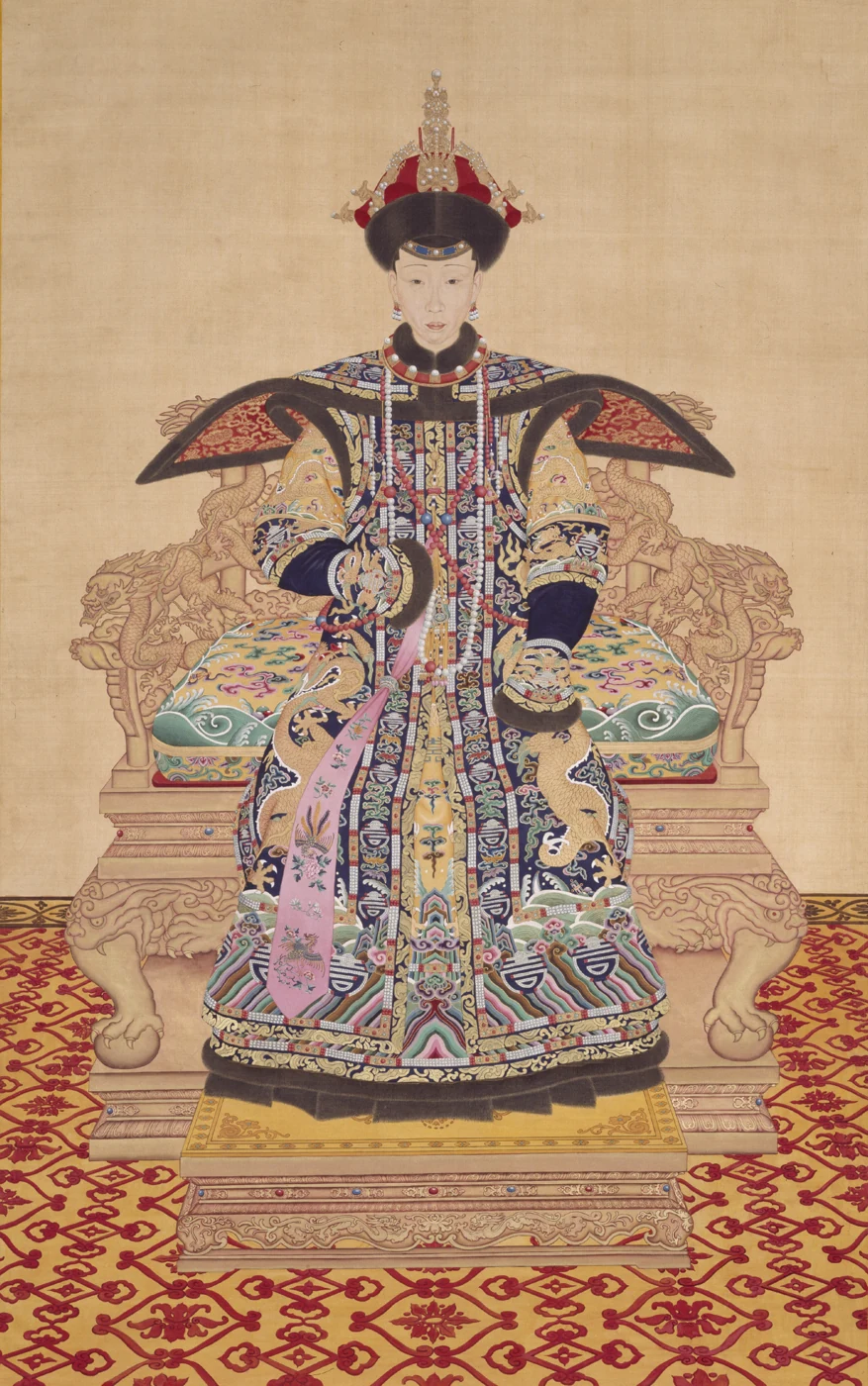
1727 CE–1775 CE
Imperial Noble Consortposthumously elevated empress
Empress Weigiya
魏佳氏(孝仪纯皇后)
Empress Xiaoyichun (October 23, 1727–February 28, 1775), of the Weigiya clan and originally surnamed Wei, was initially registered among the bondservants of the Manchu Plain Yellow Banner and was later raised into the Manchu Bordered Yellow Banner. She was the Qianlong Emperor's third empress, though elevated only after her death, and the mother of the Jiaqing Emperor. The source describes her as the only Qing empress of Han…
1727 CE–1775 CEQing Dynasty
PROFILE
Empress Xiaoyichun (October 23, 1727–February 28, 1775), of the Weigiya clan and originally surnamed Wei, was initially registered among the bondservants of the Manchu Plain Yellow Banner and was later raised into the Manchu Bordered Yellow Banner. She was the Qianlong Emperor's third empress, though elevated only after her death, and the mother of the Jiaqing Emperor. The source describes her as the only Qing empress of Han Chinese ancestry. In 1745, the tenth year of the Qianlong era, she entered the palace and was granted the rank of Noble Lady Wei; that same year she was promoted to Imperial Concubine Ling. She continued to rise through the consort ranks and bore the Qianlong Emperor four sons and two daughters. After the Step Empress Nara fell from favor in 1765, Lady Weigiya was promoted to Imperial Noble Consort and placed in charge of the Six Palaces, effectively directing the inner court for ten years. In 1773 her son, the fifteenth imperial prince Yongyan, was secretly designated heir. She died in 1775 at age forty-nine and received the posthumous title Imperial Noble Consort Lingyi. In 1795, when the Qianlong Emperor publicly announced Yongyan as crown prince, he posthumously elevated Yongyan's mother as Empress Xiaoyi. Her full posthumous title was expanded under the Jiaqing and Daoguang emperors to Empress Xiaoyi Gongshun Kangyu Ciren Duanke Minzhe Yitian Yusheng Chun.
- Alternate names
- Empress Xiaoyichun; Consort Ling, Weigiya clan
- Period
- Qing Dynasty
- Dynasty / polity
- Qing Dynasty
- Identity
- Imperial Noble Consort; posthumously elevated empress
- Ethnicity / group
- Han Chinese ancestry (entered the Manchu banner system)
- Clan
- Wei clan, later Weigiya clan
- Banner affiliation
- Bondservant household of the Imperial Household Department's Plain Yellow Banner; later raised into the Manchu Bordered Yellow Banner
- Native place
- Not reliably confirmed in available sources
- Date of birth
- October 23, 1727
- Place of birth
- Unknown
- Date of death
- February 28, 1775
- Posthumous title at death
- Imperial Noble Consort Lingyi
- Major achievements
- Favored consort of the Qianlong Emperor; mother of the Jiaqing Emperor; posthumously elevated as Empress Xiaoyichun
LIFE TIMELINE
Age nineteen | Granted the rank Noble Lady Wei; ordered promoted to Imperial Concubine Ling in the same year and formally invested in the eleventh month
Age twenty-two | Ordered promoted to Consort Ling; formally invested in the fourth month of the following year
Age twenty-five | Her father, whose name is recorded in the Chinese source as 清泰, died; in the ninth month her natal family was transferred from bondservant manager registration to a bondservant company
Age thirty | Gave birth to the seventh imperial daughter at Wufu Hall in the Old Summer Palace on the fifteenth day of the seventh month
Age thirty-one | Accompanied the emperor on a southern tour in the first month; gave birth to the fourteenth imperial son Yonglu on the seventeenth day of the seventh month
Age thirty-two | Gave birth to the ninth imperial daughter on the fourteenth day of the seventh month
Age thirty-three | Suffered a miscarriage in the intercalary sixth month; ordered promoted to Noble Consort Ling in the eleventh month and formally invested in the twelfth
Age thirty-four | Fourteenth son Yonglu died in the third month during smallpox inoculation; on the sixth day of the tenth month, she gave birth at Tiandi Yijiachun in the Old Summer Palace to the fifteenth imperial son Yongyan, later the Jiaqing Emperor
Age thirty-six | Accompanied the emperor on a southern tour in the first month; gave birth to the sixteenth imperial son on the thirtieth day of the eleventh month
Age thirty-nine | Accompanied the southern tour; after the Step Empress cut her hair and fell from favor, promoted to Imperial Noble Consort on the ninth day of the fifth month, formally invested in the sixth month, and placed in charge of the Six Palaces
Age forty | Gave birth to the seventeenth imperial son Yonglin on the eleventh day of the fifth month
Age forty-five | Accompanied the emperor on an eastern tour to Mount Tai and Qufu in the second month
Age forty-seven | At the winter solstice, her fifteenth son Yongyan was secretly designated imperial heir
Age forty-nine | Her natal family was raised into the Manchu Bordered Yellow Banner on the twenty-fifth day of the first month; she died on the twenty-ninth; in the second month she received the posthumous title Imperial Noble Consort Lingyi; in the tenth month she was interred in Yuling Mausoleum
Posthumous | On the third day of the ninth month, the Qianlong Emperor proclaimed Yongyan crown prince and posthumously elevated his mother as Empress Xiaoyi; formally invested in the tenth month
Posthumous | Full honorific expanded to Empress Xiaoyi Gongshun Kangyu Ciren Yitian Yusheng Chun
Posthumous | The characters Duanke were added in the twelfth month
Posthumous | The characters Minzhe were added in the fourth month, producing the full title Empress Xiaoyi Gongshun Kangyu Ciren Duanke Minzhe Yitian Yusheng Chun
BIOGRAPHY
Biography
Family Background and Early Life
The Weigiya empress descended from the Wei family of Shenyang, a Han Chinese family incorporated into the banner system. The family's banner ancestor is recorded in the Chinese source as 绥恩, with the Han Chinese name given there as 魏国贤. In the late Ming he had been a military-household chiliarch and was later sent to Liaodong to fight the Later Jin. After his superior Mao Wenlong was killed by Yuan Chonghuan, he crossed the sea with Geng Zhongming and submitted to Hong Taiji of the Later Jin, receiving a company command in the Han Chinese Plain Yellow Banner. He was later investigated by the regent Dorgon for sheltering a saddle maker in violation of fugitive regulations. Because of his earlier service in crossing the sea and surrendering, he escaped severe punishment; instead, the entire company to which he belonged was transferred into the Third Bondservant Company of the First Subdivision of the Imperial Household Department's Plain Yellow Banner.
After the family's entry into the banner system, successive generations served in the Imperial Household Department. A grandson of the banner ancestor, Sixing, rose to guard-school command and married a woman whose clan name is recorded in the source as 陈佳氏. Sixing's son is recorded in the Chinese source as 五十一, also written 武世宜, with the Han Chinese name given there as 魏九龄. He first served as an internal manager and during the Yongzheng reign became a minister of the Imperial Household Department, the highest office within that administrative system. He was appointed in the eleventh month of 1725 and died the following month after only a short tenure. Empress Weigiya, born in 1727, therefore never knew her grandfather.
Her father, whose name is recorded in the Chinese source as 清泰 and whose Han Chinese name is given there as 魏明禄, also rose to internal manager. He married a woman of the Yanggiya clan and had three sons, whose names are recorded in Chinese as 和绷额, 英敏, and 德馨. The empress's grandmother and mother had served as female officials carrying investiture texts and seals during the 1723 ceremonies for the empress and consorts. The source notes that wives of Imperial Household Department managers could indeed serve as female ceremonial officials during investitures of consorts and imperial sons' wives.
As an Imperial Household Department banner family, the Wei household accumulated substantial property by the early Yongzheng reign, including at least eight residences totaling about two hundred rooms. After the death in 1725 of her grandfather, recorded in the Chinese source as 五十一 (also 武世宜, with the Han Chinese name given there as 魏九龄), irregularities were discovered in the disposal of confiscated goods during his supervision of the Chongwen Gate customs office. The Yongzheng Emperor ordered repayment of 16,732 taels, seven qian, and five fen of silver. Her father sold 110 taels of family silver, seven houses totaling 182.5 rooms apart from the main residence, and land near Wanping and elsewhere to the state. A balance of 2,509 taels remained unpaid until a request for remission was granted in 1735.
During the Qianlong reign, Lady Weigiya entered the palace through an Imperial Household Department selection. Surviving documentation does not make the exact date or her first rank entirely clear. A note by the Qianlong Emperor to his poem on pouring wine at Empress Xiaoxian's tomb states that Imperial Noble Consort Lingyi had been taught and raised by the empress and was later buried near her in the underground palace. On this basis, the source suggests that Lady Weigiya may initially have served under Empress Xiaoxianchun as a young woman "learning the rules." The Qianlong inner court included other women from the Three Upper Banners of the Imperial Household Department who are recorded as having learned palace rules under a senior consort.
Rise through the Consort Ranks
In 1745, the tenth year of Qianlong, Lady Weigiya was made Noble Lady Wei and on the twenty-third day of the first month was ordered promoted to Imperial Concubine Ling. Her formal investiture took place on the seventeenth day of the eleventh month. The source states that the Manchu word corresponding to the title Ling was mergen, meaning intelligent or wise. She was nineteen.
In the third month of 1748, Empress Xiaoxianchun died. In the seventh month the Qianlong Emperor formally promoted Noble Consort Nara to Imperial Noble Consort, Consort Jia to Noble Consort, and Imperial Concubines Ling and Shu to consorts. On the fifth day of the fourth month of 1749, Lady Weigiya was formally invested as Consort Ling. The source notes that in the thirteenth year of Qianlong, amid the emperor's grief and agitation after losing both a son and his empress, a number of imperial relatives and senior officials were punished. Consort Ling's father was penalized because offerings of pastries for the deceased Empress Xiaoxian's altar were delayed.
In 1751, Consort Ling's father died. On the twenty-second day of the ninth month, the Qianlong Emperor transferred her natal family from the Plain Yellow Banner bondservant manager registration to a bondservant company and granted them houses and land while remitting debts.
Between 1756 and 1766, Lady Weigiya bore the Qianlong Emperor four sons and two daughters in relatively close succession. On the fifteenth day of the seventh month of 1756, at Wufu Hall in the Old Summer Palace, she gave birth to the seventh imperial daughter. On the seventeenth day of the seventh month of 1757, she gave birth to the fourteenth imperial son Yonglu; on the fourteenth day of the seventh month of 1758, to the ninth imperial daughter. In the intercalary sixth month of 1759 she became pregnant, but household records indicate that preparations associated with pregnancy ended by the twenty-fourth day of the ninth month, showing that she had miscarried. On the twentieth day of the eleventh month, she was ordered promoted to Noble Consort Ling and was formally invested on the seventeenth day of the twelfth month. On the eighteenth day of the third month of 1760, her fourteenth son Yonglu died during smallpox inoculation. On the sixth day of the tenth month, she gave birth at Tiandi Yijiachun in the Old Summer Palace to the fifteenth imperial son Yongyan, later the Jiaqing Emperor.
In the first month of 1762, Noble Consort Ling accompanied the emperor on a southern tour and on the thirtieth day of the eleventh month gave birth to the sixteenth imperial son. On the fifteenth day of the first month of 1765, she and the Step Empress Nara accompanied another southern tour. During the tour the Step Empress cut her hair and was sent back to the Forbidden City under confinement. The sixteenth imperial son died on the seventeenth day of the third month. On the ninth day of the fifth month, Noble Consort Ling was ordered promoted to Imperial Noble Consort and was formally invested on the eleventh day of the sixth month. She was placed in charge of the Six Palaces. During the emperor's Rehe hunting tour from the seventh through the tenth months she accompanied him. In the eighth month, some of the pearl ornaments and ceremonial accoutrements allocated to the Imperial Noble Consort were upgraded.
A Manchu memorial from the Imperial Household Department dated the eighth day of the first month of 1766 shows that, late in pregnancy, the Imperial Noble Consort took over duties for the Lantern Festival inner-court tables and arrangements for residence at the Old Summer Palace from the confined Step Empress. On the eleventh day of the fifth month, she gave birth to the seventeenth imperial son Yonglin. The Step Empress died in the seventh month.
Management of the Six Palaces
Lady Weigiya remained Imperial Noble Consort for ten years and during this time directed the inner court. She gave birth to the Qianlong Emperor's youngest son, Yonglin, later Prince Qingxi of the First Rank. The emperor secretly designated her fifteenth son Yongyan as heir while she was still alive.
In 1767, when Princess Hejia of the Second Rank became critically ill, the Qianlong Emperor, then at Rehe, ordered princes and ministers remaining in Beijing to notify the Zhangjia Khutughtu and Imperial Noble Consort Weigiya to visit the princess. The Imperial Noble Consort led several consorts, princesses, and widowed imperial daughters-in-law to the princess's residence, saw her shortly before death, and later attended mourning rites.
In 1770, the seventh imperial daughter was titled Princess Hejing of the First Rank and married Lawang Dorji, grandson of the Mongol prince Celing. A memorial from Guangdong governor Debao the same year respectfully inquired after the health of the empress dowager and imperial noble consort. The source links this to the fact that Debao's daughter had once learned palace rules under Consort Ling before becoming a lower-ranking consort.
In 1771 the Imperial Noble Consort accompanied the emperor on an eastern tour to Mount Tai and Qufu. The ninth imperial daughter was later titled Princess Heke of the Second Rank and in 1772 married Jalantai, son of the senior official Zhaohui. At the winter solstice of 1773, Lady Weigiya's fifteenth son Yongyan was secretly designated imperial heir. In 1774 Yongyan married a daughter of He'erjing'e from the Hitara clan as his principal wife.
Illness and Death
Late in the thirty-ninth year of Qianlong, after returning to the palace from Rehe with the emperor, the Imperial Noble Consort fell ill and received treatment in Tishuntang, the eastern side room of the Hall of Mental Cultivation. On the tenth day of the first month of 1775, her seventh daughter died. On the twenty-fifth day, the emperor ordered the Imperial Noble Consort's natal family raised into the Manchu Bordered Yellow Banner and organized as a hereditary company. The emperor returned to the palace twice, on the eleventh and twenty-seventh days of the first month, to visit her during her illness.
At the mao hour on the twenty-ninth day of the first month, the Imperial Noble Consort died at age forty-nine. When announcing her death, the Qianlong Emperor referred to her as Imperial Noble Consort Lingyi. He ordered numerous imperial princes, princesses, and their spouses to observe mourning inside or outside the palace and appointed officials to supervise the funeral rites.
On the eleventh day of the second month, Prince Jian Fengnehen was appointed principal envoy and Guanbao, assistant grand secretary and minister of personnel, deputy envoy. They carried the investiture texts and seals to Jing'anzhuang and formally conferred the posthumous title Imperial Noble Consort Lingyi. The source states that the Manchu corresponding to Ling was the same as that of her former title, while fujurungga for Yi meant cultivated, graceful, or beautiful. After her death the Qianlong Emperor repeatedly visited Ji'ansuo and Jing'anzhuang to pour wine before her coffin. Buddhist monks, Chan monks, and Daoist priests recited scriptures in rotating groups from the transfer of the coffin until its final interment.
The Qianlong Emperor wrote a mourning poem for Imperial Noble Consort Lingyi recalling that most of their children had only recently completed marriages while the seventeenth son was still young, praising her conduct as leader of the inner palace and her filial service to the empress dowager, and lamenting the repeated deaths among the women of his household.
On the twenty-sixth day of the tenth month of 1775, the coffin of Imperial Noble Consort Lingyi was placed in the underground palace at Shengshuiyu, the future Yuling Mausoleum in the Eastern Qing Tombs, on the western side of the Qianlong Emperor's designated coffin position.
Posthumous Elevation
On the third day of the ninth month of 1795, the Qianlong Emperor publicly announced the fifteenth imperial son Yongyan as crown prince and at the same time posthumously elevated Yongyan's mother, Imperial Noble Consort Lingyi, as Empress Xiaoyi. The source states that the Manchu term corresponding to Yi in this title was yongsunggo, meaning proper in ritual. In the tenth month, Prince Rui Chunying and Prince Zheng Urguna carried the investiture documents and seals to Yuling and formally conferred the title Empress Xiaoyi on Lady Weigiya.
In 1796 and 1797, the retired Qianlong Emperor repeatedly instructed the Jiaqing Emperor that after Qianlong's death, the Buddhist chapel in the Hall of Mental Cultivation and Anyou Palace in the Old Summer Palace should enshrine only the spirit tablets of the Jiaqing Emperor's biological father, the retired Qianlong Emperor, and biological mother, Empress Xiaoyi. Qianlong also took Jiaqing to sacrifice at the tombs of Empress Xiaoxian and Empress Xiaoyi and wrote that a mother should rise in honor through her son, explaining the logic of her posthumous elevation.
In the ninth month of 1799, her posthumous title was expanded to Empress Xiaoyi Gongshun Kangyu Ciren Yitian Yusheng Chun. Duanke was added in the twelfth month of 1820 and Minzhe in the fourth month of 1850, producing the final full title Empress Xiaoyi Gongshun Kangyu Ciren Duanke Minzhe Yitian Yusheng Chun.
During the Jiaqing reign, the Jiaqing Emperor established a memorial image hall for his mother in Chuxiu Palace, one of her former residences, displaying her portrait and personal objects. In 1799 he ordered an official copy of her portrait made and mounted with ivory rollers and a brocade cover.
Major Activities
Promotion in the Inner Court and Management of the Six Palaces
Beginning as Noble Lady Wei in 1745, Lady Weigiya advanced through Imperial Concubine Ling, Consort Ling, Noble Consort Ling, and Imperial Noble Consort. After the Step Empress Nara lost favor in 1765, Lady Weigiya was promoted to Imperial Noble Consort and placed in charge of the Six Palaces, directing the inner court for ten years. The source describes her as the only Imperial Noble Consort of the Qianlong reign who had not come from the emperor's pre-accession household yet was entrusted with overall management of the Six Palaces. Her responsibilities included ceremonial and residential arrangements for the inner palace and the Old Summer Palace.
Children
Lady Weigiya was among the Qianlong Emperor's most prolific consorts. Between 1756 and 1766 she bore four sons and two daughters: Princess Hejing of the First Rank, the fourteenth imperial son Yonglu, Princess Heke of the Second Rank, the fifteenth imperial son Yongyan, the sixteenth imperial son, and the seventeenth imperial son Yonglin. Yonglu and the sixteenth son died young, and she also suffered a miscarriage in 1759. The source interprets her rapid promotions and repeated pregnancies as evidence of the Qianlong Emperor's favor.
Raising of the Natal Family's Banner Status
Lady Weigiya's natal family was raised in banner status twice during her lifetime. In the ninth month of 1751, the emperor transferred her family from the Plain Yellow Banner bondservant manager registration to a bondservant company and granted houses, land, and debt relief. On the twenty-fifth day of the first month of 1775, the family was raised from a bondservant company into the Manchu Bordered Yellow Banner and organized as a hereditary company. After Lady Weigiya was posthumously elevated as empress in 1795, her family received a hereditary duke title of imperial favor and entered the ranks of prominent noble lineages. The source cites a later account stating that she did not seek official posts for large numbers of relatives but preferred that ordinary family members receive soldiers' stipends and advance only if personally qualified.
Designation of Her Son as Heir
At the winter solstice of 1773, the Qianlong Emperor secretly designated Lady Weigiya's fifteenth son Yongyan as imperial heir. This was one of the most consequential events of her life. She died two years later, in the first month of 1775. On the third day of the ninth month of 1795, the emperor publicly announced Yongyan as crown prince and simultaneously elevated his biological mother posthumously as Empress Xiaoyi.
Personal Relations
Family
- Grandfather: recorded in the Chinese source as 五十一 (also 武世宜, with the Han Chinese name given there as 魏九龄), senior Imperial Household Department official
- Father: recorded in the Chinese source as 清泰 (with the Han Chinese name given there as 魏明禄), internal manager
- Mother: a woman of the Yanggiya clan
- Brothers: names recorded in Chinese as 和绷额, 英敏, and 德馨
- Sons: fifteenth imperial son Yongyan, later the Jiaqing Emperor; fourteenth son Yonglu; sixteenth son; seventeenth son Yonglin
- Daughters: Princess Hejing of the First Rank; Princess Heke of the Second Rank
Imperial Household
- Qianlong Emperor: Husband and ruler
- Empress Xiaoxianchun: Qianlong's first empress; Lady Weigiya may have learned palace rules under her
- Step Empress Nara: Qianlong's second empress; after her fall from favor, Lady Weigiya assumed management of the inner court
Children's In-Laws
- Lawang Dorji: Husband of Princess Hejing of the First Rank
- Jalantai: Husband of Princess Heke of the Second Rank and son of Zhaohui
- Hitara clan woman: Principal wife of Yongyan, the fifteenth imperial son
Historical Assessment
Qing and Contemporary Assessments
- In his mourning poem for Imperial Noble Consort Lingyi, the Qianlong Emperor praised her dignified leadership of the palace and filial devotion to the empress dowager.
- In his note to a poem on sacrificing at Empress Xiaoxian's tomb, Qianlong wrote that a mother should be honored through her son and considered the posthumous elevation of Imperial Noble Consort Lingyi after her son's designation as successor to be legitimate and proper.
- The source cites Dun Chong as describing Lady Weigiya as virtuous and far-sighted for declining to seek excessive official appointments for her natal relatives.
Late Qing and Republican Period
- The Draft History of Qing: Table of Imperial Affines records that Empress Xiaoyichun's father, recorded in the Chinese source as 清泰, belonged to the Weigiya clan, was registered in the Manchu Bordered Yellow Banner, and served as an internal manager.
- The imperially commissioned history of the Eight Banners records that in 1775 the relatives of Imperial Noble Consort Lingyi were transferred out of the Imperial Household Department and organized into a company under the Manchu Bordered Yellow Banner.
- From the late Qing onward, popular works on the imperial palace made Lady Weigiya, often under the title Consort Ling, widely known, though the source cautions that her historical image differs from later fictional portrayals.
Modern Period
- Modern Qing historians generally treat Lady Weigiya as an important figure in the Qianlong inner court. Her rise from bondservant background to Imperial Noble Consort in charge of the Six Palaces and her eventual posthumous elevation through her son's accession provide a major case for studying Qing palace institutions.
- Scholars have paid particular attention to the raising of her natal family from Imperial Household Department bondservant status into the Manchu Bordered Yellow Banner as a concrete example of the Qing practice of banner elevation for imperial consort families.
- The source presents her as the only Qing empress of Han Chinese ancestry and treats her changing status within the banner system as relevant to studies of ethnic and institutional integration.
FIGURES ASSOCIATED WITH THIS DYNASTY
Bibliography
- Draft History of Qing: Table of Imperial Affines
- Imperially Commissioned General History of the Eight Banners: Manchu Companies of the Bordered Yellow Banner
- Xiang Si, Elegant Anecdotes of the Forbidden City: Imperial Life and Court Stories in the Purple Forbidden City, China Workers Press, 2024