Birth in Beijing
Heshen was born into a Manchu Plain Red Banner family in Beijing; orphaned in early childhood.
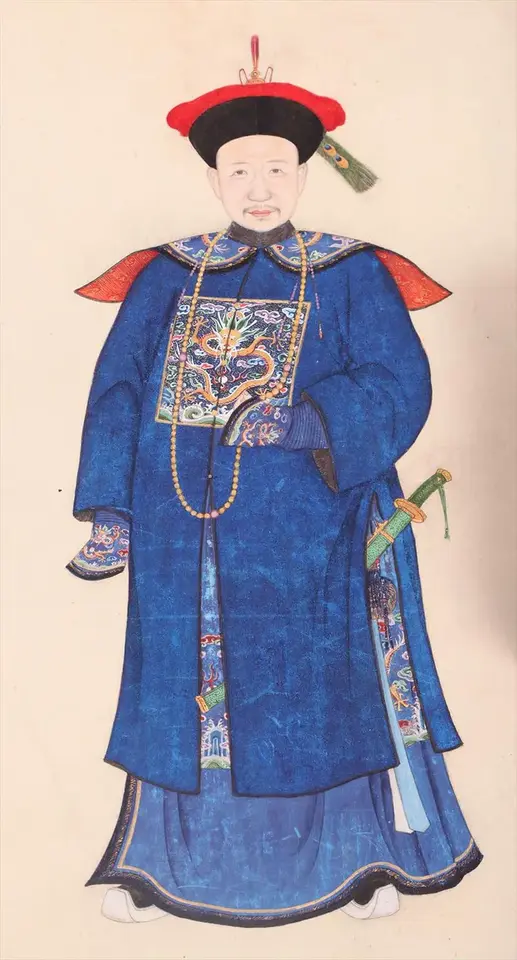
1750 CE–1799 CE
钮祜禄·和珅
Niohuru Heshen (1750–1799), originally named Shanbao, courtesy name Zhizhai, was a member of the Manchu Plain Red Banner born in Beijing. He was the paramount court favorite, statesman, and financier of the late Qianlong reign, historically renowned as the most corrupt and wealthy official in imperial Chinese history. Rising to Grand Academician of the Wenhua Hall, Chief Grand Councilor, and Minister of the Imperial…
Niohuru Heshen (1750–1799), originally named Shanbao, courtesy name Zhizhai, was a member of the Manchu Plain Red Banner born in Beijing. He was the paramount court favorite, statesman, and financier of the late Qianlong reign, historically renowned as the most corrupt and wealthy official in imperial Chinese history. Rising to Grand Academician of the Wenhua Hall, Chief Grand Councilor, and Minister of the Imperial Household, he was ennobled as First-Class Duke Zhongxiang and widely whispered of as the "Second Emperor." Educated at the prestigious Xian'an Palace Government School, Heshen was gifted in classical learning and fluent in Manchu, Chinese, Mongolian, and Tibetan. Attracting Qianlong's attention in 1773 through his sharp wit and encyclopedic recall of administrative memorials, Heshen enjoyed a meteoric rise, cemented when Qianlong wed his favorite youngest daughter, Kurun Princess Hexiao, to Heshen's son Fengshen Yinde. Dominating the inner court for over twenty years, Heshen created the system of "punitive silver fines" (yizuijin) to enrich Qianlong's private coffers, directed the compilation and printing of the Siku Quanshu, and coordinated high-level foreign and frontier diplomacy, including the British Macartney Embassy of 1793. However, Heshen engaged in extortion, venality, and commercial monopolization, operating dozens of pawnshops, banks, and mercantile fleets that amassed an unprecedented private fortune. When the retired Qianlong Emperor passed away in February 1799, the Jiaqing Emperor moved swiftly, arresting Heshen the following day. Indicted on twenty capital counts of treasonous corruption, Heshen had his assets confiscated—surpassing hundreds of millions of silver taels, equivalent to fifteen years of imperial treasury revenues—inspiring the adage: "When Heshen fell, Jiaqing had his fill." Heshen was granted the privilege of taking his own life by hanging in February 1799 at age forty-nine.
Heshen was born into a Manchu Plain Red Banner family in Beijing; orphaned in early childhood.
Studied at the prestigious Xian'an Palace Academy, mastering four languages and classical Confucian scholarship.
Inherited a third-class hereditary title and was appointed Imperial Bodyguard of the Third Class.
Impressed the Qianlong Emperor with prompt, erudite replies to classical queries, receiving promotion to palace management.
Promoted to Vice Minister of Revenue, Grand Councilor, and Minister of the Imperial Household Department at age twenty-six.
Investigated corruption in Yunnan; Qianlong betrothed his favorite daughter, Kurun Princess Hexiao, to Heshen's son.
Devised the "punitive silver fines" system to channel funds into Qianlong's private coffers.
Appointed Grand Academician of the Wenhua Hall and Chief Grand Councilor, dominating the civil and military bureaucracy.
Managed diplomatic protocols and trade negotiations during the visit of Lord Macartney's British embassy at Chengde.
Retained absolute control of state administration following Qianlong's formal abdication to the Jiaqing Emperor.
Qianlong passed away on February 7; arrested by Jiaqing on February 8 and stripped of all titles.
Sentenced on twenty capital counts of treasonous venality; granted permission to commit suicide by hanging on February 22 at age forty-nine.
Heshen was born into the prestigious Suwan Niohuru clan of the Plain Red Banner in Beijing. His father, Changbao, an officer in the Fujian garrison, died when Heshen was nine, and his mother had passed away in childbirth years earlier. Orphaned and destitute, Heshen and his younger brother Helin relied on a loyal household servant and their father's concubine, enduring cold condescension from relatives. This hardship forged in Heshen an insatiable hunger for administrative power and wealth. Admitted to the Xian'an Palace Government School reserved for Manchu elites, Heshen applied himself, mastering the Confucian classics alongside Manchu, Chinese, Mongolian, and Tibetan, while perfecting an elegant calligraphic hand that mirrored Qianlong's own.
In 1769, after failing the provincial civil examination, Heshen inherited a third-class hereditary title. In 1772, he was appointed Imperial Bodyguard of the Third Class stationed in the Forbidden City.
In 1773, while reviewing an urgent frontier dispatch concerning an escaped convict in Yunnan, the Qianlong Emperor cited an obscure Confucian passage: "When a tiger or rhinoceros escapes from its cage, or a tortoise-shell or jade is damaged in its casket, whose fault is it?" While surrounding ministers cowered in silence, the twenty-four-year-old bodyguard Heshen stepped forward, calmly answering with the exact commentary from Zhu Xi and analyzing border negligence. Startled by the erudition and handsome bearing of the young bodyguard, Qianlong summoned him for hours of intimate conversation, immediately promoting him to manage the imperial fences at the Summer Palace.
By 1776, at the age of twenty-six, Heshen had ascended to Vice Minister of Revenue, Grand Councilor, and Minister of the Imperial Household Department (Neiwufu), gaining privileged access to the Qianlong Emperor's inner chambers.
Heshen's thirty-year tenure as paramount favorite derived from his ability to read the emperor's desires and his financial resourcefulness. As Qianlong aged, his appetite for architectural extravagance, art collecting, and imperial southern tours depleted the formal board treasuries. In 1780, Heshen solved the monarch's fiscal dilemmas by inventing the "punitive silver fines" (yizuijin) mechanism. Imperial officials accused of administrative errors or bureaucratic infractions were permitted to pay fines directly into the emperor's private Imperial Household coffers in exchange for escaping criminal demotion. This lucrative revenue stream yielded millions of silver taels annually, providing funding for the Old Summer Palace and Chengde Mountain Resort while rendering Heshen indispensable to the sovereign.
In 1780, Qianlong cemented their bond by betrothing his favorite youngest daughter, Kurun Princess Hexiao, to Heshen's six-year-old son, Fengshen Yinde. Promoted to Grand Academician of the Wenhua Hall, Minister of Personnel, and Chief Grand Councilor in 1786, Heshen held unprecedented executive sway. Provincial governors and viceroys secured office solely through his patronage, and contemporaries whispered that Heshen was the true "Second Emperor."
Beyond personal indulgence, Heshen proved a capable administrator. Appointed Chief Director of the Siku Quanshu project, he coordinated the compilation, editing, and transcribing of 79,000 volumes across three thousand classical works, managing the construction of the imperial libraries (Wenyuan, Wenjin, and Wensu Halls).
Fluent in Tibetan and Mongolian, Heshen personally directed the grand reception of the Sixth Panchen Lama at Chengde in 1780, managing complex diplomatic and religious protocols. In 1793, when the British mission led by George Macartney arrived demanding trade concessions, Heshen served as principal imperial negotiator. Displaying diplomatic poise, he maintained imperial kowtow protocol while listening to British overtures, demonstrating diplomatic statecraft.
Concurrently, Heshen's venality reached historic proportions. Exploiting his control over customs barriers, salt monopolies, and official postings, he extorted massive seasonal bribes ("charcoal money" and "ice money") from regional magistrates. Furthermore, he invested his extorted fortunes into private commercial enterprises, owning seventy-five major pawnshops, commercial banks, and merchant trading fleets across the empire, becoming an unprecedented bureaucratic-mercantile oligarch.
In 1795, the eighty-five-year-old Qianlong Emperor formally abdicated to his fifteenth son, Yongyan (the Jiaqing Emperor), styling himself Retired Emperor (Taishang Huang). During the subsequent three-year transition, as Qianlong's physical faculties declined and his speech became unintelligible, Heshen alone interpreted the sovereign's mumblings. Standing between the thrones of Qianlong and Jiaqing during morning audiences, Heshen pronounced imperial decrees, completely sidelining the newly enthroned Jiaqing, who masked his hatred behind smiling deference.
On February 7, 1799, the eighty-nine-year-old Qianlong Emperor passed away in the Yangxin Hall. Within twenty-four hours, the Jiaqing Emperor moved. Ordering Heshen and his crony Fu Chang'an to maintain constant vigil beside the coffin in the Qianqing Palace, Jiaqing effectively isolated Heshen from the imperial guards. On February 8, Jiaqing stripped Heshen of all offices and had him arrested.
On February 12, Jiaqing issued an imperial proclamation listing twenty capital crimes, including arbitrary usurpation of imperial prerogative, fabrication of decrees, financial corruption, and accumulation of private armies. When imperial investigators inventoried Heshen's opulent palace (modern Prince Gong's Mansion) and rural estates, the findings shocked the court: tens of millions of silver taels in bullion, thousands of gold bars, hundreds of jewel-encrusted coral trees, and vast real estate networks whose aggregate value exceeded two hundred million to eight hundred million silver taels—exceeding fifteen years of the Qing state's total annual tax revenue. The revelations gave rise to the popular saying: "When Heshen fell, Jiaqing had his fill."
Ministers demanded execution by slow slicing (lingchi). However, out of consideration for Heshen's decades as Chief Minister and to spare the feelings of Princess Hexiao, Jiaqing granted him the privilege of suicide. On February 22, 1799, prison officials presented Heshen with a white silk cord. Composing a final poem declaring that his fifty years had been an illusion, the forty-nine-year-old minister hanged himself in his cell.
Heshen served as Chief Grand Councilor and Grand Academician for over two decades, directing the Six Ministries, the Imperial Household Department, and the Grand Council. Exhibiting formidable administrative acumen and memory, he navigated the complex factional politics of the late Qianlong court, running imperial governance during the final decades of the High Qing era.
Heshen formulated the innovative fiscal mechanism of "punitive silver fines," diverting revenues from bureaucratic infractions into the emperor's private privy purse. While funding Qianlong's lavish architectural commissions and southern excursions, this fiscal shortcut compromised official accountability, institutionalizing systemic corruption throughout late imperial governance.
Heshen directed the editorial completion of the 79,000-volume Siku Quanshu, supervising the construction of the imperial libraries. Leveraging his multilingual proficiency in Manchu, Tibetan, and Mongolian, he orchestrated the historic 1780 visit of the Sixth Panchen Lama and conducted the delicate diplomatic negotiations surrounding the 1793 British Macartney Embassy.
By combining administrative authority with commercial investments in pawnshops, private banks, and real estate, Heshen accumulated a fortune estimated in hundreds of millions of silver taels. His historic fall and confiscation under the Jiaqing Emperor became the definitive case study of bureaucratic venality and autocratic imperial purge in Chinese history.
FIGURES ASSOCIATED WITH THIS DYNASTY