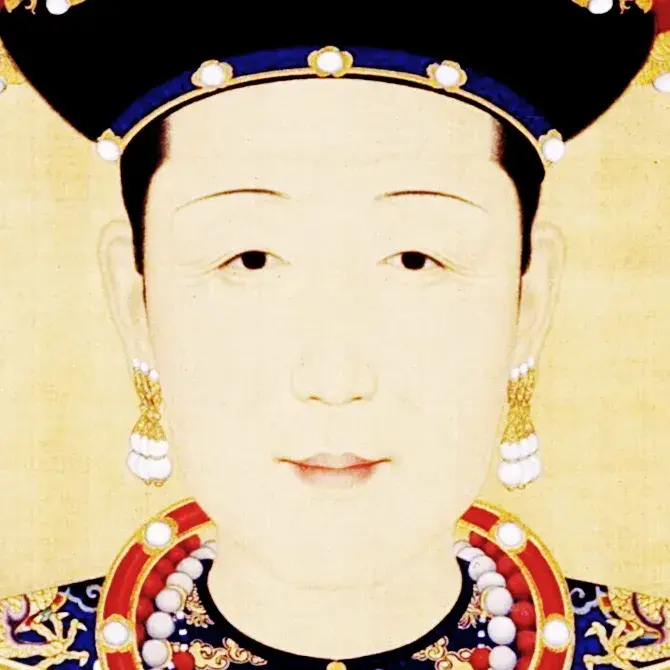
Life Story
Heritage and Entry into Imperial Service
Uya Malu traced her ancestry to the Babai branch of the Uya clan, originally settled in Hada territory. Her great-grandfather, Ebogen, submitted to the Later Jin during the founding wars of Nurhaci and was assigned to the Plain Yellow Banner bondservants under the Imperial Household Department. His son Esen demonstrated exceptional marksmanship during campaigns against Joseon and Datong under Huangtaiji, killing hostile archers who wounded the imperial son-in-law Yangguri. For these battlefield exploits, Esen was awarded the hereditary title of Cavalry Commandant and rose to Grand Minister of the Internal Affairs and Supervisor of the Imperial Buttery. Her father, Weiwu, served as a Commander of the Guards.
Although registered within the bondservant rolls, the Uya lineage produced distinguished civil and military officials. Her grand-uncle Duobi served as Senior Vice Censor-in-Chief and Grand Minister of the Imperial Household Department; his relative Samaha attained the jinshi degree in 1655 and served as Minister of Works, while Dalihu reached the post of Grand Secretary and Vice Minister of Rites.
In 1673, Uya Malu participated in the annual Imperial Household draft for banner maidens. Recorded in archives as Malu, daughter of Third Class Guard Weiwu, she was fourteen years old. Noted for her composed grace, quiet modesty, and natural dignity, she passed the imperial examinations and entered the Forbidden City, serving with diligence in the inner palaces under the watchful eyes of Grand Empress Dowager Xiaozhuang and Empress Dowager Renxian.
Elevation as Imperial Consort and Birth of Yinzhen
Uya Malu's solemn propriety and gentle temperament earned the admiration of the Kangxi Emperor. In 1677, during the first general investiture of the inner court, Lady Niuhuru was elevated as Empress and Lady Tong as Noble Consort. Uya Malu received the rank of Noble Lady with concubine-level stipends.
On November 13, 1678, nineteen-year-old Uya Malu gave birth to Kangxi's fourth surviving son, Yinzhen. Under early Qing palace protocols, concubines of lower rank were not permitted to raise their biological children. Consequently, Prince Yinzhen was placed under the guardianship of Noble Consort Tong (later Empress Xiaoyiren). Uya Malu accepted this protocol with graceful acquiescence, never displaying resentment or seeking political entitlement.
In December 1679, in recognition of her maternal merit, the Kangxi Emperor promulgated a gold patent investing her as Concubine De. The imperial patent praised her: 'Gentle and benevolent in nature, prudent in conducting herself; attuned to the harmony of ritual ornaments and skilled in classical decorum; vigilant in early mornings and late nights, never flagging in diligence.'
Presiding Over Yonghe Palace and Prolific Offspring
In March 1680, Concubine De gave birth to her second son, Yinzuo. In December 1681, following the victorious suppression of the Revolt of the Three Feudatories, the Kangxi Emperor celebrated peace with an expansive reorganization of the inner palaces. Alongside the promotion of Lady Tong to Imperial Noble Consort, Concubine De was elevated to Consort De, joining the ranks of the Four Consorts (Hui, Yi, De, and Rong).
Following her promotion, Consort De became the resident mistress of Yonghe Palace in the eastern palace complex. For over four decades, she managed Yonghe Palace with equanimity. She treated junior concubines, palace ladies, and attendants with genuine benevolence, avoiding all ostentation, extravagance, or factional patronage. Her quiet integrity won deep veneration from both Grand Empress Dowager Xiaozhuang and Empress Dowager Renxian.
Prolific Offspring and Deep Imperial Favor
Consort De was one of the most prolific imperial mothers of the Kangxi era. Over a decade, she bore six imperial children: Prince Yinzhen in 1678, Prince Yinzuo in 1680 (who died at age six), her seventh daughter in 1682 (died in infancy), her ninth daughter in 1683 (the revered Princess Gurun Wenxian, who married Shun'an'yan), her twelfth daughter in 1686, and Prince Yinti in 1688. Prince Yinti grew into an exceptional military leader, eventually designated as Prince General to command imperial campaigns in the northwest. Bearing two prominent imperial princes who would dominate the late Kangxi political horizon established Consort De as a preeminent matriarch of the dynasty.
Prudence Amid the Succession Crisis
During the stormy final decades of Kangxi's reign, the imperial court was convulsed by the fierce succession struggle known as the Contention of the Nine Princes. Consort De found herself in an extraordinarily delicate position: her eldest son Yinzhen was a seasoned, calculating prince who maintained close ties with senior statesmen, while her youngest son Yinti was championed by the faction of the Eighth Prince and entrusted with command of imperial expeditionary armies.
Trapped between two competing biological sons, Consort De exercised profound political caution. She remained secluded within Yonghe Palace, strictly forbidding her natal relatives from engaging in political intrigues or lobbying for either prince. Whenever her sons paid respects, she urged fraternal solidarity and filial devotion toward their father, steering clear of dynastic factions.
Her moral neutrality and refusal to manipulate her proximity to the emperor protected her household from the catastrophic purges that destroyed other consort families during the late Kangxi era.
Empress Dowager Elevation and Peaceful Demise
On December 20, 1722, the Kangxi Emperor passed away at the Changchun Garden, and Prince Yinzhen ascended the throne as Emperor Shizong of Qing. On the day of his enthronement, Yongzheng promulgated an imperial edict honoring his mother as Empress Dowager, selecting the auspicious title Empress Dowager Renshou.
To elevate his mother's lineage, Yongzheng decreed that the entire Uya clan be permanently transferred from the Imperial Household Department bondservant rolls into the prestigious Manchu Plain Yellow Banner, creating an independent hereditary company. He posthumously elevated three generations of maternal ancestors—Ebogen, Esen, and Weiwu—as First Class Dukes, granting her brother Baiqi hereditary dukedom and substantial estates.
Peaceful Demise at Yonghe Palace and Two-Reign Commemoration
Despite these honors, the elderly dowager suffered acute grief over Kangxi's death and distress over the deteriorating relationship between Yongzheng and her younger son Yinti, who was recalled from the northwest and placed under confinement. The strain undermined her health, and she fell critically ill in the fifth month of 1723. Although Yongzheng attended her daily at Yonghe Palace and oversaw medical treatments, she passed away peacefully on June 25, 1723, at the age of sixty-four.
Yongzheng wept bitterly, lamenting the loss of his mother, and conferred the posthumous title Empress Xiaogong Ren. In October 1723, her imperial casket was moved alongside that of the Kangxi Emperor into the underground palace of the Jingling Mausoleum, forever sharing ancestral veneration in the dynastic temple.
Major Achievements
Matriarch of the High Qing Imperial Lineage
Empress Xiaogong Ren's most lasting contribution to the Qing dynasty was giving birth to Emperor Shizong of Qing (the Yongzheng Emperor), whose thirteen-year administrative reign instituted crucial fiscal, bureaucratic, and agrarian reforms that consolidated the High Qing golden age.
Her maternal legacy extended to Prince Yinti, the celebrated Prince General whose campaigns pacified the northwestern borderlands, as well as Princess Gurun Wenxian, one of the most intellectually accomplished princesses of the Kangxi court. By giving birth to six imperial children, she anchored the dynastic lineage during the height of the Qing Empire.
Pillar of Inner Palace Moderation
Throughout her four decades presiding over Yonghe Palace, Consort De exemplified the virtues of modesty, benevolence, and self-restraint. Ascending from the humble ranks of palace maidservants to become one of the Four Principal Consorts, she never abused imperial patronage or engaged in ostentatious display.
Her gentle stewardship fostered an atmosphere of calm in the eastern palaces, mitigating friction among concubines and setting a high standard of domestic propriety. Her personal austerity and maternal discipline profoundly influenced the administrative mindset of the young Yongzheng Emperor.
Impartiality and Protection of Family
During the bitter factionalism of the late Kangxi succession struggles, Consort De adhered strictly to the principle of non-interference in court governance. Refusing to favor either of her competing sons in public, she shielded her maternal clan from political ruin.
Imperial Favor to Maternal Kin and Banner Elevation
Her composure enabled her household to transition seamlessly into the Yongzheng era without suffering retribution. Following Yongzheng's accession, her elevation of status transformed the Uya clan into an elite Banner house that supplied top-tier ministers and military commanders for generations.