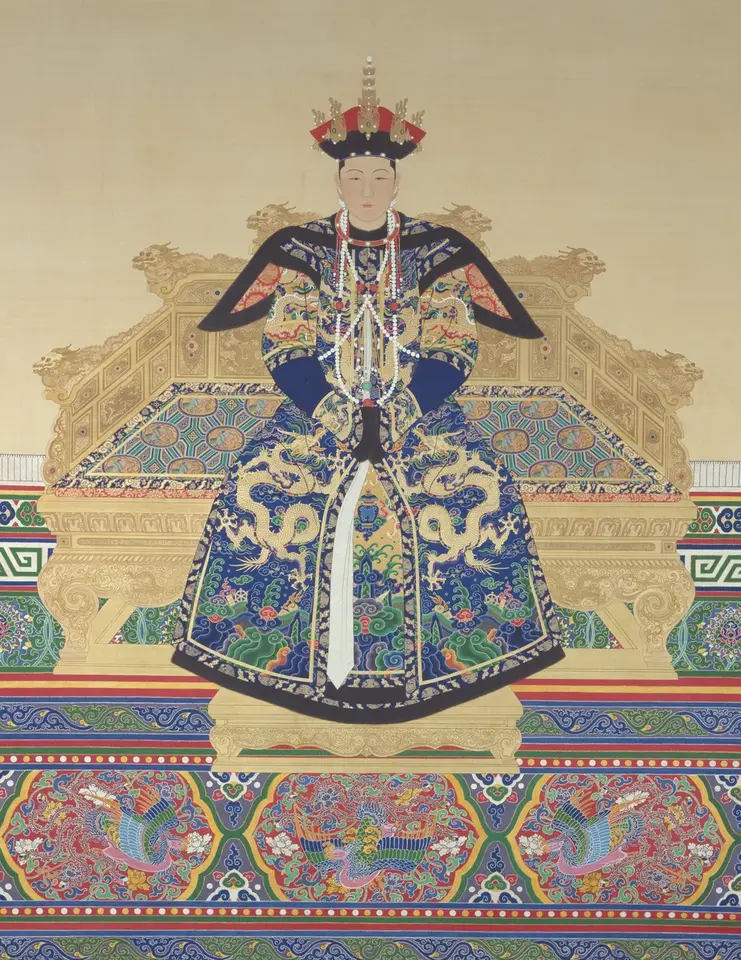
Life Story
Noble Heritage and Grand Imperial Wedding
Empress Heseri was born on February 3, 1654, into the Doyingge branch of the Heseri clan, one of the founding noble houses of the Manchu Plain Yellow Banner. Her grandfather, Sonin, served four emperors as an erudite scholar-statesman and was appointed Chief Regent by the Shunzhi Emperor upon his deathbed. Her father, Gabula, held office as Grand Minister of the Internal Affairs and was later created First Class Duke Chengen, while her uncle Songgotu rose to Grand Secretary of Baohe Hall and prominent state councilor.
Lineage and the Grand Imperial Wedding of 1665
In the fourth year of Kangxi, amid intense political rivalry between Regent Minister Sonin and the aggressive Regent Minister Oboi, Grand Empress Dowager Xiaozhuang arranged the marriage of eleven-year-old Kangxi to eleven-year-old Lady Heseri. This alliance secured Sonin's loyalty and established a counterweight against Oboi's faction. On October 15, 1665, the court delivered the imperial betrothal gifts, comprising twenty thousand taels of gold, ten thousand taels of silver, one thousand bolts of brocade, and forty steeds.
On October 16, 1665, the grand wedding took place in the Forbidden City according to combined Manchu and Han classical rites. Empress Heseri was formally installed as mother of the realm and took up residence in Kunning Palace, initiating a remarkably harmonious partnership with the young monarch.
Palace Administration and Oboi's Fall
Empress Heseri was noted for her modesty, serene judgment, and frugality. Despite her supreme rank, she wore laundered garments, avoided unnecessary ornament, and treated palace concubines with kindness and impartiality. Her strict adherence to classical learning earned her universal respect from Grand Empress Dowager Xiaozhuang and Empress Dowager Renxian.
During the critical years between 1665 and 1669, when Oboi monopolized civil appointments and executed political opponents, Empress Heseri maintained peace and order within the inner quarters. Her presence provided the young Kangxi with a secure and peaceful domestic refuge. The political cohesion of the Heseri clan, orchestrated by Sonin and Songgotu in coordination with the palace, culminated in Kangxi's successful coup against Oboi in June 1669.
In December 1669, the empress gave birth to their first son, Chenghu. Kangxi was overjoyed by the arrival of his firstborn legitimate son. Tragically, Prince Chenghu died in March 1672 at the age of four. The emperor personally attended the funeral rites and suspended court sessions, offering deep consolation to the grieving empress.
Tragic Demise and Extraordinary Mourning
On June 6, 1674, Empress Heseri went into labor with her second child in Kunning Palace. Around noon, she successfully delivered a healthy boy, Prince Yinreng. However, severe postpartum hemorrhaging set in immediately following delivery. Despite emergency interventions by imperial physicians, the empress passed away that afternoon at the age of twenty-two.
The Kangxi Emperor was struck with overwhelming grief. In an unprecedented departure from dynastic protocol, he ordered her casket placed in Qianqing Palace, the emperor's primary residential and administrative hall, setting up mourning alters beside the imperial throne. Kangxi suspended court audiences for five days and spent days in mourning attire at her bier, weeping inconsolably.
On June 27, her casket was moved to the temporary mortuary palace at Gonghuacheng outside Beijing. Over the subsequent four years, the emperor made frequent pilgrimages to Gonghuacheng, visiting her bier more than eighty times to pour libations and compose sorrowful elegies, often halting military discussions to pray before her spirit tablet.
Crown Prince Investiture and Dynastic Impact
To fulfill his devotion to the departed empress, the Kangxi Emperor took an unprecedented constitutional step. In December 1675, breaking the longstanding Manchu tradition against early succession decrees, Kangxi officially promulgated an imperial edict creating the two-year-old Prince Yinreng as Crown Prince of the Qing Empire. The emperor raised Yinreng in his own palace, supervising his education directly and attributing the boy's status to the virtuous memory of Empress Heseri.
In 1681, following the completion of the underground chambers of the Jingling Mausoleum, Empress Heseri's casket was permanently entombed alongside that of Empress Xiaozhaoren. This established a new imperial precedent where an empress was buried before the sovereign, leaving the stone vault unsealed to await the emperor's eventual burial.
Reputation as Virtuous Empress and Classical Erudition
Initially granted the posthumous title Empress Renxiao by Kangxi, her name was amended to Empress Xiaocheng Ren in 1723 by the Yongzheng Emperor to avoid repeating the character Ren from Kangxi's own posthumous title. Her legacy as Kangxi's first and most beloved consort remained an enduring touchstone of early Qing court history.
Major Achievements
Domestic Support for Kangxi's Early Consolidation
Empress Heseri played an indispensable role during the critical consolidation of the Kangxi Emperor's personal rule. Marrying the young sovereign during a dangerous regency crisis, her presence in the palace solidified the alliance between the throne and the premier Regent Sonin.
Her calm and dignified administration of Kunning Palace insulated the young emperor from inner court distractions, allowing him to orchestrate the political downfall of Oboi in 1669 and firmly assume autocratic governance.
Embodiment of Early Qing Consort Propriety
Empress Heseri established the benchmark for early Qing empress conduct. Living through a period of transition where traditional Manchu customs merged with classical Confucian court ritual, she exemplified classical filial devotion toward Grand Empress Dowager Xiaozhuang.
Her refusal to indulge in jewelry, her gentle treatment of palace attendants, and her intellectual cultivation earned her the description of Virtuous Empress in official court annals.
Historical Catalyst for Imperial Succession
Giving Birth to the Imperial Heir and Early Demise
Empress Heseri's motherhood catalyzed one of the most significant institutional experiments in Qing history: the open creation of a crown prince. By investing Yinreng as imperial heir in 1675 solely out of reverence for his mother, Kangxi attempted to introduce the Han principle of legitimate primogeniture into the Manchu state.
Institutional and Political Impact of Her Early Demise
Although the subsequent political volatility of the Crown Prince would embroil the court in the Contention of the Nine Princes decades later, the initial creation of Yinreng was a monumental testament to Kangxi's profound love for his first empress.