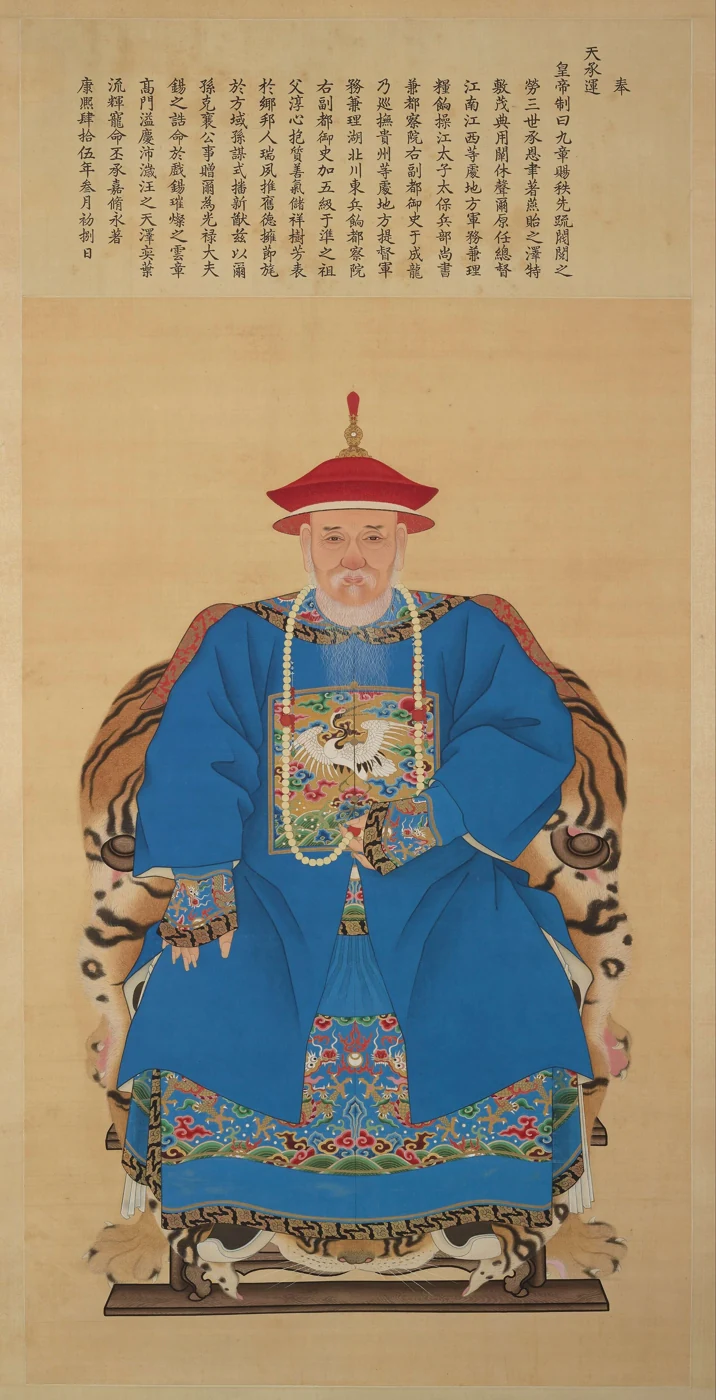
Later artistic depiction of Yu Chenglong in a historical painting or book illustration.

1617 CE–1684 CE

Qing official and exemplary local administrator

Yu Chenglong

于成龙

Yu Chenglong (September 26, 1617–May 31, 1684), courtesy name Beiming and art name Yushan, was a native of Yongning Prefecture in Shanxi, present-day Fangshan County in Lüliang. A prominent official of the early Qing, he became famous for incorruptibility and upright conduct and was praised by the Kangxi Emperor as “the foremost incorrupt official under Heaven.” Yu entered official service comparatively late, at age…

1617 CE–1684 CEQing Dynasty

PROFILE

Yu Chenglong (September 26, 1617–May 31, 1684), courtesy name Beiming and art name Yushan, was a native of Yongning Prefecture in Shanxi, present-day Fangshan County in Lüliang. A prominent official of the early Qing, he became famous for incorruptibility and upright conduct and was praised by the Kangxi Emperor as “the foremost incorrupt official under Heaven.” Yu entered official service comparatively late, at age forty-five. He successively served as magistrate of Luocheng, prefect of Hezhou, assistant prefect of Huangzhou, prefect of Wuchang, Judicial Commissioner of Fujian, governor of Zhili, and ultimately Governor-General of Liangjiang with the additional title of Minister of War. During more than twenty years in office he maintained a frugal and incorrupt lifestyle, implemented numerous measures regarded as beneficial to the population, and became deeply respected by local people. He died in office as Governor-General of Liangjiang in 1684, the twenty-third year of Kangxi, and received the posthumous name Qingduan.

Period
Qing
Dynasty/Polity
Qing
Identity
Qing official and exemplary local administrator
Ethnicity
Not reliably established in historical sources
Native Place
Yongning Prefecture, Shanxi (present-day Fangshan County, Lüliang, Shanxi)
Date of Birth
September 26, 1617
Place of Birth
Unknown
Date of Death
May 31, 1684
Place of Death
Unknown
Highest Office
See Biography and Major Deeds

LIFE TIMELINE

Age one | Born at the chou hour on the twenty-seventh day of the eightOpen

Age one | Born at the chou hour on the twenty-seventh day of the eighth lunar month in Laibao village, Yongning Prefecture, Shanxi.

Age twenty-three | Sat for the provincial examination, obtained a suppOpen

Age twenty-three | Sat for the provincial examination, obtained a supplementary tribute-student ranking, and did not take office because his father was elderly.

Age thirty-one | Entered a school established at Chongshan Temple in TOpen

Age thirty-one | Entered a school established at Chongshan Temple in Taiyuan.

Age thirty-five | Failed the provincial examination again.Open

Age thirty-five | Failed the provincial examination again.

Age forty-two | His father Yu Shihuang died.Open

Age forty-two | His father Yu Shihuang died.

Age forty-five | Studied at the Imperial Academy and, after presentingOpen

Age forty-five | Studied at the Imperial Academy and, after presenting himself for selection, was appointed magistrate of Luocheng in Guangxi.

Age fifty-one | Promoted to prefect of Hezhou in Sichuan; residents ofOpen

Age fifty-one | Promoted to prefect of Hezhou in Sichuan; residents of Luocheng followed him for hundreds of li to see him off.

Age fifty-three | Promoted to assistant prefect of Huangzhou PrefecturOpen

Age fifty-three | Promoted to assistant prefect of Huangzhou Prefecture in Huguang.

Age fifty-seven | Took charge of Wuchang Prefecture as the Revolt of tOpen

Age fifty-seven | Took charge of Wuchang Prefecture as the Revolt of the Three Feudatories began.

Age fifty-eight | Acting prefect of Wuchang; pacified Liu Junfu's upriOpen

Age fifty-eight | Acting prefect of Wuchang; pacified Liu Junfu's uprising; transferred as prefect of Huangzhou and suppressed the Dongshan rebels.

Age sixty-one | Promoted to circuit intendant of the Lower Yangtze DefOpen

Age sixty-one | Promoted to circuit intendant of the Lower Yangtze Defense Circuit of Huguang.

Age sixty-two | Promoted to Judicial Commissioner of Fujian and overtuOpen

Age sixty-two | Promoted to Judicial Commissioner of Fujian and overturned unjust “collaboration with the sea” cases.

Age sixty-three | Promoted to Provincial Administration Commissioner oOpen

Age sixty-three | Promoted to Provincial Administration Commissioner of Fujian and recommended as “first in incorruptibility and competence in Fujian.”

Age sixty-four | Promoted to governor of Zhili.Open

Age sixty-four | Promoted to governor of Zhili.

Age sixty-five | Received in audience at the capital; the Kangxi EmperOpen

Age sixty-five | Received in audience at the capital; the Kangxi Emperor granted him one thousand taels of silver and an imperial horse and called him “the foremost incorrupt official.”

Age sixty-six | Promoted to Governor-General of Liangjiang with the adOpen

Age sixty-six | Promoted to Governor-General of Liangjiang with the additional title of Minister of War.

Age sixty-eight | Died on the eighteenth day of the fourth lunar monthOpen

Age sixty-eight | Died on the eighteenth day of the fourth lunar month while serving as Governor-General of Liangjiang; posthumous name Qingduan.

BIOGRAPHY

Biography

Family Background and Early Years

Yu Chenglong's family moved during the reign of the Yuan emperor Shundi to Baishuangli village in Shizhou, present-day Lishi District of Lüliang, Shanxi. By the time of his great-grandfather Yu Su, the entire family had moved to Laibao village, thirty kilometers north of the prefectural seat. Yu Chenglong was born at the chou hour on the twenty-seventh day of the eighth lunar month of the forty-fifth year of Wanli, September 26, 1617. He was the second son of Yu Shihuang and his first wife, Lady Tian. Lady Tian died soon after his birth, and his father remarried Lady Li. Yu Chenglong had a harmonious relationship with his stepmother and received a good education in a stable household.

In 1639, at age twenty-three, Yu Chenglong sat for the provincial examination. The examiners at Taiyuan were openly engaged in favoritism and malpractice, and Yu used his examination paper to criticize contemporary abuses directly. He failed to place on the main list and only obtained a supplementary tribute-student ranking. After later sitting for the metropolitan examination, he declined an opportunity to take office on the ground that his father was elderly and returned to Laibao.

After the Qing established control over the Central Plains, Yu continued preparing for the examinations. From 1647 to 1651 he studied for four years at a school established at Chongshan Temple in Taiyuan, but again failed the provincial examination in 1651, when he was thirty-five. In 1654 his elder brother Yu Hualong died and his third son Yu Tingyuan was born, leaving Yu to bear the main burden of household expenses. His father was old and frequently ill, his stepmother was also elderly, and his first two sons were in school. The family's resources became strained, and Yu was occupied with maintaining the household and no longer had time for the examinations. His father died in 1658.

Taking Office at Luocheng

In 1661, at age forty-five, Yu Chenglong entered the Imperial Academy. After completing his studies, he went to the capital for official selection and was appointed magistrate of Luocheng in Guangxi. Luocheng lay in the mountainous ethnic-minority region of northern Guangxi, with steep terrain, deep ravines, dangerous wildlife, and widespread miasmatic disease. Yao and Zhuang communities lived among one another, language barriers were common, and disputes were frequent. The county had been under Qing rule for less than two years and had been badly damaged by warfare; of the previous two magistrates, one had died and the other fled.

Despite knowing the difficulties, Yu accepted the appointment. Before leaving, he wrote to a friend: “On this journey I will absolutely not make warmth and full meals my concern; the four words in which I place my confidence are only ‘Heavenly principle and conscience.’” He left his mother, wife, and children, rode a donkey, took four servants, and traveled more than six thousand li to Luocheng. The county seat contained only six households, had no proper walls, and the yamen consisted of three thatched rooms. On arrival, he cut thorn branches and planted them as a gate, piled earth in the courtyard for a table, dug a cooking pit beside it, and possessed only one pot and one basin.

After taking office, Yu summoned clerks and residents daily and calmly asked about their hardships, while announcing the court's policy of pacification. He reaffirmed the baojia system. When robbery or theft occurred, he immediately sent attendants to investigate; once an accusation was verified, he dealt with it quickly. Through repeated enforcement the area gradually became more secure. Yao leaders from neighboring districts often raided Luocheng; Yu organized local militia to drive them back and prepared to attack their strongholds, after which the leaders, frightened, swore not to return. With greater security, residents resumed production. Yu repeatedly petitioned superiors to reduce labor obligations, arranged for salt to be imported from the interior, built a county school, and established a charitable institution for the poor, after which Luocheng was said to be well governed.

Yu lived in great poverty at Luocheng. Some of his four servants left, while others died of miasmatic disease. Local residents felt sympathy for him, came to greet him morning and evening, and sometimes pooled money to give him, but he consistently declined. When a family member once visited, residents assumed he needed money and collected a substantial sum. Yu laughed and said that since the place was six thousand li from his home, carrying so much money would only increase the traveler's burden. He still refused the gift.

Hezhou and Huangzhou

In 1667, Yu Chenglong's record in Luocheng was noticed by Guangxi governor Jin Guangzu and Governor-General of Guangdong and Guangxi Lu Xingzu, who recommended him as the province's only “outstanding official” of the year. The Kangxi Emperor promoted him to prefect of Hezhou in Sichuan, present-day Hechuan in Chongqing. When the people of Luocheng learned that he was leaving, they came out in large numbers, blocked the road in grief, and followed him for hundreds of li before returning in tears.

Hezhou's economy had been badly damaged by the late-Ming rebellions and Qing warfare in Sichuan. The city had only a little more than one hundred households, annual regular tax revenue was merely fifteen taels of silver, and service burdens remained heavy. Yu abolished unreasonable regulations and abuses inherited from the Ming, recruited people to reclaim wasteland, and had the government lend seed grain and draft cattle. Within a little more than one month the population returning to the area increased to about one thousand households. When the governor ordered the cutting of nanmu timber, Yu submitted a direct memorial titled *Detailed Report on the Cutting of Nanmu*, criticizing the project as burdensome and wasteful to the people.

In 1669 he was promoted to assistant prefect of Huangzhou in Huguang and stationed at Qiting. Banditry was common and robberies occurred even in daylight. Yu pacified the bandit leader Peng Bailing and allowed him to atone by helping arrest other bandits. On one occasion, after learning the location of a bandit stronghold, Yu disguised himself as a beggar, entered it, and lived among the bandits for more than ten days, learning the details of their activities. He then left, summoned constables, arrested the group, and brought them to justice; other bandits fled the area. He also frequently traveled incognito through villages, investigating local conditions. In robberies and difficult cases he was often able to trace the facts, impressing local residents. Because of his record, Huguang governor Zhang Chaozhen again recommended him as an “outstanding official.”

Prefect of Huangzhou during the Revolt of the Three Feudatories

In 1673 Yu was transferred to take charge of Wuchang Prefecture and was due to be promoted to prefect. At the same time the Revolt of the Three Feudatories broke out. Wu Sangui sent numerous Hubei-born officers back to their home districts carrying letters intended to incite rebellion. In May 1674 a forged rebel letter was discovered in Macheng. The county magistrate responded by indiscriminately arresting people on charges of “collusion with rebels.” Liu Junfu and his son exploited the situation, contacted strongholds in the Dongshan area, and launched an uprising. Because Yu had great local influence, he was asked to restore order. He adopted a policy of conciliation and issued public notices that persuaded most coerced followers to return home. He then entered Liu Junfu's mountain stronghold alone despite the danger and persuaded Liu and three hundred gunmen to submit, ending the unrest within ten days. In August Yu was transferred as prefect of Huangzhou.

At that time He Shirong at Yongning, Chen Dingye at Yangluo, Liu Qiye at Shipi, and Zhou Tiezhao and Bao Shiyong at Quanban each raised several thousand men. Collectively called the “Dongshan bandits,” they represented a major threat. Yu rejected proposals to abandon Huangzhou and instead organized local militia for an active campaign. He gathered two thousand militiamen from the surrounding townships and sent Huanggang magistrate Li Jingzheng against Yangluo, where Chen Dingye was killed. Yu then personally led troops against He Shirong. During the fighting, company commander Wu Zhilan was shot and killed and government troops began to give ground. Yu rode forward and told company commander Li Maosheng, “If I die in battle, you are to report it to the governor!” Li fought hard, while military examination graduate Zhang Shangsheng moved behind the enemy; their combined attack won a major victory and captured He Shirong alive. Yu then took Quanban and pacified all the rebellions within only twenty-four days, receiving high praise from Governor-General of Huguang Cai Yurong.

In 1676 Huangzhou suffered famine and rumors spread. Yu repaired the pavilions at Red Cliff and spent his days there composing poetry with subordinate officials, calming public anxiety. Soon afterward his stepmother died and he was required to observe mourning, but Cai Yurong petitioned that he be retained in office despite mourning. In 1677, when the court created a new Lower Yangtze Defense Circuit headquartered at Huangzhou, Yu was promoted to circuit intendant.

“First in Incorruptibility and Competence in Fujian”

In 1678 Yu Chenglong was promoted to Judicial Commissioner of Fujian. At the time, in its struggle against the Zheng regime on Taiwan, the Qing court enforced maritime prohibitions, and local officials repeatedly opened large cases under charges of “communication with the sea,” often implicating thousands. Yu demanded retrials and strongly advocated reversing wrongful convictions; more than one thousand innocent people were released. For this he was recommended for the third time as an “outstanding official.”

In 1679 he became Provincial Administration Commissioner of Fujian. Fujian governor Wu Xingzu submitted a special memorial recommending him to the court as “first in incorruptibility and competence in Fujian.”

Governor of Zhili and Governor-General of Liangjiang

In 1680 Yu Chenglong was promoted to governor of Zhili. In 1681 the Kangxi Emperor personally received him in audience, granted him one thousand taels of silver and an imperial horse, composed a poem praising his integrity and ability, and called him “the foremost incorrupt official.” In 1682 Yu became Governor-General of Liangjiang with the additional title of Minister of War. When news of his appointment reached Nanjing, the price of plain cloth rose rapidly. The source says that the entire city changed into simple cloth clothing, wedding families did not dare use music, officials reduced their retinues, and some people were so frightened that they remained indoors, while corrupt clerks and rogues fled in all directions.

In 1683, because Yu's administration was so strict about gifts that Liangjiang sent no “red-envelope” payments to the capital, he made many enemies and was impeached by Ma Shiji. The Kangxi Emperor, aware that Yu had offended many senior officials, formally demoted him five ranks while retaining him in office to quiet the opposition. The governors of Jiangsu and Anhui were then transferred away, and Yu temporarily performed both governors' duties in addition to the governor-generalship.

Yu died in office in 1684. When the people of Nanjing heard the news, “men and women, old and young, wept in the streets and closed the markets.” His belongings consisted only of one worn robe and a few jars of salt and fermented beans. When his coffin was returned to his native place, tens of thousands of people walked twenty li and prostrated themselves at the riverbank, weeping as they saw him off. The Kangxi Emperor exceptionally wrote the text of his memorial stele himself, posthumously granted him the title Grand Guardian of the Heir Apparent, and bestowed the posthumous name Qingduan.

Major Activities

Personal Integrity and Frugality

Throughout his career Yu Chenglong was diligent and incorrupt. Wherever he served he maintained a frugal lifestyle. Sources describe him as eating porridge mixed with bran and rice together with his servants and living on coarse rice, thin porridge, and vegetables, “not knowing the taste of meat for an entire year,” which earned him the nickname “Yu Greens.” He forbade extravagance among family members and servants. No family members accompanied him to his posts; he and his wife were separated for twenty years and saw each other only once during that period. Even as Governor-General of wealthy Liangjiang he ate simple food. After his death, officials handling his funeral found in his bedroom only a worn robe, several measures of rice in an earthen jar, and a few containers of salt and fermented beans, causing them to weep.

Skill in Judicial Cases

Yu Chenglong was known for deciding difficult cases and for strict, impartial law enforcement. As assistant prefect of Huangzhou he frequently traveled incognito, discovered clues from minor details, and adjudicated doubtful or unresolved cases. Many wrongful judgments were overturned, leading residents to call him “Yu Qingtian,” meaning “Clear-Sky Yu,” a conventional nickname for an upright magistrate. Pu Songling's *Strange Tales from a Chinese Studio*, juan 9, “Governor Yu,” recounts two stories about Yu solving cases.

Pacifying Rebellions and Stabilizing the Population

During the Revolt of the Three Feudatories, Yu demonstrated both military ability and political tact in Hubei. He first ended Liu Junfu's uprising through conciliation, then used two thousand local militiamen to defeat rebel forces numbering in the thousands and pacified the Dongshan movement within twenty-four days. During famine in Huangzhou he repaired the Red Cliff pavilions and publicly composed poetry there with his staff to calm panic among the population.

Reversing Unjust Convictions

As Judicial Commissioner of Fujian, Yu confronted repeated prosecutions for “communication with the sea.” He insisted on retrials and obtained the release of more than one thousand innocent people. Fujian governor Wu Xingzu later praised him as “first in incorruptibility and competence in Fujian.”

Administrative Achievements

At every post Yu emphasized restoring production and reducing burdens. In Luocheng he reaffirmed baojia, encouraged farming, built a school, and established a charitable institution. In Hezhou he recruited settlers to reclaim land and lent them draft animals and seed, increasing the returning population to about one thousand households within a month. In Zhili and Liangjiang he tightened official discipline, causing corrupt clerks and local rogues to flee.

Personal Relations

Family

  • Great-grandfather: Yu Su.
  • Father: Yu Shihuang.
  • Birth mother: Lady Tian.
  • Stepmother: Lady Li.
  • Elder brother: Yu Hualong.
  • Third son: Yu Tingyuan.
  • Grandson: Yu Zhun.

Friends and Supporters

  • Wei Xiangshu: Censor-in-Chief, who strongly recommended Yu Chenglong to the Kangxi Emperor; the two had long admired one another without having met.

Ruler–Minister Relations

  • Kangxi Emperor: Yu's ruler, who called him “the foremost incorrupt official” and “the foremost incorrupt official under Heaven” and personally wrote his memorial stele.
  • Jin Guangzu: governor of Guangxi, recommended Yu as an “outstanding official.”
  • Lu Xingzu: Governor-General of Guangdong and Guangxi, recommended Yu as an “outstanding official.”
  • Zhang Chaozhen: governor of Huguang, recommended Yu as an “outstanding official” and placed great trust in him.
  • Cai Yurong: Governor-General of Huguang, petitioned that Yu remain in office despite mourning obligations.
  • Wu Xingzu: governor of Fujian, recommended Yu as “first in incorruptibility and competence in Fujian.”

Colleagues and Conflicts

  • Ma Shiji: impeached Yu Chenglong; the accusations were later found unsubstantiated according to the source.
  • Chen Tingjing: Vice Minister of Personnel, wrote a stele inscription for Yu Chenglong.

Historical Assessment

Qing and Contemporary Assessments

  • The Kangxi Emperor asked, “How many officials are there like Yu Chenglong?” and called him “the foremost incorrupt official under Heaven,” as recorded in juan 277 of the *Draft History of Qing*.
  • Fujian governor Wu Xingzu called Yu “first in incorruptibility and competence in Fujian,” also recorded in the *Draft History of Qing*.
  • The source quotes a historical judgment that “Yu Chenglong won the people's hearts to such a degree as is rarely seen in ancient histories.”
  • Censor-in-Chief Wei Xiangshu strongly recommended Yu and lamented that, despite long-standing mutual admiration, not meeting him was his greatest regret.

Late Qing and Republican Period

  • The *Draft History of Qing* states: “Yu Chenglong was upright by nature and incorrupt in conduct, foremost in his age.”
  • Late Qing scholars treated him as a model incorrupt official, and his deeds circulated widely.

Modern Period

  • Modern writer Wang Zhenchuan, in *Biography of Yu Chenglong*, presents him as an outstanding representative of clean government in the early Qing and argues that his integrity and administrative ability still have contemporary relevance.
  • Historians generally regard him as a leading example of incorrupt self-discipline among Qing officials and note the long influence of his official maxim “Heavenly principle and conscience.”
  • After the television drama *Yu Chenglong, an Incorrupt Official of an Age* aired in 2000, his story again attracted widespread attention.

LOCAL NETWORK

Aisin Gioro Xuanye↗Related entry

Original note (Chinese): 于成龙的君主,康熙帝称其为“清官第一”“天下廉吏第一”,亲自撰写碑文,追赠太子太保

Guo Xiu↗Linked from this entry

Original note (Chinese): 与郭琇“久结兄弟”,在治河问题上同一立场,共同弹劾靳辅

金光祖 · No matching entry available

广西巡抚,举荐于成龙为广西省唯一的“卓异”

卢兴祖 · No matching entry available

两广总督,与金光祖共同举荐于成龙为“卓异”

张朝珍 · No matching entry available

湖广巡抚,器重于成龙,举荐其为“卓异”

蔡毓荣 · No matching entry available

湖广总督,高度褒奖于成龙平定东山贼之功,奏请其夺情视事

吴兴祚 · No matching entry available

福建巡抚,举荐于成龙为“闽省廉能第一”

魏象枢 · No matching entry available

左都御史,极力在康熙面前推荐于成龙,两人神交已久却未见面

马世济 · No matching entry available

参劾于成龙被下属蒙蔽及辱骂学政,后经查明为不实

陈廷敬 · No matching entry available

吏部侍郎,为于成龙书写碑文

于时煌 · No matching entry available

于成龙之父,年老多病,于成龙因父亲年迈未就职

田氏 · No matching entry available

于成龙生母,于成龙出生后不久病逝

李氏 · No matching entry available

于成龙继母,于成龙与继母关系融洽

于化龙 · No matching entry available

于成龙兄长,顺治十一年(1654年)病故

于廷元 · No matching entry available

于成龙三子,顺治十一年(1654年)出生

于准 · No matching entry available

于成龙孙子,康熙四十二年(1703年)被康熙帝召见,后升任江苏巡抚

CONTEMPORARIES

Bibliography

  • *Draft History of Qing*, juan 277, “Biography of Yu Chenglong”
  • *Veritable Records of the Shengzu Renhuang Emperor of the Great Qing*, juan 74