Age one | Born in the imperial capital Yingtian Prefecture as Zhu Yuanzhang's third grandson and Zhu Biao's second son.
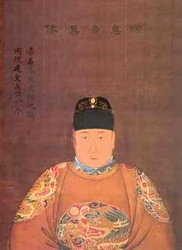
1377 CE–1402 CE
Emperor
Zhu Yunwen
朱允炆
Zhu Yunwen (December 5, 1377–unknown), the second emperor of the Ming Dynasty, reigned under the era name Jianwen and is commonly known as the Jianwen Emperor. He was a grandson of Zhu Yuanzhang, Emperor Taizu of Ming, the second son of Crown Prince Yiwen Zhu Biao, and the son of Lady Lü. In 1392, the twenty-fifth year of the Hongwu era, he was designated imperial grandson-heir. After Zhu Yuanzhang died in 1398, the…
1377 CE–1402 CEMing Dynasty
PROFILE
Zhu Yunwen (December 5, 1377–unknown), the second emperor of the Ming Dynasty, reigned under the era name Jianwen and is commonly known as the Jianwen Emperor. He was a grandson of Zhu Yuanzhang, Emperor Taizu of Ming, the second son of Crown Prince Yiwen Zhu Biao, and the son of Lady Lü. In 1392, the twenty-fifth year of the Hongwu era, he was designated imperial grandson-heir. After Zhu Yuanzhang died in 1398, the thirty-first Hongwu year, Zhu Yunwen succeeded to the throne. He pursued a relatively lenient style of government and a policy of reducing the power of the imperial princes. This prompted Zhu Di, Prince of Yan, to launch the Jingnan Campaign. In 1402, the fourth year of Jianwen, Nanjing fell and Zhu Yunwen disappeared, becoming one of the enduring mysteries of Ming history. The Hongguang Emperor of Southern Ming later granted him the posthumous title “Emperor Sitian Zhangdao Chengyi Yuangong Guanwen Yangwu Keren Duxiao Rang” and the temple name Huizong; the Qianlong Emperor of Qing later granted the posthumous title “Emperor Gongmin Hui.”
- Alternate Name
- Jianwen Emperor
- Period
- Ming Dynasty
- Dynasty/State
- Ming Dynasty
- Identity
- Emperor
- Ethnicity/Ethnic Affiliation
- Not recorded in historical sources
- Native Place
- Not recorded in historical sources
- Date of Birth
- December 5, 1377
- Place of Birth
- Not recorded in historical sources
- Date of Death
- Not recorded in historical sources
- Reign
- 1398–1402
- Predecessor
- Emperor Taizu of Ming (Zhu Yuanzhang)
- Successor
- Emperor Chengzu of Ming (Zhu Di)
- Era Name
- Jianwen
- Temple Name
- Huizong
- Posthumous Title
- Jianwen Emperor
- Major Achievements
- Grandson of Zhu Yuanzhang; succeeded after the early death of his father, pursued reduction of princely power, triggered the Jingnan Campaign, and was overthrown by Zhu Di.
LIFE TIMELINE
Age two | His principal mother Lady Chang died; his birth mother Lady Lü, originally a secondary consort, was elevated to principal consort of the crown prince.
Age fifteen | Attended his ailing father Zhu Biao day and night.
Age sixteen | Zhu Biao died. Zhu Yunwen mourned so intensely that his health declined; in the ninth lunar month he was designated imperial grandson-heir.
Age twenty | Asked Zhu Yuanzhang to revise the Great Ming Code and altered seventy-three provisions he considered excessively severe.
Age twenty-two | Zhu Yuanzhang died in an intercalary fifth lunar month, and Zhu Yunwen ascended the throne, designating the following year the first year of Jianwen. In the sixth month he appointed Qi Tai Minister of War and Huang Zicheng Minister of the Court of Imperial Sacrifices; in the seventh month he summoned Fang Xiaoru as Hanlin Lecturer; in the eighth month he deposed Zhu Su, Prince of Zhou.
Age twenty-three | Formally changed the era name to Jianwen in the first lunar month. In the second month he posthumously honored his father Zhu Biao as Emperor Xiaokang and elevated Lady Lü as Empress Dowager. In the fourth month Zhu Bai, Prince of Xiang, burned himself to death, and the Princes of Qi and Dai were deposed; in the sixth month the Prince of Min was deposed; in the seventh month Zhu Di, Prince of Yan, launched the Jingnan Campaign.
Age twenty-four | Li Jinglong suffered defeat at the Battle of Baigou River; Tie Xuan and Sheng Yong held Jinan, forcing the Yan army to withdraw.
Age twenty-five | Both sides won and lost battles; Yan forces entered Zhengding.
Age twenty-six | In the fifth lunar month the Yan army crossed the Yangzi. Zhu Yunwen issued an edict blaming himself and an appeal for loyalist forces. In the sixth month the Jinchuan Gate was opened to the enemy, Nanjing fell, and Zhu Yunwen disappeared.
BIOGRAPHY
Biography
Family Background and Early Life
Zhu Yunwen was born in the eleventh lunar month of 1377, the tenth year of the Hongwu era. He was the third grandson of Zhu Yuanzhang, Emperor Taizu of Ming, and the second son of Crown Prince Yiwen Zhu Biao. His birth mother, Lady Lü, was originally a secondary consort of the crown prince. His elder half-brother Zhu Xiongying, born to the principal consort Lady Chang, died young. After Lady Chang died in 1378, Lady Lü was elevated as the crown prince's principal consort, making Zhu Yunwen the senior surviving grandson in the main line.
Zhu Yunwen was described as intelligent, studious, and filial. In 1391, when Zhu Biao fell ill, the fifteen-year-old Zhu Yunwen attended him day and night. After his father's death the next year, his grief became so intense that he grew thin and weak. Zhu Yuanzhang comforted him by asking whether his sincere filial devotion did not also require concern for his grandfather. In the ninth lunar month of the same year, Zhu Yuanzhang passed over Zhu Yunwen's younger half-brother Zhu Yuntong and designated Zhu Yunwen imperial grandson-heir.
Zhu Yunwen was strongly influenced by Confucian political ideals and continued his father's preference for relatively humane government. In 1396 he asked Zhu Yuanzhang to revise the Great Ming Code, consulting ritual classics and earlier legal traditions, and amended seventy-three provisions that he regarded as excessively severe. The initiative was widely praised.
Accession and Lenient Government
In the intercalary fifth lunar month of 1398, the thirty-first Hongwu year, Zhu Yuanzhang died. His final instructions named Commandant-Escort Mei Yin among those charged with supporting the new ruler. Zhu Yunwen ascended the throne at age twenty-two and designated the following year the first year of Jianwen. He rapidly promoted Qi Tai to Minister of War, Huang Zicheng to Minister of the Court of Imperial Sacrifices, and Fang Xiaoru to Hanlin Lecturer; the three became central advisers.
The Jianwen Emperor pursued policies presented as humane and lenient. He pardoned offenders, remitted tax arrears, granted food and clothing to elderly commoners, ordered local governments to support widowers, widows, orphans, the childless, disabled, and sick, promoted agriculture and sericulture, expanded schools, and examined official performance. He also limited the amount of land that Buddhist and Daoist institutions could hold and redistributed surplus land to poor households. According to the source text, the prison population fell by roughly two-thirds compared with the Hongwu reign, and some social tensions eased.
He also reformed the bureaucracy, raising the rank of the six ministers from second to first rank, expanding the Hanlin Academy and Imperial University, and adding offices connected with the crown prince's establishment. He encouraged remonstrance. On one occasion, after illness caused him to arrive late at court, Investigating Censor Yin Changlong criticized him in a memorial; rather than punish Yin, the emperor publicly praised his forthrightness.
Reduction of Princely Power and the Jingnan Campaign
Zhu Yuanzhang had enfeoffed many sons as powerful princes with military forces. Zhu Yunwen had worried about this even while imperial grandson-heir and had discussed possible responses with his grandfather, proposing first moral persuasion and ritual restraint, then territorial reduction, reassignment, and ultimately force if necessary. After becoming emperor, he adopted the proposals of Huang Zicheng and Qi Tai and began reducing the power of the princes.
In the eighth lunar month of 1398, Zhu Su, Prince of Zhou, was reduced to commoner status and exiled to Yunnan. In the fourth lunar month of 1399, Zhu Bai, Prince of Xiang, burned himself to death, while the Princes of Qi and Dai were deposed; in the sixth month the Prince of Min was removed. The court also stationed forces around Beiping to watch Zhu Di, Prince of Yan.
Zhu Di had long harbored political ambitions. In the seventh lunar month of 1399 he raised troops under the slogan of “clearing the emperor's side,” beginning the Jingnan Campaign. The central government initially possessed superior forces, but command was poor. Li Jinglong suffered repeated defeats at the Baigou River and Zhengcunba. Sheng Yong and Tie Xuan later held Jinan and temporarily checked the Yan advance. In 1402 the Yan army moved south, crushed the central army at Lingbi, crossed the Yangzi, and advanced directly on Nanjing.
Fall of Nanjing and Disappearance
On the thirteenth day of the sixth lunar month of 1402, Zhu Hui, Prince of Gu, and Li Jinglong, Duke of Cao, opened the Jinchuan Gate and surrendered. Yan forces entered Nanjing. Fire broke out in the palace, and Zhu Yunwen and his crown prince Zhu Wenkui disappeared. Zhu Di, who later became the Yongle Emperor, claimed that bodies had been found in the ruins, but later generations repeatedly questioned the claim.
Several theories arose about Zhu Yunwen's fate: that he died in the fire, escaped the capital, or became a Buddhist monk. Zhu Di sent Hu Ying on secret searches for sixteen years, and later tradition also associated Zheng He's maritime expeditions with a search for the missing emperor. In 1440, the fifth year of the Zhengtong era, a monk in Guangxi claimed to be the Jianwen Emperor but was exposed as an impostor. Zhu Yunwen's final fate remains unresolved.
Zhu Yunwen was a grandson of the Ming founder Zhu Yuanzhang and the second son of the heir apparent Zhu Biao, his mother being the consort Lü. The veritable records note his birth in the eleventh month of 1377, the third imperial grandson. He was quick and fond of learning and filial in the extreme: at fourteen he nursed his sick father without leaving his side day or night, and when two years later the prince died he mourned until he was wasted away, so that the founder, comforting him, asked whether in being truly filial he did not think of him. In the ninth month of 1392 he was made imperial great-grandson. It is told that being born with a misshapen crown his grandfather called him "half-moon"; and that when the founder set father and son to write on the new moon, Zhu Biao's lines on the unrounded shape and on shadows falling on rivers and lakes displeased him as ill omens. Asked by his grandfather to cap the line on the wind in the horse's tail, he answered of rain on the sheep's wool, while the Prince of Yan answered of sunlight on dragon scales, which the founder liked better. As the founder had made his heir judge the memorials, and the heir, being merciful, had much lightened the punishments, so now the same charge was given to the great-grandson, who likewise tempered it with leniency; and he asked leave to search the ritual classics and the penal codes of past dynasties and to amend seventy-three articles of the Hongwu code that were disproportionately severe, to the praise of all. In 1396 he re-fixed the ceremonies by which the princes should be received by the heir, giving them family rites in the inner hall, since they were his elders. The Ming historian Yin Shouheng records that the founder told him he had entrusted the defence against the northern barbarians to the princes, that the frontier might be quiet and peace be given him; and that the great-grandson answered that if the barbarians were not quiet the princes would repel them, but if the princes were not quiet who would repel them; and that being asked his meaning he said that they should be won by virtue, restrained by the rites, and failing that have their lands cut down, and failing that their persons changed, and in the last resort be attacked with arms, which the founder allowed could not be bettered. When the great-grandson sat at the east corner gate and asked Huang Zicheng how the princes, honoured and holding great armies and often lawless, were to be dealt with, Huang answered that their guards were only enough to protect themselves, and that if they rebelled the six armies would be more than they could withstand; that the seven kingdoms of Han, though strong, had come to destruction, for the difference of strength was one thing and the justice of the cause another; and the great-grandson approved. On the founder's death in the intercalary fifth month of 1398 he took the throne, proclaimed a general amnesty and made the next year the first of Jianwen, burying the late emperor at the Xiaoling that day. He decreed three years' mourning, and when the ministers asked that a day be counted for a month he answered that he would not imitate the ancients in silence, wearing hemp in court, coarse mourning in private with staff and belt, eating gruel, and the sacrifices of the suburbs and temple as usual. He ordered officials of the fifth rank and above to recommend men they knew, on pain of punishment if unfit; he merged prefectures and counties and abolished redundant offices, and made Qi Tai president of the Ministry of War and Huang Zicheng chief of the court of sacrifices, both sharing in the government. In the seventh month he called Fang Xiaoru to be a Hanlin reader; in the eighth he reduced the Prince of Zhou to commoner for his crimes and banished him to Yunnan, exempted one man in every household of the garrisons of Xingzhou, Yingzhou and Kaiping, and released one-man households from the military registers. In the eleventh month he made Zhang Bing governor of Beiping and Xie Gui and Zhang Xin commanders there to watch the Prince of Yan. In the second month of 1399 he posthumously honoured his father as emperor and his mother as empress, honoured the consort Lü as empress dowager, made his wife Ma empress and his eldest son crown prince, and enfeoffed his brothers as princes of Wu, Heng and Xu; he proclaimed a search for neglected worthies, gave grain and cloth to the aged, ordered the officials to care for the widowed, orphaned and disabled, encouraged farming and schools, examined officials, relieved the famine-stricken, honoured chastity and filial piety, buried exposed bones, remitted the rent of waste land, and forbade the princes to command civil and military officers, revising the establishments of all offices. In the third month he sacrificed to Confucius, abolished all non-urgent business, posted Song Zhong, Xu Kai and Geng Huan with troops at Kaiping, Linqing and Shanhaiguan, moved two guards from Beiping and Yongqing to Zhangde and Shunde, sent twenty-four investigating commissioners through the realm, and asked for plain speaking when an earthquake shook the capital. In the fourth month the Prince of Xiang burned himself to death and the princes of Qi and Dai were reduced to commoners; in the sixth the Prince of Min was reduced and moved to Zhangzhou; Ni Liang, a company commander of the Yan guards, informed against his master, the officers Yu Liang and others were executed, the Prince of Yan was reproved by decree and his staff arrested, and Zhang Xin went over to him. On the revolt of the Prince of Yan in the seventh month, which began with the killing of Zhang Bing and Xie Gui and the death of several loyal officers, town after town fell, and Geng Bingwen was made general against him with Li Jian and Ning Zhong as his deputies, sacrifices being offered and the Prince of Yan struck from the imperial register. After Geng Bingwen's defeat on the north bank of the Hutuo in the eighth month, at which Li Jian, Ning Zhong and Gu Cheng were taken, Li Jinglong was made general in his place; the Prince of Liao and the Prince of Ning were summoned to court, and when the latter refused his guards were withdrawn. In the tenth month the Yan troops surprised Daning, and Chen Heng went over to them with the Prince of Ning and the Duoyan guards; in the eleventh Li Jinglong's army was routed at Zhengcunba and fled to Dezhou, and the emperor, on a fresh memorial from the Prince of Yan, removed Qi Tai and Huang Zicheng from office but kept them in the capital. In 1400 Zicheng and Huang were again employed after the relief of Jinan by Tie Xuan and Sheng Yong, who beat the Yan forces at Dongchang in the twelfth month and killed the general Zhang Yu; in 1401 Sheng Yong won at Jiahe, killing Tan Yuan, though he was afterwards beaten and fell back on Dezhou, and Qi Tai and Huang Zicheng were again degraded with an offer to the Prince of Yan to cease hostilities. In 1402 the Yan armies took one town after another in the east, and though He Fu, Ping An and Xu Huizu won several actions, a false report that the Yan troops had gone north caused Xu Huizu to be recalled and He Fu's army to be left alone; the great defeat at Lingbi followed, with Chen Hui, Ping An and others taken, the Yan crossed the Huai, and Xu Huizu's and Sheng Yong's forces were beaten. In the fifth month the emperor issued a call to arms to the whole realm and sent envoys to raise troops in every quarter, recalling Qi Tai and Huang Zicheng, while the prefects of Suzhou, Ningbo and Huizhou and the magistrate of Leping raised troops in his defence. In the sixth month Sheng Yong's fleet beat the Yan at Puzikou but was worsted in a second action, Chen Xuan went over with the fleet, the Yan crossed the Yangzi, Zhenjiang surrendered, and on the jiazi day envoys were sent out with wax-sealed letters to hasten the relief armies. On the yichou day the Yan troops attacked the Jinchuan gate; Xu Zengshou, who plotted to open it from within, was executed, but the Prince of Gu and Li Jinglong rebelled and admitted the Yan army, and the capital fell. Fire broke out in the palace and the emperor was never seen again; the Prince of Yan sent a eunuch to take the bodies of emperor and empress from the fire and buried them eight days later. Of his end there have always been two accounts, the official one that he and his eldest son died in the flames and the popular one that he survived and fled. It is recorded that as the Yan troops entered he set fire to the palace, that the Prince of Yan, seeing the smoke, sent men who came too late and brought out a body, at which he wept; and in his letter to the king of Korea after taking the throne he wrote that Jianwen, coerced by treacherous ministers, had burned his own palace. Others record that he had a woman's body taken from the fire and pretended it was the emperor's, burying it eight days later with full rites on the advice of the scholar Wang Jing. The textual researches note a drain beneath the palace leading beyond the wall, ten feet high and eight wide, enough for a man or a horse, prepared for escape. In 1978, when a building was put up inside the Taiping gate and a cellar dug, a tunnel was found running to the Ming palace, some two and a half metres high and two wide, which a researcher of the Jiangsu academy of social sciences identified as the watercourse of Qingshan mountain. A scholar of the Chinese Academy of Social Sciences holds that there is no conclusive evidence that he died in the palace. A Ming fortress has been found at Xintian in Yongzhou, Hunan, seven thousand square metres in extent with a stone wall three hundred and forty-six metres around and four metres high, thought to have been a refuge of the emperor; but of the many claims of his whereabouts some are legend and some rest only on genealogies, and while Xintian alone has inscriptions, these have been judged forged, the "two emperors" of the stones being read by local scholars as the two emperors of the Southern Ming; the fortress was in fact built by the Shi family, descendants of those settled there as military colonists in the early Ming, and the Ming historian Shang Chuan, having inspected it, concluded that it had nothing to do with Jianwen. The gazetteer of Qiantang records that the Dongming temple stood before the great Zha mountain, and that Jianwen as a monk came there and left a portrait; that he had come at dawn, whence the temple took its name, and that he planted a peony white as silver. A temple history of 1673, discovered in 2010 in the Shanghai library, relates that at the fall of the capital he opened his chest, found the monk's certificate in the name of Yang Yingneng and the implements of ordination, and knowing the decree of fate went out as a monk, dwelling on Dongming mountain for six years under the patriarch Chan until his traces became known and he departed; and the temple placed him second only to its founding patriarch. His image stands in the main hall with a couplet on monks and emperors. Popular tradition also gives him poems written in flight and places of refuge in the south-west; and scholars note from the biographies of Yao Guangxiao and Hu Ying that the Yongle emperor doubted the burned corpse, and sent Hu Ying for sixteen years through the towns and villages to seek him, being called at night on his deathbed to hear his report. In 1440 an old monk of over ninety came to court claiming to be the former emperor, and proved to be a man of Junzhou named Yang Xingxiang, who died in prison four months later, twelve monks being sent to Liaodong; and thereafter the south-west was said to hold traces of an emperor turned monk. Under Zhengde, Wanli and Chongzhen the ministers several times asked that his titles be restored, and the matter was always referred to the ministries without result. In his reign Zhu Yunwen reformed the statutes, raising the six presidents of ministries to the first rank and abolishing thirty-nine prefectures and nine departments, in what was called the new government of Jianwen. In the Hongguang years of the Southern Ming he was given the posthumous title of yielding emperor with the temple name Huizong, and in 1736 the Qianlong emperor had the court confer on him the posthumous name Gongmin Hui.
Major Activities
Jianwen Reforms
During his reign, the Jianwen Emperor implemented a series of changes later described as the “Jianwen Reforms.” Politically, he elevated the ranks of the six ministers, altered government offices, and attempted to restore certain older institutional models. Legally, he removed harsh provisions inherited from the Hongwu period's Great Pronouncements and prohibited the use of posted proclamations as substitutes for formal adjudication. Economically, he reduced heavy taxes in Jiangnan and revised exemptions granted to Buddhist and Daoist institutions. Culturally, he expanded the Hanlin Academy and strengthened Confucian education. These reforms expressed a Confucian ideal of benevolent government but also affected entrenched interests.
Decision to Reduce the Princes
Reducing princely power was the Jianwen Emperor's most consequential political decision. He successively deposed the Princes of Zhou, Xiang, Qi, Dai, and Min and made military preparations against the Prince of Yan. Qi Tai advocated striking Yan first, while Huang Zicheng preferred to weaken Yan by first removing allied or neighboring princes; the emperor adopted the latter approach. The speed and severity of the policy alarmed the princes and contributed directly to the Jingnan Campaign.
Lenient Government and Relief for the People
After his accession, the Jianwen Emperor proclaimed a general amnesty, remitted taxes, and distributed relief. He ordered local governments to redeem children sold by impoverished families, limited monastic landholding, and redistributed excess holdings to the poor. These measures eased some immediate hardship but did not fundamentally alter the Ming political order.
Education and Personnel
The Jianwen Emperor relied heavily on civil officials such as Qi Tai, Huang Zicheng, and Fang Xiaoru. Fang Xiaoru led work on the Veritable Records of the Ming Taizu Emperor and sought to reshape politics in line with Confucian ideals. The emperor also created advisory and study positions for the sons of imperial princes and restricted princes from intervening in local administration.
On taking the throne Zhu Yunwen turned from his grandfather's severity to leniency. He reformed the harsh legal system: the Hongwu emperor had issued a body of statutes, supplemented from time to time by admonitions and by proclamations of typical cases, the Great Admonitions having been compiled, revised and enlarged between 1385 and 1387 and appended with the proclamations to the code of 1397; and Zhu Yunwen, holding parts of his grandfather's code too severe, especially the penalties of the admonitions and proclamations, is said to have urged the removal of seventy-three such articles even in the old emperor's lifetime. On coming to the throne he forbade trials and judgments to be based on the admonitions and stopped the posting of the proclamations, and by amending the statutes he corrected the unjust and mistaken cases of the Hongwu years, so that the prisoners of his reign were but a third of those before. He remitted arrears of rent, relieved the stricken, and had the government ransom those who had sold themselves into slavery. In finance the Jianwen court framed new measures to lighten the excessive taxes of the previous reign, above all cutting the heavy land tax of the south, and especially of the rich prefectures of Suzhou and Songjiang; these continued the reductions begun under Hongwu but went far beyond them. He set a uniform levy of one bushel of grain per mu in those prefectures and lifted the ban forbidding men of Suzhou and Songjiang to hold the office of president of the Ministry of Revenue, imposed by the founder lest the men of those rich prefectures control the finances for the benefit of their own region. He also limited the tax-free land of Buddhist and Daoist establishments: the monks and priests, protected by the founder, had seized great tracts of fertile land and become powerful landlords, and their wealth caused resentment, since they enjoyed exemption from taxes and service and even imposed burdens on the local people; two memorials asked for limits, and in the eighth month of 1401 he approved them, allowing each monk or priest no more than five mu free of tax, the surplus to be given to those who needed land. He also decreed that the land tax in Jiangsu and Zhejiang should not exceed one bushel per mu, gave half a year's rent to the realm, and remitted arrears. In frontier defence the Jianwen reign also built walls: archaeologists have found, north of the present Ming wall, an unfinished wall lying further north, running from Kaiping towards the Yinshan in Shanxi as the Datong outer wall, which some scholars date to the Jianwen years and believe was abandoned under Yongle. To strengthen the emperor's control of the princes he issued new regulations forbidding them to take part in civil or military government and providing Confucian tutors for the young princes, as part of a general strategy to abolish the semi-autonomous principalities. His reign was reckoned as extending four years, from the thirty-second to the thirty-fifth of Hongwu, 1399 to 1402, and was known as the Jianwen era; and in popular histories his government was remembered through the many legends of his unhappy fate, while in the novels and romances from the sixteenth century onward he and his martyred followers became tragic heroes.
Personal Relations
- Zhu Yuanzhang: grandfather, Emperor Taizu of Ming.
- Zhu Biao: father, Crown Prince Yiwen.
- Lady Lü: birth mother, later Empress Dowager.
- Lady Chang: principal mother, posthumously Empress Xiaokang.
- Zhu Xiongying: elder brother, died young.
- Zhu Yuntong: younger half-brother, Prince of Wu, later deposed.
- Zhu Yunjian: younger half-brother, Prince of Heng, later deposed.
- Zhu Yunxi: younger half-brother, Prince of Xu, later charged with sacrifices to Zhu Biao.
- Lady Ma: empress.
- Zhu Wenkui: eldest son and crown prince, disappeared in 1402.
- Zhu Wengui: younger son, later confined.
- Huang Zicheng: Minister of the Court of Imperial Sacrifices and principal architect of the policy to reduce princely power.
- Qi Tai: Minister of War and supporter of the same policy.
- Fang Xiaoru: Hanlin Lecturer and leading Confucian scholar.
- Zhu Di: Prince of Yan, later Yongle Emperor and leader of the Jingnan Campaign.
- Li Jinglong: Duke of Cao and commander for the Jianwen court who later surrendered to Yan.
- Sheng Yong: military commander who distinguished himself in the defense of Jinan.
- Tie Xuan: Shandong official who helped hold Jinan.
- Mei Yin: Commandant-Escort who received Zhu Yuanzhang's final instructions to assist the new ruler.
- Zhu Di: opponent in the Jingnan Campaign.
- Zhu Su, Prince of Zhou; Zhu Fu, Prince of Qi; Zhu Gui, Prince of Dai; Zhu Pian, Prince of Min: imperial princes deposed during the reduction of princely power.
Historical Assessment
Ming / Contemporary
- Zhu Di, the Yongle Emperor, used works such as the Record of Pacifying the Jingnan to denounce the Jianwen Emperor as one who distorted Heaven's mandate and harmed the people; such assessments served obvious political purposes.
- Mei Yin and other Jianwen loyalists privately honored him with the posthumous title “Emperor Shenzong Xiaomin,” expressing continued allegiance.
- From the mid-Ming onward, many scholar-officials sympathized with the Jianwen Emperor. During the Wanli reign, Zhang Juzheng reportedly told the emperor that Jianwen had shaved his head and escaped by a side route when the Jingnan army entered the capital, accepting the possibility that he had survived.
Early to Mid-Qing
- The Qianlong Emperor granted him the posthumous title “Emperor Gongmin Hui,” formally recognizing his imperial status, while criticizing him as benevolent but indecisive and as having opened the way to war.
- Gu Yingtai's Mingshi Jishi Benmo gives an extensive account of stories about Jianwen's disappearance and treats his fate sympathetically.
- The History of Ming praises him as naturally humane and fond of learning and notes that he had asked Zhu Yuanzhang to revise seventy-three excessively severe provisions of Hongwu law.
Late Qing and Republican Period
- Late-Qing historian Meng Sen, in his lectures on Ming history, criticized the Jianwen Emperor for lacking an effective strategy to reduce princely power and for employing unsuitable advisers, attributing his defeat to political inexperience.
- Republican historian Wu Han described him as benevolent but indecisive while acknowledging the humane intentions of his policies.
Modern Period
- Modern historian Shang Chuan has noted that no conclusive evidence proves that the Jianwen Emperor died in the palace fire and has argued that the mystery remains open.
- Modern scholars often interpret the Jianwen Reforms as an attempt to realize Confucian political ideals but emphasize the emperor's limited political and military experience.
- Claims that an ancient tomb at Shangjinbei in Ningde, Fujian, belonged to the Jianwen Emperor remain controversial; most scholars consider the evidence insufficient for a firm conclusion.
FIGURES ASSOCIATED WITH THIS DYNASTY
Bibliography
- History of Ming, Annals of the Gongmin Emperor
- Veritable Records of the Ming Taizu Emperor
- Veritable Records of Emperor Taizong of Ming
- Meng Sen, Lectures on Ming History