Birth
Born into a scholarly lineage in Fenyi, Jiangxi.
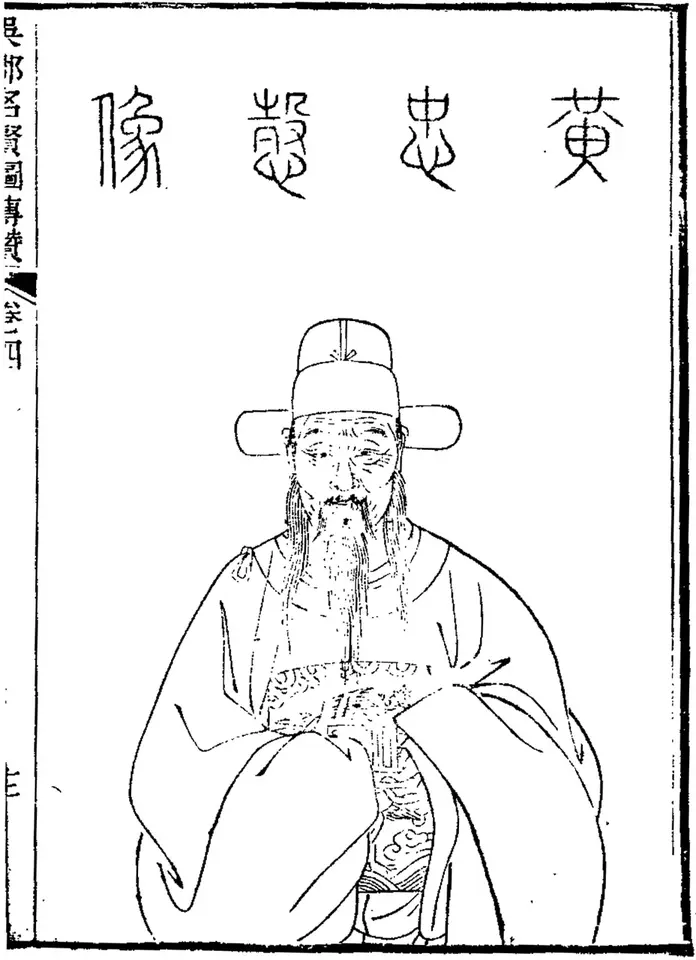
1350 CE–1402 CE
黄子澄
Huang Zicheng (黄子澄, 1350–1402), originally named Huang Shi (黄湜), was a native of Fenyi in Yuanzhou Prefecture, Jiangxi (modern Fenyi, Xinyu, Jiangxi). He was an eminent early Ming civil official, Hanlin scholar, and the primary intellectual confidant of the Jianwen Emperor (Zhu Yunwen). Placing first in the metropolitan examinations (Huiyuan) and third in the palace examinations (Tanhua) in 1385, he served as tutor in the…
Huang Zicheng (黄子澄, 1350–1402), originally named Huang Shi (黄湜), was a native of Fenyi in Yuanzhou Prefecture, Jiangxi (modern Fenyi, Xinyu, Jiangxi). He was an eminent early Ming civil official, Hanlin scholar, and the primary intellectual confidant of the Jianwen Emperor (Zhu Yunwen). Placing first in the metropolitan examinations (Huiyuan) and third in the palace examinations (Tanhua) in 1385, he served as tutor in the Eastern Palace, developing an enduring bond with the young imperial heir. Following the Jianwen Emperor's accession in 1398, Huang Zicheng was elevated to Chief Minister of the Court of Imperial Sacrifices and concurrent Hanlin Academician, collaborating with Minister of War Qi Tai to direct high policy and actively advocate for curbing regional princely domains to centralize imperial authority. During the outbreak of the Jingnan Campaign, Huang Zicheng directed wartime strategy from the imperial court. However, his strong endorsement of Duke of Cao Li Jinglong as supreme commander led to catastrophic defeats at the battles of Zhengcunba and Baigou River, squandering the imperial military advantage. When the rebel forces of Prince of Yan Zhu Di breached the defenses of Nanjing in 1402, Huang Zicheng departed the capital in disguise, traveling through Suzhou and Jiaxing to recruit loyalist militias. Captured following a betrayal, he was brought before the newly enthroned Yongle Emperor, where he maintained fearless defiance. He was subjected to dismemberment by lingchi, and his family was exterminated across generations. In later centuries, both the Southern Ming court and the Qing Dynasty rehabilitated his memory, conferring posthumous titles honoring his unyielding dynastic loyalty.
Born into a scholarly lineage in Fenyi, Jiangxi.
Admitted to the Imperial Academy in Nanjing as a tributary student.
Placed first in the metropolitan examination (Huiyuan) and third in the palace examination (Tanhua), appointed Compiler in the Hanlin Academy.
Served as Companion and Reader in the Eastern Palace, instructing Crown Prince Zhu Biao and later Imperial Grandson Zhu Yunwen, rising to Chief Minister of the Court of Imperial Sacrifices.
The Jianwen Emperor ascended the throne, elevating Huang Zicheng to concurrent Hanlin Academician and consulting him on curbing the principalities.
Coordinated the demotion of the Prince of Zhou; the Prince of Yan rose in rebellion, launching the Jingnan Campaign.
Endorsed Li Jinglong to replace veteran commander Geng Bingwen, leading to subsequent tactical collapses.
Dismissed from court following Li Jinglong's defeat at Baigou River, but recalled shortly thereafter to advise the emperor.
Reinstated after Sheng Yong's victory at Dongchang, then dismissed again to placate northern demands.
Dispatched to recruit loyalist militias in Suzhou; captured in Jiaxing following the fall of Nanjing.
Interrogated personally by Zhu Di in Nanjing; refused submission and was executed by lingchi; his clan suffered complete extermination.
Huang Zicheng was born in 1350 in Fenyi County, Yuanzhou Prefecture, Jiangxi. Hailing from a respected rural lineage that valued classical learning, he displayed exceptional intellectual aptitude from his youth. He immersed himself in the Confucian canon under renowned regional scholars, studying the Book of Changes under Ouyang Zhen, the Book of Documents under Zhou Yuxue, and the Spring and Autumn Annals under Liang Yin. Renowned across Jiangxi for moral rectitude and elegant prose, he was selected as a tributary student in 1384 and entered the Imperial Academy (Guozijian) in the southern capital of Nanjing.
In 1385, during the eighteenth year of the Hongwu reign, Huang Zicheng sat for the imperial examinations. In the metropolitan examination, he earned first place as Huiyuan; in the palace examination presided over by Emperor Taizu (Zhu Yuanzhang), he took third place, earning the title of Tanhua. He was immediately appointed Hanlin Compiler, and subsequently promoted to Senior Compiler and Expositor-in-Waiting. Emperor Taizu, recognizing his profound learning and grave moral bearing, appointed him to the Eastern Palace staff to instruct Crown Prince Zhu Biao and imperial grandsons, where he served for over a decade, eventually rising to Chief Minister of the Court of Imperial Sacrifices.
During his tenure as tutor in the Eastern Palace, Huang Zicheng developed an exceptionally close personal bond with Imperial Grandson Zhu Yunwen. On one occasion, while Zhu Yunwen sat alone beneath the palace portico gazing pensively into the distance, he summoned Huang Zicheng and inquired with deep anxiety: "My royal uncles command elite garrisons along the northern frontier and exercise immense military power. Should they entertain treasonous designs in the future, how might the court control them?"
Huang Zicheng replied promptly with classical precedent: "Consider the Rebellion of the Seven States during the Western Han: the feudal princes were incomparably arrogant, yet once Emperor Jing mobilized central armies, their rebellion was crushed within months. The imperial court commands hundreds of prefectures and vast wealth, while regional princedoms control only limited territories. In matters of right versus rebellion, the imperial throne holds supreme moral authority. If the princes rebel, what resistance can they mount against imperial armies?!" Hearing this resolute answer, Zhu Yunwen felt greatly reassured.
In May 1398, Emperor Taizu passed away, and Zhu Yunwen ascended the imperial throne as the Jianwen Emperor. Revered by the new sovereign as "Master Huang," Huang Zicheng was granted concurrent appointment as Hanlin Academician, entering the inner decision-making circle alongside Minister of War Qi Tai. Together, they urged the immediate execution of a policy curbing regional principalities. While Qi Tai advocated striking first at the most formidable threat—the Prince of Yan (Zhu Di) in Beiping—Huang Zicheng argued that the court should first remove vulnerable princes guilty of overt administrative misconduct, such as the Prince of Zhou (Zhu Su), to accumulate evidence of justice. The emperor adopted Huang Zicheng's counsel, sequentially demoting the princes of Zhou, Xiang, Qi, Dai, and Min throughout 1398 and early 1399, isolating the Prince of Yan.
In July 1399, Prince of Yan Zhu Di openly launched the Jingnan Campaign, marching under the banner of eliminating corrupt court ministers, specifically naming Qi Tai and Huang Zicheng as treacherous flatterers. The Jianwen court dispatched veteran marshal Geng Bingwen with 130,000 troops to quell the northern insurrection. However, Geng Bingwen suffered an initial tactical defeat along the Huotuo River outside Zhending.
Anxious for rapid victory, Huang Zicheng urged the emperor to relieve Geng Bingwen and replace him with Duke of Cao Li Jinglong, son of founding marshal Li Wenzhong. Despite Qi Tai's strong objections that Li Jinglong was inexperienced in battlefield command, Huang Zicheng insisted that the young duke possessed military lineage and could command high-ranking generals. Emperor Wu accepted the recommendation, bestowing supreme command and 500,000 troops upon Li Jinglong.
Li Jinglong proved utterly incompetent in field operations, suffering disastrous encirclement at Zhengcunba in 1400, followed by catastrophic collapse at the Battle of Baigou River, losing hundreds of thousands of veteran imperial soldiers. The strategic advantage permanently shifted to the rebel army. Overwhelmed with remorse, Huang Zicheng wept before the throne, striking his forehead on the palace steps and pleading for Li Jinglong to be executed under military law to appease the ancestral spirits. The emperor, however, could not bring himself to execute the duke. In an attempt to placate the Prince of Yan, the court temporarily dismissed Huang Zicheng and Qi Tai from metropolitan posts, though both continued secretly directing defense strategy from the capital.
In late 1401, following the imperial defeat at the Battle of Jiahe, the court once again removed Huang Zicheng and Qi Tai from office in a desperate bid to sue for peace. Both ministers traveled to the lower Yangtze region to rally local garrisons. Huang Zicheng arrived in Suzhou, collaborating with Prefect Yao Shan to recruit loyalist volunteer regiments. However, in June 1402, rebel forces crossed the Yangtze River. The treacherous Li Jinglong and Prince of Gu opened the Jinchuan Gate of Nanjing, and the imperial capital fell amidst flames that consumed the imperial palace.
Hearing of the catastrophe, Huang Zicheng attempted to mobilize his provincial levies, but regional forces disintegrated rapidly. He took refuge in the household of scholar Yang Ren in Jiaxing, preparing to flee south to continue resistance. Betrayed by an informant, he was arrested by Yan forces and transported under heavy guard to Nanjing.
Brought before Zhu Di in the palace, Huang Zicheng stood erect and refused to kneel. When Zhu Di demanded to know why he had slandered the royal princes and caused dynastic war, Huang Zicheng retorted with unyielding fury, denouncing Zhu Di as an unfilial rebel who had usurped his nephew's throne in defiance of heaven. Furious at his defiance, Zhu Di ordered guards to sever his limbs and cut out his tongue. Huang Zicheng dipped his finger into his own blood and wrote defiant characters across the palace stones. He was executed by lingchi dismemberment, and his entire clan across three degrees, encompassing sixty-five close relatives and hundreds of distant kin, was slaughtered without mercy.
During the extermination of Huang Zicheng's clan, a loyal family retainer secretly rescued his infant son Huang Dezi, fleeing southward into Huguang where the child was raised under the surname Tian. In the late Ming and Qing eras, Huang Zicheng's martyrdom was officially rehabilitated, and ancestral shrines were erected in his native Fenyi to honor his unyielding loyalty.
Huang Zicheng served as imperial tutor in the Eastern Palace for over thirteen years, providing classical instruction to Crown Prince Zhu Biao and the young Jianwen Emperor. Renowned for his erudition and personal integrity, he combined deep knowledge of the Confucian classics with historical statecraft, instilling in the future monarch a strong commitment to civil governance, moral rectitude, and centralized dynastic authority.
Following the accession of the Jianwen Emperor, Huang Zicheng was the primary intellectual architect of the policy to curb regional principalities. Recognizing that Emperor Taizu's feudal arrangements threatened the central monarchy, he devised the sequential strategy of disciplining junior princes before confronting the Prince of Yan. Although tactical miscalculations subsequently compromised its execution, his objective reflected the structural necessity of centralizing sovereign power in early Ming statecraft.
Throughout the Jingnan Campaign, Huang Zicheng served as the principal wartime coordinator for the imperial government, drafting defense edicts and mobilizing metropolitan manpower. While his recommendation of Li Jinglong proved to be a catastrophic tactical error, his unwavering devotion to the legitimate imperial house remained steadfast, demonstrating profound administrative loyalty during dynastic crisis.
Following the military reversals of 1401 and 1402, Huang Zicheng repeatedly ventured into provincial prefectures to organize loyalist volunteer forces. When Nanjing fell, he chose capture and excruciating execution over submission to the usurper. His fearless confrontation with Zhu Di and his martyrdom under extreme torture established him as one of the paramount symbols of bureaucratic loyalty in Chinese dynastic history.
The official Ming records preserved the condemnatory imperial edicts of Zhu Di, which labeled Huang Zicheng a "treasonous flatterer who alienated the imperial flesh and blood."
However, private Ming historians and scholars universally revered him. In the Wanli reign, philosopher Li Zhi praised his moral rectitude, while historical commentator Zou Yuanbiao celebrated his martyrdom as the peak of Confucian devotion.
During the Southern Ming Hongwu restoration in 1644, Emperor Hongguang formally cleared his name, conferring the posthumous title Jiemin ("Steadfast and Mourned").
When Emperor Qianlong supervised the compilation of the Biographies of Ministers Who Died for Dynastic Duty in the Ming, he held Huang Zicheng in supreme esteem, officially granting him the posthumous title Zhongque ("Loyal and Upright").
The Qing official History of Ming recorded: "Qi Tai and Huang Zicheng gave their lives for their sovereign, standing firm through horrific torture; their moral radiance illuminates the ages, wiping away all former criticisms of tactical error."
Philosopher Wang Fuzhi noted: "Huang Zicheng lacked military calculation, and his recommendation of Li Jinglong destroyed the dynastic altars; yet his unyielding martyrdom preserved the moral backbone of the scholar-gentry."
Modern historians evaluate Huang Zicheng as a classic Confucian scholar-statesman whose strategic vision was hobbled by an absence of practical military acumen. His fundamental policy—curbing regional principalities to consolidate imperial power—was historically necessary and ultimately adopted in modified form by Zhu Di himself. However, his academic dogmatism and disastrous personnel choices in warfare accelerated the fall of the Jianwen regime. Despite these tactical failures, his supreme personal integrity, resistance against usurpation, and willingness to endure horrific death for principle have established him as an enduring archetype of moral courage in Chinese political history.
FIGURES ASSOCIATED WITH THIS DYNASTY