Noble Birth
Born in Maoling as the youngest daughter of the illustrious general Ma Yuan.
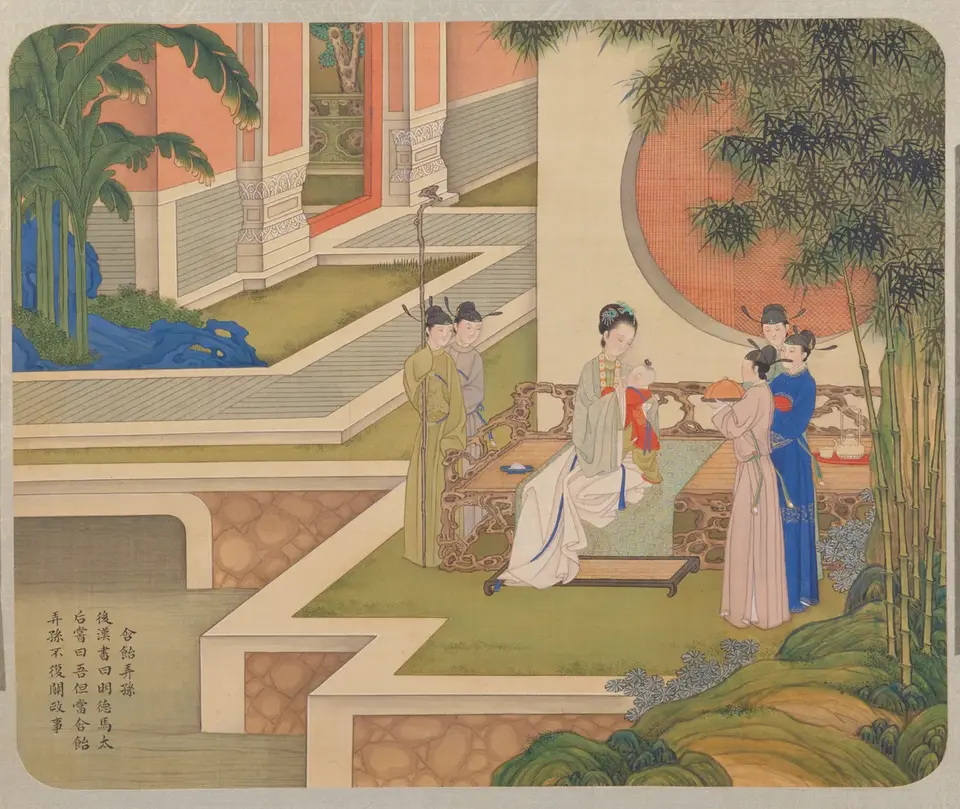
39 BCE–79 CE
马氏(汉明帝皇后)
Empress Ma (c. 39 – August 16, 79 CE), posthumously honored as Empress Mingde (明德皇后), was the celebrated empress consort of Emperor Ming of Han (Liu Zhuang) and the adoptive mother of Emperor Zhang of Han (Liu Da), revered throughout Chinese history as a paramount exemplar of maternal virtue, frugality, and political restraint. The youngest daughter of Ma Yuan, the legendary General Who Calms the Waves, she entered the…
Empress Ma (c. 39 – August 16, 79 CE), posthumously honored as Empress Mingde (明德皇后), was the celebrated empress consort of Emperor Ming of Han (Liu Zhuang) and the adoptive mother of Emperor Zhang of Han (Liu Da), revered throughout Chinese history as a paramount exemplar of maternal virtue, frugality, and political restraint. The youngest daughter of Ma Yuan, the legendary General Who Calms the Waves, she entered the household of the Crown Prince at the age of thirteen following her father's death. Renowned for her natural gentleness, filial devotion, and deep erudition in classical canons, she was deeply cherished by Liu Zhuang. In 57 CE, upon Emperor Ming's ascension, she was invested as an Imperial Consort, and was elevated to Empress in 60 CE. Despite her supreme imperial status, Empress Ma championed strict austerity, dressing in coarse unadorned silks, dining on simple fare, and forbidding luxury across the palace. When Emperor Zhang mounted the throne in 75 CE and sought to lavish noble fiefs and high offices upon her brothers, Empress Dowager Ma vehemently refused, issuing celebrated imperial edicts warning against the historical perils of foreign relative encroachment. She initiated the compilation of the imperial court daily records Xianzong Qiju Zhu, pioneering an indispensable historiographical tradition. She passed away in the Kaiyang Palace in 79 CE at age forty-one, interred beside Emperor Ming in the Xiejie Mausoleum.
Born in Maoling as the youngest daughter of the illustrious general Ma Yuan.
Father Ma Yuan died during the southern expedition; family suffered political slander.
Selected into the household of Crown Prince Liu Zhuang at age thirteen, earning high favor.
Emperor Ming ascended the throne; Lady Ma was formally created an Imperial Consort and elevated to Empress in 60 CE while adopting Prince Liu Da.
Persuaded Emperor Ming to curb mass implicating tortures during the Prince of Chu Liu Ying treason trials, saving numerous innocent lives.
Supervised the compilation of Xianzong Qiju Zhu, pioneering the imperial daily record genre.
Set up silkworm and weaving workshops in the northern palace to model imperial frugality.
Emperor Ming died; Emperor Zhang ascended the throne, honoring her as Empress Dowager.
Issued her famous edict resolutely rejecting noble titles and fiefs for her brothers.
Passed away in the Kaiyang Palace on August 16 at age forty-one; interred in Xiejie Mausoleum.
Lady Ma belonged to the prominent Fufeng Ma lineage, which traced its ancestry to the royal house of Zhao during the Warring States period. Her father, Ma Yuan, was one of the foremost military titans who aided Emperor Guangwu in founding the Eastern Han dynasty, celebrated as the General Who Calms the Waves. Endowed with acute intelligence, graceful dignity, and towering height, young Lady Ma was literate from early childhood, mastering the Classic of Poetry, the Spring and Autumn Annals, and the Book of Rites. In 49 CE, when she was merely ten years old, her father died of illness during a grueling military campaign in the malaria-ridden southern valleys of Wuling. In the wake of his death, jealous court factions slandered Ma Yuan, stripping the family of imperial favors. Despite her tender age, Lady Ma managed household finances and domestic affairs with adult composure, winning profound admiration across her home commandery.
Recognizing the family's undeserved distress, Lady Ma's mother arranged for her daughters to be presented for palace selection. In 52 CE, at the age of thirteen, Lady Ma entered the household of Crown Prince Liu Zhuang. Within the Eastern Palace, she conducted herself with consummate humility, serving Empress Yin Lihua with meticulous filial devotion while treating fellow palace consorts with gentleness and respect, completely free of petty jealousy. When Emperor Ming mounted the throne in 57 CE, Lady Ma was appointed an Imperial Consort. Because she had no children of her own, Emperor Ming entrusted the newborn Prince Liu Da (son of Consort Jia) to her care. Lady Ma poured immense maternal affection and intellectual care into the child's upbringing, forming an unbreakable bond such that the young prince never knew she was not his biological mother. In the spring of 60 CE, with the unanimous acclaim of the imperial court, Emperor Ming formally proclaimed her Empress of the Han dynasty.
As Empress, Lady Ma transformed the cultural atmosphere of the imperial court. Dismayed by the creeping ostentation among court aristocrats, she wore garments made of coarse raw silk (lian), disdaining embroidery and opulent jewelry; palace consorts and noblewomen, observing her austere dignity, voluntarily abandoned extravagant attire. She spent her leisure hours reading classical philosophy, discussing administrative statecraft with Emperor Ming, yet she adamantly refused to interfere in foreign policy or bureaucratic appointments. Furthermore, she initiated the daily recording of the emperor's official words and administrative acts, personally overseeing the creation of Xianzong Qiju Zhu, thereby founding the venerable institutional format of the imperial court daily records (Qiju Zhu) in Chinese historiography.
In 75 CE, Emperor Ming passed away, and Liu Da ascended the throne as Emperor Zhang. In accordance with imperial statutes, Empress Ma was elevated to Empress Dowager. Bound by filial gratitude, Emperor Zhang repeatedly submitted proposals to enfeoff his maternal uncles Ma Liao, Ma Guang, and Ma Fang as noble marquises with extensive revenue estates. Empress Dowager Ma vehemently rejected every petition, issuing her landmark memorial Edict Forbidding the Enfeoffment of the Ma Clan. Reminding her son that past dynasties had repeatedly crumbled due to the unchecked arrogance and luxury of foreign consort clans (waiqi), she commanded her brothers to observe strict humility, ride simple carriages, and dedicate themselves to agrarian modesty. When persistent drought struck the empire in 77 CE, courtiers blamed the disaster on the failure to honor the emperor's maternal uncles; Empress Dowager Ma issued another blistering decree, declaring that natural disasters stemmed from administrative waste rather than neglected noble titles. Only after years of peace did she permit her brothers modest peerages, while retaining strict surveillance over their conduct. In the summer of 79 CE, she fell ill in the Kaiyang Palace, passing away on August 16 at the age of forty-one. In accordance with her deathbed testament, she was interred beside Emperor Ming with minimal burial goods and no precious jade ornaments.
Empress Ma's austere conduct established an enduring historical standard for imperial matriarchs across two millennia of imperial China. Her personal embrace of unadorned silk and rejection of luxury reshaped court ethics during the early Eastern Han, fostering a social environment conducive to economic recovery.
Empress Ma stands out uniquely among Chinese empress dowagers for her proactive, unyielding suppression of nepotism within her own clan. By blocking her brothers from monopolizing court power, she prevented the premature political decay that had destroyed the Western Han under the Wang clan, ensuring the enduring stability of the Ming-Zhang Golden Age.
Her intellectual supervision over Xianzong Qiju Zhu founded the official institutional tradition of daily imperial logs (Qiju Zhu). This innovative historiographical methodology became a mandatory state institution in every subsequent imperial dynasty, preserving indispensable primary documentation for Chinese civilization.
When Ma Yuan died on the Wuling campaign in 49 CE and was slandered by Liang Song, the ten-year-old Lady Ma managed household affairs with adult poise, prompting her cousin Ma Yan to petition for her entry into the Crown Prince's palace in 52 CE.
Entrusted by Emperor Ming with raising Consort Jia's newborn son Liu Da, Lady Ma nurtured the prince with tireless devotion and was invested as Empress in 60 CE when Empress Dowager Yin declared her virtue surpassed all others in the harem.
During the 71 CE treason trials of Liu Ying, Prince of Chu, Empress Ma wept before Emperor Ming to halt indiscriminate implicating tortures, saving hundreds of officials while strictly refusing to seek favors for her own family.
As Empress Dowager under Emperor Zhang, she wore unadorned coarse silk (lian), established weaving workshops in the palace, and repeatedly blocked Emperor Zhang's proposals in 76–77 CE to enfeoff her brothers Ma Liao, Ma Guang, and Ma Fang until they accepted modest non-political peerages in 79 CE.
Empress Ma personally taught the Classic of Filial Piety and Analects to palace ladies and compiled Xianzong Qiju Zhu, removing references to her own brother Ma Fang's medical attendance to preserve institutional impartiality.
Revered by Fan Ye, Emperor Taizong of Tang, Empress Zhangsun, and Sima Guang as the supreme model of consort restraint in Chinese history, Empress Mingde remains a foundational figure in the study of Eastern Han court politics.
FIGURES ASSOCIATED WITH THIS DYNASTY