Born | Born at the residence of the Prince of Yan in Beiping; his grandfather Zhu Di reportedly dreamed that Emperor Taizu gave him a great jade tablet and took the dream as an auspicious sign.
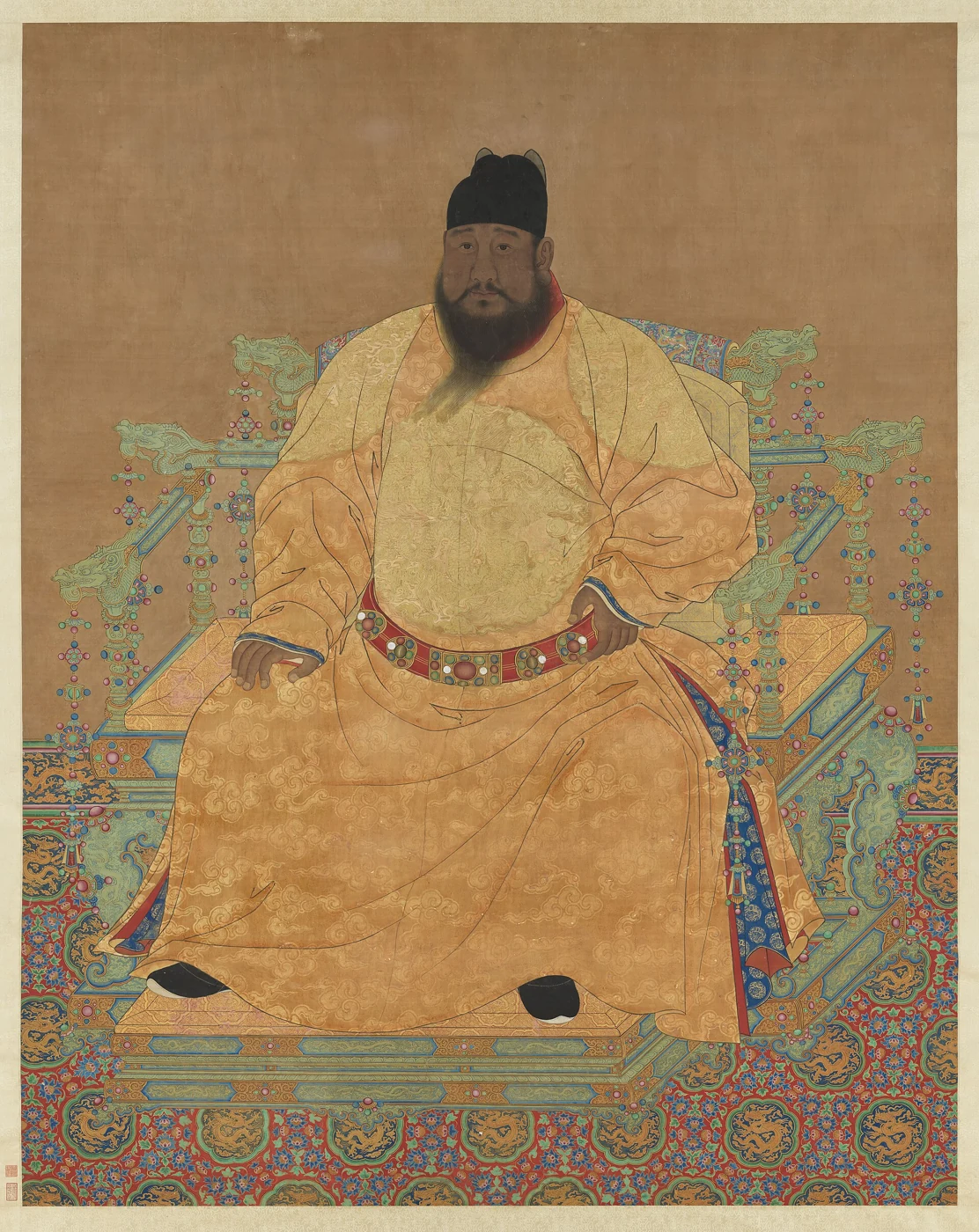
1399 CE–1435 CE
Ming emperor
Zhu Zhanji
朱瞻基
Zhu Zhanji (1399–1435), Emperor Xuanzong of Ming, art name Changchun Zhenren, was the fifth emperor of the Ming Dynasty, reigning from 1425 to 1435. He was also a painter and calligrapher. He was the eldest legitimate son of Zhu Gaochi, Emperor Renzong of Ming, and Empress Chengxiaozhao, Lady Zhang. Zhu Zhanji was favored by his grandfather Zhu Di, the Yongle Emperor, and in 1411 was designated imperial grandson-heir. He…
1399 CE–1435 CEMing Dynasty
PROFILE
Zhu Zhanji (1399–1435), Emperor Xuanzong of Ming, art name Changchun Zhenren, was the fifth emperor of the Ming Dynasty, reigning from 1425 to 1435. He was also a painter and calligrapher. He was the eldest legitimate son of Zhu Gaochi, Emperor Renzong of Ming, and Empress Chengxiaozhao, Lady Zhang. Zhu Zhanji was favored by his grandfather Zhu Di, the Yongle Emperor, and in 1411 was designated imperial grandson-heir. He accompanied Zhu Di on several northern campaigns and frontier inspections. Zhu Zhanji ascended the throne in 1425 and changed the era name to Xuande the following year. During his reign he suppressed the rebellion of Zhu Gaoxu, Prince of Han, continued the reduction of princely military power, and relied on ministers including the “Three Yangs”—Yang Shiqi, Yang Rong, and Yang Pu. His government reduced tax arrears, provided disaster relief, streamlined administration, and strengthened the Grand Secretariat. In foreign and frontier policy he pursued strategic contraction, abandoning Jiaozhi in the south and withdrawing from Kaiping in the north while making three frontier inspection tours to maintain defenses against Mongol groups. Later historians grouped his reign with that of his father under the name “Reign of the Ren and Xuan Emperors.” Zhu Zhanji was also accomplished in painting and calligraphy, with works such as Wuhou Reclining Aloft and Three Rams Opening Auspiciousness attributed to him. His enthusiasm for cricket fighting also earned him the later nickname “Cricket Emperor.” He died in Qianqing Palace in the first lunar month of 1435 at the age of thirty-six, received the temple name Xuanzong, and was buried at Jingling.
- Alternate Names
- Xuande Emperor; Emperor Xuanzong of Ming, Zhu Zhanji
- Art Name
- Changchun Zhenren
- Period
- Ming Dynasty
- Date of Birth
- March 16 1399
- Date of Death
- January 31 1435
- Dynasty/State
- Ming Dynasty
- Identity
- Ming emperor
- Ethnicity/Ethnic Affiliation
- Not recorded in historical sources
- Native Place
- Not recorded in historical sources
- Place of Birth
- Residence of the Prince of Yan in Beiping
- Place of Death
- Not recorded in historical sources
- Reign
- 1425–1435
- Predecessor
- Emperor Renzong of Ming (Zhu Gaochi)
- Successor
- Emperor Yingzong of Ming (Zhu Qizhen)
- Era Name
- Xuande
- Temple Name
- Xuanzong
- Posthumous Title
- Emperor Xiantian Chongdao Yingming Shensheng Qinwen Zhaowu Kuanren Chunxiao Zhang
- Highest Office
- See Biography and Major Achievements
- Major Achievements
- Son of Emperor Renzong of Ming; helped create the Reign of the Ren and Xuan Emperors; suppressed the rebellion of Zhu Gaoxu, Prince of Han.
LIFE TIMELINE
Age three | Zhu Di succeeded in the Jingnan Campaign; Zhu Zhanji became the emperor's senior grandson.
Age eight | Began formal studies outside the inner palace; Yao Guangxiao and others were appointed teachers.
Age ten | Traveled with Zhu Di to Beijing and observed farms and local customs along the way.
Age eleven | First left in charge of Beijing with Xia Yuanji assisting him, gaining early experience in government.
Age twelve | Formally designated imperial grandson-heir.
Age fifteen | Accompanied Zhu Di on his second northern expedition against the Oirats and participated in the Battle of Qulan Hūshūn.
Age eighteen | Married Hu Shanxiang as consort of the imperial grandson-heir.
Age twenty-one | Moved to the newly established capital Beijing with Zhu Di and his father and took residence in the imperial grandson's palace.
Age twenty-five | Zhu Di died; Zhu Gaochi succeeded as emperor. In the tenth lunar month Zhu Zhanji was made crown prince.
Age twenty-six | Sent to reside in Nanjing in the fourth lunar month; Emperor Renzong died in the fifth month; Zhu Zhanji ascended the throne in the sixth month and designated the following year the first year of Xuande.
Age twenty-seven | Suppressed the rebellion of Zhu Gaoxu, Prince of Han, in the eighth lunar month and renamed Lean Prefecture Wuding Prefecture.
Age twenty-eight | Imperial Noble Consort Sun gave birth to Zhu Qizhen in the eleventh lunar month; the court decided to abandon Jiaozhi.
Age twenty-nine | Deposed Empress Hu and installed Lady Sun as empress; personally campaigned against the Uriyangkhai in the eighth lunar month and reportedly hit enemy soldiers with all three arrows he shot at Kuanhe.
Age thirty | Zhu Gaoxu was executed; Yang Pu entered the Grand Secretariat, completing the “Three Yangs.”
Age thirty-one | Conducted a second frontier inspection as far as Ximalin in the tenth lunar month; Zheng He was ordered on his seventh maritime expedition.
Age thirty-four | Zheng He died at Calicut; Wang Jinghong led the fleet home.
Age thirty-five | Conducted a third frontier inspection in the ninth lunar month; became ill on the twenty-first day of the twelfth lunar month.
Age thirty-six | Died in Qianqing Palace on the third day of the first lunar month and was buried at Jingling in the sixth month.
BIOGRAPHY
Biography
Family Background and Early Life
Zhu Zhanji was born in 1399, the first year of the Jianwen era, as the eldest son of Zhu Gaochi, heir of Zhu Di, Prince of Yan, and Zhu Gaochi's principal wife Lady Zhang. According to later accounts, on the night of his birth Zhu Di dreamed that his father Zhu Yuanzhang gave him a great jade tablet symbolizing imperial authority and said, “Transmit it to your descendants, and may they prosper forever.” When Zhu Di awoke he learned that a grandson had been born. After seeing the child at one month old and noting his resemblance to himself, Zhu Di regarded the dream as fulfilled. While Zhu Zhanji was still an infant, Zhu Di launched the Jingnan Campaign. Zhu Gaochi remained in Beiping, and Zhu Zhanji was largely raised by his grandmother Lady Xu, Empress Renxiao.
In 1402, after Zhu Di captured Nanjing and became emperor, Zhu Zhanji became the emperor's senior grandson. He arrived in Nanjing the following year and thereafter was frequently at Zhu Di's side. Zhu Di greatly favored him. Xie Jin's remark about the “excellent imperial grandson” was later said to have helped confirm Zhu Gaochi as crown prince, illustrating Zhu Zhanji's importance in succession politics. In 1407 Zhu Zhanji began formal studies. Zhu Di appointed Yao Guangxiao, Junior Preceptor of the Heir Apparent, together with Hanlin scholars Lu Xuan, Zheng Li, and others as instructors. They were told to emphasize filiality, brotherly respect, benevolence, righteousness, and the lessons of emperors and kings needed for governing the realm rather than merely literary polish. Zhu Zhanji was described as quick-minded, able to grasp the general meaning of several lines at a glance and remember what he read.
Zhu Di worried that a child raised in the palace would not understand ordinary life. In 1409 he took Zhu Zhanji to Beijing and had him visit farms and observe tools, food, clothing, and rural conditions so that he would understand that state resources came from agricultural labor. The next year, when Zhu Di campaigned against the Tatars, he left the eleven-year-old Zhu Zhanji in Beijing under the guidance of Minister of Revenue Xia Yuanji. This gave the prince his first practical experience with government. Zhu Di also compiled a manual for him describing Zhu Yuanzhang's difficult rise to power and examples of capable and incapable rulers of earlier dynasties.
Years as Heir
On the tenth day of the eleventh lunar month of 1411, Zhu Zhanji was formally designated imperial grandson-heir. The following year Zhu Di ordered Minister of War Jin Zhong to select brave and strong youths from around the empire to form a “young guard” for Zhu Zhanji. Through this corps Zhu Zhanji practiced military formations and gained experience in military organization.
In the third lunar month of 1414, Zhu Di launched his second campaign into the northern steppe against the Oirats and specifically ordered Zhu Zhanji to accompany him. Officials including Hu Guang, Yang Rong, and Jin Youzi lectured him on the classics and history during pauses in the march. At Qingshuiyuan, Zhu Di asked whether Zhu Zhanji understood the purpose of the expedition. Zhu Zhanji replied that the emperor did not seek the enemy's land or livestock but campaigned because repeated submission and rebellion made long-term military pressure necessary, comparing the situation with ancient punitive expeditions. Zhu Di praised the answer. In the sixth lunar month the Ming army defeated the Oirats at Qulan Hūshūn; Zhu Zhanji then strongly urged a withdrawal, and Zhu Di agreed.
In 1417 Zhu Zhanji married Hu Shanxiang as consort of the imperial grandson-heir. In 1420 he moved to Beijing with Zhu Di and Zhu Gaochi and took residence in the imperial grandson's palace. During his education, some tutors repeatedly criticized his fondness for recreation and reported their concerns to Zhu Di. Dai Lun and Lin Changmao in particular earned his resentment, while Zhang Ying and Chen Shan were more accommodating. After Zhu Zhanji became emperor, Dai and Lin suffered retaliation whereas Zhang and Chen received promotion, an episode later used to illustrate the emperor's strong memory of personal favors and grievances.
Accession and Suppression of the Han Prince's Rebellion
In the seventh lunar month of 1424, Zhu Di died at Yumuchuan. Zhu Zhanji, acting on instructions from his father Zhu Gaochi, who was governing from Nanjing, hurried to the returning army to receive the imperial remains and help stabilize the situation. Zhu Gaochi ascended the throne as Emperor Renzong in the eighth month, and Zhu Zhanji was formally designated crown prince on the eleventh day of the tenth month.
In the fourth lunar month of 1425, repeated earthquakes in Nanjing led Emperor Renzong to order Zhu Zhanji to reside there and make offerings at Xiaoling. In the fifth month Zhu Gaochi suddenly became gravely ill and sent the eunuch Hai Shou to Nanjing to summon Zhu Zhanji. The emperor died before news of the prince's return arrived. Zhu Gaoxu, Prince of Han, who coveted the throne and was enfeoffed at Lean in Shandong, allegedly placed troops along the route in an attempt to ambush Zhu Zhanji. Zhu Zhanji received the summons and immediately rode north by the relay road with light cavalry, moving with sufficient secrecy and speed to evade the ambush. On the third day of the sixth lunar month he reached Lugou Bridge and received the testamentary edict. On the twelfth day he ascended the throne, proclaimed a general amnesty, and designated the following year the first year of Xuande.
After accession, Zhu Zhanji continued to treat Zhu Gaoxu with outward generosity, granting his requests and giving him benefits more generous than those of other princes, while waiting for open rebellion. In the eighth lunar month of 1426 Zhu Gaoxu indeed rose in revolt, organized five armies, and sent a messenger to court denouncing Xia Yuanji and others as corrupt ministers. Zhu Zhanji initially planned to send Xue Lu, Marquis of Yangwu, to campaign against him. Yang Rong and Xia Yuanji instead urged the emperor to lead the expedition personally, arguing that speed and the sovereign's presence would deter wavering factions. Zhu Zhanji accepted their advice and led an army said to number five hundred thousand toward Lean. He repeatedly sent letters warning Zhu Gaoxu and shot proclamations into the city calling on the rebels to surrender. Zhu Gaoxu had initially treated the prospect of Xue Lu's attack lightly but became fearful when he learned that the emperor had come in person. Morale inside Lean collapsed. Zhu Gaoxu attempted to flee by a side route on the twenty-first day of the eighth lunar month but was captured as soon as he emerged. Zhu Zhanji renamed Lean Prefecture Wuding Prefecture and returned to the capital on the twenty-fourth.
Afterward Zhu Gaoxu and his sons were reduced to commoners and confined in the “Xiaoyao City” compound inside the Xihua Gate. More than six hundred followers, including Wang Bin and Zhu Heng, were executed, and more than fifteen hundred were sent to frontier garrisons. In 1429 Zhu Gaoxu angered the emperor through further misconduct and was burned to death beneath a bronze vessel. Zhu Zhanji later wrote an account of the eastern expedition, but when ministers congratulated him he reportedly remarked that the episode was a misfortune for the state and no cause for celebration. He accepted Yang Shiqi's recommendation to spare Zhu Gaosui, Prince of Zhao, while requiring him to surrender military guards. Other princes, including Zhu Jihong of Jin and Zhu Mengwan of Chu, were likewise compelled to give up part of their forces. The long-standing problem of heavily armed princes was thereby substantially reduced.
Reign of the Ren and Xuan Emperors
After accession Zhu Zhanji relied heavily on senior ministers inherited from Emperor Renzong's government. Yang Shiqi and Huang Huai served in the Grand Secretariat, Jian Yi and Xia Yuanji held senior ministerial posts, and Duke of England Zhang Fu commanded major military forces. In 1429 Huang Huai retired and Jin Youzi died, while Yang Pu entered the Grand Secretariat. Together Yang Shiqi, Yang Rong, and Yang Pu were known as the “Three Yangs.” Although Jian Yi and Xia Yuanji remained highly ranked, policy consultation increasingly centered on the Three Yangs, and the Grand Secretariat's influence grew. Zhu Zhanji often summoned ministers to Wenhua Hall or Wenyuan Pavilion for discussions that continued late into the night.
Yang Shiqi became the central civil adviser of the Xuande court and repeatedly helped the emperor remit tax arrears and provide disaster relief, advocating policies of recuperation after the large military projects of the Yongle reign. Yang Rong was especially trusted on military and frontier matters, while Yang Pu was known for reserve and advice on broad principles. On the Three Yangs' recommendation, Zhu Zhanji abandoned the costly Jiaozhi administration and concentrated more heavily on domestic government.
The emperor also continued to supervise frontier defense. In 1428 he inspected the northern frontier and in the ninth lunar month led three thousand cavalry through Xifeng Pass. At Kuanhe he personally fought forces identified in the source as Uriyangkhai and reportedly hit enemy soldiers with three arrows. In 1430 he again toured the frontier as far as Ximalin northwest of Xuanfu, personally inspecting forts, troops, armor, and banners. In 1434 he made a third tour and expressed satisfaction with improvements in frontier discipline.
A major domestic controversy involved the empress. Zhu Zhanji long lacked a son. In the eleventh lunar month of 1427, Imperial Noble Consort Sun gave birth to his eldest son Zhu Qizhen. Empress Hu Shanxiang had no son and was frequently ill, while Zhu Zhanji favored Lady Sun. In the second lunar month of 1428 he summoned Yang Shiqi, Yang Rong, Jian Yi, Xia Yuanji, and Zhang Fu to Wenhua Hall and expressed his intention to have Empress Hu give up her position. The ministers were shocked and argued that she had committed no offense. Realizing that the emperor had already decided, Yang Shiqi and others suggested that she voluntarily cite illness and resign in order to preserve her dignity. In the third month Empress Hu submitted a resignation and moved to Chang'an Palace with the title “Jingci Xianshi.” Lady Sun became empress in the fifth month. Empress Dowager Zhang continued to treat the deposed empress with respect and often seated her above Empress Sun at palace gatherings. Zhu Zhanji later regretted the deposition and referred to it as an act of his youth.
Death
On the twenty-first day of the twelfth lunar month of 1434, Zhu Zhanji suddenly became ill. From the next day officials assembled at the Left Shun Gate to inquire about his condition. The year-end ceremonies and the New Year's audience of 1435 were canceled, and officials were instructed instead to pay respects to Crown Prince Zhu Qizhen at Wenhua Hall. On the second day of the first lunar month, Zhu Zhanji ordered the suspension of certain palace procurements and construction works. He died in Qianqing Palace on the third day at the age of thirty-six.
His testament named Crown Prince Zhu Qizhen as successor and instructed that major affairs first be reported to Empress Dowager Zhang and Empress Sun. The court conferred the posthumous title Emperor Xiantian Chongdao Yingming Shensheng Qinwen Zhaowu Kuanren Chunxiao Zhang and the temple name Xuanzong. He was buried at Jingling in the sixth lunar month. Ten consorts were made to follow him in death according to the source text.
Zhu Zhanji was the eldest son of the Hongxi emperor Zhu Gaochi by his principal wife, of the Zhang family. On the night of his birth his grandfather, then still prince of Yan, dreamed that his own father, the founder Zhu Yuanzhang, gave him a great jade tablet and told him that it should be transmitted to sons and grandsons for ever. Waking, he was told that a grandson had been born, and when at the full month he saw a child who looked much like himself and had a spirited face, he was delighted and took the dream for fulfilled. While Zhu Zhanji was still in swaddling clothes his grandfather rose in the campaign of Jingnan, his father held Beiping, and he was raised by his grandmother of the Xu family with unbounded affection. In the sixth month of 1402 Zhu Di took Nanjing and the throne, and Zhu Zhanji became the emperor's eldest grandson, reaching Nanjing in the intercalary eleventh month of the next year escorted by the commander Gu Neng; thereafter he attended his grandfather almost daily, receiving instruction in word and example. Zhu Di was then dissatisfied with Zhu Gaochi and inclined to make his second son, Zhu Gaoxu, heir, but when the chancellor Xie Jin said in the debate that there was "a good imperial grandson", Zhu Di resolved to make Zhu Gaochi heir — a measure of what the boy meant to him.
In the fourth month of 1407 Zhu Zhanji began his formal schooling. Zhu Di appointed the junior preceptor of the heir and the Hanlin attendants Lu Xuan and Zheng Li as his teachers, called him by nature clear and penetrating, and directed that his instruction should center on the filial, fraternal, benevolent and righteous as recorded in the classics and histories and on the great lessons of kingship that fit a man to order the world, and not on parsing chapters like a schoolman or on skill in literary composition. When the empress Xu died that autumn her last words still concerned him, charging his father and grandfather to bring him up well. Under his teachers he read several lines at a glance, understood the sense at once, finished every scroll he took up and forgot nothing, ranging over the classics, histories and philosophers. His grandfather, fearing that he would grow up knowing nothing of the world outside the palace, took him to Beijing in 1409 and had him visit farm households on the way, look at ploughs and at how peasants lived, so that he should feel the hardship of husbandry and know that everything the state used came from it. In the second month of the next year, when Zhu Di campaigned in person against the Tatars, he left the imperial grandson in charge of Beiping with the minister of revenue to assist him — his first taste of real business, on which he remarked that his grandfather had left him ready-made methods and he had only to follow them. Zhu Di also wrote for him a book on the roots of government, describing the founder's difficulties and the conduct of wise and foolish rulers through the ages.
In the eleventh month of 1411 Zhu Di formally invested him as imperial grandson-heir. To train him in arms, he had the minister of war Jin Zhong select young men of seventeen to twenty from Yingtian, Fengyang, Chuhe and Beiping and the provinces of Shandong, Shanxi, Shaanxi, Henan, Sichuan, Huguang, strong and skilled, and send them to the capital as the grandson's escort, called the Young Army, in which Zhu Zhanji practiced tactics and drill. In the third month of 1414 Zhu Di took him on his second campaign against the Oirats, telling his attendants that the boy was clever, acute and beyond others in courage and wisdom, and that on this clearing of the desert he should attend in order to learn the art of war's surprises, see the ranks for himself, know the soldiers' hardships and understand what conquest costs; scholars of the campaign were set to lecture him on the classics between marches. At Qingshui yuan his grandfather, pointing to the steep hills and the troops struggling through the sand, asked him if he knew why this was done, and Zhu Zhanji answered that his grandfather did not covet the land or herds but that these enemies were beast-like, unable to feel gratitude and reverting to rebellion as soon as they submitted, so that long campaigns were needed to subdue them; that a son of heaven with the tribute of the four seas at his command might well live at ease, and that he led armies over great distances only to drive the enemy into the far desert so that none should come near the frontier and his descendants and subjects should enjoy perpetual peace. Zhu Di said that his words had gone straight to his heart. After the battle at Hulan Hushiven he urged his grandfather, who wished to pursue, to turn back, and was heeded; the tales in unofficial histories of a eunuch leading him into an ambush at Jiulongkou are rejected by later criticism as inconsistent with the record. In the third month of 1417 he married the lady Hu as his consort.
In the twelfth month of 1420 Zhu Zhanji moved with his grandfather Zhu Di and his father Zhu Gaochi to the newly completed Beijing, taking up the imperial grandson's palace in the southeast of the palace city. During his training as heir he quarreled with some of the tutors who kept him strictly to his books: Dai Lun and Lin Changmao remonstrated with him repeatedly against excessive amusement and reported him to Zhu Di, which he resented, while Zhang Ying and Chen Shan flattered and pleased him. After his accession Dai and Lin were punished and Zhang and Chen promoted into the grand secretariat — a detail showing that the grudges of the heir's years bore on appointments in the early Xuande reign.
In the seventh month of 1424 Zhu Di died at Yumuchuan. Zhu Zhanji, at the order of his father, who was then supervising Nanjing, went to the army to receive the coffin and help steady the situation; in the eighth month Zhu Gaochi took the throne as the Hongxi emperor; in the ninth month the prince of Zhao and the assembled officials petitioned for the appointment of an heir, which the emperor declined in form and then allowed, investing Zhu Zhanji as crown prince on the eleventh day of the tenth month. In the fourth month of 1425, because Nanjing, the root of the state, had suffered repeated earthquakes, Zhu Gaochi sent him there to hold the city and to sacrifice at the tomb of the founder. When some ministers proposed sending a senior official or a prince instead, the emperor said that no one but the crown prince could hold Nanjing: his virtue and prestige were enough to settle men's minds, and with men's minds settled heaven's will would be too; that the founder's tomb had long gone unvisited and weighed on him day and night; that sending the crown prince was the same as going himself; and that his own father, on his northern tours, had been free of anxiety at home precisely because he himself had held Nanjing. Zhu Zhanji said he dared not decline so great a matter and left Beijing on the thirteenth day of the fourth month.
In the fifth month of 1425 Zhu Gaochi fell suddenly and gravely ill and sent a eunuch to recall the crown prince; before word could return he died on the twelfth day. The prince of Han, Zhu Gaoxu, who coveted the throne and had eyes everywhere, on hearing of the death sent picked troops to ambush and kill Zhu Zhanji on the road and seize the succession. Zhu Zhanji, receiving the summons, rode at once with light cavalry by the post road, so secretly and swiftly that the ambush never caught him; partway there the minister of revenue Xia Yuanji and others were already waiting to receive him, and the capital had been put under martial law. He reached the city on the third day of the sixth month and at once lifted the martial law, telling his ministers that the empire's sacred vessel was not to be had by cunning or strength, and that with the founder's charge settled, who would dare harbor wicked designs. The officials and princes petitioned him one after another, he declined three times and consented, and on the twelfth day of the sixth month took the throne, proclaiming a general amnesty and naming the next year the first of Xuande.
After his accession Zhu Zhanji still treated the prince of Han with indulgence, granting whatever he asked and giving him more than to other princes, in fact to let him show his hand. Zhu Gaoxu, thinking the new ruler easy to impose upon, pressed on with his plans and rose in the eighth month of 1426, organizing five armies, making Wang Bin and Zhu Heng generals and commanders, sending an envoy to the court to denounce Xia Yuanji and others as traitors whose execution he demanded, and writing to the princes and dukes to attack the government. When the news reached the capital Zhu Zhanji first meant to send the marquis of Yangwu, Xue Lü, against him; but Xue Lü changed color at the order and showed reluctance, while Yang Rong and Xia Yuanji urged a personal campaign on the ground that speed was everything and that it would overawe the waverers, and the duke of Yingguo, Zhang Fu, offered to take twenty thousand men and seize him. Judging that as a new ruler he must go in person to daunt the disaffected, Zhu Zhanji resolved on it. On the tenth day of the eighth month he sacrificed to heaven, earth and the ancestral temple, marched from the capital with a host said to be five hundred thousand, Xue Lü in the van, and went straight for Le'an. On the way he wrote again and again to Zhu Gaoxu, setting out his interests and urging him to give up his chief plotters, and shot edicts into the city to call on the rebels to surrender. Zhu Gaoxu had made light of Xue Lü's coming, but hearing that the emperor was with the army he took fright, and the city's morale broke, soldiers wanting to seize him to redeem themselves. At the end of his resources he slipped out of Le'an by a side road on the twenty-first day of the eighth month and was taken the moment he appeared; Zhu Zhanji renamed Le'an as Wuding.
On the return to the capital he reduced Zhu Gaoxu and his sons to commoners and confined them in the "Carefree City" within the Xihua gate; more than six hundred and forty of their partisans, Wang Bin and Zhu Heng among them, were executed and fifteen hundred sent to the frontier. In 1429, Zhu Gaoxu having provoked the emperor by fresh misconduct, he was put in a bronze vat and burned to death. Zhu Zhanji afterward wrote a record of the eastern campaign, but when his ministers offered congratulations he only sighed that this was a misfortune of the state and no occasion for rejoicing. On Yang Shiqi's advice he spared the prince of Zhao and had him give up his guards and military power, and he dealt with the princes of Jin and others in turn, requiring them to surrender part of their guards, greatly reducing the power of the imperial clan. The problem of the princes that had troubled several reigns since the founding was thus largely settled, and central authority further consolidated.
While he attended to internal government, Zhu Zhanji did not neglect the frontier. In the eighth month of 1428 he toured the border with troops and in the ninth month rode out of the Xifeng pass with three thousand armored horse, and in the battle at Kuanhe shot three arrows himself, each of them hitting, and broke the Uriyangkhad. In the tenth month of 1430 he toured the frontier again as far as Ximalin in the northwest, visiting the forts and camps and inspecting horses, armor and banners with satisfaction; in the ninth month of 1434 he made a third tour and told his ministers at Ximaling that in five years the border had become well ordered and its commanders were doing their duty.
Within the imperial family there was one storm. Zhu Zhanji long had no son; in the eleventh month of 1427 the consort Sun bore him his eldest son, Zhu Qizhen. The empress Hu had no child and was often ill, while the emperor favored the Sun lady, and he conceived the wish to set her aside. In the second month of 1428 he summoned the grand secretaries Yang Shiqi and Yang Rong, Jian Yi and Xia Yuanji and the duke of Yingguo, Zhang Fu, to the Wenhua hall, dismissed the attendants, and spoke of the empress's illness and childlessness, wishing her to resign of her own accord. The ministers were astonished and said the empress had done no wrong and that to depose her was contrary to propriety; the emperor was displeased and questioned them again and again, until, seeing his mind made up, they advised that the empress be allowed to plead illness and resign so as to preserve her dignity, to which he agreed. In the third month the empress Hu memorialized her resignation and retired to the Chang'an palace with the title of the Immortal of Serene Compassion; in the fifth month the Sun lady was made empress. The empress dowager Zhang treated Hu generously, always seating her above the new empress at palace banquets, at which the empress Sun was often out of countenance. Some years later Zhu Zhanji regretted the deposition too, excusing himself with the remark that it was the doing of his youth.
On the first day of the first month of 1435, being ill, he excused the ministers from the New Year audience; on the second he ordered the withdrawal of the eunuchs sent out to buy goods and to build; on the third he died at thirty-eight, leaving a testament that the crown prince Zhu Qizhen should succeed and that all great affairs must first be reported to the empress dowager Zhang and the empress Sun. He was given the posthumous name Zhang and the temple name Xuanzong, and was buried at Jingling in the sixth month.
In the matter of the imperial clan his measures went further than his father's. First he took away their guards: when an officer of the Qin household accused the prince of Qin, the prince in fear asked to give up two of his three guards; the prince of Chu, unwilling to be suspected, offered two likewise, and the princes of Shu and the rest followed. By the end of the reign five princes — Zhao, Qin, Chu, Shu and Su — had surrendered several guards each, keeping only small bodyguards, while the court repeatedly called the princes' guards to frontier duty, further draining their military strength. Second, he limited their political activity: unlike Zhu Di, who had often had them to court, he invoked the ancestral instructions to forbid the princes to come to the capital at all, permitting only correspondence; he restricted the scale and expense of their marriages and funerals; he allowed their descendants to choose their own matches and merely report them, ending the earlier practice of the court's strict selection; and princes who broke the law, such as the prince of Jin, were reduced to commoners and punished. Through the steady reductions of the Xuande reign the early Ming princes' power of "guards of picked troops and command over dukes and marquises" was wholly dismantled; they were left, as the saying went, with empty titles and rich stipends, no longer a military threat to the throne, and the clan problem that had troubled the Hongwu, Yongle and Hongxi reigns was largely settled.
Zhu Zhanji knew that to give the people peace one must choose the right magistrates, and he took the discipline of officials seriously. Early in the reign the left censor-in-chief of the censorate, Liu Guan, took bribes and perverted the law, conspiring with his son Liu Fu and with a justice-board director and a censor to take heavy bribes, mitigate death sentences and let criminals go, so that the censorial office rotted quickly and corruption at court grew. In 1428, after careful preparation, Zhu Zhanji first sent Liu Guan out of the capital to inspect the river works and then appointed Gu Zuo, a transmission commissioner known for integrity and bluntness, right censor-in-chief in charge of the censorate. Gu Zuo quickly established the facts and asked that more than thirty corrupt censors, Yan Hao among them, be dismissed; the emperor approved at once, sent them to Liaodong as clerks for life, and ordered that censors who broke the law be punished three degrees more heavily and that any taking of bribes be judged severely. Liu Guan and his son were then arrested, tried and sent to garrison Liaodong; the deputy censor-in-chief at Nanjing was also ordered to reform the Nanjing circuits, dismissing more than thirty corrupt censors, and after these measures the censorial offices in both capitals were clean and corruption was checked. Between 1424 and 1434, it is recorded, the censors demoted more than two hundred and forty officials, submitted two hundred and forty-seven impeachments naming at least six hundred and fifty-nine officials, and offered two hundred and fifty-one further memorials of advice and remonstrance.
In selecting and assessing local officials he acted as well. In 1430, hearing that prefectural and departmental officials mostly rose by seniority and that many were unfit or extortionate, and finding the posts of nine great prefectures — Suzhou, Changzhou, Xi'an among them — vacant, he ordered the chief officers of the six boards to recommend capital officials as candidates. The minister of personnel, Jian Yi, and others recommended nine men, whom he appointed, and Kuang Zhong, going to Suzhou, proved upright and clean, equalized taxes and service, and won the people's support, becoming a famous model magistrate of the Ming. He afterward repeatedly had the six boards recommend local officials, so that the principal prefectures were staffed from men chosen at the center, securing both the quality of local administration and the court's hold on the provinces. For assessing those in office he used, besides the regular triennial review, the censors on circuit and the grand coordinators, having touring censors and the surveillance commissions examine local officials jointly and deal with the grasping and the wicked at once rather than waiting for the three-year term to expire. The most important institutional development of local government in his reign was the emergence of the grand coordinator. In 1421 thirteen ministers, vice ministers, censors-in-chief and court officials had been sent out on tours called "grand coordination", with no fixed establishment and a return to court at the end of the business; under Hongxi the Guangxi administration commissioner Zhou Gan toured Zhejiang and reported on the local tyrants. In the eighth month of 1425 Zhu Zhanji sent the Guangxi surveillance commissioner Hu Gai as chief minister of the court of judicial review to Jiangnan, and the next year Hu Gai brought the tyrants, ruffians and corrupt clerks of Songjiang whom the local authorities could not control to the capital for trial by the censorate. In 1430, because taxes and grain were widely concealed and abused, he had ministers recommend a group of officials to be raised to vice-ministerships and sent to coordinate the provinces and supervise the grain: the vice minister of personnel to Jiangxi, the vice minister of revenue Zhao Lun to Zhejiang, the vice minister of rites to Henan and Shanxi, the vice minister of justice to the northern metropolitan region and Shandong, and the vice minister of works to the Suzhou and Songjiang prefectures. The edicts he gave them said that anyone obstructing the grain business should be reported truthfully, and that anything convenient for the people should likewise be memorialized. The coordinators had power over litigation and the interrogation of the cunning, and became the emperor's specially commissioned resident ministers.
In judging cases Zhu Zhanji sought equity and lenity, at times deliberately lightening punishment, so that his final rulings in grave cases almost always differed somewhat from those of the three judicial offices. In the seventh month of 1426 the censors tried the Liyang bully Shi Ying and his son, with some twenty officials who had taken their bribes, all liable to death; the court of judicial review went over it and all confessed without complaint. When it came to the emperor he questioned each of the twenty-odd condemned men himself, executed only Shi Ying and his son, sent most of the rest to labor in transport and released seven outright. In 1427, trying prisoners, he ordered that all but murder and treason be reduced a degree in punishment, and of the two thousand-odd then judged most were let off lightly; the judicial offices thought him too lenient and said so repeatedly, but he held that if such men mended their ways the practice was to be approved. That year he established the commutation of punishment by delivering grain, giving criminals a road to reform, except for the gravest offenses of wickedness, unfilial conduct and murder. Because he judged leniently he allowed and encouraged the wronged to appeal by beating the drum of petition, so that criminals and complainants alike came to the palace to beat it, the sound going on all day; when an official complained that condemned men were merely clinging to life and importuning the court, Zhu Zhanji retorted that the drum existed precisely to bring the feelings of those below to the throne, and that to call this troublesome was absurd, ordering that whoever had charge of the drum must treat each case seriously and be punished for concealing or obstructing any. He also heard family disputes, such as a mother-in-law and daughter-in-law at the Xiaoling guard who fell out over tea, and a youth who falsely accused his great-uncle, and disposed of both leniently by the sense of the matter without unsettling the proper order of senior and junior.
In his ten years on the throne Zhu Zhanji repeatedly remitted taxes in disaster-stricken regions and sent officials to relieve the hungry; by an incomplete count there were sixteen sizable remissions in the Xuande years, of which that of 1430 came to more than seven hundred and forty thousand piculs and that of 1432 to more than seven hundred and ninety thousand, the two together over a million and a half piculs, close to a third of the empire's whole summer and autumn tax in the early Ming. Through the reign the registered households stood between nine and ten million, the population about fifty-two million, the cultivated land about four million qing, and agriculture was on the whole stable. To keep relief from being delayed he gave local officials the power to act before reporting, allowing them to open the granaries first, and warned the court not to charge them with acting on their own authority; in the drought of 1431 he wrote a poem of compassion for the drought to show that he shared the people's anxiety, and on the way back from the tombs he talked with a farmer about his hardships and wrote the conversation down as a record of a farmer's words for his ministers, to show that he valued husbandry. For the many who fled from famine and heavy taxes he both remitted the arrears of the fugitives and required the prefectures and counties to receive and settle those who came in, freeing them from taxes and service for more than a year so that they might take to the land again; in 1430 a vice minister of works coordinating Henan brought back more than a hundred and five thousand households of fugitives to farming, a notable result.
The great works of the Yongle years, the building of Beijing and the Longling tomb, had used vast numbers of artisans. Artisans belonged to hereditary households of craftsmen, low in status and long in service at the capital, and their lot was hard. Zhu Zhanji ordered their burdens lightened more than once: in 1426 he had the board of works release half the capital's artisans and put them on rotation, exempted households with only one able man or with the aged and infirm from labor, and halted works that were not urgent, so that no great building was undertaken through the rest of the reign. He likewise stopped the timber and stone levies that wasted the people: in the seventh month of 1426, when the touring censor in Huguang reported drought and hunger while the local officials were still pressing men to carry grain and cut seventy thousand pine trees, he ordered both levies stopped at once, and the timber levy in Sichuan was halted for the same reason, the emperor writing that the labor gangs in the prefectures had all been discharged and the envoys recalled — a sign of letting the people rest.
Suzhou, Songjiang and the other Jiangnan prefectures had borne heavy taxes since the beginning of the dynasty, far above other regions, with service grossly unequal and the people hard pressed. In the ninth month of 1430 Zhu Zhanji raised Zhou Chen, secretary of the prince of Yue's household, to be vice minister of works to coordinate the southern metropolitan region and supervise the grain. Working closely with the prefect of Suzhou, Kuang Zhong, Zhou Chen reorganized the taxes and services of Jiangnan: he unified the rates on official and private land to equalize the burden and introduced commutation, allowing part of the grain tax to be paid in silver or cloth for the people's convenience, while rooting out the abuses by which tax captains collected the grain, easing the actual burden on farming households; Kuang Zhong in Suzhou alone asked for and obtained the remission of more than seven hundred thousand piculs. Zhu Zhanji supported their reforms firmly and ignored the ministers who impeached them for tampering with the established law, and with this the heavy-tax problem of Jiangnan, which had troubled the dynasty for decades, was partly relieved.
Since the Yongle move of the capital to Beijing, carrying southern grain north had become the economic lifeline of the state. Before Xuande the transport was by the relay method: farming households provided their own boats and carried the grain in stages to appointed depots, whence guard troops relayed it to Beijing. The cost was enormous — three piculs had often to be shipped to deliver one — and the round trips were long and hurt farming. On the advice of Chen Xuan, the earl of Pingjiang, and Zhou Chen, Zhu Zhanji introduced the exchange method in 1431: households carried their grain to the river ports at Huai'an and Guazhou and delivered it there to the transport troops, who took it on to Beijing, with the households paying a fixed allowance of "wastage rice" and light freight silver according to distance. This shortened the people's haul and lengthened the soldiers', greatly lightening the labor service and markedly cutting the cost of transport; the cooperation of Chen Xuan and Zhou Chen made the grain transport of the Xuande years one of the achievements of the reign.
In commercial taxation, in 1429 the court, on the ground that the paper currency did not circulate because merchants stored goods untaxed, raised the shop and stall levies fivefold and required payment in paper for warehouses, storehouses, inns, hired carts and pack animals, and the vegetable plots and orchards of both capitals; hired carriers were taxed according to tonnage and distance, five hundred strings of paper per hundred units of capacity for a voyage from Beijing to Nanjing, with honest censors and revenue officials posted to collect at the busy river points. Seven customs houses were thus established at Huoxian — later moved to Hexiwu — Linqing, Jining, Xuzhou, Huai'an, Yangzhou and the Shangxin river at Nanjing, of which the economic section of the Ming History says that the customs houses began here. These measures were meant to restore the circulation of the paper money and became an important element of Ming commercial taxation.
After his accession Zhu Zhanji often discussed with his ministers the successes and failures of earlier rulers, using them as a mirror, and warned his officials and frontier commanders again and again that though the realm was at peace arms must not be forgotten, that no one should say it was secure and in security forget danger, and that to consider danger in time of peace was the way to preserve the state. He tied the repair of armaments closely to lasting order, holding that the wise rulers of old had kept order and repelled insult, secured the interior and kept off the outer enemies, only by strict attention to arms and clear military government, and that only with a constant sense of caution and unrelaxed armament would trouble be avoided. In the imperial instructions of the second month of 1428 he set out the relation systematically: a good ruler does not forget danger in peace nor disorder in order, since trouble comes unforeseen and unpreparedness cannot meet it; the sages of old attended strictly to arms, built walls and passes, and kept weapons to defend the state, with careful planning and proper training, so that the strong were held off and the people were at peace — the way of lasting order. He therefore named three essentials: storing up generals, that is, selecting men of courage and wisdom and rewarding them richly; nourishing the soldiers, that is, caring for and resting them and training them in season; and accumulating reserves, that is, valuing agriculture and spending sparingly. With all three, he held, one could secure the interior and repel the outer enemy. At the same time he opposed the reckless use of force, criticizing those who for love of glory emptied the realm and those who trusted in their own prowess and multiplied distant campaigns until they lost armies in great numbers, holding that arms exist to repel insult and that to exhaust a state in war is no virtue in a sovereign.
In the handling of troops he laid down that training and command must each have method, covering the practice of arms, care for the soldiers, strict discipline and even rewards and punishments. To stir the sons of meritorious families to military practice he worked on them morally, holding up celebrated generals of the past as models, and institutionally: sons of officers in line to inherit a guard post must drill in the training grounds in ordinary times and have bow and horse skills at command, and at the inheritance they must pass a strict test under the rules of earlier reigns, those who failed being refused the post; those already in place were also tested, and failing at first they were sent back to practice, failing twice they were punished. He repeatedly ordered troops from the garrisons to be brought to the capital for review and drill to keep their fighting quality up.
Care for the soldiers was a marked feature of his military thinking. By the Xuande years the hereditary military households and the military colonies were showing grave weaknesses: officers oppressed their men and seized the colony lands, and the soldiers, hard pressed, deserted in growing numbers, sapping the army's strength. He therefore insisted that besides good training the men must be well kept, for generous keeping wins their hearts and precise training makes them useful; a commander's own courage and wisdom were not enough — he must rely on his men, who were the means of his fortune, and only by treating them well in ordinary times could he count on them to fight to the death in the hour of need, whereas one who never cared for them but drove them only by authority could not be sure of them in a crisis. He rebuked commanders who had no care for their men but squeezed and stripped them worse than jackals and tigers, used up their strength and stole their rations until they fled in bands, and told them to comfort their soldiers, pity their cold and hunger and share their sweet and bitter, loving them as a father loves his sons; and he issued orders again and again forbidding officers to use soldiers for private labor, seize their colony fields or pocket their pay, with arrest and punishment for those reported and verified.
To meet the desertions and the shortage of men in the garrisons he continued the policy of clearing the military rolls, sending many censors to the provinces to check the guard registers, establish how many had fled and recover them from the original military households. In 1426 he sent fifteen men, the vice minister of personnel Huang Zongzai among them, to clear the rolls in the several regions; the task became a standing duty of the censors, and in 1429 the articles governing it were increased from eight to nineteen and twenty-two further articles added against graft, to regulate the work and lessen its harassment of the people. Yet the clearing could not save the military colony system at its root: with the growth of commerce and the concentration of land its economic base could no longer be kept up, and many censors, in hunting down deserters, recklessly accused civilian households and extorted bribes from the localities, creating new troubles. The reorganization of the Xuande years helped keep the army's numbers up to a point, but did not stop the decline of the guard system; the shift to recruitment that the Ming afterward made was already foreshadowed.
On the northern frontier the policy changed from the offensives of the Yongle years to defense. At the beginning of the reign soldiers at Shuozhou proposed moving the garrisons of Dongsheng and Gaoshan back to their old stations to meet the Mongols actively, and soldiers at Xingzhou proposed colonizing and walling Kaiping and Daning, but he refused both; he also moved inward Kaiping, the last Ming post beyond the Great Wall. Kaiping lay more than three hundred li north of the wall, a frontier command set up after the early Ming general Li Wenzhong took the old Mongol capital, and with Daning to the east and Xinghe to the southwest it formed a triangle shielding Beijing; after Yongle, Daning and Xinghe were abandoned, leaving Kaiping unsupported beyond the wall and hard to supply. In 1430, under the marquis of Yangwu, Xue Lü, who was responsible for the northern defense, it was moved inward, and with that the Ming gave up every post beyond the Great Wall, the frontier settling into the defensive posture of Xuanfu, Datong and Jizhou.
In foreign relations the great decision of the reign was the withdrawal from Jiaozhi. In the Yongle years the Ming had destroyed Annam and set up a provincial administration there, after which local resistance never ceased and the Ming armies were worn out chasing it. In 1426 and 1427 they suffered repeated defeats, and in the latter year the force under Liu Sheng was destroyed near Daoma po and Liu Sheng himself killed, after which the court debated giving the province up. Zhang Fu and others urged reinforcement and another campaign, while Yang Shiqi and Yang Rong argued that years of war had exhausted the people and that Jiaozhi could not be held, so that the army should be withdrawn and the people allowed to rest. Zhu Zhanji took the latter view, recalled the troops, abolished the provincial administration and allowed a descendant of the former Tran house to rule there; the man Li Li afterward made himself master, and in 1431 the Ming invested him as king of Annam, restoring the relation of investiture and tribute. The decision was much argued over at the time, and later writers have seen it either as a prudent retreat from an impossible commitment or as the surrender of an ancestral conquest; within the larger policy of rest and recovery it answered, at any rate, to his wish to lighten the people's burdens and attend to internal government.
At sea, in the sixth month of 1430 the court ordered Zheng He to the western oceans once more, the seventh voyage of the histories. The fleet sailed from Nanjing in the first month of 1431, visiting Malacca, Ceylon and Calicut among other places, and returned in 1433, Zheng He himself dying on the way home. No great ocean voyage was made afterward, the scale of maritime exchange contracted, and the focus of policy on the southeast coast shifted toward coastal defense and the routine management of tribute trade. For the Xuande reign the voyage closed the maritime enterprise of the Yongle years and opened a turn away from it.
In his family, the consort Sun bore him his eldest son Zhu Qizhen in the eleventh month of 1427, and in the second month of 1428 the boy was made crown prince, the empress Hu resigning on grounds of illness in the third month and the Sun lady being made empress in the fifth. He had another son, Zhu Qiyu, born of the consort Wu. He died after ten years, leaving the throne to the crown prince by testament, and because Zhu Qizhen was a child, directed that great affairs be reported first to the empress dowager Zhang and the empress Sun — an arrangement that kept government for a time in the hands of the dowager and the outer ministers. Later historians group the Hongxi and Xuande reigns together as the government of Ren and Xuan, one of the cleanest periods of Ming politics and often compared to the reigns of Wen and Jing in the Han; and they point as steadily to the other side of the legacy: the dangers of the double system of secretariat and eunuch directorate, the long consequences of a frontier that turned from attack to contraction, and the foreshadowing of the eunuch domination and the Tumu disaster of the Zhengtong years that followed.
Major Activities
Suppression of Zhu Gaoxu's Rebellion and Reduction of Princely Power
In the eighth lunar month of 1426, Zhu Gaoxu, Prince of Han, rose in rebellion. At the urging of Yang Rong and Xia Yuanji, Zhu Zhanji led the campaign personally. The emperor's presence shattered rebel morale, and Zhu Gaoxu was captured after attempting to flee. The emperor renamed Lean Prefecture Wuding and confined Zhu Gaoxu and his sons after returning to the capital. In 1429 Zhu Gaoxu was executed. Zhu Zhanji thereafter accepted Yang Shiqi's advice to spare Zhu Gaosui, Prince of Zhao, on condition that he surrender his guards, and other princes were similarly compelled to relinquish military forces. By the end of the Xuande reign several princes had surrendered multiple guard units, substantially reducing the military threat of the princely establishment.
Domestic Government and the Reign of the Ren and Xuan Emperors
Zhu Zhanji relied on the Three Yangs and other senior ministers and continued Emperor Renzong's shift toward recuperation. His administration remitted taxes, provided relief, helped displaced households resume production, dismissed corrupt, incompetent, elderly, or infirm officials, reduced redundant positions, controlled the number of new appointments, and strengthened recommendation procedures. The Grand Secretariat became increasingly influential. Zhu Zhanji frequently consulted ministers in person and maintained comparatively close working relationships with them. Economic conditions improved, and later historians described the period as the Reign of the Ren and Xuan Emperors.
Abandonment of Jiaozhi and Strategic Contraction
The Ming had spent heavily on military operations in Annam, administered as Jiaozhi, during the Yongle reign. In the Xuande period, forces led by Lê Lợi repeatedly defeated Ming armies. Zhu Zhanji concluded that the empire was exhausted and that continued distant warfare brought little benefit. Following the advice of the Three Yangs and others, he decided to abandon Jiaozhi. In 1427 he recognized Trần Cảo as ruler of Annam and ended the southern campaign. After Lê Lợi displaced Trần Cảo and requested recognition, Zhu Zhanji rejected proposals for renewed war and eventually recognized Lê Lợi. Annam thereafter continued tributary relations. Zhu Zhanji also withdrew the northern position at Kaiping and concentrated more resources on domestic government.
Three Frontier Inspections and the Kuanhe Campaign
In 1428 Zhu Zhanji toured the northern frontier. When reports arrived that Uriyangkhai forces with ten thousand cavalry had entered the border region, he selected three thousand cavalry and moved rapidly beyond Xifeng Pass. The enemy initially mistook the force for ordinary frontier troops. Zhu Zhanji divided his cavalry into two wings and personally shot at the enemy vanguard. Ming troops then used firearms, causing heavy losses and a rout. When the enemy recognized the imperial yellow-dragon banner, surviving soldiers dismounted and surrendered according to the source narrative. In 1430 Zhu Zhanji conducted a second inspection as far as Ximalin, reviewing forts, troops, armor, and banners. In 1434 he made a third tour and expressed approval of frontier discipline.
Zheng He's Seventh Maritime Expedition
In January 1431, corresponding to the fifth year of the Xuande era in the source chronology, Zhu Zhanji ordered Zheng He to sail again because many foreign polities had ceased regular tribute. This was Zheng He's seventh and final maritime expedition. The fleet is recorded as carrying 27,550 people. During the return voyage Zheng He died at Calicut on the west coast of India in 1433. The eunuch Wang Jinghong led the fleet back, reaching Nanjing on July 22, 1433. No comparably large Ming state-sponsored oceanic expedition followed.
Literature, Painting, and Calligraphy
Zhu Zhanji was one of the more accomplished artist-emperors of the Ming and used the art name Changchun Zhenren. He painted landscapes, figures, flowers, and birds; works attributed to him include Wuhou Reclining Aloft, Three Rams Opening Auspiciousness, and Melon and Mice. He also practiced running and cursive scripts. Historian Ray Huang argued that Zhu Zhanji's artistic talent, even if it did not surpass that of Emperor Huizong of Song, was at least comparable. Zhu Zhanji also enjoyed hunting, food, and cricket fighting. Pu Songling's famous story “Cricket” in Strange Tales from a Chinese Studio uses Emperor Xuanzong of Ming as its imperial setting, and later writers nicknamed him the “Cricket Emperor.”
Establishment of the Palace School and the Eunuch Question
In 1426 Zhu Zhanji ordered the establishment of the Palace School to teach eunuchs to read. The measure was intended in part to improve communication and administrative competence among palace servants, but later critics regarded it as an important step in the growth of literate eunuch involvement in government. The source text emphasizes that Ming emperors remained dominant over eunuchs and often used them as instruments of rule and as checks on ministers, while acknowledging that later writers nevertheless linked the institution to the long-term growth of eunuch political power.
In the fifth month of 1425 the Hongxi emperor died, and Zhu Zhanji came back from Nanjing to take the throne, changing the era name to Xuande the next year: the Xuande emperor. His first great matter was his uncle, the prince of Han, Zhu Gaoxu. In the eighth month of 1426 Zhu Gaoxu rose in rebellion at Le'an under the same "Jingnan" pretext his father had used; Zhu Zhanji took Yang Rong's advice and led the campaign in person. Reaching the city, he sent letters and edicts urging submission while displaying his army, and Zhu Gaoxu's following melted away and he came out and surrendered, the rebellion ending within ten days. Zhu Zhanji did not slaughter: Zhu Gaoxu was reduced to commoner status and confined within the Xi'an gate, and those who had been dragged into the affair were largely pardoned. Only the position of the prince of Zhao, Zhu Gaosui, gave some unease on the way back, and in the end he chose to leave him untouched, so that the Xuande reign did not repeat the disaster of the Jianwen emperor's attempt to cut down the princes.
In the conduct of government the emperor relied on the seasoned ministers trained under the founder and the Yongle emperor. He brought Yang Shiqi, Yang Rong and Yang Pu into the grand secretariat to handle business and had the ministers of personnel and revenue, Jian Yi and Xia Yuanji, assist in the government, giving the age the name of the rule of the Three Yangs; edicts were drafted and memorials answered chiefly through the secretariat, while the emperor himself held audience and discussed state affairs face to face, so that communication between ruler and ministers was comparatively open. He took seriously the inspection and impeachment of officials, warning the censorate and the provincial surveillance commissions again and again to judge honestly and not to drift into indulgence; and while he did not always accept the remonstrances of the censors, he generally kept the door open to them. That the government of the Xuande years was called clean by later ages owed something to this body of ministers and something to the emperor's own diligence and even temper.
After his accession Zhu Zhanji relied heavily on the ministers of his father's reign. The grand secretariat then held Yang Shiqi, Yang Rong and Yang Pu, Xia Yuanji was at the revenue board and the duke of Yingguo, Zhang Fu, commanded the army, all of them well treated; after Huang Huai retired and Jin Youzi died in 1429, Jian Yi and Xia Yuanji, though high in rank, deferred in counsel and decision largely to the Three Yangs, and the secretariat's weight grew steadily. The emperor talked with his ministers with an open heart, often receiving them in the Wenhua hall or the Wenyuan pavilion to consult on government, sometimes until the night was half gone. Of the three, Yang Shiqi was the central figure of the reign, taking part in many great decisions and repeatedly helping to remit arrears and relieve disaster, insisting on letting the people rest so as to ease the exhaustion left by the great campaigns of the Yongle years; Yang Rong was a sure hand in military matters, always summoned when there was trouble on the frontier, and his advice usually hit the mark; Yang Pu was retiring by nature but his proposals always touched matters of consequence. It was on the advice of these men that Zhu Zhanji gave up the war in Jiaozhi and turned his attention to internal government, drawing in the long years of campaigning since Yongle.
This group of ministers was the personnel foundation of what is called the government of the Ren and Xuan reigns. Yang Shiqi excelled in administration and the handling of officials, Yang Rong in frontier affairs and improvisation, Yang Pu in scrupulous steadiness; their temperaments and strengths complemented one another, and with Zhang Fu over the army and Xia Yuanji over finance they allowed decisions to be balanced among military, fiscal and civil considerations. The emperor trusted them while keeping his own judgment, hearing matters in person before deciding and talking them over again when views differed — a manner of government already different from that of later reigns, when the emperor sat deep in the palace and everything passed through drafted rescripts.
The rise of the grand secretariat was the most important institutional change of the Xuande reign. Under Yongle the secretariat was newly created, its members of low rank and purely advisers without independent political standing; the Hongxi emperor raised Yang Shiqi, Yang Rong and Jin Youzi to the rank of minister and junior preceptor, putting them on a level with the heads of the six boards, and the secretariat's weight began to grow. Zhu Zhanji leaned on it further, taking the Three Yangs into his confidence so that no matter of inner government, great or small, was decided without their opinion; and though the ministers of personnel and revenue, Jian Yi and Xia Yuanji, were still received, counsel and decision lay largely with the Three Yangs, and from then on the secretariat's power grew daily.
The great institutional innovation of the reign was the establishment of the right of drafting rescripts. Previously memorials from within and without the court were answered by the emperor himself; in the Xuande years the secretariat and the ministers Jian Yi and Xia Yuanji were for the first time allowed to write their opinions in black ink on small slips pasted to the face of each memorial and submit them, called itemized notes, for the emperor's reference; if he approved, the eunuchs of the directorate of ceremonial copied out the formal answer in red, called the vermilion endorsement. With this the secretariat changed from a merely advisory body into a confidential center taking part in decisions, its authority, as contemporaries said, that of a Han or Tang chancellor in all but the name, and the practice, established under Xuande, lasted to the end of the Ming. Along with it the secretaries gained the power to return and correct improper imperial orders, to take part in the great conferences on policy, and to draft edicts in the emperor's name.
While perfecting the secretariat, Zhu Zhanji also markedly raised the power of the eunuchs, establishing in outline the system by which secretariat and directorate of ceremonial governed together. In the seventh month of 1426 he set up the Inner School and like offices to teach young eunuchs to read and write, taking in two or three hundred children of about ten as a standing arrangement; the eunuchs thus acquired literacy, the condition of their later participation in government. More critically, he gave the vermilion endorsement to the directorate of ceremonial: since the number of memorials submitted daily was enormous, he answered a few himself and had the eunuch scribes of the directorate endorse the rest in accordance with the secretariat's drafts, so that the directorate became the private agent of the imperial will with the power to approve or reject the secretariat's proposals. The system worked well enough while Zhu Zhanji lived, for he was diligent and the eunuchs he trusted were men of decent character who endorsed as the secretariat had drafted; but the design carried a great danger: once a later emperor neglected government or a child came to the throne, the directorate could use the vermilion endorsement to overrule the secretariat, decide affairs at its own will and even pervert the law and destroy ministers. The misrule of the eunuch Wang Zhen in the Zhengtong reign grew directly out of it, and later ages said that the abuses of the dynasty began with the Xuande emperor.
As designed, the double system of secretariat and directorate of ceremonial was meant to hold the two in check and make both answerable to the emperor. The secretariat represented the outer bureaucracy, the directorate the inner imperial power, and neither could monopolize government alone; the arrangement preserved the emperor's final say in great affairs and prevented a single minister from dominating, a substantial readjustment of central power after the abolition of the chancellorship, whose broad shape lasted to the end of the Ming. It must be said too that its working depended heavily on how diligent the emperor was: that under Xuande the endorsements followed the secretariat's drafts and the machine ran normally was because Zhu Zhanji himself handled business and knew it well; once a successor neglected government or was a child, the directorate's power to endorse became a power to veto, and the eunuch interference and domination from the Zhengtong reign onward came from exactly this. Later writers who said the abuses of the Ming began with the Xuande emperor meant this institutional legacy.
In justice and civil government his lenity worked together with his tightening of official discipline. On one hand he punished corrupt censors severely to restore order; on the other he lightened ordinary sentences and kept the drum of petition open so that grievances could reach him, aiming at clear laws and simple government. This answered to the same purpose as his remission of tax arrears and relief of disaster, that is, to restore the strength of a people worn down by the frequent campaigns of the Yongle years. The fiscal and judicial policies of the reign thus kept a steady line, and this is a chief reason why the government of the Ren and Xuan reigns was praised by later ages.
In letters and education Zhu Zhanji had his Confucian ministers compile several works: the sixty-two sections of the Book of the Five Relations, gathering from the classics, histories and philosophers the good words and deeds of ruler and minister, father and son, husband and wife, elder and younger brother and friends; the five sections of the Mirror of Consort Kin, on the conduct of imperial relatives by marriage; thirty-seven sections of the words and deeds of famous ministers of past ages; and a single section of Admonitions for Officials which he wrote himself and issued to the officials within and without the court, requiring integrity and diligence. In 1433 he had Yang Shiqi and Yang Rong choose ten good calligraphers from the academies to make several copies each of the Four Books, the Five Classics and other works for storage in the Guanghan and Qingshu halls. These compilations had a plain didactic purpose, in keeping with his emphasis on the discipline of officials and his promotion of good magistrates.
In religion the early Ming emperors had both kept Buddhism under strict control and actively used it: the founder, the Yongle and the Hongxi emperors all took an interest while remaining temperate. In the Xuande years the court carried on the Yongle policy of favoring Buddhism and treated Tibetan monks with ever greater courtesy, opening the way to the excessive patronage of Tibetan Buddhism by later Ming emperors. This turn was not inconsistent with the rest of his government: on the frontier and in Tibetan affairs religious exchange was itself one means of keeping relations, while the growth of the emperor's personal piety left a long mark on politics after Xuande.
In religious policy the court's favor to Tibetan Buddhism became markedly more generous in the Xuande years. In the second month of 1426, rewarding the campaign against the Qushen and Anding, it conferred in a single act five titles of great national preceptor and six of Chan master on Tibetan monks, and two years later granted a fourth-rank silver seal and patent to another; in 1434 it gave the monk Shakya Yeshe, already styled the Great Compassionate Dharma King, an even longer title. Tibetan monks thus came in grades from the Great Compassionate Dharma King, the Son of Buddha of the Western Heaven and the great national preceptors down through national preceptors, Chan masters, heads of monasteries and lamas, and the numbers maintained in the capital grew steadily, so that by the end of the reign the temples of Beijing housed the greatest concentration yet seen. In 1435, after the Yingzong emperor came to the throne, the board of rites proposed reducing the Tibetan monks in the capital temples by six hundred and ninety-one, and in 1436 by four hundred and fifty more — a measure of the scale.
At the same time Zhu Zhanji and his consorts built Buddhist temples in the capital and elsewhere. Later scholarship counts nine temples built by him and his consorts in the capital — one new, six rebuilt and three repaired — and the Xuande years are taken to have opened the fashion among Ming emperors and consorts for building Buddhist temples in Beijing on a large scale. In 1426 he ordered a great temple built at Minzhou and gave it its name; in 1427 a large monastery was completed in what is now Ledu in Qinghai, the greatest Tibetan Buddhist establishment in the Huangshui valley and the best preserved group of Ming buildings in the northwest; and because he reverenced the Indian monk, he built a temple at Mount Wutai to house his relics. These acts came partly from the emperor's own faith and partly from the Ming practice of using religion to maintain relations with Tibet.
Personal Relations
- Grandfather: Zhu Di, Yongle Emperor.
- Grandmother: Lady Xu, Empress Renxiao.
- Father: Zhu Gaochi, Emperor Renzong of Ming.
- Mother: Lady Zhang, Empress Chengxiaozhao.
- Uncles: Zhu Gaoxu, Prince of Han; Zhu Gaosui, Prince of Zhao.
- Empresses: Hu Shanxiang, Empress Gongrangzhang, later deposed; Lady Sun, Empress Xiaogongzhang.
- Consorts: Consort Wu, mother of Zhu Qiyu; Consort Liu.
- Sons: Zhu Qizhen, later Emperor Yingzong of Ming; Zhu Qiyu, later Emperor Daizong of Ming.
- Teachers: Yao Guangxiao, Lu Xuan, Zheng Li, Hu Guang, Yang Rong, Jin Youzi.
- Senior advisers: Yang Shiqi, Yang Rong, Yang Pu (the Three Yangs), Jian Yi, Xia Yuanji, Zhang Fu, and Huang Huai.
- Eunuchs: Jin Ying, Fan Hong, Wang Jin, and Wang Zhen.
- Zhu Di, Yongle Emperor: grandfather and sovereign.
- Zhu Gaochi, Emperor Renzong: father and predecessor.
- Zhu Qizhen, Emperor Yingzong: son and successor.
- Zhu Gaoxu, Prince of Han: uncle who launched a rebellion and was suppressed.
- Dai Lun and Lin Changmao: tutors whose repeated remonstrance caused resentment; both suffered after Zhu Zhanji became emperor.
Historical Assessment
Ming / Contemporary
- The History of Ming praises Xuanzong for restoring orderly administration, keeping granaries full, allowing ordinary people to return to stable livelihoods, suppressing the sudden rebellion of a powerful prince, and maintaining frontier security. It treats his reign as a period in which the population gradually recovered after six decades of Ming rule and suggests that his political and military capacity continued the achievements of his ancestors.
- Mingshi Jishi Benmo praises his respect for ancestral policy, attention to agriculture, disaster relief, anti-corruption measures, engagement with the classics, and frontier defense, while identifying the abandonment of Jiaozhi and the deposition of Empress Hu as significant shortcomings.
- Tan Qian's Guoque credits Zhu Zhanji with practical frontier experience from youth, firm handling of the Han prince's rebellion, concern for civilian life, and a balanced use of severity and leniency, while also criticizing the deposition of Empress Hu and abandonment of the southern territory.
Ming-Qing Transition
- He Qiaoyuan's Mingshan Cang places Zhu Zhanji after the militarily forceful reigns of the Hongwu and Yongle emperors and describes the Renzong-Xuanzong period as one in which government increasingly relied on humane and moral cultivation.
- Zha Jizuo's Zuiwei Lu notes Zhu Zhanji's interests in games, horses, boats, crickets, and trained pigeons and suggests that elite fashions became more luxurious under his influence.
- The Veritable Records of King Munjong of Joseon preserves remarks by Yun Bong that both the Hongxi and Xuande emperors enjoyed entertainments and that Xuanzong frequently staged palace performances.
- The Veritable Records of King Sejong of Joseon similarly records criticism of the emperor's fondness for games and tensions within the palace.
Modern Period
- Historian Ray Huang argued that the Xuande Emperor's artistic talent, even if it did not exceed that of Emperor Huizong of Song, was at least comparable.
- Modern scholars generally regard the Reign of the Ren and Xuan Emperors as one of the more successful periods of Ming government and credit Zhu Zhanji with effective consolidation, while continuing to debate the abandonment of Jiaozhi, the deposition of Empress Hu, and the establishment of the Palace School.
- The system of educating eunuchs initiated under Zhu Zhanji has often been treated as one institutional origin of later eunuch political influence, though the source text emphasizes that Ming emperors throughout the dynasty retained ultimate dominance over eunuch officials.
FIGURES ASSOCIATED WITH THIS DYNASTY
Bibliography
- History of Ming, Annals of Emperor Xuanzong
- Veritable Records of King Munjong of Joseon and Veritable Records of King Sejong of Joseon
- Ray Huang, 1587, A Year of No Significance, and related studies of Ming history