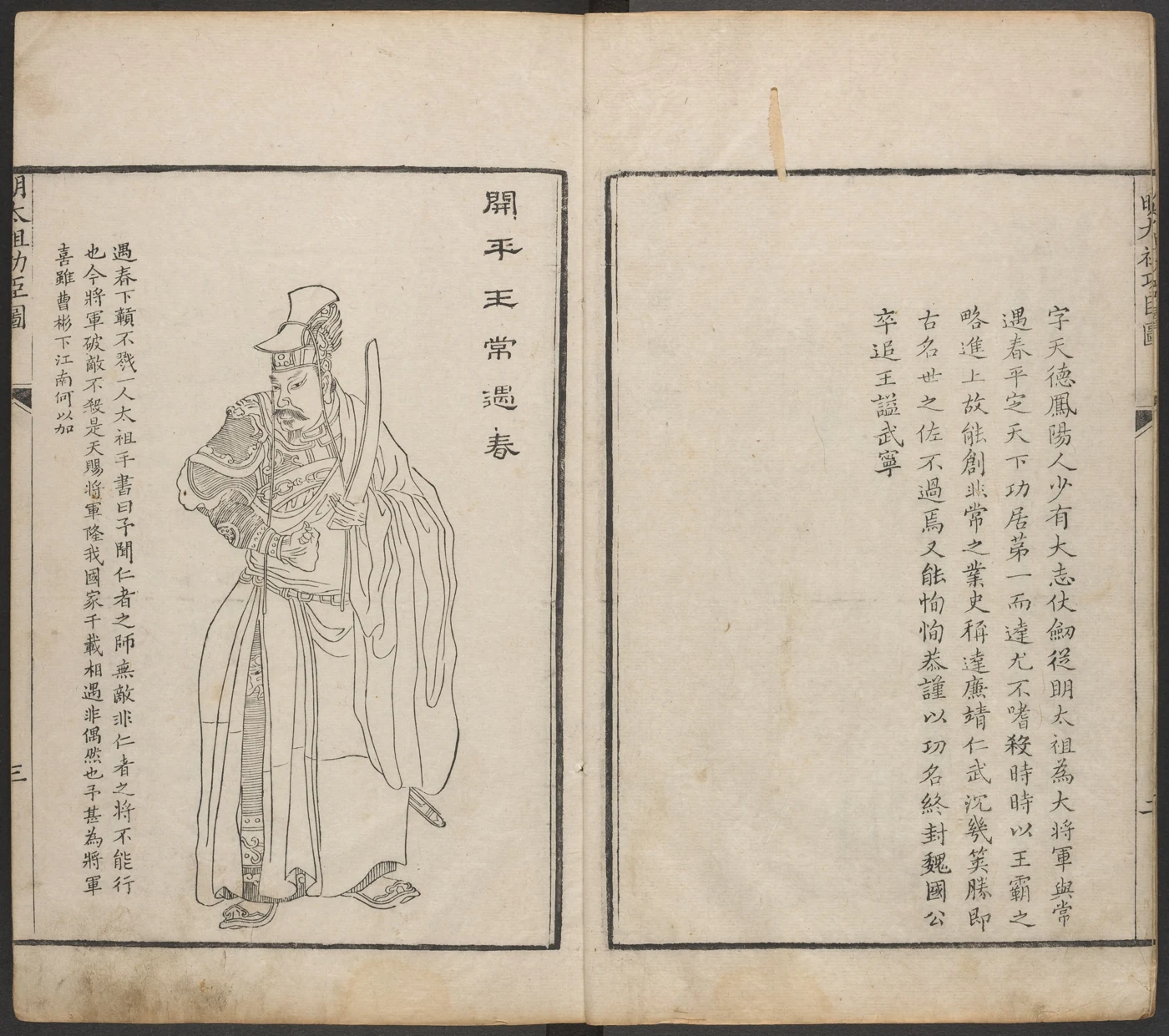
Biography
Family Background and Early Years
Chang Yuchun was born into a poor farming family in Huaiyuan County. As a youth he was unwilling to spend his life in the fields and studied martial arts under others. Because his family could not afford tuition, he performed additional labor in exchange for instruction. As an adult he was striking in appearance, tall and long-armed, exceptionally strong, highly skilled at riding and archery, and capable with many kinds of weapons.
Chang grew up during the late Yuan, when social conflict intensified and bandits and rebel armies proliferated. In 1352, driven by hunger, he joined the outlaw Liu Ju, who operated around Huaiyuan and Dingyuan. Liu recognized Chang's strength, made him a squad leader, and treated him as a trusted follower. Chang accompanied Liu in highway robbery and housebreaking. After several months, however, he concluded that Liu cared only for looting and had no larger ambitions, and began to consider leaving the band and seeking another path.
Joining Zhu Yuanzhang and Winning Merit in the Yangzi Crossing
In April 1355, while accompanying Liu Ju on raids around Hezhou, Chang encountered Zhu Yuanzhang's army attacking the city. He had already heard that Zhu was chivalrous and capable, so he disguised himself as a commoner and observed Zhu's conduct. He saw Zhu treat soldiers as brothers, maintain strict discipline, and refrain from harming civilians. Comparing the two men, Chang concluded that Zhu could achieve great things while Liu was merely a bandit, and decided to join Zhu at Hezhou.
Zhu initially received him coolly and asked whether he had come because he was hungry and wanted food from the army. Chang replied that he lacked neither food nor clothing under Liu Ju, but Liu had no ambition beyond robbery; he had heard that Zhu was wise and capable and therefore wished to offer his life in pursuit of a future. Zhu asked whether he could cross the river and fight; Chang answered that he would fight wherever Zhu directed and wished to be in the vanguard on the day of the crossing. Impressed by his powerful build and earnest words, Zhu accepted him.
In June of that year, Chang crossed the Yangzi southward with Zhu. At the Battle of Caishiji, Yuan troops held the rocky bank while the boats were still more than thirty feet offshore and no one could land. Chang came forward in a fast boat and, on Zhu's order, attacked. When Yuan soldiers seized his halberd, he used the momentum to leap onto the rocks, shouted, and charged into their formation. The enemy broke, other commanders landed, Caishi fell, and the army advanced on Taiping. Chang was appointed vanguard officer of the general command headquarters and later promoted to commandant.
Campaigns in Jiangsu and Zhejiang and War against Chen Youliang
Chang thereafter followed Xu Da in capturing Zhenjiang and Changzhou and was promoted to grand marshal commanding troops. In July 1359 he led an assault on Quzhou. His army built siege engines and long ladders and tunneled beneath the Great West Gate. The Yuan defender Bayan Buqa used oil-soaked reeds to burn the siege engines, heavy hooks to counter assault devices, long axes to cut ladders, and secondary walls to block the tunnels. After a prolonged stalemate, Chang led a surprise force into the barbican of the South Gate, destroyed the defenders' equipment, and pressed the attack. Yuan resistance collapsed; circuit judge Zhang Bin opened the Little West Gate at night to admit the army, and 10,000 armored soldiers were captured. Chang was promoted to assistant administrator of the Bureau of Military Affairs.
Early in 1360 Xu Da learned that Chen Youliang planned to attack Chizhou and ordered Chang to place 10,000 elite troops in ambush at Liuquankou. When Chen's army attacked the city, Xu sallied from the gates and Chang struck from behind, routing the enemy, killing more than 10,000 and capturing 3,000. Chang argued that the prisoners were crack troops who would become a future danger if spared. Xu disagreed and reported the matter to Zhu, but Chang had already buried alive more than half of the prisoners during the night. Zhu was displeased and ordered the remainder released.
In the fifth month of the same year Chen Youliang led a huge naval force toward Yingtian. Zhu Yuanzhang, facing a stronger enemy, planned an ambush and lured Chen inward. Chang and Feng Guosheng were ordered to lead 30,000 men of the five palace wings in ambush as the main force. At the Battle of Longwan, Chen's troops landed and were struck by the ambushers, suffering heavy casualties. As the river tide fell, more than a hundred large enemy ships ran aground, and Zhu sent both land and naval forces forward. Chen was decisively defeated and fled. Chang's merit was outstanding, and he was promoted to provincial assistant grand councilor.
In 1363 Chen Youliang mobilized what was claimed to be an army of 600,000 and fought Zhu's forces for thirty-six days on Lake Poyang. On one occasion Zhu's ship ran aground and Chen's general Zhang Dingbian moved in to surround it. Chang charged to the front, shot and wounded Zhang, and rammed Zhu's vessel with his own to free it from the shoal. Chang later organized a fire attack using small boats and the wind. Much of Chen's fleet burned, and more than half of his men were lost; the source describes the lake as turning red. Chen retreated toward Hukou with the remnants of his fleet and was killed by a stray arrow in the fighting. Chang received extensive rewards of gold, silk, and land and was promoted to grand councilor.
Defeating Zhang Shicheng and the Northern Expedition
In August 1366 Zhu Yuanzhang appointed Xu Da supreme general and Chang deputy general and sent 200,000 troops east against Zhang Shicheng. Chang defeated Wu forces at Taihu, Bishan, and Sanliqiao and advanced on Huzhou. Zhang sent reinforcements to Jiuguan behind the army. Chang moved a surprise force through Daqiangang to strike their rear, defeated their elite troops, attacked Xu Yi at Pingwang, burned his red-dragon ships, defeated him again at Wuzhen, pursued the enemy to Shengshan, destroyed both land and water stockades, and captured the Jiuguan troops. Huzhou fell. The army then besieged Pingjiang, with Chang camped at Tiger Hill. Zhang Shicheng secretly moved against him, but Chang defeated him at the northern moat and nearly captured him. In August 1367, after other units broke the Feng Gate, Chang broke through the Chang Gate and entered the city. Pingjiang fell, Chang was promoted to senior state affairs grand councilor and enfeoffed as Duke of E.
In October 1367 Zhu appointed Xu Da supreme general for the expedition against the Yuan and Chang deputy general, with 250,000 troops for the northern campaign. Zhu personally warned Chang that among a million men none surpassed the deputy general in breaking fronts and storming strong positions; the concern was not that he could not fight, but that he fought too rashly, and a great general should not constantly compete with junior officers. Chang bowed in thanks.
In 1368 Zhu Yuanzhang became emperor and concurrently appointed Chang junior guardian of the crown prince. Chang took cities in Shandong, captured Bianliang, and advanced into Henan. Fifty thousand Yuan troops formed north of the Luo River. Chang charged their line alone; more than twenty cavalrymen attacked him with spears, but he shot the leading man dead with one arrow, shouted, and rode into the formation, followed by his strongest men. The enemy collapsed and was pursued for more than fifty li. Prince Aliwen surrendered, and the cities of Henan submitted in succession. After an audience with the emperor at Bianliang, Chang and Xu Da took the prefectures of Hebei. Chang led the vanguard to Dezhou, brought naval forces up the river, defeated Yuan troops at Hexiwu, captured Tongzhou, and entered Dadu in August; the Yuan emperor fled north. Chang separately took Baoding, Hejian, and Zhending.
Capture of Kaiping and Sudden Death
After taking Dadu, Chang and Xu Da advanced on Taiyuan. Köke Temür came to its relief. Chang told Xu that their cavalry had assembled but the infantry had not, so a sudden daytime engagement would cause heavy losses and a night attack offered the best chance of victory. Köke Temür's subordinate Huobima happened to offer surrender and agreed to act from within. Elite cavalry advanced silently at speed. Köke Temür was by candlelight working on military documents and fled in confusion on a weak horse with only eighteen riders toward Datong. Huobima surrendered with 40,000 troops, and Taiyuan was captured. Chang pursued Köke Temür to Xinzhou before returning. An edict changed Chang's title to left deputy general, placing him above right deputy general Feng Sheng. He then took Datong, moved against Fengyuan Circuit, joined Feng Sheng's army, and captured Fengxiang to the west.
In 1369 the Yuan commander Yesu attacked Tongzhou. Zhu ordered Chang to return to defend the region, with Li Wenzhong as his deputy, commanding 80,000 infantry and 10,000 cavalry out of Beiping. Chang defeated Yuan commander Jiang Wenqing at Jinzhou and defeated Yesu at Quanning. When attacking Daxing Prefecture, he divided 1,000 cavalry into eight ambush forces; the defenders fled at night and were captured. Chang then occupied the Yuan upper capital at Kaiping, and the Yuan emperor fled toward Karakorum. On the triumphant return, Chang reached Liuhechuan, west of present-day Longguan in Chicheng County, Hebei, and died suddenly of what the source calls “wind after removing armor,” aged only forty. Zhu mourned deeply and, following a precedent involving Emperor Taizong of Song and Zhao Pu, posthumously awarded Chang a long series of honors including Grand Guardian and right grand councilor, enfeoffed him as Prince of Kaiping, granted the posthumous title Zhongwu, and included him in sacrifices at the imperial ancestral temple. Chang's tomb stood outside Taiping Gate in Jinling as a companion burial to the Xiaoling Mausoleum.
Chang Yuchun came of a poor peasant family. Unwilling as a youth to end his days in the fields, he learned the martial arts with others, and being too poor to pay a teacher he worked at odd jobs to earn his lessons. Grown, he was of a striking figure, tall and long-armed and of great strength, and accomplished in arms and especially in mounted archery. The Ming History says he was a native of Huaiyuan, styled Boren, of marvellous appearance and strength beyond other men, long-armed and a good archer; that he was first a bandit under Liu Ju and, seeing that Liu Ju would come to nothing, went over to Zhu Yuanzhang at Heyang. It is told that as he came he lay down weary in the fields, dreamed of a spirit in armour with a shield calling him to rise for his lord was coming, and waking found Zhu Yuanzhang at hand and went to greet him.
He grew up at the end of the Yuan, when the tensions of society had sharpened and bandits and rebels rose on every side. Unable to bear his poverty and hunger and discontented with his lot, he joined Liu Ju, a bandit chief about Huaiyuan and Dingyuan. Liu Ju, seeing his strength, made him a sergeant and kept him close. He rode with him plundering on the roads and robbing houses, and at first found it a fine life, eating meat in plenty and sharing in the silver; but after some months, seeing that Liu Ju only plundered and had no plans or larger purpose, he began to think of leaving the band and finding another road.
In the fourth month of 1355, plundering with Liu Ju, he happened upon Zhu Yuanzhang's army attacking Hezhou. Having long heard that Zhu was generous and able, he took the chance to watch him in the guise of a common man, and saw how he was easy of approach and treated his soldiers as brothers, and how strict his army was and how it did no harm to the people. Judging that Zhu was a man to do great things and Liu Ju no more than a bandit, he resolved to join him. Zhu Yuanzhang received him coldly at first, asking whether he had gone hungry and come to his army for a meal; Chang Yuchun answered that under Liu Ju he had robbed and never wanted for food or clothes, but that Liu Ju thought of nothing but plunder and had no great purpose, and that hearing the general was a wise and able man he had come to offer his life for his future. Asked whether he could cross the river and fight with him, Chang Yuchun said that where the general pointed he would strike, and that on the day of the crossing he would ask to be the vanguard. Zhu, seeing his frame and his honest speech, kept him, and from that time Chang Yuchun left the bandits to be a loyal soldier. The Ming History dates this to the fourth month of 1355 and records that he soon asked to be made vanguard, and that Zhu said he had only come for food and could not be kept, and that Chang Yuchun pressed him until he answered that it would be time enough to serve him after the river was crossed.
In the sixth month of 1355, soon after Chang Yuchun joined him, Zhu Yuanzhang crossed the Yangtze. In the famous action at Caishi, against the tight defence of the Yuan naval commander Manzi Haiya, Chang Yuchun in a small boat forced his way through the current under a hail of arrows, leaped ashore and broke into the enemy's ranks, charging this way and that as if there were none there; Zhu Yuanzhang at once landed his army, the Yuan troops fell back and the forts along the river came over one after another, and Zhu took Taiping in the flush of victory. Thereafter he campaigned year after year: made grand marshal of the centre after the taking of Changzhou; wounded by a stray arrow before Ningguo, where he bound the wound and fought on until the city fell; taking Matuosha and storming Chizhou with the fleet, becoming commander-in-chief of the provincial horse, foot and naval forces; serving in the capture of Wuzhou and holding it as assistant in the privy council; moving against Quzhou, where by a surprise entry through the south gate barbican he destroyed the defences and took it by assault with ten thousand armoured men; failing before Hangzhou and being recalled to Yingtian; and helping Xu Da to destroy Zhao Pusheng's naval camp and then holding Chizhou, where he broke the Han troops at the foot of Mount Jiuhua. In the third month of the next year Zhu took Jiqing and renamed it Yingtianfu, Chang Yuchun's part in it being the greatest. The possession of Jiqing and its neighbourhood gave Zhu a rich base for further expansion in Jiangnan; in these campaigns Chang Yuchun first showed his quality and began to be trusted by Zhu Yuanzhang.
Chang Yuchun was famed throughout his life for daring in battle, and it appears in every campaign he fought. Coming to notice at Caishi, he long led the van or commanded in chief in Zhu Yuanzhang's armies, taking part in the capture of Jiqing, Changzhou, Ningguo, Chizhou, Wuzhou and Quzhou, and winning great merit in Zhu's establishment and expansion in Jiangnan. Among Zhu Yuanzhang's commanders he stands beside Xu Da as one of the two chief military leaders of the early Ming. Zhu's judgment of him, recorded in later accounts, was that he was brave and full of stratagem, a general hard to come by; and his early years as a bandit are used by later writers to illustrate the disorder of the end of the Yuan and the plight of the uprooted.